Webyshops.com, a leading online vendor of optics, range gear, and hunting accessories has prepared a helpful guide for new hunters. This “how to” article Before You Start Hunting provides basic information on preparing for a hunt, finding a hunter education class, choosing appropriate gear, and selecting a safe, approved area for hunting.
Hunting Affiliation Groups
There are many good organizations dedicated to promoting hunting and preserving our hunting habitats. These groups all offer valuable information for hunters:
Recommended Books about Hunting
There’s no shortage of hunting hunting-related reading material. Here are some of the best books written about hunting.
For many years, the Varmint Hunters Association (VHA) has produced an excellent print periodical, The Varmint Hunter Magazine. Along with hunting stories, the magazine features articles about precision reloading and methods for accurizing rifles. The Varmint Hunter Magazine is available by subscription, and you can also purchase back issues through the VHA Online Store.
Right now the VHA is offering two FREE digital editions of The Varmint Hunter Magazine. Can’t beat that price. Click the links below to view (or download) the latest Fall 2014 Edition (Issue #92) or the previous Summer 2014 Edition (Issue #91). These digital eZines can be read on your computer or by most mobile devices. But since these are complete magazines, it make take a minute or two to download the full PDF files (be patient).
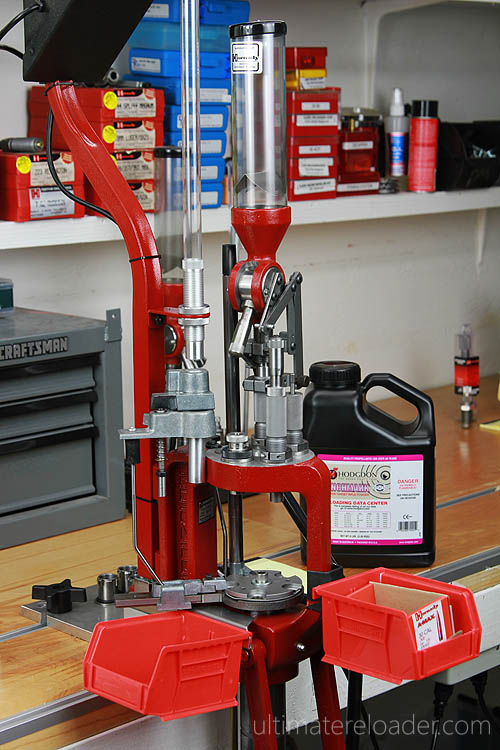
When you need ammo fast — lots of ammo, it’s hard to beat a progressive reloading press for output. We use progressive presses to load handgun ammo and .223 Rem cartridges for varmint safaris. With good dies, and proper press set-up, today’s progressive presses can produce surprisingly uniform and accurate ammo. No, you won’t see Benchrest Hall-of-Famers loading PPC cartridges on progressives. However, if you need 1000 rounds for your next prairie dog adventure, you should consider getting a progressive. Below you can see a Hornady Lock-N-Load AP configured to load .308 Winchester in bulk.
UltimateReloader.com has published helpful Tips to Optimize Progressive Rifle Loading. No matter whether you have a Red (Hornady), Green (RCBS), or Blue (Dillon) progressive, this article can help you load more efficiently and produce better results. Here are some highlights:
Proper Brass Prep
Just like a good paint job requires good prep work, great rifle ammo requires good brass prep. In order to make sure your rifle loading goes smoothly, make sure to perform the following brass prep steps:
Clean the brass (tumble, ultrasonic, etc.)
Inspect brass for cracks, deep dents, etc.
For military brass: de-prime, ream/swage primer pockets, size with small-base sizer die (small base usually optional).
Measure brass length — if too long, size and then trim.
Final inspection before loading.
Cleaning primer pockets may be something you’ll consider (I don’t clean primer pockets except for rare cases or match ammo).
Smooth and Steady Pace
Since you’re loading rifle ammunition on a progressive, you’re already saving a load of time, so there’s no need to rush things! Attention to detail is super-important for safety and for good results. Always keep an eye on powder level (goes down FAST) and what’s happening at each station.
The Right Press and Press Setup
Look for a heavy-duty, well-built press that will stand up to rifle loading. You’ll also want to make sure your powder measure will have the proper capacity (~25 grains for .223, ~50 grains for 308). If you are bulk reloading, ensure you have enough stations for sizing, charging, powder check, bullet feed, bullet seating, and (optional) bullet crimp.
More Ultimate Reloader Resources for Users of Progressive Presses:
National Hunting and Fishing Day (NHF Day) takes place on Saturday, September 27, 2014. The annual celebration serves as a reminder that conservation succeeds because of leadership and funding from hunters, shooters and anglers. National, regional, state and local organizations will run thousands of “open house” hunting- and fishing-related events around the country. Events will include Fishing Derbys, Hunting Expos, Wing-shooting tournaments, and much more. Over four million Americans will participate. For information on NHF Day, visit www.nhfday.org. To find NHF Day events, click the link below.
Forum member Thomas Haugland from Norway has produced an excellent video that covers practical field shooting skills for hunters. In his video, Thomas (aka ‘Roe’ on Forum and Sierra645 on YouTube) shows how to verify his zeros from bipod and he demonstrates improvised field rests from the prone, kneeling, and sitting positions.
Thomas explains: “In this video I focus on basic marksmanship techniques and making ready for this year’s hunt. As a last check before my hunting season, I got to verify everything for one last time. My trajectory is verified again, the practical precision of the rifle is verified. I also practice making do with the best [improvised] rest possible when an opportunity presents itself. After getting knocked in the face by a 338LM rifle during a previous filming session, I had to go back to basics to stop [flinching]. I include some details from bipod shooting that hopefully some hunters will find useful. Fingers crossed for this years season, good luck!”
Thomas has produced many other quality videos for his Sierra645 YouTube Channel. On his “Langholdsskyting” YouTube Channel, you’ll find 30 more nicely-made videos (in both English and Norwegian) about hunting and precision shooting.
Spectacular Scenery
Below you’ll find a great video by Thomas that demonstrates up/down angle (incline) shooting. This video features some amazing scenery from Norway along with angle estimation sequences and use of the ACI (Angle-Cosine Indicator). Even without the technical tips, this video is well worth watching just to see the jaw-dropping Norwegian scenery! Yes that’s Thomas standing on the top of the peak in the photo (above right).
Hunting season is right around the corner. For many of us, that means liberating a rifle that sits in a safe most of the year, grabbing a box of cartridges, and heading to the wilds. But this “once a year thing” carries with it potential risks.
It is all to easy to grab some rounds that may look right, but which are, in fact, a slightly different chambering. Likewise it is possible some hunting rounds got put in the wrong box after last year’s hunting trip. Be very careful when you get ready for a hunting trip — check the headstamp, cartridge dimensions, and bullet diameter of all your rounds. If you make an ammo selection mistake, the consequences can be disasterous, as this story reveals.
The .223 WSSM and 6mmBR Disaster Report by Dr. Jim Clary
Under most circumstances, shooters don’t have to worry about chambering the wrong cartridge into the wrong rifle. After all, the cartridges are well marked and we all know which rifle we are shooting on any given day. In many cases, incorrect cartridges cannot be chambered — larger cases will not fit in smaller chambers, for example. No problem! That being said, I can tell you that even an experienced, careful and normally safe shooter can make a mistake.
The following is an account of just such a mistake that could have resulted in death or dismemberment. Fortunately, the shooter was not hurt, but the rifle was completely destroyed.
Last year, a friend purchased a Savage Precision right bolt, left port, single shot bolt action in 6mmBR Norma. It was an incredible prairie dog gun and he spent the summer burning powder and busting dogs. In October, he purchased a stainless steel Browning A-Bolt Varmint in .223 WSSM. The weather in the upper Midwest turned sour by the time he got the brass tuned up and he only got to fire it a few times before he was “socked in” for the winter. Thus, he spent his evenings loading ammo for the spring thaw.
During a break in the weather, he grabbed both rifles and a couple of bags of .223 WSSM and 6mmBR cartridges and headed to the range to check out his new loads. In case you are not familiar, the 6mmBR is smaller in diameter and a mite shorter than the .223 WSSM. Because of this, it will chamber in a .223 WSSM, but the .243 caliber (6mm) bullet is too big for the .22 caliber bore. That is what happened to my friend.
The rest is history — when he squeezed the trigger, all hell broke loose. The entire bottom of the rifle blew out, including the magazine assembly. The explosion actually cut the stock into two pieces. However, the bolt held and amazing as it may seem, the .243 bullet was “swaged” right out of the .223 barrel.
6mmBR (left) and .223 WSSM (right) cartridges above the remains of Browning A-Bolt rifle.
One Small Mistake Is All It Takes
Now, realize that my friend has been shooting all manner of firearms, safely, for over half a century. He is meticulous, thorough and conscientious in his approach to reloading and shooting. However, he made one mistake. He put some lose 6BR cartridges in a baggie as he packed up from a prairie dog hunt last summer, without noticing that the baggie was marked .223 WSSM in black marker. Then, when the break in his winter weather came, he grabbed the bag, believing it to be the WSSM cartridges and didn’t check the head stamp.
Couldn’t happen to you? How many times have we emptied our pockets of cartridges and dropped them into a plastic container on the shooting bench? How many times have we set down to a marathon reloading session, loading several calibers in a row? How many times have we put the wrong bullets, cases or primers into the incorrect container? My point is that even the safest of us can make a mistake. So, look at the picture above and take a bit more time when you reload your ammunition at home or chamber a round in the field. It might save your life.
Hunting season is right around the corner. If you don’t own a worthy deer-hunting rig, there are many affordable options available. You can often save yourself $100.00 or more by purchasing a “turn-key” deer rifle package — a hunting rifle combo complete with rings and rifle-scope.
The American Hunter magazine website recently published a guide to affordable package hunting rigs. Jon Draper spotlights Four Off-The-Rack Deer Rifle Combos from Howa, Mossberg, Ruger, and Savage. Two of the four rigs, the Mossberg and Savage entries, come in at under $500 including scope/rings. Next up is the Ruger American Rifle, priced at $679.00 MSRP with 3-9x40mm Redfield Revolution scope.
The priciest entry is Howa’s Hunter Zeiss Walnut Package. MSRP is a not insubtantial $1103.00 for the Howa package, but this includes a premium-quality Zeiss Terra 3-9x42mm optic. The Howa also has a very nice two-stage 2.5 to 3.8-lb HACT trigger* that we prefer to the triggers on the other three, lesser-priced rifles.
To learn more, CLICK HERE to read the American Hunter Deer Rifle Combo article.
* HACT stands for Howa Actuator Controlled Trigger. Howa’s HACT assembly is a trigger and sear unit that works like a two-stage trigger. This allows the shooter to take up trigger creep before squeezing through. HACT trigger pull weight adjusts from 2.5 to 3.8 pounds. We like the lower weight for varmint rifles shot from prone or portable benches, while we prefer the heavier pull weight for a carry rifle.
Nightforce now offers a 5-20x56mm SHV scope that retails for $1170.00 (non-illuminated) or $1299.00 (illuminated). This follows up on Nightforce’s successful 4-16x56mm SHV scope. The higher magnification range suits long range hunters and the large 56mm objective provides excellent low-light hunting capability. The 5-20 SHV offers plenty of travel: 80 MOA total elevation, 50 MOA windage.
The 5-20x56mm SHV boasts capped, waterproof turrets with 1/4-MOA click values, and 10 MOA per revolution on the elevation turret. The scope offers a side parallax control (25 yards to infinity), plus a European-style, fast-focus eyepiece.
Two reticles are offered for the 5-20x56mm SHV. The IHR features large dagger-style pointers, an open field at the top, and an cross in the center. The MOAR reticle has 1 MOA elevation and windage markings, with a floating center crosshair. With either reticle, illumination is optional at extra cost.
Our friend Len Backus of LongRangeHunting.com has checked out the new 5-20x56mm Nightforce and he is impressed: “With a 56mm objective the SHV’s light transmission is outstanding even at high power. Nightforce has added a ‘Zero Set’ feature which is a set-screw based stop system allowing you to dial back to your pre-set zero and stopping you from dialing past. It’s not quite as sharp a stop as their ‘Zero Stop’ but it will definitely do the trick. I bought my first Nightforce scope about 14 years ago. In summer of 2012 I had a four-hour private tour of the Nightforce headquarters. I remember being so impressed with the forward thinking going on there. It was obvious they were preparing for a major push on new technology and new products and this SHV is an absolute winner in that regard.”
Product Tip from EdLongrange. We welcome reader submissions.
Here is a simple but effective product that can benefit varminters and game-hunters. The slip-on, padded RRR (“triple R”) gun rest cushions your rifle on any surface and helps eliminate noise when shifting the gun from one shooting position to another. The RRR slip-on rest is made of neoprene (wet suit material) with a built-in, thick Armaflex foam cushion on the bottom. This $19.95 sleeve protects the finish of your rifle, while providing a cushioned layer between your rifle and the supporting surface.
Hunters will appreciate how the RRR slip-on rest quiets the gun when the forearm is placed on supporting surface (watch video). The padded, neoprene covering acts like a sound deadener. With the RRR in place, the rifle forearm doesn’t clang or rattle, even when you set the gun on a metal frame or hard surface.
Video Shows RRR in Use in the Field
This padded sleeve works great when shooting from a truck, providing a padded surface when aiming from a truck mirror or door frame. Likewise, the RRR rest works well in the field when shooting from a tree-limb, or a boulder.
The patented RRR slip-on rest fits rifle stocks from 1¼ inches to 2¼ inches wide, and will not interfere with your scope. Installation is easy — after unloading the rifle, simply slide the RRR over the barrel and fore-end, with the RRR logo on top, so that the cushion section is under the rifle stock.
► The RRR slip-on rest cushions your rifle. This helps to keep the shot from going high even when the rifle is placed on a hard surface.
► The RRR protects the finish on the stock of your rifle from scratches when resting on hard surfaces.
► The RRR can be slipped over the fore-end with a sling attached.
► The neoprene, water-resistant RRR works well even in wet or snowy weather. (But you should remove from gun after a wet hunting session.)
American Rifleman TV begins its new season tonight, July 2, 2014, on the Outdoor Channel at 6:30 p.m. ET and 10 p.m. ET. This week’s episode features the S.A.A.M. Hunter Training Program at the FTW Ranch in Barksdale, Texas. At this facility, ARTV staffers learn the basic principles of long-range precision shooting as part of the S.A.A.M. Safari Course. In the Rifleman Review segment the new Remington R51 is featured, and in the “This Old Gun” segment you’ll see the infamous handgun that started World War I: the FN Model 1910.
Watch Preview of 2014 Season Opening Episode of American Rifleman TV
American Rifleman TV is the on-screen version of the National Rifle Association’s American Rifleman magazine. American Rifleman Television covers firearms, the shooting sports, and gun rights issues. “ARTV is part of the larger American Rifleman brand,” said Editor-in-Chief Mark A. Keefe IV. “It’s a show about guns- we teach the history of them and the people who use them.”
Rifleman Feature
Each episode of ARTV is built around one primary feature segment. In that lead story, ARTV staffers may visit a firearms factory, attend a major shooting competition, or work with elite instructors at one of the nation’s leading training facilities. In this week’s season opener, ARTV’s reporters practice long-range precision shooting at the S.A.A.M. hunter training center in Texas.


 For many years, the Varmint Hunters Association (VHA) has produced an excellent print periodical,




 Forum member Thomas Haugland from Norway has produced an excellent video that covers practical field shooting skills for hunters. In his video, Thomas (aka ‘Roe’ on Forum and
  Thomas has produced many other quality videos for his Sierra645
  Hunting season is right around the corner. For many of us, that means liberating a rifle that sits in a safe most of the year, grabbing a box of cartridges, and heading to the wilds. But this “once a year thing” carries with it potential risks.


 This padded sleeve works great when shooting from a truck, providing a padded surface when aiming from a truck mirror or door frame. Likewise, the RRR rest works well in the field when shooting from a tree-limb, or a boulder.

 American Rifleman TV begins its new season tonight, July 2, 2014, on the Outdoor Channel at 6:30 p.m. ET and 10 p.m. ET. This week’s episode features the


