Coalinga Range in California. At dawn we could clearly see 7mm and .30 Cal bullet holes at 1000 yards.
While attending the CA Long Range Championship a few seasons back, we had the opportunity to test the performance of a high-magnification (63X) spotting scope in near-ideal conditions (maybe the best I’ve ever witnessed). On the event’s last day we arrived at 5:45 am, literally as the sun was cresting the horizon. I quickly deployed our Pentax PF-100ED spotting scope, fitted with a Pentax SMC-XW 10mm fixed-power eyepiece. When used with the 100mm Pentax scope, this 10mm eyepiece yields 63X magnification. Befitting its $319.00 price, this eyepiece is extremely clear and sharp.
At the crack of dawn, viewing conditions were ideal. No mist, no mirage, no wind. The first thing this Editor noticed was that I could see metal nail heads on the target boards. That was astonishing. As soon as the first practice targets went up, to my surprise, I could see 6.5mm, 7mm, and 30-caliber bullet holes in the white at 1000 yards. No lie…
That’s right, I could see bullet holes at 1000. I know many of you folks may not believe that, but there was no mistaking when I saw a 7mm bullet cut the white line separating the Nine Ring and Eight Ring on the target in view. (I was watching that target as the shot was fired and saw the shot-hole form). And when I looked at the 30-cal targets, the bullet holes in the white were quite visible. In these perfect conditions I could also make out 3/8″ bolt heads on the target frames.
The Human Factor — Good Vision Required
When viewing the bullet holes, I was using my left naked eye (no safety glasses or magnification). I also had a contact lens in my right eye (needed for distance vision). To my surprise, while I could see the bullet holes without much difficulty with my left eye, things were fuzzier and slightly more blurry with the right eye, even when I re-focused the scope. That contact lens was degrading the fine resolution.
Then I invited 3 or 4 shooters to look through the scope. One younger guy, with good eyes, said immediately: “Yeah, I can see the holes — right there at 4 o’clock and seven o’clock. Wow.” Some older guys, who were wearing glasses, could not see the holes at all, no matter what we did to the scope’s main focus and diopter adjustment.
The lesson here — if you have to wear glasses or corrective contact lenses, just that extra bit of optical interference may make a difference in what you can see through the scope. Basically anything that goes between the scope eyepiece and your eyeball can degrade the image somewhat. So… you may be better off removing your glasses if you can still obtain good focus sharpness using the diopter adjustment and focus ring. I did the left vs. right eye test a half dozen times, and I could definitely see small features at 1000 yards with my naked eye that I could not see with my right eye fitted with a contact lens. (I did have to re-focus the scope for each eye, since one had a corrective lens while the other did not.)
Mirage Degrades Image Sharpness and Resolution
The “magic light” prevailed for only an hour or so, and then we started to get some mirage. As soon as the mirage appeared I was no longer able to see raw bullet holes, though I could still easily see black pasters on the black bulls. When the mirage started, the sharpness of the visible image degraded a huge amount. Where I could see bullet holes at dawn, by mid-morning I could barely read the numbers on the scoring rings. Lesson: If you want to test the ultimate resolution of your optics, you need perfect conditions.
Chromatic Aberration Revealed
As the light got brighter and the mirage increased I started to see blue and red fringing at the edges of the spotting disk and the large numerals. This was quite noticeable. On one side of the bright, white spotting disc you could see a dark red edge, while on the other side there was a blue edge (harder to see but still present).
The photo below was taken through the Pentax spotter lens using a point and shoot camera held up to the eyepiece. The sharpness of the Pentax was actually much better than this photo shows, but the through-the-lens image does clearly reveal the red and blue fringing. This fringing is caused by chromatic aberration — the failure of a lens to focus all colors to the same point. Chromatic aberration, most visible at high magnification, causes different wavelengths of light to have differing focal lengths (see diagram). Chromatic aberration manifests itself as “fringes” of color along boundaries that separate dark and bright parts of the image, because each color in the optical spectrum cannot be focused at a single common point on the optical axis. Keep in mind that the Pentax does have “ED” or low-dispersion glass, so the effect would be even more dramatic with a cheaper spotting scope.
If you wonder why top-of-the-line spotting scopes (such as the $3558.00 Swarovski ATS-80 ) cost so much, the answer is that they will deliver even LESS chromatic aberration at long range and high magnification. With their exotic apochromatic (APO), ultra-low-dispersion glass, a few ultra-high-end spotting scopes can deliver an image without the color edging you see in the photo above.
The Pentax PF-100ED is a heck of a spotting scope. Any scope that can resolve bullet holes at 1000 yards is impressive. But if you want the ultimate in optical performance, with minimal chromatic aberration, you may need to step up to something like the 88mm Kowa Prominar TSN-88A with Flourite Crystal lenses ($3999.00 with eyepiece), or the 82mm Leica APO-Televid ($3649.95 with 25-50X eyepiece).
EDITOR’s NOTE: The purpose of this report is to show what is possible… in IDEAL conditions. With this Pentax 100mm, as well as a Swarovski 80mm, we can often resolve 6mm bullet holes at 600 yards. But again, that performance requires really good viewing conditions. By 10:00 am at my range, even with the 100mm Pentax at 75 power, seeing 6mm bullet holes is “iffy” at best. So don’t go out and mortgage the house to buy a $4000 optic with the hope that you’ll be able to spot your shots at 1000 yards. If conditions are anything less than perfect, you’ll be lucky to see bullet holes at 500 yards.
The real solution for very long-range spotting is to set up a remote target cam that broadcasts a video picture to a screen at your shooting station. Among the target cams on the market, we recommend the LongShot LR-3 2-mile UHD. This modern target cam system boasts excellent resolution and incredible range. The LongShot LR-3 target cam is used in major ELR competitions. The Longshot LR-3 currently sells for $999.00 on Amazon.
Coalinga Range in California. At dawn we could clearly see 7mm and .30 Cal bullet holes at 1000 yards.
While attending the CA Long Range Championship a few seasons back, we had the opportunity to test the performance of a high-magnification (63X) spotting scope in near-ideal conditions (maybe the best I’ve ever witnessed). On the event’s last day we arrived at 5:45 am, literally as the sun was cresting the horizon. I quickly deployed our Pentax PF-100ED spotting scope, fitted with a Pentax SMC-XW 10mm fixed-power eyepiece. When used with the 100mm Pentax scope, this 10mm eyepiece yields 63X magnification. Befitting its $299.00 price, this eyepiece is extremely clear and sharp.
At the crack of dawn, viewing conditions were ideal. No mist, no mirage, no wind. The first thing this Editor noticed was that I could see metal nail heads on the target boards. That was astonishing. As soon as the first practice targets went up, to my surprise, I could see 6.5mm, 7mm, and 30-caliber bullet holes in the white at 1000 yards. No lie…
That’s right, I could see bullet holes at 1000. I know many of you folks may not believe that, but there was no mistaking when I saw a 7mm bullet cut the white line separating the Nine Ring and Eight Ring on the target in view. (I was watching that target as the shot was fired and saw the shot-hole form). And when I looked at the 30-cal targets, the bullet holes in the white were quite visible. In these perfect conditions I could also make out 3/8″ bolt heads on the target frames.
The Human Factor — Good Vision Required
When viewing the bullet holes, I was using my left naked eye (no safety glasses or magnification). I also had a contact lens in my right eye (needed for distance vision). To my surprise, while I could see the bullet holes without much difficulty with my left eye, things were fuzzier and slightly more blurry with the right eye, even when I re-focused the scope. That contact lens was degrading the fine resolution.
Then I invited 3 or 4 shooters to look through the scope. One younger guy, with good eyes, said immediately: “Yeah, I can see the holes — right there at 4 o’clock and seven o’clock. Wow.” Some older guys, who were wearing glasses, could not see the holes at all, no matter what we did to the scope’s main focus and diopter adjustment.
The lesson here — if you have to wear glasses or corrective contact lenses, just that extra bit of optical interference may make a difference in what you can see through the scope. Basically anything that goes between the scope eyepiece and your eyeball can degrade the image somewhat. So… you may be better off removing your glasses if you can still obtain good focus sharpness using the diopter adjustment and focus ring. I did the left vs. right eye test a half dozen times, and I could definitely see small features at 1000 yards with my naked eye that I could not see with my right eye fitted with a contact lens. (I did have to re-focus the scope for each eye, since one had a corrective lens while the other did not.)
Mirage Degrades Image Sharpness and Resolution
The “magic light” prevailed for only an hour or so, and then we started to get some mirage. As soon as the mirage appeared I was no longer able to see raw bullet holes, though I could still easily see black pasters on the black bulls. When the mirage started, the sharpness of the visible image degraded a huge amount. Where I could see bullet holes at dawn, by mid-morning I could barely read the numbers on the scoring rings. Lesson: If you want to test the ultimate resolution of your optics, you need perfect conditions.
Chromatic Aberration Revealed
As the light got brighter and the mirage increased I started to see blue and red fringing at the edges of the spotting disk and the large numerals. This was quite noticeable. On one side of the bright, white spotting disc you could see a dark red edge, while on the other side there was a blue edge (harder to see but still present).
The photo below was taken through the Pentax spotter lens using a point and shoot camera held up to the eyepiece. The sharpness of the Pentax was actually much better than this photo shows, but the through-the-lens image does clearly reveal the red and blue fringing. This fringing is caused by chromatic aberration — the failure of a lens to focus all colors to the same point. Chromatic aberration, most visible at high magnification, causes different wavelengths of light to have differing focal lengths (see diagram). Chromatic aberration manifests itself as “fringes” of color along boundaries that separate dark and bright parts of the image, because each color in the optical spectrum cannot be focused at a single common point on the optical axis. Keep in mind that the Pentax does have “ED” or low-dispersion glass, so the effect would be even more dramatic with a cheaper spotting scope.
If you wonder why top-of-the-line spotting scopes (such as the $3558.00 Swarovski ATS-80 ) cost so much, the answer is that they will deliver even LESS chromatic aberration at long range and high magnification. With their exotic apochromatic (APO), ultra-low-dispersion glass, a few ultra-high-end spotting scopes can deliver an image without the color edging you see in the photo above.
The Pentax PF-100ED is a heck of a spotting scope. Any scope that can resolve bullet holes at 1000 yards is impressive. But if you want the ultimate in optical performance, with minimal chromatic aberration, you may need to step up to something like the 88mm Kowa Prominar TSN-88A with Flourite Crystal lenses ($3999.00 with eyepiece), or the 82mm Leica APO-Televid ($3649.95 with 25-50X eyepiece).
EDITOR’s NOTE: The purpose of this report is to show what is possible… in IDEAL conditions. With this Pentax 100mm, as well as a Swarovski 80mm, we can often resolve 6mm bullet holes at 600 yards. But again, that performance requires really good viewing conditions. By 10:00 am at my range, even with the 100mm Pentax at 75 power, seeing 6mm bullet holes is “iffy” at best. So don’t go out and mortgage the house to buy a $4000 optic with the hope that you’ll be able to spot your shots at 1000 yards. If conditions are anything less than perfect, you’ll be lucky to see bullet holes at 500 yards.
The real solution for very long-range spotting is to set up a remote target cam that broadcasts a video picture to a screen at your shooting station. Among the target cams on the market, we recommend the LongShot LR-3 2-mile UHD. This modern target cam system boasts excellent resolution and incredible range. The LongShot LR-3 target cam is used in major ELR competitions. The Longshot LR-3 currently sells for $999.00 on Amazon.
Coalinga Range in California. At dawn we could clearly see 7mm and .30 Cal bullet holes at 1000 yards.
While attending the CA Long Range Championship a few seasons back, we had the opportunity to test the performance of a high-magnification (63X) spotting scope in near-ideal conditions (maybe the best I’ve ever witnessed). On the event’s last day we arrived at 5:45 am, literally as the sun was cresting the horizon. I quickly deployed our Pentax PF-100ED spotting scope, fitted with a Pentax SMC-XW 10mm fixed-power eyepiece. When used with the 100mm Pentax scope, this 10mm eyepiece yields 63X magnification. Befitting its $299.00 price, this eyepiece is extremely clear and sharp.
At the crack of dawn, viewing conditions were ideal. No mist, no mirage, no wind. The first thing this Editor noticed was that I could see metal nail heads on the target boards. That was astonishing. As soon as the first practice targets went up, to my surprise, I could see 6.5mm, 7mm, and 30-caliber bullet holes in the white at 1000 yards. No lie…
That’s right, I could see bullet holes at 1000. I know many of you folks may not believe that, but there was no mistaking when I saw a 7mm bullet cut the white line separating the Nine Ring and Eight Ring on the target in view. (I was watching that target as the shot was fired and saw the shot-hole form). And when I looked at the 30-cal targets, the bullet holes in the white were quite visible. In these perfect conditions I could also make out 3/8″ bolt heads on the target frames.
The Human Factor — Good Vision Required
When viewing the bullet holes, I was using my left naked eye (no safety glasses or magnification). I also had a contact lens in my right eye (needed for distance vision). To my surprise, while I could see the bullet holes without much difficulty with my left eye, things were fuzzier and slightly more blurry with the right eye, even when I re-focused the scope. That contact lens was degrading the fine resolution.
Then I invited 3 or 4 shooters to look through the scope. One younger guy, with good eyes, said immediately: “Yeah, I can see the holes — right there at 4 o’clock and seven o’clock. Wow.” Some older guys, who were wearing glasses, could not see the holes at all, no matter what we did to the scope’s main focus and diopter adjustment.
The lesson here — if you have to wear glasses or corrective contact lenses, just that extra bit of optical interference may make a difference in what you can see through the scope. Basically anything that goes between the scope eyepiece and your eyeball can degrade the image somewhat. So… you may be better off removing your glasses if you can still obtain good focus sharpness using the diopter adjustment and focus ring. I did the left vs. right eye test a half dozen times, and I could definitely see small features at 1000 yards with my naked eye that I could not see with my right eye fitted with a contact lens. (I did have to re-focus the scope for each eye, since one had a corrective lens while the other did not.)
Mirage Degrades Image Sharpness and Resolution
The “magic light” prevailed for only an hour or so, and then we started to get some mirage. As soon as the mirage appeared I was no longer able to see raw bullet holes, though I could still easily see black pasters on the black bulls. When the mirage started, the sharpness of the visible image degraded a huge amount. Where I could see bullet holes at dawn, by mid-morning I could barely read the numbers on the scoring rings. Lesson: If you want to test the ultimate resolution of your optics, you need perfect conditions.
Chromatic Aberration Revealed
As the light got brighter and the mirage increased I started to see blue and red fringing at the edges of the spotting disk and the large numerals. This was quite noticeable. On one side of the bright, white spotting disc you could see a dark red edge, while on the other side there was a blue edge (harder to see but still present).
The photo below was taken through the Pentax spotter lens using a point and shoot camera held up to the eyepiece. The sharpness of the Pentax was actually much better than this photo shows, but the through-the-lens image does clearly reveal the red and blue fringing. This fringing is caused by chromatic aberration — the failure of a lens to focus all colors to the same point. Chromatic aberration, most visible at high magnification, causes different wavelengths of light to have differing focal lengths (see diagram). Chromatic aberration manifests itself as “fringes” of color along boundaries that separate dark and bright parts of the image, because each color in the optical spectrum cannot be focused at a single common point on the optical axis. Keep in mind that the Pentax does have “ED” or low-dispersion glass, so the effect would be even more dramatic with a cheaper spotting scope.
If you wonder why top-of-the-line spotting scopes (such as the $2980 Swarovski ATS-80 ) cost so much, the answer is that they will deliver even LESS chromatic aberration at long range and high magnification. With their exotic apochromatic (APO), ultra-low-dispersion glass, a few ultra-high-end spotting scopes can deliver an image without the color edging you see in the photo above.
The Pentax PF-100ED is a heck of a spotting scope. Any scope that can resolve bullet holes at 1000 yards is impressive. But if you want the ultimate in optical performance, with minimal chromatic aberration, you may need to step up to something like the 88mm Kowa Prominar TSN-884 with Flourite Crystal lenses ($2450.00 body only), or the 82mm Leica APO ($3899.00 with 25-50X eyepiece).
EDITOR’s NOTE: The purpose of this report is to show what is possible… in IDEAL conditions. With this Pentax 100mm, as well as a Swarovski 80mm, we can often resolve 6mm bullet holes at 600 yards. But again, that performance requires really good viewing conditions. By 10:00 am at my range, even with the 100mm Pentax at 75 power, seeing 6mm bullet holes is “iffy” at best. So don’t go out and mortgage the house to buy a $4000 optic with the hope that you’ll be able to spot your shots at 1000 yards. If conditions are anything less than perfect, you’ll be lucky to see bullet holes at 500 yards. The real solution for very long-range spotting is to set up a remote target cam that broadcasts a video picture to a screen at your shooting station. Among the target cams on the market, we recommend the LongShot LR-3. It boasts excellent resolution and incredible range. The LongShot LR-3 target cam is used in major ELR competitions.
Leupold recently annouced a new, premium spotting scope with outstanding low-light performance. Leupold’s new Santium SX-5 Spotter features a jumbo 80mm objective with a 27-55X zoom eyepiece. The SX-5 is offered in both straight and angled versions. Suggested retail price (including eyepiece) is $2339.00. Best “street price” should be around $1800.00. That positions Leupold’s SX-5 above Vortex, Burris, and Pentax price-wise, but the SX-5 is over $1000 less than high-end, 80mm-class Swarovski and Leica spotters which approach $3000 with eyepiece.
We’re interested to see how this new Leupold stacks up against the Kowa TSN-880 Prominar spotter ($2450.00 on Amazon) which has been a benchmark in the 80mm class. Leupold worked hard to give the SX-5 “second to none” low-light performance. The goal was to create a truly superior optic for hunters who may spend long periods “glassing” for game at dawn and dusk.
The SX-5 features High Definition (HD) glass with proprietary lens coatings to maximize light transmission and color fidelity. Zac Bird, Product Manager for Leupold states: “The human eye is most sensitive to colors outside the middle of the spectrum during dawn and dusk, when game is moving — the Twilight Max HD Light Management System literally helps you see more in less light. The superior glare reduction it offers ensures the maximum amount of usable light gets to your eye. Our proprietary lens coatings and superior optical design help deliver the very best contrast and resolution”
Features of New SX-5 Santiam HD 27-55x80mm Spotting Scope: – Full-Diameter Focus Ring for smooth and precise focusing
– Oversized Eyepiece for reduced fatigue
– Guard-Ion Rain-Shedding Lens Coating
– Built-in Retractable Lens Shade
– Tough Rubber Armor Coating
– Full Lifetime Warranty
Price vs. Performance in the Field
Should a hunter spend a couple grand ($2000) on a spotting scope? It depends on your priorities. Leupold says: “Don’t underestimate the importance of a quality spotting scope. Your spotter can mean difference between tagging out or going home empty-handed…. Ultimately, you can’t shoot what you can’t find.”
This Kowa TSN-501 optic is small and affordable. You can order fromCreedmoor Sports.
The photo above tells the story. Kowa’s new TSN-500 series spotting scopes are VERY light — just 14.1 ounces (400 grams) and VERY compact — 9.4 inches in length (239mm). This is a game changer for hunters, varminters, PRS shooters, and anyone who wants a spotter that is easy to pack and carry. And for long-range competitors (F-Class, Palma) who use a spotter mainly to watch mirage, the TSN-501 (angled) may well do the job. That’s a big deal because this spotter costs less than $350.00 complete with 20-40X zoom eyepiece. Put the money you save into a new barrel, or a stock upgrade.
Kowa offers both an angled model TSN-501, and a straight model TSN-502. Both have a 50mm front objective. We think most rifle shooters will prefer the angled model, but hunters and pistol shooters may favor the straight model. Creedmoor says: “It’s the perfect spotting scope for 10 meter air rifle, 50 ft or even 50 meter smallbore. Its weight and size make it convenient to carry with your gear and allows you to have a lighter scope stand to hold it.”
Close Focus Capability
Kowas’ TSN-500 series scopes will focus down to 2.5 meters. Read that again — this is a really big deal for those who use their scope for nature observation (as well as shooting). With the ability to focus so close (inside 3 yards), this optic can perform many roles.
UPDATE: Some readers did not understand how to most effectively use this price-tracking service. They wondered: “What good does it do for me to know past prices?” Well you can set a price target, and CamelCamelCamel.com will email you (in the future) when the price has dropped to that level. That’s a powerful tool that WILL save you money!
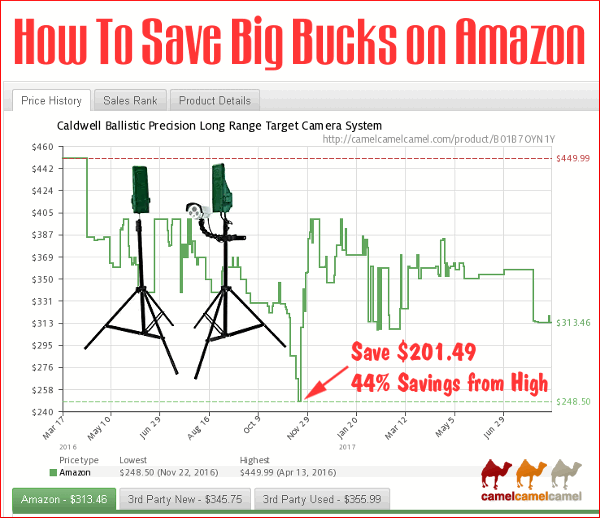
Take the time to read this article and we bet you’ll save $100.00 or more this year. Honest. This article explains how to find the right time to buy a product from Amazon.com at a super-low price. Amazon price trend graphs, updated by the hour, show exactly when prices have been slashed on your favorite Amazon items. With this “insider info” you can save big — often 50% or more. This applies to everything Amazon sells — optics, reloading gear, tools, electronics, you name it.
Here’s how it works — find a product you want on Amazon.com. Then go to CamelCamelCamel.com and enter the product in the search field. Usually the product name is enough, but you can also enter the Amazon URL. When the product appears in the search results, click on the product name. Then a chart will appear that shows the price trends for a given time period (All Time, 1 Year, 6 Months etc.). You can see right away if it’s time to buy, or you need to wait for a price reduction.
Here’s one example. Steiner makes a black version of its 8×30 Military-Marine Binoculars called the AZ830. We found these on sale for about $120.00 and posted that on our Deals of the Week. Later the same binoculars cost over $280! Yet some months before, this Steiners cost just $75.87! You could save $204.71 by buying at just the right time — that’s a 73% savings! Check out the 1-year price history from CamelCamelCamel.com:
Here’s another example, the popular RCBS Rock Chucker press. In the last year, the price has fluctuated between $166.68 and $112.49, a $54.19 difference! By using the CamelCamelCamel price checker website, you could snag a Rock Chucker for $112.49, saving over 32%.
Track Third-Party Prices As Well for Ultimate Savings
CamelCamelCamel will also give you the lowest third-party price on Amazon. This option shows products sold on Amazon but fulfilled by third parties. Check out this chart for the Kowa TSN-880, one of the best spotting scopes on the market. The third-party price is in blue. In the last year it bounced between $849.95 and $2450.00! That’s a difference of $1600.05, or 65%. Even measured vs. the Amazon direct sale high price ($2254.00), the savings is over 60%.
Set Up Your Own Price Watch Page with Notifications
We have no affiliation with CamelCamelCamel.com but we know it can help you save big money on Amazon purchases. We have subscribed to this service, and you may want to do so as well. When you subscribe, you can create a Product Price Watch List. Let’s say you’re looking to snag a Leica Rangefinder, Lyman BoreCam, and Vortex Scope. Put those items on your watch list and you can see price trends instantly whenever you visit CamelCamelCamel.com.
In addition, you can have email alerts sent to you when the price of a “watched” product hits a “trigger” price you set. For example, we told the site to let us know when the AZ830 binoculars hit $120.00 again. And we snagged a nice Seiko titanium watch recently, saving $90 on the price.
At the request of our readers, we provide select “Deals of the Week”. Every Monday morning we offer our Bargain selections. Here are some of the best deals on firearms, hardware, reloading components, and shooting accessories. Be aware that sale prices are subject to change, and once clearance inventory is sold, it’s gone for good. You snooze you lose.
1. Kelbly.com — 15% Off Discount on All Products
Looking for a Panda or Atlas Action, or a complete match rifle? Here’s a great promotion from our friends at Kelbly’s. Now through Tuesday, August 23, 2016 you can get 15% of ANYthing on the Kelblys.com website. That includes rifles, actions, stocks, barrels, scope rings, muzzle brakes, Berger bullets, accessories and more. To save big, use code 15ALL at checkout. Don’t delay — this offer expires at 11:59 pm on September 1, 2016.
2. EuroOptic.com — Tikka T3 Liquidation Sale, Huge Discounts
Looking for a great price on an excellent hunting rifle? Here is the Tikka Deal of the Decade. EuroOptic.com has received nearly 3,500 Tikka T3 rifles, which will be sold at deep discounts as part of an inventory clearance program by Beretta, Tikka’s parent company. The Tikka T3 is a good, stout rifle with a smooth, 3-lug action, crisp trigger, and quality barrel. Accuracy is typically well under 1 MOA (for three shots). T3 barreled actions also are a good “core” for a tactical build. The strong T3 action handles detachable magazines, and fits a variety of third-party stocks.
3. Monmouth — Hornady 6.5 Creedmoor Brass, $34.95 for 50
The 6.5 Creedmoor has become one of the most popular chamberings for tactical/practical shooting. This mid-sized cartridge offers excellent ballistic performance with 120-140gr bullets, with moderate recoil and excellent inherent accuracy. Now you can get Hornady-brand 6.5 Creedmoor brass at a very good price: $34.95 for 50 cases (that’s $69.90 per 100).
If you are looking for a rugged, reliable, and affordable spotting scope to watch flags, mirage, and shot spotting discs, this angled-body Kowa TSN-61 will do the job. And $259.00 with free, fast Prime Shipping is a great deal. These Kowa spotters have been used successfully for years by prone and High Power competitors. Sure the glass can’t rival the latest top-of-the-line HD spotting scopes, but the TSN-61 is a small fraction of the price of high-end models which cost $2000 or more. The money you save can buy four premium hand-lapped barrels. NOTE: Eyepieces are sold separately — expect to pay $275.00 – $300.00 for a Kowa 20-60X Zoom eyepiece.
5. Midsouth — $15.00 HazMat Fee with 15-lb Powder Purchase
When you purchase powder, it makes sense to buy in bulk. That way you get powder from the same lot, and save on the HazMat fees. Now you have even more incentive to place a big order. Right now Midsouth is offering $15.00 Hazmat with orders of 15 or more pounds of powder. Get 15 one-pounders or two eight-pound jugs and you’ll qualify. Midsouth has a large selection of popular powders in stock, including Hodgdon Varget, H4198, H48931sc, and the new IMR Enduron powders. With this special HazMat deal you can save up to $20.00 (many vendors charge $35.00 HazMat per order). Don’t hesitate — this offer ends 8/25/2016.
6. Amazon — Tipton Gun Vise, $30.32 (free Prime Shipping)
This is an awesome deal on a durable, well-designed polymer Gun Vise that every rifle owner can use. Your Editor has one of these units which has served well for more than a decade. The base has compartments for solvents, patches, and tools. The cradles and pads contacting your gunstock are a soft, rubber-like material that is gentle on fine finishes. This vise is relatively light in weight, but sturdy enough to support big, heavy rifles.
A Mildot Master is one item every tactical/practical shooter should own. This handy tool has been used successfully for years. It doesn’t require batteries, no keypad data entry is require through a keypad is necessary, as the device is purely analog. No complex calculations for determination of telescopic sight adjustment or hold-over at various ranges are necessary, as the scales of the device convert drop/drift figures directly into both MOA and mils.
8. Amazon — Ten-Pack of 2″-Diameter Splatter Targets, $8.99
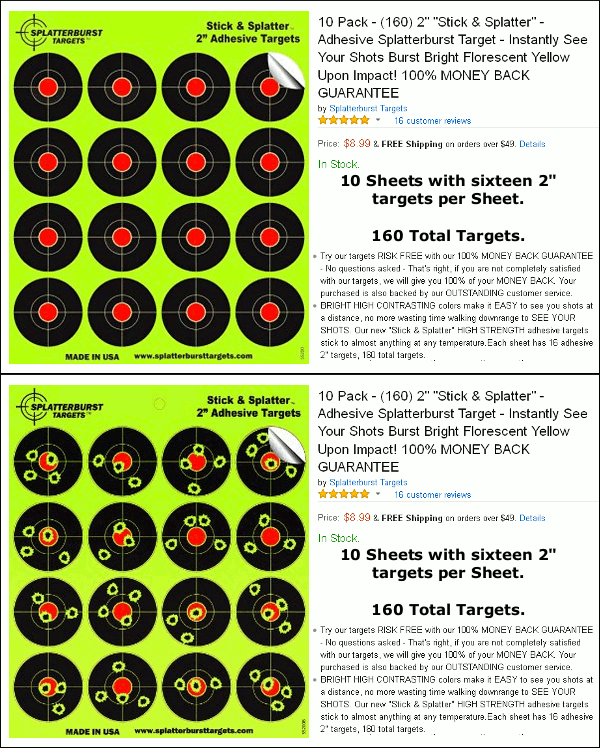
We use these splatter targets for fun shoots and practice at 300 and 400 yards. When hit, each shot displays as a bright, neon-green/yellow circle. That makes it easy to spot your shots, even with relatively low-power optics. These targets also work great for handgun practice at shorter distances. For just $8.99 you get ten sheets each with 16 stick-on circles — a total of 160 target bulls.
At the request of our readers, we have launched a “Deals of the Week” feature. Every Monday morning we offer our Bargain selections. Here are some of the best deals on firearms, hardware, reloading components, and shooting accessories. Be aware that sale prices are subject to change, and once clearance inventory is sold, it’s gone for good. You snooze you lose.
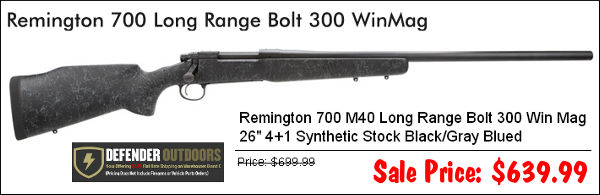
Come on, admit it — who wouldn’t like to have a .300 Winchester Magnum in their personal arsenal. Here’s a chance to pick up a nice Rem 700 in .300 WM for under $650.00. The Model 700 Long Range features a 26″ heavy varmint barrel mated to Remington’s Long Action. This model comes with a Bell and Carlson M40-type tactical synthetic stock with dual front swivel studs for a sling and bipod. The 700 Long Range also features an aluminum bedding block for accuracy. The trigger is the externally-adjustable X-Mark Pro, factory set at 3.5 pounds.
Right now Nikon is running a “Rock your Rimfire” promotion with instant savings of up to $50.00 per scope. With this program, you get a super-low price at time of purchase — there are no rebate forms to fill out or delays. While a variety of Nikon rimfire scopes are on sale currently, we think the most attractive deal is the Nikon 4-12x40mm Prostaff scope with BDC (bullet drop compensation) reticle. Right now, this scope is just $99.95 at Grafs.com. That’s a steal.
Bullet-maker Bart Sauter used this RAVpower portable charging unit to power his LabRadar chronograph at a short-range shooting match. He reports: “I bought a RAVPower pack from Amazon. It was the most powerful cell phone charger they had and it was reduced to $31. It was able to run the LabRadar for two full days without recharging and still had juice.” This unit has impressive specs: “4.5A Output: Highest output in the market, featuring a 4.5A total output capable of simultaneously charging two tablets, making it faster and more powerful than the rest. Exclusive iSmart Technology… ensures fastest and most efficient charge.”
Need quality .22 LR rimfire ammo at an affordable price? Consider Norma. Most folks think Norma only produces centerfire ammo and cartridge brass. As a result, people haven’t been looking for Norma rimfire ammo. Their loss is your gain. Accurate, reliable Norma .22 LR ammunition is in-stock right now at leading online vendors. This is good quality ammo, made in Europe. Bullets.com has Norma Tac-22 ammo in stock at $5.25 per 50-rd box (SKU: BL7819). In addition, Bullets.com offers Norma Match-22 ammunition at $7.50 per 50-rd box (SKU: BL11887).
Everyone needs a good .22 LR rimfire handgun, and the Browning Buck Mark is a classic. This stainless, bull barrel version is marked down this week to $379.99. That’s a very good price. Buckmarks, with their excellent triggers and great ergonomics, are fun to shoot and VERY accurate. This is a pistol you can keep for a life-time and pass on to your kids. Browning says: “Every Buck Mark starts out as a solid piece of aircraft-grade 7075 aluminum alloy, and then is CNC machined to exacting tolerances. The crisp single-action trigger, hand reamed chamber, target crowned barrel and finely adjustable target sights mean the Buck Mark comes ready for fun straight from the box.”
6. Widener’s — Norma 203B and 204 Powders on Sale
Looking for an excellent powder for your .308 Win, 6BR, or other small-to-midsized cartridge? You should consider Norma 203B. This Bofors-made powder is essentially the same as Alliant Reloder 15, which has set many records in the 6mmBR and 6mm Dasher cases. Right now Norma 203B is on sale at Wideners.com for just $19.95 per pound. That’s a great deal for an outstanding propellant. Other vendors charge up to $29.00 per pound for Norma 203B. Widener’s also has 8-lb jugs of Norma 204 powder is also on sale now for $139.00 (which works out to $17.35/lb). Norma 204 has a burn rate similar to H4350.
7. Amazon — Kowa 60mm TSN-601 Spotting Scope Body
If you are looking for a rugged, reliable, and affordable spotting scope to watch flags, mirage, and shot spotting discs, this angled-body Kowa TSN-61 will do the job. These Kowa spotters have been used successfully for years by prone and High Power competitors. Sure the glass is not as sharp as the latest top-of-the-line HD spotting scopes, but the TSN-61 is a small fraction of the price of high-end models which can run $2000 or more. The money you save can buy four premium hand-lapped barrels. NOTE: This item is the scope body only. Eyepieces are sold separately — expect to pay $260.00 – $300.00 for a Kowa 20-60X Zoom eyepiece.
8. Harbor Freight — Ammo Box and LED Light Super Savings
Here are two great deals from Harbor Freight — both coupons are good through the end of March, 2016. We like these plastic ammo boxes better than metal .30-cal milsurp ammo cans because the plastic boxes are lighter, don’t rust, and they are much kinder and gentler to human shins and vehicle interiors. This $2.99 compact LED light works great to illuminate the interior of your gun safe. At this price you can buy three and keep a spare for your Emergency kit or vehicle glove compartments.
Forum members have asked “what’s the best option in a spotting scope in the $500 to $1000 price range?” We’d certainly have to include Kowa spotting scopes on the “short list” for value-priced, high-performance spotters. And now Kowa spotting scopes are cheaper than ever, thanks to Bullets.com’s Holiday Kowa Promotion. Kowa Spotting scope and binoculars are on sale at Bullets.com for up to 26% off regular list prices.
If you need an affordable spotting scope for High Power matches or hunting, consider the 66mm or 82mm Kowas. If you want a no-compromise, ultra-low-dispersion glass, category-leading spotting scope, take a look at the 88mm Kowa Prominars. These have been rated among the “best of the best” in a variety of independent spotting scope comparison tests. Bullets.com is also discounting a wide range of Kowa binoculars.
Creedmoor Sports is offering two Holiday Specials with complete Spotting Scope systems, including Spotting Scope (with eyepiece), Scope Cover, and Scope Stand. You can choose between two price levels. If you are on a limited budget, go for the Konus 80mm bundle (item ID Konus-bundle). This includes Konus 80mm spotting scope, Scope Cover, and 3/4″-diameter Polecat Stand with two stand extension rods. These items would normally sell for $607.75, but now you can get them all for $545.00 with Holiday Special Pricing.
Creedmoor Sports also has a Holiday Kowa Scope Package (item ID SCOPEPKG) that can save you $112.65 off the regular $1487.65 price. This is really a nice bundle that should meet the needs of even top High Power competitors.
KOWA SCOPE PACKAGE — For $1375.00 you get all the following:
Kowa TSN-82SV 82mm Angled Spotting Scope
25X Long Eye Relief Eyepiece
Creedmoor Scope Cover in blue
Creedmoor 1″-diameter PoleCat Scope Stand
Two Extension Rods for Stand
Creedmoor Scope Stand Bag
See-Through Objective Lens Cover
Kowa Eyepiece Cover
The regular price for all this hardware is $1487.65, so you save $112.65 with this Kowa Scope Package. That’s a pretty significant savings you can put back into bullets and brass.


 While attending the CA Long Range Championship a few seasons back, we had the opportunity to test the performance of a high-magnification (63X) spotting scope in near-ideal conditions (maybe the best I’ve ever witnessed). On the event’s last day we arrived at 5:45 am, literally as the sun was cresting the horizon. I quickly deployed our Pentax PF-100ED spotting scope, fitted with a Pentax SMC-XW 10mm fixed-power eyepiece. When used with the 100mm Pentax scope, this 10mm eyepiece yields 63X magnification. Befitting its $319.00 price, this eyepiece is extremely clear and sharp.
 Then I invited 3 or 4 shooters to look through the scope. One younger guy, with good eyes, said immediately: “Yeah, I can see the holes — right there at 4 o’clock and seven o’clock. Wow.” Some older guys, who were wearing glasses, could not see the holes at all, no matter what we did to the scope’s main focus and diopter adjustment.
 Chromatic Aberration Revealed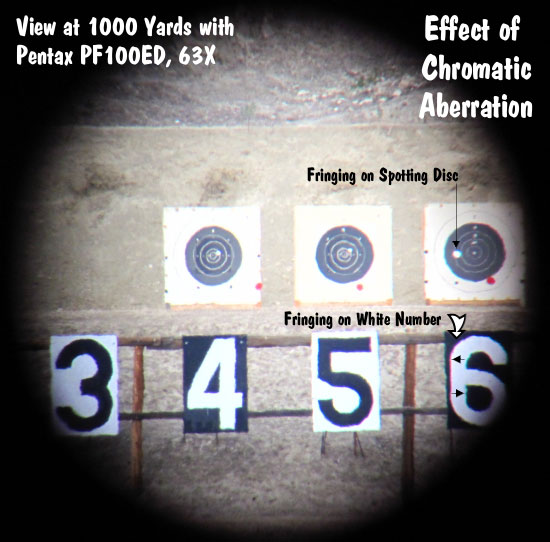
 CLICK HERE to view LARGE PHOTO that shows aberration more clearly.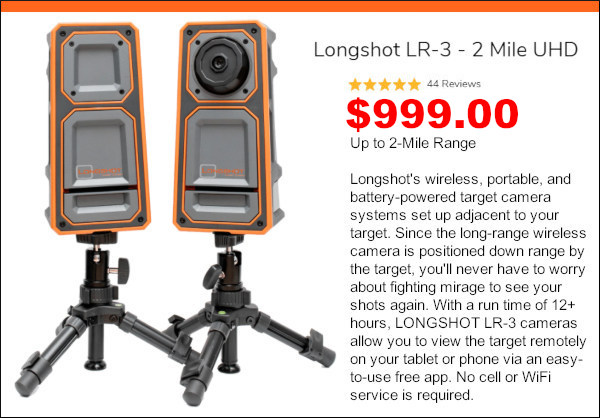









 Forum members have asked “what’s the best option in a spotting scope in the $500 to $1000 price range?” We’d certainly have to include Kowa spotting scopes on the “short list” for value-priced, high-performance spotters. And now Kowa spotting scopes are cheaper than ever, thanks to Bullets.com’s


