If you read our 2011 Super Shoot Report by James Mock, you’ll see that Vihtavuori N133 powder is the overwhelming choice of top short-range benchrest shooters for loading their 6PPCs. Other Vihtavuori powders, such as N135, N150, and N550 are also very popular for other match and hunting cartridges.
If you currently use a Vihtavuori (VV) powder, or you plan to try a Vihtavuori powder in the near future, visit www.Lapua.com soon. Load info on Lapua’s Vihtavuori Reloading Data Page has been updated (or added) for the following calibers: .222 Remington, .223 Remington, .223 WSSM (new caliber data), .22-250 Remington, 6.5 Grendel, 6.5×47 Lapua, and 7.62x53R. In the updated tables, you’ll find VV powder recipes for a wide variety of bullets from Hornady, Lapua, Nosler, Sierra, Speer and other bullet-makers.
Though these recipes are fairly conservative, always start low and work up gradually when using a new powder for the first time. Likewise, you should back off your load if you change ANY component or if you have fitted a new barrel to your rifle.
Vihtavuori N100 Series
The N100 series powders are single-base powders used mainly in rifle calibers. There are ten N100 series powders with different burning rates and suitability from the .17 Remington up to the .458 Winchester Magnum and two special powders for .50 BMG.
N500 Series
The N500 series powders are impregnated extruded rifle powders with Nitroglycerol added as extra energy component. If higher loading densities and more energy are needed, N500 series powders are competent alternatives for the N100 series powders. N500 series High Energy powders are available in five different burning rates.
Story tip by EdLongrange. We welcome submissions from our readers.
Dispelling Some 6mm BRX Myths, by Robert Whitley
I recently had an interesting and fact-filled conversation with Bob Crone (the inventor of the 6mm BRX) about his BRX. Bob actually called me because he was concerned that there are a lot of myths and about his 6mm BRX and he wanted to “set the record straight” on a few things. Here’s my summary of some topics we discussed:
Myth One:Bob made his 6mm BRX chamber by running a 6mm BR reamer in too deep.
Truth: There is no truth to Myth One. Bob said he specifically designed the BRX reamer and had it made with the head space he specified and a neck length appropriate for his newly designed 6mm BRX wildcat cartridge.
Myth Two:In the course of making up his 6mm BRX, Bob had a version with a .120″ longer head space than a 6mm BR Norma.
Truth: Bob was clear that his original design for the 6mm BRX always had a .100″ longer head space than a 6mm BR and that he never deviated from that. Right after Bob started working with his 6mm BRX, Bill Shehane came forward with a 6mm BRX version he made up that had a .120″ longer head space, and thus the confusion started. In truth, the original 6mm BRX always was (and still is) a chambering with a head space .100″ longer than a 6mm BR Norma.
Myth Three:The BRX was originally set up for 105-107gr bullets.
Truth: Bob said he set up his original reamer with a zero freebore and he has his gunsmith use a throater to throat whatever chamber was being made to where he wanted a particular bullet to touch the lands. Bob said he originally started with a 1:10″ twist barrel and shot a bunch of the 95gr VLDs and also 87gr bullets. Later he used an 8.5″ twist barrel for the heavier bullets.
Myth Four:The original BRX was set up also for use with Remington BR Brass.
Truth: Bob said he always used Lapua brass. He originally was an avid reader of Precision Shooting magazine and saw that the .262″ neck-turn neck was working real well with the 6 PPC and 6mm BR bench rest shooters and he decided to try to go with something that was already working well for 6mm shooters. He says his original reamer had a .262″ neck, but he also has a .272″ “no-neck-turn” version that he used on some of his rifles. He said the Lapua brass was so good and consistent, that for some rifles he just “didn’t want to mess with it” so he went with the “no-neck-turn” .272″ neck too.
Myth Five:The “false shoulder” method was used to make brass.
Truth: Bob said he never used the “false shoulder” method to make 6mm BRX brass, he just loaded 6mm BR brass with a bullet well into the lands of the BRX chamber and fire-formed brass that way. He noted that the accuracy with some of the fire-forming rounds was “outrageous” (i.e. outrageously good that is), so much so, they were shot in matches sometimes.
Myth Six:The 6mm BRX has a blown-out or straightened out body.
Truth: Bob said he kept the basic body taper of the 6mm BR cartridge. He wanted the cartridge to be an easy and inexpensive (but high performance) 6mm wildcat, and the original design was (and still is) set up to use readily available 6mm BR dies (up off the shell holder about .100″ from the normal position).
Author’s note: It was a most enjoyable experience to talk to Bob Crone. He is not only still passionate about his 6mm BRX, but he has a commanding knowledge of it as well.
Reamer Print provided by AR-X Enterprises LLC, www.6mmAR.com.
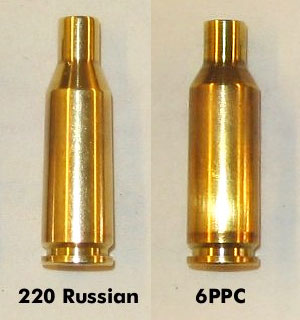
Jackie Schmidt, posting on Benchrest Central, observed that there may have been some production changes with Lapua 220 Russian brass. This brass is commonly used as the parent case for fire-forming 6 PPC cases. The newer 220 Russian brass has slightly thicker neckwalls, and, according to Jackie, the new brass is more consistent in overall neckwall thickness.
Jackie writes: “I have not made any new PPC cases in a while. But I finally used up all of my older 220 Russian brass, and just bought 500 new cases, in the blue plastic boxes. The necks are thicker. By at least .0008 (eight ten-thousandths). That is right at .0015 on diameter. I am getting neck-wall thickness of .0142″ on the old cases, .0150″ on the new cases. I [fire-formed] two cases, and seated a Flat Base Ultra bullet in each. The old case, with a seated bullet and non-neck-turned case, measures .2708″ average. By contrast, the new case, with a seated bullet in an unturned neck, measures .2722″ average. That is, on average, about .0015 difference in the diameter of a seated round.”
“Anybody else notice this? I guess the main reason I did the measuring is that I am thinking of having a ‘no-neck turn’ reamer ground. With this new brass, .0274″ would be the minimum. The new brass is a tad better in overall [neck]-wall thickness variation.” — Jackie
What does Lapua say? We’ve sent inquiries to Lapua’s USA tech representatives. We hope to have a response soon.
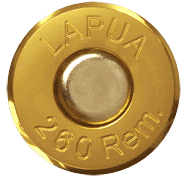
OK, you .260 Rem shooters, break out your credit cards. The Lapua .260 Remington cartridge brass has finally arrived. Kevin Thomas of Lapua tells us: “Sorry for the wait guys, but it’s here. Grafs.com has its shipment and will begin shipping orders [May 4, 2011]. Kaltron Pettibone received theirs a few days ago and should be filling existing orders as I write. Let us know what you think of this stuff. Looks pretty good so far, but the proof’s in the pudding.” Grafs.com has the .260 Rem brass in stock at $96.99 per 100-ct box (Shipping included with $4.95 handling fee). Eabco.com has the .260 Rem brass in stock for $92.50 per 100-ct box.
EABCO.com has a selection of Lapua factory-loaded ammo on sale at super-low prices — about 40% off current retail. These are older supplies of ammo that have been sitting in inventory for a while, so Eabco has cut the price dramatically to move it. Keep in mind that the price of Lapua brass has risen dramatically in the last couple of years, so this loaded ammo has become more attractive. Eabco has the Lapua 6mmBR 77gr HP loaded ammo on sale at $24 for 20 rounds, or $1.20 per finished round. Consider that you may now pay $0.80 per piece of Lapua 6mmBR brass. So, another way to look at it is that this ammo is worth about $16.00 per box… just for the brass.
Special Lapua Ammo Inventory Clearance Sale — Limited Quantities
Eabco tells us: “These are odd lots of loaded ammo in 20-round boxes. Some may not be the most popular bullet weight or style, so the price is much lower than our regular line of Lapua ammo. But this is all first-rate ammunition, made from total Lapua and VihtaVuori components. Quantities are limited. When these lots sell out, we won’t have more.”
810-4316034 – Lapua 6.5×55 Swedish Ammo 100 gr. FMJ (20 rounds) $24
810-4316048 – Lapua 6mm BR Norma Ammo 77 gr. HP (20 rounds) $24
810-4316051 – Lapua .243 Win Ammo 90 gr. FMJ (20 rounds) $24
810-4317183 – Lapua .308 Win Ammo 170 gr. FMJBT (20 rounds) $29
Many Other Bargains at EABCO ‘Garage Sale’
If you are looking for other discount gun parts and reloading accessories, check out EABCO’s ongoing “Garage Sale”. Here you’ll find stuff like scope bases, lens covers, press parts, snaps caps, plus odds and ends. There are even a couple custom rifles for sale along with a Vintage Cessna Airplane. Check out the Garage Sale — you may find something you need for pennies on the dollar.
Lapua recently announced that it is replacing three of its .224-caliber bullet types with new and improved versions. For service rifle shooters, the new GB541 looks like a good choice for short-course events.
55gr Softpoints Replaced with Non-Cannelure E539 Bullet
Two older soft point bullet designs, the 55gr E372 and the 55gr E369, are being replaced by Lapua’s new E539 55gr bullet. The E539 is a multi-purpose NON-cannelure soft point design with a 0.202 G1 BC.
New Higher-BC GB541 Bullet Replaces 69gr GB401
The .224 GB501 69gr Scenar has been replaced by a ballistically superior GB541 69gr Scenar bullet designed especially for long range target shooting. The new GB541 bullet has a 0.341 G1 Ballistic Coefficient and a 0.171 G7. Both numbers were established in field testing using Doppler Radar.
Lapua now offers a FREE ballistics program for modern smart phones that run Java Apps. (Unfortunately, that excludes Apple iPhones and Android OS phones, but Lapua says that the majority of smartphones run Java). The program calculates drift and drop, and it corrects for altitude, temp, air pressure, and shot angle. The Lapua Ballistics App also includes a database of Lapua bullet profiles with ultra-reliable radar-derived Ballistic Coefficients. Sound good? Now go get your smart phone. The program must be downloaded with a mobile phone. Open a web browser in your smart-phone and navigate to www.lapua.com/ballistics and choose the correct version for your phone.
Lapua’s exterior ballistic software for mobile phones is capable of predicting trajectories in real time with extreme accuracy. Using Lapua Ballistics, there is no need for checking tables and calculating cosines for inclination compensation (you still have to input the angle). The program also compensates for the effect of cartridge temperature on muzzle velocity and the effect of atmospheric conditions on the projectile’s trajectory.
Lapua Ballistics is based on precise Doppler Radar measurements of actual bullet drag — professional data available only for Lapua bullets. Lapua Ballistics can be installed on all smartphones supporting basic Java (Java MIDP 2.0). NOTE: Apple iPhone and Android platforms do not support Java ME.
The new, 9th Edition of the Vihtavuori Reloading Guide has been released. The complete Reloading Guide can be downloaded for FREE as a PDF (Adobe Acrobat) file. The rifle reloading data has been expanded and revised with more powder selections for existing bullets. The load data for .243 Winchester has been revised extensively, and there is new caliber data for 6mm Remington, 6.5×55 Swedish and 6.5×55 SKAN. Load info for the .260 Remington, 6.5×55 Swedish, 30-06, and 45/70 has also been expanded in the 9th Edition of the VV Reloading Guide.
The 9th Edition includes updated loading data for the following cartridge types:
Centerfire Handgun
.45 ACP
Centerfire Rifle
6mm Remington
.243 Winchester
.260 Remington
6.5×55 Swedish (Modern Action)
6.5×55 SKAN (Modern Action)
.30-06 Springfield
.45-70 Government
Error Correction: In the hard-copy, USA-printed version of the 9th Ed. Vihtavuori Reloading Guide, there is an error on page 25 concerning modern 6.5×55 loads. The data is correct in the PDF version of the Reloading Guide (linked above). CLICK HERE to download print version correction.
You’ve probably heard by now, but this is big news, so it bears repeating. Lapua has started production of .260 Remington cartridge brass. Lapua hopes to deliver the first shipments to the USA by late March, 2011. This is a very positive development for hunters, high power shooters, and tactical shooters. With the latest generation of powders (including Reloder 17), the .260 Remington is a potent cartridge with the 140gr-class bullets, and it hammers with the Lapua Scenar 123s or Berger 130s, and H4350-speed powders. In the video below, Kevin Thomas, Lapua’s USA Marketing Manager, provides more specifics about the .260 brass, and Lapua’s other new-for-2011 products.
On the bullet front, Lapua is proudly rolling out its new “L” series of projectiles, starting with the 6mm 105gr Scenar and then expanding to the whole Scenar match bullet line. NOTE: These are NOT new bullet designs — Lapua is not changing the bullet shapes, weights, or internal construction. So you’ll be getting the same bullets, only with tighter tolerances, and improved quality control.
Lapua has tightened its production tolerances for the L series of bullets. Lapua claims that the L series of bullets will be more uniform in weight, with improved concentricity. Length from base of bullet to ogive will be held to very tight tolerances. Apart from the notations on the box, the new Lapua L bullets will be marked with an “L” crest stamped on the bullet heel. Lapua claims this tiny stamp will not affect accuracy nor reduce the bullet’s ballistic coefficient.
Lapua explains: “We have set out to tighten all measures and requirements, including our already famous quality control standards.” Scenar L bullets will exhibit: “closer weight tolerances, tighter jacket wall concentricity standards, and greater uniformity in every dimension, starting from the gilding metal cup, lead wire and jacket forming, ending up to core-jacket assembly, boat tail pressing and tipping.”
Testing the Scenar Ls for Uniformity
Are the new Scenar “L” series bullets actually more uniform than previous Scenars (which were really very, very good)? Based on my quick test of 20 sample bullets pulled at random from a box, I would say the 105gr Scenar Ls are some of the most uniform factory bullets ever. Adam Braverman gave me a box of the new 105gr Scenar “L” bullets. I randomly chose twenty (20) bullets, and measured them base to ogive using a Hornady comparator. With the exception of one bullet, everything was pretty much “dead on”. I listed two at 0.7125″, but they were awfully close to the others. Basically, except for the one bullet measuring 0.711″, they were all the same within the practical resolution of my calipers. Very impressive indeed.
All Bullets within One-Tenth of Grain
Next I checked for weight uniformity. I weighed each of the 20 bullets twice, using a calibrated RCBS ChargeMaster scale. NOTE: This is NOT a lab quality scale. The 0.1 grain total spread among the bullets is within the scale’s range of error. But I did weigh each bullet at least twice, and the ones that were one-tenth of a grain light I weighed four times. Three bullets out of the twenty measured 105.2 grains. All the rest were 105.3 grains. Remarkable.
Here is great news for high-power shooters, tactical competitors, and hunters. Lapua will be producing .260 Remington brass starting in 2011. The official announcement will be made at SHOT Show 2011 in Las Vegas, and brass should start arriving in early spring. With Lapua’s introduction of .260 Rem brass, precision shooters now have a “no-brainer” first choice for cartridge brass in this popular chambering. No longer will you have to sort and cull (and re-sort) Rem-brand .260 brass. And you won’t have to fool around necking-up .243 brass or necking down .308 brass, with the problems that come with case-reforming operations.
The .260 Rem offers ballistics similar to the 6.5×55 with a cartridge size that fits short actions. For long range, the .260 Rem works great with 120gr to 142gr bullets, making it highly suitable for both hunting and target shooting. Here is what Lapua says about its new brass:
The .260 Rem was used to stunning effect at Camp Perry to win the 2010 Championships setting an incredible new national record in the process. .260 shooters have hammered their way into the winner’s circles of a wide variety of competitive disciplines, a real testament to the capability of this outstanding cartridge.
The .260 isn’t just a target round. It has also shown itself to be a fine performer in the field for medium game. Effectively duplicating the ballistic performance of the time-honored 6.5×55, the .260 has already developed a well-earned reputation for dependable stopping power on deer, antelope and similar game. Given the tremendous selection of bullets for every conceivable application, the 260 is an extraordinarily versatile cartridge. With such a solid history already established in such a short time, Lapua is proud to add the .260 to our line of premier components for the handloader.
[Editor’s Comment: I shot the .260 Rem extensively for 3 years, testing many powder/bullet/primer combinations. I tried both Remington-brand brass (very inconsistent), and necked-up Lapua and Norma .243 brass. If you want a reliable, accurate “go-to” load for the new Lapua .260 brass, I recommend Lapua 123gr Scenars with Hodgdon H4350 powder, running at about 2950 fps. Both Fed 210M and CCI large rifle primers work well. If you run the ballistics, you’ll find you give up little or nothing shooting the 123s vs. the 140gr class bullets because you can achieve significantly higher velocities with the lighter bullets, when using most powders. If you simply MUST shoot the 140s, try Reloder 17 to get higher velocities.]


 If you read our 2011 Super Shoot Report by James Mock, you’ll see that Vihtavuori N133 powder is the overwhelming choice of top short-range benchrest shooters for loading their 6PPCs. Other Vihtavuori powders, such as N135, N150, and N550 are also very popular for other match and hunting cartridges.
  Dispelling Some 6mm BRX Myths, by
  Truth: Bob was clear that his original design for the 6mm BRX always had a .100″ longer head space than a 6mm BR and that he never deviated from that. Right after Bob started working with his 6mm BRX, Bill Shehane came forward with a 6mm BRX version he made up that had a .120″ longer head space, and thus the confusion started. In truth, the original 6mm BRX always was (and still is) a chambering with a head space .100″ longer than a 6mm BR Norma.
 Myth Five: The “false shoulder” method was used to make brass.
 Jackie Schmidt, posting on
  OK, you .260 Rem shooters, break out your credit cards. The Lapua .260 Remington cartridge brass has finally arrived. Kevin Thomas of Lapua tells us: “Sorry for the wait guys, but it’s here. Grafs.com has its shipment and will begin shipping orders [May 4, 2011]. Kaltron Pettibone received theirs a few days ago and should be filling existing orders as I write. Let us know what you think of this stuff. Looks pretty good so far, but the proof’s in the pudding.”

 Lapua recently announced that it is replacing three of its .224-caliber bullet types with new and improved versions. For service rifle shooters, the new GB541 looks like a good choice for short-course events.
 Lapua now offers a FREE ballistics program for modern smart phones that run Java Apps. (Unfortunately, that excludes Apple iPhones and Android OS phones, but Lapua says that the majority of smartphones run Java). The program calculates drift and drop, and it corrects for altitude, temp, air pressure, and shot angle. The Lapua Ballistics App also includes a database of Lapua bullet profiles with ultra-reliable radar-derived Ballistic Coefficients. Sound good? Now go get your smart phone. The program must be downloaded with a mobile phone. Open a web browser in your smart-phone and navigate to
 On the bullet front, Lapua is proudly rolling out its new “L” series of projectiles, starting with the 6mm 105gr Scenar and then expanding to the whole Scenar match bullet line. NOTE: These are NOT new bullet designs — Lapua is not changing the bullet shapes, weights, or internal construction. So you’ll be getting the same bullets, only with tighter tolerances, and improved quality control.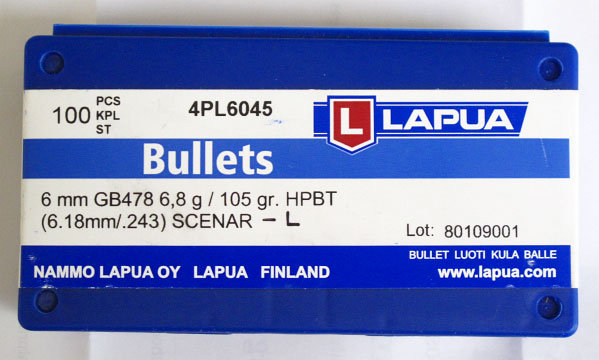
 Testing the Scenar Ls for Uniformity


