


Multi-Distance Target Test Confirms Linear Bullet Paths
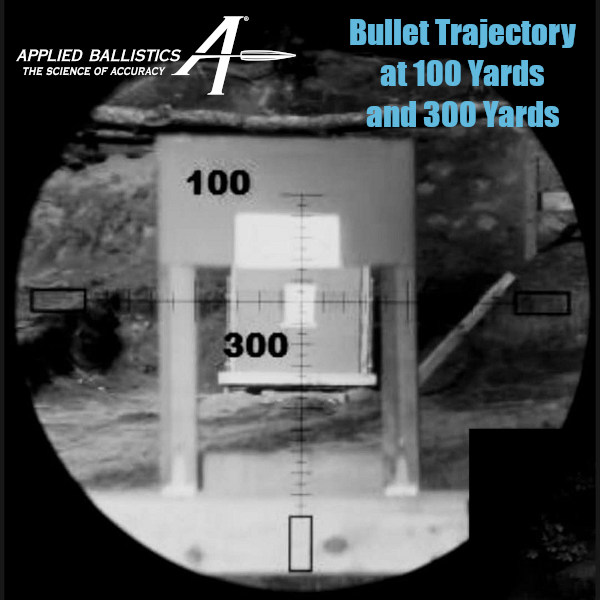
Can a shot group actually get smaller (in MOA size) at 300 yards than at 100 yards? Bryan Litz and his Applied Ballistics team performed an extensive test to answer that question. The test provided examples of groups fired on the 100-yard plus 300-yard ‘shoot-thru’ target system. There are two (2) target supports, one at 100 yards and a second at 300 yards. Bullets pass through the first target paper at 100 yards and continue on to 300 yards where you see a bigger group of the the same bullets, impacting more distant.
The photograph below combines the 100-yard group placements (upper left), with the same shot sequences forming larger groups at 300 yards. Note that the group pattern geometry is virtually identical but with the distance between the shots expanded.
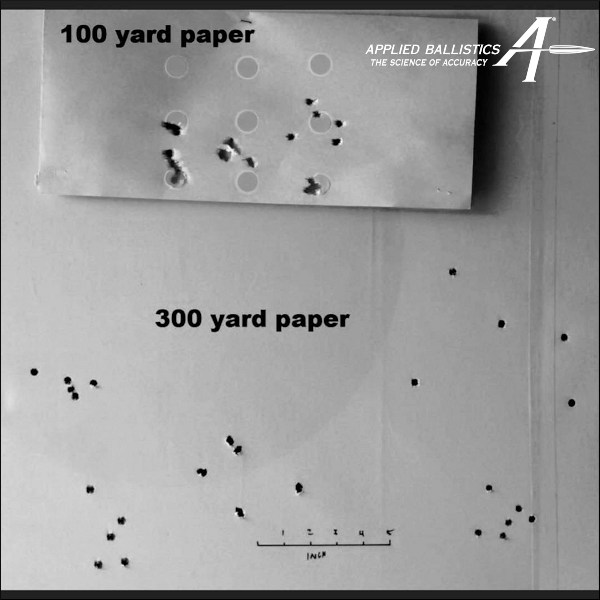
 100 Yard to 300 Yard Linear Test Results
This test and many others were fired on the shoot-thru target, looking for something that would result in non-linear dispersion, meaning, a smaller MOA group at 300 than 100 as claimed by many on the internet.
NOTE: Some folks online claim that their rifles shoot tighter-MOA (smaller minute of angle) groups at 300 yards than at 100 yards. While this is theoretically possible, this Applied Ballistics multi-target test showed that groups shrinking in MOA at great distance is very, very unlikely.
Bryan Litz explains: “Long story short; after over 70 trials from .224 to .510 caliber, we found no evidence of non-linear dispersion. Bullets simply don’t fly that way. 1 moa at 100 is 1 moa at 300. During the course of the testing, we did find something that probably made a lot of people think that groups were converging, but it was to do with optics (not parallax) rather than trajectory.
This full test is in Chapter 2 of Bryan Litz’s book: “Modern Advancements in Long Range Shooting – V2″. Get more information HERE: Bryan Litz Ballistics Facebook Page.


