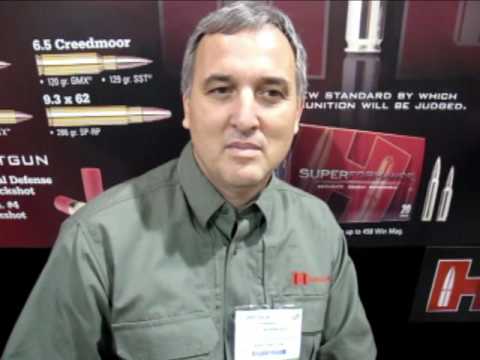
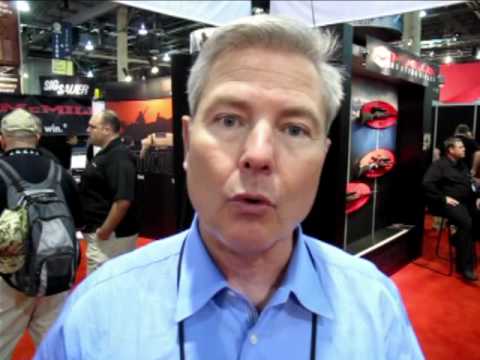
Blast from the Past: As we get set up in Phoenix for the 2016 Berger Southwest Nationals, we thought we’d revisit one of our more interesting features from a few years back. At the 2010 SHOT Show, we had the unique opportunity to corner three “superstars” of High Power shooting, and solicit their wind-reading secrets. Carl Bernosky, David Tubb, and John Whidden all shared some championship-caliber wind wisdom in video interviews. If you shoot competitively, you’ll want to watch these videos. David’s video is worth watching twice because some of the key points he makes go by pretty quickly.
In the three videos below (in alphabetical order), Carl Bernosky (10-Time Nat’l High Power Champion), David Tubb (11-time Nat’l High Power Champion and 7-time Nat’l Long-Range Champion), and John Whidden (2-Time Nat’l High Power Long-Range Champion) shared some of the wind-doping strategies that have carried them to victory in the nation’s most competitive shooting matches. This is GOLD folks… no matter what your discipline — be it short-range Benchrest or Long-Range High Power — watch these videos for valuable insights that can help you shoot more accurately, and post higher scores, in all wind conditions.
We were very fortunate to have these three extraordinarily gifted champions reveal their “winning ways”. These guys REALLY know their stuff. I thought to myself: “Wow, this is how a baseball fan might feel if he could assemble Babe Ruth, Hank Aaron, and Ted Williams in the same room, and have them each reveal their hitting secrets.” Editor’s Note: These interviews were conducted before Bernosky and Tubb won their most recent National Championships.
Here’s a “spy photo” of the new scope. Price and release date are yet to be determined.
If you’ve been planning to purchase a premium, high-magnification, variable-power competition scope this year… you may want to hold off for a few weeks. We just learned that Schmidt & Bender will be introducing an all-new, “super-zoom” optic for 2016. Schmidt & Bender’s impressive new 5-45x56mm PM II High Power, offers a remarkable 9X zoom ratio. That makes it suitable for a wide variety of shooting disciplines. A tactical competitor can dial back to 5-power for a wide field of view on close-in targets. Or, for 1000-yard shooting, crank the scope all the way up to 45-power. S&B says the scope is intended for “tactical ultra-long-range shooting”. With its ultra-bright, ultra-sharp German glass, this new scope could also become popular with F-Class competitors — if it is priced reasonably. We called Schmidt & Bender USA, but we were informed that no further product details or pricing information could be released prior to SHOT Show.
In addition to the new 5-45X comp scope, Schmidt & Bender plans to introduce six other new scope models in 2016. There will be two Polar T96 models, a 3-12X and a 4-16X. The current 2.5-10X Polar T96 boasts an industry-leading 96% light transmission. S&B claims this is the “brightest low-light hunting scope in the world”. For 2016, S&B will also introduce two PM II models with digital reticle display features, the 3-27X and 5-25X “Digital BT” scopes. Finally, two new PM II “Ultra-Bright” scopes will be added to the lineup. We believe these will be a 3-12X and a 4-16X.
The Coriolis Effect comes into play with extreme long-range shots like this. The rotation of the earth actually moves the target a small distance (in space) during the course of the bullet’s flight. Photo by Dustin Ellermann at Whittington Center Range.
When you’re out at the range, the Earth seems very stable. But it is actually a big sphere zooming through space while spinning around its axis, one complete turn every 24 hours. The rotation of the earth can create problems for extreme long-range shooters. During extended bullet flight times, the rotation of the planet causes an apparent deflection of the bullet path over very long distances. This is the ballistics manifestation of the Coriolis Effect.
Bryan Litz of Applied Ballistics has produced a short video that explains the Coriolis Effect. Bryan notes that Coriolis is “a very subtle effect. People like to make more of it than it is because it seems mysterious.” In most common shooting situations inside 1K, Coriolis is not important. At 1000 yards, the Effect represents less than one click (for most cartridge types). Even well past 1000 yards, in windy conditions, the Coriolis Effect may well be “lost in the noise”. But in very calm conditions, when shooting at extreme ranges, Bryan says you can benefit from adjusting your ballistics solution for Coriolis.
Bryan explains: “The Coriolis Effect… has to do with the spin of the earth. You are basically shooting from one point to another on a rotating sphere, in an inertial reference frame. The consequence of that is that, if the flight time of the bullet gets significantly long, the bullet can have an apparent drift from its intended target. The amount [of apparent drift] is very small — it depends on your latitude and azimuth of fire on the planet.”
Coriolis is a very subtle effect. With typical bullet BCs and velocities, you must get to at least 1000 yards before Coriolis amounts to even one click. Accordingly, Bryan advises: “Coriolis Effect is NOT something to think about on moving targets, it is NOT something to think about in high, uncertain wind environments because there are variables that are dominating your uncertainty picture, and the Coriolis will distract you more than the correction is worth.”
“Where you could think about Coriolis, and have it be a major impact on your hit percentage, is if you are shooting at extended range, at relatively small targets, in low-wind conditions. Where you know your muzzle velocity and BC very well, [and there are] pristine conditions, that’s where you’re going to see Coriolis creep in. You’ll receive more refinement and accuracy in your ballistics solutions if you account for Coriolis on those types of shots. But in most practical long-range shooting situations, Coriolis is NOT important. What IS important is to understand is when you should think about it and when you shouldn’t, i.e. when applying it will matter and when it won’t.”
The Coriolis Effect — General Physics
The Coriolis Effect is the apparent deflection of moving objects when the motion is described relative to a rotating reference frame. The Coriolis force acts in a direction perpendicular to the rotation axis and to the velocity of the body in the rotating frame and is proportional to the object’s speed in the rotating frame.
A commonly encountered rotating reference frame is the Earth. The Coriolis effect is caused by the rotation of the Earth and the inertia of the mass experiencing the effect. Because the Earth completes only one rotation per day, the Coriolis force is quite small, and its effects generally become noticeable only for motions occurring over large distances and long periods of time. This force causes moving objects on the surface of the Earth to be deflected to the right (with respect to the direction of travel) in the Northern Hemisphere and to the left in the Southern Hemisphere. The horizontal deflection effect is greater near the poles and smallest at the equator, since the rate of change in the diameter of the circles of latitude when travelling north or south, increases the closer the object is to the poles. (Source: Wikipedia)
Many of us dream of taking and making a shot at one mile (1760 yards). Well Top Shot Champion Dustin Ellermann pushed the envelope even farther during a recent ultra-long-range session at the NRA’s Whittington Center in New Mexico. On his Facebook page, Dustin wrote: “I earned the ‘One Mile+ Shot’ mancard this week with 1MOA Solutions. We reached out to 2,100 yards with the Barrett M99 .50 BMG out in the hills of the Whittington Center. You can see the target area marked in the center of the photo. This is a locked-down mountain range, with 30,000 acres.”
Bullet flight time was 3.7 seconds, drop was 94 MOA, velocity at target was only 1,100 fps. The 7,500′ elevation and a 5 degree down-slope helped the ballistics. Dustin reports: “About six seconds after impact you would hear the ‘ding’.” [Editor’s note: Yes it really takes roughly six seconds for sound to travel 2100 yards. The speed of sound at 7500′ elevation* is 1053.61 fps, or roughly 351.20 yards per second. The distance-to-target of 2100 yards divided by 351.2 works out to a 5.98 second time delay.]
One of Dustin’s friends commented: “We rarely think about what the bullet does after it exits, but seeing the 60% drop in velocity [over the trajectory] and how long it was actually in flight (3.7 seconds) makes these types of shots so amazing! Congrats to you making the One Mile + club!”
*This is with temperature corrected -30° F below standard at sea level.
Applied Ballistics has created a new series of YouTube videos about precision long range shooting. Featuring ace long-range shooter and professional ballistician Bryan Litz, these videos address various topics of interest to long-range marksmen. In this week’s video, the second in the series, Bryan Litz examines the most common causes of ballistics shooting errors at Long Range.
Watch Applied Ballistics Video about Common Mistakes in Long Range Shooting:
Bryan Litz of Applied Ballistics often hears the question: “What are the main reasons people miss their target at long range?” To answer that question, in this video, Bryan explains the most important variables in Long Range shooting. Bryan says: “Probably the number one thing is range — you have to have a [precise] range to your target because your bullet is dropping, and to hit the target you need to correct for bullet drop.” Distance may be indicated on the target bay (or berm), but for open ranges you should ascertain distance-to-target with a quality laser rangefinder. Even when the distance to target is shown with a sign or marker, you may want to confirm the distance with your rangefinder. (You may be surprised — we’ve seen marked target distances at commercial ranges off by 25+ yards!) Bryan says: “Get a good laser range to the target and you’ll be within a couple yards”.
After distance to target, the most important variable is the wind. This is the most challenging factor because the wind is constantly changing. Bryan explains: “After 300 or 400 yards, the wind [will] move your shots off the target if you don’t correct for it. The best way to account for the wind is to measure it at your location with a Kestrel. The Kestrel can give you the speed and direction of the wind at your location, which can baseline your wind call for your long-range shot.” Bryan acknowledges that there will still be variables: “The wind isn’t always blowing the same downrange as at your location… and the wind is always changing”. Bryan notes that you need to account for variances in wind between the time you gauge the wind angle and velocity and the time you actually you take your shot.
The Fullbore (Target Rifle) World Championships are now underway at Camp Perry. Held every four years (like the Olympics), the ICFRA World Target Rifle (Fullbore) Championships event is quite possibly the most important long-range rifle competition on the planet. This year the World Championships take place in the USA, at Camp Perry, Ohio. Teams from 11 countries are competing. Here we have some early reports from the August 8th Opening Ceremony…
Report by Ray Gross, Captain U.S. F-TR Team, 8 August, 2015
The U.S. Army Golden Knights parachuted in as part of the opening ceremony for the World Long Range Championships being held at Camp Perry, Ohio. Three of our sister teams, the U.S. Palma Team, the U.S. Veterans Team and the U.S. Under-25 Team will be competing against teams from around the world. Several members of our team, Ray Gross, Steve Hardin, Bryan Litz, and Lane Buxton, are part of the U.S. Palma Team.
The format is very similar to our own World Championships. Everyone entered in the Individuals will shoot 15 shoots for record at 800, 900, and 1000 yards and they will complete that course of fire three times over the next several days. The team event fires the same course twice.
The main difference from our style of shooting is that they will compete using aperture-type target sights and will be using an arm sling as support compared to the scopes and bipods that we use. The rings on our target are substantially tighter to account for the the greater stability and accuracy of the type of rifles that we use.
Report from Anette Wachter (aka 30CalGal), 8 August 2015
Day One of the World Long Range Championships — we had Opening Ceremonies this morning which had our U.S. Army Golden Knights jumping in and the flag raising of each participating country. Sherri Gallagher, former USAMU shooter and now a Golden Knight, led the team as the first and solo jumper. I was sort of hoping she would land in the prone position with a rifle and start the competition. The rest of the Knights fell from the sky and landed perfectly on the X.
The U.S. Fullbore Nationals consisted of individuals and various team events as well as the biggest event, the America’s Match. The USA has never lost the America’s Match at home. We won it three years ago here at Perry and last summer up in Canada. Yesterday was not in the cards. First let me congratulate Great Britain for some outstanding shooting. They lost a total of 17 points for 8 shooters all day and took the Gold. Australia came in second, South Africa 3rd and the USA in 4th. Very humbling yes. One of our coaches had to leave at the middle of the match for a family emergency as well. So I believe the kinks are done and we can move on successfully for this coming week of Worlds. We have the best shooters in the U.S. on our team. Things will turn around. Three women were in the top 25 of the Fullbore Nationals: Michelle Gallagher, Trudie Fay, and Jane Messer. Our Veterans and Under 25s had their World Championship team events as well. Our Veterans took the Gold and the USA Under 25s took the Bronze. The GB kids shot very well and received Gold and Silver medals.
From August 3 through August 14, Camp Perry, Ohio will be the center of the Fullbore (Palma Rifle) universe. From 3-7 August the U.S. Fullbore Championship will take place on the shores of Lake Erie, followed by the ICFRA World Target Rifle (Fullbore) Championships, which runs 8-14 August. The Worlds are a very big deal — just like the Olympics, the ICFRA World Target Rifle (aka Fullbore or Palma) LR Championships event is held every four years. This year the World Championships take place in the USA, at Camp Perry, Ohio. Teams from 11 countries will be competing. The United States won’t host the Worlds again for at least another 25 years.
Our friend Anette Wachter (aka 30CalGal) was on hand for the start of the U.S. Fullbore Championships this week. Here are some images Anette posted from Perry. Many foreign shooters are already in the USA, using the U.S. Fullbore Championship as a “tune-up” for the upcoming World Championships. In addition some of the international events are being held this week such as the ICFRA Veterans World Championship Team Match and the ICFRA Under-25 and Under-21 World Team Championships.
Photos courtesy Anette Wachter. Read Anette’s Shooting Commentaries on 30CalGal.com.
The matriarch of American Long Range Shooting has done it again. The amazing Nancy Tompkins won the 2015 NRA Long Range Championship with an impressive performance. This marks the fifth time Nancy has won the LR Championship. This year’s LR match went down to the wire after many days of shooting. It all came down to X-Count, with two talented ladies tied for score. Shooting a 1242-58X over the multi-day competition, Nancy finished four Xs ahead of SSG Amanda Elsenboss (1242-54X). Both women dropped only 8 points out of 1250 possible. Amanda’s USAMU team-mate, SFC Brandon Green, finished third, one point back, at 1241-75X. SFC Green, the newly-crowned 2015 High Power National Champion, had high X-Count by a wide margin.
This year’s Long Range Championships event was hugely popular, with 321 competitors on the match roster. Many familiar faces ranked among the Special Award winners. Our friends David Tubb (1241-69X) and Jim O’Connell (1235-66X) were High Senior and High Grand Senior, respectively. Tubb finished fourth overall, with the second-highest X-Count. There were also talented newcomers, such as High Junior Charlotte Flanagan, a young Kiwi from far-away New Zealand. Firing a 1236-40X, Charlotte is shooting at an extremely high level for someone so young. As Ken Littlefield noted: “It’s pretty impressive to come into Camp Perry for the first time and win the Junior Championship!” Charlotte could be formidable at the World Fullbore LR Championships slated for 3-9 August at Camp Perry.
Here are the overall Top 10 finishers. Note that Michelle Gallager, Nancy Tompkins’s daughter, made the Top 10, making this a “family affair” for the Tompkins/Gallagher clan:
1. NANCY TOMPKINS (1242-58X), HM, Div. B – U.S. Match ‘Any’ Rifle*, Rule 3.2, 3.7(c)
2. SSG AMANDA ELSENBOSS (1242-54X), HM, USA REG W Div. B – U.S. Palma Rifle, Rule 3.3.1(a)
3. SFC BRANDON GREEN (1241-75X), HM, USA REG Div. B – U.S. Palma Rifle, Rule 3.3.1(a)
4. DAVID TUBB (1241-69X), HM, Div. B – U.S. Palma Rifle, Rule 3.3.1(a)
5. DAVID CALVERT (1241-63X), MA, Palma Rifle (NRA Rule 3.3.3 (b))
6. JANE MESSER (1240-60X), HM, Palma Rifle (NRA Rule 3.3.3 (b))
7. DAVID LUCKMAN (1239-68X), MA, Palma Rifle (NRA Rule 3.3.3 (b))
8. SGT DICONZA (1238-59X), HM, USMC REG Div. B – U.S. Palma Rifle, Rule 3.3.1(a)
9. PHILLIP CROWE (1238-54X), HM, Div. B – U.S. Palma Rifle, Rule 3.3.1(a)
10. MICHELLE GALLAGHER (1237-64X), HM, Div. B – U.S. Palma Rifle, Rule 3.3.1(a)
*The NRA Match bulletin lists Palma Rifle, but Nancy said she shot her “Any Rifle”.
In this photo, Michelle Gallagher is missing … but someone had to take the photo.
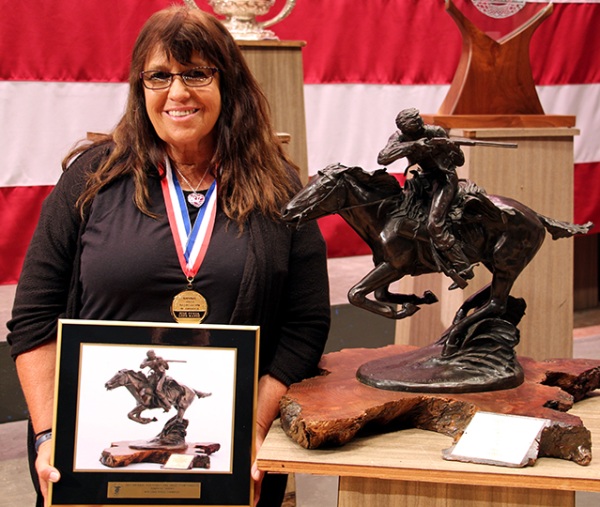
Here is Nancy with the Tompkins Trophy. And yes, if you are wondering, that trophy was donated, decades ago, by hubby Mid Tompkins as the top prize for the Long Range High Power Rifle competition.
This week, many of the world’s top marksmen have been competing at the National Long Range High Power Rifle Championships, held 29-31 July, 2015 at Camp Perry. The distances are great (1000 yards maximum) as are the challenges — the fickle winds blowing off Lake Erie can be unpredictable.
This year is extra special. The USA hosts the World Fullbore Long Range Championships next week at Camp Perry. The World Championships are held every four years, but any country may only host the event every 25 years. That means the next Fullbore Worlds in the USA could not take place before 2040. This year, teams from 11 countries will compete for national honors (and serious bragging rights). Many top international shooters have already arrived, and they are using the NRA Long Range High Power Championships as a “prelim” for the Fullbore Worlds next week.
Ace ISSF 300m shooter Reya Kempley shoots a hybrid rig with a Stolle Panda Action in an Anschütz smallbore-type metal stock.
Here’s the same rifle, as fitted with hand rest for position shooting. CLICK to Zoom:
British Palma Shooter David Luckman hung tough after suffering a dissappointing 8 (low right) on his first record shot. After serving up that 8 at 4 o’clock, David fought back, shooting all tens and Xs for the rest of his 10-shot string. (Orange stickers show record shots — the yellow dots mark sighters.) David doesn’t crack under pressure — he won the 2012 Long Range Championship at Camp Perry, and he is the reigning ICFRA World Long Range Fullbore (Palma) Rifle Champion.
Those targets are placed a long way off. Now imagine trying to shoot half-MOA with iron sights.
Past Long-Range Champion John Whidden shows good form. John runs a centerfire action in an Anschütz metal smallbore stock. He smithed this rig himself. John favors the ergonomics and adjustability of the Anschütz stock. He also really likes the small-diameter, rounded forearm on this design. “This stock suits me really well”, John told us.
This competitor has an Eliseo (Competition Machine) Tubegun in Patriotic Stars and Stripes Livery.
This U.S. Marine Corps shooter campaigned a classic “Battle Rifle” in the LR Championship, firing a semi-auto version of the M14. It looks like he named the rifle “Lucy”.
Photos from 2015 NRA Long Range High Power Rifle Championships courtesy NRABlog.com.
The NRA High Power Long Range Championships kicked off on the 29th of July. Despite challenging winds there were many impressive performances, including one by newly-crowned NRA High Power Champion SFC Brandon Green. The talented USAMU shooter traded his Across-the-Course Rig for his 7mm RSAUM prone rifle to compete in the series of Long Range matches. Brandon shot very well, finishing with a 100-7X in the final Shoot-Off to win the Mustin Trophy match.
Shown at top is SFC Brandon Green with his long-range rifle. Note: the target in the photo shows the shot position for Brandon’s 10-shot Shoot-Off — all 10s and Xs. However, this is a REDUCED-SIZE target used for shot-marking (display) purposes only. The actual 1000-yard NRA Long-Range Target has a 10″ X-Ring, and a 20″ Ten-Ring. So the group of shots shown is much smaller than Green’s actual shots on the real 1000-yard target. Nonetheless this was a very impressive string for a sling-shooter using iron sights.
If you’re curious about Green’s long-range rifle, it is a 7mm RSAUM with an Anschutz trigger in a Robertson Composites prone-style stock. This rifle features iron sights, but when USAMU shooters participate in scoped “any sights” competitions, they normally use Nightforce NSX scopes, according the USAMU coach SFC Emil Praslick III.
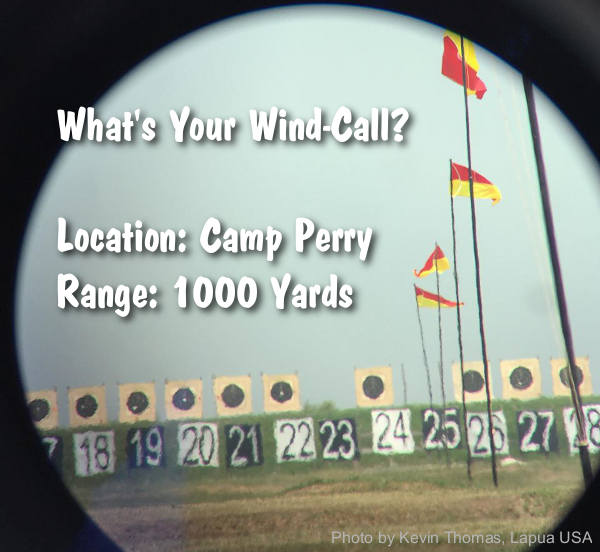
You Call the Wind…
Conditions were far from easy on Day 1 of the Long Range Championships. Here is a shot taken through a 25X spotting scope by Kevin Thomas of Lapua. Take a look at those flags swinging at different angles. Based on what you can see, what’s your wind call?




 When you’re out at the range, the Earth seems very stable. But it is actually a big sphere zooming through space while spinning around its axis, one complete turn every 24 hours. The rotation of the earth can create problems for extreme long-range shooters. During extended bullet flight times, the rotation of the planet causes an apparent deflection of the bullet path over very long distances. This is the ballistics manifestation of the