If you watch just one episode of Shooting USA TV this year, it should probably be this week’s hour-long SHOT Show Special. Tonight, March 14, 2017, enjoy a full hour of SHOT Show coverage. Jim Scoutten’s team of gun journalists work hard every January, bringing you highlights from the gun industry’s largest trade show. Jim, son John Scoutten, and other staffers prowled the 12 miles of aisles in the Sands Convention Center in Las Vegas, visiting many of the 1,600+ exhibitors. This episode provides a “first look” at the new guns, optics, and gear introduced for 2018. Click HERE to learn more about this week’s 2018 SHOT Show episode.
2018 SHOT Show Highlights: Ruger Precision Rimfire, Sig P365, M1A in 6.5 Creedmoor, MR-10 Bolt Action Comp Rifle, Colt Competition 1911, and a whole lot more.
Shooting USA Hour AIR TIMES
Shooting USA’s SHOT Show Special will air for a full hour on Wednesday, March 14, 2016 on the Outdoor Channel. Here are the air times, but you should check your local schedule. Look for Shooting USA TV on the Outdoor Channel.
Wednesday Night Schedule:
Eastern Time – 9:00 PM
Central Time – 8:00 PM
Mountain Time – Check Listings
Pacific Time – 9:00 PM
Here are some of the 50+ new products featured on the SHOT Show Special:
In the past few years, the 6.5 Creedmoor cartridge has become the leading cartridge for tactical/practical gun games. It offers excellent ballistics, moderate recoil, and good accuracy with a variety of powder and bullet combos. Along with the 6.5×47 Lapua, the 6.5 Creedmoor has demonstrated that a .264-Caliber mid-sized caliber is truly a jack of all trades — it can be accurate on paper, win PRS matches, and also harvest game during hunting season. If you own a 6.5 Creedmoor (or plan to get one) and hand-load your ammo, this post should provide a good start. Sierra Bullets now offers 6.5 Creedmoor Load Data for bullets from 120 to 142 grains — the most popular weight range for this chambering.
Sierra Bullets has released very complete load data for the popular 6.5 Creedmoor cartridge. This medium-sized cartridge has become one of the most popular chamberings for tactical and PRS shooters. The 6.5 Creedmoor combines excellent accuracy, good mag-feeding, good barrel life, moderate recoil, and reasonable component cost. That’s why this cartridge has caught on quickly.
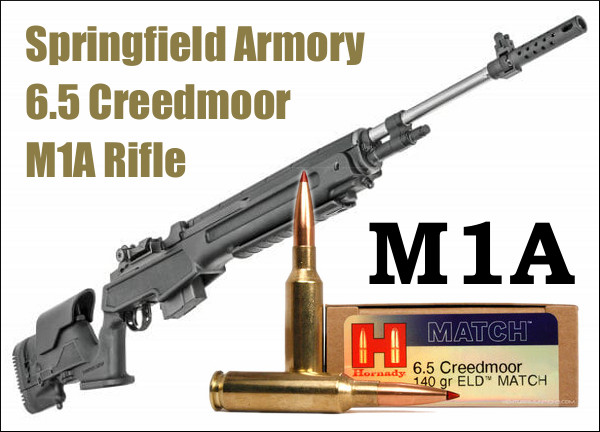
The Springfield M1A is now available in 6.5 Creedmoor. For Gas Guns like this, be sure to full-length-size your brass after every firing, with adequate shoulder bump.
Developed in 2007 by Dennis DeMille and Dave Emary, the 6.5 Creedmoor is a shortened and improved 30 TC cartridge case that was inspired by the .308 Winchester design. This short action design was created to maximize case capacity and a wide range of loading lengths, while still fitting in standard short action magazines. With the correct twist barrel, the versatile 6.5 Creedmoor can take advantage of the wide range of bullet weights available in 6.5 mm (i.e. .264 caliber). Reloaders should keep in mind that the 6.5 Creedmoor works best with medium to medium-slow powders such as H4350, Varget, Win 760, and RE-17. The light recoil and adaptability of the efficient 6.5 Creedmoor cartridge has already proven itself in high power, precision rifle series and benchrest competitions. Couple that with respectable barrel life and its intrinsic accuracy potential and you have a recipe for success which should insure its legacy for decades to come.
Here are three tables from the Sierra Bullets Reloading Manual (5th Edition). IMPORTANT — This is just a sample!! Sierra has load data for many other 6.5mm bullet types, including FB, Spitzer, SBT, HPBT, and Tipped MK from 85 grains to 142 grains. To view ALL 6.5 Creedmoor DATA, CLICK HERE.
INDICATES MAXIMUM LOAD – USE CAUTION
LOADS LESS THAN MINIMUM CHARGES SHOWN ARE NOT RECOMMENDED.
INDICATES MAXIMUM LOAD – USE CAUTION
LOADS LESS THAN MINIMUM CHARGES SHOWN ARE NOT RECOMMENDED.
INDICATES MAXIMUM LOAD – USE CAUTION
LOADS LESS THAN MINIMUM CHARGES SHOWN ARE NOT RECOMMENDED.
When two or more guys get together at a shooting range, sooner or later, a challenge will ensue. It’s a guy thing — guys are competitive. We’ve seen it on varmint hunting trips too: “Bet I can hit that P-dog at 700 yards.” “No you can’t.” “Yes I can.” “Wanna Bet?”
You know how it goes. There are challenges for pride, bragging rights, and often some money is involved, or perhaps a six-pack.
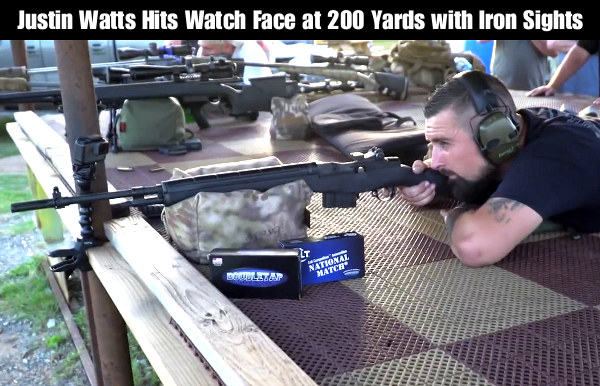
In this GunVenture video, three shooters take on the challenge of hitting the face of a watch at 200 yards using an M1A rifle with standard iron sights. The rules were exact — you had to hit the FACE of the watch, not just the strap. And the bullet had to penetrate the center of the watch — no splash shots or ricochets allowed. Not an easy shot — we figure that watch face is about 1.5″ in diameter or roughly 0.75 MOA at 200 yards. They were shooting factory .308 Win ammo with 155gr bullets — a Palma load.
GunVenture Video — 200 Yard Watch Challenge with Iron Sights M1A
One of the shooters, range owner Justin Watts, rose brilliantly to the challenge. You can see Justin’s remarkable shot at 3:20 time mark. Holding slightly for wind, he drilled the watch face dead center, obliterating it, but leaving most of the band intact. At 4:25 the video reveals that the whole center of the watch (the works) was blown out, leaving nothing but a rubber doughnut. Mighty Impressive.
After making the impressive shot, Justin explained to his buddies what they did wrong. Among other things they did not compensate for the wind. Justin also observed that the first shooter sent his shot right because of the M1A’s heavy trigger pull: “Probably what happened is the trigger pull is so heavy [he] pulled it to the right. Most of the time when you have a right-handed shooter and a heavy trigger like that, it’s going to pull you off to the right.”
The U.S. Army Marksmanship Unit (USAMU) has published a great series of reloading “how-to” articles on its Facebook Page. This post covers key factors to consider when loading ammunition for Match Rifles and Service Rifles, with a particular focus on self-loading “gas guns”. Visit the USAMU Facebook Page each Wednesday for other, helpful “Handloading Hump-Day” tips.
We offer some “cardinal rules” to help new gas-gun handloaders with safety and efficiency. These address both Match Rifle and Service Rifle versions of the AR15, M1 Garand, M1A, and M110. However, they can also improve safe reloading for many other auto-loaders such as M1 Carbines, FALs, SIGs, etc. The author distilled these principles many years ago to help focus on the essential aspects of these rifles.
RULE ONE: Service Rifles Are Not Benchrest Rifles
Gas-guns require a relatively loose fit between ammunition and chamber (vs. bolt actions) for safe, smooth operation. Many techniques, such as neck sizing and keeping cartridge headspace quite tight, are popular in the extreme bolt gun accuracy realm. However, they are of little value with Service Rifles, and some could even be hazardous. Before adopting a specialized technique, seriously consider whether it is appropriate and beneficial in a gas-gun.
RULE TWO: Never Compromise Safety to Obtain Accuracy
Example: If choosing a brand of great, but ultra-sensitive match primers offers possibly better accuracy at the risk of slam-fires in your design of rifle, don’t do it! You are issued exactly two eyes and ten fingers (best-case scenario). Risking them trying to squeeze 0.25 MOA better accuracy out of an M1A, etc. simply isn’t worth it.
RULE THREE: Tailor the Precision to Your Individual Skill and Your Rifle’s Potential
This has been addressed here before, but bears repeating for newcomers. If you are struggling to break out of the Marksman Class, or using a CMP M1 “As-Issued,” then laboriously turning the necks of your 600-yard brass is a waste of time. Your scores will improve much faster by practicing or dry-firing. On the other hand, if the reigning champions anxiously check your scores each time you fire an event, a little neck-turning might not be so far-fetched.
Verifying Load Improvements — Accuracy hand-loading involves a wide variety of techniques, ranging from basic to rather precise. Carefully select those which offer a good return on investment for your time and labor. In doubt? Do a classic pilot study. Prepare ammo for at least three or four ten-shot groups with your new technique, vs. the same with your standard ammo. Then, pick a calm day and test the ammo as carefully as possible at its full distance (e.g. 200, 300, or 600 yards) to verify a significant improvement. A little testing can save much labor!
RULE FOUR: Be Your Own Efficiency Expert
Serious Service Rifle shooters generally think of ammunition in terms of thousands of rounds, not “boxes”, or even “hundreds”. Analyze, and WRITE DOWN each step in your reloading process. Count the number of times each case is handled. Then, see if any operations can be dropped or changed without reducing safety or accuracy. Eliminating just two operations saves 2000 steps per 1000 rounds loaded. Conversely, carefully consider any measurable benefits before adding a step to your routine.
RULE FIVE: In Searching for Greater Accuracy with Efficiency, Look for System Changes
For example, instead of marking your 300-yard rounds individually to differentiate them from your 200-yard ammo, would a simple change in primers work? If accuracy is maintained, using brass-colored primers for 200 and silver for 300 provides an indelible indicator and eliminates a step! Similarly, rather than spending hours selecting GI surplus brass for weight and neck uniformity, consider splurging on some known, high-quality imported match brass for your 600-yard loads. Results should be excellent, time is saved, and given limited shooting at 600 yards, brass life should be long.
RULE SIX: Check All Your Primers Before Packaging Your Loaded Ammo
This seems simple and even intuitive. However, many slam-fires (which were much more common when M1s and M1As were the standard) are due, at least in part, to “high” primers. Primers should be seated below flush with the case head. The USAMU has addressed this at length in a previous column, but each round should be checked for properly-seated primers before they are packaged for use.
The 6.5 Creedmoor craze goes one step further. Soon you can buy a Springfield M1A chambered for this mid-sized cartridge popularized by PRS shooters. Both bolt-action and AR-platform rifles chambered for the 6.5 Creedmoor have been available for quite some time, but this is a new direction for the M1A, which has traditionally been chambered for the 7.62×51 NATO/.308 Winchester round. As chambered for the 6.5 Creedmoor, Springfield’s M1A should be easier on shooters’ shoulders. The 6.5 Creedmoor M1A has 28% less recoil than the .308 Winchester version.*
The new 6.5 Creedmoor M1A features a 22″ medium-contour, 1:8″-twist stainless barrel with factory muzzle brake. The rifle comes with iron sights: .062 post front sight and .0520 aperture rear sight adjustable for ½ MOA windage and 1 MOA elevation. Springfield ships the rifle with a 2-stage trigger tuned to 4.5 – 5 pounds. A Springfield Armory Optics mount is available to fit a magnified optic, but, to be honest, we haven’t been very impressed with that mount.
Two stock options are offered: a basic black polymer stock (not recommended — it’s weak and flexy) or a deluxe “precision” stock with adjustable cheekpiece and adjustable LOP. The deluxe precision stock, shown above, is much more rigid, and can be configured with front underside Picatinny rail (see video). Rifle Specs HERE.
With the basic polymer stock, the 6.5 Creedmoor weighs 11.4 pounds (unloaded) and has a $1985.00 MSRP. With the adjustable precision stock, the gun is a bit heavier and retails for $2045.00 in either matte black or Flat Dark Earth (FDE).
“Having a 6.5 Creedmoor caliber in the M1A lineup gives long-range shooters more choices with the precision and accuracy they require,” says Springfield Armory CEO Dennis Reese. “They can choose the round they prefer…”, i.e. .308 Win or the 6.5 Creedmoor. Excellent factory ammo is available for both chamberings.
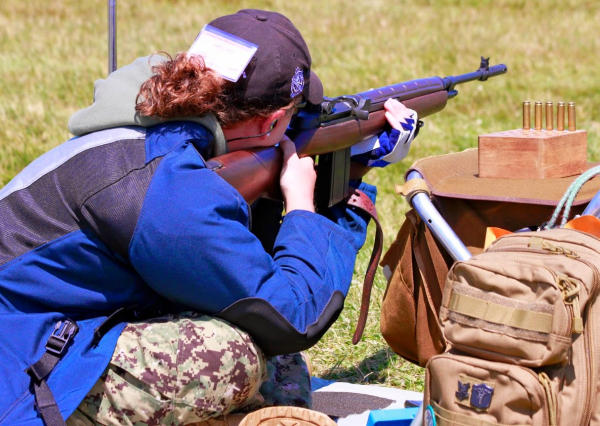
Photo of 2009 M1A Match at Camp Perry. Shooter is Nick Till, 2007 Service Rifle Champion.
If you are looking for a robust semi-auto rifle that has an interesting legacy (the M1A was derived from the U.S. Military’s M14), this new M1A may suit your tastes. Every year at Camp Perry, Springfield Armory sponsors a very popular M1A match which attracts marksmen from around the country. We can’t say for sure that the 6.5 Creedmoor M1As will be allowed in M1A matches, but we would expect they will, though perhaps competing in a separate division.
Do you own a Springfield M1A (or wish you did)? Then you should watch this 5-minute video from the American Gunsmithing Institute (AGI). This video shows the basics of the operation of the popular M1A rifle, the civilian version of the military M14. In this video, gunsmith John Bush field-strips the M1A and shows how the bolt, op rod, and trigger group fits together and operates. This video contains excerpts from the M1A Rifle Armorer’s Course, AGI Course #1584. The full Armorer’s Course is available on DVD from www.AmericanGunsmith.com.
Watch Highlights of AGI M1A Rifle Armorer’s Course:
Registration Opens for 2017 CMP Springfield M1A Match
The 11th annual Springfield Armory M1A Match will take place during the 2017 National Trophy Rifle Matches. The CMP will host the event on Saturday, July 22, following the John C. Garand Match. Competitors of all experience levels are encouraged to bring their M1A rifles to Camp Perry and compete. Registration for the match will open April 1, 2017, and is open to all individuals ages 12 and above, with an entry fee of $50 (junior $25).
The Springfield Armory M1A match began with one man’s idea and passion. Springfield Armory’s Mike Doy witnessed the waning of classic M1 Garand and M1A rifles from the competitive High Power firing lines. “I really wanted to get those M1A rifles out of safes and closets and back out onto the field. So 11 years ago, I promoted the idea of running an M1A-specific match at Camp Perry. That first year we had over 600 competitors and spectators.” Now the match offers some of the biggest pay-outs at Camp Perry. In recent years, Springfield Armory has donated over $25,000 worth of cash and prizes, including a $2,000 cash award to the overall winner.
Most gun guys know that the NRA publishes a monthly magazine called American Rifleman. What you may not know is that NRA also offers an American Rifleman television series on the Outdoor Channel. On each episode the hosts of American Rifleman TV review popular firearms (pistols, rifles, and shotguns). Most episodes include an historical segment. For example, in the 2016 Season Premiere, American Rifleman TV looks back at WWII, spotlighting The Men & Guns of the Pacific.
Highlights from other American Rifleman TV Episodes:
Springfield Armory M1A Review:
The Springfield Armory M1A is a civilian, semi-auto rifle based on the U.S. Military’s M14. Your Editor owned an M1A, and it was a fun gun. In High Power and Service Rifle competition, low-recoil 5.56 (.223) AR-platform rifles have displaced the M1A, but there is a hugely popular Springfield M1A Match every year at Camp Perry. The M1A Match at Perry offers over $25,000 in cash and prize awards each year.
Leupold Factory Tour:
Founded in 1907, Leupold & Stevens produces high-quality optics (with a legendary warranty) in Beaverton, Oregon. Leupold scopes are favorites for hunters as well as competitive shooters. In this episode, American Rifleman TV takes a tour of the Leupold & Stevens factory in Oregon.
Ruger American Rimfire Review:
Ruger offers both Standard and Compact models of its American Rimfire in two chamberings: .22 LR and .22 WMR. This rifle features a detachable, rotary magazine, like Ruger’s popular 10/22. The American Rimfire is a very affordable, yet reliable and surprisingly accurate rifle.
Old “Number 2″ belonging to Ray Gross. Click Photo for full-screen Image.
Ray Gross is captain of the United States F-TR Team. While he’s mostly involved in F-Class shooting these days, that wasn’t always the case. Ray is an experienced service rifle shooter, who secured his Distinguished Rifleman Badge 21 years ago. Ray has shot many different rifles during his competitive shooting career, but the rifle above has a special place in Ray’s heart. This old semi-auto earned Ray his Distinguished Badge, and he’ll never forget that…
“I said goodbye to an old friend last week…
Affectionately known as ‘Number 2′, she is the rifle that I earned my Distinguished Rifleman Badge with in 1995 (#1159).
That rifle was also responsible for a fair amount of Venison in the ’90s, as well. But since then, she has spent a lot of time in the closet. Last time I got her out was to destroy a bunch of hard drives containing evidence collected during my Computer Forensics days. She deserved better than that.
I will miss the beautiful sound of all that American steel slamming into battery when I tripped her bolt.” – Ray Gross
Nick Till in 2009 M1A Match. Nick was the 2007 Service Rifle Nat’l Champion. Photo courtesy NRA Blog.
This year marks the 10th anniversary of the NRA Springfield M1A Match, scheduled for July 31, 2016 at Camp Perry, Ohio. The Springfield M1A Match will kick off the 2016 NRA National High Power Rifle Championships. With this year’s anniversary M1A competition, more than 4,000 competitors will have shot the classic M1A for score from Camp Perry’s 300-yard line.
Big bucks will be at stake in this year’s M1A match. Springfield Armory is donating over $25,000 worth of cash and prizes, including a $2,000 cash award to the overall winner. All competitors who register by July 15, 2016 will also receive a free Springfield M1A Match T-shirt.
Sponsored by Springfield Armory, the NRA Springfield M1A Match was conceived to promote use of this historic battle rifle, based on the military’s M14. “Springfield Armory has always been about heritage,” stated Springfield Armory CEO Dennis Reese. “I competed myself last year. It was incredibly inspiring to see hundreds and hundreds of our M1A rifles on the Camp Perry firing lines.”
M1A Match Course of Fire
Equipment rules allow pretty much all types/grades of M1As in the match. The one-day course of fire consists of 50 shots at 300 yards on the NRA MR-65F target, as follows: 5 sighters; 20 shots slow-fire prone; 10 shots rapid-fire prone; 10 shots rapid-fire, kneeling or sitting; and 10 shots slow-fire standing.
Video of 2009 M1A match at Camp Perry (NOTE: Loud wind noise — turn down speakers.)
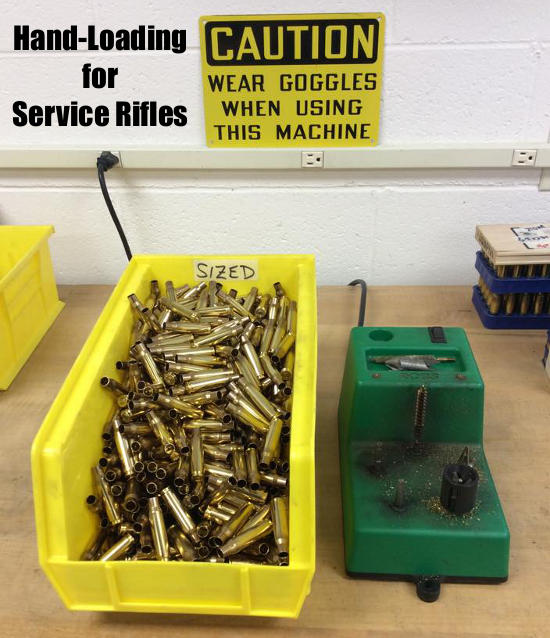
By Dennis Santiago Competition teaches you things. Compared to loading for benchrest bolt guns, producing ultra-reliable and accurate ammo for tight-chambered, semi-auto .308 target rifles requires a different approach to case prep. Smoothness of operation is much more important in a field course gun. Reliability trumps everything (even case life) for these types of guns.
In the photo below, there’s a Redding small base body die for bumping the shoulder and making sure the case body is at SAAMI minimum. This body die is not just nice to have. It is vital. There are also a full-length sizing die and a Lee Collet neck-sizer in that turret holder. One or the other gets used after the body size die depending on what rifle the ammo will be used in. The semi-auto rounds always go through the full-length sizing die. After that comes trimming and finally cleaning — then loading can begin. The cases are trimmed using a Gracey trimmer so everything’s the same each and every time. I use an RCBS Competition Seater Die to seat the bullets. One nice feature of this RCBS die is the open side slot that allows you to place bullets easily.
It’s a long path methodology but uniformity is accuracy. More important for safety, controlling “stack-up” errors in the system solution is how one achieves reliability. The chamber-hugging philosophies of benchrest bolt guns do not apply well to AR-10s. Like most things, the right answer is context-dependent. Success is about accepting and adapting.
Dennis Talks About Using a Semi-Auto in Tactical Competitions
I have succumbed to the Dark Side — deciding to put an AR-10 together. For tactical competitions you want a bolt gun most of the time but there are times the course of fire favors the use of a semi-auto. I was using an M1A that gives me 0.75 MOA performance but I heard people were getting almost bolt-gun-level, half-MOA accuracy out of their AR-10s — so I wanted to see if that was really achievable. A quarter-MOA difference in accuracy potential may seem tiny in practical terms but it will make a difference in competition. In a match, the difference between 3/4-MOA and 1/2-MOA can alter your hit probability on a small target by 20-30%.
The AR platform also lets you tinker with triggers, stock ergonomics and muzzle brakes that help in managing the dynamics of a long distance shot better. Well I found out you can get the incremental accuracy but there’s more work to do to get the same reliability. Being a curious sort, it’s worth it to me to explore it. It’s a far cry from as-issued M-1 shooting with whatever HXP is handy. This is definitely swimming in the deep end of the pool.


 Developed in 2007 by Dennis DeMille and Dave Emary, the 6.5 Creedmoor is a shortened and improved 30 TC cartridge case that was inspired by the .308 Winchester design. This short action design was created to maximize case capacity and a wide range of loading lengths, while still fitting in standard short action magazines. With the correct twist barrel, the versatile 6.5 Creedmoor can take advantage of the wide range of bullet weights available in 6.5 mm (i.e. .264 caliber). Reloaders should keep in mind that the 6.5 Creedmoor works best with medium to medium-slow powders such as H4350, Varget, Win 760, and RE-17. The light recoil and adaptability of the efficient 6.5 Creedmoor cartridge has already proven itself in high power, precision rifle series and benchrest competitions. Couple that with respectable barrel life and its intrinsic accuracy potential and you have a recipe for success which should insure its legacy for decades to come.


 When two or more guys get together at a shooting range, sooner or later, a challenge will ensue. It’s a guy thing — guys are competitive. We’ve seen it on varmint hunting trips too: “Bet I can hit that P-dog at 700 yards.” “No you can’t.” “Yes I can.” “Wanna Bet?”







 Competition teaches you things. Compared to loading for benchrest bolt guns, producing ultra-reliable and accurate ammo for tight-chambered, semi-auto .308 target rifles requires a different approach to case prep. Smoothness of operation is much more important in a field course gun. Reliability trumps everything (even case life) for these types of guns.


