We first ran this article it was very well received. Since then, many Forum members have requested an explanation of MILS and mildots, so we decided to run this feature again…
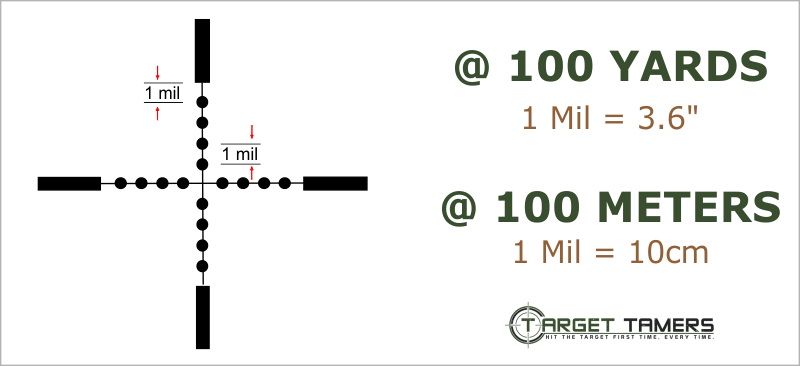
1 Milliradian (Milrad or ‘Mil’) = 1/1000th of a radian | 1 Milliradian = 0.0573 degrees.
In this NSSF Video, Ryan Cleckner, a former Sniper Instructor for the 1st Ranger Battalion, defines the term “MilliRadian” (Milrad) and explains how you can use a mildot-type scope to range the distance to your target. It’s pretty simple, once you understand the angular subtension for the reticle stadia dots/lines. Cleckner also explains how you can use the milrad-based reticle markings in your scope for elevation hold-overs and windage hold-offs.
Even if you normally shoot at known distances, the hold-off capability of milrad-reticle scopes can help you shoot more accurately in rapidly-changing wind conditions. And, when you must engage multiple targets quickly, you can use the reticle’s mil markings to move quickly from one target distance to another without having to spin your elevation turrets up and down.
WEB RESOURCES: If you want to learn more about using Milliradians and Mildot scopes, we suggest the excellent Mil-dot Explained article from targettamers.com Guide. This covers the basics you need to know, with clear illustrations.
Also informative is The Truth about Mil Dots by Michael Haugen. Mr. Haugen begins with basic definitions: 360 degrees = 2 x Pi (symbol π) Radians. That means 1 Radian is about 57.3 degrees. 1 Milliradian (Milrad or ‘Mil’) = 1/1000th of a radian. Thus 1 Milliradian = .0573 degrees.
In Service Rifle competition in the United States, scopes are currently limited to a maximum magnification of 4.5 power (4.5X). Both the NRA and CMP rulebooks stipulate that variable and fixed scopes cannot exceed this power, and the objective lens diameter must not exceed 34mm.
Service Rifle Scope Configuration Rules
Maximum Magnification: 4.5x power is the max magnification allowed for Service Rifles.
Variable Power Limit: If using a variable scope, it can have any magnification range as long as it cannot be dialed higher than 4.5X.
Lens Size: 34mm is the maximum allowed objective lens diameter.
Sight Consistency: The same optical sight must be used for all stages of a course of fire. Changing optics between slow-fire and rapid-fire strings is prohibited.
Mount Height: The scope centerline must be no higher than 3.5 inches above the barrel bore centerline.
Popular Service Rifle Optics
Because of the 4.5X power limit and 34mm max objective size, Service Rifle competitors typically run purpose-built AR-optimized service rifle optics or tactical low-power variable optics (LPVOs). The most popular service rifle optics include:
Sightron S-TAC 1-4.5X24mm SR-1/AR-1 Scope
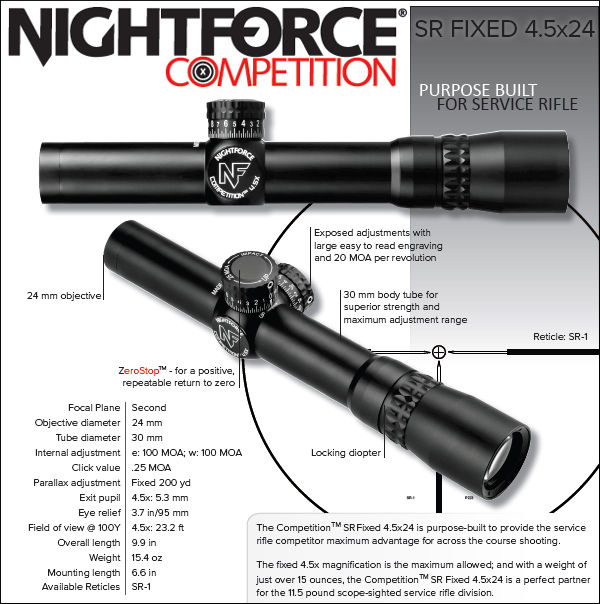
Nightforce Competition SR Fixed 4.5x24mm
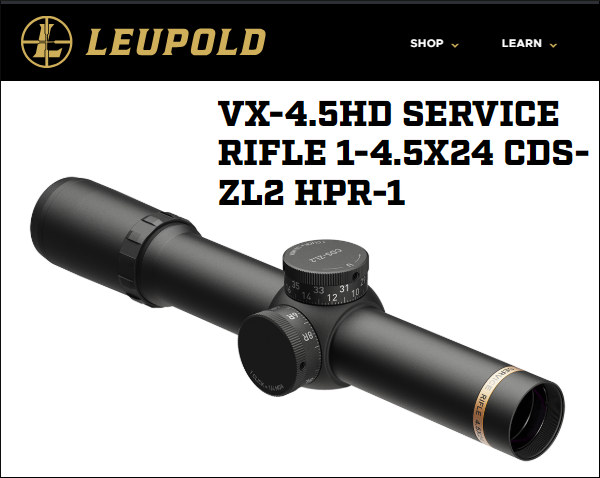
Leupold VX-4.5HD Service Rifle 1-4.5x24mm CDS-ZL2 HPR-1
This photo is one of Nightforce’s series of picturesque “Gunscapes”. SEE MORE HERE.
We should remember the real reasons many of us enjoy the shooting hobby. Many of us like shooting because it gets us outdoors, away from work pressures. Shooting gives us a chance both to enjoy solitude as well as have fun with friends and family in the outdoors. For this Editor, a solo trip to the range in mid-week was often the perfect antidote to job stress. Going to a scenic venue and sending a few shots downrange was satisfying. And getting out of the hustle and bustle of the city did indeed calm the soul.
Talented 3-position shooter (and trick-shot artist) Kirsten Joy Weiss says that any day at the range is “always a good day”. Here is her photo to prove it. If that shot doesn’t motivate you to spend a day outdoor with rifles, we’re not sure what will. Here’s hoping you’ll have a chance to get in many fun days of shooting and/or hunting this summer and fall. That can be with air rifles, rimfire guns, or centerfire guns — they are all fun to shoot.
What is Parallax?
Parallax is the apparent movement of the scope’s reticle (cross-hairs) in relation to the target as the shooter moves his eye across the exit pupil of the riflescope. This is caused by the target and the reticle being located in different focal planes.
Here’s a good explanation of scope parallax. This video has been watched over 790,000 times.
Why is it Important?
The greater the distance to the target and magnification of the optic, the greater the parallax error becomes. Especially at longer distances, significant sighting error can result if parallax is not removed.
How to Remove Parallax
This Nightforce Tech Tip video quickly shows how to remove parallax on your riflescope.
While keeping the rifle still and looking through the riflescope, a slight nod of the head up and down will quickly determine if parallax is present. To remove parallax, start with the adjustment mechanism on infinity and rotate until the reticle remains stationary in relation to the target regardless of head movement. If parallax has been eliminated, the reticle will remain stationary in relation to the target regardless of eye placement behind the optic.
What is Parallax?
Parallax is the apparent movement of the scope’s reticle (cross-hairs) in relation to the target as the shooter moves his eye across the exit pupil of the riflescope. This is caused by the target and the reticle being located in different focal planes.
Here’s a good explaination of scope parallax. This video has been watched over 790,000 times.
Why is it Important?
The greater the distance to the target and magnification of the optic, the greater the parallax error becomes. Especially at longer distances, significant sighting error can result if parallax is not removed.
How to Remove Parallax
This Nightforce Tech Tip video quickly shows how to remove parallax on your riflescope.
While keeping the rifle still and looking through the riflescope, a slight nod of the head up and down will quickly determine if parallax is present. To remove parallax, start with the adjustment mechanism on infinity and rotate until the reticle remains stationary in relation to the target regardless of head movement. If parallax has been eliminated, the reticle will remain stationary in relation to the target regardless of eye placement behind the optic.
What is Parallax?
Parallax is the apparent movement of the scope’s reticle (cross-hairs) in relation to the target as the shooter moves his eye across the exit pupil of the riflescope. This is caused by the target and the reticle being located in different focal planes.
Here’s a good explanation of scope parallax. This video has been watched over 790,000 times.
Why is it Important?
The greater the distance to the target and magnification of the optic, the greater the parallax error becomes. Especially at longer distances, significant sighting error can result if parallax is not removed.
How to Remove Parallax
This Nightforce Tech Tip video quickly shows how to remove parallax on your riflescope.
While keeping the rifle still and looking through the riflescope, a slight nod of the head up and down will quickly determine if parallax is present. To remove parallax, start with the adjustment mechanism on infinity and rotate until the reticle remains stationary in relation to the target regardless of head movement. If parallax has been eliminated, the reticle will remain stationary in relation to the target regardless of eye placement behind the optic.
This photo is one of Nightforce’s series of picturesque “Gunscapes”. SEE MORE HERE.
We should remember the real reasons many of us enjoy the shooting hobby. Many of us like shooting because it gets us outdoors, away from work pressures. Shooting gives us a chance both to enjoy solitude as well as have fun with friends and family in the outdoors. For this Editor, a solo trip to the range in mid-week was often the perfect antidote to job stress. Going to a scenic venue and sending a few shots downrange was satisfying. And getting out of the hustle and bustle of the city did indeed calm the soul.
Talented 3-position shooter (and trick-shot artist) Kirsten Joy Weiss says that any day at the range is “always a good day”. Here is her photo to prove it. If that shot doesn’t motivate you to spend a day outdoor with rifles, we’re not sure what will. Here’s hoping you’ll have a chance to get in many fun days of shooting this summer and fall. This Editor hopes to test some rimfire ammo this weekend…
This photo is one of Nightforce’s series of picturesque “Gunscapes”. SEE MORE HERE.
August is National Shooting Sports Month. So be sure to get to the range sometime soon, preferrably outdoors.
We should remember the real reasons many of us enjoy the shooting hobby. Many of us like shooting because it gets us outdoors, away from work pressures. Shooting gives us a chance both to enjoy solitude as well as have fun with friends and family in the outdoors. For this Editor, a solo trip to the range in mid-week was often the perfect antidote to job stress. Going to a scenic venue and sending a few shots downrange was satisfying. And getting out of the hustle and bustle of the city did indeed calm the soul.
Talented 3-position shooter (and trick-shot artist) Kirsten Joy Weiss says that any day at the range is “always a good day”. Here is her photo to prove it. If that shot doesn’t motivate you to spend a day outdoor with rifles, we’re not sure what will. Here’s hoping you’ll have a chance to get in many fun days of shooting and/or hunting this summer and fall. That can be with air rifles, rimfire guns, or centerfire guns — they are all fun to shoot.
What is Parallax?
Parallax is the apparent movement of the scope’s reticle (cross-hairs) in relation to the target as the shooter moves his eye across the exit pupil of the riflescope. This is caused by the target and the reticle being located in different focal planes.
Why is it Important?
The greater the distance to the target and magnification of the optic, the greater the parallax error becomes. Especially at longer distances, significant sighting error can result if parallax is not removed.
How to Remove Parallax
This Nightforce Tech Tip video quickly shows how to remove parallax on your riflescope.
While keeping the rifle still and looking through the riflescope, a slight nod of the head up and down will quickly determine if parallax is present. To remove parallax, start with the adjustment mechanism on infinity and rotate until the reticle remains stationary in relation to the target regardless of head movement. If parallax has been eliminated, the reticle will remain stationary in relation to the target regardless of eye placement behind the optic.
What is Parallax?
Parallax is the apparent movement of the scope’s reticle (cross-hairs) in relation to the target as the shooter moves his eye across the exit pupil of the riflescope. This is caused by the target and the reticle being located in different focal planes.
Why is it Important?
The greater the distance to the target and magnification of the optic, the greater the parallax error becomes. Especially at longer distances, significant sighting error can result if parallax is not removed.
How to Remove Parallax
This Nightforce Tech Tip video quickly shows how to remove parallax on your riflescope.
While keeping the rifle still and looking through the riflescope, a slight nod of the head up and down will quickly determine if parallax is present. To remove parallax, start with the adjustment mechanism on infinity and rotate until the reticle remains stationary in relation to the target regardless of head movement. If parallax has been eliminated, the reticle will remain stationary in relation to the target regardless of eye placement behind the optic.


 In this NSSF Video, Ryan Cleckner, a former Sniper Instructor for the 1st Ranger Battalion, defines the term “MilliRadian” (Milrad) and explains how you can use a mildot-type scope to range the distance to your target. It’s pretty simple, once you understand the angular subtension for the reticle stadia dots/lines. Cleckner also explains how you can use the milrad-based reticle markings in your scope for elevation hold-overs and windage hold-offs.