|
|
October 22nd, 2020

 Are sound suppressors useful in competition shooting? In some disciplines, and in venues where sound “moderators” are permitted, the answer is “yes”. Some years ago Shooting Sports USA (SSUSA), published an interesting article about the use of sound suppressors (aka “cans”). The article explores the use of suppressors in Europe and in tactical matches in North America. You’ll also find an explanation of the rules and regulations governing suppressor ownership and use in the United States. Are sound suppressors useful in competition shooting? In some disciplines, and in venues where sound “moderators” are permitted, the answer is “yes”. Some years ago Shooting Sports USA (SSUSA), published an interesting article about the use of sound suppressors (aka “cans”). The article explores the use of suppressors in Europe and in tactical matches in North America. You’ll also find an explanation of the rules and regulations governing suppressor ownership and use in the United States.
Former SSUSA Editor Chip Lohman tested three rifles from the bench and found that suppressors did not harm accuracy (at least with these rigs). In fact, all three test rifles (.223 Rem, .308 Win, and .338 Lapua Magnum), shot slightly better 5-shot groups at 200 yards with a suppressor than without. However, the suppressors did alter point of impact. Interestingly, velocity standard deviation (SD) values were lower with suppressors in place for all three test rifles. This observation calls for further study.*
CLICK HERE to Read Suppressor Article in Shooting Sports USA.

So the use of suppressors in competition could be a good thing. However, in the United States, current NRA High Power rules prohibit the use of sound suppressors. NRA Rule 3.16.1 subsection (a) states: “Sound Suppressors are not authorized for use in High Power competition.” In addition, there are some practical problems with suppressors — the heat rising off of a naked suppressor can create mirage problems (that’s why some shooters wrap their cans with a cover).
Despite such issues, it is now common to see moderators on rifles used in non-NRA-sanctioned tactical matches such as the Precision Rifle Series. For example, many competitors in the popular Steel Safari field challenge match use suppressors. The photo below shows our friend Zak Smith competing in the Steel Safari with his suppressed Accuracy International rifle.

Commentary — What Can We Conclude?
Obviously, this three-rifle SSUSA test was not definitive. One well might observe different results with different types of suppressors, fitted to different kinds of rifles. Mounting a suppressor to any barrel will certainly affect harmonics and “tune”. But this SSUSA study does suggest that tactical shooters, who are allowed to use suppressors in competition, may find that the benefits of suppressors (significantly reduced recoil and less noise) outweigh any meaningful accuracy loss, at least in PRS-type matches.
*The article cautions that one should not extrapolate too much from the SD numbers, given the low number of test shots. Chronograph-maker Ken Oehler, when asked to comment on the SD values stated: “[You should] report the observed SDs, but draw no conclusions until… you can do more testing with larger sample sizes.”
April 17th, 2015
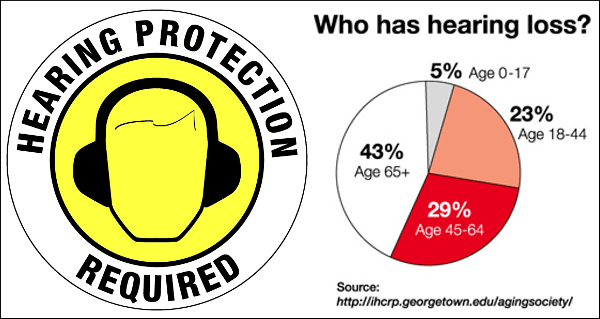
Hearing loss can be progressive and irreversible. If you are a shooter, this is serious business. You need to use effective hearing protection every time you go to the range. Even if you are away from the firing line, gunshot noises can damage your hearing. Good foam earplugs costs mere pennies but they can prevent deafness in your later years. Many folks also wear muffs over plugs. Some other shooters prefer the custom-molded ear plugs. Electronic muffs can be useful when you are away from the firing line because they allow you to converse.
Here are some comments from Forum members on the subjects of hearing loss and the need for proper ear protection. You can join the discussion in this FORUM THREAD:
“If you are young and don’t want to end up with profound hearing loss like I have… ALWAYS ALWAYS ALWAYS use hearing protection. This is from a guy who is social security/medicare eligible, has two Re-Sound aids at a not so cheap $2000.00 EACH… and now has religion! When I was young [we] never wore ear gear and laughed at the ringing after 100 rounds of 12 gauge at the skeet range. Now we live with the consequences. Be smarter than I was!” — Gary0529
“Take it from a 70-year-old that has been shooting 49 years. I now have a Re-Sound hearing aid in the left ear and a Cochlear Implant in my right. I still cannot hear. Custom molded plugs are best. Some are sold at gun shows and some are made by the folks that make hearing aids. They are cheap as compared to this $200,000 implant. DO IT NOW for everyone around guns.” — Richard King, King’s Armory
“Say WHAT? You have to type a little louder! I used to shoot without any muffs, when I was ‘young and indestructible’, and now I have about 40% loss. When I take youngsters and friends shooting, they get muffs and plugs. I’m not allowed suppressors where I live. I would use them if I could.” — Josh B.
“For what it’s worth, I wear both ear plugs and muffs that have NO sound adjustment capability. As a youngster (15) I wore no ear protection either in shooting or motorcycle riding. I kept doing that until entering military service at age 18 where we had to wear ear plugs at the range. Started wearing ear plugs after that, except when motorcycle riding. At around age 53 my hearing started going south as a result of my own stupidity as a youngster and now some 15 years later I only have about 45% of my hearing left. So beware all — there is a price to pay if you don’t protect your hearing.” — Shynloco

“Here are several points to consider:
1. The NRR (noise reduction rating) is determined by “experimenter” fit, not user fit, and trained listeners during the testing period. This results in inflated protection numbers compared to real-world protection.
2. Any disruptions in the protector/skin seal will greatly reduce the effectiveness. Think eye glass temple bars, lots of hair, ear wax, etc. A 5% leak results in a 50% reduction in effectiveness.
3. Double protection gives only 5-10 dB extra protection.
4. Bone conduction gives about 50 dB protection so hearing protectors are the weak link[.]
5. Keep the protectors in/on your ears. Over 8 hours, if you remove them for only 30 minutes (cumulative), the effective protection is cut in half.
So, if you are using a really good muff with NRR of 33 and a foam plug with NRR of 27, the real-world NRR would be about 35 dB, at best. This would attenuate a gunshot by that amount. The key is time versus exposure. Limit the exposure and you limit the dose.” — DelS
“Personally, I use Etymotic Research GSB-15 electronic blast protectors. They are rated at 26-28 dB, but inserted correctly, with the correct fitting tip, approach 38 dB. And, they have a compressor amplifier that allows you to hear soft sounds normally and with very high fidelity. As the sound level goes up, the gain goes down till at an ambient sound pressure level of around 90 dB SPL, the gain is unity, or what comes in goes to the ear canal. However, once the sound level gets to 117dB SPL, the amplifier cannot go higher. So, if you are firing a large rifle with an impulse noise of around 160 dB SPL, your ear only hears 117 dB SPL of that for an effective attenuation of about 40 dB. RIGHT! about the same as the mastoid bone! Can’t get any better than that.
What gives me the right to say all these things? First, a BSEE as well as the graduate course in Audiology and a hearing aid dispensers license. And working in research and product development for the ear the last decade of my career.” — Norm Matzen
September 5th, 2013
Approximately 27,000 suppressors, also called “silencers” or “sound moderators”, are sold in the United States every year. That may surprise you because the main-stream media often incorrectly report that suppressors are illegal. In fact, suppressors are legal to own in 39 states, provided that the devices are acquired in compliance with federal and state laws (which are explained below). In most of those 39 states, owners of legally-acquired suppressors may use their “cans” for hunting. The American Silencer Institute (ASA) has created a graphic showing where suppressors are legal to own, and where they may be used for hunting. Take a look:


SILENCER LEGALITY AND OWNERSHIP
Silencers are regulated under the National Firearms Act (NFA) of 1934, under the oversight of the Bureau of Alcohol, Tobacco, Firearms and Explosives (BATFE). To legally purchase/possess a silencer you must:
- Be at least 21 years of age to purchase a silencer from a dealer.
- Be at least 18 years of age to purchase a silencer from an individual on a Form 4 to Form 4 transfer (contingent on state laws).
- Be at least 18 years of age to possess a silencer as a beneficiary of a trust or as a member of a corporation (contingent on state laws).
- Be a resident of the United States.
- Be legally eligible to purchase a firearm.
- Pass a BATFE background check with a typical process time of 60-120 days.
- Pay a one-time $200 Transfer Tax.
- Reside in one of the 39 states that currently allows civilian ownership of silencers.
NOTE: In addition to these basic Federal rules regarding silencers, particular states may have additional registration requirements or other regulations. Check with a knowledgeable firearms attorney in your jurisdiction before beginning the process of buying a suppressor.
BENEFITS OF SILENCERS
NOISE REDUCTION
According to OSHA, the threshold for a hearing safe impulse noise is 140 dB. Without hearing protection, exposure to any impulse noise over 140dB causes varying degrees of permanent noise induced hearing loss, which can also lead to tinnitus. Most well-engineered silencers take the dB level of their host firearm well below 140 dB, making those silencers effective primary hearing safety devices. You should always still wear hearing protection (muffs or plugs) when using suppressors.
RECOIL REDUCTION
By containing the explosion at the muzzle, suppressors significantly reduce perceived recoil energy, reduce the rifle’s rearward movement on recoil, and reduce rifle torquing and muzzle flip. The reduction of recoil (and rifle torquing/hopping) lessens shooter fatigue and helps the shooter get his sight picture back on target rapidly after firing. With smaller calibers, a suppressor may enable the shooter to maintain a nearly-continuous sight picture, following the shot into the target. In addition, by reducing felt recoil (and muzzle blast), a suppressor can help inexperienced shooters avoid flinching.
Map Graphic by American Silencer Association.
|


