Here’s a handy product for pistol shooters and 3-Gun competitors. The NRA Handgunner Backpack provides a convenient transport solution for your pistols, magazines, and assorted range gear. This product offers all the carrying capacity of a large range bag, in a design that, when worn on your back, leaves your hands free to haul long-gun cases, target frames, spotting scopes, or other bulky hardware. Measuring 17″ wide, 22″ high and 9″ deep, the pack has plenty of room for your gear.
Quad-Pistol Gear Hauler
The cleverly-designed Handgunner Backpack carries up to four pistols. Undo the zipper, slide out the compartment, place your pistols in one of the four foam gun cradles. Store your magazines in a zip-up side pocket with six (6) individual mag sleeves. There are also specially designed compartments for ammo boxes, muffs, protective eyewear, target stapler, and more. You’ll find handy embroidered patches showing the right spot for each gear item.
Lars Dalseide, editor of the NRAblog, tells us this pack is comfortable and sturdy. The shoulder straps and the rear back panel feature moisture-wicking padding and the pack comes with a waterproof cover. And the pack won’t collapse when you set it on a bench — it stands up on its own.
We’re impressed with the design and features of this pack. A lot of smart thinking went into its design. As you might expect though, because the Handgunner Backpack has so many features, it’s not cheap. This specialized backpack sells for $119.95 at the the NRA Online Store. We don’t think that’s too much, considering what this pack can do. This could be a sweet Xmas gift for the pistolero or 3-Gun shooter in the family. If you are running a shooting match, the Handgunner Backpack would make a great prize — way more useful than a walnut plaque.
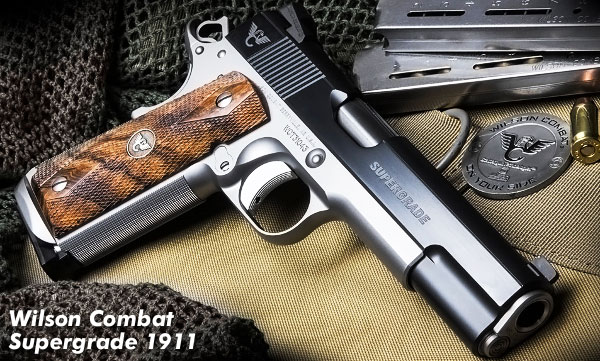
While AccurateShooter.com focuses on rifles, we know that a large percentage of our readers own handguns, with 1911-style pistols being particular favorites. For you 1911 owners, here are four short videos from Brownells showing how to fieldstrip, clean, lubricate, and re-assemble a 1911-style pistol.
FBI Photo shows a Glock Model 22, .40 S&W caliber. This will be replaced by new, striker-fired 9mm Luger pistols in both compact and full-size formats.
The Federal Government loves to spend your tax dollars, and the FBI wants its share of the action. The Federal Bureau of Investigation recently issued a Request for Proposal (RFP) for the next generation of 9mm FBI pistols. At stake is $85,000,000 in Federal dollars for handguns, parts, and accessories. CLICK HERE to Download FBI RFP.
The FBI is actually seeking two 9x19mm pistols, one “Compact” and the other “Full-Size”. The pistols must be striker-fired, and capable of a “20,000 round endurance firing cycle”. Trigger pull weight shall be “no less than 4.5 pounds nor exceed 6 pounds”, with NO mag disconnect/safety. There will also be no manual external safety, no grip safety, and no de-cocking lever. Here are the RFP basic descriptions of the pistols:
Class I Compact Pistol: One (1) Class I Pistol with a barrel length of no less than 3.75” and no greater than 4.25”, minimum magazine capacity of 14 rounds, night sights, six (6) magazines, FBI approved gun lock. Firing pin/Striker fired only.
Class II Full Size Pistol: One (1) Class II Pistol with a barrel length of no less than 4.26” and no greater than 5.20”, minimum magazine capacity of 16 rounds, night sights, six (6) magazines, FBI approved gun lock. Firing pin/Striker fired only.
Why Change from .40 SW back to 9x19mm?
Last time we checked the FBI had more than enough firepower. The FBI’s stated need for $85 million dollars worth of 9mm pistols* certainly raises questions, while re-igniting the “great caliber debate”. In May 1997, the FBI officially adopted the Glock .40 S&W pistol for general agent use. Now it is going back to the 9mm Luger (aka 9x19mm), which it had used in Sig P226/228 pistols from 1988 to 1997.
Why make the change? Some people think advancements in propellants and 9mm bullets allow the smaller cartridge to rival the .40 SW for penetration and stopping power. Possibly the FBI learned that many of its agents couldn’t shoot the snappy, harder-recoiling .40 SW very well. So this change to a more user-friendly round may be all about compensating for lawmen who can’t shoot straight.
A report originating at the FBI Training Academy in Quantico, VA may explain why the FBI wants to dump the .40 SW in favor of the 9mm. Here are highlights from the Report’s Executive Summary:
LEOs miss between 70 – 80 percent of the shots fired during a shooting incident.
9mm Luger now offers select projectiles which are, under identical testing conditions, outperforming most of the premium line .40 S&W and .45 Auto projectiles tested by the FBI.
9mm Luger offers higher magazine capacities, less recoil, lower cost (both in ammunition and wear on the weapons) and higher functional reliability rates (in FBI weapons).
The majority of FBI shooters are both FASTER in shot strings fired and more ACCURATE with shooting a 9mm Luger vs shooting a .40 S&W (in similar sized weapons).
There is little to no noticeable difference in the wound tracks between premium line law Auto enforcement projectiles from 9mm Luger through the .45 Auto.
Source: FBI Training Division, FBI Academy (Quantico, VA) Report quoted in LooseRounds.com.
* In addition to the Compact and Full-Size duty pistols, the FBI plans to acquire training pistols and spare parts: “Class I Inert Training Pistol (a.k.a. Red Handle); Class I Man Marker Training Pistol (a.k.a. SIMUNITION); Class I & Class II Pistol Replacement Parts”. The $85,000,000 contract price would include these additional items.
This photo shows some of the handguns actually found by the TSA in carry-ons last year.
Here’s an important reminder to our readers who have concealed-weapon carry permits — don’t overlook your carry gun when traveling through airports. Many travelers with carry permits are forgetting weapons stashed in carry-on luggage. The TSA is encountering more firearms than ever, and those weapons are normally confiscated with their owners subject to penalties.
In 2014, according to TSA.gov, 2,212 firearms were discovered in carry-on bags at checkpoints across the country (that’s a 22% increase over 2013). Of those, 1,835 (83 percent) were loaded. Firearms were intercepted at a total of 224 airports.
Another problem is that Carry Permit holders may enter an airport with their guns still on their person. Here are actual examples:
A 94-year-old man attempted to enter the checkpoint at LaGuardia Airport with a loaded .38 caliber revolver clipped to his belt.
A loaded .380 caliber firearm was discovered strapped to the ankle of a passenger who walked through a metal detector at Cincinnati/Northern Kentucky International Airport.
A loaded .380 caliber firearm was discovered in the rear pocket of a San Antonio International Airport passenger during advanced imaging technology screening.
If you are traveling by air, make sure you remove all firearms from your person (or carry-on luggage), unload the firearm(s), place any weapon in a locked, hard-sided container, and declare them as checked baggage. Anything else can land you in jail.
Here are the TSA guidelines for transporting firearms as checked baggage:
Comply with regulations on carrying firearms where you are traveling from and to, as laws vary by local, state and international governments.
Declare all firearms, ammunition and parts to the airline during the check-in process. Ask about limitations or fees that may apply.
Firearms must be unloaded and locked in a hard-sided container and transported as checked baggage only. Firearm parts, including firearms frames and receivers, must also be placed in checked baggage and are prohibited in carry-on baggage.
Replica firearms may be transported in checked baggage only.
Rifle scopes are permitted in carry-on and checked bags.
All firearms, ammunition and firearm parts, including firearm frames, receivers, clips and magazines are prohibited in carry-on baggage.
It’s official… the U.S. Army is replacing the M9 Pistol made by Beretta. On August 28, 2015, the Army released the official solicitation for the XM17 MHS Pistol, a modular design that will replace the M9, the Army’s version of Beretta’s model 92. This is a big contract — the Army intends to acquire at least 300,000 pistols, all from one manufacturer.
According to Military.com: “One of the major goals of the MHS [Modular Handgun System] effort is to adopt a pistol chambered for a more potent round than the current 9mm[.] The U.S. military replaced the .45 caliber 1911 pistol with the M9 in 1985 and began using the 9mm NATO round at that time.” It is unclear what chambering the U.S. Army wants instead of the 9x19mm. Some pundits suggest the Army wants a larger-diameter bullet, while others think the Army is looking for a higher velocity projectile that can penetrate body armor. While the Army has not specified a particular cartridge, the XM17 spec requires that the pistol’s projectile penetrate at least 14″ of ballistics gel at 50 meters. The Army also hopes that the new pistol will be more durable and easier to maintain than the M9.
This XM17 solicitation document, a whopping 351 pages long, contains detailed specs for the pistol, accessories, along with performance standards. Guns.com says the specification includes accuracy standards as well as modular design requirements: “The Army said the handgun should be able to hit a 4-inch target at a 50-meter range at least 90 percent of the time throughout the gun’s lifespan. To compete in the Modular Handgun System, and the XM17 designation, the pistol needs modifiable grips, varied magazine options, ambidextrous controls, and rails for accessories.”
Story based on report by Kyle Jillson forNRABlog.com.
Doug Koenig secured his 16th NRA Action Pistol title this week at the 2015 NRA Bianchi Cup in Columbia, Missouri. Koenig’s final score was a perfect 1920 with 180 tie-breaking Xs. Koenig needed all those Xs to win — runner-up Jeremy Newell (1920-166X) also racked up a perfect 1920 score, but with 14 fewer Xs. Carl Bernosky, a ten-time NRA High Power Rifle Champion, placed third overall with 1918-180X. Australian shooter Anita Mackiewicz set a new record for a female shooter with a 1916-166X.
Koenig’s success at the Bianchi Cup is unparalleled. Doug’s 16 titles account for nearly half of the 37 total Bianchi championships held. Bruce Piatt has the next best career Bianchi Cup record, with five Bianchi titles, less than one-third of Koenig’s total.
Remington has introduced the brand new RM380, an ultra-small DAO .380 ACP carry pistol. This alloy-framed gun weighs just 12.2 ounces (unloaded), and is very compact, measuring 5.25 inches long. Capacity with flush-base magazine is 6+1, and Remington plans to offer a 7-round magazine with a pinky extension. Because it is hammer-fired, the RM380 has second-strike capability. There is no manual safety.
The RM380 is different that many small .380 ACP pistols in using a locking breech rather than a straight blow-back action. Remington claims this reduces perceived recoil. At a media preview hosted at the Arizona Gunsite Academy, pre-production models were tested. Those examples proved reliable, running extended strings (100+ rounds) without failure. However, testers commented on the long, very heavy, 7.9-pound trigger pull.
This video will give you chills (starting at about the 0:25 mark). We need to remember to follow all the firearms safety rules, and apply them all the time. At the range, all it takes is one brief moment of inattention to create a life-threatening situation. Never assume the downrange area is safe. Use your own eyes and ears.
This video shows a competitor shooting a stage at an action pistol match. He starts when instructed by the Range Safety Officer (RSO). But unbeknownst to both RS0 and competitor, a volunteer is downrange working on targets. Watch carefully. At 0:27 the shooter sweeps left to right, engaging a paper silhouette target to his right. Then, at 0:30, as he begins a mag change, his head turns downrange. A few yards away is a white-shirted range worker! The shooter yells “Hey what’s going on?!”
What’s going on indeed… The RSO should have ensured that nobody was downrange before the shooter even stepped up to the firing line. If other competitors standing to the side had been alert, they might have seen the worker changing targets and called for a halt. And the target-worker himself — even if he was wearing earmuffs, he should have noticed that live fire had commenced just yards away…
We also have to wonder about the stage design. This set-up made it very difficult to see downrange. The white panels (see 0:10-0:20) definitely hid the target worker from view. In hindsight, given the way the stage was laid out, this was truly an “accident waiting to happen”. It’s fortunate that no one got injured in this incident. But this chilling video provides a lesson to all shooters — “Safety First”.
How could this “near-fatality” have been averted? Post your comments below.
Got a 1911-style centerfire pistol? Would you like to cross-train with an ergonomically-identical rimfire version that lets you shoot less-expensive .22 LR ammo and not worry about recovering your brass? Well check out Kimber’s Rimfire 1911s. We think John Moses Browning would smile at this adaptation of his classic 1911 design.
Guaranteed Accuracy
Kimber’s line-up of rimfire pistols includes matte black and silver-tone Rimfire Target models ($871 MSRP), plus a deluxe, two-tone Rimfire Super model ($1220 MSRP) with Rosewood grips, front strap checkering, and KimPro II finish. Shown above, the Rimfire Super model is guaranteed to put five shots in 1.5″ or less at 25 yards. Both standard and deluxe models feature aluminum frame and slide, steel barrel, and adjustable match-type sights.
What’s That Pistol?
While viewing Panteo’s Training with a 22 DVD, we noticed a sweet-looking, silver-tone m1911-style rimfire pistol in the hands of host Michael Bane. At first, we thought this might be a new stainless version of Sig Sauer’s popular 1911-22. But, in actuality, Bane was shooting a Kimber Rimfire Target pistol. Michael’s aluminum-framed Kimber performed great in rapid-fire drills. See one in action below.
Watch Slow-Motion Video of Kimber Rimfire Target (Black Version)
Hoping to impress consumers (and possibly secure a major military contract or two), Beretta has introduced the APX, a new striker-fired 9mm handgun. The APX borrows elements from the Glock, HK VP9, and S&W M&P pistols. The grip looks very ergonomic, with an extended rear overhang on the top (like the M&P) and contoured grooves on the front (like the VP9). The most distinctive feature of the new Beretta would be the prominent machined ridges on the slide designed to aid in racking the pistol.
The APX is built with a chassis system. This means that the internal sub-frame is the serialized part. The new APX features a reversible, ambidextrous magazine release. The magazines themselves have a prominent plate on the bottom for easier insertion/extraction. To better fit various hand sizes, three different backstrap inserts can be fitted to the grip.
Beretta hopes many of the world’s armies will adopt this new pistol, which was released at IDEX (International Defense Exhibition & Conference) in late February. According to Gear Scout:
“The pistol is designed specifically for the military market, and Beretta says it’s destined to become the company’s entry into the Army’s Modular Handgun System. But, the Army has yet to release the final requirements for that program to industry. The US Army contract might be the gold rush of pistol contracts, but it’s not the only tender happening at the moment. No doubt, getting the APX out at IDEX was a way to show worldwide (and cash-flush Middle East) defense ministers the major features of the pistol while the company finishes up development on the US military/LE and eventual commercial configurations that will hit the US market soon.”


 Quad-Pistol Gear Hauler
 FBI Photo shows a Glock Model 22, .40 S&W caliber. This will be replaced by new, striker-fired 9mm Luger pistols in both compact and full-size formats.


 Guaranteed Accuracy


