AccurateShooter’s Target Page provides over 50 FREE downloadable targets. You’ll find all types of targets — sight-in targets, varmint targets, rimfire targets, bullseye targets, tactical targets, load development targets and more. CLICK HERE for all our free targets, including our popular LOAD DEV target.
On this load development target, all your load data fits neatly in the boxes under each target. The diamonds have 1/2″ sides and you can align your cross-hairs on the horizontal and vertical lines. When we test, we crank in a little elevation, setting the point-of-impact higher. That way our shots fall in the gray circles, leaving the red diamonds intact for precise aiming.
Storm Tactical Targets — Hundreds of FREE, Printable Targets
If you want an even greater selection of targets, specialized for PRS and NRL shooters, Storm Tactical offers a vast collection of tactical targets, available in three different versions: MOA, MIL Yards, and MIL Meters. These target sets were created with input from Sniper’s Hide. Storm Tactical also created a great rimfire target set. This includes side-by-side target blocks for fun, one-on-one competition. If you shoot NRL22 or just enjoy shooting with a buddy, we highly recommend the rimfire target set.
Overall there are 299 Storm Tactical Targets in four sets.
CLICK links to launch each Storm Tactical target collection. Then you can click the download icon to save to your hard drive. OR, you can scroll up and down to select the target(s) you like which you can tell your printer to print. We do recommend downloading the complete archives. File sizes are listed.
Here’s a Tikka T3 in Third Eye Tactical cerakoted chassis.
Rimfire Twin Target, for One-on-One Shooter Challenges
You’ll find this fun target on the third page of the Rimfire Target Pack. Just download the PDF file and instruct your printer to deliver page three. Or print out all six (6) rimfire targets if you like.
In this video, former Army Ranger sniper team leader Ryan Cleckner explains how proper head and scope position is a critical component to accurate shooting. Ryan finds that some shooters place the scope too far forward or too far rearward. If the scope is too far back you may have issues with eye relief and stock reach to shoulder. If it is too far forward, you may have cheek-weld problems or get neck strain. Cleckner cautions: “When you are in a good prone position, you don’t want any strain in your neck muscles or back.”
In the video, Cleckner offers a simple method to check your scope position:
“To see if your scope is set up properly … close your eyes, lay your head on your gun, get completely comfortable, and only when you are set-up, then open your eyes. If you can’t see clearly through your scope, CHANGE something [such as comb height or scope position]”.
“When you open your eyes, if you see some scope shadow [i.e. the black ring around the edge of the scope picture], figure out which way you need to move your head to get rid of that shadow, and then make adjustments to either your position, the rifle, or the scope.”
“Very often you’ll open your eyes and realize you need to move further back or further forward. Instead of moving your position [or head], move the scope and get it set up properly.”
Tip on Viewing Your Reticle:
Cleckner: “Sometimes it can be difficult to focus between the target and the reticle, even with the parallax adjusted properly. I recommend you focus only on the reticle. Just like the front sight on a rifle or a handgun, that reticle is what you can control, and it’s what matters. Focus on a crisp, clear reticle, in a stable platform, and all that’s left is trigger control.”
Long Range Shooting Handbook — A Good Resource
Cleckner’s Long Range Shooting Handbook covers a wide range of topics important for precision marksmanship — both shooting skills and technical matters. You can view Sample Chapters from Ryan’s Book on Amazon.com. Cleckner’s book is designed as an intro to key concepts such as MOA vs. Mils, External Ballistics, and Environmental Effects. Included are personal tips and advice based on Cleckner’s years of experience as a sniper instructor and special operations sniper.
The Long Range Shooting Handbook is divided into three main categories: What It Is/How It Works, Fundamentals, and How to Use It. “What It Is/How It Works” covers equipment, terminology, and basic principles. “Fundamentals” covers the theory of long range shooting. “How to Use It” gives practical advice on implementing what you’ve learned, so you can progress as a skilled, long range shooter.
Ryan Cleckner was a special operations sniper (1/75 RGR) and he served as a U.S. Army sniper instructor. Currently he works as a firearms industry executive and practicing firearms attorney.
This Sunday GunDay article showcases multiple PRS/NRL tactical-type precision rifles. All these impressive rigs are featured in a long-running thread in our AccurateShooter Forum. In that thread, titled Post Pics of your PRS Match Rifles, you’ll find dozens of current PRS/NRL competition rigs. These feature a wide variety of actions, stocks, optics, muzzle devices, and support bags.
Many guys who posted photos of their PRS/NRL rifles also listed the rifles’ components, optics, triggers, and other accessories. If you are thinking about building a rifle for PRS/NRL competitions, or just for fun field-style shooting and varmint hunting, definitely delve into today’s Sunday GunDay story. You’ll find good suggestions about chambering, barrel contours, and optics choices. In addition, many of the photos feature bipods, tripods, and various support bags. This is a quick way to compare accessory components.
Matt’s Duo at the Range
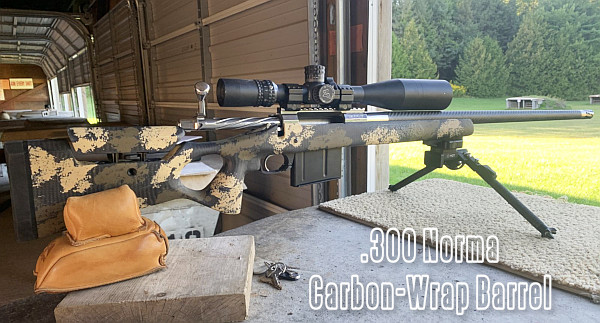
Forum member “Matt_3479″ posted two of his tactical rifles during load development at the range. These two rigs are quite different. The upper rifle features a Defiance Deviant action with TriggerTech special in a Manners T5A Elite stock with Mini Chassis. The barrel is a 27″ Hell’s Canyon 1:9.5″-twist chambered for the .300 Norma. Matt says he is still working on his load tune, but the cartridge is able to drive 215gr bullets at 3150-3200 FPS.
The second rifle (below) boasts a Terminus Zeus action with TriggerTech Diamond trigger. The chassis is a Kinetic Research Group (KRG) Whiskey 3–Gen 6. The barrel is a 26″ K.S. Arms Ltd. 1:7″-twist chambered for the 25 Creedmoor cartridge. Matt says this 25 Creedmoor cartridge will drive 131gr bullets at 2890 FPS.
Wooley’s Wicked Accurate 6mm Creedmoor
This tack-driving 6mm Creedmoor from Forum member “Wooley” shows how accurate that cartridge can be with in a good rifle with a great barrel. This Nightforce-equipped rifle produced a 0.217″ 5-shot group with Hodgdon H4350 powder. Impressive!
Tactical .223 Ackley in Accuracy Int’l Chassis
This handsome tripod-mounted rig belongs to Forum member “Hoser”. This now features a Terminus action with barrel chambered for the .223 Ackley. Hoser is happy with his new 3-lug action: “Very happy with the switch to a 3-lug Terminus action, it feeds like butter. I have about 500-600 rounds on the action and it keeps getting smoother. I finally threw my Bighorn TL2 and 3 in the trash [due to crappy feeding] — a good call. Bighorn used to be such a top-shelf company too.”
MPA Comp Duo — Upgrades in Progress
These two rifles belong to Forum member “GoLong”. While they both feature MPA Comp chassis systems, if you look carefully, you’ll note that each has a different butt pad and grip. Owner Golong tells us he is planning some upgrades: “I am moving the gray chassis to a different action and going with an Accuracy Int’l AI AX chassis. I also ordered up a lateral-adjustable cheek piece and … a thinner butt pad from MPA. I am also moving from the MPA mounts for both of these and replacing them with SPUHR 4002s.”
Tactical Trio — 6.5 Creedmoor, 6mm Creedmoor, .223 Rem
Here are three rifles all belonging to Forum member “300 Whisper”. They are all fitted in Manners stocks. At left is a 6.5 Creedmoor with Defiance action. In the middle is a 6mm Creedmoor with Defiance action. And on the right is a .223 Rem with factory Tikka tactical barreled action. For middle rifle optics, 300 Whisper notes: “I am debating on putting on a DMRII or another SWFA HD on the 6CM.”
6.5 Creedmoor (left) — GAP built Defiance Deviant, Bartlein 24″ med Palma 1:8″-twist barrel, Manners T4A stock (mini chassis), Timney Calvin Elite trigger, metal cerakoted matte brown. Scope: SWFA HD Mil FFP.
6mm Creedmoor (middle) — Alpha Omega build Defiance Tenacity, Bartlein heavy Palma 26″ 1:8″-twist barrel, Manner T2A with Mini Chassis, TriggerTech trigger, Area 419 brake, metal Cerakoted matte black. Scope: Bushnell DMRII with G2 reticle Mil FFP.
.223 Rem — (right) Tikka Tac3 barreled action, varmint contour, 1:8″-twist, Timney trigger, Manners PRS1 stock with Mini Chassis and ARCA rail, Metal Cerakoted matte black, Surefire brake, Atlas bipod. Scope: Bushnell DMR mildot Mil FFP.
Pair of Rifles in Accuracy Int’l Stocks
Here is a nice pair of rifles belonging to Forum member “M16_4_Real”. The top rifle, in an AI AE MKII folding stock, has multiple barrel/chambering options: Gradous 6 Dasher, A-Team Precision 6 Dasher, Accurate Ordinance 6.5×47 Lapua, and Accurate Ordinance 6XC. The optic is a Premier Heritage 5-25x56mm Gen2 XR in Nigtforce UL Ti Rings. There are Area 419 Hellfire brakes on two of the barreld. The owner runs a Samb300 thumbrest plus 3D-printed data card mount. Ammo is held with a MDT 12-rd Dasher mag. The sandbag is a Waxed Canvas OG Game Changer Git Lite.
The lower rifle, in an AI AX chassis with Kelbly Atlas action, also has multiple variants: Kelbly 6 Dasher, Kelbly 6.5×47 Lapua, and PBB 6GT (new GAP cartridge). The Steiner T5Xi 5-25x56mm SCR optic rides in Nightforce UL TI rings. The 6.5 barrel has a PVA Jet Blast brake, while the 6mm barrels can use Area 419 Hellfires.
Other accessories include: MHA ARCA rail, Samb300 thumbrest, Hoptic USA 2-rd Quiver, Yow-Tech data card mount, and RDS E-Dope Card. The bags show are a SAP Lightweight rear bag, plus a Sticky Pint Size Game Changer Git Lite.
Tripod Details — Behind the two rifles is a high-tech Innorel RT90C Carbon Fiber Bowl Tripod equipped with Innorel BH-55 ball head, Bushnell Bino Mount, Kydex Timer Mount, Raush Tripod Hammock, and 6″x9″ clipboard. Gear on the tripod includes: German Precision Optics 10x50HD Binoculars, Kestrel 5700 Sportsman, and Amazon touch screen timer.
Rock Solid Chassis with Defiance Alpha 11 Action
This rig belongs to Forum member “Eric 32″. That chassis may not be familiar to many readers. It is a Rock Solid brand chassis, featuring MST vertical grip. As built by GA Precision, this rifle boasts a Defiance Alpha 11 action from Short Action Customs (SAC) with Huber 2-stage trigger. The barrel is a Bartlein 1:8″-twist chambered for 6XC and fitted with SPR barrel “bugnut” and Area 419 Hellfire brake. The Schmidt & Bender 5-26x56mm P4F scope rides in a Spuhr 4003 mount.
6mm Dasher in Manners TCS Stock
We don’t know much about this cool rifle, except that it is chambered for the ultra-accurate 6mm Dasher and the action sits in a Manners TCS Stock. Maybe the proud owner, Forum member “jsimonh”, can provide some details in the comments. We just like the camo paint scheme, great ergonomics/adjustability, and suppressor with matching camo cover.
Every year the NRA Publications group announces Golden Bullseye winners for various product categories (rifle, handgun, shotgun, optics, gear etc.). These awards are like the Oscars for the shooting industry. There are many Golden Bullseyes given out each year because there are separate awards given by different NRA Magazines — including American Rifleman, Shooting Illustrated, and American Hunter. Here are the 2021 Rifles of the Year (Golden Bullseye Winners) as chosen by each of those three publications.
American Rifleman 2021 Golden Bullseye Award Winner
Rifle of the Year — Benelli LUPO
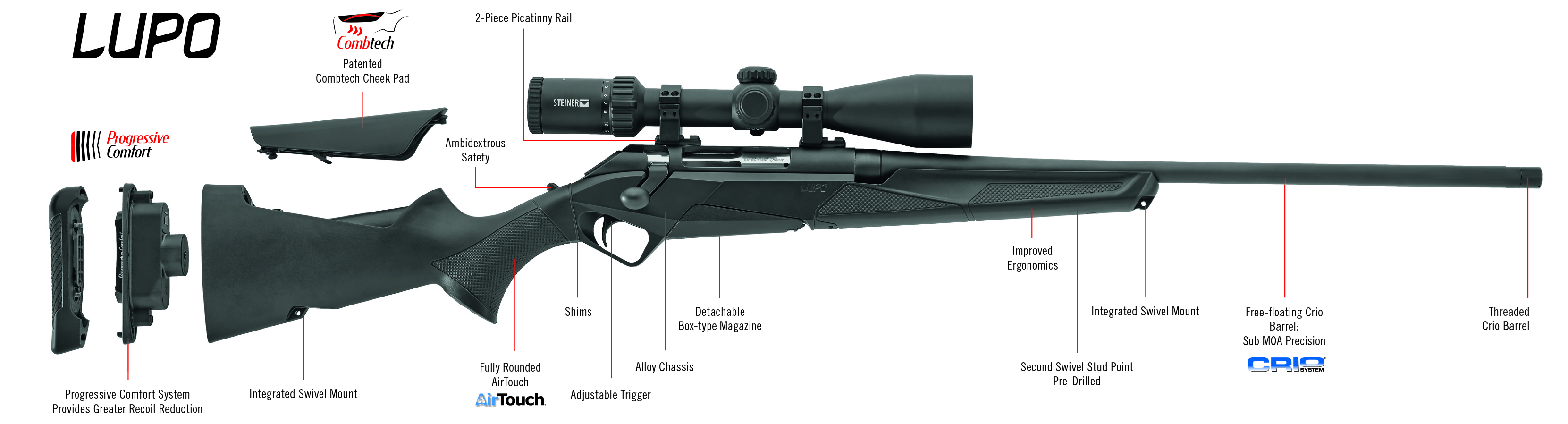
The LUPO is Benelli’s first bolt-action rifle (“Lupo” is Italian for “wolf”). This new chassis-style hunting rifle allows for user fitting/customization out of the box. The LUPO design boasts no less than seven exclusive Benelli patents. It offers a built-in recoil reduction system, adjustable trigger plus grip-to-trigger “reach” customizable via receiver/stock spacers. The Airtouch Grip surfaces allow for a firm, comfortable hold on the rifle. The action comes with rails and an ambi-safety. Fort its innovative LUPO Benellit offers a 3-shot sub-MOA guarantee.
American Hunter 2021 Golden Bullseye Award Winner
Rifle of the Year — Springfield Armory Model 2020 Waypoint
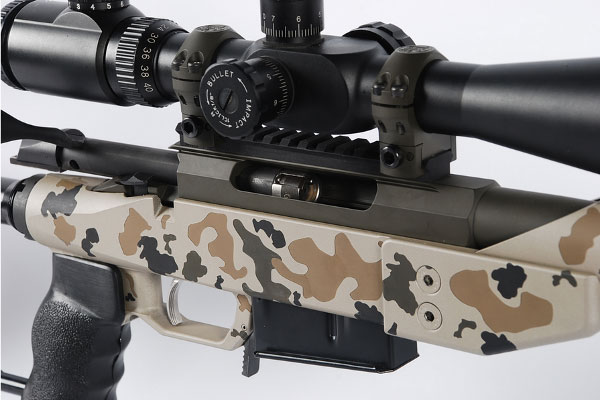
We’re in the thick of hunting season now, so we’re featuring an impressive new hunting rig from Springfield Armory. The new Model 2020 Waypoint rifles feature advanced carbon-wrapped barrels*, TriggerTech triggers, and carbon-fiber, hand-painted camo stocks. The actions are pretty impressive too — with precision machining, enlarged ejection port, and integral recoil lug. These Waypoint rifles rival full-custom hunting rigs, yet are reasonably affordable. Starting price is $1699.00 with stainless barrel, while the deluxe model with carbon-wrapped barrel and adjustable cheekpiece is still under $2,400.00.
Handsome Hand-Painted Carbon-Fiber Stocks
Minimum gun weight with carbon-wrapped barrel and fixed cheek is just 6.6 pounds.
Shooting Illustrated 2021 Golden Bullseye Award Winner
Rifle of the Year — Savage Axis II Precision
The Savage AXIS II has has been given a Precision Series upgrade with a MDT Chassis designed for Savage AXIS II platform. The MDT black aluminum chassis features an olive drab injection-molded skin. It has adjustable comb height while length of pull adjusts via spacers. An MLOK™ fore-end allows easy fitting of accessories. This rifle features a black-finished action fitted to 22″ carbon steel, button-rifled heavy barrel with threaded muzzle. The Savage AccuTrigger adjusts from 2.5 to 6 pounds pull-weight.
About the Golden Bullseye Awards
Now in their 19th year, the NRA Publications Golden Bullseye Awards acknowledge the finest products available in the shooting sports. The winners are selected by a seven-member committee consisting of editors, graphic designers and veteran NRA Publications staff, representing more than a century of collective experience in the shooting and hunting industry.
To qualify for consideration for a Golden Bullseye Award, a product must have been:
— Recently introduced and available to consumers.
— Used/tested by a staff member or magazine contributor.
— Reliable in the field, meeting or exceeding the evaluator’s expectations
— Innovative in design and function.
— Readily perceived as a value to the purchaser.
— Styled in a manner befitting the shooting and hunting industry.
“In the uncertain year of 2020, companies with in the firearm industry continued to innovate”, said American Rifleman Editor-in-Chief (EIC) Mark Keefe. American Hunter EIC J. Scott Olmsted added: “Companies in the firearm and outdoor trade industry continued to provide innovation, quality and value to us all. American Hunter is proud to honor these companies’ dedication to our pastime with 2021 Golden Bullseyes.”
Are you looking to get started in PRS and tactical/practical competitions? Here are three videos that can help you improve your game. These videos feature two top PRS competitors, and George Gardner of G.A. Precision, considered one of the founding fathers of the PRS game. You’ll find other PRS-focused videos on the Long Range Precision Shooters YouTube channel.
PRS Ace Shows Skills Barricade Technique — with POV Video
This first video features 2015 PRS Champion David Preston shooting the PRS Skills barricade. Dave Preston is widely considered the best in the nation running this PRS stage. Dave nearly always shoots 100% with the fastest recorded time. In this video you’ll see him successfully engage all eight shots in under 43 seconds — that’s crazy fast. This includes a POV sequence (4:35 time-mark) showing the actual view through Dave’s scope.
The PRS Skills Barricade is an 8-round, 4-position stage featured at most PRS matches. It’s called a “Skills Stage” as it is run the same way at every national match and gives shooters the ability to compare skill levels based on hit percentage and speed. The target is a 10″ plate at 400 yards. There are four different positions, with two shots each. Most people run this stage in about 70 seconds, some in the mid-60s, while Dave does it in the low 40s!
Know Your Limits PRS Stages — Pro Tips
The Second video showcases how 2018 Oklahoma PPS Champion Clay Blackketter approaches Know Your Limit Stages. With these particular type of stages you have to make judgment calls about your rifle’s accuracy and your ability to hold on target. You can boost your score by shooting the smallest target(s), but you risk losing points if you miss. Clay explains how best to manage a Know Your Limits stage.
Cartridge Choice for PRS and Tactical Competition
Today’s third video reviews many of the different caliber selections popular for PRS-style competition. The video examines pros and cons of various cartridge choices, focusing on accuracy, recoil, mag-feeding, and value for money. This segment features G.A. Precision owner/founder George Gardner.
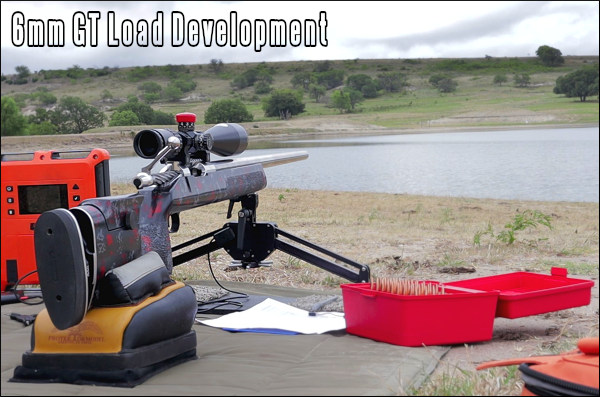
Most Top PRS shooters are using 6mm catridges these days. These deliver excellent accuracy with lower recoil and cheaper bullet cost. Popular choices include 6 Dasher, 6mm Creedmoor, 6XC, 6-6.5×4 and the new 6GT cartridge, which is sort of a stretched version of a 6mmBR. It has a bit more case length for better feeding, and greater case capacity than a 6BR so you can shoot 105-108 grain bullets at the 2950 fps node.
CLICK HERE for a full write-up on a 6GT rifle build by Mike McCasland (Texas Precision). This includes load development suggestions and a 6GT reamer print. The most common 0.120″ freebore chamber allows for the majority of high-BC 6mm projectiles found in both F-Class and PRS. Mike had good luck with the pointed 107gr Sierra Match Kings (SMK), as well as the 110gr Hornady A-Tips in his rifle, shown below:
Practical Shooter’s Guide
Thinking of getting started in the Practical/Tactical shooting game? Looking for ways to be more stable when shooting from unconventional positions? Then you may want to read Marcus Blanchard’s Practical Shooter’s Guide (A How-To Approach for Unconventional Firing Positions and Training). Unlike almost every “how to shoot” book on the market, Blanchard’s work focuses on the shooting skills and positions you need to succeed in PRS matches and similar tactical competitions. Blanchard provides clear advice on shooting from barricades, from roof-tops, from steep angles. Blanchard says you need to train for these types of challenges: “I believe the largest factor in the improvement of the average shooter isn’t necessarily the gear; it’s the way the shooter approaches obstacles and how they properly train for them.”
Are sound suppressors useful in competition shooting? In some disciplines, and in venues where sound “moderators” are permitted, the answer is “yes”. Some years ago Shooting Sports USA (SSUSA), published an interesting article about the use of sound suppressors (aka “cans”). The article explores the use of suppressors in Europe and in tactical matches in North America. You’ll also find an explanation of the rules and regulations governing suppressor ownership and use in the United States.
Former SSUSA Editor Chip Lohman tested three rifles from the bench and found that suppressors did not harm accuracy (at least with these rigs). In fact, all three test rifles (.223 Rem, .308 Win, and .338 Lapua Magnum), shot slightly better 5-shot groups at 200 yards with a suppressor than without. However, the suppressors did alter point of impact. Interestingly, velocity standard deviation (SD) values were lower with suppressors in place for all three test rifles. This observation calls for further study.*
So the use of suppressors in competition could be a good thing. However, in the United States, current NRA High Power rules prohibit the use of sound suppressors. NRA Rule 3.16.1 subsection (a) states: “Sound Suppressors are not authorized for use in High Power competition.” In addition, there are some practical problems with suppressors — the heat rising off of a naked suppressor can create mirage problems (that’s why some shooters wrap their cans with a cover).
Despite such issues, it is now common to see moderators on rifles used in non-NRA-sanctioned tactical matches such as the Precision Rifle Series. For example, many competitors in the popular Steel Safari field challenge match use suppressors. The photo below shows our friend Zak Smith competing in the Steel Safari with his suppressed Accuracy International rifle.
Commentary — What Can We Conclude?
Obviously, this three-rifle SSUSA test was not definitive. One well might observe different results with different types of suppressors, fitted to different kinds of rifles. Mounting a suppressor to any barrel will certainly affect harmonics and “tune”. But this SSUSA study does suggest that tactical shooters, who are allowed to use suppressors in competition, may find that the benefits of suppressors (significantly reduced recoil and less noise) outweigh any meaningful accuracy loss, at least in PRS-type matches.
*The article cautions that one should not extrapolate too much from the SD numbers, given the low number of test shots. Chronograph-maker Ken Oehler, when asked to comment on the SD values stated: “[You should] report the observed SDs, but draw no conclusions until… you can do more testing with larger sample sizes.”
Considered the biggest PRS-type rifle match in the world, the 2020 GAP Grind/Bushnell Pro/Am kicks off today. The big GAP Grind runs for three days, October 2-4, at the K&M Shooting Complex in Finger, Tennessee. In association with the Precision Rifle Series (PRS), the format will again be a professional-amateur, individual and team match to promote sportsmanship and welcome new shooters to the competition scene. Competitors ranging from top professionals to those seeking their first taste of the sport are invited to attend.
The GAP Grind is held at the impressive K&M Shooting Complex in Tennessee:
Lots of Action, with 20+ Stages
The GAP Grind is a challenging, “high tempo” match with minimal down-time between stages. Over the course of 20+ stages, competitors will fire 200+ shots at a variety of steel, paper, moving, and reactive targets out to 1,200 yards. Targets vary in size/difficulty based on the shooter’s position, distance, and time allotted. Most stages include “stressors” — i.e. time limits or required movement(s).
Ramia Whitecotton Facebook photo.
The GAP Grind typically attracts over 300 competitors — half experienced shooters and the other half newcomers to the sport. The key to growing the shooting sports is attracting new shooters. The best way to bring in “new blood” seems to be the Pro-Am type format. At the GAP Grind, experienced shooters share their knowledge and guide the new shooters through the competition.
Bushnell Side Match on October 2, 2020
On Friday, October 2, Bushnell will sponsor a side match featuring the RXS-250, a new red dot optic. This is an impressive impact-resistant design, with 10 user-adjustable brightness and True Tone coatings for a sharp, distortion free image. Bushnell will provide prizes to competitors — a lucky amateur will receive a new Bushnell Elite Tactical optic. Plus range officers will receive product prizes to thank them for dedicating time to the event.
Looking for a match-worthy PRS/NRL rig for under $1750.00? Check out Savage’s new Elite Precision Model 110. GunsAmerica Digest recently did a very thorough test of the 110 Elite Precision, declaring that this modern Savage is “Competition-Ready Out of the Box.”
The 110 Elite Precision has many notable features:
1. Modular Driven Technologies (MDT) Adjustable Core Competition (ACC) Chassis
2. Trigger adjusts from 1.5-4.0 pounds
3. Barrel comes with timed muzzle brake from factory
4. MDT Stocks easily accepts Weights and Accessories
5. Takes AICS-compatible Magazines
6. Titanium Nitride coated bolt body
This rifle boasts an excellent MDT ACC modular chassis. GunsAmerica stated: “Combined with the excellent trigger, an AR-compatible vertical grip, flared magazine well, and AICS mag system (along with a host of additional features), the 110 Elite Precision comes with everything you need [for PRS/NRL matches].” The stock has ARCA rails on the fore-end and M-LOK mounting points for accessories and/or weights. You can add an additional 9 pounds of steel to customize the balance/mass of the rifle to improve stability and minimize recoil.
The Cheekpiece and Buttpad are adjustable, along with Length of Pull (LOP).
Another reviewer noted that the 110 Elite Precision has important accurizing tweaks from the factory: “Key upgrades include a blueprinted action … Savage squared the receiver face and cleaned up the receiver threads to ensure they’re concentric with the barrel’s bore. This combination goes a long way in eliminating the occasional flyer that can ruin a good group or cause a miss in a match.” Source: GunsandAmmo.com.
Decent Accuracy with Factory Ammo
What kind of accuracy can you expect? Decent for a factory barrel and factory ammo. With Hornady 6.5 Creedmoor ammo, shooting off a sled, the test rifle delivered 1.1-MOA average groups. We would expect considerably better accuracy using a proper front rest with a bag-rider fitted to the fore-end. Likewise, the gun would almost certainly shoot better with handloads with Lapua brass and Berger bullets. Handling was good: “The Elite Precision is about as shootable as it gets. The 12.6-pound rifle produces very little recoil with the 6.5 Creedmoor cartridge, and … the ACC chassis can be weighted to control recoil even further.”
Actual owners have been impressed with the 110 Elite Precision. One buyer posted: “You couldn’t build a complete PRS rifle that is this good of a platform for even close to the price!” GunsAmerica tester Jordan Michaels concurred that this rig is a great choice for PRS/NRL factory-class: “If you’re in the market for a rifle to compete in a long-range competition, the Savage 110 Elite Precision is an excellent choice.”
This week Shooting USA TV features an innovative rifle competition in Colorado, the Hornady Precision Hunter Steel Challenge. This is a unique match set in 2000 acres of natural terrain at the Cameo Shooting Complex in Colorado. The match replicates long-range hunting challenges, with steel targets sized to simulate the vitals of western game animals. Some 135 competitors engaged steel targets in 20 challenging stages.
Match Director Scott Satterlee says, “This is as close as it can get to mountain hunting. We have vital-sized targets out there. They are 12-inch squares turned to diamonds which are really difficult to hit”.
SHOOTING USA TV Air Times
View Shooting USA on the Outdoor Channel: Wednesdays 9:00 PM (Eastern and Pacific); 8:00 PM Central.
NOTE: If you miss today’s broadcast, you can still view the show on Vimeo for a small 99-cent fee, or just $1.99 per month unlimited. LINK HERE: Shooting USA on Vimeo.
The inaugural Hornady Precision Hunter Steel Challenge took place in Colorado August 8 and 9. This unique competition involved lots of hiking with various shooting positions in challenging natural terrain. The unique match was hosted at the Cameo Shooting Complex near Grand Junction, CO.
There were 135 registered competitors — quite a turn-out for a physically demanding match in a fairly remote location. Congrats to Heavy Class and Overall Winner Brian Black who topped the field with 140 Match points (100% of possible). Brian shot a 6.5×47 Lapua with Berger 6.5mm 140gr Hybrids. Brian’s winning rig featured a Lone Peak Arms Fuzion action, Benchmark barrel, and XLR Element chassis.
The Hornady Precision Hunter Steel Challenge tests a rifleman’s fitness and skills as marksman and hunter. The stages were blind with a 4-minute time limit to move to the shooting area, locate, range, and engage targets. Shooters could choose between two rifle weight classes (light or heavy) and had to meet a minimum power factor cartridge requirement that helped even the playing field. The match featured a diverse course of fire with a good mix of prone and natural terrain shooting positions.
Hunting Ammo Tested by Shooting USA
In this same episode, Shooting USA tests a variety of Hornady hunting ammo offerings on the G.A. Precision private gun range in Missouri. (We’d love to have our own private range like that!) Jason Hornady says his company starts the design of all hunting ammunition with bullet selection: “For us it started with the bullet … for us the bullet still makes the cartridge.”.
Many of our readers are thinking of trying out PRS-type competition. Tactical matches are becoming more popular every season. Along with F-Class, tactical/practical disciplines are the fastest-growing forms of competitive rifle shooting. Rich Emmons, one of the founders of the Precision Rifle Series (PRS), has written an insightful article about getting started in the tactical game. This will help PRS novices pick the right equipment and understand the game. Here are highlights from Emmon’s “PRS — Intro to Competition” article, originally published on the PRS website. You may also want to read the current PRS FAQ Page.
Precision Rifle Series — Intro to Competition
by Rich Emmons, PRS President
Tactical Shooting with a precision rifle is not like other disciplines, there is no set course of fire or format. That is what makes it so fun!
First, you have to ask yourself what do you want to accomplish. When I was introduced to long range shooting, immediately a light turned on for me, once I saw how easy it was to hit 300–600 yard targets. What I quickly learned from my first competition and the many that followed was there is so much to learn and shooting in competition put everything you thought you knew to the test. So back to the question: “What do YOU want to accomplish?”. The reality is you may not know yet, you just think it is cool to have a bad ass rifle and scope that can make almost any shot. Now if you’ve got that rifle and scope, it’s time to take it to the next level.
Watch PRS 2016 Championship
Getting Started — What to Expect
If you’re reading this, you have probably already have been bitten by the long range shooting bug. It can seem quite intimidating to just jump in with a new bunch of shooters you don’t know and shooting lingo you don’t quite understand yet. But here is the key — show up and shoot! I guarantee you if you show up to a match as a new shooter, other experienced shooters will guide you along and give you help on anything you need.
AUDIO: Click Button to hear Rich Emmons Talk about the Precision Rifle Series.
Now, a couple things you should just expect. You’re not as good as you think you are. Don’t expect to come into your first match and beat all the veterans. That just doesn’t happen unless you have had some really good coaching or other shooting competition experience to get you ready for this type of competition. If possible, find a local rifle club that has monthly long range matches, or any type of match will help prepare you for a larger PRS event. Getting involved with a rifle club and starting out shooting monthly matches is definitely the way to jump into competition shooting.
The Gear You Need
The first question that many ask is: “What kind of rifle/caliber/scope do I need?” The easiest answer to this is, the best you can afford. It’s no secret the gear is expensive. It took me several years of buying sub-par gear and eventually trading up to figure this out. Now, a guy can get a real sense of pride of doing it on the cheap, or with a factory rifle. I’ve seen many old Savage 10FPs take down custom rigs that cost 10 times as much. And if that’s all you can afford, then eventually you will learn the limitations of yourself or your gear. As for choice of cartridge/caliber, the respected Precision Rifle Blog has analyzed five years worth of match results from the best tactical shooters in the nation. CLICK HERE to read a PRB article that reveals what cartridge types the “top guns” use.
Craig Arnzen of Area 419 has created a useful article reviewing the gear PRS shooters need, including support bags, hearing protection, and other key accessories such as muzzle brakes. This helpful article also covers factory ammunition options.
Making Good Ammo
Producing quality reloads is something you have to master. It’s not hard at all, you just have to pay attention to detail, and eventually you are going to do something stupid like mis-priming your brass, or skip a row of brass when dumping your powder. Everybody has their own horror story of some reloading failure that cost them a stage or even a match. So load to perfection, work with your rifle to find what load it likes the best, then start your practice.
Practice Makes Perfect
You want to become ONE with your rifle, learning everything you can about its functionality. Getting comfortable with the operation of your rifle is key. Learn the feel of your trigger, dry-firing until you wear the paint off your bolt handle. Learn how the rifle works best — pay attention to little things like the sound and feel of the bolt feeding a round from the mag (or when it doesn’t). Learn how to remove a jammed round quickly, learn how to reload a magazine quickly. Learn to scan across a field and find targets in a quick manner, seeing the targets with your eye and coming into the scope on target. These are some of the basic practices that separate the new shooters from the seasoned ones.


 If you want an even greater selection of targets, specialized for PRS and NRL shooters, Storm Tactical offers a vast collection of tactical targets, available in three different versions: MOA, MIL Yards, and MIL Meters. These target sets were created with input from Sniper’s Hide. Storm Tactical also created a great rimfire target set. This includes side-by-side target blocks for fun, one-on-one competition. If you shoot NRL22 or just enjoy shooting with a buddy, we highly recommend the rimfire target set.





 The lower rifle, in an AI AX chassis with Kelbly Atlas action, also has multiple variants: Kelbly 6 Dasher, Kelbly 6.5×47 Lapua, and PBB 6GT (new GAP cartridge). The Steiner T5Xi 5-25x56mm SCR optic rides in Nightforce UL TI rings. The 6.5 barrel has a PVA Jet Blast brake, while the 6mm barrels can use Area 419 Hellfires.


 Every year the NRA Publications group announces Golden Bullseye winners for various product categories (rifle, handgun, shotgun, optics, gear etc.). These awards are like the Oscars for the shooting industry. There are many Golden Bullseyes given out each year because there are separate awards given by different NRA Magazines — including American Rifleman, Shooting Illustrated, and American Hunter. Here are the 2021 Rifles of the Year (Golden Bullseye Winners) as chosen by each of those three publications.








 Hunting Ammo Tested by Shooting USA


