Here’s a great Do-It-Yourself project for tactical shooters. Ed and Steve of the 65Guys.com have created a versatile wooden barricade designed for easy transport. The goal with this design was to create a stable barricade that offers a variety of shooting positions, but can also fit in the bed of a pick-up or the back of an SUV. The 69″ tall barricade is hinged in the middle, so it’s just 27″ wide. To deploy the Barricade you simply fold it open and then nest the lower wings in ground-level stands.
We call this the BYOB Project — Build Your Own Barricade. Anyone with basic wood-working skills should find the Barricade prettyeasy to make. The only tricky part is cutting the side Dado joints for the left and right lower wings. But when you’ve got it completed, you have a low-cost unit that is versatile and sturdy yet easy to pack in a truck and carry out on the range. In the video below the 6.5 Guys showcase their Gen 2 barricade and explain how to build one just like it.
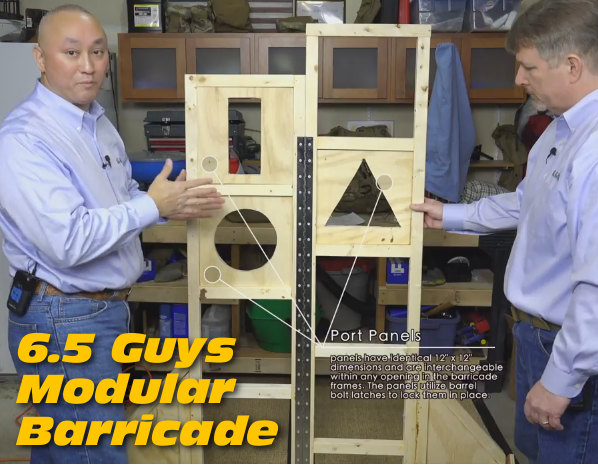
Looking at the 6.5 Guys Modular Barricade
The Modular Barricade was drawn up by Steve in PowerPoint and then dimensions added. Once the entire plan was created, Steve cut components to size and then used ordinary wood screws and wood glue to assemble the barricade frame. This was done to ensure maximum rigidity due to the light weight construction using 2″ x 2″ frame members. A long piano hinge was used to allow the Barricade to fold in half, while still having high torsional rigidity. Each of the Barricade openings are 12″ x 12″ square. This consistent ‘window’ spacing allows interchangeable panels with different cut-out shapes to be placed at varies heights/locations in the Barricade.
Modular Barricade Key Features
— Lightweight construction using low-cost 2×2 wood beams.
— Collapsible frame with center hinges for easy transport and deployment.
— Multiple Support levels at 6″ vertical intervals (6″ variance R to L).
— Modular port design allows ports to be changed and moved as desired.
6.5 Guys’ Modular Barricade — Construction Tips
The Modular Barricade can be constructed over a weekend with the proper materials and basic shop tools such as a power saw and electric screwdriver. Steve used a router for the side panel dado joints but a table saw could also be used for that task. Steve’s only real issue with the build involved the port panels — getting them to fit right. The 2″ x 2″ frame wood wasn’t always straight; even a small variation in the wood could cause a port panel to be too tight or too loose. Steve had to do a lot of extra sanding and planing to get the port panels to fit just right.
Where and How to Use the Barricade for Training
Because the 6.5 Guys’ Modular Barricade is so easy to move, you can simply pack it up and deploy it at your local range for practice. (Do ensure club/range rules allow shooting from barricades.) While the Barricade is designed to sit on the natural ground, the base stands can also be placed on concrete if your range does not allow deployment forward of the normal firing line. While you can use the Barricade for training on your own, Ed and Steve say novice shooters can benefit from a formal clinic.
In the video below, the 6.5 Guys discuss precision rifle training with Scott Satterlee, an instructor with Core Shooting Solutions. This video explains why new shooters should consider enrolling in a formal training clinic. Topics covered are: typical course format and “curriculum”, the gear needed to participate in a precision rifle clinic, and skills shooters should practice before attending the clinic.
Christmas is coming soon. Books have always been popular holiday gifts. If you haven’t completed your holiday shopping, here are some recommended titles that should please the serious shooters and firearms enthusiasts on your shopping list. For shooting clubs, books also make great end-of-season member awards. Most of us would rather have a useful book than one more piece of wood to toss in a box in the closet.
Here Are TEN BOOKS Recommended for Serious Shooters:
Glen Zediker’s latest book, Top-Grade Ammo, is a great resource for all hand-loaders — beginners through advanced. This 314-page guide covers every aspect of the reloading process — component sorting, priming, sizing, bullet seating and more. With 430 photos, Top-Grade Ammo is a richly-illustrated, step-by-step guide to producing high-quality handloads. Unlike many reloading books, Top-Grade Ammo is current and up-to-date, so it covers modern practices and the latest precision reloading tools. While Zediker focuses on producing match-grade ammo for competition, this book will also help novice reloaders on a budget. This book features a special “lay-flat” binding so it’s easy to use as a benchtop reference. To view Chapter List and sample pages visit ZedikerPublishing.com.
If you’re a serious long-range shooter, consider adding this book to your library. Relying on extensive ballistics testing, Modern Advancements contains some fascinating research results, including the effects of twist rate on muzzle velocity, BC, and precision. Other sections detail the evolution of modern rifle, bullet, and optics designs. And there is an important comparison test of chronographs. Laser rangefinders and wind measurement devices are explained in detail by contributing author Nick Vitalbo. This book is a valuable resource for anyone who wants to understand the current “state of the art” in today’s shooting world. There is a ton of “hard science” in this book — not just opinions.
Thinking of getting started in the Practical/Tactical shooting game? Looking for ways to be more stable when shooting from unconventional positions? Then you may want to read Marcus Blanchard’s Practical Shooter’s Guide (A How-To Approach for Unconventional Firing Positions and Training). Unlike almost every “how to shoot” book on the market, Blanchard’s work focuses on the shooting skills and positions you need to succeed in PRS matches and similar tactical competitions. Blanchard provides clear advice on shooting from barricades, from roof-tops, from steep angles. Blanchard says you need to train for these types of challenges: “I believe the largest factor in the improvement of the average shooter isn’t necessarily the gear; it’s the way the shooter approaches obstacles and how they properly train for them.”
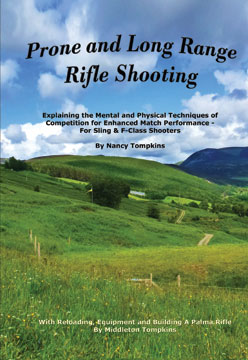
Nancy Tompkins is one of the greatest long-range shooters in American history. She has won five National Long-range Championships. Tompkins’ treatise is a must-read for serious Palma, F-Class, and High Power shooters. The revised Second edition includes F-Class equipment and techniques, and newly updated information. Color pictures. Topics include Mental & Physical training, Reading Wind & Mirage Shooting Fundamentals, International Competition, and Loading for Long Range. Nancy Tompkins is a 4-time winner of the National Long Range Championships, and has won countless other major events. Nancy has been on six Palma Teams (as both a shooter and a coach).
Ryan Cleckner is noted for his ability to explain complex topics in an easy-to-comprehend manner. Now Cleckner has authored a book, the Long Range Shooting Handbook, which expands on the topics covered in Cleckner’s popular NSSF video series. The Long Range Shooting Handbook is divided into three main categories: What It Is/How It Works, Fundamentals, and How to Use It. “What It Is/How It Works” covers equipment, terminology, and basic principles. “Fundamentals” covers the theory of long range shooting. “How to Use It” gives practical advice on implementing what you’ve learned, so you can progress as a skilled, long range shooter. You can view Sample Chapters from Ryan’s Book on Amazon.com.
Tony Boyer, the most successful shooter in the history of short-range benchrest competition, shares many of his match-winning tips in this 323-page book. The book covers all aspect of the benchrest discipline: loading, windflags, rest set-up, addressing the rifle, and match strategies. This is a high-quality publication, filled with valuable insights. Every serious benchrest shooter should read Tony’s book. Boyer has dominated registered benchrest in a fashion that will never be duplicated, having amassed 142 U.S. Benchrest Hall of Fame points. The next closest shooter, Allie Euber, has 47 Hall of Fame points. This handsome, full-color book is 323 pages long, with color photos or color illustrations on nearly every page.
This book should be on the shelf of every short-range benchrest shooter. (Shooters in other disciplines will find the book helpful as well.) Butch Lambert says Mike’s book is “far and away the best Benchrest book written. Very comprehensive, it touches on every aspect of our game.” Mike’s 368-page book is dedicated to getting the most from modern rifle accuracy equipment with an emphasis on shooting 100-200-300 yard group benchrest tournaments. This book covers the most popular hardware plus new equipment offerings are covered, including external mount scopes, actions, triggers, stocks, wind flags, and more. Also covered are rifle handling techniques, note taking, tuning, bullet selection, goals, and match strategies. Mike provides many tips that will help active competitors update their own competitive program.
This book by 11-time National High Power Champion David Tubb focuses on position shooting and High Power disciplines. Section One covers fundamentals: position points, natural point of aim, breathing, triggering mechanics and follow-through, sling selection and use, getting started, getting better, avoiding obstacles. Section Two covers mechanics of offhand, sitting, and prone positions. Section Three covers shooting skills, including wind reading and mental preparation. Section Four covers the technical side of shooting, with extensive disuctions of rifle design, load development, reloading barrel maintenance, and rifle fitting. We consider this book a “must-read” for any sling shooter, and there is plenty of good advice for F-Class shooters too.
Bullseye Mind (Mental Toughness for Sport Shooting) by Dr. Raymond Prior, $14.00 (Softcover).
Having a Bullseye Mind means thinking in ways that create confidence and consistency, even under pressure. A “must-read” for competitive shooters, Bullseye Mind is a mental training book written specifically for the shooting sports. The book is well-organized, with handy highlighted lists and key “talking points”. Each chapter concludes with examples from a world-class shooters such as: Matt Emmons, 2004 Olympic Gold Medalist; Vincent Hancock, 2-time Olympic Gold Medalist; Jamie Corkish, 2012 Olympic Gold Medalist; Petra Zublasing, 2014 World Champion/ISSF Shooter of the Year; and Nicco Campriani, 2012 Olympic Gold Medalist, 2010 World Champion. This book has earned rave reviews from competitive shooters who found it really helped their “Mental Game”. One recent purchaser states: “This book is as though you had a coach in your back pocket…”
Cartridges of the World (15th Edition, 2016), belongs in every serious gun guy’s library. This massive 680-page reference contains illustrations and basic load data for over 1500 cartridges. If you load for a wide variety of cartridges, or are a cartridge collector, this book is a “must-have” resource. The latest edition includes 50 new cartridges and boasts 1500+ photos. The 15th Edition of Cartridges of the World includes cartridge specs, plus tech articles on Cartridge identification, SAAMI guidelines, wildcatting, and new cartridge design trends. In scope and level of detail, Cartridges of the World is the most complete cartridge reference guide in print. Cartridges of the World now includes a 64-page full-color section with feature articles.
Ask most gun guys about the Precision Rifle Series (PRS), and they’ll tell you it’s a discipline for bolt-action “tactical” rifles. Yes that’s true, but PRS now has a “Gas Gun” series as well, and many local PRS-style matches also allow gas guns to compete in their own division.
Capitalizing on the success of the bolt-gun competitions, this year the PRS approved a new Gas Gun series for semi-auto rifles such as AR15s and AR10s. The inaugural 2017 PRS Gas Gun Series competition took place February 17-19, 2017 at the CORE Shooting Solutions range in Baker, Florida. This article explains the basics of the Gas Gun Series and offers some factory hardware options.
PRS Director Shawn Wiseman Explains New Gas Gun Series in this Video:
Gas Gun Series Basics — Interview with PRS President Shooting Sports USA interviewed PRS President Shawn Wiseman.
SSUSA: What will be the format of the 2017 PRS Gas Gun Series matches?
Wiseman: The matches will be a two day format with 8 to 10 stages per day. There are three Divisions; Tactical Light for 5.56x45mm NATO/.223 Rem. rifles, Tactical Heavy for 7.62x51mm NATO/.308 Win., and Open for everything else up to .30 cal. The maximum distance will be 800 yards.
SSUSA: What guns do you expect to be popular?
Wiseman: In the Open Division, I expect to see a lot of 6.5 Creedmoors for two main reasons; it’s an inherently accurate cartridge and Hornady makes great ammo for the folks that aren’t into reloading. I think the Tactical Light Division will probably be the most popular. It is hard to say specifically what rifles will be the most popular but there are a few AR companies that are known for the accuracy. Armalite, GA Precision, LaRue and Seekins will all be very popular rifles in this Series. I think we will continue to see high-end optics with 5X to 6X zoom range on the rifles. Bushnell, Kahles, Leupold, Nightforce and Vortex will continue to be the most popular.
PRS Gas Gun Series Factory Firearm Options
While you can compete in the Gas Gun Series with an AR15, many Open Division competitors are favoring the larger AR10-platform rifles that can shoot the 6.5 Creedmoor and 6mm Creedmoor cartridges. Both Savage and Smith & Wesson offer AR10-type rifles optimized for this competition.
Smith and Wesson M&P 10, 6.5 Creedmoor
S&W’s AR10-platform rifle is a leading choice for the PRS Gas Gun Division. The M&P 10 in 6.5 Creedmoor shows good build quality and good accuracy with factory 6.5 Creedmoor ammo. If you’re a fan of the 6.5 Creedmoor cartridge, the M&P 10 is a smart gas gun option. S&W offers good customer service and a rock-solid warranty. This rifle features a 2-Stage Match Trigger, Magpul MOE Stock, 15″ M-LOK handguard, and a 20″ barrel with 1:8″-twist 5R Rifling. MSRP is $2035.00.
Savage MSR-10 Long Range, 6.5 Creedmoor and .308 Win
The updated Savage MSR-10 Long Range is available now in .308 Win and 6.5 Creedmoor. Next month (January 2018), Savage will also release a 6mm Creedmoor version. This rifle features a Magpul PRS Gen3 Stock, Blackhawk 2-stage trigger, non-reciprocating side charging handle, and QPQ-treated heavy barrel (1:8″ twist for 6.5 Creedmoor; 1:10″ for .308 Win). MSRP for all chamberings is $2284.00.
New .224 Valkyrie for AR15 Platform
Another option would be the smaller AR15 chambered for the new .224 Valkyrie cartridge. This brand new offering from Federal is basically a 6.8 SPC necked down to .224 caliber. With the 90gr Sierra MatchKing, it offers ballistics comparable to a 6.5 Creedmoor, with less recoil.
PRS Gas Gun Series Rules
For the new PRS Gas Gun Series, a committee of top PRS shooters, Multi-Gun shooters, and Match Directors developed the PRS Gas Gun Series Rule Book. Highlights of the Rules are listed below.
For the new PRS “Gasser” Competition, the PRS developed rules on gun types, scoring, match timing, penalties, safety and other key topics. CLICK HERE for Full PRS Gas Gun Series Rules.
Open Division: The Open Division rifles will not exceed a caliber of .30 or a velocity of 3,200 fps. A match DQ will result any rounds over the speed limit of 3,200 fps (+/- 32 fps for environmental factors and equipment discrepancies). Match Officials may request at any point during a match that a competitor fire their rifle through chronograph. If the bullet exceeds the 3,200 fps speed limit, the shooter will receive an automatic match DQ.
Tactical Light Division: Intended to allow competitors the opportunity to compete using traditional military and law enforcement caliber (.223/5.56). This promotes Active Duty military and law enforcement competitors use of their Service and Department-issued rifles. Tactical Light Division rifles are restricted to 5.56 NATO/.223 Remington chamberings only. Bullet weight cannot exceed 77 grains and muzzle velocity cannot exceed 3,000 fps.
Tactical Heavy Division: Intended to allow competitors the opportunity to compete using traditional military and law enforcement caliber. This promotes Active Duty military and law enforcement competitors’ use of their Service and Department issued rifles. Tactical Heavy Division rifles are restricted to 7.62 NATO/.308 Winchester calibers only. Bullet weight cannot exceed 178 grains and muzzle velocity cannot exceed 2,800 fps. No modified wildcat rounds permitted to shoot in the Tactical Divisions Anyone discovered violating this rule will receive an automatic Match DQ. Tactical Division shooters will shoot the exact same COF as Open Division shooters.
Rifleshooter.com built this tactical rifle (top image) with a Howa 1500 action, Shilen barrel, and MDT chassis. Below is a factory Howa 1500 Multi-Cam rifle.
Many of our readers are thinking of purchasing a Howa rifle or barreled action. These feature smooth-running actions with a good two-stage HACT trigger. But some folks have heard that it may be difficult to find stocks, or to fit an after-market barrel. That’s not true. There are many stock options available, and in this article, Bill of RifleShooter.com shows that it is easy to remove the factory-installed barrel with the right tools. We think a Howa makes a fine basis for a varmint rig or field rifle. Or you can build a tactical as Bill did. You can start with the factory barrel and when you want/need more accuracy, then have a gunsmith install a custom barrel from Krieger, Shilen, or other quality brand.
What You Need to Know About Howa 1500-series Rifles
Tech Feature by RifleShooter.com
Consider this article the “Howa 1500 Overview”. AccurateShooter.com’s editor mentioned there’s been a lot of interest in Howa rifles and barreled actions imported by Legacy Sports International. In addition to being able to buy a complete rifle from a dealer, Brownells sells barreled actions in a wide variety of calibers and configurations. In this post we are going to take a look at the Howa 1500 series.
Howa Rifles — General Background
Howa is a Japanese heavy machinery company. One of its product lines are firearms, which, are imported into the United States of America by two different companies, Legacy Sports International and Weatherby. Legacy sells the 1500 under the manufacturers name while Weatherby re-brands the guns as the Weatherby Vanguard. In general, the finishes on the Weatherby rifles are more refined than the LSI-imported 1500s.
General Evaluation of Howa 1500 Rifles
I’ve found Howa 1500s to be solid, entry-level rifles that are capable of sub-MOA accuracy out of the box. I’ve actually purchased two Howa rifles I’ve tested because I like them so much. The gun below, a Howa Mini-Action in 7.62×39 Russian, is one of my favorite factory guns to shoot. I’m running a Tract Optics Toric on it, these are solid little rifle scopes that offer great performance for the money.
Check out this three-shot group I drilled at 100 yards with the rifle above and 125-grain Sierras. It took a lot of work and load development to get there, but when it did, it worked well.
Howa 1500 HACT 2-Stage Trigger
Howa 1500s feature the very nice Howa HACT trigger. This is an adjustable, two-stage trigger, set for about 3 pounds (combined stages). Crisp and repeatable, this is an excellent trigger for a factory gun. There is no annoying Glock-style safety lever in the middle of the trigger blade. The 2-stage design and pull weight range works well for a hunting rifle or a rig for PRS competition. Rifleshooter.com says the Howa trigger is “one of the best factory triggers, along with Tikka. I’ve found the Howa trigger superior to a Remington 700 — the Howas doesn’t need to be replaced.
Writing for the Western Outdoor News, WONews.com, Steve Comus has field-tested the new HACT Trigger. Steve writes: “I always liked two-stage triggers, because of the way I could take-up the slack and then actually know when the rifle was going to go off. The take-up on the [HACT] trigger was fast and easy. The crisp, positive release when pressure was put on during the second stage [reminded me] of some of the target rifles I shot through the years.”
Howa Actions — Three Options
Howa offers three action lengths: Mini, Short, and Long. You can see the bolts for the three action lengths in the image below. The Mini-Action has similar external dimensions to the Remington Model Seven, however, the Mini-Action’s bolt does not travel as far to the rear. This is a mixed bag. The upside is you have a quicker action (shorter bolt throw). The downside is you are limited to shorter rounds such as the .223 Remington, 7.62×39mm Russian, and 6.5 Grendel. But if you need a bigger cartridge, just choose the standard or long action Howa variant.
Howa 1500 vs. Remington 700 — Important Differences
Is the Howa 1500 a Remington 700 clone, or some kind of improved Remington 700? No, not really. While the top radius of the Howa 1500 does match the Model 700, and they can both use the same two-piece scope bases, there area number of differences.
If you look at the Howa 1500 alongside the Remington 700 you’ll note the M700 is a round action, while the Howa is a flat-bottom action. In many ways the Howa’s bottom half reminds me of a push-feed Winchester. This means the chassis and stocks that support a Howa 1500 are not V-block based like you’ll find on a 700, instead they have a flat bottom. While the bolt of the Howa is similar in external appearance to the Model 700, it does offer some improvements, notably an M16-style extractor and a firing pin assembly that can be easily removed without tools.
Howa 1500 action screws are metric and are in a different location from the 700. The Howa 1500 has an integral recoil lug that accepts the front action screw, this means you have more of the front action screw engaging the action. WARNING: If you install it into a poorly-fitted stock or action you may bind it.
Can a Howa Action Be Used for a Custom Rifle Project?
Absolutely! You can either buy a barreled action from Brownells and throw it in a chassis system/stock of your choice or you can use a stripped action to build a custom rifle. If you are in the chassis market, MDT offers a wide variety of chassis in different price ranges. All have worked well for me.
How to Remove Howa Factory Barrel from Action
You may have heard internet grumblings about removing Howa barrels. Some keyboard commandos say they are extremely difficult to remove without a relief cut. Well Bill at Rifleshooter.com demonstrates that Howa barrels can be removed without trouble, provided you have the right tools. Watch this video:
Watch Howa Barrel Removal Video — Quick and Easy (Click Speaker Icon for Audio)
Q: Is it difficult to remove a barrel from a Howa 1500?
A: Not very. I’ve heard from some smiths that worked on Howas (years ago) that the factory barrels are difficult to remove. However of the half dozen or so Howa barrels that I’ve pulled, they’ve been very easy. I use a Brownells action wrench with the top piece for a Rem Model 700 and the flat bottom resting against the flat on the wrench.
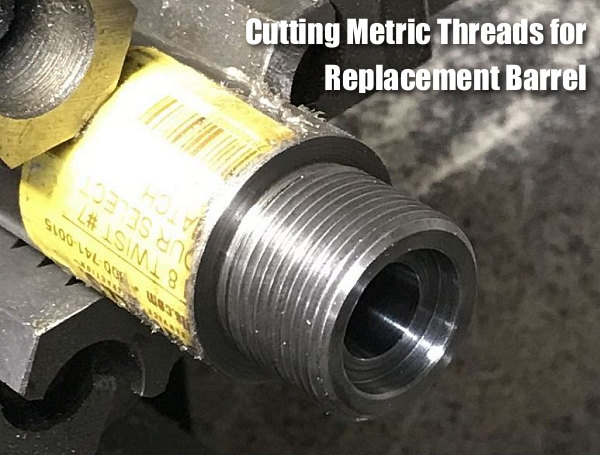
Howa Actions Require Metric Barrel Threads
It’s easy to thread a barrel for a Howa Action. You just have to cut metric threads — most lathes out there can cut them. I cut the threads below on a manual lathe using change gears. [Editor: John Whidden cuts metric tenon threads with a CNC lathe. “It’s easy,” John tells us, “No issue whatsoever.”]
Many of our readers are thinking of trying out PRS-type competition. Tactical matches are becoming more popular every season. Along with F-Class, tactical/practical disciplines are the fastest-growing forms of competitive rifle shooting. Rich Emmons, one of the founders of the Precision Rifle Series (PRS), has written an insightful article about getting started in the tactical game. This will help PRS novices pick the right equipment and understand the game. Here are highlights from Emmon’s “PRS — Intro to Competition” article, originally published on the PRS website. You may also want to read the current PRS FAQ Page.
Precision Rifle Series — Intro to Competition
by Rich Emmons, PRS President
Tactical Shooting with a precision rifle is not like other disciplines, there is no set course of fire or format. That is what makes it so fun!
First, you have to ask yourself what do you want to accomplish. When I was introduced to long range shooting, immediately a light turned on for me, once I saw how easy it was to hit 300–600 yard targets. What I quickly learned from my first competition and the many that followed was there is so much to learn and shooting in competition put everything you thought you knew to the test. So back to the question: “What do YOU want to accomplish?”. The reality is you may not know yet, you just think it is cool to have a bad ass rifle and scope that can make almost any shot. Now if you’ve got that rifle and scope, it’s time to take it to the next level.
Watch PRS 2016 Championship
Getting Started — What to Expect
If you’re reading this, you have probably already have been bitten by the long range shooting bug. It can seem quite intimidating to just jump in with a new bunch of shooters you don’t know and shooting lingo you don’t quite understand yet. But here is the key — show up and shoot! I guarantee you if you show up to a match as a new shooter, other experienced shooters will guide you along and give you help on anything you need.
AUDIO: Click Button to hear Rich Emmons Talk about the Precision Rifle Series.
Now, a couple things you should just expect. You’re not as good as you think you are. Don’t expect to come into your first match and beat all the veterans. That just doesn’t happen unless you have had some really good coaching or other shooting competition experience to get you ready for this type of competition. If possible, find a local rifle club that has monthly long range matches, or any type of match will help prepare you for a larger PRS event. Getting involved with a rifle club and starting out shooting monthly matches is definitely the way to jump into competition shooting.
The Gear You Need
The first question that many ask is: “What kind of rifle/caliber/scope do I need?” The easiest answer to this is, the best you can afford. It’s no secret the gear is expensive. It took me several years of buying sub-par gear and eventually trading up to figure this out. Now, a guy can get a real sense of pride of doing it on the cheap, or with a factory rifle. I’ve seen many old Savage 10FPs take down custom rigs that cost 10 times as much. And if that’s all you can afford, then eventually you will learn the limitations of yourself or your gear. As for choice of cartridge/caliber, the respected Precision Rifle Blog has analyzed three years worth of match results (2014, 2015, 2016) from the best tactical shooters in the nation. CLICK HERE to read an article that reveals what the “top guns” use. (CLICK HERE for PRB cartridge survey covering 2012-2014.)
Making Good Ammo
Producing quality reloads is something you have to master. It’s not hard at all, you just have to pay attention to detail, and eventually you are going to do something stupid like mis-priming your brass, or skip a row of brass when dumping your powder. Everybody has their own horror story of some reloading failure that cost them a stage or even a match. So load to perfection, work with your rifle to find what load it likes the best, then start your practice.
Practice Makes Perfect
You want to become ONE with your rifle, learning everything you can about its functionality. Getting comfortable with the operation of your rifle is key. Learn the feel of your trigger, dry-firing until you wear the paint off your bolt handle. Learn how the rifle works best — pay attention to little things like the sound and feel of the bolt feeding a round from the mag (or when it doesn’t). Learn how to remove a jammed round quickly, learn how to reload a magazine quickly. Learn to scan across a field and find targets in a quick manner, seeing the targets with your eye and coming into the scope on target. These are some of the basic practices that separate the new shooters from the seasoned ones.
Seems like new cartridges are being introduced every few months, particularly for the AR15 platform. This past January, Nosler gave us the .22 Nosler, a potent cartridge with better ballistics than the “plain vanilla” .223 Remington. American Rifleman reported: “Nosler is claiming its new [.22 Nosler] cartridge … can get 300 FPS and 25% more energy out of the AR platform” compared to the .223 Rem.
New .224 Valkyrie from Federal
Now Federal has introduced a .22-Caliber Hot Rod cartridge — the .224 Valkyrie. Designed to rival the .22 Nosler while still running well in ARs, the new .224 Valkyrie offers excellent long-range performance when loaded with modern, high-BC bullets.
Federal claims its .224 Valkyrie ammo loaded with the Sierra 90 MatchKing stays supersonic all the way out to 1300 yards. Watch the video above for details. Design-wise, the .224 Valkyrie has a medium-length neck, 30° shoulder. Unofficially, we are told this new cartridge is “based on on the .30 Remington/6.8 SPC case, necked down to .22 caliber”. (Source: TheFireArmBlog). It’s similar in appearance to a 6.5 Grendel necked to .22-Caliber, but the body is longer. Case capacity has been measured at 34.5 grs H2O, about 1.3 grains less than the .22 Nosler.
Federal currently offers four types of .224 Valkyrie Ammunition: 75gr TMJ “American Eagle”, 60gr Nosler Ballistic Tip “Varmint”, 90gr SP “Fusion MSR”, and 90gr HP SMK “Premium”.
COMMENTARY — Do We Need Another .22-Caliber Cartridge?
Is the .224 Valkyrie really needed? Bolt-gunners can just shoot a 22-250 (or a 22 Dasher if you want a more efficient cartridge). But for guys who want a hot-performing .22-Caliber round that feeds and functions 100% in AR-Platform rifles, this .22 Valkyrie may make sense. Just as the .22 Nosler has found favor with some shooters, there may be a market for the .224 Valkyrie — both among varmint hunters and PRS Gas Gun Series competitors.
Conceivably some bolt-action PRS shooters might adopt the .224 Valkyrie. Why? Reduced recoil. With the 90gr SMK, the .224 Valkyrie offers ballistics similar to the 6.5 Creedmoor but with significantly less felt recoil. Check out this a chart from Federal showing comparative recoil levels (highlights added).
Even with the heavy-for-caliber 90gr SMK, the .224 Valkyrie delivers significantly less felt recoil than a 6.5 Creedmoor shooting 130gr or 140gr bullets. You get a similar trajectory and good wind-bucking ability, with less push. The reduced recoil CAN make a difference, particularly during rapid-fire strings. Since PRS is shot “on the clock”, less recoil could provide a competitive advantage.
Cheaper to Shoot? Maybe, But Consider Barrel Life…
Cost considerations might also drive some PRS shooters to the .224 Valkyrie. Quality .22-Cal bullets definitely cost less than match-grade 6.5 mm projectiles. Therefore, high-volume shooters may find the .224 Valkyrie more affordable to shoot. On the other hand, barrel life for the .224 Valkyrie will likely be shorter than with the 6.5 Creedmoor, so you may end up paying more in the long run. What you save on the cost of bullets you may have to invest in new barrels.
Sierra Bullets has recently released load data for the 6mm Creedmoor cartridge, a necked-down version of the 6.5 Creedmoor, a popular PRS, tactical, and hunting cartridge. Sierra has released very comprehensive 6mm Creedmoor load data, covering fifteen (15) different bullets from 55 to 110 grains. NOTE: Hornady-brand brass was used for Sierra’s 6mm Creedmoor load tests, not the newer, stronger Lapua 6.5 CM brass with small primer pockets. Hand-loaders using Lapua 6.5 Creedmoor brass necked to 6mm may have to adjust their loads.
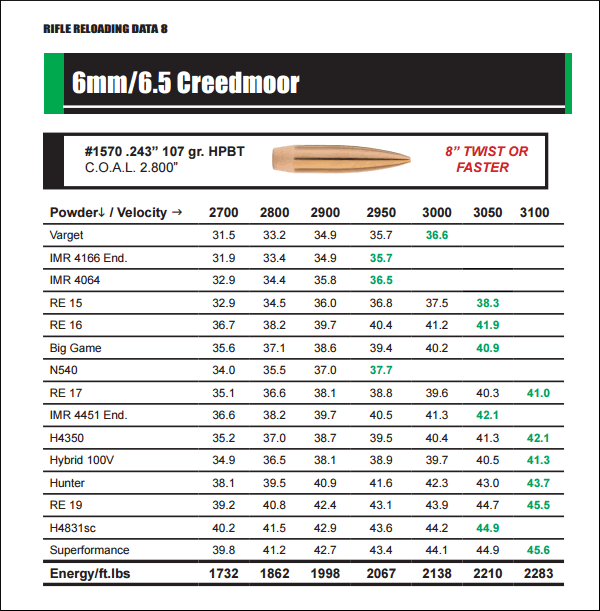
Sierra writes: “As soon as the 6.5 Creedmoor was released in 2007, a 6mm version was being envisioned. After the 6mm Creedmoor demonstrated its worth at 1000 yards it began to catch the attention of Precision Rifle Series (PRS) competitors. The 6mm/6.5 Creedmoor is a great fit for those looking for an AR platform-friendly cartridge. It delivers velocities very similar to the .243 Win and yet fits the AR10 magazine length[.] The 30-degree shoulder makes this a very efficient case and helps prolong case life as well. The 6mm/6.5 Creedmoor works well with powders such as H4350, RE-17, and Ramshot Hunter for heavier long-range bullet weights. Slightly faster powders such as RE-15, Win 760, and Vihtavuori N540 work well with lighter weight bullets.”
Sierra Bullets Tested for 6mm Creedmoor Load Data
55gr BlitzKing (#1502)
60gr HP (#1500)
70gr HPBT (#1505)
70gr BlitzKing (#1507)
75gr HP (#1510)
In developing its 6mm Creedmoor load data, Sierra tested a very wide selection of propellants, two dozen overall. For the smaller bullets, fast-burning powders such as Benchmark, H4895, and CFE223 were tested. For the heavier 100+ grain bullets, Sierra tested a selection of medium-burn-rate powders including H4350, Reloder 16, Reloder 17, Varget, and Superformance. Sierra did a very thorough job. We know this information will be welcomed by 6mm Creedmoor shooters.
Don’t know what powder to try first? For the 107-110 grain bullets, if you want best accuracy and low ES/SD, our Forum members recommend Alliant Reloder 16 and Hodgdon H4350. If you are seeking max velocity with the 110-grainer, look at Hodgdon Superformance and Reloder 19.
Here are Sierra’s 6mm Creedmoor Load Data Charts for the 107gr MK and 110gr MK. There are a half-dozen other tables for lighter-weight bullets.
Hornady has introduced a new Short Magnum cartridge, the 6.5 PRC (Precision Rifle Cartridge). This will be offered as factory ammo in both a “Match” version (with 147gr ELD) and a “Precision Hunter” version (with 143gr ELD-X bullet). Presumably, in the future, Hornady will offer 6.5 PRC brass separately for hand-loaders, but Hornady has no time-line for brass availability. However, you can get 6.5 PRC brass right now from GA Precision at $86.00 per 100 cases. GA Precision’s George Gardner, who helped develop this cartridge, has posted: “It’s a non-rebated short mag based on a short RCM [Ruger Compact Magnum] case. It has 3-4 grains less capacity than the 6.5 SAUM which nets about 30-50 fps deficit to the SAUM.”
The 6.5 PRC Match seems to be aimed at the PRS crowd and long-range tactical shooters. The product launch photo shows a tactical rifle and steel plate. Hornady says the 6.5 PRC was “designed to achieve the highest levels of accuracy, flat trajectory, and extended range performance in a sensibly-designed compact package. Utilizing moderate powder charges that result in repeatable accuracy, low recoil, and reasonable barrel life, the 6.5 PRC produces high velocities for target shooting with performance well beyond 1000 yards.”
“High Velocities”? Wait a minute — here’s the ballistics chart from Hornady’s 6.5 PRC page. It shows a muzzle velocity of 2910 FPS. That’s not much better than a 6.5 Creedmoor (which can push 140s over 2800 fps), so we wonder about this. You have to ask — what is the point? Is there anything this 6.5 PRC can do that the venerable 6.5-284 can’t do just as well or better — with a standard bolt face?
New 6.5 PRC Is a Short Magnum Requiring Magnum Bolt Face
Dubbed the “big brother” to the 6.5 Creedmoor, the 6.5 PRC fits in short or medium actions with a standard magnum bolt face (.532”). The case geometry features a long cartridge case neck and 30-degree case shoulder. It sort of looks like a 6.5 Creedmoor on steroids. For its loaded 6.5 PRC Match Ammo, Hornady is showing a 2910 fps Muzzle Velocity with the 147gr ELD Match bullet. That’s not very impressive. Why go to the trouble?
Comment — Does This New 6.5 PRC Cartridge Fill a Need?
Honestly, we don’t get this. If you need more speed than a 6.5 Creedmoor and want to stick with a .264-diameter bullet, then shoot a .260 Rem or 6.5-284 using a standard bolt. This requires a magnum bolt face. The 6.5-284 is a barrel burner; the 6.5 PRC promises to be likewise. On the other hand it may work better than a 6.5-284 in a short-action magazine — that may be what Hornady is thinking…
The 6.5 PRC clearly seems to be targeted at the PRS crowd. But we see many top PRS competitors moving DOWN in cartridge size, rather than up. Many PRS guys have stepped down from the 6.5 Creedmoor to the 6mm Creedmoor, or even a 6mm Dasher. The benefit is less recoil, and cheaper bullets. Are there really many PRS shooters clamoring for a short magnum? We don’t think so.
We’ll see if this new 6.5 PRC cartridge catches on — maybe some PRS guys will want this for long-range side matches. Rifle makers currently chambering the 6.5 PRC include GA Precision, Gunwerks, PROOF Research, Stuteville Precision and Seekins Precision.
6.5 PRC Ammunition for Hunters — Also New for 2018
Hornady will also sell a version of 6.5 PRC ammo design for hunters. The Precision Hunter version, shown below, is loaded with the 143-grain ELD-X Bullet. Again, however, we really don’t know why any hunter would want to shoot this cartridge, when you already have so many good choices, such as the 6.5x55mm Swede, and the original .284 Winchester, both of which can use a standard bolt face.
If you have a hunting rifle with a magnum-size bolt, why not shoot the 7mm RSAUM or 7mm WSM? Barrel life is not really an issue for hunters, so the smaller case capacity of the 6.5 PRC is not really an advantage. Perhaps the veteran hunters among our readers can enlighten us, using the comments section. Would you build a hunting rifle chambered for the 6.5 PRC?
Thinking of trying out the Precision Rifle Series, starting off with a gas gun? Well Gavin Gear of UltimateReloader.com did just that, competing in his first-ever PRS match up in Washington State. With its timed stages (some just 90 seconds long), Gavin learned that PRS is about speed as well as accuracy. As a PRS newbie, Gavin found the competition fun but challenging. Gavin’s account of his experiences, set forth in two articles with accompanying videos, will help other novice PRS competitors prepare for PRS-type matches and assemble the right equipment.
What PRS is All About
PRS is all about pushing your rifle skills to edge. You may have to hit targets at four different distances in 90 seconds- and dial in your dope between each shot. These kinds of challenges are super-difficult, but with enough experience and practice, it’s amazing what you can do. I saw guys that were so smooth, steady, fast, and accurate, it was mind blowing! It doesn’t come easy, and the guys at the top of the heap are super-dedicated. — Gavin Gear
This video has cool Aerial Drone footage, and in-depth explanation of stages:
Gavin’s First PRS Match: The Experience
By: Ultimate Reloader
Gavin told us that he’s wanted to try out the PRS game: “For a long time I’ve talked with friends about trying out a PRS-style match. Life has been busy, but when the right opportunity came, I decided to give it a try. My friend and shooting partner Jim Findlay offered to help me prepare, and told me it would be ‘fun to shoot gas guns together’. I decided I would shoot an AR-15, and thought that would be an ideal opportunity to try something new — the 22 Nosler. I wasn’t sure exactly what I was getting myself into, but that’s typically the way things happen when you’re really trying something new. It was a great experience, and it taught me a lot about shooting. I also made some great connections and friends during the match. If you are at all interested in PRS (Precision Rifle Series, or just Precision Rifle in general) I would suggest you enter and compete in a match. You most likely won’t regret it.”
Gavin enjoyed his first match: “Overall, the match was more fun and more laid back than I thought it would be. The guys in our squad were all really helpful, and even loaned me gear to try out when they noticed my gear wasn’t right for a particular shooting activity. One such case was when Ken Gustafson (of KYL Gear) offered to loan me one of the bags he had made. Below you can see me shooting off the infamous unstable tippy tank trap with a KYL Gear bag, and I’ll have to say [the bag] was amazing. It helped me lock down my rifle and get on target. What a great feeling!”
Gavin did experience issues with his “stout” 22 Nosler loads: “I did run into some trouble — I had loaded my 22 Nosler rounds to max charge weight with Varget powder and experienced some failure-to-feed issues during the match. Initially I thought my bolt needed more lubrication, but [it was] between 96 – 100°F during the hottest part of the Match day.” With the ultra-high ambient temperatures, Gavin experienced over-pressure. Word to the wise — “Test everything you plan to use on match day, and take into account things like weather conditions as well”.
Gear Choices and Selection
Gavin tells us: “In order to be successful in a PRS match, you need a rifle that is accurate enough, extremely reliable, has great ergonomics, handles well, and fits your budget.”
22 Nosler AR-15 rifle used by Gavin in the PRS match
18″ 1:8-twist 22 Nosler Upper
Two Stage Match Trigger – .154″ Hi-Speed DMR (GEISSELE AUTOMATICS)
Hogue AR-15 rubber grip
Magpul PRS stock
Harris S-BRM 6-9″ bipod
Vortex Viper HS-T 6-24x50mm scope
Action Type — Bolt vs. Semi: While most PRS competitors use bolt-action rifles, there are classes of competition that specifically call for semi-automatic actions to be used. Even so, in Open Class where you can pick which action type you’d like to use, there’s a split between the two for various reasons. I used an AR-15 in my first match, and for comparison, I think I’ll use a bolt-action rifle in my next match!
Support — Bipods and Bags: I think the first thing I said when trying to shoot from a barricade was: ‘You have to be kidding’. For someone used to prone shots from a bipod (when shooting long-range) this new challenge seemed impossible. My reticle was literally all over the place trying to shoot a target at 400 yards. But over time things improved drastically! Part of this improvement came from practice and technique, and part came from using the right support systems, such as the Game Changer Bag from Armaggedon Gear:
Photo Courtesy Accurate Ordnance.
All the Gear Items You Need — Bags, Bipods, Optics and More
UltimateReloader.com’s PRS Gear Summary covers Rifle Choice (gas gun vs. bolt-action), chambering options, optics, support systems (bipods and bags), dope cards, accessories and much more. Both novice and experienced PRS competitors will find this article well worth reading.
Christensen Arms just unveiled a new rifle for PRS competitions and tactical applications. Christensen’s innovative Modern Precision Rifle features an all-new, proprietary chassis system and weighs less than seven pounds (for the 16″-bbl .308 Win version). The Modern Precision Rifle sports high-tech features, such as carbon fiber handguards/fore-end and cheek-piece, and black nitride-coated bolt, receiver, and muzzle brake. The rifle comes complete with a +20 MOA scope rail and a true folding stock with magnetic closure. The Christensen MPR carries a $2295.00 MSRP. That’s a grand more than a Ruger Precision Rifle, but the Christensen MPR’s action runs smoother and the gun is much, much lighter. The fore-end also feel better in the hand and the Christensen Arms rifle balances better than the Ruger.
The Christensen MPR is made from top-quality materials throughout. The chassis is machined from 7075 billet aluminum and features V-block bedding to promote superior accuracy. Other features include an adjustable folding stock with a locking hinge mechanism, and oversized, fluted bolt knob. The Modern Precision Rifle is built with a carbon fiber-wrapped barrel, free-floating handguard, and adjustable comb. The rifle is guaranteed to shoot sub-MOA.
Initial chamberings include 6.5 Creedmoor and .308 Winchester in a variety of barrel lengths. Additional calibers, including long-action offerings, are expected in 2018. The Modern Precision Rifle will hit dealers’ shelves within the next 6-8 weeks with an MSRP of $2295.00.
Carbon Components Keep Weight Down
Visit the Christensen Arms website for full specifications, technical drawings, and more photos.








 Howa 1500 HACT 2-Stage Trigger