Hodgdon Powder Company, Inc. launched a Facebook Page earlier this month. The new page, launched September 10, gives Hodgdon customers an outlet to discuss reloading, hunting, target shooting and other powder-related topics. “We envision this page as a community for our friends, fans, and experts to get together and talk shop. If you have a question, a great hunting story to tell, or just want to brag about a nice tight group this is the place for you”, said Chris Hodgdon, the company’s Public Relations Manager. “While so much of handloading is in the data and details, we also know there’s a huge social component to it as well.”
We’re pleased to see that Hodgdon’s Facebook page is regularly updated. Much to our amazement, Chris Hodgdon himself is answering user reloading and product questions. How many companies let you communicate directly with a top company decision-maker?
New Content Daily
Unlike some companies that roll out a Facebook page with much hooplah but then let it languish, Hodgdon has been adding new, interesting content daily, including cartridge histories, product release info, hunting stories, and even match reports. Just today, Hodgdon posted an informational diagram for the .30-06 cartridge:
Gear Review by Boyd Allen
Just about everyone knows that Wilson and Redding make neck-sizing bushings. But few shooters seem to be aware that RCBS produces bushings. In fact, RCBS does make quality neck-sizing bushings, including very nice Tungsten Disulfide-coated bushings.
As a companion product for their Gold Medal bushing-style dies, RCBS produces its own line of sizing bushings, that have a couple of notable features. First, along with plain steel bushings, RCBS offers bushings with a distinctive, dark gray Tungsten Disulfide (WS2) anti-friction coating. Redding offers bushings in bare “white” steel or with a gold-colored Titanium-Nitride anti-friction coating. Wilson bushings are plain steel with a shiny silver finish. Though the Redding and Wilson plain steel bushings may look like stainless, remember that these un-coated bushings need to be kept oiled or they WILL rust. In normal use, you shouldn’t have to worry about rust on the Tungsten Disulfide-coated RCBS bushings.
Comparing coated bushings, Redding’s gold TiN-coated bushings look pretty, but the WS2 anti-friction coating on RCBS bushings seems to work as well. Tungsten Disulfide (WS2) has an extremely low coefficient of friction — 0.03 compared to 0.6 for Titanium Nitride. Accordingly, the RCBS WS2-coated bushings can work with minimal neck lubrication. When I actually sized necks with the RCBS WS2-coated bushings, the “smoothness” of the neck-sizing operation seemed on a par with other quality, coated bushings.
Another notable difference with the RCBS bushings (compared to other brands) is that RCBS stamps the bushing size onto the outside of the bushing, rather than on the top. RCBS puts the bushing diameter on a reduced-diameter band that runs around the circumference of each RCBS bushing. I think that this is a good idea because it eliminates the possibility that raised edges from the stamping itself might interfere with proper bushing alignment*. (Remember that the top of the bushing — where size marks are stamped by other bushing-makers — contacts the retaining cap in the die during sizing.) Putting the size marks on the outside also makes it easy to distinguish RCBS bushings from other bushing brands.
The other feature that I like is the shape of the entry chamfer on the bottom of the RCBS bushing. This chamfer is large and angular, rather than curved. This is only a guess, but I think that it may do a better job of letting the bushing align itself with the case as it is inserted into the die, and do a better job on brass from chambers that allow more neck expansion. (The picture shows the smaller chamfer at the top of the bushing.)
That about wraps it up, with the exception of one small point. While MidwayUSA has a wide selection of RCBS bushings, other retailers need to do a better job of stocking these bushings. I got mine from RCBS, but you may have trouble finding them in many online catalogs, or on dealers’ shelves. Hopefully this small review will help to increase awareness of RCBS bushings, and more retailers will carry them.
*As you probably know, stamping displaces metal, some of which is raised above the level of the surface that was stamped. Although it can be argued that shooters have gotten some pretty spectacular results in spite of any cocking of neck bushings caused by their being stamped on top, I am sure that a lot of us would prefer to have things as straight as they can be, and moving the stamping to a recessed band that runs around the outside of the bushing helps accomplish this.
Brownells now offers a full line of name-brand reloading equipment and supplies — all backed by Brownells unconditional lifetime guarantee. The new Brownells reloading product line features Dies, Presses, and Tools from RCBS, Lee Precision, Lyman, Redding, Sinclair International, and many more. Along with reloading tools and equipment, Brownells will offer reloading components (Brass, Bullets, Primers, Powder, etc.) from major manufacturers including Hornady, Nosler, Sierra, Hodgdon, Remington, Winchester, and others.
To kick off the launch of its new Reloading product line, Brownells is running a limited-time promotion. For orders containing reloading products, customers can receive a $10 discount on orders totaling more than $99, a $20 discount on orders totaling more than $199, or a $30 discount on orders totaling more than $299. Don’t delay. These special discounts are valid Thursday, August 16, 2012 through Monday, August 20, 2012. Use product codes DRR ($99+), DRS ($199+), or DRT ($299+) during check-out.
“We are excited to launch our new reloading category,” said Pete Brownell, President/CEO of Brownells. “Much like the addition of our ammunition line last year, the ‘You asked, we listened’ philosophy played a major part in our decision. We found that many of our customers enjoy reloading and find it to be a cost saver, so we’re happy to provide them with the supplies they want.”
Talented tool-maker Curt Knitt has designed a better mousetrap — a new Concentricity Gauge that makes it easier than ever to get fast, repeatable results when measuring case and bullet run-out (aka “eccentricity”). The breakthrough design feature is the large-diameter wheel which spins the case. With most other concentricity gauges you must rotate the case with your finger(s). Anyone who has tried this knows that it is difficult to get a full, 360° rotation of the case without disturbing the indicator. Typically you can get two-thirds of a rotation or so, but then you have to reposition your finger to complete the rotation. Moving your finger often causes the case to jiggle or move slightly, and more often than not, the dial indicator jumps a bit, interrupting your measurement. Been there, done that.
Drive Wheel Smoothly Spins Cases for Fast, Error-Free Readouts
With the new Accuracy One Concentricity Gauge from CTK Precision, the rubber-rimmed drive wheel has a much larger diameter than any cartridge case (7:1 diameter ratio on magnums). So, when you rotate the drive wheel just a half-turn or so (using knurled knob on the wheel axis), you can easily and smoothly turn the cartridge three (or more) full rotations. The drive wheel maintains a constant, even load on the case, so the case doesn’t wobble and the dial indicator gives a continuous, un-interrupted read-out. What’s more, clever cartridge support design geometry pulls the case back against the rim stop as you engage the drive wheel. This holds the case in position laterally during measurement. Morever, this allows very fast one-handed operation. You don’t have to hold the case down with your fingers while maintaining side force against the case rim stop.
Watch Video Showing Concentricity Gauge Used with Small and Large Cartridges
The Accuracy One Concentricity Gauge works with the full range of cartridges — everything from .22LR to .50 BMG. Adjusting the tool for different-length cases is incredibly easy, because the roller blocks (case supports) are held in place by magnets. You just slide the blocks to the desired position — no tools needed! The indicator stand is also held by magnets so it can slide to any position you want along the case body or bullet. And, the indicator can be moved to the front rail and rotated 90°. This way you can measure on the inside of the case neck.
Does this new design really work? Absolutely — it works brilliantly and it’s FAST. Watch the video and see for yourself. We could do two-rotation (720°) measurements on cases in a third the time it takes to do a one-rotation gauging operation with other tools. And the actual measuring operation can be done one-handed, leaving your free hand to pic up the next case (or bullet) to be measured. And yes, this tool can also measure bullet concentricity — measured from tip, ogive, bearing surface, and/or boatail.
1. Directional Drive Wheel pushes the cartridge or bullet into the stop for accurate, repeatable readings with equal pressure. The replaceable rubber drive ring will not harm cartridges or bullets.
2. Two-position bullet and cartridge stop.
3. Precision ball bearings provide friction-free movement.
4. Heavy steel base with E-coat finish and bolt-on rubber feet.
5. Indicator stand and roller blocks ride in machined slots and are held in place by N42 Neodymium magnets. This allows rapid, smooth, tool-free adjustments.
6. Indicator stand can be place in front OR rear machined slots. This allows for both internal and external measurements.
7. Fine-Adjustment Horizontal Indicator Stand allows very precise indicator angle/load adjustments.
8. Indicator Stand will accept horizontal indicators that are .350″ wide or narrower, and are 1.75″ to 2.25″ from the indicator contact point to the center of the main body.
9. Adjustable mechanical arm stop holds the arm up for one-handed operation.
10. Precision Drive Wheel has a 13:1 ratio for .22 rimfire, 7:1 for magnums, and 3.7:1 for 50BMG.
11. Concentricity Gauge accepts cartridges from .22LR rimfire to .50 BMG.
The Accuracy One Concentricity Gauge is available from BulletTipping.com. Price for the unit, complete with quality horizontal indicator, is $325.00. Price, without indicator, is $280.00. The initial run of Concentricity Gauges is now in final production. Gauge sets should hit the market in 4 to 6 weeks. To place an advance order, fill out the PDF Order Form, or call (814) 684-5322. To learn more about setting up and using this new tool, read the Concentricity Gauge Instructions, and watch the video above.
To achieve best accuracy with a rifle, you must control bullet seating depth very precisely, so all bullets end up in the same place relative to the entrance of the lands, every time. There may be multiple cartridge OALs which prove accurate. However, with each, you first need to determine a “zero” point — a reliable, and repeatable OAL where the bullet is “just touching” the lands.
There are tools, such as the Hornady (formerly Stoney Point) OAL Gauge, that will help you find a seating OAL just touching the lands. However, the tool requires that you use a special modified case for each cartridge you shoot. And, while we find that the Hornady OAL Gauge is repeatable, it does take some practice to get in right.
Make Your Own Length-to-Lands Gauge with a Dremel
Here’s an inexpensive alternative to the Hornady OAL tool — a slotted case. Forum member Andris Silins explains how to create a slotted case to measure length to the lands in your rifle:
“Here’s what I did to find length to lands for seating my bullets. I made four cuts into the neck of fire-formed brass. Then I pressed the bullet in lightly and chambered the entire gauge. As the cartridge chambers, the bullet slides back into the case to give you length to lands. It took less than five minutes to get it cut and working. A little light oil in the barrel just past the chamber helps ensure the bullet does not get stuck in the lands. It works great and is very accurate.
I made the cuts using a Dremel with a cut-off wheel. You can adjust tension two ways. First, you can make the cuts longer or shorter. Longer cuts = less tension. If you used only three cuts instead of four you would get more tension. The trick is to be gentle when you open and close the bolt. If you ram the bolt closed you may wedge the bullet into the lands. When you open the bolt it helps to keep a finger or two near by to guide the case out straight because the ejector wants to push it sideways.”
MidwayUSA has knocked $1.50 off the prices of LoadBooks reload manuals for three of the most popular centerfire calibers: .223 Rem, .308 Win, and .30-06. As discounted, these manuals now cost $5.49 (regular price $6.99). In addition, the most popular pistol load manuals are also marked down to $5.49 (9mm, .38 Spl, .357 Mag, 40sw, and .45 ACP, .45 Colt).
All of these caliber-specific reloading guides are packed with information from major US bullet- and powder-makers including Accurate, Alliant, Hodgdon, Hornady, IMR, Lyman, Nosler, RCBS, Sierra, Speer and Winchester. LoadBook manuals are printed on heavyweight paper and spiral-bound so they will lay flat on any surface. Most load manuals have about 54 pages. NOTE: since most of these manuals have not been updated within the last 5 years, you won’t find the latest bullet designs or recently-introduced powders such as Hodgdon Hybrid 100V or Alliant Reloder 17.
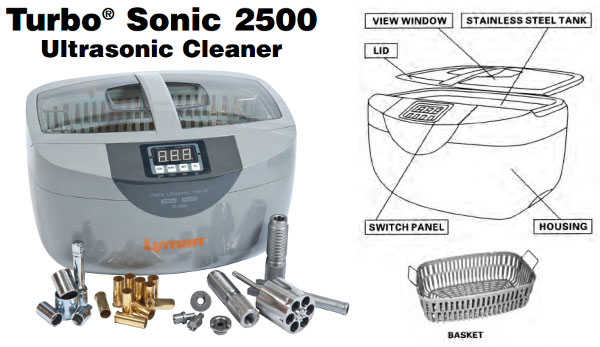
Lyman has introduced two new Turbo®Sonic Ultrasonic Cleaning units, a large 6.3-quart model TS-6000 and a smaller 23.6 oz. model TS-700. Along with the original mid-sized TS-2500 model introduced in 2011, Lyman now offers a full line-up of three (3) ultrasonic cleaning units: large, medium, and small. By most reports the TS-2500 worked well, so we expect the new TS-6000 and TS-700 will also handle ultrasonic cleaning duties well.
TS-6000
The large Model TS-6000 processes up to 1300 9mm cases or four handgun frames in less than 15 minutes (when the built-in heater is used). This workhorse is powered by two industrial-grade transducers and has an integral drain and hose for easy solution changes. The unit’s two-color LED display panel controls five different timed cleaning cycles.
TS-700
The small-footprint Model TS-700 fits in tight spaces. This unheated model handles up to 100 9mm cartridge cases. The compact TS-700 can also clean parts such as dies, muzzle brakes, and mould blocks. Note: Lyman recommends using its Steel & Stainless Steel Solution for dies and other steel components. The TS-700 features oscillation circuitry and five (5) timed cleaning cycles.
TS-2500
The mid-sized TS-2500 model, with heated tank, shown below, process up to 900 9mm cases per cleaning cycle. Introduced in 2011, this product has been widely adopted by hand-loaders. The TS-2500 will clean cases inside and out, including primer pockets, in less than 15 minutes.
Lyman TS-6000 and TS-2500 Units Can Heat Solution for Faster Cleaning
Ultrasonic cleaning machines employ ultrasonic cavitation to gently lift and dissolve carbon, dirt, lubricants, and other residues left on fired cases and small metal parts. Lyman’s TS-6000 and TS-2500 TurboSonic cleaning units feature tank heaters to warm the cleaning solution. Because ultrasonic cavitation works faster and better with a warm solution, Lyman claims its machines’ built-in heaters will speed up your cleaning job, by cutting processing time.
Lyman Cleaning Solutions (Three Types) — Lyman now offers its Brass Cleaning Solution and Steel & Stainless Steel Cleaning Solutions in 4 oz., 16 oz. and 32 oz. sized bottles. For even more versatility a new 16 oz. Jewelry Solution is available. For more information visit www.lymanproducts.com.
A handy eBook version of the popular resource ABCs of Reloading is now on sale for $1.99. That’s right — for the price of a cup of coffee at Starbucks, you can get a very useful 288-page introductory reloading treatise, complete with hundreds of photos. The print version of this book costs $17.81 at Amazon.
This eBook will not tell you about some advanced reloading methods used by benchrest shooters. However, you’ll find good basic information on important topics such as: powder storage, proper handling of primers, how to set full-length dies, press mounting and set-up, trimming brass, and measuring for run-out. For those who are new at reloading this is a very useful guide that contains the fundamentals you need to know to be a safe and productive reloader. If you have friends who are getting started in reloading, you can send this eBook to them. It’s a thoughtful, inexpensive gift.
Please note: This $1.99 edition is a digital book, NOT a paperback. It does have hundreds of photos and many charts. We found the text very easy to read on a Kindle, and most of the photos were plenty big. You can download a sample for free if you’re curious to see how the book displays before you buy.
What’s an eBook?
An eBook is a digital file with text, photos and graphics. You download the file from Amazon.com to your Kindle (hand-held) eReader, home computer, lap-top computer, iPad or smartphone. You may have to install a free eReader App on your computer or phone before you can access the file. Once the file is loaded you can search text, make bookmarks, and highlight text.
Do I Need a Kindle?
No. Even if you do not own an Amazon Kindle, you can read the eBook on any kind of computer, or you can read the eBook on a smartphone or iPad. But you may have to install a program (App) before the file can be opened. The reading Apps are FREE.
Amazon Prime Members Can Get eBook for FREE
If you have an Amazon Prime membership, you can download this eBook for FREE — provided you haven’t used up your “one book a month” allotment. Certain Amazon titles (like this) are in the Prime Member Lending Library. Each month, you’re allowed to download one Lending Library eBook for free. If you haven’t “borrowed” an eBook this month, and you’re an Amazon Prime member, you can get the digital edition of the ABCs of Reloading for FREE.
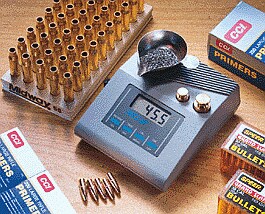
Here’s a tip that can help you score higher at matches and get more predictable results when weighing loads with an electronic scale. Kelly Bachand, a top prone shooter and electrical engineering major at the Univ. of Washington, tells us that all digital scales can drift. Therefore Kelly recommends re-calibrating electronic scales often. In addition — and this is key — Kelly recommends that you shoot the ammo in the exact order in which it was loaded. Arrange your loaded ammo in a box in the order of loading and shoot it first-loaded to last-loaded. (Or, if you prefer, shoot it last-loaded to first-loaded.) The important thing is to maintain the order and not mix everything up. That way, if your scale drifts, the effect of drift on charge weight will be incremental from one loaded round to the next, so point of impact change should be negligible. Conversely, if you shoot your last-loaded round right after your first-loaded round, the effect of scale drift is at its maximum, so powder charge varience is maximized. And that can produce a different point of impact (POI) on the target.
Tips on Loading with Electronic Scales by Kelly Bachand
If you use a digital scale to measure powder charges, recalibrate the scale often. I like to do this about every 25 rounds or so. Additionally, most electronic scales rely on eddy currents for their precision. Eddy currents are easily disrupted by static electricity so keep a cloth or ground strap nearby to remove any static currents should the scale start acting up; I usually just use a fabric softener sheet that has gone through the dryer once.
Shoot Ammo in Order of Loading
I shoot my rounds in the same order or reverse order as I load them. If the charge weight varies due to scale drift during use, the difference will be gradual if I shoot in the same order as production (or reverse order). I should be able to adjust for the slight varience in charge weight without having any wildly high or low shots (see the charts below for a graphical demonstration). I usually load my ammunition just 100 rounds at a time. Give yourself plenty of time and remember that you will make your best ammunition when you are fully awake and alert.
This graph demonstrates the effect a .01% (that’s 1/100th of 1 percent) difference in scale measurement would have over the course of 100 rounds assuming the desired load is somewhere between 46 and 47 grains. The final round made would have almost 1% less (or more) powder than the first, that’s almost an 0.5 grain difference from the first. If shot back to back, these rounds will invariably have different points of impact on the target.
This graph demonstrates the same .01% difference in scale measurement but this time with a recalibration every 25 rounds. By recalibrating the scale every 25 rounds the furthest a weighed charge ever gets from the original is less than 0.25%. Again if the charge being weighed is between 46 and 47 grains then the 26th round made would vary from the 1st by .12 grains. Even that small difference would likely show on target.
Either way it is important to note that if the bullets are shot in the same (or reverse) order as they are made, the biggest difference from bullet to bullet in this example is less than .01 grains.
by James Calhoon
(First Printed in Varmint Hunter Magazine, October, 1995)
In the course of talking to many shooters, it has become clear to me that the manufacturers of primers have done a less than adequate job of educating reloaders on the application of their primers. Everybody seems to realize that some primers are “hotter” than others and some seem to shoot better for them than others, but few reloaders know that primers have different pressure tolerances.
Primer Pressure Tolerance
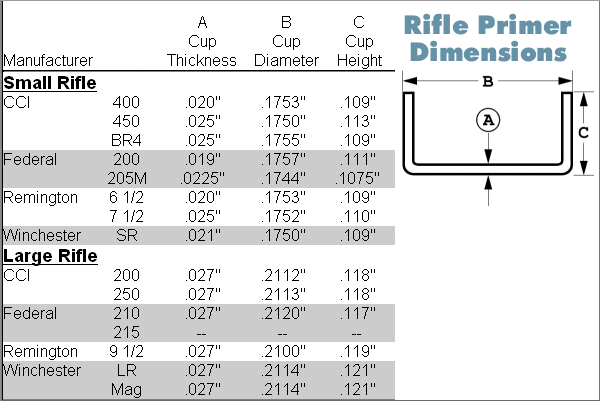
When loading a .223 to the maximum, I was getting primer piercing before I reached case overloading. I don’t know what prompted me to try CCI 450s instead of the 400s which I had been using, but I did. Presto! No more piercing! Interesting!? A primer that has a hotter ignition and yet withstands more pressure! Thats when I decided that it was time to do a dissection of all primers concerned. The chart below shows my results.
By studying the numbers (Cup “A” thickness), one can see which primers in the small rifle sections should be more resistant to primer cratering and/or piercing. Primer cup diameters are all similar and appear to follow a specification, but check out the cup thickness in the small rifle primers (Dimension “A”). Some cups are quite a bit thicker than others: .025″ for CCI 450 vs. .0019″ for Fed 200. Large rifle primers all appear to have the same cup thickness, no matter what the type. (As a note of interest, small pistol primers are .017″ thick and large pistol primers are .020″ thick.)
If you are shooting a 22 Cooper, Hornet, or a Bee, the .020″ cup will perform admirably. But try using the .020″ cup in a 17 Remington and you will pierce primers, even with moderate loads.
Considering that cup thickness varies in the small rifle primers, it is obvious that primer “flatness” cannot solely be used as a pressure indicator.
Another factor which determines the strength of a primer cup is the work-hardened state of the metal used to make the primer cup. Most primers are made with cartridge brass (70% copper, 30% zinc), which can vary from 46,000 psi, soft, to 76,000 psi tensile strength when fully hardened. Note that manufacturers specify the hardness of metal desired, so some cups are definitely “harder” that others.
What does all this mean to the reloader? - Cases that utilize small rifle primers and operate at moderate pressures (40,000 psi) can use CCI 400, Federal 200, Rem 6 1/2, or Win SR. Such cases include 22 CCM, 22 Hornet and the 218 Bee. Other cases that use the small rifle primer can use the above primers only if moderate loads are used. Keep to the lower end of reloading recommendations.
– Cases that utilize small rifle primers and operate at higher pressures (55,000 psi) should use CCI 450, CCI BR4, Fed 205 and Rem 7 1/2.
– All the large rifle primers measured have the same thickness. Therefore choose based on other factors, such as accuracy, low ES/SD, cost, cup hardness, and uniformity.
Hope this clears up some primer confusion. If you want more information about primers, priming compounds, or even how to make primers, the NRA sells an excellent book called “Ammunition Making” by George Frost. This book tells it like it is in the ammo making industry.


 Gear Review by Boyd Allen


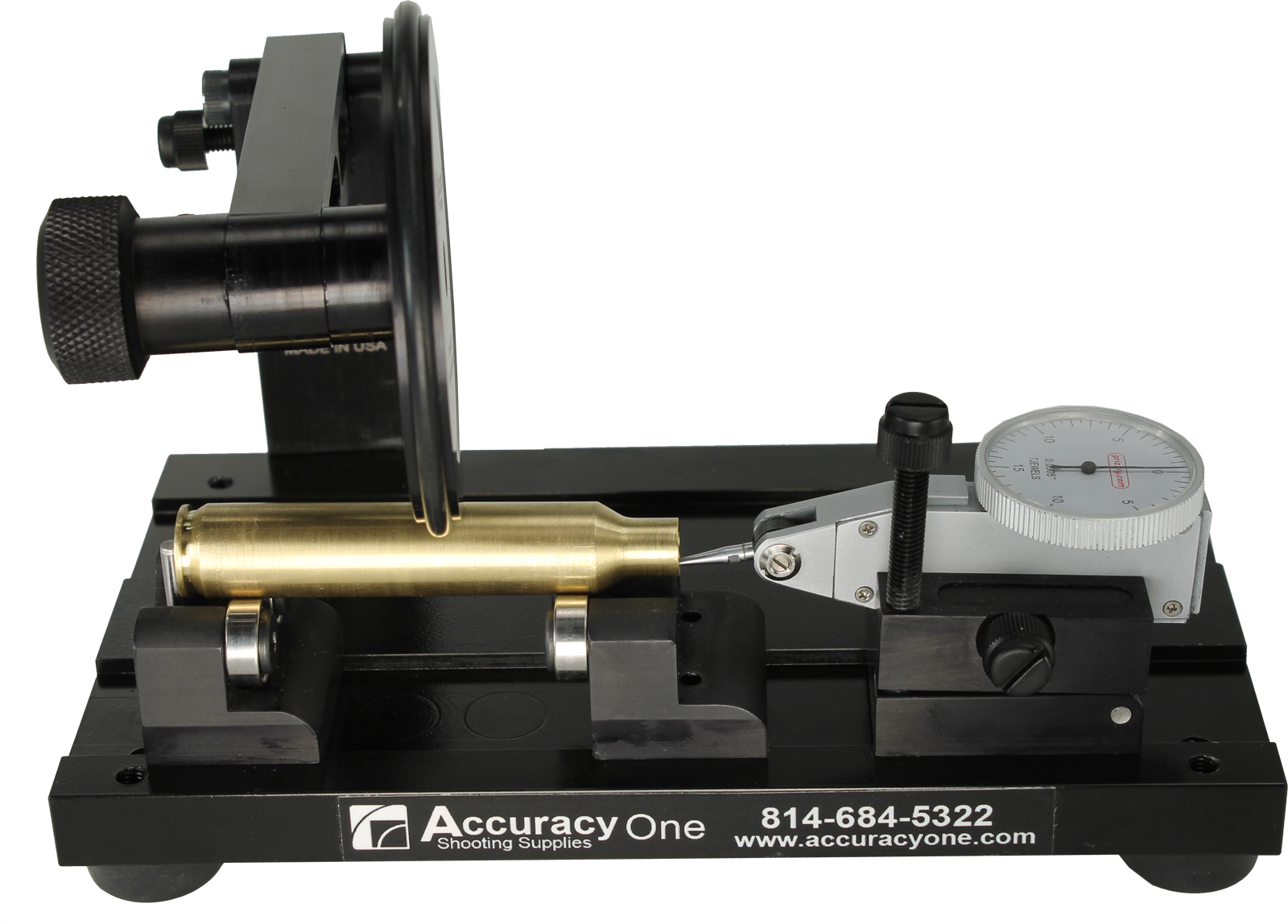
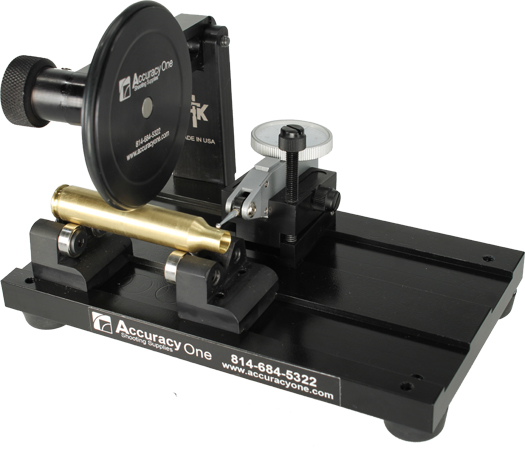
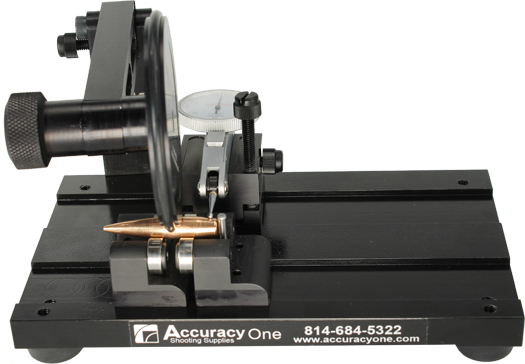
 The Accuracy One Concentricity Gauge works with the full range of cartridges — everything from .22LR to .50 BMG. Adjusting the tool for different-length cases is incredibly easy, because the roller blocks (case supports) are held in place by magnets. You just slide the blocks to the desired position — no tools needed! The indicator stand is also held by magnets so it can slide to any position you want along the case body or bullet. And, the indicator can be moved to the front rail and rotated 90°. This way you can measure on the inside of the case neck.



 Amazon Prime Members Can Get eBook for FREE
 Here’s a tip that can help you score higher at matches and get more predictable results when weighing loads with an electronic scale. Kelly Bachand, a top prone shooter and electrical engineering major at the Univ. of Washington, tells us that all digital scales can drift. Therefore Kelly recommends re-calibrating electronic scales often. In addition — and this is key — Kelly recommends that you shoot the ammo in the exact order in which it was loaded. Arrange your loaded ammo in a box in the order of loading and shoot it first-loaded to last-loaded. (Or, if you prefer, shoot it last-loaded to first-loaded.) The important thing is to maintain the order and not mix everything up. That way, if your scale drifts, the effect of drift on charge weight will be incremental from one loaded round to the next, so point of impact change should be negligible. Conversely, if you shoot your last-loaded round right after your first-loaded round, the effect of scale drift is at its maximum, so powder charge varience is maximized. And that can produce a different point of impact (POI) on the target.