|
|
June 3rd, 2011
RCBS has a launched a new website, www.ReloaderHub.com, an advanced online community dedicated to reloading. The website is designed as a social hub where readers can exchange load data and recipes, engage in forum discussions, and share outdoor- and shooting-related photos and videos. RCBS will also run regular contests and promotions on the site. Currently you can enter to win an RCBS Reloading Starter Kit, valued at $364.95 MSRP. You can use all site features at no charge — ReloaderHub.com site membership is free.

ReloaderHub.com features a handy Reloading Calculator that lets you quickly figure out the cost of your ammo, based on the price of your components and anticipated number of reloads on your brass. You’ll find dedicated photo and video archives, where members can post their own “home movies” and images. To stimulate file uploading and forum participation, the site also features a point system. The more content you upload, the more points you earn towards virtual badges (points have no retail value at this time).
|
COMMENTARY: Clearly RCBS put considerable time and effort into ReloaderHub.com. Generally speaking, it has a nice look and feel, and the photo archive area is easy to access. However, we think the site could benefit from some design changes.
First the Message Board area doesn’t use standard Forum Formatting. The layout of the primary Message Board topics page is poorly laid out, requiring too much scrolling. Then it gets worse once you get inside a particular Message Board Category, such as “Hunting Report”. There’s too much vertical space between thread titles, and once you manage to drill down to an actual thread, the displayed font is small and somewhat hard to read.
This leads to the site’s second major problem. ReloaderHub.com is supposed to be a place where users share load recipes. This, apparently, is to be done through the Message Board. But we predict people will have trouble placing logically-related topics in the Message Board, so the load recipe postings will soon become a mish-mash. RCBS should have created a dedicated area for load recipes with a clear, consistent formatting for data entry. RCBS could have provided pull-down menus for cartridge type and powder, with supplementary fields for charge weight, primer, OAL etc. That would organize the data logically so that user recipes could become part of a searchable database with consistent entries among all calibers. The way the site’s Message Board is currently organized, we think most visitors will struggle to find and sort through the load data entries.
|
May 27th, 2011
Benchrest Hall of Famer Speedy Gonzalez has prepared a comprehensive Guide to Benchrest Competition. It covers all aspects of the game: gear selection (hardware), reloading methods and tools, plus shooting skills and strategies. All of this is available on the web for free, thanks to Speedy and the Swedish Benchrest Shooters Association (SBRSA).
CLICK HERE to read Speedy’s Guide to Benchrest Shooting.

Speedy’s article is a gold-mine of info on shooting components and specialized reloading tools. It is also richly illustrated with high-quality photos showing gun components and reloading gear. Many of the photos show tools that have been sectioned so you can view the internal components.


Speedy also covers bullet design, and load tuning. There are thoughtful sections on Time Management and Target Management that will benefit all competitive shooters, no matter what their discipline.

April 25th, 2011
Selection from BARNES BULLETS’ Tips, Tools, and Techniques
by Ty Herring, Barnes Consumer Service
The purpose of this month’s Tip from Barnes is to make you aware of valid pressure signs in most centerfire rifle cartridges so you can keep yourself out of hot water. Following the Barnes Manual should do exactly that. Below are photos of cartridges that definitely had too much pressure. Fortunately [they] were fired in controlled circumstances and no one was injured. But this shows what can happen if you are not careful….

 High-Tech Pressure Testing Equipment High-Tech Pressure Testing Equipment
At Barnes Bullets, we use some of the best equipment when we develop load data for you. Ours is state-of-the-art with a specialized “conformal” pressure system. This set-up uses a high-tech SAAMI-spec pressure barrel with a hole bored into the chamber area and a piezoelectric transducer is installed. As the pressure peaks under firing, the gauge that is specially calibrated reads the pressure and sends a signal to the control box where a technician can see the results.
For many years hand loaders have used the old fashioned trial and error method, hoping that by adding another grain of powder you don’t blow yourself up. Certain “guidelines” have been the standard — such as when the primer gets flat, or when the bolt locks up — you should stop and reduce the charge. These methods have worked for many, but some of them are more myth than reality. I’d like to go over some of these common pressure signs to help you avoid the pitfalls.
Pressure Signs That May Be Unreliable or Deceptive
When I first started hand loading centerfire rifle cartridges, I was told that when the primer flattens I should back the load down. This is one of those semi-myths. Some primers will flatten under high pressure and others will not. I’ve had some Remington primers that have blown right out of the case without ever showing any sign of flattening and on the other hand I’ve had Winchester primers that flatten with only a starting charge. I believe this to be a function of the thickness and hardness of the primer cup. The other myth that seems common is primer “cratering”. Cratering of the primer can be caused by a hot load. But it can also be a result of a slightly large firing pin hole in the bolt or a firing pin that is a bit too long or excessive headspace. Split or cracked cases are another area where it’s assumed that high pressure is the cause. Again this is only myth. Although it can be a result of high pressure — split or cracked cases are more likely caused due to a flaw in the case, improper head space or just simply from being sized and fired repetitively.

[Editor’s Note: Flattened Primers, Primer Cratering, and Cracked Cases CAN DEFINITELY BE CAUSED by excessive pressure. Accordingly, you SHOULD be careful when you see any of these conditions. If you see very flat primers or deep cratering be alerted that you may have exceeded safe pressures. Ty Herring simply makes the point that these telltale pressure signs may sometimes occur even when pressure levels are “normal” or moderate — due to the presence of other problems. Hence these indicators may be misleading. Nonetheless — all these signs (flattened primers, cratered primers, split cases) CAN be valid warnings. If you see these conditions, exercise caution because you may, in fact, have excessively hot loads.]
Valid Pressure Signs You Should Understand
So what are valid pressure signs? I’d say the most common and repeatable pressure sign that one can visually see is the “ejector groove mark”. It shows itself on the bottom of the case [between the edge of the rim and] the primer. It is caused when the pressures within the chamber force the case against the bolt face. On most bolt faces there is a round spring loaded ejector pin. On others there is a rectangular groove to eject the spent round. Under very high pressure the brass case will flow into this groove thereby causing the “ejector groove mark”. If and when you see this mark, it is a sure sign of high pressure. Some of the new high pressure cartridges such as the WSMs are made to run at these higher pressures and some factory loads will manifest the ejector groove mark even though they are within their pressure specification.

Older-Generation Cartridges
Some cartridges have very low maximum pressure ratings such as the 45-70, 30-30, 416 Rigby along with many others that will never show an ejector groove mark. Or should I say, they should never show one. By the time you reach that high of pressure in one of these rifles, it is likely the gun will be in pieces and the bolt may become part of you.
Sticky Bolt Lift and Difficult Extraction
Another common and very real high pressure sign is heavy or sticky bolt lift or extraction. This is caused due to the brass flowing and swelling in the chamber under tremendous pressure. However heavy bolt lift is not always a sign of high pressure. It may be caused by a variety of other issues. Knowing your gun and how it usually extracts a cartridge will be a clue as to whether or not you are actually getting high pressure.
This article appears courtesy Barnes Bullets. The article originally appear in the June 2011 Barnes Bullet-N Newsletter. Story tip from Edlongrange.
April 14th, 2011
Thinking of combining rifle and pistol powder in a blended duplex load? Well think again. If you want to keep all your fingers, stick with factory powders and established loads at safe pressures. Here’s what can happen with a duplex load composed of both rifle and pistol powders. This catastrophic kaboom of an AR rifle took place at the Phoenix (AZ) Rod & Gun Club (PRGC) range. The photos, first posted on the ArizonaShooting.com forum, show how the AR blew up, ruining the bolt carrier, splitting the upper receiver, blowing out the Cavalry Arms polymer lower, and actually detaching the barrel.

Another shooter, who was nearby when the Kaboom occurred, reported: “I was standing 10 feet behind [the shooter], loading mags. The shot was no different than any other shots. I only looked up because the RO was yelling for assistance.”
Obstructed Barrel? Probably Not: “The target showed four hits — the fourth round Kaboomed the rifle. [If there was an obstructed barrel only three holes should be on the target.] A piece of the exploded cartridge is still in the chamber of the barrel. The barrel extension split into three major pieces with smaller pieces cutting the left inside forearm.”
Suspected Cause? “It was a combination of rifle and pistol powder. The rest of the batch was pulled and there were apparently 3-4 other rounds with mixed loads.” It has been reported that these were commercial .223 Rem reloads.
What Happened to the Operator? “The shooter is fine. He got whacked in the face with the charging handle, giving him a fat lip. Minor cuts on his face. His wrist got fragged with carbon fiber/free float tube remains, which were embedded in his skin for a few weeks.”
Parts Ruined: Upper receiver, Cav Arms MK2 polymer lower receiver, Bolt Carrier Group (total loss), forearm, barrel, gas tube, gas block, muzzle brake, mag release, bolt release, custom trigger and take-down pins. Also charging handle is bent and trigger group sustained some damage.
February 1st, 2011
The new, 9th Edition of the Vihtavuori Reloading Guide has been released. The complete Reloading Guide can be downloaded for FREE as a PDF (Adobe Acrobat) file. The rifle reloading data has been expanded and revised with more powder selections for existing bullets. The load data for .243 Winchester has been revised extensively, and there is new caliber data for 6mm Remington, 6.5×55 Swedish and 6.5×55 SKAN. Load info for the .260 Remington, 6.5×55 Swedish, 30-06, and 45/70 has also been expanded in the 9th Edition of the VV Reloading Guide.
CLICK HERE for FREE Download of Vihtavuori 9th Ed. Reloading Guide PDF.
| The 9th Edition includes updated loading data for the following cartridge types:
Centerfire Handgun
.45 ACP
Centerfire Rifle
6mm Remington
.243 Winchester
.260 Remington
6.5×55 Swedish (Modern Action)
6.5×55 SKAN (Modern Action)
.30-06 Springfield
.45-70 Government |
 |
Error Correction: In the hard-copy, USA-printed version of the 9th Ed. Vihtavuori Reloading Guide, there is an error on page 25 concerning modern 6.5×55 loads. The data is correct in the PDF version of the Reloading Guide (linked above). CLICK HERE to download print version correction.
Story sourced by Edlongrange.
January 24th, 2011
Hornady has a new, compact, one-station Case Prep Assistant for 2011. This handy, affordable unit easily fits on your benchtop. The dual-voltage (110v/220v) Case Prep Assistant can power inside and outside chamfer tools as well as neck brushes and primer pocket cleaners/uniformers. Included with the Case Prep Assistant are chamfer and deburr tools, with plenty of onboard storage for optional case prep accessories such as primer pocket cleaners, case neck brushes and other 8-32 thread tools. The unit is compatible with both 110V or 220V power. The Case Prep Assistant retails for under $90.00 — Midsouth Shooter’s Supply has it for $83.88 currently.

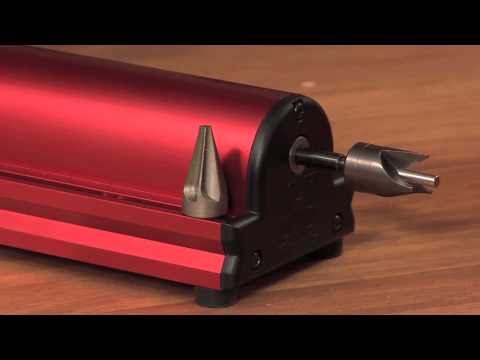
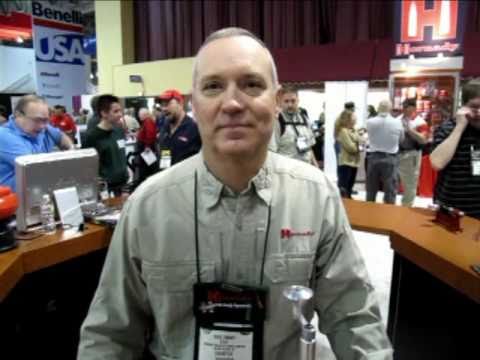
The new compact Case Prep Assistant complements Hornady’s large Case Prep Center, introduced in 2010. The large prep center performs all case prep functions, including case trimming which is handled by a vertical (drill-press-type) motorized trim station. Cases are held with a cam-lock shell-holder and then lowered vertically on to the spinning trimmer head. Hornady’s Dave Emary demonstrated both products for us at the 2011 SHOT Show. Dave then told us about the Vintage Sniper Rifle Matches which he has helped organize for the CMP.
January 7th, 2011
Lyman has introduced a handy new multi-function Case Prep Tool. Most serious reloaders employ a variety of tools to chamfer and de-burr case mouths, and to clean and uniform primer pockets. As you may need four or five separate tools to do all these tasks, keeping track of all those gadgets can be a challenge. The Lyman Case Prep Multi-Tool makes life simpler. The Multi-Tool comes with six matching tool-heads, all of which conveniently store inside the orange-anodized aluminum handle.
Lyman’s new double-ended Case Prep Multi-Tool is a smart design. It holds tools on both ends, and the orange handle unscrews in the middle to provide secure storage for all necessary case prep fittings: Outside Deburring Tool, VLD Inside Deburring Tool, Large & Small Primer Pocket Cleaners, and Large & Small Primer Pocket Reamers. Both ends of the handle are threaded, allowing two heads to be mounted at the same time.

COMMENT: Priced at $24.95 MSRP, the Lyman Case Prep Multi-tool is a good value, considering what it would cost to buy a full set of case prep tools one by one. However, we wish some of the tool heads had better cutting edges out of the box. For the Multi-tool heads (as with most Lyman cutting tools), you’ll benefit by honing the cutting edges with a good whetstone or blade sharpener.
December 12th, 2010
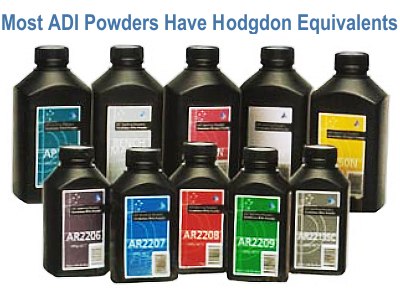
Many of the most popular powders sold under the Hodgdon brand in the USA (including Varget and H4350) are actually made by Thales Australia Ltd. (formerly ADI, Ltd.) in Australia. Some load manuals list Thales (ADI) data, but not Hodgdon data, or vice-versa, so we’ve compiled this list of equivalent powders. If you can’t find a recommended load for a particular Hodgdon powder in your caliber, download the latest ADI Smokeless Powders Handloaders Guide (2010, 5th Edition), a 5-megabyte Acrobat file.
Here’s a list of ADI to Hodgdon Powder equivalents:
AS30N=Clays
AP50N = (No Hodgdon)
AS50N = International
AP70N = Universal
AP100 = (No Hodgdon)
AR2205 = H4227
AR2207 = H4198
AR2219 = H322
Bench Mark1 = (No Hodgdon)
Bench Mark2 = BenchMark |
AR2206 = (No Hodgdon)
AR2206H = H4895
AR2208 = Varget
AR2209 = H4350
AR2213 = (Discontinued)
AR2213SC = H4831
AR2217 = H1000
AR2225 = Retumbo
AR2218 = H50BMG |
About IMR 8208 XBR
NOTE: Although new IMR 8208 XBR is made by Thales (ADI), Hodgdon has not published an ADI-equivalent product code. Thales has loaded some of the 8208 XBR into military ammo. However, Thales Australia Ltd. tells us: “[We] have yet to release the IMR 8208 XBR propellant in Australia to the sporting shooters market; thus it does not have an equivalent Thales (ADI) name”.
December 9th, 2010
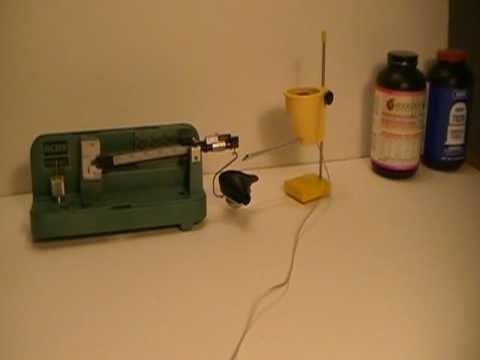
 Most reloaders have used a powder trickler at one time or another. However, they can be frustrating to use for a variety of reasons — e.g. the tube is too short, or the trickler is too low, or the unit isn’t stable enough, or the powder volume isn’t adequate. Well, the inventors of the Omega Powered Powder Trickler have considered all those practical shortcomings in existing tricklers, and built a superior product — a “better mouse trap.” Most reloaders have used a powder trickler at one time or another. However, they can be frustrating to use for a variety of reasons — e.g. the tube is too short, or the trickler is too low, or the unit isn’t stable enough, or the powder volume isn’t adequate. Well, the inventors of the Omega Powered Powder Trickler have considered all those practical shortcomings in existing tricklers, and built a superior product — a “better mouse trap.”
Every aspect of the new $55.00 Omega powered trickler (from Dandy Products LLC) shows smart thinking. First, hopper height can be adjusted from 1/2″ to 5.5″ high. The tube is long enough to reach the middle of large-footprint scales such as the Denver Instrument MXX-123. And the outer end of the tube is cut at an angle, so you can see the powder kernels as they flow out — no more surprise clumps that raise your charge 0.2 grains. The powder hopper itself is bigger than most, holding a full 1000 grains. That lets you load all afternoon without having to constantly replenish your trickler.

In practice, the Omega trickler is easy to use. It is reasonably fast, while being as precise as anything on the market. The unit is controlled by a two-button control pad, with a black button for slow feed and red button for fast feed. You can use the fast button to load the bulk of reloading powder and then use the slow button to maximize the accuracy of your load. The control pad is connected to the dispenser by a 24″ cable. That two-foot cable run allows plenty of trickler placement options on your bench. Watch the video below to see the Omega Trickler in use.
Omega User Comments
Posting on 24HourCampfire.com, JasonK gave the Omega Trickler high marks: “This thing rocks! It can trickle fast, it can trickle slow, it can drop a kernel or two at a time. After ordering my Omega I quickly shopped for an Acculab VIC-123 scale, accurate to within .02 grains.”
Another Omega user, In2Deep, writes: “You can actually tap the low-speed button and drop kernels while watching the scale. After a little practice it only takes a few seconds to trickle up a load. Using an Acculab 123 scale, it can drop charges that repeatedly read down to around 4 one-hundredth’s of a grain. It turned out to be a tool that really works and saves time. There are rubber feet on the unit and surprisingly it does not cause interference with the digital scale which is often mentioned as a problem with most of the vibratory tricklers. Not many products are even worth the time to do a testimonial but this is a winner[.]”
Forum member Barry O (aka TheBlueEyedBear) has been using an Omega Trickler for a while, and he currently has a second-generation (upgraded) unit on his bench. Barry likes the unit, with some reservations. Barry tells us: “it took me some time to get used to it. One main gripe is the length of time it takes to get the thing primed and ready to dispense powder. But after that, not too bad. I still use my trusty tweezers for fine tuning loads.”
 Handy View Prism for Beam Scale Viewing Handy View Prism for Beam Scale Viewing
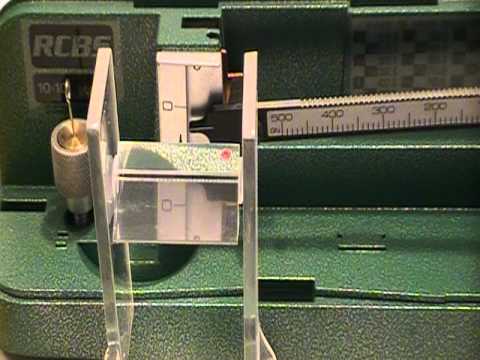
For reloders using balance-beam scales, Omega offers a clever portable prism that makes it much easier to see the tip of the balance beam, when the scale is on the benchtop. Omega’s Handy View accessory mounts a prism in a plastic stand. The prism changes the sightline so you can easily monitor the beam tip without having to bend down to see the beam alignment marks.
The prism slides up/down and swivels (around horizontal axis) to allow adjustment of viewing angle. It is a simple set-up, but it really works, allowing you to monitor scale beam movement with greater precision (and less neck strain). The Handy View costs $17.95, and is offered with either a yellow stand or clear plastic stand. You can see how the Handy View works in the video below.
 Thanks to Boyd Allen for suggesting this product for review.
November 5th, 2010
 Big Volume Offers Nearly 1100 Pages of Info Big Volume Offers Nearly 1100 Pages of Info
With its massive new 8th Edition, Hornady has compiled its most comprehensive Cartridge Reloading Handbook ever. The 8th Ed. Handbook has data for many new propellants, including Superformance, LEVERevolution, Reloder 17, 4007SSC, 8208XBR, Hybrid 100V and more. The new Handbook also features the latest information for the newest Hornady bullets including: FTX, GMX, DGS, DGX, and favorites like V-MAX, InterBond, SST, InterLock and XTP.
New Cartridges Included in 8th Edition
Hornady’s Reloading Handbook now covers many of the popular new accuracy and hunting cartridges. New cartridge additions include the 6.5 Grendel, 6.5 Creedmoor, 30 TC, 300 RCM, 338 RCM, 308 Marlin Express, 338 Marlin Express, 375 Ruger, 416 Ruger, 450 Nitro Express, 470 Nitro Express, 500 Nitro Express and more.
Hornady’s New Reloading Handbook (item #99238) ships in December — just in time for Christmas. It will be sold through shooting gear vendors, such as MidwayUSA, as well as through book-sellers such as Amazon.com.
Online Ballistics Guide Offered
Supplementing the information in its new Loading Handbook, Hornady offers a web-based Ballistics resource, with an interactive Ballistics Calculator. Use this to plot your ammo’s trajectory and determine the terminal energy of your rounds. In addition, the Ballistics resource has easy-to-understand, authoritative explanations of internal, external and terminal ballistics. Check out the features of Hornady’s Ballistics Resource below:
|

Click the above link to learn what physically occurs inside the gun barrel when a projectile is fired.

Click the above link to learn what happens to a projectile after it leaves the barrel.

Click the above link to learn how a projectile acts when it encounters the target.

Calculate trajectory and wind drift using Hornady’s interactive Ballistics calculator. Just click the graphic above and then fill in your cartridge information.
|
 |
|


