A good riflescope is essential for many types of competition, and the vast majority of hunters have scoped rifles. Some F-Class and benchrest competitors are now using optics with up to 60X magnification. Over the past 30 years, scopes have continued to evolve with improved glass, more reticle types, vastly increased elevation travel, bigger main tubes, FFP and SFP options, and even built-in electronics.
When shopping for a riflescope, it’s useful to understand how scopes work — how the internal mechanisms control windage and elevation, how parallax controls work, and how magnification levels are controlled.
Basics of How Riflescopes Work
This Burris video (above) covers the key aspects of scope function: zoom magnification, windage control, elevation control, parallax control (front or side mount), and ocular lens focus. There are some tips on getting a new scope running smoothly — it’s wise to rotate the power control a few times as well as both windage and elevation knobs. The video below also explains how to set ocular focus controls optimally.
Scope Break-In Methods and Diagnosing Issues — Great Video
We recommend that all serious shooters watch this video start to finish. A very knowledgeable scope engineer, Leupold’s Mike Baccellieri, explains the fine details of scope operation — with very useful recommendations on how to ready a new scope for use (See 36:50 time-mark). With a new optic he advises to run the controls multiple times to full travel. Also, take your time to get the diopter control just right (See 26:40 time-mark).
The video also explains why, with a new scope or one that hasn’t been used much, it is sometimes effective to rotate the elevation PAST the desired setting then come back a click (See 35:40 time-mark). In addition, near the end of the video, the expert explains how you can use a mirror to determine if the scope mount (base and/or rings) is NOT aligned with the bore axis, forcing excess travel to get on target (See 42:00 time-mark). We have seen this caused by scope rails attached slightly off axis.
Large diameter turrets make windage and elevation markings easier to see, and the click “feel” may be more noticeable given the greater diametrical travel between clicks.
First Focal Plane (FFP) vs. Second Focal Plane (SFP)
The main visual difference between First Focal Plane (FFP) and Second Focal Plane (SFP) scopes is the appearance of the reticle (and its hash marks) at different magnification levels. With a FFP scope, the reticle increases in visible size (and line thickness) with increased magnification. This is so the angular hash marks remain constant (in Mils or MOA angular span) at all magnification levels. So, on a 10-30X FFP scope, a 0.1 Mil hash mark represents the SAME angular measurement at 10X, 20X, or 30X (or any magnification). The downside of the FFP system is that the reticle lines can appear very thick at high magnification. But for a PRS/NRL match, with targets at multiple distances, it is important that the hash marks represent the same angular measurement at all power settings.
On a Second Focal Plane (SFP) scope, by contrast, the reticle lines (and hash marks) appear visually (in thickness) the same at all magnification levels. This means the hash mark divisions will only be precise at one magnification level, as designed by the manufacturer. For example, you could have exact 1 MOA Hash marks at 10X. But zoom the scope to 20X and the same reticle hash mark would then cover 2 MOA. SFP scopes are popular with competition shooters who shoot at specific known distances. Not having thick reticle lines at 25X to 50X is an advantage when aiming at precise benchrest and F-Class targets.
ZEISS now makes excellent FFP Scopes with both MOA and Milrad options
Minute of Angle (MOA) vs. Milliradian (MILRAD or MIL)
This video also explains MOA vs. MRAD (Milliradian) controls. A Minute of Angle (MOA) is an angular measurement that represents 1.047″ at 100 yards. Modern MOA scopes are typically configured with 1/4 MOA or 1/8 MOA clicks. A Milliradian (MRAD) is another angular measurement defined as one-thousandth of a radian. Milrad scopes are commonly configured with 0.1 Milrad clicks. How much is a 0.1 mil at 100 yards? One mil equals 3.6 inches at 100 yards; therefore, 1/10th of that, 0.1 Mil, equals 0.36” – roughly a third of an inch – at 100 yards. That’s pretty close to the common quarter-inch (1/4 MOA) increment found on MOA riflescopes.
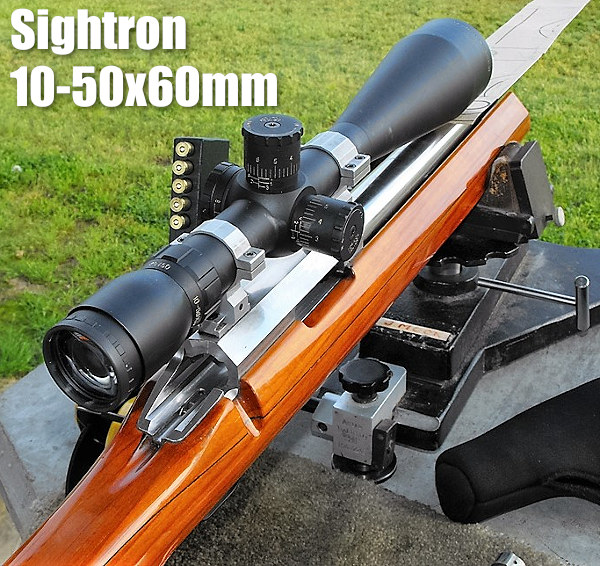
Sightron makes excellent high-magnification SFP zoom scopes favored by many competitors. These have proven quite reliable and offer very good performance for the price.
Scope Mounting Method and Alignment
When mounting a scope, you want to make sure the scope is aligned properly, so that vertical travel is precisely up and down, not offset. Begin by supporting the rifle with a good front and rear rest. Use a portable level to ensure the rifle is not tilting slightly left or right around the barrel bore axis. Then you want to align your scope’s vertical axis. For this, we recommend setting up a plumb bob — a weighted line that hangs straight down. This can be set up indoors or outdoors. Align your reticle’s vertical axis precisely with the plumb bob line, making sure not to move the rifle.
One caution — we have seen some riflescopes that are internally off-axis by up to 4 degrees. In this case, you can align the reticle’s vertical axis with the plumb bob line but then find that your turrets are slightly titled. That is a scope manufacturing fault that will result in some error when you input a large click value (e.g. 10+ MOA up or down).
When mounting your scope, a key factor to consider is the eye relief — the distance of the rear “ocular” lens to your eye. When mounting the scope, put your head in the position at which you normally shoot. NOTE: As your optimal head position may be quite a bit different when shooting prone vs. shooting from a bench, you may want to adjust the scope placement for different shooting positions. This Editor had to move his comp rifle scope about an inch rearward when local club matches changed from prone to bench.
As part of the NRA Mentor Program, the NRA offers a helpful video about using sights. This covers all types of sighting systems — blade sights, aperture sights, V-notch sights, red dot sights, shotgun bead sights, and telescopic sights with reticles. For new shooters, this video can be helpful — it explains sight basics in very clear and comprehensible terms. And even for experienced shooters, this can provide some helpful tips on sight alignment, particularly when shooting pistols.
Additional information about using sights is contained in the NRA’s free Guide for New Shooters. This helpful 14-page digital publication provides the key firearms safety rules, explains range etiquette, and even has a section on gun cleaning. CLICK HERE to download Guide for New Shooters.
Training With Lasers — Trigger Control
Training with laser sights helps diagnose and improve trigger control errors by showcasing the importance of “surprise break” and follow-through. Working with gun-mounted lasers, which put a red or green dot right on the target, can quickly diagnose errors such as recoil anticipation, jerking the trigger, and breaking the wrist. This video shows how handgunners can use pistol-mounted lasers to correct bad habits and shoot more consistently.
No doubt you’ve heard the term “reticle” before, but it probably brings to mind the cross-hair you see through a rifle-scope. This term “reticle” can also describe an optical aid used to score targets. This story discusses a new scoring reticle with precisely-defined circles etched on clear plexiglass. This scoring reticle (as attached to a magnifying crystal) is used to determine whether bullet holes fall inside or outside the scoring circles on targets. This unique new scoring reticle allows match scorers to “equalize” the shot placements of all popular calibers from .204 up to .308. This way, there’s a “level playing field” for all calibers, and any caliber rifle can compete on an equal basis with the 30s.
New ‘Equalizer’ VFS Scoring Reticle
by Ron Goodger
The ubiquitous controversy over the advantage of larger caliber bullets in VFS (Varmint for Score) matches still rages, but there is a simple solution that is being embraced by all to whom I have shown it. The concept is simple, and it accomplishes the same thing the UBR (Ultimate Benchrest) targets do with the advantage that it can be used on any target a club happens to have on hand.
I had heard shooters complain about the advantage that larger calibers have many times and wish there was a fair way to score targets that would level the playing field for all calibers. The UBR concept came along and I read up on it. When a match was held close enough that I could enter, I did so and observed first hand what it was all about. The UBR targets essentially make the distance from the bullet hole center to the scoring ring edge the same for each caliber by using different-sized rings on the caliber-specific targets. After seeing the accompanying disadvantages of using this method (the chief one being the large number of targets required by UBR rules and the resulting increased time required to hold a match), I began searching for a simpler way to accomplish the same thing. I was aware of a number of mid-West clubs wanting to make scoring fair but unwilling to use the UBR method because of the disadvantages.
I came up with an idea late in 2015 and designed a scoring reticle that would do the job. The following diagrams graphically explain how UBR and my scoring reticle accomplish the same thing. The illustration above shows how different caliber bullets hitting the same center point of impact will each just score the 10 ring edge on the different-sized, caliber-specific UBR 10 Rings . It is clear that it is the distance from the center of the bullet to the scoring ring that is made uniform by the different 10 Ring sizes.
The illustration below shows how my VFS scoring reticle accomplishes the same thing by scoring every shot with an .308-equivalent ring that circumscribes the inner caliber-specific ring. The dotted line shows that the center of each bullet hits the same distance from the edge of the scoring ring. It is clear that, using current VFS scoring techniques, the .224, .243, and .257 bullets would score misses. However, scoring each bullet with the .308 ring around the hole illustrates that all calibers would be scored the same.
Scoring Reticle Converts Any Caliber Shot to a .308-Equivalent Hole
The above photo of an IBS 100-yard target has a 6mm hole that is clearly a nine (9), using current scoring methods. But consider that, if a .308 bullet from a 30 BR hit in the very same location, that .30-caliber shot would score in the Ten Ring. Why should the 6mm bullet, whose center was just as close to the middle of the target, be penalized because of the bullet diameter? The image on the right shows the scoring reticle with the 6mm scoring ring centered on this hole. With this scoring reticle, the .308 ring around the 6mm hole clearly scores the 10 Ring, just as a 30-caliber bullet centered in the same spot would do. That is as fair as it can get.
The above image (two shots per frame) from a Hillsdale Michigan varmint target has two 6mm holes that scored a 16. Score values are 10 points for a shot in the white, 5 points for a shot in the orange, and 1 point for hitting the center dot. This was a match that had 30BRs shooting in it. The next photo shows how scoring this frame with the VFS reticle would have resulted in a 21 because the left side of the reticle’s .308 circle just extends into the 10-point white bulls-eye region. So, in effect, there were two (2) shots in the white for 2×10 points (based on the .308 equalizer effect of the reticle). This shows how the reticle will level the VFS playing field regardless of what target is being used.
VFS Scoring Reticle Features and Specifications
The 6mm circles have been placed in the center of the reticle because it is expected to be the most commonly-used caliber, and that makes it easier to see in the crystal. Any of the ring sets can be used for a .308. The sizes of the circles are guaranteed accurate to within .001″ on the outside edge of the circle by the reticle’s manufacturer. I have found the best magnifier crystal to use is a genuine Badash crystal that measures 3.25″ in diameter. They are available from several eBay sellers and are easily attached using a piece of packing tape about 3/4-inch wide around the edge of the reticle (visible on the crystal in the lower part of the photo). That makes the Plexiglas reticles easy to replace in the event they become scratched up from frequent use.
A number of Midwest rifle clubs have already purchased these scoring reticles. The Plexiglas reticles are available for $15.00 each plus $2.04 shipping from the author (does not include the crystal). Email him at LRGoodger [at] gmail dot com for more information.
Here’s a “spy photo” of the new scope. Price and release date are yet to be determined.
If you’ve been planning to purchase a premium, high-magnification, variable-power competition scope this year… you may want to hold off for a few weeks. We just learned that Schmidt & Bender will be introducing an all-new, “super-zoom” optic for 2016. Schmidt & Bender’s impressive new 5-45x56mm PM II High Power, offers a remarkable 9X zoom ratio. That makes it suitable for a wide variety of shooting disciplines. A tactical competitor can dial back to 5-power for a wide field of view on close-in targets. Or, for 1000-yard shooting, crank the scope all the way up to 45-power. S&B says the scope is intended for “tactical ultra-long-range shooting”. With its ultra-bright, ultra-sharp German glass, this new scope could also become popular with F-Class competitors — if it is priced reasonably. We called Schmidt & Bender USA, but we were informed that no further product details or pricing information could be released prior to SHOT Show.
In addition to the new 5-45X comp scope, Schmidt & Bender plans to introduce six other new scope models in 2016. There will be two Polar T96 models, a 3-12X and a 4-16X. The current 2.5-10X Polar T96 boasts an industry-leading 96% light transmission. S&B claims this is the “brightest low-light hunting scope in the world”. For 2016, S&B will also introduce two PM II models with digital reticle display features, the 3-27X and 5-25X “Digital BT” scopes. Finally, two new PM II “Ultra-Bright” scopes will be added to the lineup. We believe these will be a 3-12X and a 4-16X.
Swarovski has a new STR 80 spotting scope with an illuminated reticle. That’s right, this new STR 80 spotter has a ranging reticle like a riflescope, with adjustable brightness levels. This 80mm spotting scope can be used for estimating range to targets, using MIL-based or MOA-based stadia lines on the cross-hairs. This allows you to range targets optically, as you could with a ranging reticle in a riflescope.
Revolutionary Reticle “ON”, Reticle “OFF” Technology
The STR 80’s illuminated ranging reticle makes the new STR 80 a fairly unique product among high-end, imported spotting scopes. Thanks to a new technology, Swarovski is the first manufacturer to successfully project a reticle directly in a spotting scope. The reticle (MOA or MRAD) can be activated or deactivated as required. Notably, because the reticle appears via electro-illumination, it can be “turned off” for un-obstructed viewing. So you can have a totally clear field of view when desired, OR a ranging reticle when that functionality is desired. Having the ability to turn OFF the reticle is great — that’s a very intelligent feature.
When viewing targets, the STR 80’s sharp HD (high-definition) lenses will resolve bullet holes at long range. Current Swaro 20-60X and 25-50X (wide) eyepieces can be used with the new STR 80 spotter. Optional accessories include Picatinny mounting rail, digiscoping attachment, and a winged eye cup.
How to Range with STR 80 Reticles
The new STR 80 scope offers a choice of either MOA or MRAD reticles with 15 brightness levels, 10 day levels, and 5 night levels. For convenient ranging, set the magnification level so that the MOA reticle displays ¼ MOA divisions, while the MRAD Reticle displays 0.1 MIL divisions. (NOTE: the reticle will change in size relative to the target at different magnifcation levels. Therefore ranging is normally done at one standard magnification level).
Dustin Woods, Sales Director for Swarovski Optik NA said: “Long range shooters asked for a premium spotting scope with integrated reticle and we have listened. With our new STR spotting scope we now have MOA and Mil-Radian reticle models. Because the reticle is illuminated, the user can have the reticle turned on when they are judging hits and misses but also turn it completely off for an unobstructed view during observation. This product is a real game changer in the precision shooting segment.”
Carl Zeiss Sports Optics (Zeiss) has a new mobile Ballistics Calculator App for iOS (Apple) and Android devices. Modeled after the web-based Zeiss Ballistics Calulator, the new Mobile App is tailored to work precisely with Zeiss Ballistic reticles. Mike Jensen of Carl Zeiss Sports Optics explained: “We wanted those who use our proprietary ballistic reticles to have a ballistic tool that could be used virtually anywhere you have a signal for your device.”
The Zeiss Ballistic Calculator App allows users to pick their ballistic reticle from a drop-down menu. The user also has the ability to select factory or hand load data as well as environmental variables, and then the system will calculate and display the optimum magnification setting. With this system, distant yardages now coincide with the Zeiss ballistic reticle subtensions. The system allows the user to adjust standard settings for altitude and temperature, as well as other advanced settings, e.g. for muzzle velocity and sight height above bore.
Zeiss Ballistics Calculator App Features:
– One page screen application for fast data entry and easy to read results.
– Comprehensive and current database for factory and hand-loaded ammunition.
– Adjustable settings to customize unique shooting environments.
– Slide feature to visualize how magnification change alters point of impact.
The Zeiss Mobile Ballistic Calculator App can be downloaded at Google Play (Android App) and iTunes (iPhone App) for $4.99. Zeiss has noted that the App will soon be updated to include the Zeiss ASV ballistic turret system.
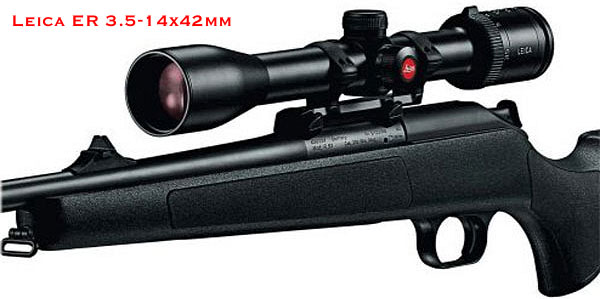
If you are looking for a premium-quality hunting scope, with a wide magnification range, here is a great opportunity. Leica has just discontinued the Leica ER Scope Series. These are excellent optics that will be sold on “close-out” basis through EuroOptic.com. These Leica ER Scopes will be offered by EuroOptic for as much as $600.00 off the regular price, with target turret models available for as little as $1179.00. These scopes all include Leica’s Lifetime Warranty. According to EuroOptic: “Quantities vary and there will not be any more once they are gone”.
Leica ER Rifle Scopes are rugged, bright, and precise. Each Leica ER Rifle Scope is designed for field use, with a long tube for easy mounting and eye relief to spare – perfect for large caliber hunting rifles. Choose from the Leica ER 2.5-10×42, an all around scope with a wide field of view for quick acquisition, or the Leica ER 3.5-14×42, a higher magnification scope with an optional ASV elevation turret.
A varmint shooter’s target is not conveniently placed at a fixed, known distance as it is for a benchrester. The varminter must repeatedly make corrections for bullet drop as he moves from closer targets to more distant targets and back again. Click HERE to read an interesting Varmint Forum discussion regarding the best method to adjust for elevation. Some shooters advocate using the scope’s elevation adjustments. Other varminters prefer to hold-over, perhaps with the assistance of vertical markers on their reticles. Still others combine both methods–holding off to a given yardage, then cranking elevation after that.
Majority View–Click Your Scope
“I zero at 100 yards — I mean really zero as in check the ballistics at 200 and 300 and adjust zero accordingly — and then set the scope zero. For each of my groundhog guns I have a click chart taped into the inside of the lid of the ammo box. Then use the knobs. That’s why they’re there. With a good scope they’re a whole lot more accurate than hold-over, with or without hash marks. This all assumes you have a good range finder and use it properly. If not, and you’re holding over you’re really just spraying and praying. Try twisting them knobs and you’ll most likely find that a 500- or 600- or 700-yard groundhog is a whole lot easier than some people think.” – Gunamonth
“I have my elevation knob calibrated in 100-yard increments out to 550. Range-find the critter, move elevation knob up…dead critter. The problem with hold-over is that it is so imprecise. It’s not repeatable because you are holding over for elevation and for wind also. Every time you change targets 50 yards, it seems as if you are starting over. As soon as I got completely away from the hold over method (I used to zero for 200), my hit ratios went way up.” — K. Candler
“When I first started p-dog shooting, I attempted to use the hold-over method with a 200-yard zero with my 6mm Rem. Any dog much past 325-350 yards was fairly safe. I started using a comeups table for all three of my p-dog rifles (.223 Rems and 6mm Rem). 450-yard hits with the .223s are fairly routine and a 650-yard dog better beware of the 6mm nowadays. An added benefit (one I didn’t think of beforehand) with the comeups table (elevation only), is that when the wind is blowing, it takes half of the variables out of the equation. I can concentrate on wind, and not have to worry about elevation. It makes things much more simple.” — Mike (Linefinder).
“I dial for elevation and hold for wind. Also use a mil-dot reticle to make the windage holds easier. For windage corrections, I watch for the bullet strike measure the distance it was “off” with the mil-dot reticle, then hold that much more the other way. Very fast once you get used to it.” — PepeLP
Minority View–Hold-Over is Better
“I try to not touch my knobs once I’m zeroed at 200 meters. Most of my varmint scopes have duplex reticles and I use the bottom post to put me on at 300 meters versus turning knobs. The reason I try to leave my knobs alone is that I have gone one complete revolution up or down [too far] many times and have missed the varmint. This has happened more than once and that is why I try not to change my knobs if at all possible.” — Chino69
“I have been using the hold over method and it works for me most of the time but the 450 yards and over shots get kinda hard. I moved to a 300 yard zero this year and it’s working well. I do want to get into the click-up method though; it seems to be more fool-proof.” — 500YardHog
Compromise View–Use Both Methods
“I use both [methods] as well — hold over out to 250, and click up past that.” — Jack (Wolf)
“I use the target knobs and crank-in elevation. I also use a rangefinder and know how far away they are before I crank in the clicks. I have a scope with drop dots from Premier Recticle and like it. No cranking [knobs] out to 600.” –Vmthtr
Leupold has just introduced a new second focal plane reticle with MOA-based hashmarks, allowing precise hold-overs and hold-offs (for wind). The new TS-32X1 reticle, is a minute-of-angle (MOA) based system designed to allow for precision shots without the need for dial adjustments. The TS-32X1 reticle is designed to work with riflescopes that employ 1/4-MOA target adjustments or M1 dials.
The TS-32X1 is the first in a family of MOA-based reticles that will cover several magnification ranges. The TS-32X1 will be available for a wide variety of Leupold riflescopes. For $159.99, the Leupold Custom Shop can also retrofit this reticle into many existing Leupold scopes. Adding the TS-32X1 to a new riflescope ordered through the Custom Shop will cost $129.99.
MOA-Based Hashmarks on Horizontal and Vertical Stadia
On the TS-32X1 reticle, a heavy post and thin stadia crosshair features 1-MOA hashmarks on both the horizontal and vertical lines. Every other hash mark on the horizontal stadia is slightly longer, providing quick and easy 2-MOA measurements. There is a number placed every fourth MOA for quick reference.
The vertical stadia is also set up with 1-MOA tics and longer 2-MOA marks. In addition, every fourth mark is numbered, all the way to the complete 32-MOA elevation range. Wind dots in the lower half of the reticle are spaced in 2=MOA increments, both vertically and horizontally.
This new TS-32X1 reticle is currently available for most second (rear) focal plane VX-3, VX-III, Vari-X III and Mark 4 4.5-14 LR/T riflescopes. Existing riflescopes can be retrofitted for $159.99 through the Leupold Custom Shop. To add the TS-32X1 to a new riflescope ordered through the Custom Shop is $129.99.
Product tip from EdLongrange. We welcome reader submissions.
Here’s a new scope that may be well-suited for short-range varmint hunting (for smaller critters) and for rimfire tactical matches. Bushnell has released a new, affordable 2-7x32mm variable rifle scope with a Bullet Drop Compensating (BDC) reticle configured for the .22 LR rimfire cartridge. Anyone who has shot the .22 LR past 50 yards knows that this round drops a lot in a short distance. The “Drop Zone” BDC reticle, with multiple aiming points out to 125 yards, helps you stay on target. The reticle is calibrated for 38-40 grain, .22 LR high-velocity loads, with a 50-yard zero. This new scope, part of Bushnell’s AR line of scopes, features a 1″ main tube, target-style turrets, and side-focus parallax adjustment. MSRP is $149.99, but web vendors have lower prices. Amazon.com sells the scope for $131.23 with free shipping for Prime Members.




 Swarovski has a new

 Carl Zeiss Sports Optics (Zeiss) has a new mobile


 A varmint shooter’s target is not conveniently placed at a fixed, known distance as it is for a benchrester. The varminter must repeatedly make corrections for bullet drop as he moves from closer targets to more distant targets and back again.
  Minority View–Hold-Over is Better
 Leupold has just introduced a new second focal plane reticle with MOA-based hashmarks, allowing precise hold-overs and hold-offs (for wind). The new TS-32X1 reticle, is a minute-of-angle (MOA) based system designed to allow for precision shots without the need for dial adjustments. The TS-32X1 reticle is designed to work with riflescopes that employ 1/4-MOA target adjustments or M1 dials.
 Here’s a new scope that may be well-suited for short-range varmint hunting (for smaller critters) and for


