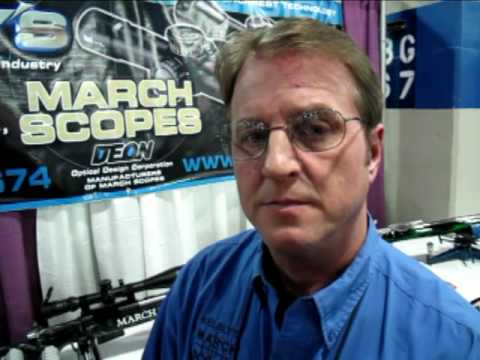
We had a chance to visit with Jim Kelbly of Kelbly’s Inc., at SHOT Show 2010. Jim had all the new March scopes on display, including the amazing 8-80x56mm long-range scope, part of March’s ground-breaking 10 times zoom range series. Jim reviewed the March line-up, explaining the many high-magnification models available for precision shooters.
Jim also showed us the stainless Grizzly II action and the new Atlas series of stainless actions. The Atlas actions are designed for varminters, tactical shooters, and long-range shooters who want an affordable stainless action with a Remington 700 action footprint. The Atlas actions should be a simple drop-in installation for stocks inletted for Rem 700s. At the close of the interview, we asked Jim about the future of benchrest competition. Jim believes that we will see more cross-over of short-range shooters into the long-range disciplines (and vice-versa), along with growth in the F-Class and tactical disciplines.
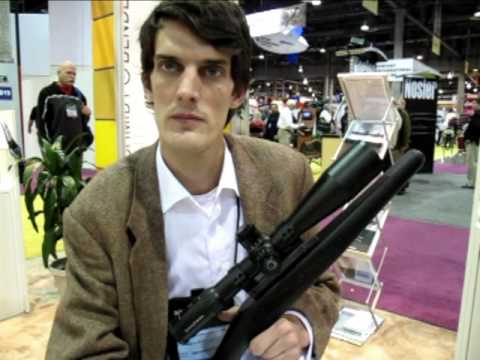
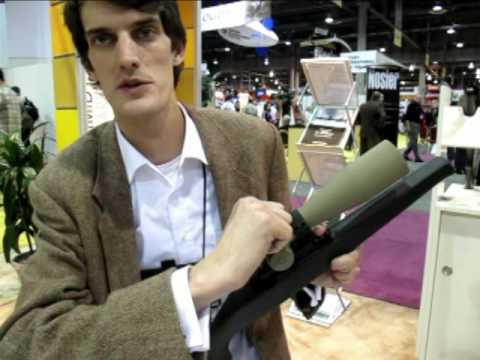
It’s big, it’s bright, and yes, it’s finally here in America. We’re talking about the Schmidt & Bender 12.5-50x56mm PM II/P scope, perhaps the most impressive long-range riflescope we saw at SHOT Show 2010. We first profiled this scope in April 2007, so it’s been a very long wait, but reasonable quantities of the big 12.5-50X PM II have finally reached American shores in reasonable quantities. The suggested retail price is a jaw-dropping $3199.00, but when you consider the whole package — clarity, sharpness, image contrast, color fidelity, click options, reticle options, ruggedness, and warranty policy — the S&B 12.5-50×56, has few, if any, rivals among ultra-high magnification scopes. This is a great scope, make no mistake about it, even if does cost as much as a custom-built rifle. Jason and I both agreed that, if there was one item we’d like to carry home from SHOT Show and mount on our rifles, it would be the S&B 12.5-50x56mm. This scope is as bright at 50X as other quality scopes at 40X.
The 12.5-50x56mm is is available with 1/4 MOA clicks, 1/8 MOA clicks, or mil-based clicks, and with normal or double-turn turrets. NOTE: S&B also sells a 12.5-50×56 version optimized for 10m-70m Field Target shooting. It has a silver finish and “Big Wheel” side parallax control.
New Features on 5-25x56mm PM II
In addition to the 12.5-50x56mm long-range scope, Schmidt’s engineers showed us the popular 5-25x56mm PM II sporting a new “desert tan” ceramic coating. (CLICK HERE for large photo.) For 2010, this scope features new turret options that provide extra feedback and security for the shooter. First, either or both turrets can be locked in place by pushing down on the turret sleeve. Just pull up to unlock. Second, a pop-up cap confirms when the elevation knob is on the second revolution. That makes easier to use the scope at night. Finally, every 10th click of knob rotation is a heavy, tactile “clunk”. This does help track your revs and is especially useful with mil/cm-based turrets. S&B offers a wide selection of reticles, and you can choose between either first focal plane (FFP) or second focal plane (SFP) options.
At SHOT Show, Sightron rolled out its much-awaited 10-50x60mm, and it looks good. Currently available in either a Fine-Cross-Hair (FCH) reticle, or FCH with target dot, the new unit has 1/8 MOA clicks and 50 MOA of windage and elevation. Priced under $1000.00, this is a good value compared to other premium optics with similar max magnification.
Affordable High-Magnification Long-Range Optic
With a “street price” under $995.00, the Sightron 10-50 could become hugely popular in 600/1000-yard benchrest and F-Class shooting. The big new zoom features a jumbo 60mm objective, 30mm maintube, and 1/8 MOA clicks. Nearly 17″ long and weighing 28.9 ounces, make no mistake, this is a BIG piece of glass. If the new 10-50×60mm SIII Sightron is as good as the 8-32×50mm LR SIII we tested in 2009, this should be a fantastic scope for the money.
New Tactical Scopes with Rear Parallax Control
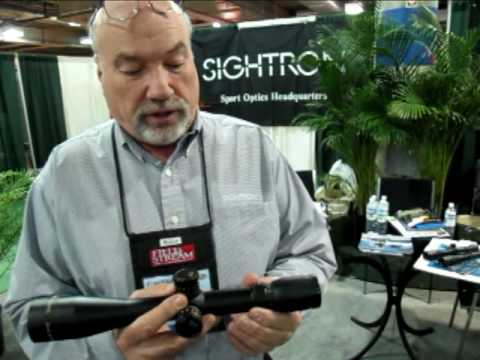
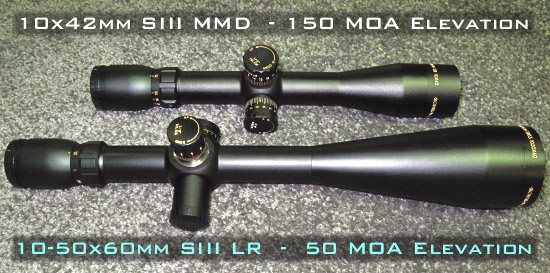
Sightron had another much smaller, but equally impressive, scope on hand. It was the 10X model from the new SIII Tactical series which includes 16X and 20X versions also. The new SIII fixed-power Tactical Sightrons feature a modified mildot (MMD) reticle with 1/4 MOA clicks. These scopes (10X, 16X, and 20X) all boast an amazing 150 MOA of total elevation (and windage). We repeat: 150 MOA of total up/down travel. That allows you to shoot well past 1000 yards without needed an angled scope base. The parallax control is at the back, where you’d normally find a zoom ring. The position is actually very handy. With the parallax (focus) control near the rear eyepiece, you can easily set the parallax with your firing hand without moving out of position. These new fixed-power Tactical Scopes will retail for about $550.00.
Today at the SHOT Show’s “Media Day at the Range”, Burris gave us a glimpse of the future in hunting optics. The new Burris Eliminator scope will range your target, calculate your trajectory, and illuminate a spot on the reticle that becomes your aimpoint at extended range. We could write a treatise on the Eliminator’s breakthrough technology, but all you really need to know is that after you range your target with the scope, a red dot appears on the vertical crosshair that is the correct aiming point for your ranged distance. The ballistics “hold-over” is already calculated. Just put the calculated red dot on the target, and pull the trigger. It’s that simple.
The new “Eliminator” scope is being introduced as a 4-12x42mm optic, for an expected $850.00 street price. The laser is activated with a simple push-button on the left side of the scope, and also comes with a remote switch that you can attach to the rifle in a more convenient position allowing the laser to be activated while maintaining the aim of the rifle. In the above photo you can see the remote switch on the objective end of the scope.
Once the target range is acquired, the range displays for about 10 seconds and the illuminated aiming dot remains illuminated for 70 seconds. The illumination clock allows plenty of time to pull off a good shot, yet saves battery life.
So how does the Burris LaserScope calculate the appropriate trajectory of your load? The software in the scope contains a database of hundreds of factory-loaded cartridges and even calculates handload trajectories using two (2) user-provided data points. The user inputs the zero range (100 or 200 yards) along with the inches of drop at 500 yards. The 500-yard drop is best found by real world shooting, not by using a calculated trajectory approximation from a ballistic program. The scope’s software then uses the zero-distance and the 500-yard drop figure to extrapolate the entire trajectory.
While shooting this scope on a Tikka 7mm-08, we successfully engaged targets from 350-570 yards that were approximately the size of a whitetail deer’s vitals area. Seeing how the conditions were not very conducive to accurate shooting with rain and a 5-15 mph switchy wind, we were impressed with the results.
For those that hunt or shoot out to about 600 yards or so, this scope will definitely speed up the process of pulling off an accurate long range shot. In a matter of seconds, you can locate a target, range it, and engage it. There is no time wasted fumbling with a separate laser rangefinder, no time wasted looking at a drop chart, and no time wasted clicking in the appropriate amount of elevation. As long as you can get a range on your target, the only thing left to worry about is the wind! This scope is obviously not for everyone, but we are confident that many hunters can benefit from this remarkable new technology.
Burris Eliminator Specs:
Click value 1/4″ at 100 yards
Weight 26 ounces; length 13″
Eye Relief 3-3.5″
Elevation Travel 50″
Laser range 550-800 yards based on reflectivity
We thought we’d seen the upper limit of riflescope magnification with the new 10-50x60mm Sightron SIII, the 12-50x56mm Schmidt & Bender PMII, and the 10-60×52mm March variable. Now March has raised the magnification bar — with a zoom scope boasting Eighty times (80X) magnification at max power.
That’s a lot of magnification for a spotting scope, much less an optic designed to sit on top of a rifle. We wonder how useful the 80X max power will really be. At 80-power the exit pupil is a tiny 0.7 mm — what we consider the very lower range of usability. A very small exit pupil makes the viewer’s head position ultra-critical; you’ll need to get your head aligned just perfectly. Still, the extra power may prove useful for ultra-long-range shooting or at middle distances when conditions are ideal (no mirage).
The new March 8-80x56mm Tactical/Long Range scope features 1/8 MOA clicks, a 34mm maintube, and 60 MOA of elevation. Weight is a reasonable 29.8 ounces (845 grams), while scope length is 16.0″ (shorter than many 40-power scopes). Five (5) different reticles are offered: 1/8 dot, 3/32 dot, 1/16 dot, MTR-1, and MTR-2.
In addition to the new 8-80x56mm, March will offer another tactical scope with a 10 times zoom range. The new March 5-50x56mm also has 1/8 MOA clicks, 60 MOA of travel, and comes with the same five reticle choices. At 15.67″ OAL and 29.3 ounces, the 5-50X is slightly smaller than its 80-power big brother.
.
We’ll learn more about the new March ultra-zooms at SHOT Show next week, when we visit the Kelbly’s booth. We’ll try to get a good look at the 8-80×56 and let you know how all that power works in the real world. Stay tuned for our SHOT Show reports staring January 19th.
Sightron has released photos and specifications of its entire 2010 scope line-up. This includes the new (and much awaited) 10-50x60mm SIII Long-range scope.
With a “street price” under $995.00, the Sightron 10-50 could become hugely popular in 600/1000-yard benchrest and F-Class shooting. The big new zoom features a jumbo 60mm objective, 30mm maintube, and 1/8 MOA clicks. Nearly 17″ long and weighing 28.9 ounces, make no mistake, this is a BIG piece of glass. If the new 10-50x60mm SIII Sightron is as good as the 8-32x50mm LR SIII we tested in 2009, this should be a fantastic scope for the money.
When will we have test results for the new 10-50? Very soon, hopefully. Sightron has promised to send the first available 10-50x60mm SIII production-model scope to AccurateShooter.com for testing and evaluation. We’ll share our findings as soon as we can put the new 10-50 through its paces in the field.
Consumer Survey on Reticle Choices
Currently the new 10-50x60mm scope is offered with two reticle options: a Fine Cross Hair (FCH) and a Fine Cross Hair with Target Dot (TD). The first shipment contains roughly an equal amount of each. However, Sightron’s product planners want to learn YOUR favored reticle choice. Consumer preference will influence the future production allocation between FCH and TD models. So, if the majority of you folks want a particular reticle, that’s what Sightron will try to provide in future shipments. Please respond to the POLL below with your reticle choice.
Here’s a simple procedure that lets you get a solid zero for a hunting rifle in just four shots. Of course you probably want to fire a few more rounds to confirm your zero before you head off to your hunting grounds, but this will let you get on-target with a minimum amount of time and ammo expended. (This assumes your scope is securely mounted, and the bases are not drastically out of alignment.)
1. First, remove the bolt and boresight the rifle. Adjust the position of the rifle so that, looking through the bore, you can see the center of the target with your eyes. Secure the rifle in the rests to maintain its position as boresighted. Then, without moving the rifle, center the reticle. That should get you on paper. With the rifle solidly secured in front and rear rests or sandbags, aim at the center of a target placed at your zeroing distance (50 or 100 yards). Confirm there are no obstructions in the barrel! Then load and fire one shot. Then, return the gun to the exact position it was when you pulled the trigger, with the cross-hair centered on the target as before.
2. Locate, in the scope, where your first bullet landed on the target. Now, while you grip the rifle firmly so it doesn’t move, have a friend adjust the turrets on your scope. While you look through the scope, have your friend turn the windage and elevation turrets until the cross-hairs, as viewed through the scope, bisect the first bullet hole on the target. In other words, you use the turrets to move the center of the reticle to the actual position of shot number one. Dial the crosshairs to the hole — don’t move the rifle.
3. After you’ve adjusted the turrets, now re-aim the rifle so the cross-hairs are, once again, positioned on the target center. Keep the rifle firmly supported by your rest or sandbag. Take the second shot. You should find that the bullet now strikes in the center of the target.
4. Take a third shot with the cross-hairs aligned in the center of the target to confirm your zero. Make minor modifications to the windage and elevation as necessary.
5. Now shoot the rifle from a field rest (shooting sticks, bipod, or rucksack) as you would use when actually hunting. Confirm that your zero is unchanged. You may need to make slight adjustments. Some rifles, particularly those with flexy fore-arms, exhibit a different POI (point of impact) when fired from a bipod or ruck vs. a sandbag rest.
If you recently cleaned your rifle, you may want to fire two or three fouling shots before you start this procedure. But keep in mind that you want to duplicate the typical cold bore conditions that you’ll experience during the hunt. If you set your zero after three fouling shots, then make sure the bore is in a similar condition when you actually go out hunting.
If you use mass-production ring sets, other than Burris Signature Rings or SAKO Optilock Rings (which both feature polymer inserts), you can benefit from lapping your scope rings. Lapping your rings, when done properly, with the right tools, can improve the fit of the rings, reducing bending forces and stress on the scope. Properly-lapped rings are also less likely to leave prominent marks on your scope tubes.
Forum member Boyd Allen is a strong advocate of ring lapping for factory-produced ring sets. He’s tried various lapping tools and he believes that the Kokopelli system is one of the best available. Custom crafted in Kalispell, Montana by John Werre, the Kokopelli lapping system combines a specially-machined lapping rod with patented flat-ended scope alignment bars.
Kokopelli Lapping Tool
John Werre, Kokopelli’s owner, explains why his lapping tool works better than most others: “No one was making a lapping bar that would lap anything more than the bottom half of the rings and they were made of rolled stock and only a very short stroke was possible, rapidly wearing out the bar due to the limited area of use. I did something entirely different. I designed the bar to be used with the top halves of the rings in place and utilizing a long stroke thereby distributing the wear over the entire 12″ length of the bar. Why just do half a job?”
John adds: “Another problem was that the lapping compound would readily scrape off the bar, slide around and wear the bar out as fast as the rings. I added the spiral groove to stop the scraping off of the compound and later changed to a much softer steel and put a very rough, but carefully designed, finish to accept the lapping compound, actually allowing the grit to be driven into the surface of the bar. The nasty, scruffy rough finish is full of grooves and valleys of a depth designed to ‘catch’ the very sharp lapping compound, imbedding it into the bar. You then will wear out what you’re trying to lap rather than wear out the bar at the same time. The spiral grooves also cannot catch on the edge of the scope rings as can one which has annular grooves cut perpendicular to the axis of the bar in separate rings. I have very good reasons for every unique feature of my tools. Every aspect has a valid design behind it.”
Kokopelli Scope Alignment Bars
Kokopelli’s patented scope alignment bars have flat ends and work differently than alignment bars which use pointed tips. Kokopelli came up with a flat-ended design because alignment bars with pointed tips can yield a “false positive”, meaning the points can touch when the scope rings are out of alignment. To demonstrate, try this simple experiment. Take two ordinary pencils. With one pencil in each hand, hold them parallel with the pointed (lead) tips touching. Now simply move the outboard end of each pencil, while keeping the tips touching. You can see instantly that the tips can touch even if the pencils are way out of alignment. The same thing can be true of scope alignment bars.
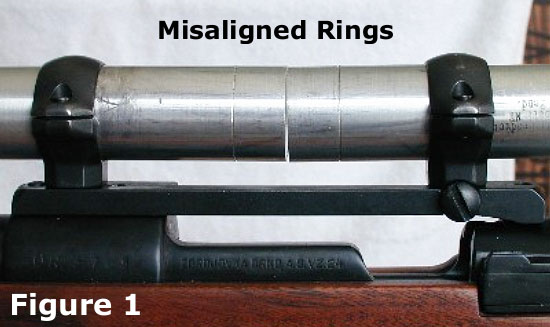
With the Kokopelli scope alignment bars, each bar is an exact cylindrical projection of the interior of each ring. When you bring the bars together, if they don’t mate perfectly, i.e. if there is any gap between the flat ends when the bars are touching, then you know you have an alignment problem. Kokopelli claims that misalignments as small as .002″ can be detected. John Werre explains: “The bars actually are a three-dimensional projection of each ring ‘hole’. You’re looking at a solid representation of the hole through the ring. Put one bar in each ring and you can then compare the axial alignment of the ‘ring holes’ to each other. If the ends match and are flat together you have reconstructed the bars into one [cylinder] and the alignment is PERFECT.” Below, in Figure 1, you can see rings that are out of alignment. In Figure 2 you can see rings that are properly aligned. Interestingly, the misalignment illustrated in Figure 1 did NOT show up with pointed ring alignment bars. This amount of misalignment can create up to 3/16″ of scope tube bending (depending on ring spacing).
The function of the Kokopelli lapping tool and alignment bars are described in greater detail on the Kokopelli website. The lapping tool and alignment bars are sold separately, or as part of Kokopelli’s complete Accurizing Kit shown below. The kit, which combines Scope Alignment Bars, Lapping Bar, pointer rod, and lapping compound in a fitted box, costs $84.50 for 1″ rings, or $91.00 for 30mm rings. For more info, contact John Werre at Kokopelli Products, 3820 Foothill Rd., Kalispell, MT 59901; phone (406) 755-3220. NOTE: Kokopelli has maintained the same prices since 2003. However, due to increased costs of materials, John Werre plans to raise his prices by mid-January, 2010. You can get current pricing by ordering soon.
MidwayUSA is running a clearance sale on “factory sample” Sightron Big Sky SII 6-24x42mm riflescopes with duplex reticles. The price has been knocked down to $468.32, a $146.01 savings over the regular price!
In addition, MidwayUSA has the “factory samples” of the newer Sightron Factory SIII 3.5-10x44mm riflescopes. These feature a 30mm tube, side focus parallax adjustment, and a Mil-Dot reticle. Clearance price is $547.42, marked down from $720.29.
Speaking of Leupold scopes, Midsouth Shooters Supply is running a big sale on genuine Leupold scopes, 2008 modelsr. A wide selection of these 2008-vintage Leupolds are discounted 30%. Note: These are new, full-warrantied scopes, not factory refurb or “blemished” models. All 2008 close-outs are being sold at 30% off to make room for the 2010 inventory.










 .
.




 Speaking of Leupold scopes,


