Eurooptic vortex burris nightforce sale


teslong borescope digital camera barrel monitor


As an Amazon Associate, this site earns a commission from Amazon sales.


December 11th, 2018

Watch Out for Bullet Nose Contact in Short Seating Stems

Seating Stem Glen Zediker

Clearance Check — Remove the seating stem and drop a bullet into it. The farther down the ogive or nose-cone the step recess grips the bullet, the better. If it’s only pressing down against the bullet tip, a crooked seat is assured, along with inconsistent seating depth. — Glen Zediker

Some folks acquire a new seating die and then are surprised to find their hand-loads show crooked bullets and/or inconsistent seating depth. The problem could be a mis-match between the bullet and the die’s seating stem. In some case, particularly with long, streamlined bullets, the bullet tip can actually touch the bottom inside of the stem. This can cause a variety of problems, as Glen Zediker explains…

Invest in a Good Seating Die
Reloading Tip by Glen Zediker
The bullet seating operation is the “last thing” that happens and it’s also the one thing that can corrupt the care and treatment given to the quality of the loaded round prior. A sleeve-style seater, well-machined, goes a whopping long ways toward preserving alignment, and, therefore, concentricity. Also make sure that the stem in yours comes to rest well down onto the bullet ogive, and, above all else, is not contacting the bullet tip! That will wreck a round.

If you have this problem, you should contact the die maker — some will offer a different seating stem expressly designed for longer, pointier bullets. This “long bullet stem” will normally drop right into your existing die. If you plan to run long, VLD-style bullets you should request the special seating stem right from the get-go.

This tip comes from Glen’s newest book, Top-Grade Ammo, available at Midsouth Shooters Supply.

Permalink Bullets, Brass, Ammo, Reloading 1 Comment »
May 11th, 2016

Bullet Seating Advice — How to Avoid Ring Marks on Your Bullets

Seating Stem Reloading Tip Sierra Bullet .223 Remington compressed loads

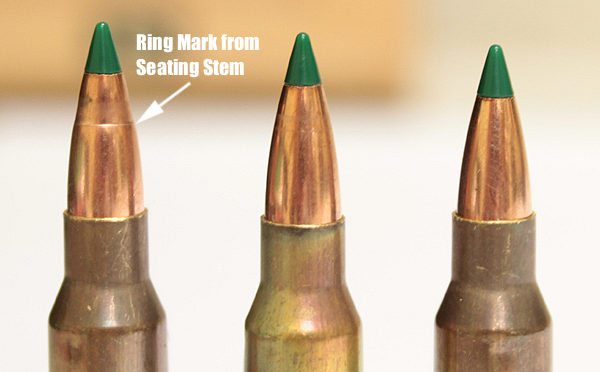
Here’s a helpful hint for hand-loaders from Sierra Bullets. While this article focuses on Sierra’s new Tipped Match-King bullets, the recommended solutions apply to other bullet types as well. The article explains how sharp edges on a seating stem can cause a ring to be pressed into the bullet jacket — especially with compressed loads that resist downward bullet movement. Here Sierra technician Rich Machholz diagnoses the problem and provides a solution.

Solutions for Ring Marks Caused by Seating Stems

by Sierra Bullets Ballistic Technician Rich Machholz
Now that the new Tipped MatchKing® (TMK) bullets are being shipped and shooters are putting them to use I have received several calls regarding marking on the bullet ogive from the seating stem.

The cause can be traced to one of several things.

In the .223 and especially with the long, 77 grain TMK seated at 2.250” or even 2.260” most loads of Varget® and Reloder® 15 are compressed loads, sometimes heavily compressed. This puts a great deal of pressure on the bullet through the seating stem. The result of all this pressure is a mark of varying depth and appearance on the ogive of the bullet. [Editor: We have seen this issue with a variety of other bullet types/shapes as well, including non-tipped VLDs. The solution is profiling the internal cone of the seating stem to match your bullet shape.]

Some older seating stems might even bear against the tip of the bullet which can make a slight bulge in the jacket just below the junction of the resin tip and the copper jacket in a compressed load. If this is the case there is not a ready fix other than calling the die manufacturer and requesting a new deeper seating stem.

Polish Your Seating Stem to Remove Sharp Internal Edges
If the seating stem is of proper depth the culprit most generally is a thin sharp edge on the inside taper of the seating stem. This is an easy fix that can be accomplished by chucking a spare 77 grain bullet in your drill, coating it with valve grinding compound or even rubbing compound or in a pinch even tooth paste.* Remove the seating stem assembly from the seating die. Turn the drill on and put the seating stem recess over the spinning bullet with the polishing compound to break or smooth the sharp edge that is making the offending mark. This might take more than one application to get the proper polish depending upon what you use, but the more you polish the better the blend of angles which will [ensure the stem matches the bullet contours, not leaving a sharp ring].

Seating Stem Reloading Tip Sierra Bullet .223 Remington compressed loads

If the above is a little more than you care to tackle you might try very fine emery cloth twisted to a point that can be inserted into the mouth to the seating stem and rotated to polish the inside to eliminate any sharp edges that might be present.

Load Advice for 77gr TMKs in the .223 Rem
And last but certainly not least. Actually, even though we don’t say you need additional data for the TMKs, remember you are dealing with heavily-compressed loads in some cases because of the additional bullet length. Due to the additional length of these new bullets and in the interest of gaining some room in the case you might consider trying a slightly faster extruded powder like BenchMark or the 4895s or an even more dense powder like the spherical H335®, CFE223 or TAC. The extra room will allow for trouble free bullet seating also.

Good luck and remember we are no further away than your telephone: 1-800-223-8799.

Sierra Bullets Match-King Reloading Bullet Seating

Permalink Reloading, Tech Tip 4 Comments »
January 22nd, 2012

SHOT Show: New Products from Redding Reloading Equipment

Video Report by Robert Whitley
Redding Reloading Equipment unveiled some new products at the 2012 SHOT Show. In this video, Dave Dibble, staff engineer for Redding, showcases some of Redding’s new items. These include the new small-caliber drop tube adapter, the Micrometer Seating Stem Retrofit kit, and Redding’s New Imperial BioGreen Case Lubricant (for pad application).

17-20 Caliber Drop Tube Adapter
This is a Lexan replacement fitting that goes on the bottom of a Redding powder measure drop tube to provide a better fit on small cases. The adapter is a simple friction fit and works with all Redding powder measures and the Redding powder funnel. The adapter simply slides onto the existing drop tube. The adapter should fit any Redding drop tube of 1960s vintage or newer.

Micrometer Seating Stem Retrofit Kit
Redding offers a unit that upgrades existing Redding standard seating dies to a micrometer-top seating die, with hash marks corresponding to .001″ (one-thousandth) movements in bullet seating depth. Note, before you order, check the part number on top of your existing standard seating die, and find the corresponding upgrade kit.

Imperial Bio-Green Case Lube
This new, non-petroleum lube, said to be “as slippery as traditional Imperial Die Wax”, can be used on any pad type-lubricant applicator. Clean-up is easy because the lube is water-soluble and the lube won’t stain your brass. Redding recommends this for folks who use ultrasonic cleaners as there is no petroleum to contaminate the ultra-sonic cleaning solution. Redding says reloaders should be able to “clean a lot more cases before changing the [ultrasonic] fluid.”

Permalink - Videos, New Product, Reloading 5 Comments »