Paula Crenshaw earned Distinguished Badge #2521 in 2020 at age 67.
Feature based on story in CMP’s The First Shot
Paula Crenshaw, a 67-year-old grandmother, never stops reaching toward new ambitions. This November, Paula earned the prestigious Distinguished Rifleman Badge at the 29 Palms Marine Base. “I’ve always been late to the party,” Paula said. “I didn’t start medical school until I was 37.”
A physician from Reno, Nevada, Paula took up rifle shooting in her early fifties to support her husband’s interests and undertake a new challenge. Turns out she loved competitive shooting. And now, in 2020, many years later she earned her own Distinguished Badge, #2521 at the age of 67. Earning the coveted Badge was “The fulfillment of my dream” Paula notes.
Paula earned her “hard leg” 10 EIC points during the National Matches at Camp Perry in 2019.
Distinguished Badges are awarded to marksmanship competitors who collect at least 30 Excellence-In-Competition (EIC) “leg” points — earned by placing in the top 10% of an EIC match. This Distinguished Rifleman program was started way bay in 1884. Now, two decades into the 21st century, the badge continues to be a prized achievement for competitive shooters.
Paula is a member of the Coalinga Rifle Club in California and the Palomino Valley Gun Club in Nevada. She had been on the hunt for a Distinguished Badge since she earned her first points in 2018, then went on to claim her own “hard leg” (10 EIC points) at the annual National Matches at Camp Perry, Ohio, in 2019.
After that, “legging out” (that is, earning enough points to receive a Distinguished Badge) became a near obsession. “I dry-fired almost every day,” she recalled. “I worked out. I thought about winning first thing in the morning and as I fell asleep at night. I read many shooting books, sometimes multiple times. I drove my non-shooting friends away talking about shooting!”
By the end of 2019, she had been so dedicated to competing that she had wrangled up 22 EIC points, just eight points away from a badge.
Overcoming a Pandemic and Anxiousness about Earning the Badge
The start of 2020 met Paula with not only the difficulty of finding matches due to the enduring pandemic but also with some EIC nervousness that kept her scores below a point-earning level. With the close of the 2020 shooting season rapidly approaching, Paula decided to go to the 29 Palms Marine Base in California in November for one of her last EIC match chances — carrying within her a newfound resolve to capture those final points she had sought after for so long.
Achieving the Goal — After So Many Years
Though her emotions were up, Paula competitive game was down as she fired a sub-par offhand score to start out the first stage of her match. “I was done for, and therefore totally relaxed and enjoyed shooting the rest of the match,” she said. Her new leisurely approach to her final three firing stages, without the pressure, shockingly boosted her scores — enough to earn herself the final points she needed for her Distinguished Rifleman Badge.
“No one was more surprised than me to learn I had won the eight-point leg,” she said, proudly. “I had finally done it”.
Husband and Wife that Shoot Together
Paula and husband Greg have shot together for many years. This demonstrates that competitive shooting can be a great activity for a couple to share. Paula told us that she often meets shooters’ wives at shooting matches who are interested in trying the sport, but some feel intimidated at first. Paula encourages them to get started. Interestingly, many shooting instructors find that women learn faster than men initially, primarily because they are better listeners, and they don’t let their egos get in the way.
Paula notes: “For us, as a couple, to share in the joys and despairs of shooting competition has been really special. The wives and girlfriends of the men I shoot with have a really wonderful opportunity to grow in their relationships. So many men I shoot with have expressed remorse they don’t share this with the women they love. Greg doesn’t babysit me and we are independent at the range. But he really helped me get started, and continues to be supportive to this day. But I’m at a point I can help him too.”
Paula said husband Greg has been a great shooting partner — helpful and supportive from the very start. And Greg was very proud of Paula’s accomplishment in earning her Distinguished Badge. To celebrate and mark the moment she earned her final Distinguished Points, Greg pinned his own Distinguished Badge on her hat. “Greg most certainly helped make this possible for me….”
Details of Service Rifle — Components and Match Loads
Paula’s rifle features a 1:7″-twist Krieger barrel with Wylde Chamber, barrel sourced from White Oak. The Sun Devil lower is fitted with a Geissele Nat’l Match trigger. The stock is a Magpul UBR. The upper is fitted with a Hera Handguard. On top is a March 1-4.5x24mm Service Rifle scope with MTR-5 reticle. Paula uses a Hollis sling, Monard shooting coat, and both Monard and Creedmoor gloves.
Match Ammunition — For 200/300 yard stages, Paula runs 73gr Berger bullets, with Varget powder and Wolf primers. For 600 yards, she uses 75gr or 80gr Hornady bullets, also with Varget powder but with CCI BR4 primers. Bullets are loaded 0.060″ off the lands.
Here is Paula’s rifle from 4 years ago. She has upgraded her rig with many new components.
Shooting Sports — Multi-Generational Fun for All Ages
One thing Paula really likes about the shooting sports is that you can keep getting better even in your 50s, 60s, 70s and beyond. Walt Berger has won Benchrest matches in his 80s! Few other sports offer true multi-generational competition like this.
“The really wonderful thing about shooting is that you can do it at any age, and even with disabilities. There is a discipline for everyone. We all seem to put lots of energy into the junior shooters. I’d like to see more energy put into helping older shooters get started. For an aging person who can no longer do some of the sports of their youth, shooting is a wonderful new venture. For me, my age, just was never a factor. I do work out to stay as strong since old age is somewhat of a slide into decrepitude. Whether you are young, middle-aged, or a senior shooter, you can all compete together.” — Paula Crenshaw
Paula is justifiably proud of her accomplishment, and she notes that there is, perhaps, an important message to be found in her earning the Distinguished Badge at age 67. Paula demonstrated that men and women can achieve important things even late in life, even after retirement. “Keep striving for your dreams” Paula told us, and “stay active with the outdoor activities you love”. A physician, Paula observes some people who remain vital and active even in their 80s, while some people in their 40s let things slide.
Even during this tough Pandemic year, Paula stays fit through weight-lifting, and she also enjoys motorcycle riding (on her own machine). She wants to encourage readers to continue all their outdoor hobbies as long as they can. As they say, you only go around once in life. The important thing, Paula tells us, is to continue to do what you enjoy, focus on your goals, and remain positive. Even at 67 Paula still enjoys mountaineering and motorcycling as well as shooting. Here is Paula in her younger days, rock-climbing.
NEXT Challenge for Paula Will Be Palma Shooting
What’s the next challenge for Dr. Paula Crenshaw? Well right now our friend Gary Eliseo of Competition Machine is building Paula a new Palma rifle, using his vaunted TubeGun chassis. Paula looks forward to competing in long-range Palma matches with the new rifle, which will be chambered in the .223 Remington. Yes, you read that right. With the latest generation of bullets and high-energy powder, a .223 Rem can be competitive with a .308 Win in many conditions.
Paula encourages women of all ages to try shooting. In her experience women often excel far beyond their expectations: “Women seem to have an advantage in shooting, in that they take to it quicker. They get better quicker. Everyone has theories. I watch beginning juniors. The guys fidget more and seem to feel embarrassed if they don’t do well. The girls don’t seem to worry if they do badly. They listen better. But I see many fantastic female juniors excel only to give it up later. So it seems men stick with it longer.”
Here are three videos from the U.S. Army Marksmanship Unit (USAMU). On Tuesdays, the USAMU regularly releases a new Training Video. Most of these Training Tuesday Videos cover match rifle shooting, but there are also tips on pistol marksmanship and shotgun shooting. You will find all the latest Training Tuesday videos on the USAMU YouTube Page.
Getting Set-Up for Prone Shooting with Mat and Spotting Scope
SGT Forrest Greenwood of the USAMU Service Rifle Team explains how to set up service rifle gear for a slow-fire, 600-yard course of fire. This video offers some helpful tips for all prone shooters — even F-class competitors. SGT Greenwood explains how to place the mat, set up the spotting scope stand, lay out the log book and ammunition, and then get ready to shoot. SGT Greenwood has earned the Distinguished Rifleman Badge and the President’s One Hundred Tab.
Rifle Shooting from the Sitting Position with SFC Brandon Green
SFC Brandon Green, three-time NRA National High Power Champion, is one of America’s greatest marksmen. In this video Brandon explains the sitting position while SGT Benjamin Cleland demonstrates. This video was filmed at the 2019 Eastern Games Rifle Small Arms Firing School (SAFS) in Butner, North Carolina. The USAMU Service Rifle Team soldiers helped run the SAFS Class hosted by the CMP.
Setting Up a Sling for High Power Service Rifle Standing Position
SPC Kade Jackovich with the USAMU Service Rifle Team offers clear advice on how to set up a sling for the standing portion of a service rifle match. The sling must be adjusted to a shorter length. Kade shows the most efficient method to do this.
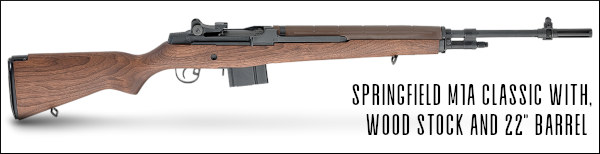
Old “Number 2″ belonging to Ray Gross. Click Photo for full-screen Image.
Ray Gross, one of America’s great rifle competitors, has served as captain of the United States F-TR Team. While Ray is best known for his F-Class shooting and leadership, Ray is also an experienced service rifle shooter, who secured his Distinguished Rifleman Badge 25 years ago. Ray has shot many rifles during his competitive shooting career, but the M1A rifle above held a special place in Ray’s heart. This old semi-auto earned Ray his Distinguished Badge, and he’ll never forget that, though he parted with the rifle in 2016.
Posting back in 2016, Ray told us:
“I said goodbye to an old friend… Affectionately known as ‘Number 2′, she is the rifle that I earned my Distinguished Rifleman Badge with in 1995 (#1159).
That rifle was also responsible for a fair amount of Venison in the ’90s, as well. But since then, she has spent a lot of time in the closet. Last time I got her out was to destroy a bunch of hard drives containing evidence collected during my Computer Forensics days. She deserved better than that.
I will miss the beautiful sound of all that American steel slamming into battery when I tripped her bolt.” – Ray Gross
Ray Gross was profiled in Shooting Sports USA last year. He explained how he started his competitive shooting career with an M1A rifle:
How did you begin in competitive shooting?
I began competing in 1991, at age 27. I bought an M1A and joined the Midland County Sportsman’s Club. One day I was at the club shooting the M1A when a member, Rich Koskela, came over and invited me to join them shooting competitions. Up until that point, I had no idea there was such a thing as NRA Competitive Shooting and I had been a member since 1986. Anyway, Rich and some of his friends showed me the basics and at my first match, I finished in the top half and first MU.
What are your major accomplishments in the shooting sports?
In 1995, I earned the Distinguished Rifleman Badge and a few years later switched to Palma rifle. On the way to making my first Palma team in 2003, I won the Army Cup, the Andrus trophy twice and the Sierra Trophy once. As a coach, I won the Herrick match, and seven F-TR National Championship team matches. Internationally, I’ve coached three gold medal America Match teams (The USA has only won four in Palma Rifle), and earned a Silver and Bronze coaching on the Palma Team in 2015 and 2019. In 2017, I led the U.S. F-TR Team to a World Championship. This year (2019), I also won the NRA ELR National Championship (25-lb max Division).”
“Descended from the M1 Garand, the M14 utilized multiple improvements that made it a far superior firearm for combat and a much better rifle for competition.” — Dick Jones, Shooting Sports USA.
In the April 2018 issue of Shooting Sports USA, you’ll find a good article on the civilian version of the M14, now sold commercially as the Springfield M1A. An evolution of the battle-proven M1 Garand, the M14 was designed to shoot the 7.62×51 (.308 Win) round instead of the larger .30-06 Springfield cartridge used in WWI, WWII and Korea. While the vast majority of today’s M1As are chambered for .308 Win/7.62×51, Springfield Armory also produces a 6.5 Creedmoor version.
Dick Jones reports that accurized M14/M1As could post remarkable scores: “The accuracy potential of the M14/M1A is unquestionable. During their reign as service rifles, they produced multiple perfect 200 scores at 600 and 1000 yards in the hands of top shooters. This is a difficult feat with a modern, scoped, magnum-caliber rifle and remarkable with an iron-sighted battle rifle. Good competition rifles can group 10 shots under one MOA, and the meticulously-massaged rifles used by the top shooters during my career would consistently put up 10 shots under an inch at 200 yards off a test cradle.”
For many years, the semi-auto version of the M14 was “top dog” in iron sights Service Rifle competition. Now that discipline is dominated by .223 Rem (5.56×45) AR-type rifles, but the bigger .308-caliber rifle, now sold as the M1A, remains popular. And in non-pandemic years, the CMP hosts a major M1A Match at Camp Perry, sponsored by Springfield Armory. This is a very popular event with 100+ competitors and significant cash prizes.
See how the modern M1A is built in this Springfield Armory Video:
As racing improves automobiles, competition improves firearms, and the current crop of Springfield M1As, from the Basic to the top-of-the-line Super Match and Loaded models, reflects the years of development. The M14 and its variants are … still considered by many to be the best battle rifle in the history of the U.S. Military. — Dick Jones, Shooting Sports USA
Military Version Operation Revealed — M14 Training Film
The original military version of the M1A was the select-fire M14. The 27-minute official U.S. Army video below demonstrates the operation of the M14. Field-stripping is shown from the 5:13 time-mark through 8:30. Cut-away drawings show the M14’s gas operation at 8:40.
Watch M14 Functioning Cycle Starting at 9:25 Mark:
The M14’s complete 8-step functioning cycle is demonstrated from the 9:25 time-mark through 22:41. These eight operations are: 1) Feeding; 2) Chambering; 3) Locking; 4) Firing; 5) Unlocking; 6) Extracting; 7) Ejecting; and 8) Cocking. This movie is fairly long, but fans of battle rifles will find it well worth their time. Every M1A owner should definitely watch this video start to finish.
William “Tom” Collins earned the CMP’s Distinguished Rifleman Badge #2500 this July. Collins earned his final EIC points at the Washtenaw Sportsman’s Club in Michigan.
One of the highest honors in competitive shooting is earning the Distinguished Rifleman Badge. This Badge was created by the War Department in 1884 to recognize members of the U.S. Army for Excellence-in-Competition (EIC) with the Army’s service rifle. Other U.S. Armed Forces soon adopted a similar program and in 1926 civilians were authorized to participate. This story is about William “Tom” Collins, 50, of Maumee, Ohio, who earned his badge in July 2020. His achievement was a landmark — Civilian Distinguished Rifleman Badge number 2500.
Collins Earns Distinguished Rifleman Badge Number 2500
Story based on Report by Ashley Brugnone, CMP Staff Writer
For over 20 years, the Civilian Marksmanship Program (CMP) has issued Distinguished Badges to competitors who collect at least 30 Excellence-In-Competition (EIC) “leg” points — earned by placing in the top 10% of an EIC match. This story is about Ohio shooter William “Tom” Collins, who recently earned Distinguished Rifleman Badge number 2500. [Editor: To learn more about the history of the Distinguished Rifleman Badge and what is takes to earn it, read Distinguished Rifleman — the Chase for Excellence by Jonathan Ocab.]
For Collins, this fulfilled a dream to join generations of elite marksmen before him. “The Distinguished Rifleman Badge has been a goal of mine since I learned about it,” Collins said. “I like to think back on the history of the badge … It makes me proud to be a part of that.”
Collins earned Distinguished Rifleman Badge #2500 in July. “Shooting is almost like meditation to me”, Collins said. “You really can’t think about anything other than the current shot. It’s very relaxing.”
He gives simple advice to other competitors hoping to one day earn a Distinguished Badge of their own: “Anyone working on it – quit thinking about it. Just shoot.”
Collins is congratulated by his friend Jamie Root after “going Distinguished”.
Collins has been shooting most of his life. Growing up in rural Ohio, he received his first BB gun around seven years old and his first .22 at age 11. It wasn’t until he joined the Army Reserves in 1987 that he received any formal marksmanship training. After he left the Reserves nine years later, he started looking toward organized shooting sports.
One day, back in 2014, he picked up his rifle and took the 45-minute drive to Fremont, Ohio, to fire in his first GSM (Garand-Springfield-Modern/Vintage Military) Match at the Sandusky County Sportsmen’s Club. It was there that he met Jesse Bragg, who was running the event.
Jesse Bragg, a retired staff sergeant from the Marine Corps Reserve Rifle Team, took Collins under his wing and showed him the ropes. Collins says Bragg seemed to want to teach more than run the match. In fact, Bragg was the one who introduced Collins to the idea of pursuing a Distinguished Badge. Collins admits that he had no clue what “going distinguished” meant. Bragg went over the terms – legging out, finishing “first leather” and other related expressions.
In 2015, Collins went to the National Matches at nearby Camp Perry, Ohio, and fired in his first President’s Rifle Match. Watching the elite shooters take their final shots inspired Collins: “Learning about the Distinguished Badge, learning about the President’s Match — I just knew that I had to get this Distinguished Badge on my way to, hopefully, getting into the President’s 100 or even the Top 20.” So Collins began traveling to GSMM competitions with his match rifle in tow, just to get in a little extra practice. It became his main focus. In June 2019, he earned his first set of six leg points at the CMP Viale Range 800 Aggregate and EIC Service Rifle Match at Camp Perry. It was a breakthrough.
When I first started, I was shooting the Garand and the M1A. [But] once I realized I wanted to get my Distinguished Badge, I said, “None of the wood guns. It’s all my match rifle until I go Distinguished”.
He went on to earn eight points at his next match in July, followed by eight more in August. With one more match left in 2019 and only seven points away from the required 30 to earn a badge, his goal was within sight. But it wasn’t until the EIC match at the Washtenaw Sportsman’s Club in Ypsilanti, Michigan, in July 2020 that he was able to conquer his nerves and earn his final points: “The most rewarding thing – it’s when you get there. When you finally earn it, everybody knows it. Everybody at the range celebrates with you. All of your friends are there with you. It’s just rewarding in itself. You’re part of that tradition that spans three centuries.”
Friendships Made on the Road to Distinguished
More so than the time, effort, and skill it took to earn the badge, the journey to become Distinguished was almost as rewarding as the badge itself for Collins, given the relationships he’s made along the way:
“These guys I’ve met and hung out with — we’ve given jobs to each other, we celebrate each other’s birthdays, we know each other’s families. It’s just been a great group of guys. You always are rooting for your friends, regardless of how well you’re doing. If you’re doing bad, you root for them even more.”
Distinguished Badge-Earning Marksmen Will Be Honored in 2021 at Camp Perry
Part of the tradition of earning a Distinguished Badge is walking across the stage at Camp Perry during the National Matches award ceremony. There, badge winners are formally pinned by their peers on a stage that has felt the footsteps of prominent marksmen for over a century.
“Last year, when I got the first points, I told myself, ‘I’m going to walk this stage at Perry next year'”. Collins and all others who earned a Distinguished Badge in 2019 or 2020 will still have the opportunity to take the stage next year at the 2021 National Matches — and that’s just what Collins plans to do.
The prone position demonstrated by two talented Service Rifle shooters. At top is SFC Brandon Green, multi-time High Power National Champion. Below is Tony Chow, a gifted match shooter. NOTE: Current Service Rifle rules allow the use of optics up to 4.5X.
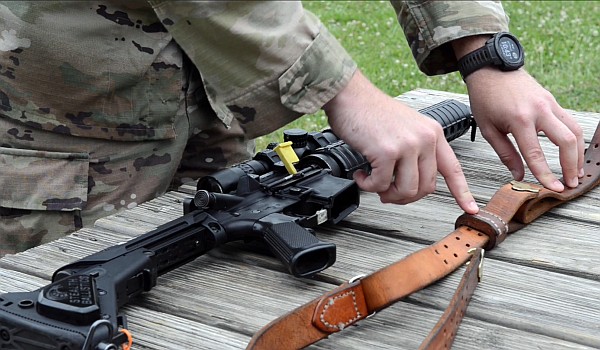
Jay Christopherson, 2020 Berger SW Nationals F-Open Champion, is one of the nation’s best F-Class shooters. When shooting F-Class, Jay uses a Seb Mini front rest and a large rear sandbag to support his big 22-lb F-Open rifle. Though he loves F-Class, Jay is also interested in Service Rifle competition where no external supports are allowed. You hold the rifle with your arms and a sling. Some Service Rifle competitions involve three position (Standing, kneeling/sitting, and prone), while others are prone only. Even in the prone position, the sling is a vital accessory.
Jay dramatically improved his Service Rifle “hard-holding” technique by enlisting the help of Emil Praslick III, former USAMU rifle coach. Emil’s guidance and advice resulted in an immediate increase in Jay’s scores on target, as recorded by his ShotMarker electronic target system. Jay noted: “These targets show the difference between hacking it on your own, and spending an hour with someone who knows what they are doing and can tell you that you are doing it wrong.” These targets show Jay’s “before and after” Service Rifle results shooting slung up prone at 600 yards:
Service Rifle, Prone with Sling at 600 Yards
Here is Jay’s target BEFORE training with Emil Praslick — a 194-3X with lots of vertical.
And here is Jay’s improved target AFTER putting Praslick’s advice to work — impressive 199-8X with significantly less vertical.
You can see on this second target much improved vertical. All 20 shots were in a vertical range much smaller than the vertical height of the 10-Ring. Had shot 16 not gone wide left, this would have been a 200. Shot 16 was OUT of the 10-Ring to the left, but note that vertically it has almost perfect elevation.
Jay stated: “I was pretty amazed at not only the difference on the target, but how much difference the changes Emil suggested made to how my hold felt. The entire feel was different and a ton less stress in my neck and arms compared to what I was feeling before. I was actually feeling pretty good about that 194 yesterday, because I hadn’t slung up in two years and that was my highest score (by one point) after doing some load fixing. But having someone explain what you are doing wrong and why makes a world of difference.
AR-platform rifles are fun and versatile, but the standard, mil-spec triggers leave much to be desired. They tend to be gritty, with creep and heavy pull weight. One of the easiest, most effective AR upgrades is a trigger group swap. An improved fire control group makes a huge difference. There are many aftermarket trigger options for the AR platform rifles. Choose single-stage or two-stage, either standard trigger assembly or unitized “drop-in” trigger, such as those made by Timney or Triggertech.
When upgraded with a precision trigger and match barrel, AR-platform rigs work great in NRA High Power competitions (Photo from NRA Blog, at Camp Perry).
Two-Stage vs. Single-Stage Triggers
Two-stage triggers have two separate movements. The first stage offers a light, spring-loaded pressure that works against the shooter’s pull until stopping at the second stage – this is called “take-up”. If there is no spring pressure, it is known as “slack”. Should the shooter continue to pull the trigger once he’s arrived at the second stage, the mechanism will operate like a single-stage trigger from there until engaging the sear and firing the gun. Some shooters prefer a two-stage trigger because it allows a mental preparation (first stage) before the final decision to “break the shot”.
Single-stage triggers feature no take-up or slack, as they begin engaging the sear as soon as the shooter begins pulling the trigger. Some competitive shooters prefer the two-stage trigger because of the feedback it provides during its first stage, while other shooters, including those using their rifle in tactical scenarios, may want the surety of a single-stage trigger, ready to engage and fire once their finger is inside the trigger guard. Regardless of preference, a good trigger will feature minimal creep and should be free of grittiness, providing a smooth, even break.
Drop-In Trigger Assembly vs. Standard Trigger Group
Once you decide between a single-stage or two-stage trigger, you can choose between standard and drop-in trigger groups. Standard trigger groups feature all the fire control group parts separated, and need to be pieced together and installed much like a mil-spec trigger, while drop-in trigger are pre-assembled and contained within a casing that simply drops in to the receiver and accepts the pins, hence the name.
After-Market Trigger Comparison
Some shooters prefer drop-in triggers due to the ease of installation, while others opt for standard groups so they can access the components individually for cleaning adjustment or replacement. If one piece of a drop-in trigger fails, you’ll need to either replace the entire unit or send it to the manufacturer for repair, whereas you may be able to simply replace the broken component of a standard trigger without needing a whole new trigger set.
Trigger Terminology — “Creep”, “Stacking”, “Overtravel”
“Creep” or “travel” is the distance the trigger moves between the end of take-up and when the trigger breaks to fire the fun. Too much creep can affect accuracy, but no creep can be unsafe, as the shooter may not be prepared to fire. “Stacking” occurs when the trigger weight actually increases during travel — this shouldn’t happen. Lastly, “overtravel” is the distance the trigger continues moving back after the gun fires.
This article is based on a longer story in the NRA Blog.
The Civilian Marksmanship Program (CMP) Oklahoma Games are slated for October 7-13, a month away. Match shooters from the middle of the country should consider attending the popular annual event held at the Oklahoma City Gun Club. CMP OK Games Registration is still open! Note — this match is not just for seasoned competitors. There will be a Small Arms Firing School, and the Oklahoma Games will also feature a New Shooter Clinic for those who have never fired in a CMP Games match.
Previously held in April, the CMP Oklahoma Games will feature the popular M1 Garand, M1 Carbine, Springfield, Vintage/Modern Military, Rimfire Sporter, and Vintage Sniper Rifle matches. Pistol matches, such as the As-Issued 1911, Military & Police Service Pistol and .22 Rimfire Pistol will also be held throughout the week. The CMP Cup Matches will again be held at this Travel Games event. This include two days of invididual competition, followed by a 4-Man Team Match, and EIC Service Rifle Match.
Electronic Targets Allow Faster Relays and No Pit Duty!
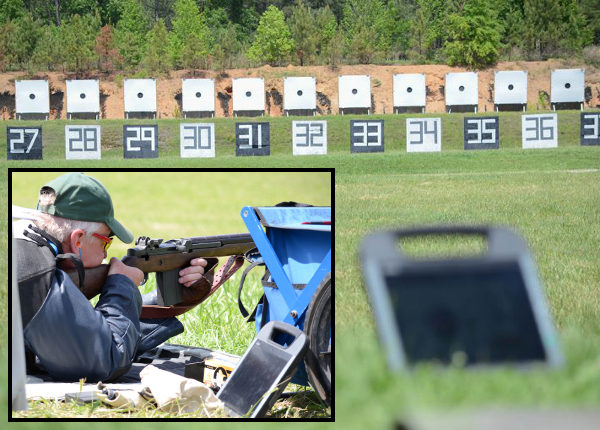
High Power competitions will be fired on CMP Targets, an electronic target system that plots shot placement in real time, and eliminates the need for pit duty — allowing quicker matches with less physical labor. Shot locations/scores appear on remote monitors placed at each shooting location.
Along with competitive matches, a rifle Small Arms Firing School (SAFS) is scheduled to instruct beginning and experienced marksmen in the classroom and on the firing line, with the help of CMP staff and certified instructors. Those in attendance will learn rifle handling, shot technique and safety, followed by firing in an actual M16 EIC match.
Match Awards will be distributed each day. All participants are invited to the annual BBQ where shooters can make friends and mingle with fellow participants and CMP staff. For some the Oklahoma BBQ is the highlight of the event.
About the CMP Travel Games
The CMP Travel Games are regional competitions held in different corners of the country throughout the year, featuring exclusive CMP rifle and pistol outdoor events. A common part of the CMP schedule for the last decade, the Games are centered around recreation-oriented competition and educational activities that are designed to accommodate experienced marksmen as well as those just beginning the sport.
Looking downrange at the 600-yard targets. All Camp Perry photos courtesy Dennis Santiago.
Our friend Dennis Santiago is at Camp Perry this summer. Yesterday (7/29/2019) he competed in the historic National President’s 100 Match. This is a huge event. in recent years, there have been over 1000 ranked competitors from throughout the nation, making this one of the biggest rifle events of the year.
The President’s 100 Rifle Match is richly steeped in history. This unique match was first held in 1878. Here’s the view from the line at 600 yards:
The 2017 President’s 100 Rifle Match was a tightly-fought affair, with the top five shooters separated by just two points. SSG John Cogshall (ARNG) shot superbly to take the top position and President’s Rifle Trophy. The top 100 competitors overall in the President’s Rifle Match are designated as the President’s 100. They receive President’s 100 medallions and certificates. GET full match results.
Top Five Shooters at 2019 National President’s 100 Match
1. SSG John Cogshall (ARNG) 390-14X (Trophy Winner)
2. SGT Thomas Colyard (SC, USMC) 389-16X
3. Sean Prosser (PA) 389-12X
4. Greg Troxell (TX) 388-11X
5. John Hefner, (TX) 388-13X
Note: SFC Brandon Green, USAMU, who holds the course record at 400-20X, also shot a 388-13X but was ranked sixth by tie-breaker.
President’s 100 Shoot Off! — The Top 20 shooters face off while everyone watches, wishing the best for every one of them. This is what attending a family gathering is for us.
President’s 100 Course of Fire
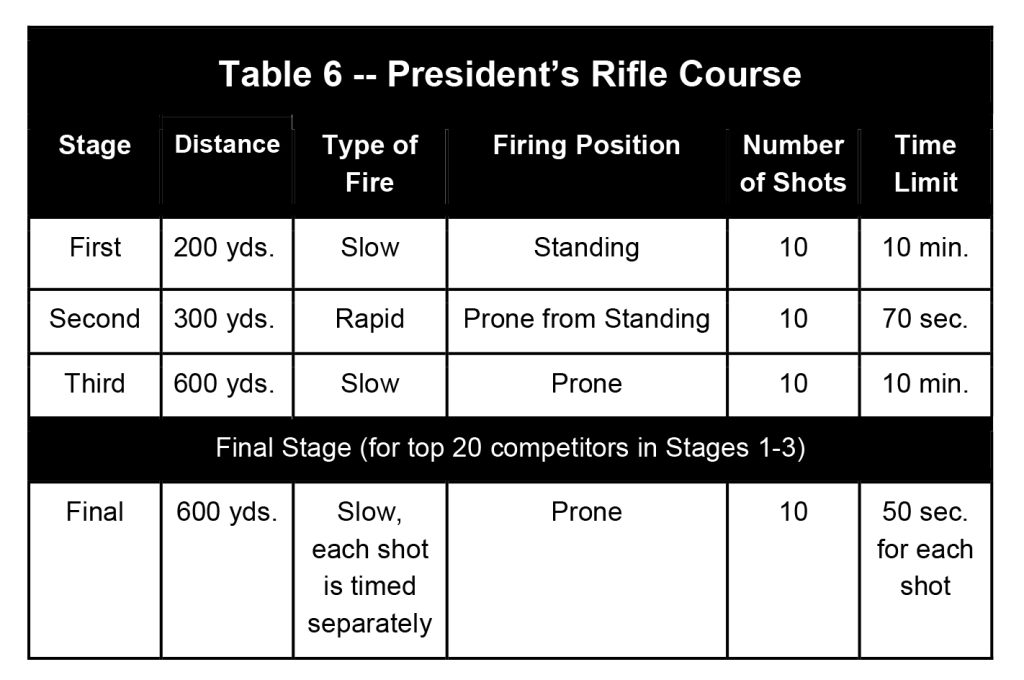
There is a three-yardage, four-stage Course of Fire for the President’s Rifle Match Course of Fire. Firing is done on the SR target at 200 and 300 yards and the MR target at 600 yards. Scores in stages 1-3 determine the President’s 100 and the final rankings of competitors in 21st place and below. Scores in stages 1-4 determine the match winner and the final rankings in places 1-20. If there is a tie for first place (equal total and X-count), the tied shooters will continue to fire one-shot-at-a-time until the tie is broken. No sighters are permitted in National Trophy Rifle Matches.
Origins of the President’s Match The National Rifle Association’s President’s Match was instituted in 1878, as the American Military Rifle Championship Match. In 1884, the name was changed to the President’s Match for the Military Rifle Championship of the United States. It was fired at Creedmoor, New York until 1891. In 1895, it was reintroduced at Sea Girt, New Jersey. Today, the match is held at Camp Perry, Ohio.
The President’s Match was patterned after the Queen’s Match for British Volunteers. That British competition was started in 1860 by Queen Victoria and the NRA of Great Britain to increase the ability of Britain’s marksmen following the Crimean War.
The tradition of making a letter from the President of the United States the first prize began in 1904 when President Theodore Roosevelt personally wrote a letter of congratulations to the winner, Private Howard Gensch of the New Jersey National Guard.
After a hiatus in the 1930s and 1940s, The President’s Match was reinstated in 1957 at the National Matches as “The President’s Hundred.” The 100 top-scoring competitors in the President’s Match were singled out for special recognition.
The SCATT MX-02 is an electronic shooter training system that is capable of operating outdoors with live, centerfire ammunition, at distances from 25 yards to 600 yards. Tony Chow tested this product for AccurateShooter.com. As fitted to his AR-15 Service Rifle, Tony concludes this is a very useful tool that can help High Power competitors refine their technique and shoot higher scores. CLICK HERE for MX-02 3000-word Review.
How the SCATT MX-02 Works
The SCATT sensor mounted on the end of the barrel has a digital camera that recognizes the black bullseye in the target, even in broad daylight outdoors. Using the bullseye as a reference, the SCATT software tracks the movement of the muzzle relative to the center of the target. The unit can plot these movements as a continuous trace, which appears on a monitor as a squiggly, colored line. By sensing the exact moment of shot release, the SCATT can also interpolate relative shot placement (for a single shot or series of shots) — but this is not the same as an electronic target which actually records the exact shot impact location on the target.
Some time ago, we reviewed this product from the perspective of a smallbore competitive shooter. (Read Previous Review.) Here we test SCATT MX-02 again, this time on an AR-15 service rifle, in order to assess its suitability for the High Power competition community.
We put the MX-02 through its paces in all three High Power shooting positions and in various environmental conditions. We wanted to find out whether the system can reliably operate in the harsher outdoor settings and withstand the recoil of a centerfire rifle. We also wanted to assess whether it provides added values for High Power shooters over older generation of electronic trainers such as SCATT’s own venerable WS-01.
On both counts, we came away impressed. The SCATT MX-02 stood up to centerfire recoil after hundreds of shots and was able to consistently recognize the often less-than-pristine High Power target faces. Both indoors and outdoors, the MX-02 acts as SCATT should and dutifully captures useful aiming traces and other data. It does that even during outdoor live-fire sessions, where shooter performance often differs from indoor dry-firing due to the sensation of recoil and environmental factors.
SCATT Rapid Fire Results (paper target on left, screen on right).
In particular, SCATT MX-02 allows shooters to effectively troubleshoot and improve their rapid-fire performance, a service that no previous-generation trainers are capable of providing. The unit isn’t perfect — the SCATT MX-02 had some mounting issues with small-diameter barrels, but a cardboard shim provided a quick and effective solution.
Overall, performance was impressive. In most realistic training conditions that High Power shooters experience, the system performed well. We can certainly recommend SCATT MX-02 as an extremely valuable tool for High Power competitors looking to take their performance to the next level.
For more information or to order SCATT products, including the MX-02, visit ScattUSA.com or call toll-free: 1-855-57-SCATT (72288).
The 2019 Eastern CMP Games & CMP Cup Matches are scheduled for April 26 through May 5, 2019. This is one of the biggest shooting matches on the East Coast, held at the Camp Butner Range in North Carolina. The CMP Games include Small Arms Firing School (SAFS), Garand/Springfield/Vintage/Modern Military Matches, Carbine Match, Rimfire Sporter match, and Vintage Sniper Team Match. There are also several pistol matches.
Following the CMP Games Matches will be the CMP Cup Matches: 4-Man Team Match, CMP 800 Aggregate Matches, and EIC Service Rifle Match. There will also be a GSM New Shooter Clinic, M1 Maintenance Clinic, and Team CMP High Power Clinic. The CMP will also sell rifles and ammunition at the event.
CMP Electronic Targets for Games and Cup Matches
All matches on the High Power rifle range will be conducted using Kongsberg Electronic Targets (KTS). The KTS system registers each shot and relays the location and score value to a monitor beside each shooter on the firing line.
The CMP Eastern Games have been very popular, thanks in no small part to the mobile electronic target system. Recent Eastern Games have drawn over 350 competitors. The Kongsberg electronic targets allowed the CMP to run relays more efficiently, and the targets eliminate the need for competitors to do pit duty. GSM Matches, which typically run four relays each day, saw days with a total of nine and 10 relays during its scheduled times, while the Vintage Sniper and other matches finished in record time.
“The electronic targets are phenomenal,” said brothers Richard and Jonathan Mast, who attended the Eastern Games along with other family members. Jonathan added, “It was the best shooting experience I’ve ever seen as far as immediately finding out where you’re shooting — best I’ve ever had.”
Throughout the CMP Games, competitors will use the CMP’s mobile electronic high power target system. The Kongsberg targets contain internal microphones that locate shot position. The scores are instantly calculated by computer and then wirelessly transmitted to portable, tablet monitors on each firing point.
The electronic targets provide immediate feedback. Importantly, the e-Targets eliminate pit duties and permit relays to fun faster and more efficiently. Shooter Caleb Mast noted: “This makes it easier for people who don’t have [a spotting scope]. All you pay is the registration fee, and I just brought what I’m wearing and was still able to score well enough to get my feedback on the monitor.”




 Ray Gross was profiled in



 The National Rifle Association’s President’s Match was instituted in 1878, as the American Military Rifle Championship Match. In 1884, the name was changed to the President’s Match for the Military Rifle Championship of the United States. It was fired at Creedmoor, New York until 1891. In 1895, it was reintroduced at Sea Girt, New Jersey. Today, the match is held at Camp Perry, Ohio.


 The 2019