Our friend Robert Whitley of ARX Enterprises LLC has learned, through careful measurement and testing, that some barrels threaded 5/8″ x 24 TPI at the muzzle may not deliver optimal accuracy. The reason is that the end of the barrel can bell out slightly, like a trombone, because too much steel has been removed. This is particularly true with .30-caliber barrels, but it can also be a problem with smaller caliber barrels (even 6mm). Robert demonstrates this phenomenon in the video below. All gunsmiths, and anyone considering threading a barrel, should watch the video. At 1:00 – 1:30 Robert gauges a 5/8″ x 24-threaded .30-Caliber barrel. You can see the belling effect clear as day.
“When setting up a commercial barrel in the lathe, we noticed that the maximum-sized bushing that would fit in the bore at the chamber end was almost .0015” smaller [than what would fit] at the muzzle. That precipitated my pin-gauging of a number of different commercial barrels that were threaded for 5/8” x 24 tpi. What I found is what’s shown on the video.” – R. Whitley
Solve Problem with a Larger Thread Diameter
If 5/8″ x 24 threading is potentially harmful to accuracy, is there a solution? Yes, you simply need to leave a little more steel on the barrel. (See Video starting at 02:40.) Frank Green of Bartlein barrels states: “We get these questions all the time. I say run the largest thread diameter that is possible.” Robert Whitley has found that a 3/4″ x 28 TPI threading does not cause the “belling effect”. Accordingly Robert recommends 3/4″ x 28 if you need to thread your barrel for a muzzle brake or suppressor. Robert explains: “We only make 3/4” x 28 TPI muzzle brakes and that’s what we recommend to customers.”
“See how much meatier the 3/4″ threading is vs. the 5/8″. The 3/4″ threading offers a lot more metal around the bore. There’s a lot less opportunity for the bore to become bell-mouthed…” – Robert Whitley
Barrel Threading Diameter — What’s Important to Know
By Robert Whitley
In truth, the 5/8” x 24 TPI threading never came out of any accuracy-based think tank or set-up, it’s a military .30-Cal threading for barrels that someone has to carry around (they needed to keep the barrel weight down so it was smaller in diameter and the threading had to work with that situation). People have somehow assumed because the military uses that threading for certain things that it must mean that it’s also fine for a highly accurate rifle too, but that’s not really correct.
I don’t think there is any better and realistic option than the 3/4″ muzzle threading, and we also do it so there is no relief cut behind the threads on the barrel (i.e. put the relief cut on the brake or jam nut, don’t chop down on the muzzle of the barrel). For some reason many have a hard time grasping that the metal at the muzzle end of a rifle is “sacred” and you should not cut it down any more than absolutely necessary. A little threaded pencil diameter nub on the end of a barrel is not ideal for accuracy especially if it’s threaded and you need to torque on it. I cringe when I see a barrel with something like an MTU or Heavy Varmint contour, only to have an itty-bitty pencil thin threaded nub right at the muzzle so someone can “screw on a can” or a muzzle brake.
Lessons Learned Over the Years
A number of years ago I did a 30BR rifle project with Craig Kostyshyn who was big in the 30BR game and he made some of the best 30BR rifle barrels for benchrest competition. When I did the project I wanted a medium-heavy Palma type contour barrel I could use and also have a muzzle turndown for a front sight band. When he found out I was going to have the muzzle turned down he said “whoa, I need to provide for that when I make the barrel because if you turn the front down later you’ll be shooting a trombone” (i.e. the muzzle bore dimension would open up).
What he did was rough contour the barrel with the turndown (about .010” oversize) before he lapped the barrel, then when he lapped the barrel he took it easy in the muzzle area and worked the back of the barrel more. I thought he was a little bit excessive in his concerns but the barrel shot great and I wasn’t going to argue with him, after all he was shooting groups in the ones. I kind of just filed that away and never thought about it until recently when I went to have Fred from Sabreco do some chamber re-work on a commercial .30-caliber barrel I had. When setting up the barrel in the lathe and indicating things Fred noticed that the maximum-sized bushing that would fit in the bore at the chamber end was almost .0015” smaller [than what would fit] at the muzzle and he mentioned it to me. That precipitated my pin-gauging of a number of different commercial barrels I had that were threaded for 5/8” x 24 TPI. What I found is what’s shown on the video.
NOTE: This is a copyrighted article. Do not reproduce or re-link more than 75 words without written permission from AccurateShooter.com.
In this interesting video, Brownells Gun Tech Caleb Savant covers the topic of linear compensators, aka “blast diffusers” or “linear blast devices”. These are quite different in function from a typical muzzle brake and they are NOT a sound suppressor. Unlike a traditional muzzle brake, a linear compensator directs the muzzle blast forward, AWAY from the shooter. This is not only good for the shooter but also for folks next to the shooter, either at the range or in a CQB law enforcement or military situation.
A “Linear Compensator”, also known as “blast diffuser”, my look similar to a muzzle brake. But it works differently. A typical muzzle brake shoots blast out the side, and can be pretty annoying for someone positioned next to the shooter. By contract, the Linear Compensator direct blast force more forward. This helps reduce perceived recoil, and importantly doesn’t send hot gasses left and ring to nearby shooters or observes. Muzzle brake output can be very annoying. This Editor once was shooting next to a .338 Lapua Magnum with a brake, just a couple feet away. With each .338 LM shot I could feel heat on arms/hands and actually feel the bones in my forearm vibrate.
Attachment Methods — Direct Thread Mounting vs. Quick-Attach Mounting
Linear compensators have become much more popular in recent years as AR-15 pistols and SBRs have proliferated. Some linear comps, such as popular models from Midwest Industries and the Troy Claymore, attach directly to the muzzle, just like a traditional flash hider or muzzle brake.
Other Linear Compensators are slip-on, quick-attach components that mount OVER another muzzle device. For example, the VG6 Precision CAGE Device (Concussion Altering Gas Expansion) attaches directly over one of their standard muzzle devices. Almost every company that makes a sound suppressor also offers a linear compensator, which typically attaches to the muzzle the same way as the silencer.
Video find by Boyd Allen. We welcome reader submissions.
Watch this video to see how a sound suppressor (aka “silencer”, “moderator”, or “can”) is constructed, start to finish. It’s more complicated than you might expect — there are quite a few stages in the process. The video below shows the fabrication of a SilencerCo Octane 45 suppressor:
SilencerCo writes: “What, exactly, goes into making a silencer? It may be more than you’d expect. From cutting metal to chemical baths, to extensive quality control every step of the way, our streamlined process is more than just a few steps. Watch our newest video, HOW IT’S MADE: Octane 45, to catch a glimpse behind SilencerCo’s doors.”
How Loud Are Unsuppressed Rifles?
Firearms Are Loud — 140 dB to 175 dB. ASHA explains: “Almost all firearms create noise that is over the 140-dB level. Exposure to noise greater than 140 dB can permanently damage hearing. A small .22-caliber rifle can produce noise around 140 dB, while big-bore rifles and pistols can produce sound over 175 dB. Firing guns in a place where sounds can reverberate, or bounce off walls and other structures, can make noises louder and increase the risk of hearing loss. Also, adding muzzle brakes or other modifications can make the firearm louder. People who do not wear hearing protection while shooting can suffer a severe hearing loss with as little as one shot[.]” Source: ASHA, Recreational Firearm Noise Exposure.
How Much Does a Good Suppressor Really Reduce Firearm Sound Levels?
That depends on the rifle, the cartridge, and the effectiveness of the suppressor. American Hunter explains: “Suppressors retard the speed of propellant gases from the cartridge that rapidly expand and rush out of the barrel. It’s these gases that produce the loud boom that’s heard for miles. A suppressor’s series of internal baffles slows these gases so they are not all released at once, thereby muffling the sound.” Many good commercial suppressors can achieve 30-35 dB sound suppression. However, Zak Smith of Thunder Beast Arms says: “There are a bunch of manufacturers who publish values that are not reproducible, or use an ad-hoc test instead of a mil-spec test. In many cases we’ve tested the exact same suppressors they’ve advertised with 30-40 dB reductions and found they are actually in the high 20s instead.”
Again, for this reason, we recommend that hunters use ear protection, such as electronic muffs, even when shooting suppressed.
There’s a good episode of Gun Talk Radio this Sunday, 10/18/2020. This week’s broadcast will cover a variety of topics. First the broadcast will focus on the importance of confirming Judge Amy Barrett as the new U.S. Supreme Court Justice. In addition, the show will explain the best way to purchase and register a silencer in compliance with all Federal laws and regulations.
This week, Tom Gresham talks with the Second Amendment Foundation’s Alan Gottlieb. They discuss what’s at stake when filling Justice Ginsburg’s seat, and what major gun rights cases SCOTUS might decide in 2021. Plus Brandon Maddox of Silencer Central discusses how his company makes it easy to get a suppressor — Silencer Central will prepare AND file the ATF paperwork for you. Call 866-TALK-GUN with your comments and questions.
Big Prizes for “Enter… If You Dare” Contest
In addition GunTalk Radio is running a great “Enter… If You Dare” contest right now. The giveaway Grand Prize winner receives a Springfield Armory XD-M Elite Optics Ready 9mm pistol, a SilencerCo compact Omega 36M modular suppressor, a Crimson Trace red dot reflex sight, AND a $400 gift certificate from Galco. Four First Prize winners will take home a $150 Galco gift certificate, plus one of four triggers from Timney Triggers. Enter now through Friday, October 30th at GunTalk.com/WIN.
Gun Talk Radio — Podcast Archive
If you miss the live show broadcast or Live Streaming, past broadcasts can be heard online via the GUNTALK PODCAST Site and Apple iTunes. The Gun Talk Podcast Archive has hundreds of past shows you can access via the internet. Here’s an informative podcast focusing on firearms selection for self-defense.
Gun Talk Podcast from 5/31/2020 — Security, Riots, and Gun Choices:
All Gun Talk shows are also archived as podcasts for download or online listening. Gun Talk is also available on YouTube, Roku, Apple TV, Amazon Fire TV, and GunTalk.com.
Area 419 is a top-tier manufacturer of reloading tools, shooting accessories, rails, suppressors, mag kits, and tactical/PRS rifle packages. To celebrate the 4/19 date which matches its company name, Area 419 is running a very compelling SPECIAL SALE. Right now you can save 10% on CZ tactical rifle builds, save 10% on suppressors, save 15% on select actions, save 20% on TriggerTech triggers, and save 50% on apparel.
In addition, during this special sale, pretty much everything else Area 419 sells is at least 10% Off. To take advantage of these big discounts, visit Area419.com and use CODE 4192020 during check-out. (NOTE: Some items, such as the TriggerTech triggers, are already discounted, so no check-out code is required). This sale runs through 11:59 pm ET on 4/20/20.
Curious about suppressors (aka “silencers”, “moderators”, or “cans”)? Below you’ll find an informative NSSF Infographic that covers the history, legal status, design, and operation of modern-day suppressors.
Here’s a cool video showing how suppressors work. This video features see-through rifle suppressors filmed with ultra-high-speed (110,000 frame per second) cameras. When played back in super-slow-motion, you can see the flame propagate through the suppressor and the bullet move through each baffle before it exists the muzzle. Check it out!
See Through Suppressor in Super Slow Motion (110,000 fps) — Click Arrow to Watch:
Suppressor Facts — What You Need to Know
In this infographic, the NSSF provides the history, specifications, benefits and uses of firearm suppressors. Don’t suppress your knowledge!
Suppressors reduce gunfire sound levels by using baffles that contain expanding gasses exiting a firearm’s muzzle when ammo is discharged. Suppressors are similar to car mufflers that were, in fact, developed in parallel by the same inventor in the early 1900s. Well-designed suppressors typically reduce the gun sound levels by 30-35 decibels (dB). Suppressors are becoming more popular even though it still takes many months to get approved. In fact, the number of suppressors registered with the ATF grew by over 1 million from 2011 to 2017. That’s a 355% increase.
You’d like to protect your hearing, and maybe you’re a little curious about how your rifle might shoot suppressed. So you’re thinking of buying a suppressor (aka “can”, “moderator”, “silencer”). You can’t just get one off the shelf at Walmart. Acquiring a suppressor requires filling out paperwork and paying a Federal $200 Tax Stamp. Plus there is typically a pretty long wait. However, the good news is that suppressor ownership is now legal in 42 of the 50 American states — that’s 84%! For most American adults, getting a suppressor is legal, provided pass the required background checks.
States Where Suppressor Ownership is Allowed
Currently, the following 42 states allow private ownership of suppressors: AL, AK, AZ, AR, CO, CT, FL, GA, ID, IN, IA, KS, KY, LA, ME, MD, MI, MN, MS, MO, MT, NE, NV, NH, NM, NC, ND, OH, OK, OR, PA, SC, SD, TN, TX, UT, VT, VA, WA, WV, WI, WY.
Note: Even if you live in one of the states listed, you should still verify that owning a suppressor is legal in your area. Some states may have municipal- or county-based restrictions.
States Where Suppressor Ownership is Prohibited
Unfortunately, there are still eight (8) States that forbid private ownership of suppressors. The eight No-Go States are: California, Delaware, Hawaii, Illinois, Massachusetts, New Jersey, New York, Rhode Island. In these eight states, private ownership of suppressors (aka “silencers”) is forbidden. Hopefully that a few of those eight hold-out states will change their laws in the months ahead.
Looking Inside a Suppressor in Action
Popular YouTube Channel Smarter Every Day recently released a cool video featuring rifle suppressors with see-through acrylic sleeves. The team filmed shots through the suppressors using ultra-high-speed (110,000 frame per second) cameras. When played back in super-slow-motion, you can see the flame propagate through the suppressor and the bullet move through each baffle before it exists the muzzle. Watch the results in the video below — it’s mesmerizing:
See Through Suppressor in Super Slow Motion (110,000 fps) — Click Arrow to Watch:
Suppressors, On Average, Reduce Noise Levels about 30 Decibels
In an article for Ammoland, gunwriter Sam Hoober says that you can expect about 30 decibels (dB) of noise reduction from the average suppressor: “Looking at a few different products, SilencerCo attests their suppressors reduce the sound pressure of a 9mm gunshot to anywhere from 125.7 dB to 131.5 dB, depending on the model. Advanced Armament Co, another popular supplier, attests a 23 dB to 33 dB reduction or down to 127 dB. Liberty Suppressors, another manufacturer, attests a reduction of 24 dB to 38 dB, depending on model and other factors. In short, we can presume something on the order of 30 dB of attenuation as an average.”
Using that 30 dB number you can quickly discern that you’ll still need hearing protection — good hearing protection — when shooting any suppressed firearm (even a .22 LR). “Spikes of 130 dB and more can result in permanent hearing damage instantly”. Source: NRA Blog.
Story idea by Boyd Allen. We welcome reader submissions.
Here’s a feel-good story. ELR ace Paul Phillips took his 9-year-old daughter Addison to the range this past weekend, to try shooting at 1000 yards. Guess what, Addison got hits at 1000! That’s impressive enough, but get this, Addison made those shots with a .22 LR rimfire rifle! Yes a .22 LR will fly that far — but it took a whopping 342 MOA of elevation and five seconds of flight time.
Paul says: “So proud of my 9-year-old making impact at 1000 yards with her .22 rimfire. My 82-year-old dad also got hits at 1000. Amazing!” Paul adds: “My daughter is very excited to get into shooting sports. The .22 ELR game is very fun for her especially shooting suppressed subsonic. It helps her to learn the fundamentals without flinching.” After her success at 1000 yards, the little lady then made multiple hits on a silhouette at 322 yards (see below).
After Addison checked the ELR box at 1000 yards, she tried a 322-yard steel silhouette target. No problem — after many hits in the center, she put three into the top without any misses. This little girl can shoot!
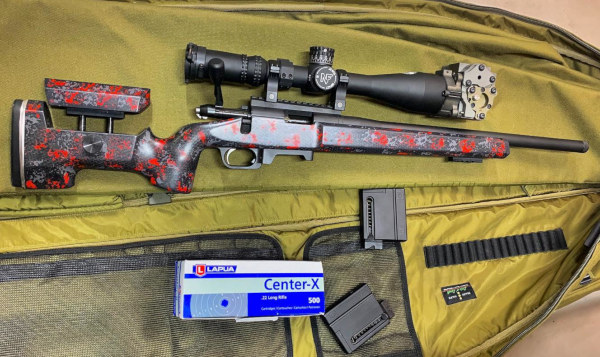
The rifle features a Vudoo Gun Works rimfire action bedded in McMillan A6 stock by Alex Sitman. The barrel is a 20″ Bartlein, fitted with a GSL Technologies suppressor (see second photo above). On top is a Nightforce ATACR 7-35x56mm F2 scope fitted with a TACOM Charlie TARAC prism system that provides +800 MOA beyond the scope’s internal elevation. The rifle rested on a Phoenix Precision bipod. The ammo was Lapua Center-X subsonic, running 1090 FPS at the muzzle. Paul notes: “The 22 GSL silencer had no noticeable point of impact shift. It actually shot better groups with it on.”
Addison’s impressive shooting was done at the Marksmanship Training Center in Lake City, Michigan. This veteran-owned shooting facility is a very scenic venue as you can see:
Ballistics Prediction Was Nearly Perfect
The Applied Ballistics solution was within one MOA at 1000 yards. 1000 yards required 342 MOA up from the 100-yard zero. Flight time was over 5 seconds! MV was 1090 FPS. The target was a 6′ x 6′ F-Class frame, covered with white paper. That’s roughly 7 MOA, equivalent to about 3.5″ at 50 yards.
Comments from Facebook Fans (and Bryan Litz)
It’s in her genes — Brian R.
Like father like daughter! — Daryll B.
Dang! And I thought my son hitting at 400 was good! — George W.
Most people I know including myself did not believe that the .22 LR genuinely flew that far (despite the warning labels). — Robert S.
Applied Ballistics was within 1 MOA on a 342 MOA solution. We’ll have to tighten that up. — Bryan Litz
All in the Family — Three Generations
Along with Addison, father Paul Phillips and grandfather Rusty Phillips (right) all took shots at 1000 yards, and all three generations of Phillips got hits. The threesome took a total of 145 shots at 1000 yards and impacted 13 times. Paul observed: “We hit almost 1 in 10 shots [with] lots of close misses. Believe it or not, most were due to elevation not wind. There were 3-5 mph winds from 3-9 o’clock. To help see hits, John Droelle was spotting for us in the 1000-yard pits.”
Our friend Gavin Gear of UlimateReloader.com recently visited a SilencerCo dealer in the state of Washington, The Range LLC in Yakima, WA. Gavin was able to test a number of suppressors (aka “moderators” or “silencers”) for both rifle and pistols. Gavin recently released a lengthy article covering his experiences. If you are in the market for a suppressor, we highly recommend you read Gavin’s SilencerCo Products Overview on UltimateReloader.com.
Gavin was able to test three SilencerCo suppressors: the Omega 300, the Hybrid, and the Osprey 45. In addition Gavin was able to handle the Maxim 9, an integrally suppressed 9mm handgun.
Gavin reports the Omega 300, which is rated up to .300 Winchester Magnum, is a very popular “can”. According to Gavin, the Omega 300 has become the best-selling rifle suppressor in history for important reasons. First, it has an integral muzzle brake. Second, it can work for multiple calibers, from .223 up to .308. Third, “It is very tough — .300 Win Mag rated, and full-auto rated”.
SilencerCo lineup, from left: Omega 300, Hybrid, Osprey 45
Gavin says the Hybrid Suppressor is an interesting concept: “One suppressor that you can configure for multiple calibers, both rifle and pistol. This includes the ability to change out the threaded mount on the muzzle end, and you can also swap out end caps that will optimize sound suppression for different calibers. The Hybrid… is full-auto rated, and can handle rifle cartridges up to and including .338 Lapua Magnum! But this suppressor can also be used for pistol applications…from 9mm up to 44 ACP.”
OK, you’ve paid the tax stamp and acquired your new suppressor (aka “silencer” or “moderator”). Do you still need to wear earplugs or muffs? Absolutely. Even with that expensive new “can”, your rifle could be generating over 140 decibels (dB) of noise — about the same as as an unmuffled 9mm pistol shot. That’s loud enough to create permanent hearing loss with repeated exposure.
Firearms Are Loud: 140 dB to 175 dB
Audiology group ASHA explains: “Exposure to noise greater than 140 dB can permanently damage hearing. Almost all firearms create noise that is over the 140-dB level. A small .22-caliber rifle can produce noise around 140 dB, while big-bore rifles and pistols can produce sound over 175 dB. Firing guns in a place where sounds can reverberate, or bounce off walls and other structures, can make noises louder and increase the risk of hearing loss. Also, adding muzzle brakes or other modifications can make the firearm louder. People who do not wear hearing protection while shooting can suffer a severe hearing loss with as little as one shot[.] Audiologists see this often, especially during hunting season when hunters and bystanders may be exposed to rapid fire from big-bore rifles, shotguns, or pistols.” Source: ASHA, Recreational Firearm Noise Exposure.
Suppressors, On Average, Reduce Noise Levels about 30 Decibels
In an article for Ammoland, gunwriter Sam Hoober says that you can expect about 30 decibels (dB) of noise reduction from the average suppressor: “Looking at a few different products, SilencerCo attests their suppressors reduce the sound pressure of a 9mm gunshot to anywhere from 125.7 dB to 131.5 dB, depending on the model. Advanced Armament Co, another popular supplier, attests a 23 dB to 33 dB reduction or down to 127 dB. Liberty Suppressors, another manufacturer, attests a reduction of 24 dB to 38 dB, depending on model and other factors. In short, we can presume something on the order of 30 dB of attenuation as an average.”
Using that 30 dB number you can quickly discern that you’ll still need hearing protection — good hearing protection — when shooting any suppressed firearm (even a .22 LR). “Spikes of 130 dB and more can result in permanent hearing damage instantly”. Source: NRA Blog.
The Myth of the “Quiet” .22 LR
The NRA Blog notes that “many rimfire shooters, particularly those using the beloved .22 Long Rifle cartridge, argue that the small .22 LR caliber doesn’t produce enough sound to damage your hearing”. So, is that really true. or is it a myth?
In fact, a .22 LR can be much louder than you think — a .22 LR pistol can produce sound levels of 134 dB. That’s well above the normal human pain threshhold.
Sound Levels for Common Noises:
9mm Luger pistol: 160 dB
Jet aircraft engine (near): 140 dB
.22 LR pistol: 134 dB
Normal human pain threshold: 120 dB
Noisy Nightclub: 110 db
Riding Motorcycle at 65 mph: 103 db
Power Lawnmower: 95 dB
Hearing damage possible: 85 dB (sustained for 8+ hours)
Ringing Telephone: 80 dB
Normal conversation: 60 dB
The Risk of Hearing Loss
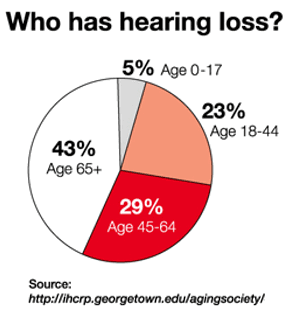
Hearing loss can be progressive and irreversible. If you are a shooter, this is serious business. As the NRA Blog cautions: “You may not even realize you’re harming your hearing. Hearing loss occurs gradually, and can go effectively unnoticed until symptoms become severe. By then, the damage is done.”
Nobody wants to go deaf. But we often see shooters without effective hearing protection when they are walking around a few yards behind the firing line. That’s bad — even if you are away from the firing line, gunshot noises can damage your hearing. You MUST use effective hearing protection every time you go to the range. Good foam earplugs costs mere pennies but they can prevent deafness in your later years. Many folks also wear muffs over plugs.






 The Risk of Hearing Loss


