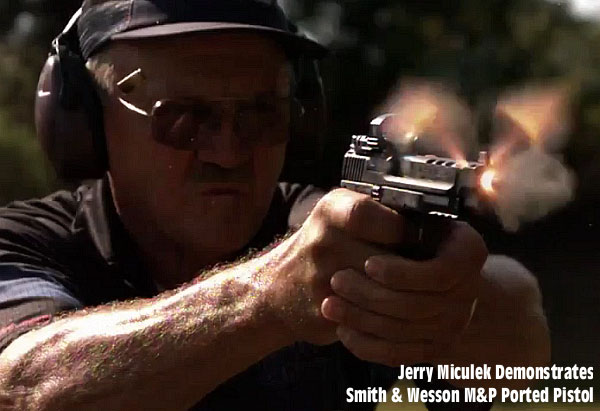
Smith & Wesson is introducing a new series of ported M&P pistols. Chambered in 9mm and .40 S&W, the Performance Center M&P Ported pistols offer a factory-ported barrel and slide. Both 4.25″ and 5″ barrel configurations are offered in each caliber. A special Performance Center sear provides a crisp 4.5-pound trigger pull with faster reset. The 9mm pistol has a 17+1 round capacity while the .40 S&W variant features a 15+1 round capacity. Both handguns (9mm and 40 S&W) have an MSRP of $812 with two magazines.
The ported design should help competitors, says pistol ace Jerry Miculek: “The two biggest advantages of running a ported gun in competition involve reduced muzzle rise and less perceived recoil. This [will] help with shorter split times and more rounds on target — two things every competitor wants.”
The new ported M&P pistols feature a slide-top platform for easy mounting of red-dot optics. These guns also have high-profile iron sights that can be used in conjunction with the optics. The M&P Performance Center Ported models also feature a textured interchangeable back strap. Three palmswell grips are supplied with each pistol, allowing shooters to custom-tailor grip size to their preference.
Video Shows Ported Pistol Features and 3D CAD Views:
Team Smith & Wesson shooter Julie Golob has a message for this Mother’s Day (Sunday, May 11th). Julie writes: “While some are using Mother’s Day week to push a gun control agenda, I’d like to encourage moms to ‘Take a Moment’. Talk to your kids about firearms safety. Help them learn what to do around firearms and have an open, honest discussion about guns and gun safety.
I truly believe that, no matter if you are pro-gun or anti-gun, everyone should know and understand the basic rules of firearm safety. It is equally important for parents to have the discussion about guns and what to do if your child finds one. Both the NSSF’s Project ChildSafe and the NRA’s Eddie Eagle GunSafe® Program are excellent. They offer resources for parents, educators, and child care providers to help ensure kids stay safe.
Julie encourages all who read this to share the message. So far, on Facebook, the “Take a Moment” image has been shared 639 times, and seen by 66,112 people. That’s the power of the internet. Julie says: “Thank you all so much for helping me spread the importance of firearms safety.”
How fast can a human shoot a revolver? The legendary Jerry Miculek answers that question in this video. Using his new, 9mm model 929 revolver, Jerry shoots 16 shots in 4.01 seconds, with a reload*. His splits between shots were running 0.16-0.17 seconds. That works out to a peak rate of fire of 353 rounds per minute, faster than some early-era machine guns. Even counting his reloads, his sustained rate of fire would be 239 rounds per minute, faster than a 19th-century Gatling gun. Note: If you are attending the NRA Annual Meetings in Indianapolis this weekend, you can meet Jerry Miculek at the Hornady booth (#6361) on Friday or Saturday at 4:00 PM.
16 shots w reload
Split Times
Peak Rate of Fire
Sustained Rate of Fire
4.01 seconds
0.16-0.17 seconds
353 rds per min
239 rds per min
Smith & Wesson 929 Eight-shot Revolver, Jerry Miculek Edition
Jerry really likes his JM Signature Edition model 629 revolver. Produced by the S&W Custom Shop, this 9mm handgun features a ported, broach-cut barrel plus a titanium cylinder. Jerry says the low-mass titanium cylinder reciprocates very fast, making for a responsive rapid-fire revolver.
*This was time on target. Total time including initial reaction time was 4.88 seconds.
Editor’s Note: Sometimes proven old designs are just as good as the latest technology. In the capable hands of Robert Vadasz, the scratched and well-used 11-year-old Smith & Wesson revolver shown below has won three PPC National Championships and the 2011 National Police Shooting Championship (multiple guns used). Here’s a profile of a great shooter and his trusty old wheelgun.
Story by Lars Dalseide, for The NRA Blog
When I first approached U.S. Border Patrol Agent Robert Vadasz about profiling the guns he used to win the 2011 National Police Shooting Championship — his third in four years — he had just completed the final stage of the Revolver 1500 Match. A match that he won with a score of 1490-117X. A match in which he used his Bob Jones PPC revolver.
“It’s a .38 Special Smith & Wesson,” said Vadasz. “My Bob Jones PPC revolver. The very first competition gun that I ever had built … probably back in 2000″. Fitted with Hogue Monogrip, the .38 hasn’t been tinkered with since the day it arrived. “Exact same gun,” said Vadasz. “It’s never been worked on. It’s never been changed. I won all three of my PPC National Championships with this gun. It’s real special to me.”
In a 2001 NRA Law Enforcement Division Newsletter, gunsmith Bob Jones talked about his work on PPC pistols: “I started working on pistols in the Navy, and it kind of stuck — it was something I really enjoyed doing,” said Bob, thinking back to his days as a Naval armorer who tinkered with .45s.
Bob’s typical modifications to a Smith & Wesson revolver include fitting a Shilen barrel, bobbing the hammer (cutting off the cocking spur), adding an Aristocrat Sight Rib, tuning and smoothing the trigger, and installing a trigger stop. The Shilen barrel increases accuracy, adds some additional weight for stability, and its increased size (and surface area) helps with heat dissipation.
Last week we reported that Smith & Wesson was recalling certain Thompson/Center (T/C) Venture rifles because of potential defects in the sear mechanism. Well it looks like the problem is worse than first thought. As a result, Smith & Wesson has expanded its recall to include ALL T/C Venture Rifles manufactured prior to October 28, 2011. The sear issue could possibly cause a Venture rifle to fire without the trigger being pulled. READ Recall Notice.
Expanded Recall of Thompson/Center (T/C) Venture Rifles
This broadens the recall announced by Smith & Wesson on November 8, 2011. This recall applies to ALL Venture rifles manufactured prior to October 28, 2011. To determine if your rifle is affected, please reference the serial number list located at www.smith-wesson.com/venturerecall or by calling Smith & Wesson directly at 1-800-713-0356. If your serial number does not fall within the list of affected serial numbers, your rifle is not part of this recall.
REMEDY/ACTION TO BE TAKEN: STOP USING YOUR RIFLE. Any unintended discharge of a firearm has the potential to cause injury or death, and we ask that you stop using your rifle until we have an opportunity to inspect the sear to make certain that there is no condition which will allow the rifle to fire without the trigger being pulled. To facilitate the inspection and, if necessary, repair of your rifle, please contact Smith & Wesson’s customer service department to receive instructions and a prepaid return label for the return of your rifle to Smith & Wesson. When you return your rifle to Smith & Wesson, be sure to attach the completed information card received from Smith & Wesson, so that your rifle can be returned to you as quickly and efficiently as possible.
CONSUMER CONTACT: Please contact Smith & Wesson directly at 1-800-713-0356, or at venturerecall@smith-wesson.com to arrange for the inspection and repair of your rifle.
Smith & Wesson is going to produce an AR15-type rifle chambered for the .300 Whisper cartridge. This will be an addition to S&W’s Military & Police (M&P) Rifle series. As the first production rifle in the AR platform to be chambered in .300 Whisper (and .300 AAC Blackout), the new rifle offers both sub-sonic and supersonic capabilities. Originally developed and pioneered by J.D. Jones of SSK Industries, the 300 Whisper is based on the .221 Rem Fireball case necked up to .308. Notably, S&W says its M&P15 .300 Whisper is compatible with both the .300 Whisper and the .300 AAC Blackout (BLK) cartridges. The latter is a SAAMI-standardized, trademark-free variant of the .300 Whisper.
Manufactured on the M&P15 (AR-clone) platform, S&W’s new semi-automatic .300 Whisper rifle features an 1 in 7.5” twist, 16″ chrome-moly barrel. Both the forged 7075 aluminum upper and lower receivers have been coated with a Realtree APG camo finish. Standard features include forward assist and a six-position, collapsible CAR stock. MSRP for the complete rifle is $1,119. A separate .300 Whisper AR flat-top upper will also be offered, with an $819.00 MSRP.
“As the popularity of the modern sporting rifle continues to grow, more hunters are seeing the advantages of taking these firearms into the field,” said Mario Pasantes, S&W Senior Vice President of Marketing. “The M&P15 300 Whisper gives consumers the ability to use either lightweight or heavy cartridges during hunting or recreational applications without changing rifles or barrels.”
Is Hunting the Real Market for S&W’s .300 Whisper M&P15?
Editor’s Comment: If this gun is intended for hunting, we’re not sure Smith & Wesson got this one right. While the .300 Whisper is an interesting cartridge, it was originally designed to run sub-sonic, or be used with a suppressor. At sub-sonic velocities, the cartridge doesn’t pack much punch — not much more than a heavy pistol round. So you’re carrying around an 8-lb rifle (with optics) that only hits like a pistol. On the other hand, it can be loaded up to supersonic velocities, yielding ballistics similar to the .30-30.
But if you run it supersonic, why mess with this oddball cartridge at all? There are many other proven, game-killing chamberings for which a huge variety of inexpensive hunting ammo is widely available. (In fairness, .300 Whisper factory ammunition does exist. Hornady now offers both 1200 fps sub-sonic and 2375 fps supersonic .300 Whisper Ammo.)
Now the use of a .300 Whisper with a suppressor is intriguing. But, realistically, how many American hunters are going to get fingerprinted and pay the $200 tax for a suppressor, not to mention the hefty cost of the suppressor itself? As for the rifle configuration, a 16″ barrel is quite short for a hunting gun, and a wobbly first-gen collapsible stock that rattles is the last thing we’d want to take hunting.
Our guess is that most purchasers of this rifle will simply use it for plinking or tactical games, where the low recoil and long barrel life associated with the .300 Whisper will be welcome. One source suggests that the .300 Whisper has become popular with metallic silhouette shooters due to its low recoil and high accuracy. However we doubt you’ll be seeing many M&P15s on the silhouette course, given the funky, collapsible buttstock and short sight radius. (Under NRA Rules, AR15-type rifles are eligible for metallic silhouette competition under rule 3.1.2, but they must use “standard type stock[s]”.)
Story Tip by EdLongrange. We welcome reader submissions.
Babes with Bullets™ is a three-day “immersion” camp program, led by a professional all-female staff, teaching novice women how to shoot handguns and some camps also offer rifle training. The head instructor is Kay Miculek, who has won multiple “action pistol” and multi-gun World and National championships. The camps also accommodate women who want to move up in competitions such as U.S. Practical Shooting Association (USPSA) or IDPA.
“This is an unusual training opportunity” stated Miculek “with all-female handgun champions picked for their abilities to work with novice women in a way that is empowering without being over-powering.” According to Miculek, many of the campers will shoot a gun for the first time and after completing the 3-day program they will have shot hundreds of rounds from various calibers of handguns. Miculek added, “Each woman will leave from this camp with a new life skill. Our emphasis is to show the ladies that shooting is a safe, enjoyable, and rewarding sport for women of all ages.”
According to Camp Director Deb Ferns, there are over 2,100 camper alumnae, ages 18 to 78, the majority having very little experience with a gun prior to camp. Ferns explained: “Think of this camp as part firearms training, part adventure camp and part pajama party”. Deb Ferns provides an introduction to the program in the video below.
Watch Babes With Bullets on the Outdoor Channel
Babes with Bullets has been a popular feature on the Outdoor Channel. Videos of Camp training sessions can be previewed at www.outdoorchannel.com/babeswithbullets. Camp registration forms and additional information are found at www.BabeswithBullets.com. If you have questions, contact Deb Ferns at (520) 331-3400 or e-mail Deb [at] BabeswithBullets.com
Smith & Wesson Supplies Guns for Camp Participants
The cost of camp is $675, which includes housing, food, range fees, instructor costs and use of complimentary firearms, provided by Smith & Wesson. Campers also qualify for discounts on Smith & Wesson handguns and rifles.
2012 Babes with Bullets Camp Locations
March 16th to 18th, 2012 Rocky Creek Ranch near Sarasota, Florida. Handgun camp for both novice and intermediate women.
April 13th to 15th, 2012 Bang-Inc.com, home range of Kay Miculek, located outside Shreveport, Louisiana. “Combo Camp” for novice and intermediates, offering two days of handgun work and one day of AR-15 rifle training. Three full range days.
June 29th to July 1st, 2012 Routt County Rifle (and Pistol) Club near Steamboat Springs, Colorado. Novice and intermediate camp with lodging located near the range.
September 7th to 10th, 2012 Rockcastle Shooting Center in Rockcastle, Kentucky. New “Combo Camp” offering beginner and intermediate handgun and rifle training.
October 12th to 14th, 2012 Tucson Rifle Club in Tucson, Arizona. Novice and intermediate camp at home range of camp director Deb Ferns.
November 2nd to 4th, 2012
Babes with Bullets is planning a Texas “Combo Camp” of handgun and rifle training first weekend of November. Site TBA.
Among female action shooters, Jessie Abbate, 2009 USPSA Ladies Back-to-Back National Champion, may be the most marketable talent in America right now. Jessie has been featured on several TV shows, including Shooting USA, Cowboys, Shooting Gallery, and American Hunter. After Abbate left Team Glock in a contract dispute, the shooting world has been wondering which sponsor would secure Jessie’s services for its team. Well, now we have an answer — Jessie Abbate will shoot for Team Smith & Wesson. Jim Shepherd’s Shooting Wire reports that “Abbate has signed with Team Smith & Wesson”, as confirmed by Abbate’s agent Russell Stott.
This now gives Team S&W a powerful threesome of female shooters as Abbate joins Womens’ Team Captain Julie Goloski Golob and Kay Clark Miculek. While 9-time USPSA Champion Golob is primarily a pistol shooter, both Kay Miculek and Jessie Abbate are top-flight multi-gun shooters as well. Abbate developed her rifle and shotgun skills in Cowboy Action shooting, and Kay is a 13-Time USPSA Multi-Gun Open Champion. Having Kay AND Jessie under contract is a big coup for Smith & Wesson, as multi-gun matches afford Smith & Wesson a chance to showcase its handguns AND its rifle products.
The Rise of Multi-Gun Competition
Multi-Gun and 3-Gun matches become more popular every season. One top 3-gun shooter who originally came up through the pistol ranks told us: “Multi-Gun is the future — it’s what TV viewers want and what sponsors want”. The major multi-gun matches are drawing 30% more competitors each year. And now 3-Gun Nation has brought multi-gun shooting to prime-time television with a compelling nationwide series with a huge cash payout in the end. That’s smart, NASCAR-style marketing. We predict that, within a few years, multi-gun events will eclipse the handgun-only events in popularity, prize money, and sponsorship interest. With Abbate added to the S&W team, along with long-time multi-gun ace Kay Miculek, S&W is positioned to dominate womens’ multi-gun competition for years to come.
After Olympian Kim Rhode, Ace handgunner Jessie Abbate is probably the most popular and marketable female shooter in America. A member of Team Glock for many seasons, Abbate split with the Austrian pistol-maker after Glock refused to allow her to wear a secondary sponsor’s logo on her competition jersey. Now all the major action shooting sponsors will be vying for Jessie’s services. Smith & Wesson will likely pursue Abbate, but Jessie might end up with Sig Sauer whose team is lead by multi-time National Champion Max Michel. If Sig can sign Abbate, Sig Sauer would arguably have both the #1 male shooter and #1 female shooter on the same squad.
On DownRange.TV, Paul Erhardt notes: “Now that the women’s division shooting powerhouse has said Auf Wiedersehen to the Haus of Glock, the question is who will [sign her]?
Smith & Wesson — This is the obvious #1 choice. If I were [S&W’s team managers], I’d be hell bent for election to sign Jessie. The 158 year-old juggernaut has already assembled a very strong shooting team, the largest of any firearms company. They are still smarting from having lost out on Max Michel who went to Sig due to bad timing with S&W’s budget year.
Sig Sauer — This company finally got into the competition world with Max Michel who promptly won the USPSA Open Nationals and the Steel Challenge. He’s a lock for both titles in the future. Jessie would bring titles in Production, Limited-10, Steel Challenge, Single Stack and Open if they build a Sig Open gun for her on an STI body.”
Ed’s Public Safety, a gunshop in Georgia, has published photos of the New “Gen 4″ Glock handguns. The much-ballyhooed design changes for the Gen 4 Glocks are interesting, but hardly revolutionary. As expected, the new Glocks will have interchangeable backstraps. That’s probably a good thing.
Other noteworthy changes in the Gen 4 Glocks are a dual recoil spring, and an interchangeable magazine release that can be moved from right to left. The dual spring is a more modern design that may reduce perceived recoil somewhat. The mag release change is smart and makes the gun more user-friendly for southpaws. Glock is making new magazines for the Gen 4 Glocks that work with the interchangeable mag release. Older magazines can still be used with the new Gen 4 Glocks, but only when the mag release button is positioned on the left.
Design Change — Too Little, Too Late?
Unfortunately, with either of the two provided backstraps, Glock’s Gen 4 grip is still fat and blocky compared to many other pistols. Also the Gen 4 Glocks retain the prominent “backstrap bulge” or flare in the bottom 1/3 of the grip’s back edge. For many shooters this “Glock bulge” causes the gun to point poorly, and for this Editor, that bulge also causes the gun to twist more on recoil (since it pushes against one side of the base of the shooting hand). The first thing done by companies that modify Glock grips is to reduce the flare or bulge in the bottom of the grip. That makes the grip much more user-friendly for smaller hands. In this Editor’s opinion the bottom rear section of the Glock grip was an ergonomic mistake when it came out in 1982 and the Gen 4 redesign really does nothing to correct the flaw. The interchangeable backstraps are just a poor “band-aid fix” when a more fundamental redesign was needed.
Overall, we think that most of the Gen 4 design changes are positive, or at worst “neutral”, but this may be a case of “too little, too late”. We doubt if the redesigned Glock is sufficiently improved to grab much market share back from the Smith & Wesson M&P series and other handguns whose sales have cut into Glock’s lucrative police contracts and civilian sales. The Gen 4 Glocks offer a modest ergonomic improvement over previous models, but they still not as well-designed ergonomically as Smith’s M&P. We doubt that police agencies which have switched to M&Ps will find reason to go back to Glocks anytime soon — unless, of course, Glock radically drops its prices, which is unlikely.


 Video Shows Ported Pistol Features and 3D CAD Views:
 Team Smith & Wesson shooter


 Story by Lars Dalseide, for


 But if you run it supersonic, why mess with this oddball cartridge at all? There are many other proven, game-killing chamberings for which a huge variety of inexpensive hunting ammo is widely available. (In fairness, .300 Whisper factory ammunition does exist. Hornady now offers both 1200 fps sub-sonic and 2375 fps supersonic
  Our guess is that most purchasers of this rifle will simply use it for plinking or tactical games, where the low recoil and long barrel life associated with the .300 Whisper will be welcome. One source suggests that the .300 Whisper has become popular with metallic silhouette shooters due to its low recoil and high accuracy. However we doubt you’ll be seeing many M&P15s on the silhouette course, given the funky, collapsible buttstock and short sight radius. (Under


 After Olympian Kim Rhode, Ace handgunner Jessie Abbate is probably the most popular and marketable female shooter in America. A member of Team Glock for many seasons, Abbate split with the Austrian pistol-maker after Glock refused to allow her to wear a secondary sponsor’s logo on her competition jersey. Now all the major action shooting sponsors will be vying for Jessie’s services. Smith & Wesson will likely pursue Abbate, but Jessie might end up with Sig Sauer whose team is lead by multi-time National Champion Max Michel. If Sig can sign Abbate, Sig Sauer would arguably have both the #1 male shooter and #1 female shooter on the same squad.
 On
On 


