|
|
June 9th, 2009
Capitalizing on the strong consumer interest in AR15-style rifles, Remington Arms recently introduced its 597-VTR, a semi-automatic 22LR with AR-style ergonomics. Inside the matte black, slab-sided “upper” is the venerable Remington 597 receiver, updated with a nickel-Teflon® plated bolt, hammer and sear. On the outside, the 597-VTR features a AR-15 pistol grip, and AR collapsible stock, and a round AR-style float tube/handguard. On top of the receiver is a 1913 Picatinny-spec scope rail. Street price for the new rifle is about $450.00, complete with compact 10-round magazine. A standard Remington 597, without the tactical goodies and black paint, costs under $200.00.

Good for 3-Gun Cross-Training and Tactical Rimfire
While we snicker a bit at an older rimfire design tarted up in new tactical clothing, the 597-VTR makes sense for some users. Three-gun competitors should like this rifle. Most multi-gun match shooters use ARs for the rifle stages. With the 597-VTR, they can cross-train using inexpensive 22LR ammo, while maintaining the same basic ergonomics. For 3-gun shooters, who engage targets from a wide variety of shooting positions (often behind barriers), the collapsible stock has utility. It will allow the shooter to make his rifle more compact when practicing CQB or house-clearing stages.

With mods, the 597-VTR should also work well for the tactical rimfire discipline. The Picatinny rail makes it easy to swap over good optics from your centerfire gun. The tubular forearm should provide a strong mount for a bipod. However, for the tactical rimfire game, which is shot mostly prone, we don’t like the collapsible stock at all. Junk it. The LOP is too short, the bottom of the stock is terrible with sandbags, and the cheek weld is wrong. Tactical rimfire shooters would be wise to replace the collapsible stock with an upgraded design with longer length of pull and a proper cheekpiece. (The 597-VTR will accept most AR15 stocks). And, in reality, with a bedding job, a basic 597 in a laminated stock (see below) would probably work just as well.

June 4th, 2009
G.A. Precision builds some of the best tactical rifles currently available, such as the Crusader model shown below. The long-awaited updated and enhanced G.A. Precision website launches today, 6/4/2009 at 12:00 noon CST. G.A. Precision’s owner George Gardner (profile below) tells us: “The new site has enhanced features and navigation and a great deal of helpful new information. It’s still a work in progress. During the rest of this year we’ll add more pages…. You can also upload pictures of you and your GAP rifle to the site, as well as testimonials.”

Find Hidden Features for a Prize
George adds: “For the unveiling there are 8-10 ‘Easter Eggs’ on the new site. Some are clickable links while others are just hidden images. The first guy to email me with all of them will win a GAP/Strider Knife (retail value $375.00). The winner will be announced on this and other gun forums.”

History of G.A. Precision
G.A. Precision was founded and started initially by George Gardner alone as a means of building competition rifles for local High Power and long range shooters. G.A. Precision has grown during the past ten years, moving through three different locations and adding 13 more employees. G.A. Precison currently builds rifles for over 300 law enforcement agencies, including FBI HRT Team Quantico, Chicago P.D. SWAT, Illinois State Police HRT Team, Cook County (Chicago) HBT. Coral Springs P.D., Florida, Kansas City MO P.D. TAC, Kansas City, KS P.D., Denton TX, Richardson TX. Dane County WI, and many others. G.A. Precision also specializes in building competition rifles for the increasingly popular long-range tactical matches held around the country. George Gardner is an active outdoorsman and shooter, regularly competing with the rifles he builds.

GAP Gladius with Manners T2A stock, 18.5″ Bartlein barrel, Nightforce F1
May 30th, 2009
 We’ve had an Anschütz model 64-R Biathlon to play with since the first of the year, thanks to Anschütz. This is a very impressive rifle. Accuracy has exceeded our expectations. Even with relatively inexpensive Wolf Match Extra and Eley Club Xtra, the gun has shot many 1/4″ groups at 50 yards from bipod. Our ace rimfire triggerman, Joe Friedrich, has shot some 50-yard groups with 4 out of 5 shots virtually through one hole, and the fifth maybe half a bullet width further out. We’ve had an Anschütz model 64-R Biathlon to play with since the first of the year, thanks to Anschütz. This is a very impressive rifle. Accuracy has exceeded our expectations. Even with relatively inexpensive Wolf Match Extra and Eley Club Xtra, the gun has shot many 1/4″ groups at 50 yards from bipod. Our ace rimfire triggerman, Joe Friedrich, has shot some 50-yard groups with 4 out of 5 shots virtually through one hole, and the fifth maybe half a bullet width further out.
Originally, the gun came with a 2.2-lb (one kilo) two-stage trigger, suited for biathlon and silhouette. That trigger was nice, and certainly shootable, as we could get the second stage down to about 9 ounces. But Anschütz recently provided its 500 gram match trigger assembly, and that has made the gun even sweeter to shoot. The 500 gram trigger installed easily, and by adjusting two screws we got the total pull weight down to 1.13 pounds, with the second stage about 5 ounces. (Note: in the video, I said the trigger pull was about “one and a half pounds”; we later adjusted it down to 1.13 pounds, or 512 grams.)
Please enable Javascript and Flash to view this VideoPress video.
The cheekpiece adjusts for height and cant angle. Length of pull can be adjusted by means of plastic spacers. With the spacers provided by Anschütz, the LOP is about 13.3 inches. That’s still a bit short for this Editor, but the gun was still very comfortable to shoot in all positions: prone, sitting, and standing. The near-vertical grip is very comfortable in prone and, with the scope positioned well forward, you can easily get your head in the right position for scoped shooting. With its built-in accessory rail, and a $6.00 track adapter, a Harris bipod attaches easily, and you can move the bipod position fore and aft.

With its excellent ergonomics and stellar accuracy, we think the Anschütz 64R Biathlon is a superb choice for tactical rimfire matches. Plus, it’s dead-nuts reliable. By contrast, at the rimfire tactical matches we’ve covered, we’ve seen a variety of misfeeds and/or mag failures with other brands of rifles. With the Anschütz 64R, mag feeding and function has been flawless. We’ve shot over 700 rounds without a single problem.

Does the rifle have flaws? Yes, a few. First, as noted, the LOP is short for someone with long arms, even with 3 spacers installed. Second, the barreled action and bolt are prone to develop rust if you don’t keep them well-oiled. We wish Anschütz offered a more durable, corrosion-resistent finish so we didn’t have to baby the blueing after each shooting session. While the magazines fed flawlessly, the mag well is recessed and the mag release is small. This caused some fumbling when we tried to do “speed reloads.” That’s it — the complaint list is pretty small, and you could easily apply a baked-on resin finish if you wanted.
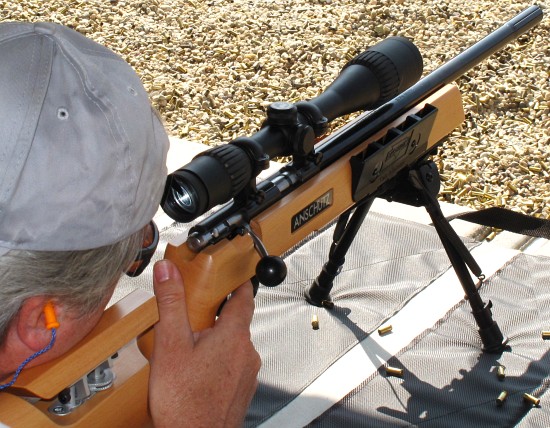
Subjectively, this gun is a hoot to shoot, and I can honestly say I’ve had more fun with this rifle than any other rimfire I’ve tested. No, it won’t rival a tuned ARA rimfire Benchrest rig, but it is still exceedingly accurate, and the gun is truly versatile. It’s ideal for tactical matches, club fun shoots, and if you lock the cheekpiece in place and use the 2.2-lb trigger, most clubs should let you use it for silhouette. The gun currently retails for about $1200.00 IF you can find one. Anschütz isn’t building many 64Rs these days, and only a handful made their way to the USA. Hopefully, our report will spur interest in the rifle and Anschütz will decide to ship more across the Atlantic.
May 4th, 2009
 Weaver is the latest company to introduce a new series of Japanese-made optics with a high (5:1) zoom ratio. The new Super Slam series includes 2-10×50, 3-15×50, and 5-20×50 riflescopes, all offered with 1″-diameter main tubes and four (4) reticle options: Dual-X (med. duplex), Fine Crosshair (with dot), Illuminated Duplex, and Weaver’s proprietary EBX™ ballistic reticle. According to Tom Knudtson, Weaver Product Line Manager. “This new EBX reticle allows for accurate bullet trajectory compensation for long-range shots and is a perfect compliment to our 3-point erector system with improved spring design.” Among the new 1″-tubed Super Slams, we think our readers will be most interested in the 6-20x50mm. This 27.5 oz. scope features side-focus parallax control, extra-hard lens coatings, and “pull-up” turrets (no caps to lose). The 6-20×50 has 1/8-MOA clicks and 3 finishes are offered: Matte Black, Gloss Black, and Silver. Weaver is the latest company to introduce a new series of Japanese-made optics with a high (5:1) zoom ratio. The new Super Slam series includes 2-10×50, 3-15×50, and 5-20×50 riflescopes, all offered with 1″-diameter main tubes and four (4) reticle options: Dual-X (med. duplex), Fine Crosshair (with dot), Illuminated Duplex, and Weaver’s proprietary EBX™ ballistic reticle. According to Tom Knudtson, Weaver Product Line Manager. “This new EBX reticle allows for accurate bullet trajectory compensation for long-range shots and is a perfect compliment to our 3-point erector system with improved spring design.” Among the new 1″-tubed Super Slams, we think our readers will be most interested in the 6-20x50mm. This 27.5 oz. scope features side-focus parallax control, extra-hard lens coatings, and “pull-up” turrets (no caps to lose). The 6-20×50 has 1/8-MOA clicks and 3 finishes are offered: Matte Black, Gloss Black, and Silver.

Tactical Super Slams Have Front Focal Plane (FFP) Reticles
There are two new Japanese-made Super Slam Tactical Models, the 3-15×50 (#800362), and the 4-20×50 (#800360). Both scopes feature 30mm main tubes, large fixed turret knobs (no caps), and a mil-dot reticle. Notably, both Tactical models have the reticle in the front (first) focal plane. This means the size of the reticle (and the mildots) remain the same (relative to the object viewed) at all magnification levels. That is an important feature for shooters using the mil-dots for ranging. FFP design is logical for a true “tactical” scope, and Weaver was wise to incorporate FFP into the Super Slam Tactical scopes. Weaver claims these Tactical scopes are waterproof, fogproof, and shockproof.
May 1st, 2009
Forum Member Mark E. (Shooter65) is the proud owner of a handsome, very accurate SAKO Finnfire ‘Range’ 22LR rimfire. Fitted with a full-size stock that replicates Tikka’s Master Sporter stocks, SAKO’s Range model has the look and feel of a centerfire gun. The size and ergonomics of the Finnfire Range makes this an excellent cross-training rifle. If you want to train with inexpensive rimfire ammo with a rifle that duplicates the feel of a centerfire, the Finnfire Range is hard to beat. Mark has competed successfully with this rifle in Southern California Rimfire Tactical matches.


Mark recently replaced the factory tube with a hand-lapped Lilja barrel. The Lilja barrel has demonstrated superb accuracy. Below is a 10-shot group at 50 yards (left), and a “dot-drill” tactical target shot at 100 yards (right).
In the video below, Mark explains the features of his SAKO Finnfire ‘Range’. This video was produced before the addition of the Lilja barrel, but the gun still shot extremely well. Unfortunately, as Mark notes, SAKO has halted production of the Finnfire Range. As a result, prices are rising for this highly desirable rimfire — guns that sold for $850 two years ago are now fetching $1100.00 or more.

May 1st, 2009
 Germany’s Vero Vellini has released a new double-strap sling system that holds your rifle securely, while allowing you to keep both hands free while hiking or stalking game. Vero Vellini’s new “High Climbing Double Sling” is modeled after the Biathlon rifle slings used in the Winter Olympics. Germany’s Vero Vellini has released a new double-strap sling system that holds your rifle securely, while allowing you to keep both hands free while hiking or stalking game. Vero Vellini’s new “High Climbing Double Sling” is modeled after the Biathlon rifle slings used in the Winter Olympics.
If you have ever tried a Biathlon-type sling you know it is far superior to a conventional over-one-shoulder sling, when you need to run, climb, or to move rapidly from one shooting position to another. We predict this double sling will become popular with alpine hunters and tactical/practical rifle shooters who must move rapidly through a multi-stage back-country course.
As with a conventional sling, the new double sling can be used to steady your shot. By looping the sling behind the elbows, you’ll get better support when taking an off-hand shot. The fully-adjustable “High Climbing Double Sling” comes in Forrest Green with Dark Brown trim. The product is very nicely made — the “air cushion” neoprene shoulder straps have stout leather end panels and the webbing and snap-buckles are top quality.

The “High Climbing Double Sling”, item V17350, retails for $89.99. To order, contact Vero Vellini’s USA dealer, Pioneer Research, (800) 257-7742. Vero Vellini also manufactures fast-access cartridge cases, scope covers, and straps for binoculars and cameras.
April 22nd, 2009
The latest CDNN Catalog has some great long-gun bargains. Here are two specials that caught our Editor’s eye. To view the CDNN catalog, visit www.cdnninvestments.com, then click the link to download the 2009-1 Catalog in .pdf format. To place an order, call 800-588-9500.
Winchester 22LR Sporter — $189.99
Looking for a “first rifle” for a young family member? This little Winchester could fit the bill. A friend of ours recently purchased one for his nephew and it’s proven to be a very nice little rifle for the money. NOTE: In the catalog pages the price is listed as $179.99, but the current price is $189.99. That’s still a great deal, and the price includes four magazines.

FN Patrol .308 (with box mag) — $599.00
If you’re looking for a good basic .308 Win rifle for hunting or tactical matches, the FN Patrol is a great value at $599.00. This rifle comes with a Hogue synthetic stock with full-length aluminum bedding block and dual front sling swivels. The action is fitting with a mil-spec Picatinny scope rail on top, and a 4-round detachable box magazine (DBM) is provided. You can select from four different barrel lengths: 18″, 20″, 22″, and 24″. We recommend the 24″ for tac matches. Hunters may prefer a shorter tube to save weight. If you prefer to mount a custom barrel or stock, CDNN is offering FN SPR short actions for just $349.00. This includes trigger group (with safety), Picatinny Rail on top, bottom metal, recoil lug, AND the 4-round box magazine. If you’re looking to build a low-cost custom tactical rig, this could be a great way to go.
March 29th, 2009
Review by LARRY BANEY
The Sightron 6-24×50mm Mildot is the latest in Sightron’s SIII line-up of side-focus, 30mm riflescopes. This follows the hot-selling 8-32×56mm SIII, which we reviewed last fall. While our 6-24x50mm test sample has a Mildot reticle, Sightron’s new 6-24x50mm scope is also offered with a fine cross-hair (FCH) with target dot reticle. Both Mildot and FCH versions are 14.96″ overall with a near-constant 3.6-3.8 inches of eye relief. Clicks are 1/4 MOA (15 MOA per revolution), and total elevation (and windage) adjustment is listed as 100 MOA (50 MOA on either side of center). That’s a class-leading amount of elevation, which should make the new 6-24×50mm popular with long-range shooters.

Shown above is the Sightron 6-24×50mm Mildot, flanked by a Leupold 8-25×50mm LRT and the Sightron 8-32×56mm. The controls on the 6-24 Sightron are identical to those of its big brother, but it is shorter, with a smaller objective. The shorter length and 50mm front objective allow a 2.8 ounce weight savings over the larger model (21.9 oz. vs. 24.7 oz.).

Sightron 6-24x50mm Quick Review
Assistant Editor Jason Baney has been evaluating the optical qualities of the new Sightron 6-24 Mildot scope. Jason also had a chance to test the scope’s real-world performance in a tactical match. Here is Jason’s report:
“When the new 6-24x50mm mil-dot Sightron SIII arrived, it looked like the little brother of the Sightron 8-32x56mm. Controls and “styling” are similar. This family relationship was made clear as my review of its performance progressed. It shared the same ergonomics, same superior glass, and same unbeatable tracking.
 I had a Leupold 8.5-25x50mm LRT for comparison purposes. The Leupold, which is actually 24.3x at max power, is a popular scope with a good reputation for clarity and sharpness. However, the new 6-24x50mm Sightron seemed better in many respects than the Leupold LRT. The Sightron’s glass appeared superior, giving better color rendition, a brighter field of view, and better contrast. I had a Leupold 8.5-25x50mm LRT for comparison purposes. The Leupold, which is actually 24.3x at max power, is a popular scope with a good reputation for clarity and sharpness. However, the new 6-24x50mm Sightron seemed better in many respects than the Leupold LRT. The Sightron’s glass appeared superior, giving better color rendition, a brighter field of view, and better contrast.
Also, with the Sightron, there was no noticeable parallax lash in the side-focus system. There was no need to start the side-focus at a travel stop every time. You could simply dial the side parallax adjustment and get the observed target in sharp focus with minimal parallax. This has been a problem with some Leupolds (i.e. you can’t get minimal parallax and best focus at the same time.) While observing bullet holes in different colored targets at 300 yards, the Sightron also appeared to show slightly better resolution than the Leupold and therefore better ability to locate individual bullet holes in the paper.”
Field Testing at the Allegheny Sniper Challenge (ASC)
In any competition riflescope, precise, repeatable tracking is absolutely vital. When you crank-in elevation and/or windage you want the reticle to move the exact value you dialed. Then you want the scope to repeat exactly when you return to the original zero. To test the Sightron’s tracking, Jason did more than a simple range test. He tested the scope’s tracking in the “real world”, during a two-day tactical comp.
Jason reports: “The 6-24 was thrown into action right away at the Allegheny Sniper Challenge (ASC) in Seneca Rocks, WV in August 2008. This was a team match that I shot with my father. ASC entails interesting weather, and even more interesting shots. In a matter of two days, over 100 shots are expended and a scope’s adjustments are REALLY put to the test. Maintaining zero is very important, because there are no sighters to check your zero. Shots range from less than 100 yards to nearly 1200 yards, and in the end, everyone has clicked their scope up-and-down 40 times or more. This means 40+ up/down repetitions on the elevation knob. This is as tough a test of a scope’s tracking ability as you’ll find.”
Great Tracking Ability, Excellent Value
So how did the Sightron’s tracking rate? The new Sightron 6-24×50 returned from ASC with the EXACT same 100-yard zero as when it started. This scope maintained its zero as well or better than any other scope out there, including those costing $3000.00+. The scope’s great elevation range was also much appreciated. Jason reports: “With 100+ MOA of elevation available and a 20 MOA base on the rifle, I had enough ‘up’ to shoot all the way out to 1200 yards with no problem.”

In Jason’s opinion this scope will be very hard if not impossible to beat in its price range in many aspects. The new Sightron 6-24 certainly rivals the overall optical quality of the Sightron 8-32×56, and that’s saying a lot. But since it is a Mildot scope there is another level of scrutiny needed. This scope is not a purpose-built tactical scope, but it represents a good base on which to build if Sightron offers enhancements in the future. If a shooter wishes only to use the mil-dots for holdover, he will be well served, but a Front Focal Plane (FFP) reticle would be more useful for serious tactical work. An illuminated reticle would also be welcome, and Jason would like to see a different reticle design with half-mil markings.
Also, some tactical shooters would prefer to have mil-based click values, rather than 1/4 MOA clicks. In raising these points, we need to stress that the $800.00 Sightron 6-24x50mm Mildot is affordable and works well as a general-purpose scope with reticle marks that allow hold-overs. This scope was not designed to compete with a $2700.00 Schmidt & Bender PMII. Jason explains: “I just want the serious tactical guys to understand that the Sightron won’t give you all the features of a dedicated FFP mildot optic with mil-based clicks. However, at about $800.00 average retail, the Sightron 6-24x50mm costs less than a third of what you’ll pay for high-end tactical scopes from S&B or U.S. Optics.”
February 9th, 2009
 The latest editions of Remington’s product catalogs are now available online. You can download the entire 2009 catalog (a 19.5 mb file), or select particular product lines: rifle, shotgun, ammunition, accessories. The Rifle Catalog features all the latest Remington rifles, including the new Model 700 ‘Target Tactical’ model. This 11.75-lb gun boasts a Bell & Carlson composite stock with ergonomic grip and adjustable LOP and cheekpiece. The Target Tactical is offered in .308 Winchester only, with a 26″ hammer-forged 5R barrel with triangular profile. MSRP is $1972. The latest editions of Remington’s product catalogs are now available online. You can download the entire 2009 catalog (a 19.5 mb file), or select particular product lines: rifle, shotgun, ammunition, accessories. The Rifle Catalog features all the latest Remington rifles, including the new Model 700 ‘Target Tactical’ model. This 11.75-lb gun boasts a Bell & Carlson composite stock with ergonomic grip and adjustable LOP and cheekpiece. The Target Tactical is offered in .308 Winchester only, with a 26″ hammer-forged 5R barrel with triangular profile. MSRP is $1972.
Complete 2009 Catalog | 2009 Rifles Catalog

Ballistics Data for Dozens of Factory Loads
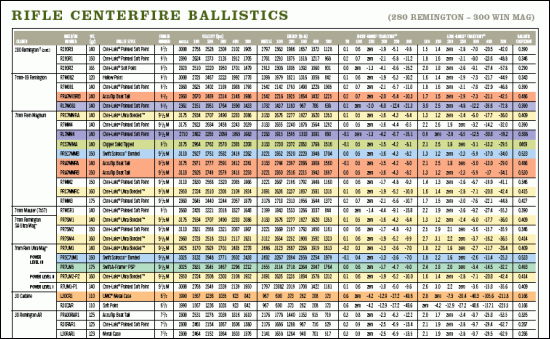
Remington also has a comprehensive Ballistics Data Sheet with ballistics information for all Remington loaded ammo — from 17 Fireball all the way up to the 45/70 Government. Even if you don’t use factory-loaded ammo, this is a very useful resource that allows you to quickly compare velocities, energy, wind drift, and drop among a wide variety of cartridges. Which shoots flatter… a .204 Ruger or a 22-250? Remington’s Ballistics Data Sheet provides a quick, reliable answer. Info is laid out in tables, with color coding for different bullet types.
CLICK HERE to download Ballistics INFO
January 20th, 2009
Tom Manners of Manners Composite Stocks had a wide selection of stocks on display at SHOT Show. The Manners stocks, with carbon-fiber layup, are extremely durable and stiff. The fit and finish is excellent, better than you’ll find with most fiberglass stocks. The designs work really well when shot from bipod, making the Manners T-Series stocks (T, T1, T2, T3, T4, GAT, T50) ideal for tactical use. Jason reports: “These are extremely strong stocks. I really like the T 2/3/4 stocks. The T2 is my favorite. It features a McMillan A5-style front with an A3-style rear.”

New Low-Profile ‘Fish Belly’ F-Class Stock
Jason was impressed with the new Manners F-Class stock. Tom says: “The shell is 100% carbon fiber with a molded-in action and barrel area. This design features a very long, stiff fore-end. From the back of the action to the tip of the fore-end the stock measures 27″ long which is around 7 1/2″ longer than our T4 stock.” The idea is to provide a “longer wheelbase” to better balance the long, 30-32″ barrels favored by many F-Class competitors. The front half of the fore-end is very thin (from top to bottom) to achieve a low profile on the bags. Much thought has gone into controlling fore-end flex. Manners’ design achieves greater vertical rigidity (less deflection under load) through an innovative “fish belly” design. The rounded undersection, like a canoe hull, strengthens the fore-end considerably.


Rimfire Stock for Tactical Cross-Training
Tom also had on display a new stock set up for the SAKO Quad switch-barrel rifle. Finished in “digital camo”, this stock has the “fit and feel” of Manners’ T-Series centerfire stocks. This lets you maintain the shooting position of your centerfire tactical stock when you switch to the SAKO Quad rimfire for low-cost training sessions.

|


