Want something more interesting than black-on-white bullseye targets? Champion Targets recently released a new series of game-theme targets. You can blast aerial drones, hunt dinosaurs, play a game of “H-O-R-S-E”, or shoot ducks in a Carnival Shooting Gallery. These new targets, which cost $7.49 per 12-pack, make great Christmas Gifts for the younger shooters in your family. What kid wouldn’t like a Dinosaur Target? And “kids of all ages” can enjoy the Shooting Gallery and Junkyard Plinker targets. The Know Your Limits target is good for tactical practice. These targets are available now from major retailers such as Amazon.com and OpticsPlanet.com.
Have you recently purchased a new scope? Then you should verify the actual click value of the turrets before you use the optic in competition (or on a long-range hunt). While a scope may have listed click values of 1/4-MOA, 1/8-MOA or 0.1 Mils, the reality may be slightly different. Many scopes have actual click values that are slightly higher or lower than the value claimed by the manufacturer. The small variance adds up when you click through a wide range of elevation.
In this video, Bryan Litz of Applied Ballistics shows how to verify your true click values using a “Tall Target Test”. The idea is to start at the bottom end of a vertical line, and then click up 30 MOA or so. Multiply the number of clicked MOA by 1.047 to get the claimed value in inches. For example, at 100 yards, 30 MOA is exactly 31.41 inches. Then measure the difference in your actual point of impact. If, for example, your point of impact is 33 inches, then you are getting more than the stated MOA with each click (assuming the target is positioned at exactly 100 yards).
How to Perform the Tall Target Test
The objective of the tall target test is to insure that your scope is giving you the proper amount of adjustment. For example, when you dial 30 MOA, are you really getting 30 MOA, or are you getting 28.5 or 31.2 MOA? The only way to be sure is to verify, don’t take it for granted! Knowing your scopes true click values insures that you can accurately apply a ballistic solution. In fact, many perceived inaccuracies of long range ballistics solutions are actually caused by the scopes not applying the intended adjustment. In order to verify your scope’s true movement and calculate a correction factor, follow the steps in the Tall Target Worksheet. This worksheet takes you thru the ‘calibration process’ including measuring true range to target and actual POI shift for a given scope adjustment. The goal is to calculate a correction factor that you can apply to a ballistic solution which accounts for the tracking error of your scope. For example, if you find your scope moves 7% more than it should, then you have to apply 7% less than the ballistic solution calls for to hit your target.
NOTE: When doing this test, don’t go for the maximum possible elevation. You don’t want to max out the elevation knob, running it to the top stop. Bryan Litz explains: “It’s good to avoid the extremes of adjustment when doing the tall target test.I don’t know how much different the clicks would be at the edges, but they’re not the same.”
Should You Perform a WIDE Target Test Too?
What about testing your windage clicks the same way, with a WIDE target test? Bryan Litz says that’s not really necessary: “The wide target test isn’t as important for a couple reasons. First, you typically don’t dial nearly as much wind as you do elevation. Second, your dialed windage is a guess to begin with; a moving average that’s different for every shot. Whereas you stand to gain a lot by nailing vertical down to the click, the same is not true of windage. If there’s a 5% error in your scope’s windage tracking, you’d never know it.”
Verifying Scope Level With Tall Target Test
Bryan says: “While setting up your Tall Target Test, you should also verify that your scope level is mounted and aligned properly. This is critical to insuring that you’ll have a long range horizontal zero when you dial on a bunch of elevation for long range shots. This is a requirement for all kinds of long range shooting. Without a properly-mounted scope level (verified on a Tall Target), you really can’t guarantee your horizontal zero at long range.”
NOTE: For ‘known-distance’ competition, this is the only mandatory part of the tall target test, since slight variations in elevation click-values are not that important once you’re centered “on target” at a known distance.
Note: The orange-color metal support frame is sold separately.
Reactive targets are fun. This versatily target offers both conventional black on white bullseyes as well as slots for reactive clay targets. Matterhorn Innovations produces the unique ReVersa Target, a heavy paperboard target with large bullseyes on the front, plus pre-cut tabs for clay pigeons on the reverse side. You can start with the black & white side for precision work, and then flip the target over and blast away at a dozen clay birds held in individual tabbed pockets. ReVersa targets cost just $4.99 each at Brownells.com. That price does NOT include the wire target-holders shown in the photos — those sell separately for $19.99.
We expect most ReVersa target buyers will use these 2′ x 3′ cardboard sheets inside 200 yards. However we think the ReVersa targets would also be useful for long-range shooters who want to try reactive targets for a change. We often shoot at clay pigeons at long range, but we either have to set them on the berm, or tape them one by one to a cardboard backer. With the ReVersa target, you can easily position a dozen clays up off the ground where they are more visible. Buyers have been happy with these jumbo-sized, double-sided targets — user feedback on Brownells.com has been all positive. Here are reviews from actual purchasers:
“Five Star. Great quality target. Many areas to shoot on the same target. I can see why this is top rated product. I plan to buy many more in the future.”
“Five Star. These are the best targets I have used. They even stood up good in the wind when my other targets would get blown over. Highly recommend…”
AccurateShooter.com has a HUGE collection of FREE downloadable PDF targets. We offer a very wide range of target designs: Load Development Grids, NRA Bullseye targets, Official-Size BR targets, Realistic Varmint Targets, Silhouette Shapes, Fun Plinking Targets, and even specialized tactical training targets. If our collection of free targets isn’t enough, or if you want to create a new kind of target — you’re in luck. There’s an Australian-based interactive website, PrintTargets.net that allows you to create your own customized, printable PDF targets.
CLICK Graphic to Create Your Own Targets.
Just follow the step-by-step instructions to set paper size, layout, bullseye color, line thickness, number of rings and diameter. You can even add Score Numbers to your target rings. PrintTargets.net is easy and fun to use. It’s much faster to create targets this way than to try to draw a series of circles with PowerPoint or MS Paint. Power-User tip: PrintTargets.net even offers a handy diamond-grid calibration diagram that you can add to your custom target designs. You’ll find the calibration grid as option #15 when you design your target — just scroll all the way down the PrintTargets.net home page.
Reactive targets are fun — a nice change of pace compared to punching paper. We know many guys like busting clay birds with rifles at 300 yards and beyond. This is good training for a varmint safari, as a clay pigeon is roughly the same size as a well-fed prairie dog. However, clays make better rifle targets if you can get them up off the ground. When placed on a berm they don’t shatter as dramatically. Birchwood Casey has a new product that makes “clay-busting” more fun.
The new Rigid™ Clay Holder Stand from Birchwood Casey features an A-frame design that sets up quickly and easily. The stand is constructed of heavy cardboard and should withstand multiple trips to the range. The die-cut holes will hold eight standard size clay targets on one side and four on the other. The Rigid Clay Holder Stand folds flat for easy storage and transport and comes packaged with three sheets of Shoot-N-C® 1″, 2″ and 3″ targets. Birchwood Casey’s clay target holder sells for a suggested retail price of $7.60. (At that prices you can afford to buy a few spares.)
Here’s a clever new product from Birchwood Casey, makers of Shoot-N-C targets. The innovative, spring-loaded “Belly Dancer” target moves when hit. This does the duty of a gong at a fraction of the weight and cost. The Belly Dancer is handy, easy to transport, and affordable ($34.07 at Amazon.com). What’s the down-side? Well, eventually you’re going to hit those springs and they will need replacement. Also, while the polymer target zone can withstand hundreds of shots, it will not last forever.
Ground Strike “Belly Dancer” Target
The new Belly Dancer Target employs springs to move back and forth when hit. The 9.5″ x 6.5″ yellow target section is made from a self-healing polymer that can withstand hundreds of hits. Designed for use with any caliber from .22 up, this Belly Dancer target doesn’t “clang” like a gong but the waiving motion indicates a hit. Shoot the neon-yellow gong-shaped head by itself or add stick-on 6″ Bullseye targets for precision work. This Belly Dancer target system works well as long as the ground is relatively soft. In rocky areas you may have trouble inserting the support shafts. But we still like this new product. It’s great for rifle practice at 300-600 yards.
Belly Dancer Target Features
– Yellow Hit Zone measures 9.5″ high and 6.5″ wide.
- Metal stand is 14″ high.
- Rated for all calibers and firearms.
- Long-last technology handles hundreds of rounds.
What lives in the Alabama backwoods and has 54 sets of ears? The answer is the new, $20 million-dollar CMP Marksmanship Park in Talladega. This new facility, set to open in May, boasts electronic Kongsberg Target Systems (KTS) at 200, 300, and 600 yards. All totaled, there are 54 Kongsberg target units, each with its own acoustic sensors — the “ears” as it were. Each KTS target has a set of acoustic sensors (very precise microphones) that plot the shot location using sound triangulation. Shot locations are accurate within a fraction of a millimeter. What’s more, because electronic targets do not expand or shrink with humidity levels, as paper does, scoring should be more consistent match to match.
Monitors Display Score and Shot Location Instantly Each target connects to a monitor that displays the hit locations to the shooter. Easy push-button controls allow the shooter to cycle through hits and options without having to change positions. The monitors employ non-glare glass protected by an aluminum frame that acts as a shade. This ensures good visibility for the shooter.
Engineered in Norway, Kongsberg target systems do more than just display shot locations to competitors. The system automatically calculate scores, and every target is networked to a central, “command” computer. This can provide updated competitor rankings, and can even display the results to event spectators on large view screens. See how it works in this animated demo video from Kongsberg:
High-contrast targets make aiming (and seeing your bullet impacts) easier. EZ2C Targets, a family business in Pennsylvania, has developed a series of very bright, high-contrast targets printed with eye-popping fluorescent red/orange and Deep Black Inks. These are available from the EZ2C online store. A set of forty (40) 11″x17″ targets printed on quality bright white paper costs $7.50. A wide variety of designs are available: Bulleyes, Grids, Silhouettes, and Diamonds as well as many specialty targets.
EZ2C’s Battleship Target (Style 22) would be great for precision rifles at 100 or 200 yards. The red circles are about 3/4″ in diameter. That’s 0.36 MOA at 200 yards. That’s a good test for an accurate rifle (and for any shooting pals who boast that their guns can shoot “1/4 MOA all day long”.)
Here are four other Fun Targets. EZ2C’s lastest design is new Tic-Tac-Toe Target. This would be a great precision rifle target at 100 yards, if you tried to hit the actual printed Xs and Os (not just the boxes). You could shoot this with a buddy — one guy shoots Red-zone Xs while the other shoots White-zone Os. The Dartboard target is also great for a two-man shooting competition. The pistol diagnosis target (lower right) shows how to correct your aim and hold, based on where your errant shots fall.
EZ2C Sample Fun Targets:
Get Customized Targets for Your Club or Business
EZ2C targets can be customized with the name/logo of your gun club or business. This is an excellent way to promote your organization or store. Here’s a suggestion — have your gun club print up customized targets to award as prizes at shooting matches. This video explains the custom printing options.
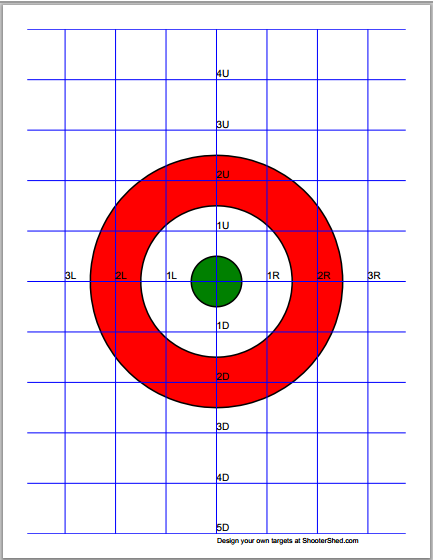
Are you creative? Do you like to design and customize things? Then you’ll love the Target Generator from the folks at ShooterShed.com. This free, interactive webpage allows you to design a variety of fun targets, including grids, benchrest-type Score Shooting targets, sight-in targets, and even playing card targets. Choose the paper size and orientation (vertical or horizontal), then select the number of target elements on the page. For example, you could have four (4) bulls or 52 playing cards. You can include a grid on the target, or tell the program to include load information blocks. For bullseye targets, you can control the number, color, and spacing (diameter) of the rings. LINK to TARGET GENERATOR.
The program provides a preview of each target you generate. If you like a particular design, save the file, and then print as many targets as you want. Check it out, this program is fun and handy to use. Here are five (5) targets your Editor created this morning just for this article. With a bit of practice, you can be generating your own custom targets in minutes. Have fun.
About the Creator of the Target Generator
The excellent Target Generator program was created by Rod Brown of Sheridan, Wyoming. Rod tells us: “I build custom rifles and coach shooters. I’ve got a 100-yard range out my back door. I shoot short- and long-range benchrest competitively around the country. I’m a full-time software development consultant and an FFL holder. When I’m not developing custom software for my clients, I’m usually fiddling in the shop, building a custom benchrest rifle, traveling to a match, chambering a barrel, or reloading some ammunition.
Story tip from Boyd Allen. We welcome reader submissions.
AccurateShooter.com offers dozens of FREE, printable targets for target practice, load development, and fun shooting. We also offer a few of the most popular NRA Bullseye targets. One or more of these printable targets should work for most training purposes. However, some readers have asked: “Where can we get the real targets… exactly like the ones used in NRA, IBS, and NBRSA shooting matches?”
All these vendors carry nearly all the NRA High Power and Smallbore targets, including the new, smaller F-Class targets. Germany’s Kruger Targets sells all the important NRA targets, and international (ISSF) air rifle and smallbore targets too.
Orrville Printing currently sell IBS targets for rimfire (50 yard) benchrest, short-range centerfire Benchrest (100, 200, 300 yards), Hunter BR Rifle (100, 200, 300 yards), plus the official 600-yard and 1000-yard IBS targets. National Target Company also has most of the IBS targets. NBRSA short-range, 600-yard, and 1000-yard benchrest targets are available directly from the NBRSA Business Office. Call (307) 655-7415 to order for the season.


 Verifying Scope Level With Tall Target Test


 Each target connects to a monitor that displays the hit locations to the shooter. Easy push-button controls allow the shooter to cycle through hits and options without having to change positions. The monitors employ non-glare glass protected by an aluminum frame that acts as a shade. This ensures good visibility for the shooter.




 AccurateShooter.com offers dozens of


