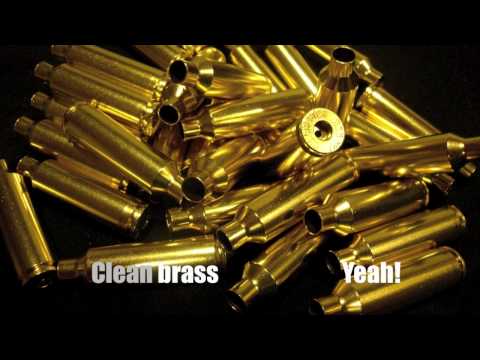
Sinclair Videos Show Cartridge Brass Cleaning Options
 Shiny brass — it may not shoot more accurately, but it does make you feel better about your hand-loaded ammo. While it’s not necessary to get brass “bright and shiny” after every firing, it is a good idea to clean powder residue, grime, and grit off your brass before you run cases into sizing dies. There are many ways to clean cartridge cases. A quick wipe with solvent on a patch may suffice for recently-shot cases. Older brass with baked-on carbon may require lengthy tumbling. Ultrasonic cleaning is another popular option that gets your brass clean inside and out.
Sinclair International has a series of helpful videos on brass cleaning. These short “how-to” videos, hosted by Bill Gravatt, Sinclair’s past President, cover the various processes you can use — tumbling, ultrasonic cleaning, chemical cleaning, and cleaning by hand.
Video ONE — Cleaning Brass in Vibratory or Rotary Tumbler
TIP: Brass that has recently been shot will clean more easily than brass that has been sitting many days or weeks. If your tumbling media is fresh the job should be done in an hour or less. It’s your choice whether to tumble with primers removed or with primers still in the cases. If you choose to tumble with primers out, we suggest you deprime with a depriming die, rather that put dirty brass into your sizing die. Some people like to add a teaspoon of liquid polish to the media. This does work, cutting tumble time, and making your brass more shiny. However, if you add liquid polish, do that BEFORE you add the brass and let the tumbler run for a 15 minutes to get the polish completely mixed into the media. Otherwise you can else up with gooey gunk inside your cases — a very bad thing.
Video TWO — Ulstrasonic Case Cleaning
TIP: There are many different types of solutions you can use. Soapy water suffices for some folks, particularly if you add a little Lemi-Shine. The Hornady and Lyman solutions work well, and can be used multiple times, provided you strain the solution to remove dirt and grit after cleaning sessions. Many ultrasonic cleaning machines have timers. Experiment with dwell time to see how long you need to immerse your brass. A very small amount of Ballistol in the solution will help lubricate your necks on the inside. This can make bullet seating go more smoothly, with more consistent neck tension.
Video THREE — Chemical Cleaners (Soaking without Ultrasound)
TIP: After using chemical cleaners, such as the Iosso solution, you need to water-rinse your brass thoroughly. A kitchen strainer helps with this (see video at 0:20). Also, don’t forget your brass in the chemical solution — follow the manufacturers recommendations and don’t exceed the recommended dwell time. Chemical cleaners work surprisingly well to remove grease and grime, and the solution can be re-used multiple times. However, if you want your cases to look bright and shiny (like new brass), you will probably have to tumble.
Video FOUR — Manual Cleaning (By Hand)
TIP: Keep some oversize patches in your range kit. At the end of your shooting sessions, wipe off your fired brass with a patch dampened with a mild, non-corrosive solvent (once again Ballistol works well). Before the carbon sets up on your brass it is very easy to remove. For tougher jobs, you can use 0000 Steel Wool (as Bill recommends in the video). You may find that timely hand-cleaning lets you avoid tumbling altogether — or you may choose to tumble (or ultra-sound) your brass only after a half-dozen or so firings.
 On our main


 To really test the stainless steel media’s cleaning power, I mixed three kinds of pistol brass that offered different challenges. First was some very old Amron headstamped .357 Magnum brass. The late Ken Lomont of Lomont Precision Bullets gave me the Amron brass as partial payment back when I was still in high school and working for him. I’ve been shooting it for years, so it’s obviously very durable. But it’s also very hard to clean, which made it great for the test.
 Before I ran the cases through the tumbler, I knocked out all of the fired primers so that the stainless steel media would be able to get into the primer pockets and run through the flash holes. The media that we have at Sinclair is only .040″ in diameter, so it will easily go through the .080″ diameter flash hole on most domestic-produced brass, as well as the smaller .060″ flash holes found on some other cases. Once I knocked out the primers, I poured the brass and the media into the tumbler drum together.
 Then I mixed up the cleaning solution. I poured ¾ of a gallon of water into the unit, and then put in four tablespoons of Dawn dishwashing detergent. I also added one teaspoon of lemon juice to keep the brass from spotting when it dried.
 Then I rinsed the media, too. Rinsing the media is important: if you don’t do it, the media will be dirty when you use it next time. The media is easier to rinse while it’s still damp, and it cleans easily with clear water. As you can see, the brass cleaned up very well and showed no evidence of water spotting because of the lemon juice. The range pick-up brass came out fully usable, showing no signs of corrosion. The nickel brass looked as if it were brand new and unfired. The Amron cases looked the best that I can ever remember seeing them. Some of them still had a light amount of carbon just behind the case mouth, but a quick twist with 0000 steel wool took care of this easily during inspection of these cases before loading. All of the primer pockets were clean and clear of carbon. Impressive!
 Based on what I have seen, I will definitely use stainless steel media a whole lot in the future, even though I will still keep some of the