|
|
June 4th, 2014
Report based on story by Ashley Brugnone, CMP Writer/Editor
Would you like to learn AR marksmanship under the tutelage of world-class USAMU team members? Then consider attending the Civilian Marksmanship Program’s Rifle Small Arms Firing School (SAFS), held Wednesday, July 16-17, during the National Rifle and Pistol Matches at historic Camp Perry. SAFS courses have been conducted at the National Matches since 1918. Hundreds of rifle participants are expected this year.

The school is structured toward teaching new shooters, so no past firearm experience is required. Intermediate shooters are also welcome to participate. Students will learn basic firing practices and competition skills. In addition to the live fire practice, students will compete in an EIC Match. All participants will be instructed by members of the U.S. Army Marksmanship Unit (USAMU) and coached by Military Rifle Team Members or CMP Rifle Master Instructors.
CLICK HERE for Small Arms Firing Schools INFO | CLICK HERE for Rifle SAFS Registration.
For those already familiar with rifle shooting, an Advanced Rifle Course will also be held to provide additional class instruction and the chance to fire in a special Excellence-In-Competition (EIC) Match. Whether an experience shooter or picking up a firearm for the first time, come enjoy a day of fellowship and fun in one of America’s oldest pastimes with the security and knowledge of some of the best marksmen in the country!

May 6th, 2014
 USAMU Service Rifle shooter/instructor SSG Brandon Green set a new national record this past week, shooting a 500-33X in the individual Aggregate, National Match Course (NMC) with metallic sights. Green was near-perfect in the 200-yard Rapids, shooting an amazing 100-9X. Green was shooting a Tubb 2000 bolt-action rifle chambered in 6XC. He set the new record using Norma factory ammo. Yep, this was factory 6XC ammo, right out of the box. USAMU Service Rifle shooter/instructor SSG Brandon Green set a new national record this past week, shooting a 500-33X in the individual Aggregate, National Match Course (NMC) with metallic sights. Green was near-perfect in the 200-yard Rapids, shooting an amazing 100-9X. Green was shooting a Tubb 2000 bolt-action rifle chambered in 6XC. He set the new record using Norma factory ammo. Yep, this was factory 6XC ammo, right out of the box.
National Record Score Card of SSG Brandon Green

SSG Green is the current NRA High Power National Champion and Interservice Rifle Champion. He and the rest of the USAMU rifle team have trained hard for the 2014 season. Yet Brandon joked about his record-setting performance, noting that the record was shot with his “back-up” gun. On his Facebook page, Brandon posted: “500-33X NMC. Not positive, possibly a record [Editor: Yes it was.] Not too bad for a #2 gun.” Not too bad indeed, Brandon. Congratulations on this achievement. This bodes well for Green’s goal to win a second straight National High Power Championship at Camp Perry this summer.
Note: After setting a National Record with 500-33X during the individual match with his Tubb 2000, SSG Green followed with a 498 the following day using a Service Rifle during the team match. Remarkable.

File photo of Green with Service Rifle (posed publicity photo).
April 26th, 2014
 To succeed in long-range shooting matches, given the high level of competition these days, you’ll need solid wind-reading abilities. We’ve found an article by SFC Emil Praslick III, USAMU Service Rifle coach, that can help you make better wind calls in competition. To succeed in long-range shooting matches, given the high level of competition these days, you’ll need solid wind-reading abilities. We’ve found an article by SFC Emil Praslick III, USAMU Service Rifle coach, that can help you make better wind calls in competition.
SFC Praslick is considered one of the best wind gurus in the United States, if not the world. He has authored an excellent two-part article on wind reading that is available on the CMP (Civilian Marksmanship Program) website. Both articles contain helpful illustrations, and are “must-read” resources for any long-range shooter–not just Service Rifle and Highpower competitors.
Click to Read Articles:
Reading the Wind (Part One) | Reading the Wind (Part Two)
 Part One covers basic principles, tactics, and strategies, with a focus on the 200-yard stages. Emil writes: “There are as many dimensions to ‘wind reading’ as there are stages to High Power competition. Your tactical mindset, or philosophy, must be different for the 200 and 300 yard rapid-fire stages than it would be for the 600 yard slow-fire. In the slow-fire stages you have the ability to adjust windage from shot to shot, utilizing the location of the previous shot as an indicator. Additionally, a change to the existing conditions can be identified and adjusted for prior to shooting the next shot.” Part One covers basic principles, tactics, and strategies, with a focus on the 200-yard stages. Emil writes: “There are as many dimensions to ‘wind reading’ as there are stages to High Power competition. Your tactical mindset, or philosophy, must be different for the 200 and 300 yard rapid-fire stages than it would be for the 600 yard slow-fire. In the slow-fire stages you have the ability to adjust windage from shot to shot, utilizing the location of the previous shot as an indicator. Additionally, a change to the existing conditions can be identified and adjusted for prior to shooting the next shot.”
In Part Two, Praslick provides more detailed explanations of the key principles of wind zeros, wind reading, and the “Clock System” for determining wind values: “The Value of the wind is as important as its speed when deciding the proper windage to place on the rifle. A 10 MPH wind from ’12 o-clock’ has No Value, hence it will not effect the flight of the bullet. A 10 MPH wind from ‘3 o’clock’, however, would be classified as Full Value. Failure to correct for a Full Value wind will surely result in a less than desirable result.”

Praslick also explains how to identify and evaluate mirage:
Determine the accuracy of the mirage. Mirage is the reflection of light through layers of air that have different temperatures than the ground. These layers are blown by the wind and can be monitored to detect wind direction and speed.
Focus your scope midway between yourself and the target, this will make mirage appear more prominent. I must emphasize the importance of experience when using mirage as a wind-reading tool. The best way to become proficient in the use of mirage is to correlate its appearance to a known condition. Using this as a baseline, changes in mirage can be equated to changes in the value of the wind. Above all, you must practice this skill!
Click HERE for more excellent instructional articles by Emil Praslick and other USAMU Coaches and shooters.
March 30th, 2014
The 2014 ISSF World Cup at Fort Benning is underway, and some events have already finished, such as the 10m Air Rifle and 10m Air Pistol. The World Cup, which has attracted many of the world’s top rifle and pistol shooters, continues through April 3, 2014. Here are some photo highlights from the first three days of the Fort Benning World Cup. There were plenty of exotic, expensive rifles and pistols on display — plus a few small toy animals (favored by the lady shooters).

 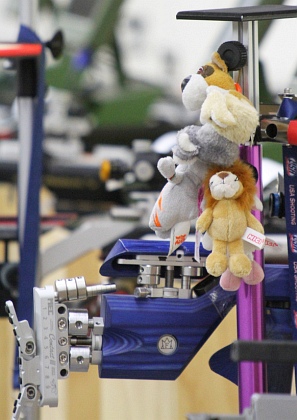
ISSF Fort Benning World Cup Photo Stream
Young Russian Wins First Gold of the Competition
Nazar Luginets, 24, from the Russian Federation, won the first medal match of the competition, the 10m Air Rifle Men event. With 209.4 points, the Russian athlete beat Serbian Milutin Stefanovic, who finished just one tenth behind Luginets. The 2013 Euro Champion, Sergey Richter from Israel, finished third.
10m Air Rifle Winner Nazar Luginets

 New Air Pistol Record Set New Air Pistol Record Set
Hoang Xuan Vinh, from Vietnam, won the 10m Air Pistol Men final, setting a new world record in the process. Currently ranked 8th in the world, The Vietnamese pistol shooter pocketed the Gold medal with a record score of 202.8 points in the final, breaking the previous 202.3-point record set by the 2008 Olympic Champion Pang Wei of China. Hoang beat Russians finalists Sergey Chervyakovskiy, and Vladimir Gontcharov, 36, who finished in second and third place with 202.3 and 181.3 points, respectively. This was an important comeback for Gontcharov, a 14-time ISSF World Cup medalist. Vladimir who started competing back in 1990, had been far from ISSF podiums since 2012.


Photos © International Shooting Sport Federation.
March 23rd, 2014
The International Shooting Sports Federation (ISSF) World Cup season kicks off right here in the USA, March 26 through April 3, 2014, in Fort Benning, Georgia. Many of the world’s best rifle and pistol shooters will be on hand — more than 400 competitors from 50 nations are expected to compete at the home of the U.S. Army Marksmanship Unit (USAMU).
ISSF World Cup (Fort Benning) 2013 50m Rifle Prone Winner Valerian Sauveplane of France.

At the last Rifle/Pistol World Cup USA back in May 2013, the USA earned two medals with Will Brown winning a gold medal in Men’s 10m Air Pistol and Dempster Christenson winning a silver medal in Men’s Air Rifle. Highlights from last year’s ISSF World Cup at Fort Benning are featured in the 24-minute video linked below. The video covers both rifle and pistol disciplines.
Here is last year’s women’s 50m 3P winner at the Fort Benning World Cup, Andrea Arsovic of Serbia.


Complete ISSF World Cup (Fort Benning) Match Schedule
If you want to watch the matches,or meet some of the shooters here is a schedule for the all the events, starting with training sessions on March 27th.
CLICK HERE for General Match INFO (PDF)
CLICK HERE for list of competitors, grouped by Nation (PDF).

Photos ©2014 ISSF | Competitor Photos: Marco Dalla Dea
March 8th, 2014
The nation’s top junior air-rifle shooters recently competed at the 2014 U.S. Army National Junior Air Rifle Championship hosted by the USAMU at the Pool Range Complex in Fort Benning, GA. Juniors (ages 14-18) competed for national titles in two divisions–Sporter and Precision — under the watchful eye of the USAMU’s shooter/instructors. More than $31,000 in endowment money was awarded to teams and individuals from the Georgia Youth Sport Shooting Foundation.

Ashley Durham and her JROTC teammates from Dalton McMichael High School in North Carolina, brought home the Sporter Division title. Durham led the way, adding the Sporter Division individual championship to her collection of trophies. David Sink, from Columbia, Md., took home top honors in the Precision Division while he and his teammates from Queen Anne’s 4-H won the Precision national team championship.
Taking time out from training for the upcoming competition season, USAMU soldiers from the International Rifle section provided instruction and mentorship for the competitors. “I shot this very competition when I was a junior,” said Sgt. 1st Class Hank Gray. “It was hosted by the [National] Guard back then. It’s rewarding to go from a competitor to host and do the same thing for the future generation of shooters.”
Competitors and USAMU instructors

Attendees said that the professionalism of the USAMU is what stood out the most at this year’s event. “Being here has been very uplifting,” said retired Air Force Master Sgt. Scott Davis, who brought the McMichael High team to the match. “The USAMU made it more than just a fun match — they provided a learning environment. They were the first to step in and show the kids how to do something[.]”
March 4th, 2014
 A great episode of Impossible Shots runs tomorrow (March 5) on the Outdoor Channel. This particular episode won an award for Best Shooting Sports broadcast. To start off, the legendary Jerry Miculek tries out a new, high-capacity shotgun (used for 3-gun matches). Jerry takes his new scattergun (right out of the box), and sets a new speed-shooting record with it. Not to be outdone, in the next sequence, SSG Josh Richmond of the USAMU juggles and shoots multiple targets with his scattergun. SSG Richmond, USA Shooting’s Shotgun Athlete of the Year, has won Gold Medals at various World Cups around the world. He is one of the best double trap shooters on the planet. A great episode of Impossible Shots runs tomorrow (March 5) on the Outdoor Channel. This particular episode won an award for Best Shooting Sports broadcast. To start off, the legendary Jerry Miculek tries out a new, high-capacity shotgun (used for 3-gun matches). Jerry takes his new scattergun (right out of the box), and sets a new speed-shooting record with it. Not to be outdone, in the next sequence, SSG Josh Richmond of the USAMU juggles and shoots multiple targets with his scattergun. SSG Richmond, USA Shooting’s Shotgun Athlete of the Year, has won Gold Medals at various World Cups around the world. He is one of the best double trap shooters on the planet.

Miculek Speed Drills with M&P 15
If you wonder how fast a self-declared “old guy” can be, watch this video of Jerry Miculek with a semi-automatic M&P 15 (AR-type) rifle he uses in 3-gun competition. Jerry puts five (5) rounds on target in just over one-half second. It sounds like full-auto fire, but if you watch the slow-motion playback sequences (timeline 0:50-1:12 and 1:34-1:53) you can see Jerry pull the trigger five times. Jerry’s “on-target” time for five shots was a mere 0.59 seconds (fifty-nine one-hundredths of a second)! To capture the rapid cycling of the rifle, the primary high-speed camera operated at 3600 frames per second. This allows “super slow-motion” playback that shows what really happens in the blink of an eye.
Jerry Miculek Fires Five Rounds in 0.59 Seconds
February 27th, 2014
 We had to share this inspiring photograph (below) of SGT Sherri Jo Gallagher. As well as being a highly-trained Army parachutist, Sherri is one of America’s top shooters. In 2010 Sherri Jo won the NRA National High Power Championship. She was only the second lady in history to become the National High Power Champion (the first was Sherri’s mother, Nancy Tompkins). We had to share this inspiring photograph (below) of SGT Sherri Jo Gallagher. As well as being a highly-trained Army parachutist, Sherri is one of America’s top shooters. In 2010 Sherri Jo won the NRA National High Power Championship. She was only the second lady in history to become the National High Power Champion (the first was Sherri’s mother, Nancy Tompkins).
Also in 2010, Sherri was named the U.S. Army Soldier of the Year, the first female soldier to be so honored. This award is given to the top soldier at the U.S. Army’s Annual Best Warrior competition.
SGT Gallagher is currently a proud member of the U.S. Army Golden Knights Parachute Team. In that role, she gets to do fun stuff like this…
SGT Sherri Jo Gallagher

 In 2010, SGT Sherri Jo Gallagher became the first U.S. military shooter since 1987 to win the Nat’l High Power Rifle Championship. She was only the second woman ever to win — the first being her mother, Nancy Tompkins. In 2010, SGT Sherri Jo Gallagher became the first U.S. military shooter since 1987 to win the Nat’l High Power Rifle Championship. She was only the second woman ever to win — the first being her mother, Nancy Tompkins.
Sherri’s family is legendary in U.S. shooting competition. She spent her childhood summers touring shooting competitions with her parents, Mid and Nancy, both competitive shooters. Sherri’s sister Michelle Gallagher is also a top-level long-range shooter, with many titles to her credit. “My family is always there for me — we are really close,” Gallagher said. “I am who I am today because of my family. We have so much fun and live life that way.”
January 23rd, 2014
At the SIG Sauer booth at SHOT Show, we had a chance to interview Max Michel, Sig Sauer’s Pistol Team Captain. Winner of multiple speed shooting world championships, Max is widely considered to be the fastest pistol shooter alive. How fast? Watch the video below. Max puts 18 shots on three targets with two (2) reloads, in a total of 4.79 seconds. That’s right, drawing from holster, he sends 18 rounds in under five seconds, with two mag changes in the process. That works out to a rate of fire of 225 rounds per minute — faster than a 19th-century Gatling Gun.
Max Michel on Fire — 18 rounds with 2 Mag Changes in Under 5 Seconds:
How did Max manage that incredible speed run? “I ate my Wheaties that morning”, Max joked. But in fact, Max acquired his amazing shooting skills the hard way — through years of dedicated practice. We asked Max about the kind of training required to attain “world-class” speed (and accuracy) with a handgun. It has taken him decades to reach this level of perfection. Max started shooting competitively while in elementary school (at age 8 or 9). He recalls coming home from school and dry firing for hours. He has spent thousands of hours practicing over the past two decades. Interestingly however, Max does most training drills at half speed. Watch the video to learn why Max trains at half speed:
Train to Win — Max Michel Reveals His Training Strategies:
At age 32, Max Michel is a legend within the world of competitive shooting. A four-time World Speed Shooting Champion, six-time USPSA National Champion, and three-time US National Steel Champion, Max is a dominant force in pistol shooting sports. Born and raised in New Orleans, Louisiana, Max began shooting when he was just 5 years old. In 1999 Max joined the USAMU’s Action Pistol Team and served in the U.S. Army for 10 years as an Army shooter and trainer. Today, Max is recognized worldwide as a top-tier athlete and instructor.
August 19th, 2013
Story by Lars Dalseide for NRABlog
It was a close one for SSG Tyrel Cooper. He’s been close before at NRA’s National Long Range High Power Rifle Championships in Camp Perry, but not as close as this. Not so close that his overall point total of 1243, while impressive, was not good enough to win. It was only good enough for a tie. Thank god for the X count. With an X count of of 71, Cooper inched by fellow U.S. Army Marksmanship Unit (AMU) teammate Brandon Keith Green by seven whole points. Talk about the skin of your teeth. “It’s been a long time coming,” said Cooper — Fourteen years to be exact.

Falling in love with High Powered Rifles
Cooper wasn’t raised on rifles. No, he was just your typical California kid on the streets of Sacramento. It wasn’t until a 14 year-old Ty accompanied his father to the Police and Fire Games that he discovered a passion for firearms.
 “I tagged along with Dad to a high power rifle match. We ran into Jim O’Connell at the practice range. He asked if I wanted to shoot one of his ARs. After a little prodding, I did and instantly fell in love. I ended up pulling targets for the rest of the match. That’s when I decided it was better to be pulling triggers than pulling targets.” “I tagged along with Dad to a high power rifle match. We ran into Jim O’Connell at the practice range. He asked if I wanted to shoot one of his ARs. After a little prodding, I did and instantly fell in love. I ended up pulling targets for the rest of the match. That’s when I decided it was better to be pulling triggers than pulling targets.”
Working odd jobs and hoarding the cash, Cooper eventually saved enough for an AR of his own. Now all he needed was a place to shoot. California, contrary to popular opinion, would provide.
“There are a lot of real good shooters who come out of California,” said Cooper. “They have one of the best high power teams in the country right now. Norman Mayo, Tom Whittaker, and Bob Gustin (3rd in this year’s Long Range High Power Championships) all came out of California. We use to shoot at the same club in Sacramento. “I grew up watching him (Gustin) shoot, wishing one day I’d be like him.”
A path to the U.S. Army Marksmanship Unit’s Long Range Rifle Team
The rest of Cooper’s teenage years were spent competing. With his father and sister in tow, they went from competition to competition throughout the state. It was a family affair.
“We only had one gun,” he said with a snicker. “I would shoot, she would shoot, then dad would shoot. After a while, he backed off and just supported us. “My sister was pretty good. I was actually her coach on the Junior Team in 2007 at the World Championships up in Canada. But that’s the last time we shot together. She went and got married, had two kids. Life got in the way.”
Cooper was working on a life of his own. Out of high school, he was searching for a place to put those rifle talents to use. That place would be with the U.S. Army. Joining at the age of 19, he spent the next few years honing skills. Reading wind, playing with ballistics, shooting whenever possible. Four years later, as a member of the USA Young Eagles Rifle Team (America’s under 21 and under 25 long range rifle team), he met with AMU Coach Emil Praslick.
“We head a real good talk. I got the letter and was off to basic training.”
It’s been a whirlwind ever since. Learning from the best in the business, Cooper utilizes his refined skills to be the best in competition and valuable resource in training. As any member of the AMU will tell you, one of their primary goals is to serve as a force multiplier. They do this by sending members of the Unit to army bases throughout the world. There they teach the troops the finer points of marksmanship.
But the travel doesn’t end there. There’s also a great deal required for the competitions. Ty explained: “For Long Range I’ve been to Canada, England, Australia, South Africa. In the states I’ve shot in California, Louisiana, Tennesee, Virginia, Georgia and Ohio. Long Range has taken me around the world, High Power has only taken me up and down the east coast.” Now, no matter where he goes, he will always be known as NRA’s 2013 National Long Range High Power Rifle Champion.

“When he was a kid growing up, he had a lot of help from a lot a good shooters,” said Robert Gustin, one of Cooper’s early mentors at the Sacramento shooting club. “One thing you can count on is that he’s always been good and will get nothing but better.” Photo above shows SSG Brandon Green, SSG Tyrel Cooper, and Bob Gustin on stage at the NRA Long Range High Power Rifle Championships in Camp Perry.
|


