SFC Brandon Green, 2022 National Long Range Champion, is congratulated by Mid Tompkins.
SFC Brandon Green of the U.S. Army Marksmanship Unit has added another remarkable achievement to his storied shooting career. In winning ALL the major Long Range events this summer, Green proved that he is one of the greatest American marksmen of all time. The USAMU’s Green, a three-time National High Power Champion, added multiple Long Range wins to his resume this summer. At the NRA National Matches in Camp Atterbury, Indiana, SFC Green won all four major “any rifle” trophies in the Long Range Championships. He was also the overall National Long-range Champion, winning the Tompkins trophy. No human had ever done that before. We congratulate Brandon on his amazing set of wins.
At Camp Atterbury this week, Brandon Green won all four NRA Long Range Individual National Trophies for Any Rifle: Wimbledon Cup, Mustin Trophy, Leech Cup, and Remington Band of Brothers Trophy. Green also won the Canadian Cup (National Any Rifle Champion) and Tompkins Trophy (overall National Long-Range Champion). No one has ever accomplished this feat in the history of the National Trophies. This is a truly historic individual performance by SFC Green, a fitting complement to his multiple High Power National Championships.
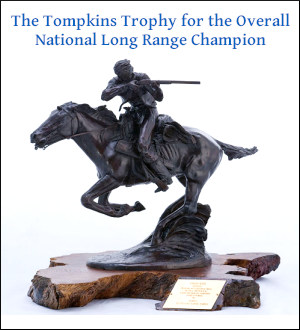
The Tompkins Trophy is a bronze statuette of a cowboy riding a horse while defending himself from an unseen pursuer. The work is entitled “Prayer and a Winchester” by L.E. “Gus” Shafer. The trophy was donated to NRA by Middleton W. Tompkins for Long Range High Power Rifle competition.
The following article by Tom Alves describes a very practical approach to physical training for those of us who are not as young and spry as we once were. Tom shows us how to give our bodies at least some of the maintenance we give our rifles. While we all realize that our rifles will outlive us, let’s see if we can’t narrow the margin a bit with some personal maintenance that just might help the shooting too!
This article originally appeared in German Salazar’s Rifleman’s Journal, and appears with permission. Sadly, German passed away last month. This was a very sad loss of a great, triple-distinguished shooter and a great shooting sports writer.
A Suggested Training Approach for Older Shooters
By Tom Alves Most articles and discussions regarding competitive shooting center around equipment. Now and then one will come across an article about physical training such as the USAMU piece on Physical Conditioning for Highpower Shooting. If you break the articles down they often discuss “core strength” and durability. The purpose of this paper is to elaborate on those points with a bit different perspective. Many of the articles you will read in books about position shooting and the one mentioned before are directed more toward the younger generation of shooters in their 20s. If you look down the line at a typical high power match these days you are likely to see quite a few folks who are in their middle 30’s and up. Many people in that age range have had broken bones and wear and tear on their joints so a training program needs to take that into account. For instance, while jogging for an extended period for heart and lung conditioning — often called cardio exercises — may be the recommended approach for younger folks, it may be totally inappropriate for older people. The procedure to repair meniscus tears in knees is one of the most frequently performed operations in this country. Another approach one often sees in training to improve core strength is the use of weight machines which isolate certain muscle groups in their operation. I would like to suggest an alternative approach that not only does not require special equipment but uses the body’s muscles in a coordinated fashion in the same way they are used in our natural movements. So, let’s set down some criteria:
1. The approach has to be low impact to conserve joints.
2. One goal is to improve the strength of the core muscles which are the muscles of our trunk that keep us erect and from where all movements initiate.
3. Along with core strength we need flexibility and full range of motion.
4. We want to improve our lung and heart function so we can have a good flow of oxygen going to our organs and muscles to reduce the rate at which we become fatigued during a competitive event.
Before I continue I believe it is appropriate for the reader to understand that I am a fellow shooter and this is a program I have designed for myself based on considerable reading and experience over a number of years. I am not a medical doctor, a formally trained exercise professional or any other type of specialist in the field. Consequently, this information is offered with the advice that you consult your medical advisor or similar authority before you embark on this or any similar regimen.
I will start with core strength and flexibility. Pilates exercises are resistance exercises that can incorporate the use of resistance bands, light weights and the weight of your body parts in order to strengthen the muscles in the abdomen, back, hips, chest and shoulders. The exercises can be performed alone but I recommend attending classes put on by a certified instructor who will ensure that you perform a balanced routine meaning you work on the front and back and both sides of your trunk. As to flexibility, yoga complements Pilates exercises and they are often taught together. In practical terms yoga strengthens through resistance using the weight of the body and increases flexibility by stretching the various muscle groups in a coordinated fashion. Some yoga exercises also work on balance which is helpful in position shooting and life in general. Again, I suggest attending formal yoga classes since an instructor can help you address such things as a joint misalignment. As an example, my right leg healed improperly after the femur was broken and my right foot splays out putting undue load on my left knee. There are a number of books available on Pilates and yoga and some of them get pretty involved; I leave that to the reader to explore. I will list some reference material at the end of the article that I have found useful.
Finally, heart and lung improvement. In order to exercise the heart and lungs while not abusing the joints, particularly the knees and hips, one has to resort to something other than jogging. Walking, bicycling, elliptical machines and swimming may be alternative methods you’d like to consider. Based on my reading, in order to get the most benefit it is important to exercise so that the pulse rate becomes elevated for periods of time rather than kept at a constant rate. The process I use, called PACE, is promoted by Al Sears, MD, http://www.alsearsmd.com/. It is interval training for the non-athlete. In simple terms one exercises, using whatever equipment one desires, to achieve a heart rate in which you are slightly above your ability to bring enough oxygen into your body to sustain the activity for an extended period. This is similar to wind sprints for a sprinter or a football player. After each episode you must rest until you have achieved recovery, meaning you can catch your breath easily. A series of three sets is recommended which covers a total time of about 20 minutes.
Report from the Author — Yes, Training Helps
As a result of this training program I have experienced increased strength in my legs and trunk, less joint stiffness, lower blood pressure, and lower resting pulse rate. The Pilates/yoga classes are usually attended 2 to 3 times a week and the interval training performed twice a week. [The author was 64 when this was first published. He is now 75, and still shooting Palma and Smallbore prone.]
Before I close I would like to touch briefly on two other related subjects: hydration and visual training. When one is exerting oneself, the body produces perspiration to keep the body’s temperature at an acceptable level. As one perspires the blood gets thicker and the ocular fluid in one’s eyes thickens as well. The heart has to work harder to supply oxygen and nutrients to the body so visual and cognitive functions degrade and fatigue sets in rapidly. Essential chemicals called electrolytes are also carried out of the body with the perspiration. As a result, it is necessary to replace moisture and electrolytes to maintain basic health and a competitive level of performance. If one goes on the Internet there is a multitude of articles on hydration. Due to the kindness of my lead Pilates/yoga instructor, Ms. Annette Garrison, I have a pretty comprehensive article on various aspects of hydration that I have included, http://www.ideafit.com/fitness-library/hyponatremia-other-side-hydration-story , for your information.
Last I want to mention visual performance training. The New Position Rifle Shooting, A How-To Guide for Shooters and Coaches by Bill Pullum and Frank Hanenkrat mentions sports vision training amongst other aspects of vision in competitive shooting. If one goes on the Internet you will find training programs directed at golfers, baseball and football players. There is one site that has a demo which, if one looks at it for long, it is obviously very similar to a shooting gallery video game. The training involves rapid recognition and hand-eye coordination. Another source of visual training exercises, along with a wealth of other information, is the book Prone And Long Range Rifle Shooting by Nancy Tompkins.
Hopefully, I have provided some information which will be helpful in improving shooting performance and extending the time you can participate at a competitive level. It is important that you proceed at your own pace. I have pushed myself too hard in the interval training and now have to back off a bit. In closing I would like to thank Annette Garrison and GS Arizona for their help, patience and encouragement.
Additional Reference Material
1. Framework by Nicholas A. DiNubile, MD This is required reading for anybody who has suffered an injury like a torn meniscus or has muscular skeletal issues. This is the book that led me to Pilates/yoga
2 P.A.C.E., The Twelve Minute Fitness Revolution by Al Sears, MD The approach I use to interval training. I am sure there are other sources.
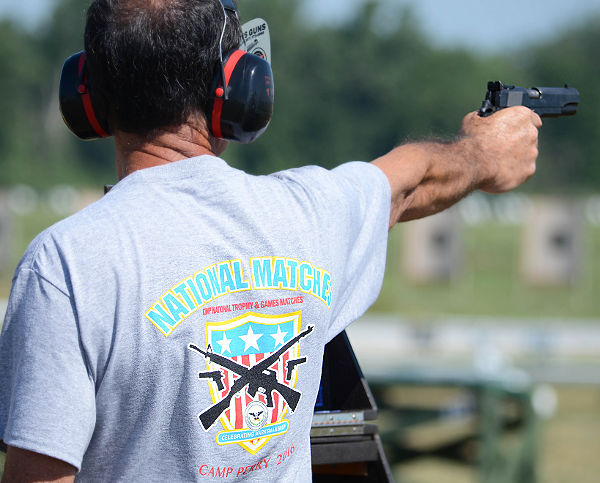
SSG Greg Markowski of the USAMU at Camp Perry, Ohio.
Today, July 12, 2022, pistol competition commences at the National Matches at Camp Perry. Many of the best pistol shooters in the country will be on the firing line, including members of the U.S. Army Marksmanship Unit Service Pistol team. After the last pistol match on Sunday, July 17th, trophies and awards will be presented to the top shooters.
If you want to compete in top competitions like this, you’ll need good ammo. The following USAMU article provides rock-solid reloading advice, explaining how to load accurate, reliable handgun ammo.
Camp Perry NM pistol firing line from CMP Photo Archives.
The U.S. Army Marksmanship Unit (USAMU) fields pistol teams as well as rifle and shotgun competition squads. Consequently the USAMU’s Reloading Shop loads tens of thousands of pistol rounds every year. In this article, the USAMU’s handgun experts talk about reloading for handguns — with smart tips on how to achieve superior accuracy with 100% reliability. This article, which offers important insights on COAL, primers, crimps and more.
Precision Pistol Reloading — Recommended Methods
Optimize the Taper Crimp
One often-overlooked aspect of handloading highly-accurate pistol ammunition is the amount of crimp and its effect on accuracy. Different amounts of taper crimp are used with various handloads to obtain best accuracy. The amount is based on bullet weight, powder burn rate and charge, plus other factors. It is not unusual for our Shop to vary a load’s crimp in degrees of 0.001″ and re-test for finest accuracy.
Use Consistent Brass
Brass is also important to pistol accuracy. While accurate ammunition can be loaded using brass of mixed parentage, that is not conducive to finest results, particularly at 50 yards. It is important for the serious competitor/handloader to use brass of the same headstamp and ideally one lot number, to maximize uniformity. Given the volumes of ammunition consumed by active pistol competitors, using inexpensive, mixed surplus brass for practice, particularly at the “short line” (25 yards), is understandable. However, for the “long line” (50 yards), purchasing and segregating a lot of high-quality brass to be used strictly for slow-fire is a wise idea.
Importance of Uniform COAL
Uniformity of the Case Overall Length (COAL) as it comes from the factory is also important to achieving utmost accuracy. More uniform case lengths (best measured after sizing) contribute to greater consistency of crimp, neck tension, ignition/burn of powder charge, and so on. Cartridge case-length consistency varies from lot to lot, as well as by maker. Some manufacturers are more consistent in this dimension than others. [Editor’s note: It is easy to trim pistol brass to uniform length. Doing this will make your taper crimps much more consistent.]
Primers and Powders — Comparison Test for Accuracy
Pay attention to primer brands, powder types and charges. Evaluating accuracy with a Ransom or other machine rest at 50 yards can quickly reveal the effect of changes made to handload recipes.
Bullet Selection — FMJ vs. JHP
Bullets are another vital issue. First, there is the question of FMJ vs. JHP. A friend of this writer spent decades making and accuracy-testing rifle and pistol bullets during QC for a major bullet manufacturer. In his experience, making highly-accurate FMJ bullets is much more difficult than making highly-accurate JHPs, in large part due to the way the jackets are formed. Small die changes could affect accuracy of FMJ lots dramatically.
The CMP now allows “safe, jacketed ammunition” in Excellence-in-Competition (EIC) Service Pistol matches, although wadcutter ammunition is prohibited. Thus, the option to use very accurate JHP designs simplifies the life of CMP Service Pistol shooters in pursuit of the prestigious Distinguished Pistol Shot badge.
Hopefully, these tips will be helpful to any pistol shooters interested in accurate handloads, not just “Bullseye” shooters. Small tweaks to one’s normal routine can pay big dividends in improved accuracy and make practice and competition more rewarding.
Stay safe, and good shooting!
TOP IMAGE: SSG Greg Markowski, a shooter/instructor with the U.S. Army Marksmanship Unit and native of Poland, fires his pistol during the 2018 Civilian Marksmanship Program’s National Pistol Matches at Camp Perry, Ohio July 13, 2018. At that event, Markowski claimed the General Mellon Trophy, General Patton Trophy and the General Custer Trophy. U.S. Army photo by Maj. Michelle Lunato/released by Defense Visual Information Distribution Service.
At the 2013 Western CMP Games, SGT Robert Evans attained what many shooters seek their entire shooting careers — a Distinguished Rifleman Badge. Evans earned his DR badge with just one hand, after losing his right hand while serving in Iraq with the U.S. Army.
SGT Robert Evans: Defying the Odds, Single-Handedly
AFter joining the Army in 2003, SGT Robert Evans served two tours in Iraq, suffering a spinal injury on the first tour. On his second tour, his life changed forever. On May 31, 2007, Evans was commanding a Bradley Fighting Vehicle in Iraq. As the Bradley drove under an old Fedayeen guard shack, an IED on top of the guard shack detonated while Evans was reaching out of the turret. The blast amputated Robert’s right hand at the wrist.
Even as a young boy, Evans had always enjoyed shooting. He vowed to stay involved with the sport despite his injury: “I couldn’t give up shooting after I lost my hand. It’s always been too important to me,” he said. “No matter what is going on in my life, when the sights are aligned and the hammer is about to fall, nothing in the world matters at that second. It’s my nirvana.”
Evans worked his way back into the sport by starting in F-Class. The position allowed him to hold hard and pull the trigger, while also being able to use his optics. Then he got involved with J.J. O’Shea’s M1 for VETS Project. The project helps transition wounded combat veterans back into the world of shooting, with equipment arrangements, position training and mental preparations.
Working with the M1 for Vets group, Evans started shooting again. But there were challenges: “The first time I shot after my amputation, it was very frustrating,” he said. “I couldn’t hold still, and shooting left-handed was so foreign.” Being extremely right-eye dominant his entire life, the loss of his right hand caused him to relearn many things, including how to shoot. Learning how to reload and adjust for wind while slung up became a pain for Evans….
In 2008, after several months and rigorous hours of dry firing, Evans found himself crossing the threshold of Camp Perry — a dream he had waited to fulfill his entire life. He scored around 50 points standing, out of 100, on his first trip. Though not bad for someone with an amputation, that wasn’t enough for Evans. He wanted to become a Distinguished Rifleman.
SGT Evans during Team Match at 2013 CMP Western Games.
He began to realize his dream as he earned his first 10 points (towards Distinguished) at Camp Perry in 2012. It took him 15 months to LEG out. His next 6 points came at the 2013 Eastern Games in Camp Butner, NC, followed by 10 more points at the 2013 National Matches. There, hoping to “bronze out,” he managed to one-up himself to actually earn a silver medal.
Then came the 2013 Western Games at the Ben Avery Shooting Facility in Phoenix, AZ. Never giving up hope and remembering his long journey from the hospital bed to the firing line, he received his final 8 points. SGT Robert Evans had become a Distinguished Rifleman.
“There was a lot of pressure, speculation and competition as to who would be the first Combat Wounded Veteran to ‘go Distinguished’ within M1 for VETS,” he said. “I’m very proud to have earned my badge, but more importantly, I hope that more wounded veterans will realize that it is within their grasp. It’s not an impossibility anymore. I hope it motivates everybody to train a little harder and hold a bit tighter – not just wounded veterans. If I can do it, anybody can.”
Commentary by GS Arizona
Robert Evans’ inspirational effort is a fresh reminder of the value of marksmanship in creating a focused challenge and reward that can help our wounded warriors regain the confidence and motivation to succeed in all aspects of life.
Robert’s effort is very reminiscent of that of Karoly Takacs, a Hungarian pistol competitor who lost his right hand in a grenade accident in World War II. Determined to overcome the injury, Takacs taught himself to shoot left-handed after the war and earned gold medals in the 1948 and 1952 Olympic Games. Robert brings that Old World grit and determination into the modern day and into the context of our nation’s most historic and cherished award for marksmanship. Robert’s Distinguished badge will shine brightly as a beacon to those who face challenges in their lives and can find a path to renewal in the brotherhood of marksmen. We salute him for his efforts and for the inspiration he brings to us all.
Editor’s Note: GS Arizona is a Distinguished Rifleman, Distinguished Pistol Shot, Distinguished Smallbore Rifleman (NRA) and a dedicated student of shooting history.
A Special Message from SGT Evans
SGT Evans wanted to thank all those who were instrumental in helping him achieve his goal of “going distinguished”. has a long list of individuals to whom he owes his successes.
“I think it’s necessary to let our fellow competitors and enthusiasts know how important they’ve been to me and the rest of the M1 for VETS shooters. They are the ones who keep us going and make our world go round,” he said. “Without all of the support from the shooting community, organizations and businesses that have donated to M1 for VETS, it never would have happened. Thank you all so very much!”
“I’d really like to thank the CMP and everyone who has helped me. That’s the real reason I went Distinguished,” he said. “M1 for VETS is a fantastic organization, and I really can’t thank them enough for what they do. No matter where my shooting career takes me, I’ll always be thankful to them for teaching, mentoring and accepting me. They are a fantastic group of guys and the reason I had the opportunity to even try. I’d also like to thank John and May Marx … and Dick Whiting.”
SGT Evans and his wife Karen after a Washington meeting with Senators Harry Reid and John Ensign.
“My mother, father and grandparents have always been there for me and are a constant source of encouragement,” he said. “And last, but certainly not least, my loving wife, Karen. She supports me no matter what I do and backs me up entirely. She’s my world and I can’t thank her enough for her support and loyalty. I love you, Karen.”
The U.S. Army Marksmanship Unit regularly publishes “how-to” articles on the USAMU Facebook page. A while back, the USAMU’s reloading gurus looked at the subject of case lubrication. Tasked with loading thousands of rounds of ammo for team members, the USAMU’s reloading staff has developed efficient procedures for lubricating large quantities of cases. This article reveals the USAMU’s clever “big-batch” lube methods. For other helpful hand-loading tips, visit the USAMU Facebook page.
Rapid, High-Volume Case Lubrication
Today’s topic covers methods for quickly applying spray lube to cartridge cases prior to sizing. A typical order for this shop may be 25,000 rounds, so [speeding up] the lubrication process can be a real time-saver. While your ammunition lots probably aren’t this large, the efficient methods discussed here may help save a considerable amount of time over your handloading career. Our case lubrication rates range from 1500-1600 cases per hour, to 2400-2500 cases per hour, depending on caliber.
This shop uses virgin brass, whereas most home handloaders use fired brass, which necessitates some small changes at times. These will be discussed as they arise. Begin with fired brass that has been tumbled clean.
Ensure as much tumbling media as possible is removed from the brass, as when it gets into a size die, it can dent cases significantly. This is a good time to round out dents in the case mouths using a tapered tool to prevent damage from the decapping stem.
First, dump the clean cases into a large box or reloading bin. Shake the bin back and forth so that many cases are oriented with the mouths up. Next, pick up as many cases as is convenient with the mouths “up”, from natural clusters of correctly-oriented cases. With 7.62mm-size cases, this is usually 3-4, and with 5.56mm cases, this can be up to 8-10. Place the cases into the rack slots, mouth-up. Doing this in groups rather than singly saves considerable time. Once these clusters have been depleted, it will be time to re-shake the bin to orient more cases “up.”.
This photo shows a case lubrication rack made by a USAMU staffer.
Naturally, adjust the spacing to best fit the calibers you reload. We have found this size … convenient for handling through the various phases of case lubrication/transfer to progressive case feeders for processing. Note that the 1/2-inch angle does not cover much of the critical case area at the base, just forward of the extractor groove, where most re-sizing force will be exerted. As the USAMU uses virgin brass, less lubrication is required for our brass than would be needed for Full Length (FL) sizing of previously-fired brass.
NOTE: The amount applied using our rack is easily enough for our purpose. If using fired brass, be sure to adequately lube this base area to avoid having cases stick in the full-length sizing die.
Using a spray lube, coat the cases adequately, but not excessively, from all sides. Be sure to get some lube into the case mouths/necks, in order to reduce expander ball drag and case stretching/headspace changes. The spray lube this shop uses does not harm primers or powder, and does not require tumbling to remove after lubing.*
Take a close look at the photo above. The USAMU shop uses a common kitchen turntable, which allows the rack to be rotated easily. We place this in a custom-made box which prevents over-spray on to floors and walls.
Angled Box Method for Smaller Cases to be Neck-Sized
A refinement of the above method which especially speeds processing of 5.56x45mm cases is as follows. A small cardboard box which holds about 100 cases is fitted with an angled “floor” secured by tape. With the smaller 5.56mm cases, usually about 8-10 cases per handful can be picked up, already correctly-oriented, and placed into the box together. This prevents having to place them into the rack slots, saving time.
HOWEVER, note that this does not allow nearly as much lube access to the case bodies as does the rack. For our purposes — neck-sizing and setting neck tension on new brass, this works well. If using this procedure with fired brass, take steps to ensure adequate lube to prevent stuck cases.
As always, we hope this will help our fellow handloaders. Good luck, and good shooting!
*A two-part test performed here involved spraying primed cases heavily, while getting more lube into the case mouth/body than even a careless handloader would likely apply. The second part of the test involved literally spraying considerable quantities of the lube directly into the cases, drenching the primers. After a several-day wait to allow the lube to penetrate the primers, they were then fired in a test barrel. All fired normally; no unusual reports were noted. This bolstered confidence that normal amounts of the lube would not adversely affect our ammunition, and we have been pleased with the results over several years.
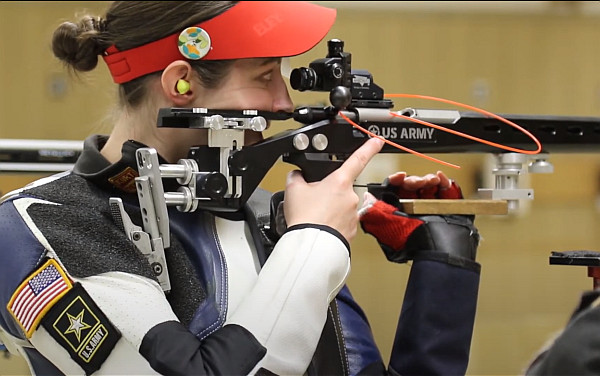
For today’s Sunday GunDay story, we feature a very talented young lady shooter, U.S. Army Staff Sergeant (SSG) Erin McNeil. Erin, who started shooting as a young teen in a 4H program, is now one of the leading service rifle and high power shooters in the nation. Erin McNeil claimed the 2021 Interservice Individual Rifle Championship with an impressive score of 996-52X, beating out 86 other service members (mostly guys BTW). That score also earned Erin the title of High Woman.
The 2021 Interservice Rifle Championships (IRC) continued with other events, including the 1000-yard match. Shown below is SSG McNeil competing in the IRC 1K Match. CLICK HERE for more match photos.
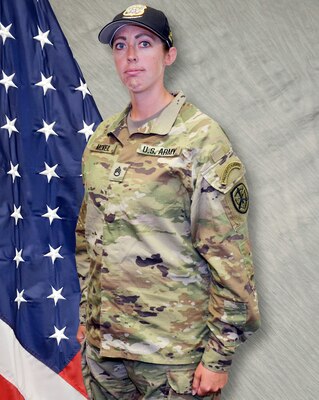
Staff Sgt. Erin McNeil hails from Fort Wayne, Indiana. She has a B.S. in Mathematics from Texas Christian University (TCU), and holds the military occupational specialty of battle management system operator. With the USAMU, SSG McNeil has served on the International Shooting Team and the Service Rifle Team. As a USAMU team member, SSG McNeil has earned the President’s 100 Tab, Rifleman’s EIC Badge, and Bronze Medal at the 2014 World Championship in 3-Position/50m Smallbore Rifle.
Along with centerfire shooting, Erin enjoys smallbore competition. She won the Bronze Medal competing in 3-Position/50m Smallbore Rifle at the 2014 World Championships.
Erin enjoys shooting competition because “It’s really between you and the gun. It’s a very mental game. I think shooting is a great sport… as long as you are able to compete within yourself.”
McNeil started shooting through a 4-H program while in the 8th grade and then shot in college with the TCU Rifle Team. Now, she serves as a shooter/instructor on the USAMU International Rifle Team. In the video below, SSG McNeil talks about her career in competitive shooting, and what she enjoys most about rifle competition — both smallbore and High Power. She notes she enjoys instructing young high school and collegiate shooters (see video below):
SSG Erin McNeil of the USAMU (left) competes in NTI match with a young lady shooter.
Like Father, Like Daughter — Both Great Shooters
Erin noted: “My father was very influential in my shooting career. As a child, I looked up to him. I knew that he had been a world-class shooter in his youth. He asked me a few times if I would be interested in starting the 4H Rifle program. He was excited when I started showing interest in the program. Although he never coached me for fear of crossing the father/daughter relationship with the athlete/coach relationship, but he was always my biggest supporter and even gave assistance when I asked for it. I had a natural talent for shooting and ended up joining my high school’s Army JROTC. I was given a NCAA scholarship to TCU during my senior year. After completing college, I was accepted into the USAMU. My dad [was] the quiet, proud encourager of my shooting career[.]”
Words of Praise for SSG Erin McNeil from Facebook
“Congrats Sergeant McNeil from an old shooter from the 1964 ARADCOM Interservice Rattle Battle matches at Fort Carson Colorado, Ft. Campbell, Ft Sheridan, et cetera. You make me proud of all you folks who carry on the tradition.” — Walter Colbert
“I’ve watched Erin shoot while I was calling the matches from the Tower at the Camp Perry smallbore championships. [She was] never bothered and never ruffled. Just keeps shooting those Xs.” — Ken Kelley
SSG Erin McNeil of the USAMU
Staff Sergeant Erin McNeil, an international rifle shooter with the U.S. Army Marksmanship Unit, Fort Benning, Georgia, has distinguished herself through her many accomplishments. Erin started shooting in 2001 and has numerous shooting accomplishments.
Her awards include the Army Commendation Medal, three Army Achievement Medals, two Army Good Conduct Medals, National Defense Service Medal, Global War on Terrorism Medal, Military Outstanding Volunteer Service Medal, two Noncommissioned Officer Professional Development Ribbons, Army Service Ribbon, President’s 100 tab, and Distinguished Excellence in Competition Rifleman’s Badge.
After graduating from Texas Christian University with a B.S. in Mathematics in 2010, Erin enlisted in the Army on February 15, 2011. After she completed Basic Combat Training at Fort Jackson, South Carolina, and Advanced Individual Training as a battle management system operator at Fort Sill, Oklahoma, she was assigned to the U.S. Army Marksmanship Unit, where she has competed in smallbore, service rifle, and long range disciplines, and she also serves as a marksmanship instructor.
SSG McNeil Offers Lessons to Junior Shooters
SSG Erin McNeil, as the noncommissioned officer in charge of the Fort Benning junior shooters club, enjoys sharing her skills and knowledge with the next generation. “You cannot come to one of these without learning something.” The photo shows SSG McNeil during the 2014 Montgomery Bell Academy Rifle Classic in Nashville, Tennessee. At that event, Erin and other top USAMU shooters provided instruction/coaching to High School competitors from all over the Southeast. “The kids who know us, and know of us, come to every clinic and benefit from them. You cannot come to one of these [clinics] without learning something.”
Today we are highlighting Olympic shooter SPC Alison Weisz, a marksmanship instructor/competitive shooter with the U.S. Army Marksmanship Unit International Rifle Team. Weisz competes internationally in both 10m Air Rifle and 50m Smallbore. Just recently, Allison earned the Bronze Medal in Women’s 10m Air Rifle and 4th place in Mixed Team 10m Air Rifle, along with USAMU teammate SGT Tim Sherry, at the ISSF World Cup in Cairo, Egypt.
Alison, who hails from Belgrade, Montana, joined the USAMU to advance her marksmanship skills. She is now a U.S. Army soldier and also a Team USA member. She represented the USA at the 2020 Olympics in Women’s 10m Air Rifle.
In the video below, SPC Alison Weisz, a marksmanship instructor/competitive shooter with the USAMU International Rifle Team, explains the mental focus she achieves during her training sessions at the range.
“The range is absolutely my ‘home away from home’. I spend all of my time on it. While I am up there it’s just peace, tranquility. Of course there are triumphs and trials and errors as well … but for me, it’s my space. I get to be with just myself and my thoughts.”
This year, Alison has already won a Bronze Medal at the ISSF World Cup in Cairo. Her competition goals are now set on the 2024 Olympics. We commend Alison for her dedication to her sport and her service to her country as a U.S. Army soldier.
The U.S. Army Marksmanship Unit regularly publishes reloading “how-to” articles on the USAMU Facebook page. One very good article, part 5 of a 6-part series, focused on Progressive Presses. This article explains proper procedures for Auto-Indexing Progressives, which advance the shell-plate with every pull of the handle. Auto Progressives are very efficient, but they also require special attention and focus, because so many things are happening at once. You need to train yourself to watch every station. If you run a progressive press now, or are considering getting a progressive, we recommend you read this article. Visit the USAMU Facebook page for other helpful handloading guidance.
Progressive Loading Presses — Self-Advancing Shellplate Type
Recently, we addressed manually-operated progressive presses for the beginning handloader. This type press requires one to manually advance the shellplate after each handle stroke. An advantage for beginners is that nothing happens at any station until the loader wants it to. This helps users avoid problems from clearing malfunctions without noticing that the shellplate has advanced itself. (Read Previous USAMU Article on Manual Progressives.)
The next, more luxurious type progressive press advances the shellplate automatically whenever the handle is cycled. [Editor: This is also called an “Auto-Indexing” Progressive Press.] Typically, each stroke automatically sizes and primes a case, operates the powder measure (if used) and seats a bullet. Some also have case feeders that automatically put a new case in the shellplate with every cycle. Others require the loader to insert a case each cycle. With both types, the loader usually puts a bullet on each sized/primed/charged case.
[CAVEAT: While our Handloading Shop has several progressive presses, ALL of our powder charges are thrown/weighed by hand. We do not use powder measures on our presses. Our progressives are used for brass preparation, priming, seating, etc., but not for fully-progressive loading.]
The manually-advanced press can be a boon to beginners, but as one gains experience it can be a mixed blessing, depending on one’s style. If one pays close attention to every operation and loads without distractions, the manual press is very reliable and allows full scrutiny of each round as it is loaded. However, if one easily drifts into day-dreaming, or isn’t focused on paying careful attention at all times, the manual progressive can be a bit of a liability. The opportunity for forgetting a powder charge, leading to a squib load, is ever-present. [Editor: A lock-out die can help reduce the risk of a squib load, or a double-charge. See below.]
The automatically-advancing progressives help prevent this by ensuring a powder charge will be dropped each time the handle is operated. Experienced handloaders often appreciate this feature due to the savings of time and effort. Individual preferences between the two press styles are influenced by several factors. These include one’s comfort with more- vs. less-complicated mechanisms, how often one changes calibers (case feeders often must be converted, in addition to dies and shellplates), how many rounds one loads annually, relative ease of changing primer mechanisms from small to large, etc. Automatic progressives and their caliber conversion kits tend to be significantly more expensive than manual progressives and caliber conversions from the same maker.
One USAMU handloader, who likes simple, bullet-proof machines and maximum efficiency when converting presses, owns two manually-advanced progressives. One is set up for large primers, and the other for small primers. He can change calibers in the twinkling of an eye. As he loads for many different calibers, this fits his style. Another handloader here is just the opposite. He loads for a few calibers, but in larger quantities. He much prefers his self-advancing press with case-feeder for its speed. He makes large lots of ammo in a given caliber before switching, to improve overall efficiency. His caliber conversion kits are more expensive than those for the manually-advanced progressive, but he uses fewer of them.
Whichever type one chooses, it is VERY important to buy quality gear from a manufacturer with a long, well-established track record for quality, durability and good customer support. Avoid jumping on the “latest, greatest” model until it has a proven track record. For example, this writer knows a loader who got a brand-new, expensive, self-advancing model press some years back, shortly after its introduction. As is too often the case these days, the manufacturer released it before all the “bugs” were worked out.
Better Safe Than Sorry — the RCBS Lock-Out Die
RCBS Makes a “Lock-Out Die” that senses the powder charge. This will halt the Progressive press if you have a double charge, or an undercharge. Your Editor has the Lock-Out Die on his RCBS Pro 2000. It has “saved his bacon” a half-dozen times over the years. It can be used on Dillon and Hornady progressives as well as RCBS machines.
It would not fully seat primers to the correct depth. No amount of adjustment, extra force, or fiddling would do better than to seat primers barely flush with the case head. Any inattention could result in a slightly “high” primer, protruding above the case head. It created a risk for slam-fires, particularly in semi-autos without spring-retracted firing pins, such as the M1 or M1A. In desperation, he had a machinist buddy study the problem and machine a new part to correct it. No dice. Its engineering didn’t permit full primer seating, even with extended parts. He now wishes he’d heeded his shooting buddies’ advice to stick with the “tried and true,” reliable performer they all used.
Whichever press one selects, see if the maker has a kit or list of commonly-replaced parts. Having needed springs, pins, etc. on hand in the rare event that one breaks or “goes missing” can save the day when one is busy loading for a match! Another tip for improving one’s overall loading efficiency (rounds loaded with minimal set-up/tear-down time) is to plan one’s handloading by primer size. For example, if your machine is set to use small primers, load all the calibers that you intend to that take small primers, before converting the press to load large-primer calibers.
In our next chapter, we’ll discuss peculiarities of progressive loading for rifle cartridges, with remedies for problems such as excessive cartridge-case headspace variation when sizing, tips for ensuring best powder charge consistency, and so on. Until then, be safe, and good shooting!
The U.S. Army Marksmanship Unit (USAMU) has produced an excellent series of videos, which collectively cover the Basic Rifleman’s Course. If you are getting started in High Power shooting, or want to improve your position shooting skills, this series is well worth watching. And these videos are not just for service rifle shooters — even bench shooters can benefit from these videos, particularly Part 5, which explains how to estimate wind speed and direction. The lead instructor for these videos is SFC Brandon Green, a three-time National High Power Champion. When SFC Green talks, you should listen.
SFC Brandon Green is a shooting superstar. Green won his third NRA National High Power Rifle Championship in 2018 at Camp Atterbury, Indiana. He dominated the HP Championship cycle, finishing eight points and ten Xs ahead of his nearest competitor. Brandon also won High Power National Championships in 2015 and 2013. And in 2017 he set new records at the CMP’s National Trophy Matches at Camp Perry. One of the greatest marksmen in the nation’s history, SFC Green has no weaknesses, excelling at all positions, both rapid-fire and slow-fire.
Part 5 — Wind and Weather Estimation (Very Useful for All Shooters)
Note: This video includes a hit location “target analysis” in the first 6 minutes.
Part 4 — Minute of Angle Explained
Part 3 — Ballistics and Zeroing
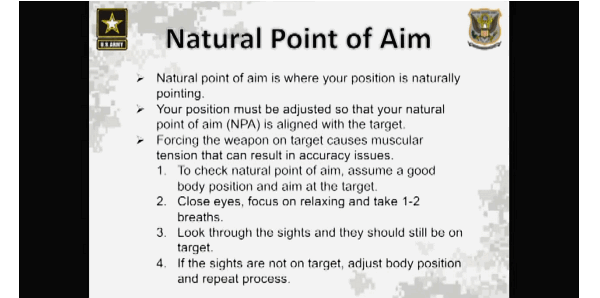
Part 2 — Positions, Sight Alignment, and Natural Point of Aim (Very Useful)
Part 1 — Aiming and Sight Picture
Three-time National High Power Champion SFC Brandon Green (left above) set four new National Records at Camp Perry in 2017.
About SFC Brandon Green — One of America’s Greatest Marksmen
A three-time National High Power Champion, SFC Green has had a distinguished shooting career while at the USAMU. In 2018 Green set 4 Individual National Records and capturing his first President’s 100 match win while setting a new national record for the match. 2018 also saw SFC Green winning his third National Trophy Individual championship while setting a new national record for this championship. In 2017 Green won his fourth Interservice Individual Championship, setting a new record for this match in the process. He was also a member of several first-place winning teams, including the Nation Team Trophy and the National Infantry Trophy team match at the National Championships.
SFC Green has won the Interservice Long Range championships five times and is the current record holder for this match. In 2007 and 2008 Green captured the coveted Wimbledon Cup trophy during the NRA National Long Range Championships. He earned his third overall NRA National High Power Championship title in 2018. Green is also a lead instructor for the USAMU’s marksmanship courses and teaches the Small Arms Firing School every summer at Camp Perry, Ohio.
Now here is an example of truly impressive marksmanship skills and amazing aiming from a USAMU soldier. From a standing position, SPC Ivan Roe shoots a tiny aspirin pill off the top of a balloon — without breaking the balloon. In fact, he does this twice … with iron sights no less.
Watch Video to See Aspirin Pill Shot Twice off Balloon:
The first time the pill sits on a small piece of tape just millimeters above the upper edge of the balloon (Time mark 00:40-45). But the second time, the aspirin pill lies flat on the top on the balloon — an even tougher challenge. Watch Ivan nail that flat pill again without hitting the balloon at 00:59. No that is truly impressive — and remember it was done from standing with Iron sights!
SPC Ivan Roe was using a German Feinwerkbau, an elite precision air rifle favored by Olympic and World Cup competitors. Originally from Montana, SPC Roe is a member of the USAMU International Rifle Team.
Did you like this demonstration of Trick-Shot marksmanship? Then visit the USAMU’s Facebook Page. The USAMU often releases shooting skills/marksmanship videos on Facebook and YouTube, with the Trickshot examples featured on Tuesday. CLICK HERE for another USAMU trick-shot video — hitting a poker chip on a fast-moving target frame with a pistol. Very impressive.


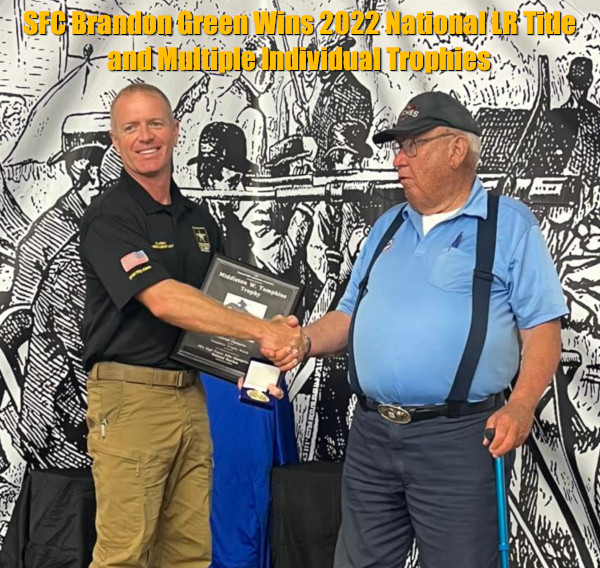 SFC Brandon Green, 2022 National Long Range Champion, is congratulated by Mid Tompkins.
 At Camp Atterbury this week, Brandon Green won all four NRA Long Range Individual National Trophies for Any Rifle: Wimbledon Cup, Mustin Trophy, Leech Cup, and Remington Band of Brothers Trophy. Green also won the Canadian Cup (National Any Rifle Champion) and Tompkins Trophy (overall National Long-Range Champion). No one has ever accomplished this feat in the history of the National Trophies. This is a truly historic individual performance by SFC Green, a fitting complement to his multiple High Power National Championships.

 Most articles and discussions regarding competitive shooting center around equipment. Now and then one will come across an article about physical training such as the USAMU piece on
 Last I want to mention visual performance training. The



 Use Consistent Brass
 SGT Robert Evans: Defying the Odds, Single-Handedly






 SSG Erin McNeil of the USAMU