|
|
March 27th, 2011
 For 2011, Champion® Traps and Targets offers new 3D and printed targets. For fans of reactive targets, Champion now sells bright “Radiation Green” versions of its single and triple varmint spinner targets. These auto-resetting targets wobble or spin on impact to indicate positive hits. The targets are made from a self-healing DuraSeal polymer than can take hundreds of hits. (The smaller the bullet, the longer the target life.) The new day-glo green color really is eye-catching, even at long range. That’s because flourescent or “dayglo” colors not only absorb and convert light energy of the dominant wavelength, but also the wavelengths of ultraviolet rays and other colors lower in the visible spectrum. As a result, your eye perceives a far more intense color. More INFO. For 2011, Champion® Traps and Targets offers new 3D and printed targets. For fans of reactive targets, Champion now sells bright “Radiation Green” versions of its single and triple varmint spinner targets. These auto-resetting targets wobble or spin on impact to indicate positive hits. The targets are made from a self-healing DuraSeal polymer than can take hundreds of hits. (The smaller the bullet, the longer the target life.) The new day-glo green color really is eye-catching, even at long range. That’s because flourescent or “dayglo” colors not only absorb and convert light energy of the dominant wavelength, but also the wavelengths of ultraviolet rays and other colors lower in the visible spectrum. As a result, your eye perceives a far more intense color. More INFO.
In addition to reactive targets, Champion offers a wide selection of printed targets, including 100 and 200-yard benchrest targets. New for 2011 are “X-Ray” animal targets and Insect Targets. The X-Ray targets display the bone structure and heart/lung position of game animals. These will surely be popular with hunters, as will a new line of “Critter” targets with 5 different realistic animals in a 10-pack. Precision shooters looking for a change from standard bullseye-targets should have fun with the new Bug and Fly Precision Targets. We like shooting the Fly Paper target at 50 yards with our rimfire rifles.
CLICK HERE to view the new X-Ray Animal Targets, Critter Targets, and Precision Insect targets.
November 3rd, 2010
At clubs across the country, varmint fun shoots (also known as “groundhog matches”) are becoming more popular every year. In these matches, usually shot from the bench, you engage paper targets, clay pigeons, steel “critter” silhouettes, or some combination of paper and reactive targets. Shooters like these matches because you can shoot a wide variety of rifles, you don’t have to spend a fortune to be competitive, and there is fun for the whole family. Rules are inclusive — you won’t be turned away because your rifle is two ounces overweight. A large percentage of the match fees usually go back to shooters in the form of cash prizes. And the level of camaraderie is high.
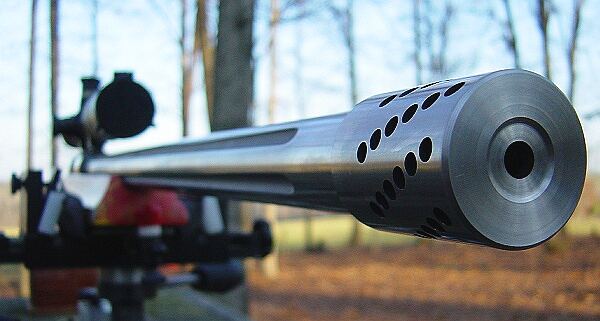
Harold Seagroves’ 3-time Hickory Ground Hog Match-Winning Rifle
 Inclusive Rules Welcome All Shooters Inclusive Rules Welcome All Shooters
Forum member Danny Reever recently explained the appeal of groundhog matches: “We don’t have a governing organization, or have to pay $50 a year membership just to compete in matches. Sure the rules vary from club to club, but you adapt. You build your rifle (or even pistol) to fall within the rules of either the clubs you shoot, or to fit all the clubs rules. If not there still is a class for you to compete in. If your factory rifle doesn’t conform to the rules, it can shoot in a custom class. If your custom doesn’t make weight for Light Custom (usually 17 pounds and under), you shoot it in heavy custom class. If you want to try your Tactical rifle or F-Class rig, bring it out there’s a class you can shoot it in. If you don’t like one club’s rules, you just don’t shoot there. It’s no big deal.
There are no National records, or Hall of Fame points — just individual range records. If you want to shoot in BIG matches (with big prizes), there is the Hickory Ground Hog Shoot among others. If competition isn’t your bag, many clubs offer mid-week fun matches that you can shoot just for fun. You shoot the same targets but with a more relaxed atmosphere with no time limits.
The best part is you don’t have to shoot perfect at every yardage. You always have a chance because in this sport it really isn’t over until the last shot is fired. Typically ALL the entry money goes to the host club, with much of the cash returned back to the shooters via prizes. Junior shooters often shoot for free, or at a reduced rate. That lessens the burden on the family’s wallet (not a small thing in these economic times). The low entry cost also encourages young guys to get involved who don’t have $4000 custom rifles or the money to buy them.
 More Fun, Fewer Complications More Fun, Fewer Complications
There isn’t a sea of wind flags to shoot over or to put up and take down. If the range has a couple of flags so much the better, but after all it is a varmint match. No pits to spot shots and slow things down either. If you can’t see your hits through your rifle scope or spotting scope well you are in the same boat as everybody else. That’s what makes it interesting/ sometimes frustrating!
As for calibers, I’ve seen everything from .223 Rem to .338 Lapua and everything in between. Our range record at my club is held by Bill Slattery, who shot a 147 out of a possible 150 with a 22BR 13 months ago. That’s on a target with a 1.250 ten ring at 200/300/500 meters. That record will stand for awhile, and shows you that some very good shooting is done at groundhog matches.
The best part is it’s laid back, everyone gets along, there is no place for big egos here. We who shoot the Ground Hog Matches don’t begrudge the other organizations and shooting disciplines, or those that shoot in them, heck some of us cross over and compete in registered benchrest matches too. Life’s too short, live and let live is our motto so just come out and have fun!”
Fellow Forum members chimed in:
FdShuster: “I’ve competed in our local ground hog matches for several years now, have introduced a number of others to them, and we all enjoy them and more importantly, continue to learn from them. Distances are as close as 100 yards, (with a 5/8″ 10 ring) to as far as 500 meters. with a 2″ 10 ring. Wind, mirage, bullet trajectories, all make them a challenge, and unlike shooting for group, where the group can be anywhere on the paper, in this game they must be very small, but also in the 10 ring. With the different classes, Custom, Factory, Hunter, almost any rifle will fit in somewhere. And Danny is correct about the friendly attitudes. I’ve seen competitors go out of their way, and jeopardize their chances of winning, to help someone else who may have a problem on the line.”
 Mike C: “Here in Texas, our version of groundhog matches involves shooting at clay pigeons at 400 yards. We use 60mm, 90mm, and 108mm clay pigeons attached to target boards. You have 10 shots to break 8 clays, with a seven-minute time limit. We have developed a good following at these matches. In 2011, a Shooter of the Year Award will be given based on the Aggregate score for three of our matches, which are held in Utopia, San Angelo, and Huntsville.” Mike C: “Here in Texas, our version of groundhog matches involves shooting at clay pigeons at 400 yards. We use 60mm, 90mm, and 108mm clay pigeons attached to target boards. You have 10 shots to break 8 clays, with a seven-minute time limit. We have developed a good following at these matches. In 2011, a Shooter of the Year Award will be given based on the Aggregate score for three of our matches, which are held in Utopia, San Angelo, and Huntsville.”
40X Guy: “I would have to say upon finishing my first year ever of ground hog matches, that the average Joe can grab his Swift, or his 25-06, or his 22-250 and go rip some holes in paper. Everybody is having a good time and its a gathering of like-minded people who have all shot chucks at some point or another. Even if one does not win the match, you can look at your target and say “darn that chuck target has five holes in him at 400 yards and he’s dead” just as well as the next guy shooting a custom bench rifle. Everybody fits in and everybody, 8 to 80, is having fun! It is addictive and will drive you to spend your hard-earned currency for sure!”
July 2nd, 2010
 On June 19, the 4R Rifle Club in Alex, Oklahoma hosted its Spring Balloon Shoot. This challenging “fun shoot” drew nearly 50 competitors from five states. In this multi-yardage event, shooters try to break four balloons, one each at 100, 250, 400, and 500 yards. A total of 18 rounds were allowed. The balloons were worth 10, 20, 30, and 45 points respectively. Shooters attacked the balloons in 12 relays. Even with challenging winds, some impressive scores were fired. When the smoke cleared and all the competitors had tried their luck, only two had perfect scores of 420. Jim Fowler turned in a pair of 410s to win the Two-Gun award, youth winner Dalton Ernst shot a 390, and factory gun champ Don Johnson managed a 365 with his Savage 6BR. On June 19, the 4R Rifle Club in Alex, Oklahoma hosted its Spring Balloon Shoot. This challenging “fun shoot” drew nearly 50 competitors from five states. In this multi-yardage event, shooters try to break four balloons, one each at 100, 250, 400, and 500 yards. A total of 18 rounds were allowed. The balloons were worth 10, 20, 30, and 45 points respectively. Shooters attacked the balloons in 12 relays. Even with challenging winds, some impressive scores were fired. When the smoke cleared and all the competitors had tried their luck, only two had perfect scores of 420. Jim Fowler turned in a pair of 410s to win the Two-Gun award, youth winner Dalton Ernst shot a 390, and factory gun champ Don Johnson managed a 365 with his Savage 6BR.
Exciting Shoot-off Decides Match Winner
The top six shooters of the day returned to the bench with clean scorecards for the Shoot-off. They would repeat the same course as earlier in the day — one balloon each at 100, 250, 400, and 500 yards, with 18 rounds. Two competitors, Don Johnson and Rick Jensen, emerged from the Shoot-off tied, having both shot clean scores of 420. The balloons were set up again, only this time, Don and Rick were allowed just 8 rounds. Hard choices had to be made. Both men elected to start at 400 yards, breaking all four balloons before moving to 500, where both Don and Rick broke three. As a final tie-breaker, each man fired a single shot at a distance of 300 yards. When the targets were retrieved, Don Johnson prevailed as the Overall Champion, with Rick Jensen in second. Don was shooting a .243 Win, while Rick had a .284 Win; both guns featured Surgeon actions. Finishing 3rd, 4th, and 5th respectively were: Shane Herman, Jim Fowler (2-Gun Champ), and Arthur McMeans.

Top Ten Shooters’ Equipment List (in alphabetical order)

Match organizers offer special thanks to the many match sponsors who filled a rich prize table, and thanks to the Reeves family for hosting yet another great match at the 4R Rifle Club.
May 5th, 2010
Here is an interesting tool that lets shooters re-shape and uniform the tips of their .22 rimfire lead bullets. Paco Kelly’s Acu’Rzr comes in two basic versions, the “Phase III Nasti-Nose” and the “Phase IV Baby Scorp’n”. The Phase III tool produces a deep-dished hollowpoint (like an ash-tray) that opens quickly and efficiently. There is also a Phase III insert that creates a flatter, open dish HP for target shooting. The Phase IV Scorpion tool creates a deep hollow point with a central post. The internal post in the middle helps achieve deeper penetration in game. The designer claims that ammo modified with either tool is more accurate because the bullet diameter “comes out the same every time”. In addition to the Phase III & IV tools, which reform one round at a time, Paco offers a Maxi series for bulk production. These let you process either three rounds at once (Maxi 3) or four rounds at once (Maxi 4).

Why re-shape lead rimfire bullets? The first reason is accuracy. The tool’s designer, Paco Kelly, claims you can improve the accuracy of budget-priced ammo by using the dish nose rod with the Phase III tool: “The dish nose forming rod is for accuracy and paper targets. It makes very sharp and clean cut holes in paper. And the consistency of the [re-shaped] bullet diameter pulls the group together.”

The main reason to use Paco Acu’Rzr tools is to improve perfomance on small game such as squirrels, prairie dogs, and jack-rabbits. Kelly says: “Unlike most commercial 22 rimfire ammo with small holes and negligible HP expansion, the Nasti-Nose will open even with standard velocity ammo. Yet it will NOT explode on contact like the hyper-velocity ammo. For small eating game, such as squirrels, the Hyper ammo is too much and the medium-velocity, hollow-pointed commercial ammo often fails to open. But not so with the Nasti-Nose.” The idea, Kelly suggests, is that you get reliable expansion with medium-velocity ammo, without destroying the game the way hyper-velocity ammo does.
The Phase III tool costs $65.00, while the Phase IV tool costs $75.00. The Maxi 3 which does three (3) rounds at once, costs $100.00, and the four-round Maxi 4 is $128.00. All tools can be customized for target rifles or European chambers. To order, contact Paco Kelly, P.O. Box 1170, Cortaro, AZ 85652 or use this ORDER FORM.
EDITOR’s NOTE: Do NOT use this tool with premium-grade rimfire target ammo. It won’t help. Use it with the cheaper bulk-pack ammo. Also, we have not tested the reformed ammo on live targets, so you have to draw your own conclusions as to its benefits on small critters.
April 23rd, 2010
MidwayUSA was able to take advantage of a Special Buy on factory-blemished bullets. These bullets have slight cosmetic defects that should not alter performance. These blem bullets will be sold on a first-come, first-served basis, with sale prices in effect through April 30, 2010. MidwayUSA shows a 6.5mm (.264) 129gr poly-tip (probably a Hornady) on sale, but it appears the 129s may have sold out already.
 There are still some great deals. The remaining inventory of blem bullets includes: There are still some great deals. The remaining inventory of blem bullets includes:
17 Cal (.177) Varmint Bullets, 20gr FMJ, Item 685063
Regularly $16.99, NOW $10.49 per 100
25 Cal (.257 ) 100gr Spitzer, Item 817547
Regularly $21.99, NOW $14.29 per 100
.270 Cal (.277) 110gr HPBT, Item 513312
Regularly $23.49, now $15.19 per 100
January 19th, 2010
Savage Arms was well represented today at the SHOT Show’s “Media Day as the Range.” We saw and shot several new offerings from Savage (including a tactical rifle in 338 Lapua Magnum and a hunting weight 6.5-284). We’ll cover these centerfire Savages later this week. One of the new Savages we really liked was the model 93R17 TR, a slick little 17 HMR. It looks and feels like a full-sized centerfire tactical bolt-gun, it comes with an excellent stock and nice trigger, and it is both affordable and very accurate. (NOTE:v Savage is also offering 22LRs rimfires in the same stock, the MK II TR and TRR.)

 This rifle features an all-new, texture-painted wood stock with a very sound “tactical” design. It is well thought out, with good ergonomics, and offers options and design details that most rimfires do not. The stock features a moderate beavertail fore-end, a fairly vertical grip and a shallow butt-hook at the rear for support using the non-shooting hand. The black textured paint is very similar to the black painted finish on McMillan stocks (notice the texture in the photo). This rifle features an all-new, texture-painted wood stock with a very sound “tactical” design. It is well thought out, with good ergonomics, and offers options and design details that most rimfires do not. The stock features a moderate beavertail fore-end, a fairly vertical grip and a shallow butt-hook at the rear for support using the non-shooting hand. The black textured paint is very similar to the black painted finish on McMillan stocks (notice the texture in the photo).
The “look and feel” of the model 93 TR is similar to the popular Rem 700 PSS, and that’s good news for tactical shooters. With the new m93 TR, you feel like you are shooting a full-size tactical rifle. It feels solid and comfortable. And this rifle features with an optional factory-installed picatinny rail — a very nice feature on a rimfire rifle. You can easily move your scope back and forth between the model 93 and a Picatinny equipped centerfire bolt-gun. The model 93 should prove very popular with shooters who want to train with an economical rimfire that has very similar ergonomics to a centerfire bolt gun. For training duties only you may prefer the 22LR version. But the 17 HMR would be our pick for a “working” varmint rifle.

With CCI hollowpoint 17 HMR ammo, the m93 proved very accurate — we hit everything we shot at with ease, even in rainy, gusty conditions. Targets were mostly clay pigeons at 50-100 yards; we could break a clay, then easily hit the smaller pieces. Clearly this gun can be a very effective short-range varminter.
Overall, we really liked the feel and ergonomics of this rifle. It is a good choice for those seeking a rimfire trainer that handles like an “adult-sized” centerfire rifle. We are confident this will make a great varmint rifle as well as a economical tactical trainer. Your Editor expects that this rifle will be a hot seller for Savage.

Savage m93 17 TR Specs: Cal 17HMR; barrel 21″; overall-length 40″; weight about 7.5 lbs.
September 19th, 2009
The 2009 200-300 Yard IBS Score National Championship was held September 12-13 at the Thurmont Conservation & Sportsmans’ Club in Thurmont, Maryland. Competition was fierce with the combined yardage winners taking one-point victories in two of the three classes. Shooting a 498-17X, Wayne France won the 200/300 combined in the Varmint for Score (VFS) class, followed by Al Weaver (497-17X), and Hal Drake (497-10X). In Hunter Class, Gary Long (491-10X) took top honors for the combined yardages, followed by Frank McKee (487-5X), and David Apple (484-11X). Finally, in Varmint Hunter Class, David Thomas (494-11X) edged Eddie Harren (493-12X), with Sara Haran finishing third with 484-5X.

During the match, there were four perfect 250s shot at 200 yards: Curtis Nelson (250-12X) and Fred Ridgway (250-11X) in VFS, Gary Long (250-6X) in Hunter Class, and David Thomas (250-8X) in Varmint Hunter Class. Wayne France nailed the best score overall at 300 yards, an impressive 249-7X in VFS class. Congratulations to the winners and to all the competitors.
2009 200/300 IBS Score Nationals Equipment List (Partial)

July 10th, 2009
 To receive the Varmint Hunter Magazine you normally have to join the Varmint Hunters Association (VHA) at a cost of $30.00 per year. A VHA membership is worth the money, but it’s always nice to see what you’ll be getting first. Right now you can sample the entire 212-page July Varmint Hunter Magazine for FREE. The current issue features shooting news, plus dozens of articles and gear reviews, illustrated with many photos and data tables. The VHA offers an online version of its July issue in a magazine-style format, allowing you to flip the pages and navigate from an index page to the article you prefer. CLICK HERE to load the July issue of Varmint Hunter Magazine. To receive the Varmint Hunter Magazine you normally have to join the Varmint Hunters Association (VHA) at a cost of $30.00 per year. A VHA membership is worth the money, but it’s always nice to see what you’ll be getting first. Right now you can sample the entire 212-page July Varmint Hunter Magazine for FREE. The current issue features shooting news, plus dozens of articles and gear reviews, illustrated with many photos and data tables. The VHA offers an online version of its July issue in a magazine-style format, allowing you to flip the pages and navigate from an index page to the article you prefer. CLICK HERE to load the July issue of Varmint Hunter Magazine.
Among the recommended articles in the July issue are:
• The 22-6.8 SPC Wildcat Explained, (p. 13)
• Medical and Safety Concerns for Varmint Hunters, (p. 49)
• Big Shooter Portable Bench Review, (p. 62)
• Ballistic Reticles for Long-Range Shooting, (p. 65)
• Don’t Get Lost — Using Topo Maps, Compass, and GPS, (p. 94)
• Comparison of the .204 Ruger and the .20 Tactical, (p. 144)
• Switch-Barrel Remington 700, “Savage Style”, (p. 168)

June 25th, 2009
California Varmint Silhouette matches are the focus of our current main feature story on AccurateShooter.com. After reading that story you might say: “Looks like fun, but how can I avoid going downrange everytime I knock down the targets?” Well, if your club already has a fixed steel plate or a gong at 500 or 600 yards, you can just shoot at it and look for the “splash marks” from bullet impact (if you can’t hear the hit). Bring a can of white paint and re-paint the target every so often. Shooting range steel is fun, but we’ve found most of the “semi-permanent” long-range steel targets at clubs are pretty large. You want something more the size of a varmint to provide a better challenge. You could set out some clay birds of course — but again that requires you to traipse down-range every dozen rounds or so.

Affordable Self-Resetting Armored Poppers
To duplicate the fun of a varmint silhouette match, we recommend self-resetting pop-up targets. These are sold by LV Steel and other target makers. Contructed of “AR500″ hardened steel, the LV poppers are rugged and very durable. The armored LV Steel targets can stand up to repeated hits from a 300 Win Mag. Shown below is LV Steel’s #4 (10″ x 6″) spring-loaded “paddle” popper. The video shows it soaking up repeated hits from a 300 Win Mag at 100 yards. Such self-resetting poppers are small enough that you could carry 2 or 3 in your car or truck easily. That way you can set up your own long-range “steel challenge” whenever you go shooting. The same poppers can also be used for pistol practice. LV Steel’s #4 paddle, made of 5/8″-thick steel, costs $150.00 and is designed to ship in a UPS flat-rate box. LV Steel makes a wide variety of other metallic targets.

June 15th, 2009
Here is an interesting tool that lets rimfire shooters re-shape and uniform the tips of their 22 rimfire lead bullets. Paco Kelly’s Acu’Rzr comes in two versions, the “Phase III Nasti-Nose” and the “Phase IV Baby Scorp’n”. The Phase III tool produces a deep-dished hollowpoint (like an ash-tray) that opens quickly and efficiently. There is also a Phase III insert that creates a flatter, open dish HP for target shooting. The Phase IV Scorpion tool creates a deep hollow point with a central post in the middle. The internal post in the middle helps achieve deeper penetration in game. The designer claims that ammo modified with either tool is more accurate because the bullet diameter “comes out the same every time”.
Why re-shape lead rimfire bullets? The first reason is accuracy. The tool’s designer, Paco Kelly, claims you can improve the accuracy of budget-priced ammo by using the dish nose rod with the Phase III tool: “The dish nose forming rod is for accuracy and paper targets. It makes very sharp and clean cut holes in paper. And the consistency of the [re-shaped] bullet diameter pulls the group together.”
The main reason to use Paco Acu’Rzr tools is to improve perfomance on small game such as squirrels, prairie dogs, and jack-rabbits. Kelly says: “Unlike most commercial 22 rimfire ammo with small holes and negligible HP expansion, the Nasti-Nose will open even with standard velocity ammo. Yet it will NOT explode on contact like the hyper-velocity ammo. For small eating game, such as squirrels, the Hyper ammo is too much and the medium-velocity, hollow-pointed commercial ammo often fails to open. But not so with the Nasti-Nose.” The idea, Kelly suggests, is that you get reliable expansion with medium-velocity ammo, without destroying the game the way more expensive, hyper-velocity ammo does.
The Phase III tool costs $65.00, while the Phase IV tool costs $75.00. Both tools can be customized for target rifles or European chambers. To order, contact Paco Kelly, P.O. Box 1170, Cortaro, AZ 85652 or use this ORDER FORM.
EDITOR’s NOTE: Do NOT use this tool with premium-grade rimfire target ammo. It won’t help. Use it with the cheaper bulk-pack ammo. Also, we have not tested the reformed ammo on live targets, so you have to draw your own conclusions as to its benefits on small critters.
|


