If you own a modern smart-phone, you have a shooting coach in your pocket. What we mean is that the video-recording capability of your smart phone can help improve your shooting. Have you ever watched yourself shooting, under match conditions? Well you may be shocked (and surprised) by what you see. Video reveals all. If you are flinching, you’ll see it. If you’re not returning your rifle to the same place on the rests after each shot, you’ll see it. If you are not maintaining a consistent cheek weld from shot to shot, you’ll see it.
If you are a serious competitive shooter (or aspire to be one), you should take a camera to the range next time you practice. Have a friend film you while you are shooting in “match-like conditions”, i.e. with time limits and a specific course of fire. After the filming session, review the video carefully.
Our IT guy, JayChris, has improved his shooting skills by filming his practice sessions and watching for gun-handling errors or other mistakes. Recently Jay won the F-Open division at the TCSA (Rattlesnake) match. Jay says his progress has been aided by video analysis:
“Video-tape yourself in match conditions (or under mock match conditions when practicing). I have video from my first season of shooting at a long range match some years ago. I can compare that to video shot in 2014. Going back to year one, I could see how much moving around I was doing. The video camera is a useful tool. I video myself every so often at the practice range, just to make sure I’m consistent. When reviewing the video, I’ve caught myself dropping a shot right after re-settling into a new position where I didn’t even notice I was doing it while shooting.”
Video analysis has helped our IT Guy, JayChris, shoot better and make fewer mistakes.
Watch Your Position on Video
Jay continues: “Watching myself and other shooters on video has shown me how important it is to establish a comfortable shooting position. I used to move all over the place between shots. I spent some time getting a feel for a position where I could eject and load without breaking my cheek/shoulder weld, and that I could hold through a 20-shot string. It’s probably not as super critical as sling shooting positions, but I think it makes a big difference. It also helps ensure that your view through the scope remains the same. If you have parallax, changing your cheek weld has consequences. This includes making sure your rifle is set on the bags at a comfortable height — too high or too low and you are straining yourself and adding muscle tension into the equation.”
Use Video To Analyze Mistakes After Matches
Video can help you identify inconsistent holds and gun-handling mistakes. A video review can be part of the regular “post-mortem” you should do after every match. Bryan Litz says: “After each match, carefully analyze how you lost points and make a plan to improve. Beginning shooters will lose a lot of points to fundamental things like sight alignment and trigger control. At every step along the way, always ask yourself why you’re losing points and address the issues.”
Video can help you spot problems (such as inconsistent head position or bad trigger technique) that cost you points. We had one friend who was complaining about “mysterious horizontal” at matches. A post-match video session revealed that he was yanking the trigger to the side, rather than pulling straight back. He then consciously worked on his trigger control and his scores improved noticeably.
Video Equipment — What You Need
If you own a digital point-and-shoot camera made within the last four years, chances are you can shoot video. It may not be HD video, but it will suffice for the task of analyzing your shooting technique. Apple iPhones and iPads (and some Android phones) can take excellent video as well, but you’ll have to figure out a mounting system if you’re out by yourself. If you don’t currently own any device that can shoot video, consider one of the choices below. You can get a great camera for under $250.00 these days. The selections below all feature wide-angle capability, so you can position the camera close to the shooter. That’s important when shooting at crowded ranges. The Panasonic Lumix ZS20 has built-in GPS functionality, so you can tag your photos/videos with latitude and longitude.
One tip — you do NOT need to record at 1920×1080 Full HD resolution. It’s nice that some of the latest cameras (including the GoPro) offer this resolution, but 1920×1080 files will be HUGE, and older computers may have trouble playing back the video. For your range movies (to be viewed on a computer), we suggest you record at 720p HD.
Ever wondered how Hornady bullets and ammunition are made? You’ll see every stage of production in this interesting video from the Outdoor Channel. Starting with raw materials (lead, copper, and brass), this 9-minute “factory tour” video shows how bullet cores are produced, how jackets are crafted, and how cartridge cases are formed, headstamped, and inspected. If you watch carefully you’ll also see the massive, multi-stage cartridge loading machines. Now one of the most successful manufacturers of ammunition and reloading components in the world, Hornady Manufacturing has come a long way from its early days. In 1949, Founder Joyce Hornady started the company “making bullets… in a garage down on 4th street” in Grand Island, Nebraska.
Your browser does not support iframes./
Lead cylinders are pressed into lead wire used for bullet cores.
Spools of flat copper are fed into cupping machines. The punched cups become bullet jackets.
All cartridge cases and loaded rounds are hand-inspected.
Hornady Manufacturing — The Early Years
During World War II, Joyce Hornady served as a marksmanship instructor at the Cornhusker Army Ammunition Plant. Following the War, Joyce and his family stayed in Grand Island, Nebraska and opened a small sporting goods retail store that sold everything from basketballs to shooting supplies.
After WWII, shooters and hunters used surplus military ammunition. This surplus ammo however, did not offer the accuracy or performance needed for target shooting, big game, or varmint hunting. Recognizing the need for better bullets, Hornady and his original partner Vernon Speer built a machine that converted spent 22 rimfire cases into bullet jackets, and then into bullets. The business relationship between Hornady and Speer later faltered, and Vernon Speer moved to Lewiston, Idaho. Using a surplus bullet assembly press in a rented garage on 4th Street in Grand Island, Nebraska, Joyce Hornady began to produce his own .30-caliber bullet.
The first year of business, Hornady Bullets had total sales of $10,000 – a figure that increased three-fold the next year. Hornady added equipment and workers, confident that more growth lay ahead. During the Korean War, Hornady earned contracts to produce a variety of products not associated with bullets — aluminum hearts for bracelets, and condenser cans for the government. After the war, the can material and the technology developed to produce them was utilized to make ultra-thin copper jackets for varmint bullets.
In 1958, the company moved to its present location on the west edge of Grand Island. The new, larger facility featured an 8,000-square-foot plant. In 1960, Hornady added a 200-yard underground testing facility.
Lapua has a very cool video — “eye candy” for any precision shooter. Definitely WATCH THIS VIDEO. This 12-minute video contains a surprising amount of “hard” info on Lapua products. As well, there are some amazing segments showing Lapua brass and rimfire ammo being produced. Watch carefully and you’ll see most of the processes used for forming and loading brass. Another short segment shows a Lapua technician inspecting a case for run-out. Neat.
The video spotlights some of the important American and international records set with Lapua ammo. You’ll see top 300m and Olympic rifle shooters in action, and there are also short comments from many champions, including American Benchrest legend Tony Boyer.
NOTE: This is long video — you may need to let it buffer (pre-load) for 10-20 seconds before playback. If that doesn’t work, let the entire video load, then hit the replay button. Please enable Javascript and Flash to view this VideoPress video.
Yes, this video is first and foremost a marketing tool, but that doesn’t lessen that fact that it is fascinating to watch. We suspect many of you will want to save the video to your computer for future viewing. That’s easy to do. Just click on the link below. (Note: After downloading, we suggest that PC users play it back through Windows Media Player. You can then drag the Media Player corners to expand the video viewing size.)
If you have a spotting scope, and a smartphone, you can now be a long-range videographer. One of the great things about digital cameras and smartphones is that, with a simple adapter, they can easily capture video through a spotting scope. This way you can record a string of shots on a target, or a shot on a game animal, or even record mirage for later review and study. Video can be a great training tool, and it’s also fun to record adventures at the range or on a hunt.
Digiscoping adapters hold your camera or smartphone at a fixed position, allowing the camera lens to faithfully record the view through the spotting scope’s eyepiece. Such set-ups work surprisingly well, and most are quite affordable. Phone Skope makes a Universal Digiscoping Adapter for iPhones. Able to adjust to different eyepiece diameters, this unit works with a variety of spotting scopes.
If you have a Swarovski spotting scope, and an Apple iPhone 5/5s, you’re in luck. Swarovski just released a new digiscoping adapter for the latest generation of iPhones. This can be used with a Swaro spotter or other brand of spotting scope with the same eyepiece diameter.
Along with iPhone adapters, Swarovski makes a variety of adapters for mounting digital cameras. Swarovski shows how to use these camera adapters in a “how-to” video (see below). One of the many tips in the video concerns focus. Many people attach the camera or iPhone and then forget to focus the spotting scope properly. Swarovski’s experts say you should focus in two steps: 1) set general focus; then 2) focus very precisely on the particular object (or surface) of primary interest.
Video Tip from EdLongrange. We welcome reader submissions.
A while back, Werner Mehl of Kurzzeit.com produced a 10-minute video for the 2010 SHOT Show. On the eve of another SHOT Show, we thought you’d like another view of a stunning video that became a huge hit on YouTube. This video has has been watched over 8.2 million times, making it one of the most popular shooting-related videos in history. Employing cameras recording at up to 1,000,000 (one million) frames per second, Mehl’s bullet flight video has been called “astounding”, “mesmerizing”, and a “work of art.” If you haven’t seen it yet, sit back and enjoy!
LINK: Kurzzeit.com Video System and PVM-21 Chronograph
Click the link above to learn more about Werner Mehl and his super-sophisticated camera systems that can record at 1,000,000 frames per second. On the same linked page you can learn about the advanced PVM-21 chronograph (now sold as the PVM-2008 or PVM-08) designed by Werner. Operating “all-infrared, all the time”, the PVM-21 is the best optical chronograph we have tested for very low light conditions, or very tricky light conditions.
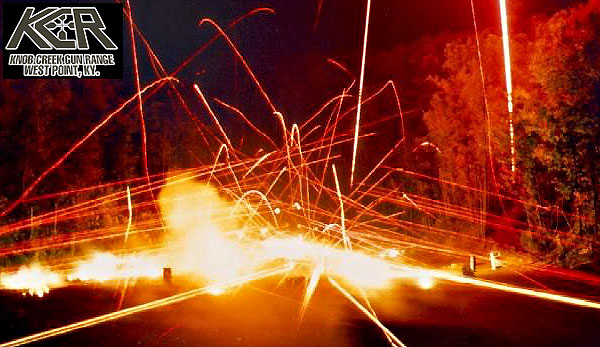
Twice a year, select-fire fans head to the Knob Creek Gun Range in West Point, Kentucky, for the nation’s largest Machine Gun Shoot. A bi-annual event, tThe Machine Gun Shoot is typically held on the second weekend of April and October. The latest Machine Gun Shoot took place October 11-13, 2013. The highlight of every Machine Gun Shoot is the Saturday Night event, where scores of guns send regular and tracer bullets down-range. This year, an estimated 1.25 million rounds were expended during the October Night Shoot.
This October, Top Shot Season 4 Champ Chris Cheng was on hand to record the firepower. Chris writes: “About an hour before dark, folks are out on the range setting up all sorts of explosives while a crowd builds, anxiously awaiting what we all know is coming. The lights go out, and the next thing you know machine guns are going off for almost 20 straight minutes. This year’s October 2013 edition did not disappoint. Check out the video below — other than the beginning, my favorite part is at the 5:50 mark [when a Mini-Gun opens fire from the right].”
Click Triangle to Watch Knob Creek Machine Gun Shoot Video (Warning: Very Loud Audio)
When we first ran this story 18 months ago, it proved immensely popular with our readers. In case you missed it the first time around, check out what can be done with a factory Savage 110 BA at extreme long range — 1760 yards. Shooter Mark Dalzell did a great job with the video, which features multiple camera views so you can see the shooter and the target at the same time. Enjoy!
This video by Mark Dalzell demonstrates the long-range capabilities of the Savage 110 BA chambered in .338 Lapua Magnum. Mark took his “BadAss” rig out to the southwest Nevada desert just north of Jean Dry Lakes. He placed a 2’x3′ target way, way out there — a full mile (1760 yards) away. At that range, flight time to target was 3.75 seconds! Sighting with a Nightforce 5-22x50mm NXS scope, Mark needed a few shots to get on target, but eventually made multiple hits, using 67 MOA of elevation and 2.25 MOA left windage. You can view the hits starting at 1:56 time-mark on the video. (Mark had a second camera set up closer to the target — this displays frame in frame in the video, and if you watch carefully you can see the strikes.) The ammo was HSM 250gr HPBT match with a 3.600″ COAL. The shooting was done at 8:13 in the morning, with clear conditions, very light winds. Temp was 57°, humidity 24.5, Density Altitude 3666. Video soundtrack is La Grange by ZZ Top.
PLAY BUTTON
LISTEN TO MARK TALK about One Mile Shooting:
CLICK Play Button to hear Mark Dalzell TALK about his .338 LM Savage 110 BA and how he scored hits at 1760 yards.
Good Shooting Mark. That’s darn good for a factory rifle. You also had the elevation dialed in real close before the firing started! That shows a good knowledge of your ammo’s long-range ballistics. We also noticed how effective that muzzle brake was. Recoil looked about the same as an un-braked .308 Win.
Ruger has created a series of videos showcasing Metallic Silhouette, IDPA, SCSA (Steel Challenge), and USPSA shooting events. Log on to Ruger’s Beginner’s Guide to Shooting Competitions webpage to see informative videos on each of these popular sports. Below you can find the Video on Metallic Silhouette and the Video on SCSA Steel Challenge pistol competition. Silhouette is a great family sport and the Steel Challenge is the ultimate pistol speed-shooting event.
INTRO to RIMFIRE RIFLE METALLIC SILHOUETTE Competition
INTRO to STEEL CHALLENGE Pistol Competition
Ruger also offers many other cool videos, both on its Video Webpage and on Ruger’s YouTube Channel. On YouTube, you’ll find a great four-part Tactical Carbine video series, hosted by Dave Spaulding, winner of the 2010 Trainer of the Year award by Law Officer Magazine. Spaulding also hosts a set of Ruger videos on defensive handgun use. For novice handgunners, Ruger offers Beginner Shooting Tips with video segments covering each of these topics:
Introduction
Firearm Safety Rules
Pistol Functionality
Body Position Stance
Dominant Eye
Gripping the Handgun
Sight Picture
Aiming
Trigger Control
Loading and Unloading
Range Basics
Ready Position
Shooting Pairs
Shooting to Slidelock
AmmoLand Shooting Sports News Service, in partnership with the National Rifle Association, will be broadcasting live video coverage of important events from the 2013 NRA Annual Meetings & Exhibits in Houston, Texas.
The streaming will open at 1 p.m. EDT on Friday, May 3rd, with the ILA Leadership Forum, which will be followed that day, at 4 p.m., by NRA News and Cam & Co on the Sportsman Channel.
On Saturday, May 4th, streaming begins at 9:50 a.m. with the NRA members meeting. In the afternoon, there is a special edition of NRA News and Cam & Co, and at 7:20 p.m. is the NRA Stand and Fight Rally. Sunday, May 5th, features the Special NRA News Wrap-Up Show at 10:00 am.
For more information, visit Ammoland.com. If you log to the NRA Meeting Video Feed, hit “refresh” to restart the embedded video player for each new event.
Brownells now offers free firearms maintenance videos on the Brownells.com website and the Brownells YouTube channel. Brownells President/COO, Matt Buckingham says: “These videos are great for any firearm owner, regardless of skill or experience level. If you’re a new owner, they’ll be extremely helpful; if you’re a longtime gun owner, they’re a great refresher.”
These how-to videos guide viewers through the steps of proper disassembly, cleaning, lubrication, reassembly, and function testing of some of today’s most popular firearms. For each firearm type, a series of FOUR video segments are offered. These are professionally filmed, with multiple camera angles and detailed close-up shots.
Watch m1911 Pistol Disassembly Video (Part 1 of 4-part m1911 series)
Watch Remington 870 Shotgun Disassembly Video (Part 1 of 4-part Rem 870 Series)
Founded in 1939, Brownells is an Iowa-based, family-owned company that sells more than 75,000 firearms parts, gunsmithing tools, accessories, and reloading components. Brownells offers a lifetime guarantee on EVERY product sold. To place an order, or for more information, call 800-741-0015 or visit Brownells.com.


 If you own a modern smart-phone, you have a shooting coach in your pocket. What we mean is that the video-recording capability of your smart phone can help improve your shooting. Have you ever watched yourself shooting, under match conditions? Well you may be shocked (and surprised) by what you see. Video reveals all. If you are flinching, you’ll see it. If you’re not returning your rifle to the same place on the rests after each shot, you’ll see it. If you are not maintaining a consistent cheek weld from shot to shot, you’ll see it.
 Video Equipment — What You Need





 Brownells now offers free firearms maintenance videos on the


