At the request of our readers, we provide select “Deals of the Week”. Every Sunday afternoon or Monday morning we offer our Best Bargain selections. Here are some of the best deals on firearms, hardware, reloading components, optics, and shooting accessories. Be aware that sale prices are subject to change, and once clearance inventory is sold, it’s gone for good. You snooze you lose.
NOTE: All listed products are for sale to persons 18 years of age or older. No products are intended for use by minors.
1. Palmetto State Armory — AR15 Lower Receiver, $49.99
⏺ Amazing Deal on quality AR lower receiver
Do you need a quality, affordable lower for your next black gun build? Here’s a great deal. Palmetto State Armory (PSA) now has stripped AR15 lowers for just $49.99. With this lower as the core, you can build up your AR for any discipline you choose: 3-Gun rifle, competition service rifle competition, varmint rifle, or even “race gun” for the PRS Gas Gun Series. These PSA lowers are forged using 7075-T6 Aluminum and have a durable, mil-spec anodized hardcoat finish.
2. Sportsman’s WH — Rangefinders on Sale, Save up to 34%
⏺ Major discounts on Leupold, SIG Sauer, and Vortex Rangefinders
3. Stocky’s Stocks — Quality Carbon Fiber Stocks on Sale
⏺ Excellent stocks for varmint and hunting rifles — strong and light
Would you like a modern, high-tech carbon fiber stock for your next hunting or varmint rifle project? Stocky’s Stocks is running a major sale on UltraLite Carbon Fiber VG2 Rem 700 Stocks, UltraLite Carbon Fiber Hunter Rem 700 Stocks and UltraLite Carbon Fiber M50 Rem 700 Stocks. With a selection this big you’re bound to find one that fits your needs. These stocks are strong, light, and durable.
4. Palmetto SA — SIG 3-9x50mm Scope + Laser RF, $179.99
⏺ Scope and rangefinder for hunting — combo for under $200
Here’s a good, ultra-affordable scope/LRF combo for a hunter on a tight budget. The Buckmasters Scope and Rangefinder Combo offers advanced SIG Sauer electro-optics for just $179.99. The 3-9x50mm scope has a Bullet Drop Compensation (BDC) reticle with holdover dots. The SIG Sauer LRF 1500 Laser Rangefinder offers fast-ranging performance with red illuminated display for low light hunting. If you don’t need a scope, you can get the Buckmasters 1500 Laser Rangefinder for just $119.99, an amazing deal.
5. Walmart — Fingerprint Access Gun Safe, $149.99
⏺ 50% Off price on Rapid Access Gun Safe (fingerprint, keypad, key)
Need to store a few rifles or shotguns with secure yet rapid access? Consider this 5-Gun Safe with Fingerprint Access. With a $299.99 MSRP, it is now just $149.99 on sale. It has five locking bolts on the door sides plus an internal locking compartment. Sized 13.8″W x 11.8″D x 57″T, this 74-lb safe can hold multiple long guns and pistols, along with other valuables. The main door can be opened instantly with fingerprint recognition, or use the digital keypad (there is also an emergency keyhole). The interior has foam barrel holder and carpeted floor, plus three pistol pouches on the door. NOTE: We do NOT recommend this as a primary gun safe, but it can be a good secondary safe.
6. Palmetto SA, Blackhawk Shooting Mat/Rifle Case, $49.99
⏺ Multi-Function Shooting Mat/Rifle Case now $100 Off
Here’s a great deal on a multi-function Mat/carry case. The Blackhawk Stalker Drag Mat Carry Case functions as a nice padded shooting mat, AND it serves as a rifle carry case and drag bag. Length is 50.5″ and width (in rifle case mode) is 9″. This mat/case is made from durable 1000 denier nylon and closed-cell foam. It has carry straps plus a shoulder strap.
7. Powder Valley — 2500 RUAG SmR Primers, $177.99
⏺ Great price on high-quality primers
If you shoot benchrest rigs, varmint rifles, or ARs, you need small rifle (SR) primers. Now you can get some very high-quality German-made RUAG SR Primers for a mere $177.99 for 2500. That’s the equivalent of $71.20 per thousand. These RUAG #4033 primers have earned positive user reviews: “Excellent quality… they performed very well… would recommend these to anyone”. NOTE: These are mil-spec primers with a fairly hard cup.
8. Midsouth — Poly-Tipped Bullet Sale, 17 to 23 Cents Each
⏺ Good, budget-priced bullets for varminters, AR15 Shooters, and hunters
If you need good bullets for your .223 Rem, 22 BR, or 22-250 varmint rig, here is a great opportunity. Get 55gr or 75gr polymer-tipped bullets at super-low prices, starting at just $41.99 for 250 — just 17 cents each. There are also 110gr .30 caliber bullets at $56.99/250 that can work for small game, or even local club matches. These deals are all on 250-count lots. CLICK HERE for Poly-tip Bullet Sale at Midsouth.
9. Amazon — Dragon AR500 Steel Targets, $16.99 and Up
⏺ Good prices on strong versatile AR500 steel gongs, 4″, 6″, 8″, 10″, 12″.
Shooting steel is fun — you get instant gratification from hearing the “clang” and seeing the gong swing. Shooting steel is also good practice for PRS/NRL events and ground-hog matches. Right now, you can get some great deals on quality AR500 steel targets. These Dragon Target Gongs (#ad) start at just $16.99 for a 4″-diameter, 3/8″-thick gong. Larger 6″, 8″, 10″, and 12″ gongs are offered in 3/8″ and 1/2″ thicknesses, and a 3-pack of 8″ gongs is available. A 6″-diameter gong is $26.99 (3/8″ thick) or $32.99 (1/2″ thick). The largest 12″-diameter gong in the heavy 1/2″ thickness is $76.99. NOTE: All these Dragon gongs have a center hole allowing more hanging options.
⏺ Sophisticated wind speed meter at a super-affordable price
Knowing wind speed is critical to making accurate ballistic adjustments both on the line or in the field. If you need a reliable yet affordable wind speed meter, consider the BTMETER BT-100 Handheld Anemometer (#ad). The BT-100’s multi-function capabilities include Wind Speed, Wind Temperature, and Wind Chill factor. The BT-100 portable wind speed gauge can accurately measure wind velocity in 5 units: m/s, km/h, ft/min, knots, mph. The unit also records air temperatures in degrees Celsius and Fahrenheit.
As an Amazon affiliate, this site can earn revenues through sales commissions.
Share the post "BargainFinder 450: AccurateShooter’s Deals of the Week"
Small patches are not very efficient at distributing bore cleaning liquids inside your bore. The problem with a tight-fitting patch is that the solvent gets squeezed off in the first few inches. You can switch to a smaller jag, or a bore mop, but there is an even better way to get an ample amount of solvent in your bore. Just spray directly into the bore with a wash bottle, an inexpensive plastic bottle with an L-shaped dispensing neck, tapered at the end.
When using the wash bottle, you can either just plug the breech and spray from the muzzle end (where most copper fouling is), or, alternately, put the wash bottle neck directly in the chamber and spray forward. When spraying from the chamber forward, you may need to use a rubber O-Ring to seal off the action… depending on the bore size and the particular wash bottle’s neck spout diameter. We prefer to plug the breech and squirt from the muzzle.
Bottle Solvent Application Method Works Great for Smaller Bores
Using wet patches or wet brushes is an inefficient way to really saturate the tight bores of 17s, 20s, and 22s. Even with a cotton bore mop, most of the solvent will be squeezed out before it gets to the end of the bore, where most copper fouling occurs. For these smaller 17, 20, and 22-caliber bores, you can just take the wash bottle and stick the tapered nozzle right in the chamber. The tapered end will press fit in the throat, sealing off the chamber. With the barrel slightly nose-down, give the bottle a couple good squirts until the solvent mists out the muzzle. In just a few seconds, this will put more solvent in the bore than a half-dozen wet patches.
A solvent-filled wash bottle is also handy for wetting your brushes. It’s much easier to saturate a bore brush (without spilling solvent on your stock), by using the wash bottle. You can get wash bottles from USPlastic.com, Amazon.com, or lab supply stores. CLICK HERE for $4.98 wash bottle.
Share the post "Speed Up Bore Cleaning Tasks with Wash Bottles"
Detail from Doan Trevor rimfire prone stock (Fiddleback Walnut) with Stiller 2500 X Action.
New Mexico Gunsmith Doan Trever is a true wizard with wood. At Doan Trevor Custom Rifle Building, he crafts stunning figured wood stocks, and also builds complete wood-stocked and fiberglass-stocked rifles that shoot as good as they look. Doan is a true master, with a mind for function and an eye for beauty. The ability to hand-craft wood is becoming a lost art. For this Sunday, we celebrate four projects crafted by Doan: two complete rifle, a special F-Class stock built for multiple actions, and an F-TR stock for a Sako action. Visit DoanTrevor.com to view find dozens of other stunning stocks and complete rifles.
Mausingfield America Rifle with English Walnut Stock
Doan told us: “This is a highly figured piece of English Walnut with burls and flowers. Along the bottom of the stock there’s a burl/flower that looks like an owl and one side looks like the Sandia Mountains. This rifle is in 30 PCR. Doan adds: “The owner is enjoying this rifle immensely.”
Walther KK500 (Twin Trigger), English Walnut Laminate Stock with Fiddleback Accents
About this unique rig Doan notes: “This left-handed rifle has two triggers. It has an electronic trigger AND a mechanical trigger. With the wood stock option, the charging cable needs to be modified modify in order to clear the trigger extension to be able to charge. Also, keeping with aesthetics, I made it able to remove the trigger guard in order to charge more easily. Removing the trigger guard does not change the bedding.”
American Walnut F-Class Stock with Figured English/Claro Walnut Fore-End Inlay
Doan explains: “The owner has three actions with the same barrel block mounting system. He wanted to be able to use one stock. I built a bedding system that would accomplish this task. The two pieces of Claro Walnut on the fore-end are mirror copies.”
F-TR Stock for Sako 85 with Johnny Byer Stock Blank
Here’s a handsome F-TR rig. Doan reports: “The pistol grip cap is a piece of Screw Bean Mesquite Wood from my old front yard in Albuquerque. (I live in Rio Rancho, NM now.) Take a look at the bottom photo with the blue background, the rifle doesn’t have any stippling yet. Sometimes, you have stippling as the last step. There’s no room for error when this order of events is necessary.”
Doan Trevor is a master gunsmith and stock-maker who works in the old style. He still hand-crafts stocks from start to finish, and does all the metal-work on the custom rifles he builds. Starting with highly-figured woods, Doan carves and shapes his stocks largely by hand, with meticulous attention to detail. Each rifle he builds is optimized for its intended discipline, and custom-fitted for the customer.
With photography by Doan’s talented wife Sue, Doan has created a website, DoanTrevor.com, that is a feast for the eyes. You can see beautiful wood-stocked rifles being hand-crafted. Doan also illustrates how he creates custom metal parts, and how he beds barreled actions into the finished stocks.
Definitely visit Doan’s website. Be sure to click on the site’s secondary pages: Rifle Building, Woodworking, and Metalworking. There you’ll find info on wood-working plus hundreds of high-quality photos.
Contact Doan Trevor
Doan Trevor Custom Rifle Building
Website: DoanTrevor.com
Email: doantrevor@gmail.com
Phone: 714-457-5566
Products and Services: Custom rifle building for High Power, F-Class, Long Range, and Smallbore shooters. Fancy Wood and Fiberglass Rifle Stocks, Custom Grips for Rifles, and Offset Sights.
Share the post "Sunday Gunday: Master of Wood — Doan Trevor Custom Rifles"
There is a good article on gun safes in SHOT Business, a publication for the NSSF SHOT Show audience. Written by Christopher Cogley, this Safe Spaces Article offers some very important things to consider when purchasing a gun safe. Here are key points from that article:
Safe Security — The security of a gun safe comes down to two main factors: the thickness of the steel and the construction of the safe. When it comes to construction, look for a safe that has continuous welded construction instead of bolts or spot-welding, which are easier for trained gun thieves to cut through with torches or high-power saws.
Lock Options — Traditional combination locks are arguably the simplest choice. The downside, though, is they don’t provide quick access to firearms in an emergency. Electronic and biometric keypads provide quicker access — but be sure to replace the batteries every year.
Fireproof Rating — Aside from theft, the biggest threat to your firearms is fire. Unfortunately, the fireproof rating on gun safes can be confusing because there is no single, “standard” fireproof rating. As a general rule, the fireproof rating states how long a safe can be exposed to a fire of a particular temperature and maintain a temperature inside the safe of no more than 350 degrees F. To put this in context, the average house fire creates temperatures between 800 and 1,200 degrees F.
Where to Place a Gun Safe in Your Home
The Safe Spaces article includes advice from Stephen Hall, CEO of Lock It Up Safes. Hall addressed the question: “Where should I put my safe?”
Hall states: “Ease of installation should NOT be the foremost consideration when making this decision. Putting a safe in the garage has both pros and cons. We see some retailers recommend the garage solely because they don’t have the right team on board to install safes in other locations, and wheeling one into the garage is the easy way out.
Putting a safe in the garage is fine if that is the only place you an put it, but most want the safe in the home, where they can get to it quickly. Temperature and humidity are important considerations as well, and both are more easily controlled in a house rather than in the garage.
One advantage to garage installation is the concrete floor provides a solid base for safe installation. Houses built on concrete slabs also offer a solid anchor on the first level. If the safe needs to go to an upper floor, the weight of the safe and its contents need to be factored in.”
Place Safe Against Outside Wall
Hall recommends placing your gun safe against an outside wall: “In case of fire, the safe will typically last longer as there is not a lot that can burn on one side of the safe, thus keeping it cooler.”
Don’t Make the Mistake of Buying an Undersized Safe
The most common mistake people make when buying a gun safe is getting a safe that’s too small. This video explains why you should probably invest in a bigger safe. First, the rated gun capacity is exaggerated — rifles with mounted optics, long barrels, wide forearms and/or pistol grips take up considerably more space than a small rimfire rifle or a lever gun with iron sights. Second, your gun collection will likely grow in years to come. Third, you may want to store other valuables in the safe — such as vital documents, jewelry, watches, and pricey electronics. In this video the host notes: “Get a much larger safe than you think you’ll need at first. This will guarantee that you will have enough room for future purchases and all the guns and equipment you currently have.”
Recommended Safe Features for Long-Gun Storage
Editor’s Recommendation:
Budget $1200-1500 for a safe from a major maker, with external hinges, and an interior at least 58″ high. That gives you room for 30″-barreled rifles with a top shelf for handguns and other valuables. A rotary rack and slide-out drawers are great additions.
Keypad or Dial? We favor rotary dial locks. With minimal maintenance they will function flawlessly for decades. But the digital locks offer quick-access and convenience. If you go digital, get a commercial-grade unit.
Fire-lining is worth getting, but a thin layer of sheet-rock doesn’t make a safe truly “fire-proof”.
Interior at least 58″ High and 30″ wide Overall Weight 750+ Pounds 8 Gauge or Heavier Wall Thickness Double-Wall, Composite Door with Relockers Minimum UL RSC Rated. TL-15 or TL-30 Rating is Desirable External Hinges
Mechanical UL Group II (or better) Lock with Standard Dial Or UL Type 1 Commercial-Grade Electronic Lock
Custom Interior Suitable for Scoped Guns with Long Barrels On-Door Storage System for Non-scoped Long Guns OR Rotary Gun Rack for Scoped Rifles and ARs
Internal (sandwiched) Insulator, Reinforced if Sheet-rock Palusol? Heat-Activated Expanding Door Seals
Slide-out Drawers for Handguns Fire-lined Inner Safe for Paper and Media
Low Gloss, Rust-resistant External Finish Pre-Drilled holes for Lag Bolts and in Rear for Electric Cord Overhead Fluorescent Lamp and/or LED Mini-lights on Strings
Share the post "Gun Safes: Key Things to Consider — Size, Locks, Steel Thickness"
There was huge news in the reloading world this week. Hodgdon Powder Company (Hodgdon) has acquired RCBS from Revelyst, a division of of Vista Outdoor (VSTO). Most operations of RCBS will remain in Oroville, California for now, and the full product line will stay in production — presses, dies, powder measures, case prep tools, priming tools, scales and more. But this is still big news, with a leading reloading gear maker being acquired by a leading powder maker/distributor.
Today’s Saturday Showcase feature some of the most popular and noteworthy RCBS products including single-stage, turret, and progressive presses, plus powder dispensers and other tools.
RCBS ChargeMaster Link Scale/Dispenser with Bluetooth
Having a modern, electronic powder scale/dispenser makes the hand-loading process vastly more efficient. The latest generation of powder dispensers are very accurate, and they can store charge settings for multiple cartridge types. The latest RCBS ChargeMaster Link dispenser has a modern interface, plus Bluetooth technology that “talks” to a handy App on your mobile device. This is available now for $299.99 at Cabelas.com.
RCBS Combo Kit — Good Choice for Getting Started in Reloading
You can definitely save money by buying multiple reloading gear items in one combo package. RCBS offers a variety of Reloading Combo Kits which feature reloading press, powder measure, scale, priming tool, and other items. These range in price from $265-$620 on Amazon. This video reviews an RCBS Rebel Master Kit. This is a very complete starter set-up, sold for $499.99 at Midsouth.
Along with the press, we like many of the components in the Rebel Master combo kit. The powder measure works well as does the trickler, and the hand primer tool is reliable, with good feeding and plenty of leverage.
RCBS Partner Press
We think all serious reloaders should have a small, secondary single-stage press for repetitive tasks such as decapping primers. In addition, a small, compact press can be transported easily to the range. Load development can be done more efficiently when loading at the range, as you can easily modify seating depth and other variables. The RCBS Partner Press (#ad) is a great choice for a secondary press. This UltimateReloader video shows the key features of the Partner Press.
RCBS 6-Station Turret Press — Operation Tips
This editor has owned and used an RCBS Turret Press for over two decades. While certainly not as versatile/sophisticated as the Area 419 XERO turret press, this six-station RCBS press does its job handily. It is a good choice if you load multiple pistol cartridges. With six stations, you can install both a sizing and a seating die for three different cartridge types, such as 9mm Luger, .357 Magnum, and .45 ACP.
RCBS Brass Boss Case Prep Center
The RCBS Boss is a powered case prep center that performs multiple tasks efficiently. Priced at $198.99 on Amazon (#ad), the RCBS Boss boasts six variable, high-speed rotating stations (four at <350 RPM; two at <550 RPM). This unit is great for initial case prep (chamfering/deburring) and regular brass maintenance.
RCBS Summit — Set-UP and Field installation on Vehicle
The RCBS Summit Press (#ad) is a very unique, small footprint press that operates differently than most reloading presses. The cast-iron Summit has a large-diameter center column and die moves up and down to meet the cartridge. With this small footprint, the Summit can be used in the field. As you can see in the second video, one of our testers actually mounted a Summit Press on his vehicle (with a special pedestal) so he could load anywhere.
RCBS Bench-mount Priming Tool (Two Short Videos)
If you need to prime large numbers of cases, the RCBS bench-mount Auto Priming Tool can do so efficiently at a modest cost (currently $155.09 on Amazon #ad). It attaches to your bench so it is secure and stable. A vertical tube holds dozens of primers that feed into the pusher as you can see in these videos. Older guys who experience pain when gripping hand primer tools have praised this bench-mounted RCBS unit.
Choosing a Case Cleaning System
Here Kent Sakamoto of RCBS looks at the three main types of brass cleaning systems: Vibratory Tumbler, Wet Tumbler (with media), and Ultrasonic Cleaning Machine. Kent reviews the pros and cons of each system. Most gun owners can benefit by having an ultrasonic machine for parts cleaning as well as a tumbler for cleaning fired brass.
As an Amazon affiliate, this site can earn revenues through sales commissions.
Share the post "Saturday Movies: RCBS Tool Videos (Hodgdon Now Owns RCBS)"
With barrels, one wonders “Can a little more length provide a meaningful velocity gain?” To answer that question, Rifleshooter.com performed an interesting test, cutting a .308 Win barrel from 28″ all the way down to 16.5″. The cuts were made in one-inch intervals with a rotary saw. At each cut length, velocity was measured with a Magnetospeed chronograph. To make the test even more interesting, four different types of .308 Win factory ammunition were chronographed at each barrel length.
This is a very useful test is you’re thinking about building a .308 Win hunting rifle, or perhaps thinking of going shorter for your F-TR rifle to save weight.
Test Barrel Lost 22.7 FPS Per Inch (.308 Win Chambering)
How much velocity do you think was lost, on average, for each 1″ reduction in barrel length? The answer may surprise you. With a barrel reduction from 28″ to 16.5″, the average speed loss of the four types of .308 ammo was 261 fps total. That works out to an average loss of 22.7 fps per inch. This chart shows velocity changes for all four ammo varieties:
Summary of Findings:
The average velocity loss per inch, for all four ammo types combined, was 22.7 FPS. By ammo type, the average FPS loss per inch was: 24.6 (Win 147 FMJ), 22.8 (IMI 150 FMJ), 20.9 (Fed GMM 168gr), and 22.5 (Win 180PP).
Interestingly, these numbers jive pretty well with estimates found in reloading manuals. The testers observed: “The Berger Reloading manual says for the 308 Winchester, ‘muzzle velocity will increase (or decrease) by approximately 20 fps per inch from a standard 24″ barrel’.”
How the Test Was Done
The testers described their procedure as follows: “Ballistic data was gathered using a Magnetospeed barrel mounted ballistic chronograph. At each barrel length, the rifle was fired from a front rest with rear bags, with five rounds of each type of ammunition. Average velocity and standard deviation were logged for each round. Since we would be gathering data on 52 different barrel length and ammunition combinations and would not be crowning the barrel after each cut, we decided to eliminate gathering data on group sizes. Once data was gathered for each cartridge at a given barrel length, the rifle was cleared and the bolt was removed. The barrel was cut off using a cold saw. The test protocol was repeated for the next length. Temperature was 47° F.”
CLICK HERE to Read the Rifleshooter.com Test. This includes detailed charts with inch-by-inch velocity numbers, multiple line charts, and complete data sets for each type of ammo. Rifleshooter.com also offers ballistics graphs showing trajectories with different barrel lengths. All in all, this was a very thorough test by the folks at RifleShooter.com.
Much Different Results with 6mmBR and a Longer Barrel
The results from Rifleshooter.com’s .308 barrel cut-down test are quite different than the results we recorded some years ago with a barrel chambered for the 6mmBR cartridge. When we cut our 6mmBR barrel down from 33″ to 28″, we only lost about 8 FPS per inch. Obviously this is a different cartridge type, but also our 6mmBR barrel start length was 5″ longer than Rifleshooter.com’s .308 Win start length (and we ended where Rifleshooter’s .308 started — at 28″). Velocity loss can be more extreme with shorter barrel lengths (and bigger cartridges). Powder burn rates can also make a difference.
Share the post "How .308 Win Velocity Changes with Barrel Cut from 28″ to 16.5″"
Here is big news for reloaders. RCBS, one of the leading producers of dies, reloading gear, case prep tools, powder dispensers, and reloading presses, has been acquired by Hodgdon Powder Company. RCBS has been operated by Revelyst, a division of of Vista Outdoor (VSTO). (SEE Revelyst Report on Yahoo Finance.) Here is the text from the official press release announcing the acquisition:
Hodgdon Powder Company Acquires RCBS Reloading
May 02, 2024
Hodgdon Powder Company is pleased to announce the acquisition of RCBS Reloading from Revelyst, a segment of Vista Outdoor (NYSE: VSTO). This acquisition is effective May 2, 2024, with Hodgdon prepared to immediately continue shipping RCBS products to wholesale and retail customers.
“This acquisition of RCBS, the leading brand in metallic reloading tools, is a perfect complement to our portfolio of smokeless powder brands for our handloading customers,” said Steve Kehrwald, president and CEO of Hodgdon Powder Company. With our world-class ballistics labs, we look forward to providing even more load data to our new RCBS customers.”
Hodgdon is thrilled to add the RCBS facility in Oroville, CA to our company-owned facilities in Shawnee, KS, Herington, KS and Miles City, MT. The addition of the RCBS team will more than double the headcount at the Hodgdon Powder Company and greatly expands the company’s manufacturing capabilities.
“For years, our friends have referred to the Hodgdon family and company as ‘The Gunpowder People’ and this acquisition further demonstrates our dedication to the handloader,” said J.B. Hodgdon, co-owner with his late brother Bob, of the Hodgdon Powder Company. “Our dad Bruce partnered with Fred Huntington from RCBS to conduct Reloading Roadshow events in the 1950s and 1960s. I believe they both are looking down today, proud to have our two great brands together in 2024.”
Comment from Vista Outdoor/Revelyst
“For more than 80 years, RCBS has demonstrated their manufacturing, innovation and operational excellence,” Said Eric Nyman, Co-CEO of Vista Outdoor and CEO of Revelyst. “We are thrilled for RCBS and their new ownership with Hodgdon Powder. This transaction joins two iconic brands, and it ensures that RCBS is positioned for success in the next chapter of its history.”
Hodgdon sent a letter today to its customers. In the letter, Hodgdon Sales V.P. Shawn Kelley states: “Hodgon Powder Company announced earlier this morning that we acquired RCBS from Vista Outdoor, effective immediately.” Shown above is the letter sent to customers.
Share the post "Major News — Hodgdon Acquires RCBS from Vista Outdoor"
Serious riflemen know that Krieger makes outstanding centerfire barrels that hold world records and have won many National Championships. But did you know that Krieger makes great rimfire barrels too? Well, Krieger does make outstanding .22 LR rimfire match barrels that can deliver impressive accuracy.
Sniper’s Hide moderator “Padom” recently tested a variety of rimfire ammo types, employing five different barrels: Krieger, Bartlein, Benchmark, Lilja, and Green Mountain. He tested at both 50 yards and 100 yards. FULL Rimfire TEST REPORT HERE.
Reporting on the 50-yard test, Padom posted: “Had a virtually dead calm day today for 50-yard RimX testing (Keystone Accuracy RimX barreled action with 1:16″ Krieger 20″ barrel). A few infrequent 3 mph gusts but pretty dead [calm] and the target showed. This Krieger just barely edged out the Bartlein by 0.003″ with a 0.177″ 6×5 with SK Rifle Match. The 10×5 was 0.198″. The best lots of Center-X weren’t far behind either. This is the first Krieger rimfire [barrel] I’ve shot and it didn’t disappoint.”
Padom noted: “Winds were much calmer tonight than this morning so the 100-yard Krieger test was a success. Winds were pretty consistent [at] 3-5 mph.”
Test Results at 100 Yards
Padom then tested ammo at 100 yards, again using his Krieger rimfire barrel: “To recap, the Krieger shot the best 50-yard results of the barrels tested so far, just barely beating the Bartlein but it was so close you can call the 50-yard results equal (.005). Well the Krieger beat all the barrels tested to date at 100 yards by a pretty good margin with Center-X. The 10×5 was incredible as well at just barely over 0.6″ showing the results were very consistent. A second lot of Center-X was right there with the previous 100-yard 6×5 best results just barely over 0.6. The third lot of Center-X shot a respectable 0.75″ 6×5. This Krieger sure is shooting very nicely. I’m really looking forward to shooting it at 300 and 400 yards[.]”
Components Tested: 20″ Krieger M24 barrel, .22 LR Match Eachus chamber 0.046 headspace, Zermatt RimX Action, Bix’N Andy TacSport Pro 2-Stage Trigger, RimX 10rd magazine, XLR Envy Pro Folding Chassis, Athlon Cronus BTR 4.5-29x56mm MIL scope.
Shooting Set-up: 100 Yards Prone with Bipod and Rear Bag.
Share the post "Rimfire Ammo Comparison Testing with Multiple Barrel Brands"
AccurateShooter.com offers a dozens of free, printable targets in our Target Collection. However, we know that sometimes shooters may prefer a commercially-printed specialty target. These may offer unique designs, hi-viz colors, splatter effect, or special functions (such as scope checking). Here are a variety of excellent commercial grid targets you can buy via Amazon or the target-maker’s website.
EZ-AIM 12″x12″ Grid with Orange Bullseyes — $7.75 for 13-pack
We like this EZ-Aim Sight-in Grid Target for sighting-in, load development. and general practice. The full 12″x12″ target is covered with a precise black-lined grid on white background. There is a large center orange bullseye, plus four additional bulls, one in each corner. Right now this target is a bargain. You can get a 13-pack of targets for just $7.75 (#ad) on Amazon.
Freedom Targets — Bullseye Sight-In Grid Target, 25 for $12.89
Here’s a great Bullseye Sight-in Grid Target. This target provides a central bull on a 1″ grid pattern. There 8 additional small orange dot aim points, plus helpful numbers on the central vertical and horizontal lines. The outer four orange aim points are set inside heavier black lines to help align your scope crosshairs. This target is nicely printed, with sharp lines and bright orange circles. You get a pack of 25 targets for $12.89 — that’s $0.52 per target.
Birchwood Casey Grid — Black on White Splatter, 5 for $4.38
We’ve all seen conventional splatter targets with a black bullseye or grid. When a shot hits the target, a halo (usually neon yellow) appears around the bullet hole. Here is another kind of splatter target that creates a black circle on a white background. This can be very effective for spotting your hits at long range. This Birchwood-Casey White Grid Target is $4.38 for a 5-pack (#ad) on Amazon. These Shoot-N-C Sight-In Targets have a self-adhesive backing, making for easy put up and take down. In addition, the target pack comes with corner pasters to cover holes or use as additional aim points.
High-Viz Option — Yellow on Black Grid with Yellow Halos
If you prefer seeing ultra-high-contrast yellow/green “halos” for your hits, Birchwood Casey also makes adhesive grid targets with five yellow-edged diamonds. Red circles provide precise aiming points in the middle of each box. You can quickly estimate group size or dial-in your zero using the hi-viz yellow 1″ grid lines. These yellow-on-black targets are available in three sizes: 8″ square, 12″ square, and 17.5″ square. These yellow-on-black grid targets start at $4.99 for an 8″ six-pack (#ad) on Amazon.
As an Amazon affiliate, this site can earn revenues through sales commissions.
This content Copyright 2024. Any republication on any other site is a violation of Federal Copyright laws and gives rise to penalties and damages.
Share the post "Great GRID Targets For Load Development and Accuracy Testing"
When neck-turning cases, it’s a good idea to extend the cut slightly below the neck-shoulder junction. This helps keep neck tension more uniform after repeated firings, by preventing a build-up of brass where the neck meets the shoulder. One of our Forum members, Craig from Ireland, a self-declared “neck-turning novice”, was having some problems turning brass for his 20 Tactical cases. He was correctly attempting to continue the cut slightly past the neck-shoulder junction, but he was concerned that brass was being removed too far down the shoulder.
Craig writes: “Everywhere I have read about neck turning, [it says] you need to cut slightly into the neck/shoulder junction to stop doughnutting. I completely understand this but I cant seem to get my neck-turning tool set-up to just touch the neck/shoulder junction. It either just doesn’t touch [the shoulder] or cuts nearly the whole shoulder and that just looks very messy. No matter how I adjust the mandrel to set how far down the neck it cuts, it either doesn’t touch it or it cuts far too much. I think it may relate to the bevel on the cutter in my neck-turning tool…”
Looking at Craig’s pictures, we’d agree that he didn’t need to cut so far down into the shoulder. There is a simple solution for this situation. Craig is using a neck-turning tool with a rather shallow cutter bevel angle. This 20-degree angle is set up as “universal geometry” that will work with any shoulder angle. Unfortunately, as you work the cutter down the neck, a shallow angled-cutter tip such as this will remove brass fairly far down. You only want to extend the cut about 1/32 of an inch past the neck-shoulder junction. This is enough to eliminate brass build-up at the base of the neck that can cause doughnuts to form.
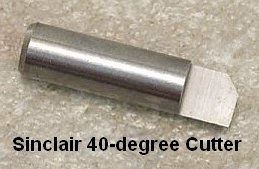
The answer here is simply to use a cutter tip with a wider angle — 30 to 40 degrees. The cutter for the K&M neck-turning tool (above) has a shorter bevel that better matches a 30° shoulder. There is also a 40° tip available. PMA Tool and 21st Century Shooting also offer carbide cutters with a variety of bevel angles to exactly match your case shoulder angle*. WalkerTexasRanger reports: “I went to a 40-degree cutter head just to address this same issue, and I have been much happier with the results. The 40-degree heads are available from Sinclair Int’l for $15 or so.” Forum Member CBonner concurs: “I had the same problem with my 7WSM… The 40-degree cutter was the answer.” Below is Sinclair’s 40° Cutter for its NT-series neck-turning tools. Item NT3140, this 40° Cutter sells for $14.99. For the same price, Sinclair also sells the conventional 30° Cutter, item NT3100.
Al Nyhus has another clever solution: “The best way I’ve found to get around this problem is to get an extra shell holder and face it off .020-.025 and then run the cases into the sizing die. This will push the shoulder back .020-.025. Then you neck turn down to the ‘new’ neck/shoulder junction and simply stop there. Fireforming the cases by seating the bullets hard into the lands will blow the shoulder forward and the extra neck length you turned by having the shoulder set back will now be blended perfectly into the shoulder. The results are a case that perfectly fits the chamber and zero donuts.”
⏺ Act soon for $50 or $75 rebate on high-quality revolvers
Smith & Wesson Wheelgun Wonderland Rebate, Save $50 or $75
Want a great revolver? We think everyone should have at least one quality Smith & Wesson wheelgun. There’s even a rebate available — but you better act fast — today (April 30, 2024) is the last day you can make a qualifying S&W revolver purchase.
Right now you can get a significant S&W Rebate on both compact carry revolvers and full-size wheelguns. For the smaller J-Frame (with $50 rebate), we like the Model 638 with alloy frame and shielded hammer. You can also get a big $75 rebate on the bigger K-, L-, or N-frame revolvers. In .357 Magnum, we like the modern L-Frame Model 686. NOTE: To get the rebates, purchases must be made before midnight on 4/30/2024 — so don’t delay.
Smith & Wesson’s J-Frame revolvers are great carry guns. We recommend the ultra-lightweight Model 638 and Model 642 Airweight wheelguns, which each weigh under one pound (14.6 oz. empty)! We like the Model 638 because it has a shielded internal hammer, so you can shoot single-action if you wish.
Rebate Applies to Popular Rimfire Revolvers as Well
The rebate is good for a wide variety of revolvers, including popular rimfire revolvers. We have an K-frame Model 617 .22LR revolver that has shot thousands of rounds. It is very accurate, with a superb trigger. Rimfire revolvers are great for training and plinking.
NOTE: There is currently a $75 S&W Rebate available for this Model 648 K-frame revolver. Qualifying purchases must be made between February 1, 2024 and April 30, 2024.
Along with its .22 LR wheelguns, S&W now offers the Model 648 in .22 WMR (Winchester Magnum Rimfire). This stainless Model 648 brings a more powerful cartridge to S&W rimfire revolver fans. Built on S&W’s medium K-frame, the 8-round Model 648 is designed for small game hunting and target shooting. The .22 WMR is definitely a much more potent varmint cartridge than the .22 LR. You have more downrange energy plus a flatter trajectory.
Share the post "Last Day Today for Smith & Wesson Wheelgun Rebate"
Every month, GunGenius.com publishes a monthly Top Selling Report listing the Top 5 Best Selling Guns for each major category of firearms sold on GunBroker.com. This culminates in a comprehensive year-end report detailing the Top Selling Firearms of the Year for all categories (rifles, pistols, shotguns). Within that report there are break-downs by type. For example there are four (4) categories of rifles: Bolt-Action, Semi-Auto, Lever Action, and Single Shot.
In today’s Bulletin article we feature the Top Ten Bolt-Action Rifles sold new on Gunbroker.com in 2023. In order, these are:
1. Ruger American Rifle
2. Remington Model 700
3. Browning X-Bolt
4. Savage 10/110
5. Savage Axis
6. CZ-USA Model 457
7. Tikka T3
8. Mossberg Patriot
9. Weatherby Vanguard
10. Winchester Model 70
BONUS: TIKKA T3x vs. Ruger American
Here are two of the Top 10 best-selling bolt-action rifles compared head-to-head. This detailed video compares the #1-selling Ruger American rifle with the #7-ranked Tikka T3x. The reviewers explain the key differences and the pros and cons of each type. The video examines the receivers, barrels, triggers, and stocks of the Tikka and the Ruger. What’s the bottom line? Well the Ruger has a price advantage, but the Tikka T3x has a better trigger, nicer action, better magazines, and probably better 5-shot accuracy.
Share the post "TOP TEN Best-Selling Bolt-Action Rifles for 2023 on Gunbroker"


 Small patches are not very efficient at distributing bore cleaning liquids inside your bore. The problem with a tight-fitting patch is that the solvent gets squeezed off in the first few inches. You can switch to a smaller jag, or a bore mop, but there is an even better way to get an ample amount of solvent in your bore. Just spray directly into the bore with a
 Detail from Doan Trevor rimfire prone stock (Fiddleback Walnut) with Stiller 2500 X Action.


 Contact Doan Trevor


 Test Results at 100 Yards


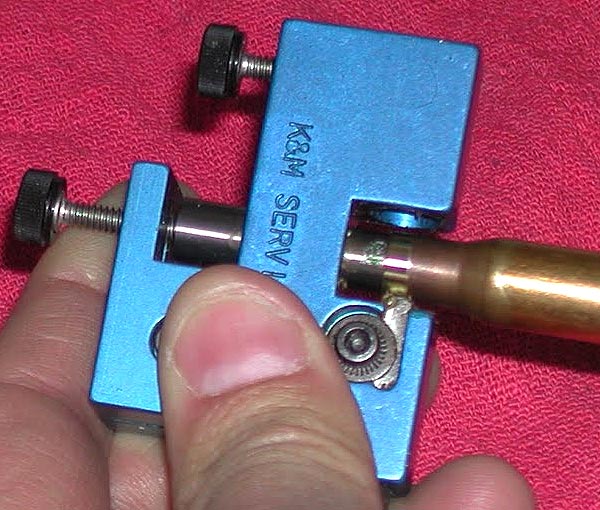
 When neck-turning cases, it’s a good idea to extend the cut slightly below the neck-shoulder junction. This helps keep neck tension more uniform after repeated firings, by preventing a build-up of brass where the neck meets the shoulder. One of our Forum members, Craig from Ireland, a self-declared “neck-turning novice”, was having some problems turning brass for his 20 Tactical cases. He was correctly attempting to continue the cut slightly past the neck-shoulder junction, but he was concerned that brass was being removed too far down the shoulder.