Here’s a little known fact that may startle most readers, even experienced gunsmiths: your barrel wears out in a matter of seconds. The useful life of a typical match barrel, in terms of actual bullet-in-barrel time, is only a few seconds. How can that be, you ask? Well you need to look at the actual time that bullets spend traveling through the bore during the barrel’s useful life. (Hint: it’s not very long).
Bullet-Time-in-Barrel Calculations
If a bullet flies at 3000 fps, it will pass through a 24″ (two-foot) barrel in 1/1500th of a second. If you have a useful barrel life of 3000 rounds, that would translate to just two seconds of actual bullet-in-barrel operating time.
Ah, but it’s not that simple. Your bullet starts at zero velocity and then accelerates as it passes through the bore, so the projectile’s average velocity is not the same as the 3000 fps muzzle velocity. So how long does a centerfire bullet (with 3000 fps MV) typically stay in the bore? The answer is about .002 seconds. This number was calculated by Varmint Al, who is a really smart engineer dude who worked at the Lawrence Livermore Laboratory, a government think tank that develops neutron bombs, fusion reactors and other simple stuff.
On his Barrel Tuner page, Varmint Al figured out that the amount of time a bullet spends in a barrel during firing is under .002 seconds. Al writes: “The approximate time that it takes a 3300 fps muzzle velocity bullet to exit the barrel, assuming a constant acceleration, is 0.0011 seconds. Actual exit times would be longer since the bullet is not under constant acceleration.”
We’ll use the .002 number for our calculations here, knowing that the exact number depends on barrel length and muzzle velocity. But .002 is a good average that errs, if anything, on the side of more barrel operating life rather than less.
So, if a bullet spends .002 seconds in the barrel during each shot, and you get 3000 rounds of accurate barrel life, how much actual firing time does the barrel deliver before it loses accuracy? That’s simple math: 3000 x .002 seconds = 6 seconds.
Gone in Six Seconds. Want to Cry Now?
Six seconds. That’s how long your barrel actually functions (in terms of bullet-in-barrel shot time) before it “goes south.” Yes, we know some barrels last longer than 3000 rounds. On the other hand, plenty of .243 Win and 6.5-284 barrels lose accuracy in 1500 rounds or less. If your barrel loses accuracy at the 1500-round mark, then it only worked for three seconds! Of course, if you are shooting a “long-lived” .308 Win that goes 5000 rounds before losing accuracy, then you get a whopping TEN seconds of barrel life. Anyway you look at it, a rifle barrel has very little longevity, when you consider actual firing time.
People already lament the high cost of replacing barrels. Now that you know how short-lived barrels really are, you can complain even louder. Of course our analysis does give you even more of an excuse to buy a nice new Bartlein, Krieger, Shilen etc. barrel for that fine rifle of yours.
In our Shooters’ Forum, there’s a long-running thread entitled Pride & Joy Rifles. There you’ll find dozens of fine firearms — from hunting handguns to long-range benchrest rigs. A while back, Forum member John L. (GunDog64) posted this handsome Palma rifle, built by Chad Dixon.
John reports: “Here is my new ‘Pride and Joy’ Palma rifle. The action is a chrome-moly Barnard supplied by MT Guns. The gun is set up for switch-barrel use with two Medium Palma-contour Bartlein barrels, one chambered in 6CM, the other in .308 Winchester. Both barrels feature 5R rifling. Up front is a Riles 30mm front sight, while the rear sight is a Warner. The stock was crafted from a superb Turkish walnut blank supplied by Luxus Gunstocks in Mt. Orab, Ohio.
Gunsmithing by Chad Dixon — Stock Finish by Owner
All gunsmithing and assembly work was performed by Chad Dixon at Long Rifles Inc., Sturgis, South Dakota. Chad designed the trigger guard, handstop rail, recoil lug, and cheek-piece adjuster. John, the rifle’s proud new owner, completed the finish work on the stock. John reveals: “This project was a year in the making but well worth the wait”.
Sinclair Int’l is offering some good deals right now. First, Sinclair has the new Rock River Arms 2-Stage AR15 match trigger marked down to $99.00 from $120.00. If you’re building a black rifle, here’s a chance to save twenty bucks. Click the image below to get the discount.
Sinclair is also running a sale now on Hornady BTHP Match Bullets. We’ve heard positive reports on the new match bullets with the Advance Manufacturing Process (AMP) jackets. Our friend John Adams has tested some of Hornady’s new 6mm 105-grainers with AMP Jackets. John says they shoot very accurately and are extremely uniform. John tells us: “I’m impressed by the new Hornady 105s. They are some of the most uniform bullets I’ve ever sampled. I absolutely stopped sorting them because the base to ogive measurements were so consistent.”
The popular BulletFlight Ballistics Program, is now available for Android OS smart phones and mobile devices. BulletFlight (from Knights Armament) has emerged over the past couple of years as one of the very best balllistics programs for iPhones and iPods. And now Android device users can enjoy the same functionality and features.
BulletFlight Android OS software comes in three different versions, all available through the Android Market. BulletFlight L1 (Level 1, $3.99) is a fast-running ballistics App with a host of features, including: user-selectable BC models (G1, G7, G8 etc.); output in inches, cm, MOA, Mils, and scope clicks; 360° wind drift calculation. BulletFlight includes a large database of bullet types (with weights, BCs etc.)
BulletFlight L2 (Level-2, $11.99) adds a full calculation screen where you may enter exact range and atmospheric details. The Level-2 version can also generate range-cards, perform cosine-angle calculations, handle mil-dot range estimations, and calculate impact energy, velocity, and flight time. What’s more, Level-2 offers GPS functionality so you can geo-locate your position, and/or download local weather information. The $11.99 L2 software package is what we recommend for most users.
BulletFlight L2 Screen Shots
Level M is Ideal for Ultra-Long-Range Shooting
Priced at $29.99, BulletFlight Level-M (Military) version further adds the ability to calculate an actual BC based on bullet drop, two velocities, or flight time. This can be useful if you make your own bullets, do extensive experimental work, or shoot at extreme long range. If you do regularly shoot beyond 1000 yards, BulletFlight Level-M is probably the best choice. The Level-M software factors bullet spin drift and Coriolis effect into the ballistics solution — making this a super-sophisticated tool. In addition, the Level-M software can calculate bullet stability based on MV, barrel twist rate, and bullet specs.
With all versions of BulletFlight, you can also create your own custom ammo profiles (with velocity, BC, bullet type), allowing you to easily output ballistic plots for multiple firearms, without having to enter the rifle/bullet profile each session.
For the next week (through September 20, 2011), Pyramyd Air is offering 10% off nearly its entire inventory of airguns and shooting accessories. To get your 10% savings simply enter code “AirgunsSep14-2011″ (without the quotes), during check-out. NOTE: This offer cannot be combined with free shipping offers.
Big Discounts on Close-Out Air Rifles
In addition, Pyramyd Air has deeply discounted some “close-out” air rifles, with prices up to 40% off. Here are some of the best deals:
Air Arms S400 MPR Left-Hand 10m Rifle: Now $795.95, reduced from $1050.00
This gun delivers 7 joules (5.16 ft-lbs) to meet international 10m match rules. The match trigger adjusts for first-stage length and second-stage pull weight, and the trigger shoe can be moved up or down and forward or back. The gun has an adjustable cheekpiece and spacers can be added to increase LOP. The gun comes complete with front and rear match sights.
Hammerli Pneuma PCP Air Rifle: Now $299.95, reduced from $556.30
Very powerful .177 hunting rifle with unique thumbhole stock & removable air tank with built-in pressure gauge. Integrated rail accepts Weaver or 11mm mounts.
Evanix Blizzard S10 Long: Now $599.99, reduced from $850.00
Powerful air rifle for hunting with 320cc air reservoir (2,900 psi). Right-hand or Left-hand stocks available (for same price). Built-in air pressure gauge (manometer). Two-stage trigger adjusts for LOP and position (3 positions). (Scope not included).
Are there significant metallurgical differences in the alloys used in various brands of cartridge brass? The answer is yes, and we have proof. Using a state-of-the-art X-Ray Fluorescence Spectrometer, some tech-savy Wisconsin shooters recently analyzed the alloys in seven different types of cartridge brass.
The test results revealed significant differences in the percentages of copper and zinc in the different brands. Copper content ranged from a low of 72% by mass (Winchester, S&B) to a high of 80% by mass (Remington). Zinc, which adds hardness to the alloy, ranged from a low of 20% by mass (Federal) to a high of 36% (‘brown box’ Lapua). Interestingly, the tests, as reported by Forum Member Fred Bohl, revealed that the alloy in the new ‘blue box’ 6mmBR Lapua brass is different than the alloy in Lapua’s older ‘brown box’ 6mmBR brass. Specifically, the ‘blue box’ 6mmBR brass has more copper and less tin (by mass). Here’s a summary of the X-Ray Fluorescence spectrometry tests:
This testing was done at major science laboratory, using high-grade X-Ray Spectrometry Analyzing equipment. Fred reports that: “The data was run by one of the club members with the permission of the test lab supervisor who is also a club member and shooter. The data in original output reports was far more detailed about trace elements at lower orders of magnitude primarily from surface contaminants (some were rerun after establishing a repeatable cleaning procedure)”. The testing process is discussed in this Shooters’ Forum thread.
We do NOT have the metallurgical expertise to infer that any particular alloy shown above is “better” than another. The alloy “blend” is merely one of many variables that can have an impact on the performance and quality of the finished product. Annealing times/methods differ and some cartridge brass is extruded while other cartridge brass is made with the traditional drawing process. Readers should not presume, on reading the above chart, that they can identify the “best shooting” brass simply based on the constituent metals in the various alloys.
General Observations about Cartridge Brass Alloys
With the cartridge brass X-Ray Spectrometry results in hand, Fred Bohl hoped to find out what “real world” conclusions (if any) we could draw from the raw data. Fred sent the test results to some knowledgeable metallurgists, soliciting their comments. Fred explains: “When I first posted this information [in the Shooters’ Forum], I had hoped to elicit replies from expert metallurgists and to initiate a useful discussion. From [their replies] I distilled the following ‘consensus’ comments”:
1. The range of Copper/Zinc ratios suitable for use in cartridge making by typical processes is 85/15 to 65/35 (% by weight or mass).
2. The range of Copper/Zinc ratios suitable for use in cartridges intended for reloading is 80/20 to 70/30. Above 80% copper, the resulting case would tend to be too soft and difficult to attain the distribution of hardness desired (harder at the base and softer at the neck). Below 70% copper the resulting case would tend to be too hard, would work harden too quickly and require frequent annealing. [Editor: That said, the ‘brown box’ 6mmBR Lapua brass, with 62% copper/36% zinc content, enjoys an unrivaled reputation for both accuracy and its ability to perform well after a dozen or more reloading cycles. We know 30BR shooters who have shot the same old-style Lapua brass (6mmBR parent case) more than 50 times. So maybe the “expert” view needs re-thinking.]
3. As the percentage of zinc increases, the tensile strength, yield strength and hardness tend to increase. However, above 35% zinc, while tensile strength will continue to tend to increase, both yield strength and hardness will tend to begin to decrease.
4. The trace additives of iron and/or silicon are used to control the processing characteristics of the alloy. Trace additions of chromium will improve corrosion resistance and give a shinier surface (both largely cosmetic).
5. Selection of the alloy and additives is a trade off among: end use desired properties; processing time and yield; and cost of materials. For example, the classic 70/30 cartridge brass was considered an optimum combination of corrosion resistance and hardness for single use by the military with good process yield at acceptable material cost.
6. All of my responding experts were surprised by the brown box Lapua alloy except for the oldest. He remembered using an almost identical alloy late in WWII when copper was in very short supply for military small arms ammunition.
Distribution of CH-Reticle Benchrest Scopes Will Be Limited
If you’re looking for a Nightforce 12-42×56 Benchrest model scope with a CH-series reticle, you may want to act soon. Nightforce is reducing production of these models and the limited runs will be strictly earmarked for Nightforce’s most active dealers. (NF Benchrest scopes with other reticle choices will continue to be widely available). Nightforce’s CH (i.e. cross-hair) reticles, are offered in three versions: CH-1 (fine cross-hair), CH-2 (fine cross-hair with 0.2 MOA inscribed dot), and CH-3 (fine cross-hair with 0.2 MOA “floating” dot). The CH reticles have always been popular with benchresters, as they provide an unobstructed view of mirage and windflags. The CH-2 reticle has been used by the USAMU for long-range and High Power competition. The CH-3 includes an open area around the 0.2 MOA dot, which makes the dot easier to see on dark backgrounds. On the CH-3, only the dot can be illuminated.
Where to Find Nightforce BR Models with CH Reticles
The CH-series reticles are no longer offered in the lower-power 8-32×56 BR model at all. If you want a CH reticle in a NF Benchrest scope, you’ll need to order the 12-42×56 scope. AND, you’ll now need to order from a major stocking dealer. EuroOptic.com currently has one of the largest inventories of 12-42×56 BR Nightforce scopes with CH Reticles — it has about 50 of these CH reticle Benchrest scopes in stock. To order, call (570) 220-3159, ask for Jason Baney and mention that you heard about these CH reticle scopes through the Daily Bulletin. Jason will make sure you get the right CH reticle version at the best possible price. Another large stocking dealer of Nightforce scopes is D&B Supply, found on the web at ScopeUsOut.com.
Later this month, GLOCK, Inc. will donate a total of $75,000 to two organizations, the Young Marines and the Marine Corps League. On Wednesday, Sept. 28th, Glock V.P. Josh Dorsey (a former Marine) will present $50,000 to the Young Marines and $25,000 to the Marine Corps League during a presentation held at the Iwo Jima Memorial, Quantico, Virginia.
$50,000 to Young Marines
This will be the sixth consecutive year that Glock has made this contribution to the Young Marines totaling $300,000. The Young Marines is a nonprofit youth organization whose mission is to provides programs for youth that promote mental, moral and physical health through teamwork, self-discipline and a drug-free lifestyle. The program strives to instill core values of “Honor, Courage and Commitment” adopted by each member of the Marine Corps.
$25,000 to Marine Corps League
This is the second year that Glock has made a contribution to this organization. The Marine Corps League is comprised of retired Marines volunteers who render assistance to all Marines and former Marines and to the families of fallen Marines. The group actively supports injured Marines, and assists youth programs. The League takes an active role in Veterans benefits issues and helps with the National Marine Corps Museum.
Forum member Lee G. (aka ‘SkeetLee’) has built a fully enclosed, 4-season shoot house with loading area. The new shoot house, located on his parents’ farm, will make most readers envious. The quality of the slab and the framing is a far sight better than what you’ll find in many tract houses. SkeetLee has experience in concrete work and construction and he did a beautiful job on his new facility, which combines a large reloading area with two concrete benches facing out to a 200-yard range. The insulated shoot house will be heated in winter, allowing year-round shooting.
Construction Planning and Progress
SkeetLee tells us: “We added 16′ to the back of the machine shop on one of our farms so I could have a place to practice my shooting. Everything worked out real well because exactly 200 yards out from the new addition is a low spot in the field that doesn’t produce any crop anyway, so we thought this would be a good spot for a berm. I started building the berm this spring before the crop got planted and it is about 60% complete. I am very lucky to have such a place to do all this, and I will be forever indebted to my folks for letting me build this range and loading/shoot room. This range is a gift to me from my folks, and I am very grateful.”
SkeetLee will be using the new shoot house very soon: “I finally have the room at least 95% done. It took the better part of the year to complete and there is still some work to do to the berm once the corn [comes] down next week, but the shoot house is darn near ready for some banging.”
Below are the two benches in progress. SkeetLee set the block in mortar then formed the tops in place with some “T” supports to hold the forms up. He used an 8″ sona tube for the rear leg, then added Re-Bar for reinforcement. It worked out really really well as you can see in the bottom photo.
Shoot House Permits Year-Round Shooting
SkeetLee notes: “This winter when the snow is flying we can stay warm and shoot until our finger(s) get sore. I also look forward to entertaining some guests.” To give our readers a better view of the interior of his shoot house, SkeetLee recorded a two-part video. Part Two is embedded below, and you can CLICK HERE for Part One.
MGM Tactical has been selected as the bullet trap, target and range equipment supplier for the largest indoor shooting range in the country, the planned Colonial Shooting Academy (CSA) in Richmond, Virginia. Construction is scheduled to be completed in February 2012. The Colonial Shooting Academy choose MGM Tactical because MGM offers state-of-the-art bullet containment systems with unique capabilities. These include:
“Impact” system rifle-grade Shoot House
“Deep V” bullet traps with .50-caliber capability
“Shoot Close” granulated rubber bullet trap for the tactical range.
The facility will have multiple ranges, a shoot house, retail selling area, offices, café, classrooms and member lounge. The facility will have five separate ranges: one 11-lane tactical range; two 25-yard mezzanine-level ranges (one with 11 lanes and one with 14 lanes); and, two additional private 7-lane ranges. All ranges will have acoustical tiles for sound deadening. The building’s basement will house a high-tech, 1590-square-foot, multi-room shoot house with multiple entries and breach doors.


 Gone in Six Seconds. Want to Cry Now?
 In our


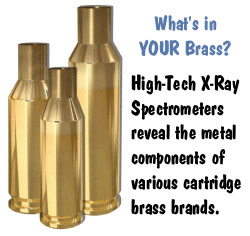 Are there significant metallurgical differences in the alloys used in various brands of cartridge brass? The answer is yes, and we have proof. Using a state-of-the-art X-Ray Fluorescence Spectrometer, some tech-savy Wisconsin shooters recently analyzed the alloys in seven different types of cartridge brass.


 Later this month, GLOCK, Inc. will donate a total of $75,000 to two organizations, the Young Marines and the Marine Corps League. On Wednesday, Sept. 28th, Glock V.P. Josh Dorsey (a former Marine) will present $50,000 to the Young Marines and $25,000 to the Marine Corps League during a presentation held at the Iwo Jima Memorial, Quantico, Virginia.
  Forum member Lee G. (aka ‘SkeetLee’) has built a fully enclosed, 4-season shoot house with loading area. The new shoot house, located on his parents’ farm, will make most readers envious. The quality of the slab and the framing is a far sight better than what you’ll find in many tract houses. SkeetLee has experience in concrete work and construction and he did a beautiful job on his new facility, which combines a large reloading area with two concrete benches facing out to a 200-yard range. The insulated shoot house will be heated in winter, allowing year-round shooting.


 MGM Tactical has been selected as the bullet trap, target and range equipment supplier for the largest indoor shooting range in the country, the planned


