In light of the tragic events in Connecticut, we strongly urge all readers to secure their firearms so they cannot be accessed by juveniles or mentally unstable persons in the household. If you don’t have a gun safe, get one. Don’t procrastinate because of cost factors — here is an affordable option you can get from Walmart. The $597.00 24-gun Cannon Safe is big enough to hold a large collection of arms and heavy enough that it would be difficult to remove — particularly if it is bolted down. Yes, there are better-built safes. But this $597.00 Cannon is a viable option if you can’t afford anything of higher quality. You want a safe that is big and heavy enough that it can’t be easily hauled off with a hand truck. For more information on Gun Safes, read our Gun Safe Buyers’ Guide
The Cannon Safari Series 24-Gun Capacity gun safe comes with a built-in door panel organizer, electronic lock, and a 30-minute fire rating. The interior is fully lined with lint-free fabric and the bottom is pre-drilled for bolting the safe to the floor. The electronic lock allows the owner to change the combination and a 9-volt battery is changed from the outside. Its door is locked with steel-active locking bolts on the left side and door wraps around the inside right side.
30-minute fire protection rating
Internal hinges and expandable smoke seal
Adjustable shelving
Dimensions: 59″H x 26″W x 22″D (depth includes handle and lock)
Model# 5926BLKEDOK
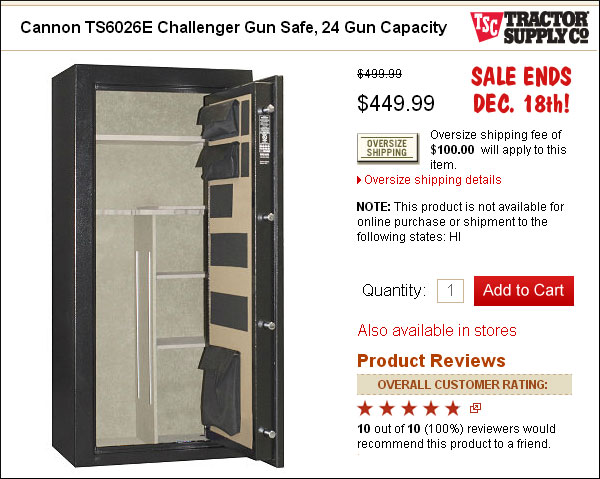
UPDATE: Bulletin Reader Michael found that TractorSupply.com has a similar 60″ x 26″ x 20″ Cannon TS6026E Challenger Gun Safe on sale for just $449.99 through December 18th, 2012. That’s the web price, but if you need delivery you have to add $100.00 for oversized shipping. If you can get to a local Tractor Supply Co. outlet near you and pick the safe up yourself, this may be an amazing deal if the store honors the web price. Don’t dawdle — Sale ends December 18th!
Midsouth Shooters Supply is now taking advance orders for the new Accurate LT-32 Powder, with initial deliveries expected in January 2013. Price for a 1-lb container is $25.12, while an 8-lb jug runs $190.50. Produced by Western Powders, LT-32 is an extruded powder with extremely small kernels (roughly .0275″). This powder is designed to perform like the legendary “T-322″ powders which worked brilliantly in short-range benchrest cartridges, especially the 6mm PPC. Early testers report that Accurate LT-32 meters superbly and is easy to tune. Western claims LT-32 exhibits very low standard deviation. (Photos below by Speedy Gonzalez).
Speedy Says Accurate LT-32 is Very Promising
Benchrest Hall-of-Famer and noted gunsmith Thomas ‘Speedy’ Gonzalez tested the prototype LT-32 powder from Western Powder earlier this year. Speedy stated: “It pains me to say it, but the new LT-32 out-shot my best lots of [the original] IMR 8208 (T-322)”.
Speedy reports: “I must say that I was quite surprised by the results of my initial testing of the new Western Powder LT-32. Shooting this morning over my Oehler 35P triple screen chronograph yielded some very unexpected results. My best lot of ‘T’ powder continues to exhibit its age as it continues to lose velocity (as it ages). While the new Western LT-32 demonstrated this morning velocities equal to what my old ‘T’ powder used to shoot like 30 years ago.
This new powder goes through the measure like a ball powder. (Note: I have always felt that one of the reasons ‘T’ powder shot so well was due to the fact it measured so well as compared to other powders. This is a definite advantage for us that rely on consistent volume instead of weight.) I will have to shoot it over a season to see if it is as temperature and humidity insensitive as ‘T’, but it looks very promising from what I saw today.
It has yet to be seen if the new LT-32 proves to not be affected by temperature and humidity like the old T-322. But from these short tests it very much mimics my T-322 of old. My ‘T’ powder was always a blessing to me in the fact that when I went to a match I did not have the same problems everyone else was having [i.e. having] to tune up and down over the course of a weekend or week. I got to shoot and concentrate on the conditions instead of making it a tuning competition. It was always kind of funny watching everybody going up and down on their powders trying to accommodate the changes in weather as the days went on. Hopefully this will allow all to become better shooters by being able to concentrate on shooting and not re-turning every time one comes back from the bench.”
Statement from Western Powders
The Accurate LT-32 is an exact copy of the original T-32 manufactured in the same plant and on the same machinery as the original. Lou Murdica has been extensively testing it and he tells us it is the easiest powder to tune that he has seen in 40 years.
According to Lou, the chamber that everybody was using in the 80s will work with this powder. The bullets do not need to be seated way out in order to get more powder in the case. In testing the powder in our Bond Universal receiver against the original “T” powder, SDs were about 30% lower with the new powder versus the “T” powder. Lou and Don Nielson donated 16 lbs. of the original T-32 lot of powder for our quality control and that is what the new powder is shot against.
All of our powders are allowed to deviate +3% to -5% in pressure from the quality control lot except LT-32 which we cut the deviation percentages in half in order to have the best lot to lot consistency in the industry for this powder[.] We developed this powder specifically for the 6mm PPC and it is QC’d in the 6mm PPC.
Keith Anderson
Western Powders Ballistic Lab
NOTE: Accurate LT-32 should also be available from PowderValleyInc.com in mid-to-late January 2013. Listed Prices are: $24.10 for 1 pound and $182.00 for 8 pounds.
Believe it or not, the National Shooting Sports Foundation’s 2013 SHOT Show is only a month away. The SHOT Show, to be held January 15-18 in Las Vegas, is the biggest event of the year in the gun industry. There will be thousands of exhibitors in the Sands Expo & Convention Center. If you qualify to attend the show (SHOT Show is not open to the general public), you can register today at SHOTShow.org. While you’re on the SHOT Show website, you can sign up for optional offerings including retailer and law enforcement seminars, the State of the Industry Dinner, SHOT Show University and more (Some of these programs require significant additional costs). While getting reading for SHOT Show 2013, you can access current updates and SHOT Show news through the SHOT Show Blog and the SHOT Show Facebook Page.
Nancy Tompkins has been working on a new Second Edition of her popular book: Prone and Long-Range Rifle Shooting. Nancy just announced that the final proof has been submitted to the printer (at last), and the book should be available in six weeks, i.e. early February, 2013. Nancy posted today: “Mid gave me roses last night after I sent the proof for book to the printer. Yay! After thousands of hours of work… I AM DONE! In six weeks it will be a book.”
The enhanced Second Edition will feature updates to the current chapters, more photos, plus an entirely new chapter on F-Class Shooting. The Second Edition will be issued with a hardback cover, for increased durability. Price isn’t set yet, but Nancy hopes to keep the price “under $40.00″. The book will be available from Sinclair Int’l and direct from Nancy via her website, RifleShootingbyNancy.com.
Author Profile:Nancy Tompkins has been shooting competitively for over 33 years. She has won the National Long Range Championship four times. Nancy was the first woman in history to win the National High Power Championship (a feat accomplished by only two ladies, the other being Nancy’s daughter Sherri Jo Gallagher). Nancy has also been the Wimbledon Cup winner, and a 5-time Leech Cup winner. She has won both team and individual medals in the World Palma Championships, and has been on 6 Palma Teams (as both a shooter and a coach).
FMG Publications has partnered with renowned firearms instructor Clint Smith in a timely video covering the precepts of safe gun-handling. Commonly known as the “Four Gun Safety Rules,” these simple steps act as a safeguard, helping to prevent tragedy.
“I was heartbroken to read about the father who accidentally shot his son in Mercer, PA, earlier this week,” said FMG Publications Director Randy Molde. “If he would have observed just one of the four gun safety rules, his son would still be alive. It’s a sobering reminder that we can never take gun safety for granted. Hopefully our viewers will share this video and, more importantly, remind friends and family of the four gun safety rules.”
Clint Smith, Director of the Thunder Ranch training facility in Oregon, is widely recognized as one of the top shooting instructors in the nation.
The National Bench Rest Shooters Association (NBRSA) now has its own eZine, Precision Rifleman, which covers NBRSA events and provides notices to members. The editors do a good job providing follow-up reports on popular matches with profiles of notable NBRSA members.
Along with match reports, you’ll find a list of upcoming events plus a handy directory of NBRSA-affiliated clubs across the country, complete with full contact information.
While Precision Rifleman is funded in part through NBRSA member dues, you can read the digital version online for free — you do not have to be a paying NBRSA member. (A print version goes out to NBRSA members).
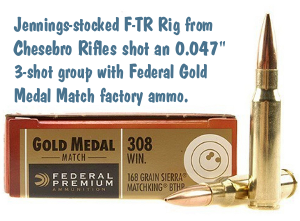
We recently reported on the new Jennings F-TR stock with integrated bipod. When we first saw this rig we thought, “OK, it looks cool, but how does it shoot?” Well, we had a chance to test a .308 Win F-TR rifle built by Chesebro Rifles using the Jennings stock, Barnard action, and 32″ Bartlein barrel. With the gun on the bench, we first shot a few rounds to confirm zero and test for function.
Then gun-builder Mark Chesebro set the rifle on the shooting mat, opened up a box of Federal 168gr Gold Medal Match (GMM) .308 Win ammo, and got down to business — from the ground. What happened next can only be described as “shock and awe”. Mark nailed three successive groups that left us shaking our heads in amazement. The Jennings stock works. Does it ever. This gun hammers.
All groups were shot from the ground, bipod-supported, with Federal factory GMM ammo.
Mark’s first three-shot group had two shots in one hole, then the third leaked a bit high for a 0.184″ group. Then Mark dialed down 2 MOA elevation, and drilled an astonishing 3-shot .047″ group. (For reference, the black diamond in the orange paster is 1/4″ from point to point.)
I was watching through a Swarovski spotting scope and I saw all three shots track into one hole that just got a little whiter in the middle with each successive round. I yelled out “Stop shooting!” because I wanted to measure the group. It was an easy mid-zero — and honestly it looked like just one bullet hole from a pistol. That is amazing with factory .308 Win ammo, particularly in a barrel throated for 185s, not the 168gr SMKs Federal uses in its Gold Medal Match .308 ammunition.
After measuring Mark’s 3-shot bughole, we walked back to the firing line and Mark shot a full 5-shot group. This would have been a two-flat, but he flinched a bit and his third shot went a little high to open the group to a 0.233″. Still darn impressive with factory ammo…
Editor’s Comment: This Gun is Ultra-Stable and Tracks Straight Back
I had a chance to shoot the gun from the ground. I can tell you this — the stock design really works. With the wide-track bipod, the gun is incredibly stable. As you’re aiming there is virtually zero horizontal movement in the crosshairs. All you need to do is squeeze the ears to set your vertical Point of Aim and pull the trigger. This thing is one of the easiest guns to shoot accurately (from the ground) that I’ve ever tried. You don’t have to struggle for stability at all — the gun wants to stay dead calm.
With the large, cylindrical Delrin feet placed on a mat, the gun tracks straight back. And there is no hop, no bounce, no roll. In fact, the gun tracked so well that I could see my bullets impact on the paper target. That’s surprising for a .308 Win with no muzzle brake. After a shot I could slide the gun forward and the crosshairs were right where they should be — the only thing I had to do is squeeze the ears to re-set my vertical. All I can tell you is the thing is very easy to shoot well.
I don’t know whether it is because of the forward-angle geometry of the legs, or the Delrin feet, or the properties of the carbon fiber tube that supports the front end, but the gun seems to have more damping than other metal-chassis stocks I’ve tried. Some metal-stocked guns seem to “ring” and transmit a sharp pulse to the shooter. This Jennings stock doesn’t do that — it seems to soak up vibration somehow. And the recoil is very mild, I think because the Delrin feet slow the gun down as they slide back smoothly.
Bottom Line:We came away very, very impressed with this rifle and the Jennings stock. I have never experienced a bipod-equipped rifle (in any caliber) that is easier to aim and hold steady, or which is easier to return to precise point of aim after each shot. And, without question, this is one of the most accurate .308 Win rifles we have ever shot from the ground. And that was with factory ammo, not tuned handloads!
Making a Great Design Even Better
Could the rifle be improved? Yes. While there is some rear elevation adjustment (via an eccentric bag-rider that rotates) we would like to see more rear-end elevation adjustment, so the gun could better adapt to uphill and downhill target placements. Also we’d like to see a higher mounting point for the bag-rider so you could use a taller, beefier rear bag. We discussed these points with Mark Chesebro, and he’s agreed to start prototyping some upgrades. This may include a thumbwheel-adjustable bag-rider (sort of like an upside-down adjustable cheekpiece). At our suggestion, the vertically adjustable bag-rider may be offered in two versions — straight and angled. With an angled bag-rider (i.e. with a slight amount of drop front to rear), you could adjust your vertical point of aim by sliding the gun forward or aft in the rear bag.
We will supplement this test report with more photos and video in a few days. We know you want to see how well it tracks. The video tells the story better than words can…
Most of us assume that if we weigh our powder carefully (down to the tenth of a grain or less) we can achieve a uniform powder fill from case to case in our handloads. Weighing does ensure that the weight of the propellant in each case is the same, but is the column of powder the same by volume each time? “Not necessarily” is the answer. An interesting experiment by our friend Boyd Allen demonstrates that the manner in which you place kernels in the case can make a significant difference in the height of the powder column within the brass case.
Using a Gempro 250 scale, Boyd measured exactly 30.6 grains of Vihtavuori N-133 powder. He then inserted this powder in the same cartridge case multiple times. (The case has a fired primer in place.) But here is the key — Boyd used various filling techniques. He did a slow fill, and a fast fill, and he also experimented with tapping and drop tubes. What Boyd discovered was that you can start with the exact same weight of powder (in fact the very same set of kernels), yet end up with vary different fill heights, depending on how you drop the kernels into the case. Look at the photos. Despite variations in lighting, the photos show the same 30.6 grains of powder, placed in the same cartridge, with four different methods.
Boyd Explains the Procedure Used for his Experiment.
EDITOR’s NOTE: So there is no misunderstanding, Boyd started with a weighed 30.6 grain charge. This identical charge was used for ALL four fills. After a fill the powder was dumped from the case into a pan which was then used for the next fill technique to be tried. So, the powder weight was constant. Indeed the exact same kernels (of constant weight and number) were used for each fill.
Boyd writes: “I used the same powder for all fills, 30.6 gr. on a GemPro 250 checked more than once. All fills employed the same RCBS green transparent plastic funnel. The fast drop with the funnel only overflowed when it was removed from the case neck, and 15 granules of powder fell on the white paper that the case was sitting on. The fast-funnel-only drop with tapping, was done with the funnel in place and the case and funnel in one hand, while tapping the case body with the index finger hard, many times (about 20 fast double taps). My idea here was to “max out” the potential of this tapping technique.
The slow drop with the funnel and 10″-long .22 cal. Harrell’s Precision drop tube, was done by holding the scale pan over the funnel and tapping the spout of the pan repeatedly on the inside of the funnel about 1/3 down from the top, with the scale pan tilted just enough so that the powder will just flow. Many taps were involved, again, to max out the technique.
Again, to be clear, after each case filling, the powder was poured from the case back into the scale pan carefully. You may notice the similarity between the fast drop with the drop tube, and the funnel only with tapping. Although I did not photograph it, fast tube drop and tapping (combined) improved on tapping alone, but only to about half as far down the neck as the slow with drop tube. Due to the endless possible permutations, I picked four and left it at that.
I believe that I can make the rough judgment that the scale pan funnel and drop tube technique, which involved a longer drop period, and probably less velocity at the top of the tube, left more room in the top of the case neck than the slow drop from the measure with the same drop tube. You have both pictures, so you can make the comparison.” — Boyd
Does Powder Column Height Variance Make a Difference?
Boyd’s experiment proves pretty conclusively that the method of dropping a given weight of powder can affect the height of the powder column in the case and the degree of powder compression (when a bullet is seated). He showed this to be true even when the exact same set of kernels (of constant weight) was used in repetitive loadings. This raises some interesting questions:
1. Will subsequent cartridge transport and handling cause the powder to settle so the variances in powder column height are diminished?
2. If significant inconsistencies in powder column height remain at time of firing, will the difference in fill level hurt accuracy, or result in a higher extreme spread in velocity?
3. Is there any advantage (beyond increased effective case capacity) for a tight (low level) fill vs. a loose (high level) fill?
We don’t know the answer to these follow up questions. This Editor guesses that, if we tested low-fill-height rounds vs. high-fill-height rounds (all with same true fill quantity by weight), we might see meaningful differences in average velocity. I would also guess that if you fired 10 rounds that exhibited quite a difference in powder column heights, you might see a higher ES/SD than if you shot 10 rounds loaded with a very consistent powder column height (either high or low). But further testing is needed to determine if these predictions are true.
Here’s a cool new item for the avid shooters on your Xmas gift list. For this holiday season, Creedmoor Sports has created special package-wrapping paper with target graphics. The unique, heavy-weight gift wrap features Dennis DeMille’s High Power Rifle National Record Target score of 200-20x+100-8x at 200 yards. The 36″ x 24″ sheets are made from 60# stock with a gloss finish. Individual wrapping sheets cost $1.95 or you can buy five sheets for $7.95. This special wrapping paper with bullseye graphics is perfect for gifts to the shooters in your family, or for gifts a club may present to members at year’s end.
Famed exhibition shooter Bob Munden passed away December 10th, from a heart attack. Bob was 70 years old. Munden’s friends at Hodgdon Powder stated: “Bob was a legend, a showman and a gentleman above all else.” Born February 8, 1942 in Kansas City, MO, Bob began his professional shooting career at age 11 in California. While still in high school, Bob placed second in the noted LeatherSlap competition, and that launched his fabled career as a fast-draw specialist and trick shooter.
Over his long career, Munden traveled around the globe giving shooting exhibitions. Munden was famous both as a speed-draw specialist and a trick shooter with all types of firearms. He was recognized as “The Fastest Man with a Gun Who Ever Lived” in the Guinness Book of World Records. As a star of Shooting USA’s “Impossible Shots” TV show, Munden provided amazing demonstrations of shooting skills for a national television audience — such as splitting a playing card tossed in the air. Many of Munden’s famous trick shots were “first-ever” challenges, tricks that no other marksman had ever done before.
Over the years Bob, often with his wife Becky (who is also a skilled shooter), appeared on many television shows, most famously American Shooter, Ripley’s Believe it or Not, Stan Lee’s Superhumans, Shooting USA, and Shooting USA’s Impossible Shots. Munden is featured in DVDs including Bob Munden: Outrageous Shooting and Bob Munden: The Collector’s Edition.
Registered as members #118 and #119 respectively, Bob and Becky entertained at the Single Action Shooting Society (SASS) End of Trail World Championships of Cowboy Action Shooting 30 times with what Becky proudly said was the most complex presentation ever offered at an exhibition shooting show. She added that Bob was Cowboy Action Shooting’s first gunsmith. After her beloved Bob passed away this week, Becky said: “We had an incredible, memorable life together.”





 According to Lou, the chamber that everybody was using in the 80s will work with this powder. The bullets do not need to be seated way out in order to get more powder in the case. In testing the powder in our Bond Universal receiver against the original “T” powder, SDs were about 30% lower with the new powder versus the “T” powder. Lou and Don Nielson donated 16 lbs. of the original T-32 lot of powder for our quality control and that is what the new powder is shot against.
 Believe it or not, the National Shooting Sports Foundation’s 2013 SHOT Show is only a month away. The SHOT Show, to be held January 15-18 in Las Vegas, is the biggest event of the year in the gun industry. There will be thousands of exhibitors in the Sands Expo & Convention Center. If you qualify to attend the show (SHOT Show is not open to the general public), you can register today at
  Nancy Tompkins has been working on a new Second Edition of her popular book: Prone and Long-Range Rifle Shooting. Nancy just announced that the final proof has been submitted to the printer (at last), and the book should be available in six weeks, i.e. early February, 2013. Nancy posted today: “Mid gave me roses last night after I sent the proof for book to the printer. Yay! After thousands of hours of work… I AM DONE! In six weeks it will be a book.”
 FMG Publications has partnered with renowned firearms instructor Clint Smith in a timely video covering the precepts of safe gun-handling. Commonly known as the “Four Gun Safety Rules,” these simple steps act as a safeguard, helping to prevent tragedy.
 The National Bench Rest Shooters Association (NBRSA) now has its own eZine,


 Mark’s first three-shot group had two shots in one hole, then the third leaked a bit high for a 0.184″ group. Then Mark dialed down 2 MOA elevation, and drilled an astonishing 3-shot .047″ group. (For reference, the black diamond in the orange paster is 1/4″ from point to point.)

 I don’t know whether it is because of the forward-angle geometry of the legs, or the Delrin feet, or the properties of the carbon fiber tube that supports the front end, but the gun seems to have more damping than other metal-chassis stocks I’ve tried. Some metal-stocked guns seem to “ring” and transmit a sharp pulse to the shooter. This Jennings stock doesn’t do that — it seems to soak up vibration somehow. And the recoil is very mild, I think because the Delrin feet slow the gun down as they slide back smoothly.


 Famed exhibition shooter


