|
|
July 26th, 2013
 A $10 million-dollar CDC report ordered by President Obama determined that victims of crime who were armed with a firearm suffered fewer injuries than crime victims who were un-armed. A $10 million-dollar CDC report ordered by President Obama determined that victims of crime who were armed with a firearm suffered fewer injuries than crime victims who were un-armed.
Well, at least the CDC came up with the right answer, but we’re flabbergasted at the cost of this study. Dustin Ellermann, past Top Shot Champion, comments: “$10,000,000 to discover the obvious… [at least] maybe now the anti-gunners will stop yelling ‘If you have a gun it will most likely be used against you!'”
According to Texas Fish & Game Blog, the CDC Report, entitled Priorities For Research to Reduce the Threat of Firearm-Related Violence, reveals that “studies that directly assessed the effect of actual defensive uses of guns (i.e., incidents in which a gun was ‘used’ by the crime victim in the sense of attacking or threatening an offender) have found consistently lower injury rates among gun-using crime victims compared with victims who used other self-protective strategies.”
Here are some comments on a related NewsMax.com story about the CDC report:
I am glad that an official Obama research project shows the same thing that Professor Gary Kleck found in his research about 20 years ago. Professor Kleck found that an honest citizen that had a gun saved himself from death more than 1 million times a year and often did not have to fire a shot. Usually when the crook saw that the citizen was armed that was the end of it.
Why does our government have to spend millions of dollars to do a study to find out what everyone else on earth in the history of man has already known?
July 26th, 2013
 Kestrel 4500 Shooter’s Weather Meters with integrated Applied Ballistics software are finally shipping. Bryan Litz, founder of Applied Ballistics LLC, reports: “Long range shooting just got a little easier. We are pleased to announce that the Applied Ballistics Kestrels have arrived! They are now available for immediate shipment. Pre-orders will ship today.” To order, follow this link for the Applied Ballistics Store. Kestrel 4500 Shooter’s Weather Meters with integrated Applied Ballistics software are finally shipping. Bryan Litz, founder of Applied Ballistics LLC, reports: “Long range shooting just got a little easier. We are pleased to announce that the Applied Ballistics Kestrels have arrived! They are now available for immediate shipment. Pre-orders will ship today.” To order, follow this link for the Applied Ballistics Store.
These Kestrel 4500 Shooter’s Weather Meters include a full-featured ballistics solver and databases of bullets so you can accurately plot trajectories. The Applied Ballistics software accesses the environmental data (wind speed, humidity, altitude etc.) recorded by the Kestrel to provide a more precise trajectory.

Features of Kestrel 4500 with Applied Ballistics Software
With integrated Applied Ballistics software, Kestrel users are now able to select from either G1 or G7 ballistic coefficients (BC) when calculating a trajectory. The new Kestrel 4500 Shooter’s Weather Meter also offers the very extensive “Litz”-measured BC library of over 225 bullets. In addition to these features, users can “train” the software to match a specific rifle based on observed impacts at long range with the ballistics calibration feature. With more accurate BC data, shooters are empowered to make more precise trajectory calculations. The new Kestrel Shooter’s Weather Meter can also receive data from wind sensor arrays designed and sold by Applied Ballistics. Like all Kestrels, the Shooter’s Weather Meter is IP67 waterproof and ruggedized to MIL-STD-810F standards.
Every Kestrel meter is pocket-sized, rugged, accurate, waterproof, easy-to-use, and backed by an industry-leading, five-year warranty.
July 26th, 2013
Sig Sauer team captain Max Michel reclaimed his title as the world’s fastest speed shooter with a pair of titles and a new world record at the World Speed Shooting Championships, held in Frostproof, Florida last week. Heavy rains and winds added an additional level of difficulty to the match, which attracts the world’s best steel challenge competitors.

Max Sets Rimfire World Record
Michel began the weekend with a world-record setting time, winning the rimfire pistol event by almost two seconds with his 61.84 second time. Michel paired a SIG SAUER 1911 MAX lower with a .22 LR conversion upper to take the title. A long-time supporter of Steel Challenge shooting, SIG SAUER returned as a platinum sponsor of the event.
Max Wins Main Event by 7.5 Seconds
Michel’s 75.58 total time brought home the main match title with a commanding 7.5 second lead over the runner-up finisher. This is Michel’s fourth World Speed Shooting Championship, which places him in a tie for the most titles at the event.
“We could not be more proud of Max and his accomplishments,” said Jarrod McDevitt, Rifle Product and Competitive Shooting Program Manager. “From the West Coast Steel Challenge to the Pro-Am to the World Speed Shooting Championship, Max has been unstoppable.”
Watch Max Michel Demo Drill (This Guy is Blazing Fast!)
At age 30, Max Michel is a legend within the world of competitive shooting. A four-time World Speed Shooting Champion, six-time USPSA National Champion, and three-time US National Steel Champion, Max is a dominant force in pistol shooting sports. Born and raised in New Orleans, Louisiana, Max began shooting when he was just 5 years old. In 1999 Max joined the USAMU’s Action Pistol Team and served in the U.S. Army for 10 years as an Army shooter and trainer. Today, Max is recognized worldwide as a top-tier athlete and instructor.
Follow Max Michel, Jr., on Facebook at http://www.facebook.com/maxmichel.us.
Follow SIG SAUER on Facebook at http://www.facebook.com/SigSauerInc.
July 25th, 2013
Story based on report by Lars Dalseide for NRABlog.
This week prone shooters are competing at the NRA National Smallbore Rifle Championships at Camp Perry. First on the agenda was the Metallic Sights Match. Shot at distances of up to 100 yards, the Metallic Championship is the aggregate of six separate matches fired over a two-day period. Courses of fire include a Dewar course (20 shots at 50 yards and 20 shots at 100 yards), 40 shots at 50 meters, and 400 shots at 100 yards.
NRABlog Archive Photo of Reya Kempley in an “Any Sights” Prone Match at Camp Perry.

Coming out on top, with a score of 2400-202X (‘X’ stands for bullseyes) was New York’s Reya Kempley. This talented young lady beat all the men, including top marksmen from the USAMU. Congrats to Reya for an outstanding performance. Here are the top five smallbore metallic sights competitors:
|
NRA Smallbore Prone Rifle
Metallic Sights
|
| Place |
Name |
Score |
| 1 |
Reya Kempley |
2400-202x |
| 2 |
Eric Uptagrafft |
2399-194x |
| 3 |
Michael Seery |
2399-187x |
| 4 |
Michael Mcphail |
2399-186x |
| 5 |
Joseph Hein |
2398-193x |
Smallbore 3P Photo Gallery
Earlier this week the Smallbore Three-Position Matches were held at Camp Perry. Here are 3P “any sights” and metallic sights event photos from the GOnraMedia Archive:


July 24th, 2013
Story based on report by Lars Dalseide for NRABlog
Fifteen members of the Great Britain Rifle Team descended upon the Viale Range at Camp Perry this week in preparation for the John J. Pershing Trophy Match. Sporting red team shirts and a touch of British swagger, they’re lead by by a man known as Jon Leech. A veteran of the sport, Leech is there to share his decades of experience to this new group of hopefuls. “They’re not juniors, though some have taken a while to mature,” he said with a laugh. “But they’re bringing with them a lot of experience.”

History of Pershing Trophy Match
The Pershing Trophy Match takes place every four years. Every time it is shot, the location alternates from the United States to Great Britain. When shot in Great Britain, it is known as the Field Marshal Earl Roberts Trophy Match. With ten shooters per team, competitors take to the line and fire 20 shots at 50 yards and 20 shots at 100. The first match, shot in 1931, was won by the Brits. Since then the Americans have dominated the event, winning 13 times overall compared to four times for the British.
Led by Leech, along with captain Neil Gibbons, the Brits have assembled a strong team this year. “This team was put together specifically for this match,” explained Leech. “This is my fourth time at Camp Perry. First in 1979 to shoot smallbore. I’ve come here just to coach this year. Pass on some knowledge to the folk who came over. We have 15 people in total — 3 officials and 12 shooters – that we’ll get that down to 10 shooters so we can beat America.”
Marksmanship Training in the Basement of Lloyds of London
A broker at the famed insurance house Lloyds of London, Leech brings a colorful background to the smallbore shooting world. A fencer at first, it was a fluky bit of chance — and a little of the Lloyd’s magic — that introduced him to the world of rifles.
“I was at Lloyds and noticed a guy sitting next to me with a collection of targets. I asked ‘Where did you do that?’ to which he replied ‘In the range underneath our building’. I didn’t even know there was such a range. I started shooting there in 1972 and kept at it.”
Spending his youth shooting in tournaments throughout Europe, he now finds himself behind the shooter rather than behind the trigger … at least when it comes to international competitions. And, as an official with the International Shooting Sports Federation (ISSF), his passport includes stamps from Bangkok, Rio de Janeiro, Copenhagen, and Croatia. “We really do enjoy our shooting together,” commented Leech. “Traveling as a shooter, I’ve met some fabulous people which is a lot of what shooting is all about. This is Band of Brothers stuff.”
July 24th, 2013
Birchwood Casey’s new splattering Pregame™ Targets offer shooters three new games for shooting alone or for some friendly competition with other shooters. New technology now creates reactive zones within each target, making it easy to see scoring hits. Shots inside the reactive zones show a white halo. Shots outside of the main aiming points display without a halo effect.
The new Pregame Targets include the Trick Shot™ pool game, Star Burst™ (three rows of red, green and blue stars), and the Checkered Flag™ race game. Shooters can make up their own rules and shoot against a competitor or time themselves and shoot against the clock. Watch the Video to see how the new targets’ reactive zones function. The 12″ x 18″ (30cm x 45cm) targets offer dozens of different possibilities. Pregame Targets come in packs of eight and sell for $12.60. For more information visit www.birchwoodcasey.com.
Watch Video to See How New Reactive Zone Splatter Targets Work:
July 23rd, 2013
 On the Applied Ballistics Facebook page, Ballistician Bryan Litz regularly offers a “Tuesday Trivia” question about ballistics. Today’s brain-teaser is a true/false question about bullet stabilization. On shooting forums you often find heated arguments about “over-stabilization”. Bryan wants readers to consider the issue of over-stabilization and answer a challenge question… On the Applied Ballistics Facebook page, Ballistician Bryan Litz regularly offers a “Tuesday Trivia” question about ballistics. Today’s brain-teaser is a true/false question about bullet stabilization. On shooting forums you often find heated arguments about “over-stabilization”. Bryan wants readers to consider the issue of over-stabilization and answer a challenge question…
Is This Statement TRUE or FALSE?
“The problem with ‘over-stabilizing’ a bullet (by shooting it from an excessively fast twist rate) is that the bullet will fly ‘nose high’ on a long range shot. The nose-high orientation induces extra drag and reduces the effective BC of the bullet.”
True or False, and WHY?
Click the “Post Comment” link below to post your reply (and explain your reasoning).
Bullet Movement in Flight — More Complicated Than You May Think
Bullets do not follow a laser beam-like, perfectly straight line to the target, nor does the nose of the bullet always point exactly at the point of aim. Multiple forces are in effect that may cause the bullet to yaw (rotate side to side around its axis), tilt nose-up (pitch), or precess (like a spinning top) in flight. These effects (in exaggerated form) are shown below:

Yaw refers to movement of the nose of the bullet away from the line of flight. Precession is a change in the orientation of the rotational axis of a rotating body. It can be defined as a change in direction of the rotation axis in which the second Euler angle (nutation) is constant. In physics, there are two types of precession: torque-free and torque-induced. Nutation refers to small circular movement at the bullet tip.
Diagram from the University of Utah Health Sciences Library Firearm Ballistics Tutorial
July 23rd, 2013
The popular vertical-loading Airglide rifle case from Plano is on sale again. You may want to strike while the price is right. Amazon.com is offering the Plano Airglide for $42.95 with FREE shipping. Free shipping is important as transport fees add $10-15 to the price with many vendors. CLICK HERE to order from Amazon with FREE shipping.
Among injection-molded rifle cases, Plano’s AirGlide™ case is unique in holding a rifle vertically, in foam cradles. This allows ample room for the 3″-wide fore-ends on BR and Varmint rifles. The foam blocks front and rear can even be trimmed for a custom fit, and velcro webbing straps hold the rifle securely.
 |
|
Airglide Will Hold a Benchrest Rifle with Wide Fore-end and 28″ Barrel
Measuring 51 1/2″L x 7 3/4″W x 12 1/4″H, the AirGlide can easily handle rifles up to 50″ in length. That should hold BR rifles with barrels up to 28.5″ (or 28″ if you have a thick recoil pad). With its 27.5″ barrel, my 6BR is exactly 49″ long (including pad) and there is about 1.3 inches to spare in an Airglide. My 6BRDX (in a Tracker ST-1000 stock with a thin metal buttplate) has a 29″ barrel and it fits. If you have a real long barrel or extended buttpad, measure the gun first. The AirGlide has proven very popular with Varmint shooters and BR competitors. Lockable and airline-approved, the AirGlide is a unique product at an affordable price. This Editor owns three Airglides and they are my favorite cases for transporting wide-stocked rifles to the range. (For airline transport, I do prefer a heavy-duty, wheeled aluminum safari case with recessed locks.)
July 23rd, 2013
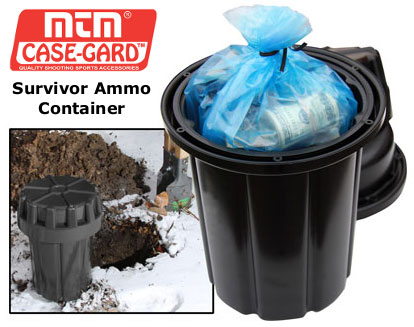 In-Ground Storage In-Ground Storage
With the price of ammo at all-time highs, folks are looking for ways they can stash ammo reserves securely, without using up precious space in their gunsafes. Additionally, there are important reasons why a locked, steel-walled gunsafe is not recommended for long-term ammo storage (see local fire regulations on the subject of ammo storage). MTM CaseGard now offers a heavy-duty, drum-style PVC container for underground storage of ammunition or other important items.
MTM’s Survivor Ammo Container features a rugged, bucket-style body with a double-O-Ring sealed lid and protective outer cap. The inner lid is held down with multiple screws to provide a secure seal. Then the larger “mushroom head” top fits in place over the whole assembly. Each container includes a heavy-duty Vapor Corrosion Inhibitor (VCI) plastic bag plus a moisture-absorbing desiccant pack. The 13.5″ x 10″ drum costs $22.10 at Midsouth Shooter’s Supply. That’s less than the cost of a box of bullets these days. Internal capacity is equivalent to a .50-Cal metal ammo can. The MTM Survivor will hold up to 600 rounds of .45 ACP or 223 ammo. It can also hold about 15-20 AR-15 magazines.
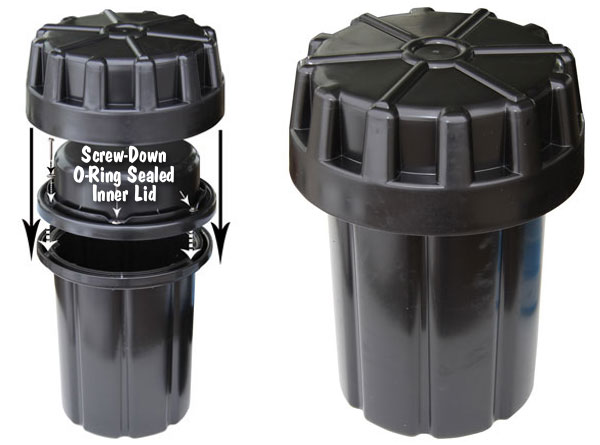
Outside Dimensions: 13.5″ (H) x 10″ (D) | Inside Dimensions: 12.4″ (D) x 7″ (H)
This is a convenient way to hide ammunition, bullets, copies of important documents, emergency money, coins and other small items. Just make sure of two things. First, remember exactly where you buried your Survivor container. You may want to include a small notation on a site plot that you place in a safe-deposit box or give to trusted family members. Second, don’t just dig a hole, drop the unit in the ground and shovel some fresh dirt over the top. Restore a “natural look” to the vegetation or ground cover over the hole. Otherwise your prominent round dirt pile may attract unwanted attention.
July 22nd, 2013
 There was an excellent article about Mirage on the South Texas Marksmanship Training Center (STMTC) website. This article explains what causes mirage and how mirage can move the perceived aiming point on your target. Most importantly, the article explains, in considerable detail, how you can “read” mirage to discern wind speeds and wind directions. With simple but effective graphic illustrations, this is one of the best explanations of mirage (and mirage reading) we have found on the internet. This is a “must-read” for any serious competitive shooter. Here is a brief sample from the article, along with an illustration. NOTE: the full article is six times longer and has 8 diagrams. There was an excellent article about Mirage on the South Texas Marksmanship Training Center (STMTC) website. This article explains what causes mirage and how mirage can move the perceived aiming point on your target. Most importantly, the article explains, in considerable detail, how you can “read” mirage to discern wind speeds and wind directions. With simple but effective graphic illustrations, this is one of the best explanations of mirage (and mirage reading) we have found on the internet. This is a “must-read” for any serious competitive shooter. Here is a brief sample from the article, along with an illustration. NOTE: the full article is six times longer and has 8 diagrams.
The term “mirage” as used by the shooter does not refer to a true mirage, but to heat waves and the refraction of light as it is bent passing through air layers of different density. Light which passes obliquely from one wind medium to another it undergoes an abrupt change in direction, whenever its velocity in the second medium is different from the velocity in the first wind medium; the shooter will see a “mirage”.
The density of air, and therefore its refraction, varies with its temperature. A condition of cool air overlaying warm air next to the ground is the cause of heat waves or “mirage”. The warm air, having a lower index of refraction, is mixed with the cooler air above by convection, irregularly bending the light transmitting the target image to the shooter’s eye. Figure 1 shows (greatly exaggerated) the vertical displacement of the target image by heat waves.
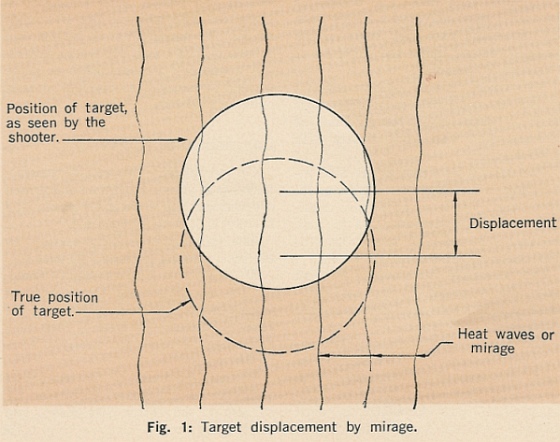
Heat waves are easily seen with the unaided eye on a hot, bright day and can be seen with spotting scope on all but the coldest days. To observe heat waves, the scope should be focused on a point about midway to the target. This will cause the target to appear slightly out of focus, but since the high power rifle shooter generally does not try to spot bullet holes, the lack in target clarity is more than compensated by clarity of the heat waves.
CLICK HERE to Read Complete Mirage Article
Mirage Is Your Friend
While hot days with lots of mirage can be frustrating, mirage can reveal how the wind is flowing (and changing). If you learn how to recognize and read mirage patterns, you can use that information to shoot higher scores. That’s why many leading long-range shooters tell us: “Mirage is your friend.” As the STMTC article explains: “A mirage condition is not a handicap, since it offers a very accurate method of perceiving small wind changes[.]”
Story tip from Boyd Allen. We welcome reader submissions.
|