Report based on story by Kyle Jillson forNRABlog
Late last night at Camp Perry, Ohio’s Hough Theater, Brian ‘Gunny’ Zins stepped atop the podium and raised the coveted Harrison Trophy above his head to the cheers of the crowd. He had just won his 12th NRA National Pistol Championship, twice as many as any other shooter in National Match history.
Photo by GOnraMedia
At the dawn of the championship’s second day it looked like Zins might have to wait a year to reach the even dozen. During the first day’s matches he had made the mistake of only firing four shots in a five shot string. And, exactly ten points behind the then-leader, he was kicking himself. “Having a saved round in the .22 Caliber Championship was a rookie mistake that will hopefully never happen again — knock on wood,” Zins laughed.
He’s able to laugh about it now because of his brilliant comeback. During the championship’s last two days Zins became a man possessed. Firing an 880 out of 900 and 885 out of 900 in the national championships’ two final events, Centerfire Pistol and .45 Caliber Pistol, he not only stormed back but finished with a 16-point lead. “But being able to pull it together, keep my head in the game and come back to win Centerfire and .45 was just huge for me,” Zins explained. “At age 44 I have twice as many national championships as anybody else and I’m not done yet. I think I have a few more left in me.”
If history is any indication, it’s certainly possible. But it’s no guarantee. Camp Perry attracts the country’s top shooters and Zins’ titles aren’t all consecutive. Since his first championship in 1996, competitors other than Zins received gold in 1997, 1999, 2000, 2006, 2009 and 2011.
Zins Shoots a Cabot Guns .45 ACP Pistol
“Something people might not know is the gun I shot for the Centerfire and .45 championships was a straight, out of the box, Cabot production gun,” Zins said. “There was no fitting in the barrel, no bushing, the only thing we did was a trigger job. Everything Cabot Guns builds is that quality and now they’ve got a bullseye edition of their guns that can win national championships.” With a little practice, of course. [Editor: Cabot 1911s are no ordinary “production guns”. The lowest priced Cabot, the GI/Classic, costs $4750.00]
Cabot Guns Video from 2012 National Pistol Championships (Zins won in 2012 also)
You’ve probably heard of the 6.5 Creedmoor, an excellent round for High Power and tactical applications. Well there’s a 6mm (.243) version of this cartridge — the 6mm Creedmoor. It has the same external dimensions (other than neck diameter) as the 6.5 version, but it lets you shoot the High-BC 6mm bullets at higher velocities. With a long barrel, you can push 105gr bullets an honest 3070-3100 fps with this cartridge. The 6mm Creedmoor has a large primer pocket and large flash hole (unlike Lapua’s 6.5×47 which has a small primer pocket, and small flash hole — like the 6mmBR).
6mm Creedmoor Brass
If you’re interested in the 6mm Creedmoor, Hornady-brand brass is available right now at reasonable prices. Yesterday, GA Precision received 110,000 pieces of 6mm Creedmoor brass. Prices are:
That works out to sixty-two cents per unit if you buy 1000 cases. CLICK HERE to Order.
We have not tested the 6mm Creedmoor cartridge yet, but we know some shooters have had good luck with it. In design, the 6mm Creedmoor is quite similar to the 6XC, which is a proven High Power cartridge that has won many championships. If you want a mid-size 6mm cartridge, with brass that doesn’t cost $1.00 per case, the 6mm Creedmoor may be an option to consider. GA Precision says this about the cartridge: “The 6mm Creedmoor is an ideal cartridge for large-platform, semi-auto rifle for shooters who wish to utilize the long, high-BC modern 6mm projectiles. Compared to the .243 Winchester, the 6mm Creedmoor case is just under .130 of an inch shorter, perfect for the confines of a short-OAL AR-style magazine. This is an ideal cartridge for competitive shooters — charges easily reach 3050-3100 FPS while coming closer to the 100% volume capacity for powder charge, often resulting in lower standard deviations recorded.”
When developing loads, it is important to know the true internal capacity of your cases, both fired and “as FL-sized”. In particular, when using the QuickLOAD program, it is vital to determine true case capacity. The default case capacity values listed by QuickLOAD may be off half a grain (or more) because brass from different manufacturers can vary considerably in capacity. Case capacity is a very important variable that will affect the pressure of a load and the velocity of your bullets.
To determine the true internal capacity of your cases, first weigh an empty cartridge case, then fill the case with water (all the way to the top of the neck) and weigh the case again. The difference in weight is your H20 capacity in grains. But how do you keep the H20 from flowing out the bottom? When measuring fired, unsized cases, you can simply leave the spent primer in the pocket. However, if you want to measure new brass or “as-FL sized” cases that have been deprimed, you’d have to insert a spent primer to “stem the tide”. Until now that is… 21st Century Shooting has come up with a simple tool that plugs the bottom of the case so you can measure H20 capacity with ease.
When we saw 21st Century’s Primer Pocket Plug we thought “That’s smart — why didn’t someone think about that a long time ago?”. This handy “end-cap” lets you quickly measure multiple new brass cases or deprimed FL-sized cases so you can get an average H20 capacity. The primer pocket plugs are NOT case-specific (they feature an O-ring that fits the pocket). One version will work with all small-primer-pocket cases, while another works with all large-primer-pocket cartridge types. Price is $19.95 for either small-pocket or large-pocket version.
NOTE: If you want to measure H20 capacity on fired, sized brass, but don’t want to shell out the money for the tool (or re-insert a spent primer), here’s a simple suggestion. When you size your case, first remove the decapping rod from the die. Then you can FL-size the case without removing the primer. Of course, you will eventually have to knock the primer out, and that requires putting the decapping rod back in the die and running the case through a second time. To avoid that hassle, the Primer Pocket Plug may be worth the $19.95 over the long haul. We just ordered one of each (small and large).
Product Find by EdLongrange. We welcome reader submissions.
Story based on report by Kyle Jillson forNRABlog
NRA Competitive Shooting’s big event of the year, the National Matches, has commenced. The Remington/NRA National Rifle and Pistol Matches are considered the World Series of the shooting sports. Here you will find the nation’s top pistol, smallbore and high power rifle shooters (and many elite shooters from overseas as well). The six NRA championships, Pistol, Smallbore Position, Smallbore Prone, High Power Rifle, High Power Rifle Mid-Range, and High Power Rifle Long Range are broken up into five legs with High Power and Midrange held simultaneously.
This week’s Pistol Championship sees competitors jockeying for the coveted Harrison Trophy, the aggregate of a Preliminary Pistol Championship, .22 Caliber, Centerfire, and .45 Caliber championships. The all-time winningest shooter of the National Pistol Championship, with 11 titles, is Brian “Gunny” Zins, a featured contestant on the History Channel’s Top Shot All-Stars TV show.
Thunderstorm Halts Preliminary Pistol Event
With the Preliminary Pistol Championship (PPC) cancelled due to a tremendous thunderstorm, the national championship’s standings (thus far) are based on the .22 Caliber Championship completed on July 11th. Leading the way at this stage in the Pistol Championships is Chad Ranton with a 879-42X. There’s still plenty of shooting left to do as Friday (July 12) ushers in the Centerfire Championship and Saturday (July 13) brings the .45 Caliber Championship.
If you’re wondering what is happening when at the NRA National Rifle and Pistol championships, here is a calendar of all the scheduled events. The pistol matches kicked off earlier this week. Smallbore (rimfire) events start July 16th, while the High Power events commence on July 26th. Click the calendar image below to see a large size version (that’s easier to read). You can also download a PDF file with the complete National Matches Event schedule for 2013 AND 2014.
If you missed Top Shot All-Stars last night on the History Channel, don’t fret — you can watch the latest full episode online HERE. This week competitors faced the ultimate long-range challenge — shooting a 40″ exploding target at ONE MILE — the longest distance ever attempted on Top Shot. The rifle was a Barrett MRAD chambered for the .338 Lapua Magnum. Whoever hit the target the quickest (and with the least number of shots) won a prize (an Oculus rifle scope). The top seven shooters were “safe” from the elimination round. The four who faltered faced possible elimination. This wasn’t easy. At one mile (1760 yards) a 10 mph wind shift can move the bullet nearly twenty FEET laterally. And a lot can happen in the 3+ seconds it takes the bullet to hit the target. (Ballistics based on a 250gr Lapua Scenar launched at 2900 fps, with full value wind vector. Lapua factory .338 LM ammo was used during this episode.)
CLICK to watch Mile Shot Full Episode on History.com
Some competitors did remarkably well — hitting the one-mile target with ease. However, challenging winds sent others to elimination, where they faced off using a prehistoric weapon, the Atlatl. To see who did well and who was eliminated, visit the Top Shot All Stars Video Archive.
Made by the same folks that created Wipe-Out™, and Carb-Out™, the NO-LEAD Brushless Lead Remover™ really works. Honest. If you are an active rimfire shooter, or if you shoot cast lead bullets in centerfire rifles and pistols, you should try this product. This stuff was introduced a year ago. We now use NO-LEAD in our rimfire benchrest rifles, and in some centerfire guns that receive a steady diet of soft-alloy cast bullets (90%+ lead). (With rimfire guns, you don’t need to use NO-LEAD very often — maybe every 300-400 rounds unless you have a real fouler of a barrel.)
If you’ve got stubborn lead fouling in a rimfire barrel, or on a pistol’s muzzle brake/compensator, you should definitely give this stuff a try. We don’t know how but it does soften lead deposits. The manufacturer says you don’t need brushes, but we found that a bit of brushing (after NO-LEAD application) can help remove more serious lead build-up.
Frankly we were surprised to find a lead solvent that really works. We have tried a half-dozen or more other lead “cleaners” that promise to dissolve lead and most of them, we discovered, are nearly useless. There’s a reason for that, as the lead alloys used in bullets don’t react to typical petrochemical-based solvents. It took the Wipe-Out chemists over five years to perfect a new water-based solution that really does dissolve lead.
NO-LEAD Cleaning Procedure — Read Carefully
NO-LEAD Lead Remover is a clear, red gel that is easy to apply. Just swab it in your bore (or on muzzle brakes) with wet patches or bore mop and let it sit for a few minutes. (The manufacturer says you can leave the NO-LEAD for up to 20 minutes, but that long of a dwell time does not seem necessary with our rimfire barrels.) When it contacts lead it will start to foam and you’ll see that the NO-LEAD solvent turns a pastel pink when it dissolves lead. The pink comes from the formation of lead oxide. After the recommended dwell time, simply patch out the dissolved lead deposits (you can also use a nylon brush for stubborn lead build-up).
NOTE: After cleaning, it is very important that you get all the NO-LEAD out of your barrel, and neutralize it. We recommend following the application of NO-Lead with Wipe-out or Patch-Out to neutralize the NO-LEAD, clear the bore, and remove residual carbon and copper fouling. If you don’t have Wipe-Out or Patch-out, flush the barrel thoroughly with Rubbing Alcohol or even a solution of Dawn dish detergent — then re-oil the bore.
Be Sure to Neutralize NO-LEAD After Use
Remember that N0-LEAD is a strong, slightly acidic chemical that needs to be neutralized after use. If you leave it on a nice, blued barrel for too long, it can harm the bluing. NO-LEAD will remove all the surface oils from the barrel bore. For this reason it is recommended that you neutralize NO-LEAD with Wipe-Out, or Patch-Out, which both contain effective corrosion inhibitors. If you don’t have those products, once you’ve flushed the NO-LEAD with something like rubbing alcohol, then follow with a gun oil. Caution: A petroleum-based gun oil will NOT, by itself, neutralize NO-LEAD. You need to neutralize first, then apply the corrosion inhibitor (or do it all in one step with Wipe-Out or Patch-Out).
Where to Buy NO-LEAD Lead Remover
NO-LEAD Lead Remover costs $14.99 for an 8 oz. squeeze bottle with a flip-top spout. This product is sold directly by Sharp Shoot R Precision Products, www.Sharpshootr.com, or you can purchase NO-LEAD through many other online vendors. For more information, email gethelp@Sharpshootr.com or contact Sharp Shoot R at (785) 883-4444. You can ask for Terry Paul, Sharp Shoot R’s owner and the master chemist who developed the NO-LEAD formula.
With a B-25 fly-over, music from the 122nd U.S. Army Band, a Flag ceremony, and the roar of a replica 1812-era cannon, the 2013 NRA National Rifle and Pistol Matches got underway at Camp Perry (Port Clinton, OH) on July 8th. Over 2000 competitors will participate in the matches in July and August.
Ohio’s Lt. Governor Mary Taylor, speaking to a crowd of over 400 attendees, noted that the National Match venue has been significantly upgraded. Over $2.9 million has been spent to improve infrastructure, fix sidewalks, and upgrade the lodging available for shooters at Camp Perry. Master of Ceremonies Judy Legerski stated that: “The matches at Camp Perry have given us some of the finest competitors and friends we will ever know.”
Shouldering a match-grade M1 Carbine, U.S. Army Lt. Gen. John S. Crosby fired the first shot downrange, officially opening this year’s event. The National Matches are hosted jointly each year by the NRA, CMP, and Ohio National Guard. The five-week event is a major operation. A combined legion of 6,000 civilian and military competitors, volunteers, spectators, vendors, and family members come to the Camp Perry Joint Training Center (CPJTC) each summer.
On July 4th, the Walking Tools Laboratory released the Gun Geo Marker App for Android OS Devices. This App lets users anonymously tag the locations of gun owners: “The Gun Geo Marker operates very simply, letting parents and community members mark, or geolocate, sites associated with potentially unsafe guns and gun owners. These locations are typically the homes or businesses of suspected unsafe gun owners, but might also be public lands or other locations where guns are not handled safely, or situations where proper rights to own or use any particular type of firearm may not exist.” The App’s creators add: “[Y]ou should mark any location about which you have a gun-related concern.” View Gun Geo Marker Website.
This tagging process is disturbing. As the Free Patriot website explains: “The applications’s entire purpose is to document and map the personal addresses of people who own guns. The ‘irresponsible’ part of that is completely at the discretion of the person [doing the tagging].”
The App’s developers encourage users to tag locations anonymously: “Happy Independence Day to all! What better way to spend your holiday than by exercising your first amendment right and making your neighborhood a safer place simply by anonymously marking the locations of any guns or owners of concern?”
The App developers have a clear anti-gun agenda: “If enough members of your community take the time to mark dangerous gun sites and owners, then this crowd-sourced data may … perhaps even influence national policy. It is a shame that this kind of ‘tattle ware’ is necessary, but it may be the only option….”
App Threatens Gun Owners
This geo-tagging App can be abused in many ways. First, the “tags” violate the privacy of law-abiding gun owners. Second, while the stated purpose of the App is to identify “potentially unsafe guns and gun owners”, there is no standard for determining “potentially unsafe”. Persons or businesses can be tagged solely to intimidate or harass. By pinpointing the location of gun owners, the tags also provide a road map for thieves. As one App reviewer states: “This app does nothing but invade the privacy of legal gun owners, and put them at risk of home robberies”.
Critical Comments from Google App Store Users:
“The makers of this app should be ashamed. The makers are asking people to rat out their neighbors. Thieves can use this app to know which houses to rob when the owners are off at work. Yes, the developers of this app have given criminals another excellent tool….”
“Anyone can mark anyone whether they own a gun or not. This is not reliable and only serves to invade the privacy of law-abiding citizens. It should be removed at once and never made available again.”
“Crime Magnet — This is dangerous and invasive. Dangerous because it allows criminals to determine where they might steal firearms. This has already happened thanks to a newspaper in New York.”
“Purely subjective and wrought with potential for abuse both by person doing marking AND potential criminals. This kind of app should be banned!”
“Great app for sheeple and criminals wanting to know which houses from which to steal firearms. Wonderful for attempting to stifle the 2nd Amendment rights and assisting Big Brother with violating the 4th Amendment as well.”
App Developed with Tax-Payer Money?
The Gun Geo Marker App was developed by Walking Tools Laboratory, which is affiliated with the University of California at San Diego (UCSD). Associated with Walking Tools is Brett Stalbaum, “a full-time lecturer and coordinator for the Interdisciplinary Computing in the Arts Major (ICAM) at UCSD”. We assume, therefore, that this App was developed, at least in part, by persons receiving tax-payer dollars through UCSD.
There is a new digital magazine for Rimfire and Air Rifle Benchrest enthusiasts, The Benchrest Shooter. You can download the premier, Summer 2013 edition for free. This initial trial version of the digital magazine is free to all member states of the WRABF and ERABSF, allowing readers to preview the type of articles planned for future editions. Here is a link for a free download:
The free download links will be valid for the next two weeks — so grab this issue while you can. Future editions will be by paid subscription only. The magazine’s creators plan to produce four (4) issues of The Benchrest Shooter eZine per year, costing $3.50/ €3 per issue (based on an annual subscription price of $14/ €12). Articles in future issues will include:
Review of the Plzen World Championships
Product reviews — airline cases, rifles, components, rests, etc.
Plans for building your own front rest
Barrel tuners — how to choose one and how to use one
Country profiles and the international community
The editors of The Benchrest Shooter encourage air rifle and rimfire benchrest competitors to get involved: “The magazine in many respects is about you, your countries, the sport, development of equipment, and sharing ideas. [We] hope that people would submit articles about such ideas and products for future issues. The magazine can supply a great more detail than a forum for instance. All advertising supports WRABF and ERABSF sponsorship. The first year is a trial to see if the new eZine will be cost-effective.”


 Zins Shoots a Cabot Guns .45 ACP Pistol
 6mm Creedmoor Brass


 If you’re wondering what is happening when at the NRA National Rifle and Pistol championships, here is a calendar of all the scheduled events. The pistol matches kicked off earlier this week. Smallbore (rimfire) events start July 16th, while the High Power events commence on July 26th. Click the calendar image below to see a large size version (that’s easier to read). You can also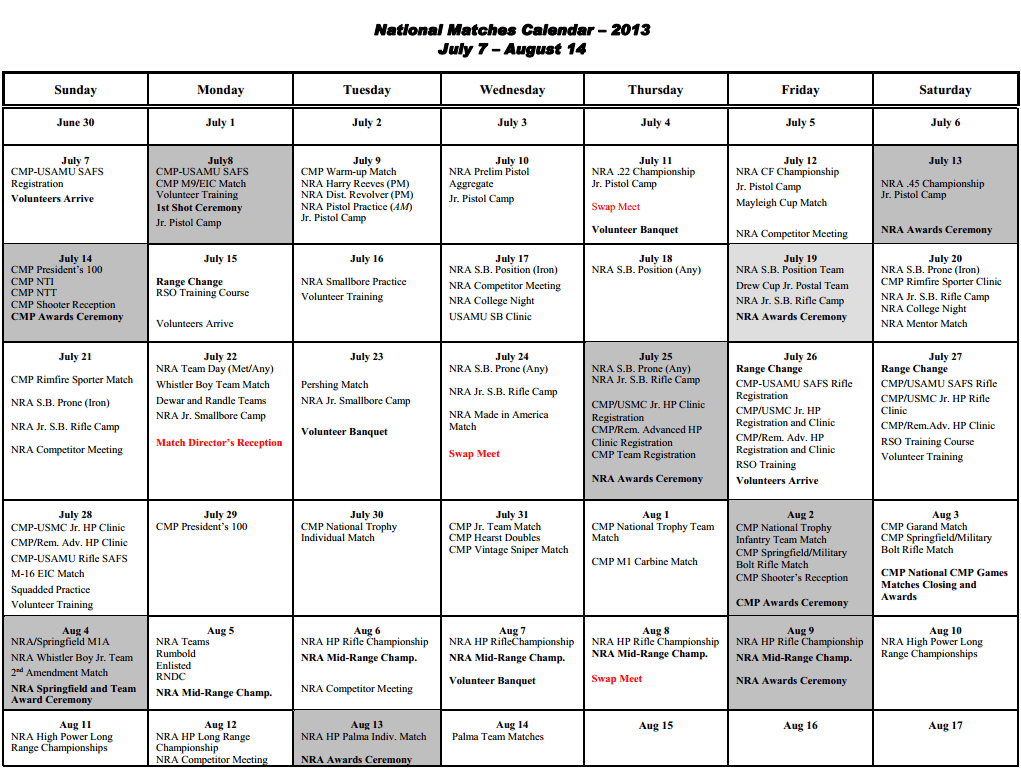


 If you’ve got stubborn lead fouling in a rimfire barrel, or on a pistol’s muzzle brake/compensator, you should definitely give this stuff a try. We don’t know how but it does soften lead deposits. The manufacturer says you don’t need brushes, but we found that a bit of brushing (after NO-LEAD application) can help remove more serious lead build-up.
 Where to Buy NO-LEAD Lead Remover
 On July 4th, the
 App Threatens Gun Owners


