If you have a laser fitted to one of your firearms, here’s a training gizmo that can help you practice your aiming and target acquisition. The LaserLyte Laser Trainer Target can register and display “hits” on its large bullseye display using 62 laser-activated LED lights. Under normal conditions, this laser-activated target can register shots up to 50 yards away. The $140.00 (street price) Laser Trainer Target is good for about 6,000 “shots”, drawing power from three (3) AA batteries. The unit is fully independent — there is no hook-up to a computer or separate processing pack.
Though it may appear smaller in the photos, the Laser Trainer Target is about the size of a school textbook: 9.5″ H x 6.25″ W x 2.0″ D, with a target area roughly five inches in diameter. The device can be used inside or outside, but you’ll probably get best results indoors. The Laser Trainer target can function with all user-activated lasers, such as grip lasers, front rail lasers, in-chamber “laser cartridges”, and even laser boresights (so long as they can be activated by trigger movement).
Fun to use and easy to deploy, the LaserLyte Trainer Target was named a 2012 Golden Bullseye Award Winner by American Rifleman magazine. MSRP is $219.95 but “street price” is WAY lower. These units sell at WalMart for $139.41. That makes it affordable. Of course you don’t experience the noise and recoil of actual shots with the LaserLyte Target Trainer, but the device can easily pay for itself, if you compare the cost of batteries vs. live ammo. These days, 1000 rounds of 9mm ammo can cost $400.00 or more.
WARNING — UNLOAD FIREARM FIRST: When Training with the LaserLyte Training Target and a firearm fitted with a laser-emitting device or laser sight, always remove and unload the magazine and then double-check to ensure the chamber is empty, and the gun is unloaded. If there is a live round in your gun, not only can you destroy your target device, but the round could cause injury or death to someone downrange.
Lapua has done extensive field testing of its bullets, using sophisticated Doppler radar equipment. Employing radar, Lapua has logged actual observed trajectories with a variety of bullet and cartridge types. And Lapua has just released updated radar data for Scenar-L bullets used with 6.5×47 Lapua, 6.5×55 Swede, and .308 Winchester chamberings. You’ll find this new data incorporated into Lapua’s product description tables for these three cartridge types.
You will also find both G1 and G7 BCs for the new line of Scenar-L Bullets in Lapua’s updated Components Table. Ballistic coefficients are based on Doppler radar data and calculated by Quick Target Unlimited Lapua Edition.
To find the BC for a particular bullet, go to the Components Table, select the caliber (on the left) and then look for the G1 or G7 value on the right for particular bullets. For example, the BCs for the new 136gr 6.5mm Scenar-L are 0.545 (G1) and 0.274 (G7).
If you are looking for the most precise trajectory predictions, nothing beats real-world testing like this. Bullet BCs can be calculated, “on paper”, from bullet size, weight, and shape. However, in the ‘real world’ the actual aerodynamic drag forces acting on the bullet change with velocity and other variables. Therefore, a bullet’s BC is NOT actually constant at every point in its flight path. Doppler radar allows Lapua to observe the actual drop of bullets at multiple points along their trajectory.
How much more precise are Doppler-radar-based trajectory predictions than typical drop charts based on modeled BCs? Consider this… when you plug the radar-based numbers for a .338 Lapua Magnum into Lapua’s ballistics software, the error in elevation is less than 2.5 cm (1″) at 1,500 meters. By contrast, the error based on a traditional G1 BC model could be over 1 meter (i.e. more than 40 inches).
Free Lapua Ballistics Software for Android OS Devices
If you want to use Lapua’s Doppler Radar data for your own ballistics calculations — there’s a App for that. Lapua’s Quick Target Unlimited (QTU) software for Android OS can be downloaded for free from the Android Market. Predicted trajectories for this software are based on precise Doppler radar ballistic measurements of Lapua bullets, making this program much more accurate than other ballistic programs for mobile phones. Note, however, the Doppler Radar data is offered ONLY for Lapua-made bullets. This App does NOT include radar data for Berger, Sierra or other brands of bullets.
Product tip from EdLongrange. We welcome reader submissions.
Need a rugged, durable stock for your Ruger 10/22? EABCO (E. Arthur Brown Company) has you covered. EABCO is offering a limited quantity of Fajen Composite 10/22 Stocks for just $49.00. EABCO tells us: “We bought out the last 24 of these, so get them while you can.” These are new-in-box, non-warping composite target stocks finished in black, with checkering on the grip and fore-end. Sling swivel studs, and rubber buttpad are installed. The stocks, sized for adults, are drop-in fits for your Ruger 10/22. There is enough clearance in the barrel channel to handle .920″-diameter heavy contour target barrels. If you are interested, call EABCO at 800-950-9088. The super-low $49.00 price is available via phone orders only.
Product tip from EdLongrange. We welcome reader submissions
We know you guys like taking photos of your rifles at the range. And, if you’re selling a rifle, scope, front rest, or rear bag, you need good photos to post in our Forum classifieds. Here’s a basic photography tip that can help you produce dramatically better photos. Use your camera’s ability to add “fill flash” even in daylight.
There’s plenty of light on a bright day. But bright light also means strong shadows. The shadows can leave parts of your subject literally in the dark. Daylight flash will help fill in those dark spots. In addition, if you are on a covered firing area, and want to include the range in your photo, you can benefit from using flash. This will prevent the foreground subject from being too dark while the downrange background is much too bright.
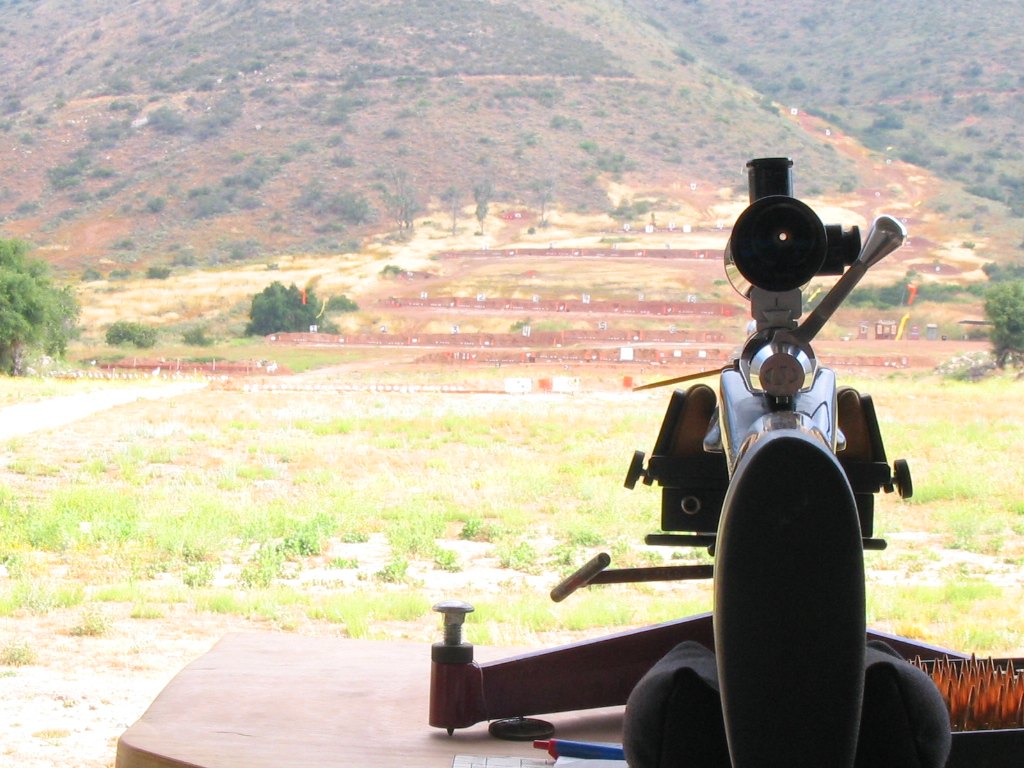
Photo without Flash
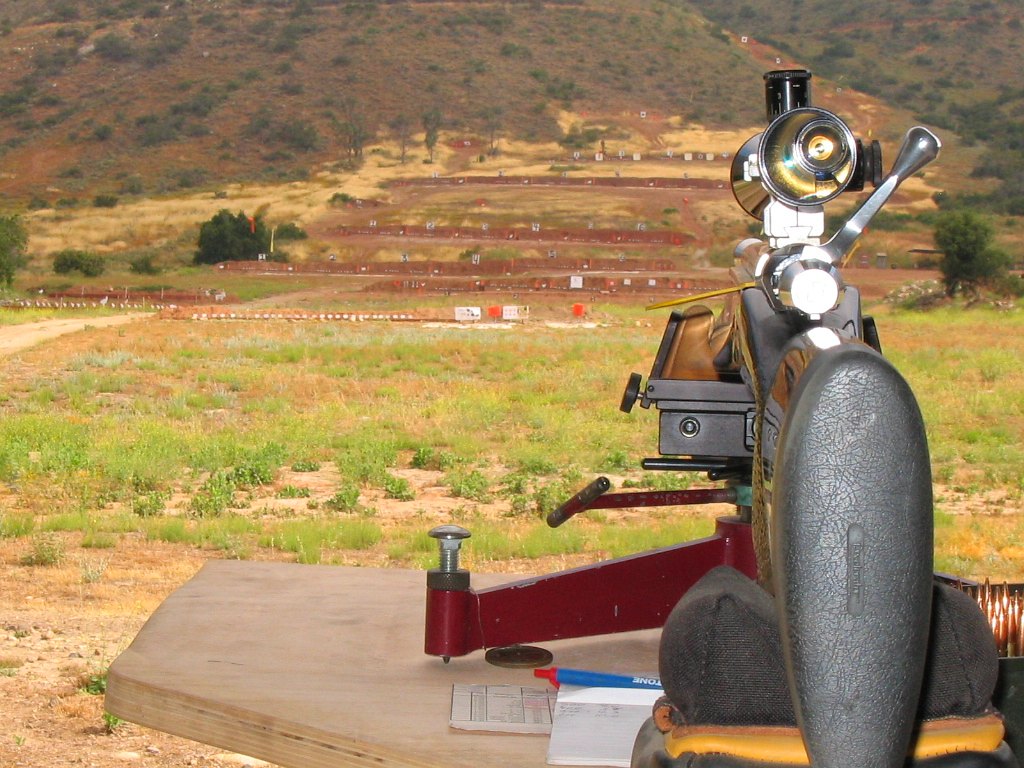
The photo above was taken without flash. As you can see, the rifle is too dark so details are lost. At the same time, the background (downrange) is over-exposed and washed out. The second photo below is taken with daylight flash. The difference is dramatic. Now you can see details of the rifle, while the background is exposed properly. Note how much easier it is to see the the targets downrange and the colors of the front rest. NOTE: these two photos were taken at the same time — just seconds apart.
Photo with Daylight “Fill-Flash”
Be sure to click on the larger versions of each photo.
How to Activate Daylight Flash
Most digital cameras have daylight flash capability. Some cameras have a separate setting for “auto fill flash”. On other cameras, you’ll have to set the camera to aperture priority and stop down the aperture to force the flash to fire. Read your camera’s manual. On many Canons, a menu that lets you set the “flash output”. For “fill flash” we like to set the flash at 30% to 50% output. This fills in the shadows sufficiently without “killing contrast” or creating too much reflection on shiny metal. Below is a photo taken with 30% flash output. Note the rich colors and how the exposure is balanced between foreground and background. Without flash the sky and target area would be “washed out”.
Here’s another tip for Canon owners. If you like deep, rich colors, use the “Vivid” setting in the effects menu. This punches up saturation and contrast.
Using ultrasound in a liquid solution, you can clean your cartridge brass inside and out. Ultrasonic cleaning is nothing new — we described this process years ago. But with the increased cost of brass, more and more shooters are turning to this effective process to get their cases clean.
Now RCBS offers an affordable Ultrasonic Cleaning Machine with some great features. The new RCBS machine boasts a 3-liter capacty, user-friendly keypad, and a built-in 100-watt heater with four settings. The unit also includes a handy drain valve and drain tube.
Ultrasonic cleaning works fast, without the long processing time (and dust) of conventional tumbling. Cleaning cases with ultrasonic machines has become very popular, as the ultrasonic process reliably removes caked-on carbon and grime from brass cases inside and out, even in the primer pocket. We do recommend that, after ultrasonic cleaning, you consider using a dry neck lube to restore lubricity to your necks for the first and second firings.
The new RCBS ultrasonic cleaner features a large 3-liter capacity, 60 watt transducer, and 100 watt ceramic heater. ‘Street Price’ for the RCBS ultrasonic machine is under $150.00, and this unit qualifies for RCBS Rebates ($10 off $50 purchase or $50 off $300.00 purchase). RCBS also sells 32 oz. bottles of cleaning concentrate that will make up to 10 gallons of Ultrasonic Solution.
The AccurateShooter.com Shooters’ Forum hit another membership milestone. We’ve surpassed 22,500 registered members. Now we hope to reach 25,000 members in the next few months. If you have considered joining our Forum, but haven’t done so yet, there’s no better time than now. As a Forum member, you’ll be part of an active community of serious shooters. You can get valuable advice on shooting and reloading from top shooters such as National Champions Larry Bartholome, Sam Hall, and Derek Rodgers. As well, many top tool-makers and barrel-makers visit the Forum regularly, such as Dave Kiff (PT&G), Frank Green (Bartlein Barrels), and John Perkins (21st Century Shooting).
If you haven’t sampled our Forum yet, cruise over to Forum.AccurateShooter.com and check it out. You’ll find a wealth of information shared by thousands of knowledgeable members, including many National Champions and record-holders. The boards are tightly moderated to prevent the ego battles common to some other internet forums. Our Shooters’ Forum maintains a high “signal to noise ratio”, with courteous and respectful exchange of ideas. To join the Forum, simply click the “Register” link and follow the prompts. There is no fee to join.
FREE Classifieds for Forum Members
Along with our informational Forum areas, we offer FREE CLASSIFIEDS for all registered forum members. You’ll find some great values in the Classifieds, and we provide a feedback system for buyers and sellers. Published feedback helps you buy and sell with greater confidence.
Barrett offers an innovative scope ring set that adjusts to two different MOA elevations through the use of variable-position cross-pins in the rear ring. Barrett’s Pin-Lock® ExRings allow a dual-setting +MOA taper by placing the adjustment pin in one of two locations. To change settings, simply remove the rear pin from one hole and insert it into the other (after loosening side locking bolts*). There are multiple ExRing versions: 30mm with 15/40 MOA settings (#66850), 30mm with 20/30 MOA settings (#66858), and 34mm with 20/30 MOA settings (#66870).
Barrett says the lower 15 or 20 MOA settings are commonly used with canted rails while the higher 30 or 40 MOA settings are for flat rails. Once an elevation setting is selected and the ring’s cross bolts are torqued to specification, Barrett ExRings become a rock-solid mount with the MOA “pre-load” angle best suited to your application. NOTE: Rings come factory preset at the lower MOA setting. CLICK HERE for Barrett ExRing Mounting Instructions (PDF).
These rings are ideal for extreme long-range shooting, offering a huge amount of elevation “pre-load” that allows the shooter to keep his scope in the middle of its elevation range. We’re not aware of any other ring system that allows a quick, repeatable change from 15 MOA preload to 40 MOA (and vice versa), or even from 20 to 30 MOA. The system will work with a wide variety of installations. ExRings will work on both flat and tapered m1913 Picatinny-type rails, and there should be enough clearance for scopes with front objectives up to 70mm in diameter. ExRings are made from tough, T-6 aluminum, hard-anodized to 60 HRC specs. A special “Zero-Gap” clamping system provides a very secure mount.
Barrett ExRings® (Extended Range Scope Rings) Key Features:
• Maximizes the riflescope’s internal elevation adjustment.
• ZERO-GAP offers wider clamping area and maximizes “scope grip”.
• ZERO BACKLASH tongue and groove interface.
• High Strength Aircraft-grade 7075 T6 aluminum.
• 2.5 times lighter than steel.
• Heat-treated steel cross bolt and captured nut for increased strength.
• Hard Anodized with a 60 HRC (Rockwell C scale).
• Both 30mm diameter and 34mm diameter available.
• BORS compatible.
ExRings Prove Themselves in Long-Range Competition
You’ll find an extensive review of the Barrett ExRings on Australian Long Range Shooter Magazine. The creator of that website, Norm Nelson, mounted Barrett Pin-Lock 15-40 MOA adjustable rings on his 7mm F-Open rig. He then proceeded to use that rifle (with ExRings) to win the 2013 Australian Long-Range Championship. Here are Norm’s comments:
“I used [the ExRings] to great effect to win the Australian Long Range F-Class Open competition earlier this year. They enabled me to use a higher magnification scope at the 1200-yard range. I have since bought a second pair and run them on my .375 Cheytac to shoot way out yonder.
The operation and fitting of these rings is quite easy and they provide a strong mounting solution for long range rifles that need an extra bit of elevation. Once mounted to the rail the ring top halves are removed and the side locking plates are loosened. At this time the rear adjustable adjustable pin can be removed if desired and placed into either [MOA position].
These are solid rings designed to withstand the recoil of the big Barrett rifles. In the testing I have done so far, I have not noticed any movement of these rings and would be surprised if I did given their build design and quality.”
*HOW to CHANGE ExRing MOA SETTINGS
Barrett recommends changing the MOA setting after scope is installed on rifle.
1. Remove the two side locking bolts from the rear ring and loosen the two side locking bolts from the front ring using the T27 Torx® end of the supplied L-wrench.
2. Use a 1/8″ pin punch to remove the adjustment pin from the rear ring.
3. Align the corresponding pin hole locations, insert and tap the adjustment pin flush using a pin punch.
4. Tighten all four side locking bolts to 50 inch/lbs or 5.6Nm
Registration for the National Shooting Sports Foundation’s 2014 SHOT Show is now open for attendees. (Media and Exhibitor registration will open in the coming weeks.) The 2014 SHOT Show will be held January 14 through 17 in Las Vegas, Nevada at the Sands Convention Center. While registering, attendees can easily add State of the Industry Dinner tickets, enroll in SHOT Show University and sign up for other educational offerings. CLICK HERE for Registration Page.
Improved WI-FI at SHOT Show Venue
The Sands Expo & Convention Center recently completed installation of a new $1.6 million wireless LAN (WLAN) that Sands executives say will deliver seamless Wi-Fi coverage throughout the Sands Expo and Convention Center’s 2.2 million square feet of flexible exhibition and meeting space. That’s a good thing for media folks, but we can envision thousands of people bumping into each other as they walk around with eyes focused on their digital devices, sending “tweets” and scanning Facebook pages.
National Hunting and Fishing Day (NHF Day) takes place on Saturday, September 28th. The annual celebration serves as a reminder that conservation succeeds because of leadership and funding from hunters, shooters and anglers. National, regional, state and local organizations will run thousands of “open house” hunting- and fishing-related events around the country. Events will include Fishing Derbys, Hunting Expos, Wing-shooting tournaments, and much more. An estimated four million Americans will participate. For information on NHF Day, visit www.nhfday.org. To find an NHF Day event near you, click the link below.
Story by Boyd Allen
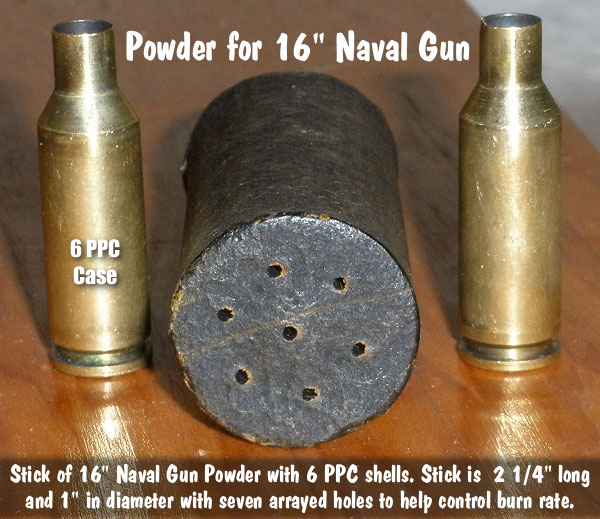
While many top competitive shooters trickle their stick powder charges to a kernel or two, that would be impractical when loading charges for giant naval guns. You may be surprised, but the shells fired by the U.S. Navy’s massive 14″ and 16″ naval guns were also propelled by stick-type extruded powders. You couldn’t trickle these ‘kernels’ though — a single stick or ‘grain’ can be over 2″ long. Take a look…
In connection with a Benchrest Central discussion that drifted to the subject of powders used in large naval guns, I heard from Joe McNeil, whose father was involved in manufacturing those very propellants as a DuPont employee. Joe writes:
“My Dad worked for the DuPont company for over 40 years. Every time the nation went to war he was assigned to the gun powder plants which DuPont ran for the government for $1.00 per year! His last assignment was at the Indiana Ordnance Plant in Jefferson, Indiana from 1952 through 1958. He had a display case made of all of the different powders made at the plant and left it to me. That’s why I have a grain of 16″ gun powder. He took me out to the Jefferson proving grounds once when they tested the powder in a 16″ gun. We watched from a half-mile away but it left a lasting impression when they fired that gun. They actually had a set of rings they fired through to test the performance of the powder and shell. This was a truly fond memory of my Dad and his work.”
Here are some pictures of the gun powder “grains” made during the Korean War at the Indiana Ordnance Works where Joe McNeil’s father worked.
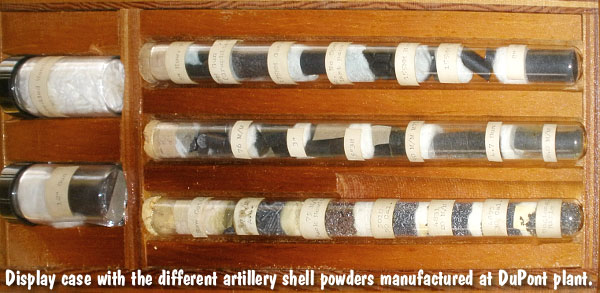
Above is the display case with the different powders manufactured at the DuPont plant. They include: 37 MM/AA, 75MM Pack Howitzer, 50 Cal. 5010, 20 MM 4831, 30 Cal. 4895, 76 MM, 3″, 5″, 90 MM, 4.7″, 240MM, 8″, 280 MM, 175 MM, 155 MM Howitzer, 155 MM Gun M.P., 8″ Gun M.P., 12″, 14, 16″. There are different-sized ‘grains’ for specific rounds.


 If you have a laser fitted to one of your firearms, here’s a training gizmo that can help you practice your aiming and target acquisition. The LaserLyte Laser Trainer Target can register and display “hits” on its large bullseye display using 62 laser-activated LED lights. Under normal conditions, this laser-activated target can register shots up to 50 yards away. The $140.00 (street price) Laser Trainer Target is good for about 6,000 “shots”, drawing power from three (3) AA batteries. The unit is fully independent — there is no hook-up to a computer or separate processing pack.
 Fun to use and easy to deploy, the LaserLyte Trainer Target was named a 2012 Golden Bullseye Award Winner by American Rifleman magazine. MSRP is $219.95 but “street price” is WAY lower. These units sell at WalMart for $139.41. That makes it affordable. Of course you don’t experience the noise and recoil of actual shots with the LaserLyte Target Trainer, but the device can easily pay for itself, if you compare the cost of batteries vs. live ammo. These days, 1000 rounds of 9mm ammo can cost $400.00 or more.
 You will also find both G1 and G7 BCs for the new line of Scenar-L Bullets in Lapua’s updated


 We know you guys like taking photos of your rifles at the range. And, if you’re selling a rifle, scope, front rest, or rear bag, you need good photos to post in our Forum classifieds. Here’s a basic photography tip that can help you produce dramatically better photos. Use your camera’s ability to add “fill flash” even in daylight.



 Using ultrasound in a liquid solution, you can clean your cartridge brass inside and out. Ultrasonic cleaning is nothing new — we described this process years ago. But with the increased cost of brass, more and more shooters are turning to this effective process to get their cases clean.


 Barrett offers an innovative scope ring set that adjusts to two different MOA elevations through the use of variable-position cross-pins in the rear ring. Barrett’s
 “I used [the ExRings] to great effect to win the Australian Long Range F-Class Open competition earlier this year. They enabled me to use a higher magnification scope at the 1200-yard range. I have since bought a second pair and run them on my .375 Cheytac to shoot way out yonder.
 Improved WI-FI at SHOT Show Venue