The new 34th Edition Blue Book of Gun Values has just been released, and is available now for $29.38. The Blue Book of Gun Values, by S. P. Fjestad, is the top-selling book in our AccurateShooter Bookstore which operates through Amazon.com. The 34th Edition of the Blue Book has 2,408 pages, easily making it the highest page count of any firearms book currently in print. This resource includes nearly 1,500 gun manufacturers, almost 20,000 gun model descriptions, and over 175,000 prices!
Updated Products and Prices
New 2013 domestic and imported makes and models have been included. All gun values have been thoroughly updated for both modern and antique firearms, including the recent paramilitary style guns. Other features include the 80-page color Photo Percentage Grading System (PPGS) and serialization and proofmark sections to help in identifying firearms. The Blue Book of Gun Values is the firearm industry’s most trusted reference book with over 1.5 million copies in print.
NEW!! CD-ROM and Online Version of Blue Book
The Blue Book’s Publisher now offers a CD-ROM version of the Blue Book of Gun Values. Priced at $34.95, this contains all the information from the printed version of the 34th Edition Blue Book of Gun Values as well as over 3,500 color images packed on an easy-to-use disc.
The Blue Book of Gun Values is now available as an online subscription for $34.95. The online subscription contains the entire database of the current Blue Book of Gun Values, but it also has many features not available with the printed version, including quarterly updates, over 2,500 firearm images, complete search abilities, and inventory capabilities. You can also get a combo package of book and online data access. If you purchase the book directly from the publishers for $44.95, for an additional $5.00 you can get a one-year online subscription. You must use discount code 34GUNSUB5 at checkout to receive the $5 subscription.
Learn About Blue Book of Gun Values NEW Online Database:
Nine-Part Video Guide for Blue Blue Users
To assist Blue Book readers, Blue Book Publications has created a nine-part instructional video series on YouTube. Part 1, the Introduction, provides an overview. Each of the other eight (8) short videos explains a key feature of the Blue Book of Gun Values and how to best utilize it. Watch one or more videos, according to your interests.
On April 25-27, many of the nation’s best multi-gun shooters will compete at the 2013 Tarheel 3-Gun Challenge in New Hill, North Carolina. Over 250 shooters will compete for monetary prizes and other awards totaling over $100,000. This is the biggest match of the year for Tarheel 3 Gun, an established 3-gun organization operating in the Triad area of North Carolina. In 2012, Tarheel 3-Gun’s regular monthly matches attracted over 100 competitors per match. “We’re proud to partner with the Tarheel 3-Gun again this year,” said Carlos Martinez of Bushmaster Firearms. “The sport of 3-gun has quickly become the fastest growing shooting sport in America.”
To learn more about the Tarheel 3-Gun Challenge and monthly matches visit Bushmaster.com or Tarheel3gun.com. Tarheel 3-Gun is now in its fourth year of holding organized 3-Gun matches. Bushmaster sponsors the monthly series as well as the Tarheel 3-Gun Challenge.
Lotus Gunworks of Jensen Beach, FL, has built a vast “double-decker” indoor shooting range featuring a two-story-high steel funnel bullet trap. Nicknamed the Lotus 8/11 for the number of steel panels used to create it (eight panels on the bottom slope and 11 panels on the top slope), this version of Action Target’s Total Containment Trap is the first of its kind. “No one has ever seen a range like this before*,” Lotus Gunworks’ Director of Operations Robbie Abell said. “We’re truly making industry history.” The official range Grand Opening is slated for next weekend, April 19-21 2013.
Why build a two-story gun range? Abell came up with the concept when it became clear that the new Lotus building in Jensen Beach was not wide enough for two side-by-side ranges AND a gun store. Necessity was the mother of invention… Lotus wanted at least two ranges, so the only option was to make a double-decker range where both levels shot into the same bullet trap.
The double-decker range required clever engineering. Bullet-trap maker Action Target “Super-Sized” its Total Containment Trap, scaling up the system from 8 feet high to a whopping 19 feet high. Then steel cross beams were fitted to support a Mancom Touch ‘N’ Go target retriever system.
Indoor ranges require ventilation to remove potentially hazardous dust and lead particles. The sheer size of the double-decker range presented a unique challenge, but Carey’s Small Arms Range Ventilation installed a system that can completely replace all the range air every 80 seconds. The old air is drawn out, and replaced with fresh filtered and refrigerated air. “The air flow in the upper level was the best I have seen on any range, and the airflow on the bottom was also very good,” said Carey’s technician Mark Hanson.
Dutch Double-Decker Range
While the Lotus Range may have the first two-story bullet trap, it’s not really the first-ever double-decker indoor shooting range. Other twin-level “double-decker” ranges exist, they just don’t have the giant bullet trap. Check out Schietsportvereniging (SSV) Katwijk, a great twin-level range in Holland featuring electronic targets with displays at each shooting station (on both levels):
Hunters and tactical shooters need scopes with good low-light performance. For a scope to perform well at dawn and dusk, it needs good light transmission, plus a reasonably large exit pupil to make maximum use of your eye’s light processing abilty.* And generally speaking, the bigger the front objective, the better the low-light performance, other factors being equal. Given these basic principles, how can we quickly evaluate the low-light performance of different makes and models of scopes?
Here’s the answer: ScopeCalc.com offers a FREE web-based Low-Light Performance Calculator that lets you compare the light gain, perceived brightness, and overall low-light performance of various optics. Using this scope comparison tool is pretty easy — just input the magnification, objective diameter, exit pupil size, and light transmission ratio. If the scope’s manufacturer doesn’t publish an exit pupil size, then divide the objective diameter in millimeters by the magnification level. For example a 20-power scope with a 40mm objective should have a 2mm exit pupil. For most premium scopes, light transmission rates are typically 90% or better (averaged across the visible spectrum). However, not many manufacturers publish this data, so you may have to dig a little.
ScopeCalc.com’s calculator can be used for a single scope, a pair of scopes, or multiple scopes. Once you’ve typed in the needed data, click “Calculate” and the program will produce comparison charts showing Light Gain, Perceived Brightness, and Low-Light Performance. In the example below, we compared a “generic” 5-18×50 Tactical scope with a “generic” 8-32 Benchrest scope.
Though the program is easy to use, and quickly generates comparative data, assessing scope brightness, as perceived by the human eye, is not a simple matter. You’ll want to read the annotations that appear below the generated charts. For example, ScopeCalc’s creators explain that: “Perceived brightness is calculated as the cube root of the light gain, which is the basis for modern computer color space brightness scaling.” In addition, the way ScopeCalc measures Low-Light Performance is pretty sophisticated: “Low Light Performance [is calculated] as the average of light gain and resolution gain through magnification, as a measure of target image acuity gain in low light similar to Twilight Performance specified by scope manufacturers. Low Light Performance calculated here is much more useful than Twilight Performance, as Twilight performance is the average of the just the objective lens diameter times magnification, while Low Light Performance is the average of the actual Perceived Brightness times magnification, which also includes the exit pupil/eye pupil relation, light transmission, approximated diffraction, as well as the perception of relative light gain. Just as with Twilight Performance, this Low Light Performance calculation does not yet include lens resolution and contrast as factors. Therefore lower quality optics will yield relatively less gains at higher magnifications.” Got that?
*In low light, the human eye can typically dilate to 5mm – 7mm. The exact amount of dilation varies with the individual, and typically declines, with increasing age, from 7mm (at age 20) to a dark-adapted pupil of about 5.5mm by age 65. To take full advantage of a scope’s light-gathering capacity, the diameter of an eyepiece exit pupil should be no larger than the max diameter of your eye’s dark-adapted pupil, so that all of the light collected by the scope enters your eye, rather than falling on the iris. A large 8mm exit pupil may seem good, but it would be partly “wasted” on a shooter in his 60s.
Our friends at Creedmoor Sports are in the final stages of the company’s move to Anniston, Alabama. To mark this event, Creedmoor is offering FREE Ground Shipping this week on most products (ammo, brass and bullets excluded). Creedmoor’s G.M. Dennis DeMille tells us: “We loaded one semi yesterday and four more are being filled here today. It’s going to take about four days to get to Alabama from California and a few days to get unpacked. As a token of our appreciation for your patience during our move, here’s a FREE Ground Shipping Coupon good all week long….”
FREE SHIPPING
Use coupon code MOVING2013
Excludes ammo, brass and bullets.
Ground shipping only. Contiguous states.
Not valid on previous orders.
No orders will be shipped until week of April 22.
NOTE: Without the Coupon Code, the discount will not be applied. If you can’t get the coupon to work, put the Code in the bottom of the checkout page and we’ll remove the shipping charges before we charge your card. If there is ammo, brass, or bullets on the order, the Coupon Code will not work.
We all know that reloading components are in very short supply these days — bullets, brass, powder — you name it. Every day we get calls and emails from guys trying to find these items. Here’s a tip for those of you who need high-quality brass: Midsouth Shooters Supply carries Norma Brass, and Midsouth has this brass for many popular cartridge types IN STOCK now. Here’s a partial list of unprimed Norma brass available for purchase at Midsouth as of April 12, 2013:
Report by Richard King (King’s Armory, Texas; ‘Kings X’ on our Forum)
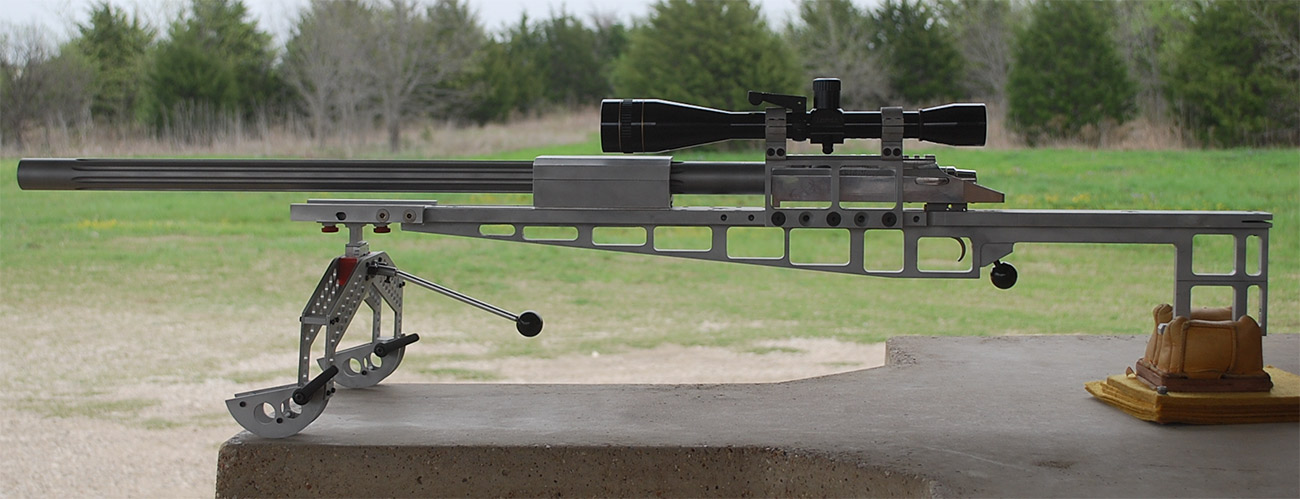
With all the talk from Vince Bottomley in the April issue of Target Shooter about aluminum stocks, I thought you might like to see my latest project. This is my personal gun, built the way I wanted it. I know it’s radical and some may not care for it. But it works.
This is pretty much an all-aluminum rifle. The action is a Kelbly F-Class with a Shilen stainless steel competition trigger. The scope is a 1″-tube Leupold 36X with a Tucker Conversion set in Jewell spherical bearing rings. The .223 barrel is Pac-Nor 3-groove, 1:6.5″-twist mounted in a “V”-type barrel block. The bipod has vertical adjustment only via a dovetail slide activated by a stick handle. It works like a joy-stick, but for vertical only. I adjust for windage by moving the rear sandbag.
The 30″ barrel is 1.250″ in diameter. With the barrel block forward, the vibrations should be at a low frequency. Instead of one long rod whipping, I now have two short rods (barrel haves) being dampened. This is my fourth barrel block gun. They work, but so does a good pillar-bedded action. I just do stuff a little different.
The vertical “keel” down the bottom of the stock stops the “spring” of a flat-bar stock. There is little, if any, noticeable flex before or during recoil. The long length of the stock, the fat barrel, and the forward-mounted barrel block work together to keep the gun from rising off the ground. BUT, remember this is a .223 Rem rifle. A .308 Win version might act very differently. I may try a .308-barreled action soon, just to see what happens. But I will stick with the .223 Rem as my choice for match shooting.
The offset scope idea came from a benchrest “rail” gun. In truth, the whole concept came from a rail gun — just adapted to being shot off a bipod. Sure it isn’t directly over the bore. It is about 1.5″ over to the left. So if you want the scope to be zeroed on the center of the target, you have to adjust for the offset. At 100 yards that is 1.5 MOA. But at 300 it is only 0.5 MOA, at 600 only a ¼-MOA, and at 1000 about 1 click on my scope.
What the offset DOES do for me is eliminate any cheek pressure. My cheek never touches the stock. Since this is only a .223 Rem, I don’t put and shoulder pressure behind it. And I don’t have a pistol grip to hang on to, but I do put my thumb behind the trigger guard and “pinch” the two-ounce trigger.
The offset scope placement could interfere with loading a dual-port action from the left. That’s not a problem for me as I set my spotting scope up on the left side very close to the rifle. I have plenty of time to reload from the right side while the target is in the pits being scored.
Again — this is my rifle. It is designed for my style of shooting. It is not meant to be a universal “fit all” for the general public. However, I will say the design is adaptable. I can easily convert the system to run in F-Open Class. I would drop a big-bore barreled action into the “V” block, slide on a heavier pre-zeroed scope and rings, add plates on the sides up front to bring the width to 3”, and maybe a recoil pad. It might be interesting to offset the wings up from to counter torque of the big bullets. But I would also have to offset the rear bag rider to get the gun to recoil straight back.
How the Gun Performs
I have had “T” to the range only twice for load development. It groups like my present barrel-blocked 223 F-TR gun. But it’s much easier to shoot and it only moves about 3/4” — straight back. I tried to build am omni-directional joy-stick bipod but I could not get all the side-to-side wiggle out of it. So I have set it up so it only moves up and down (horizontal movement is locked-out). As it works now, the joystick on the bipod lets me set elevation on the target quickly (with up/down adjustment). Then, to adjust for windage, I slide my rear bag side-to-side as needed. Once set, I just tickle the trigger and smile.
Gun Handling — Shoot It Like a Bench-Gun
I basically shoot the gun with no cheek or body contact. I don’t grip it, other than maybe a pinch on the trigger guard. The scope was offset to the left to help the shooter move off the gun and avoid the possibility of head/cheek contact with the stock.
Listen to Richard King Explain How He Shoots his ‘Texas-T’ Rifle:
[haiku url=”http://accurateshooter.net/Video/RichKingTalks.mp3″ Title=”Richard King Talks”]
Sinclair Int’l now carries Bullet Sample Packs from Bullet Proof Samples LLC. These 12-bullet packs are available for Berger, Barnes, and Nosler bullets in popular weights, types, and calibers. With the sample packs, during load development, you can try out a variety of projectiles without investing in an entire box of each type. That’s smart. Sample packs range in price from $5.99 to $15.99 (for twelve bullets per pack). Most of the Berger bullet packs are priced under $10.00, with many in the $6-$7 range.
CLICK HERE for the Sinclair Int’l bullet sample pack webpage. (Once there, select Barnes, Berger, or Nosler). You’ll also find the sample packs on page six of the Sinclair Int’l print catalog. To place an order, or for additional information, call 800-717-8211 or visit www.sinclairintl.com.
Earlier this month we ran a story on the new Sauer 101 rifle. It turns out the Sauer 101 will be distributed in the U.S. by Blaser USA. Here’s more good news for hunters — we’ve learned that Blaser will be bringing another new German hunting rifle to the USA — the Mauser M 12. You’ll find specs and photos of the M 12 below. This is a rifle with a great heritage, superb build quality, plus some innovative features.
Both the Mauser M 12 and Sauer 101 rifles should be available at retailers in late April. To learn more, visit these websites: www.Mauser-m12.com and www.Sauer-101.com. For additional information on the Blaser line of products visit www.Blaser-USA.com.
Mauser M 12 Specifications
Bolt Features: 6-lug bolt, 60° bolt lift, bolt lugs engage directly in barrel, side bolt release, bolt can be disassembled without tools.
Extraction: Dual, spring loaded-ejectors for positive extraction.
This week’s Shooting USA program features the NRA National Pistol Championships. This segment covers both rimfire and center-fire Bullseye shooting at 25 and 50 yards.
Each year the NRA hosts the Rifle and Pistol Championships at Camp Perry on the shores of Lake Erie. Camp Perry, in Northern Ohio, is the historic home to the National Championships that date back more than 100 years. Most matches have military antecedents, including the pistol championships. The Match is organized by days. Day One is for .22 LR rimfire handguns. Day Two is for center-fire (any caliber from .32 to .45), and Day Three is for .45-caliber handguns. Currently, most competitors use a model 1911 on centerfire day and use that same 1911 on Day Three for the .45 caliber matches. Red dot optics are permitted in most classes.
Golob Goes Waterfowl Hunting
On tonight’s Shooting USA broadcast, you can also watch action pistol champ Julie Golob head out with Mike Irvine on a Missouri waterfowl adventure.
This was Julie’s first duck hunting trip. Despite the cold weather, Julie had fun and returned with some great memories.
Shooting USA airs Wednesday night on the Outdoor Channel: Eastern Time: 3:00 PM, 8:00 PM, 1:00 AM; Central Time: 2:00 PM, 7:00 PM, 12:00 PM; Mountain Time: 1:00 PM, 6:00 PM, 11:00 PM; Pacific Time: 12:00 PM, 5:00 PM, 10:00 PM. The Shooting USA Hour is also re-broadcast on Friday Night/Saturday Morning (11:30 pm Pacific, 2:30 AM Eastern).


 The new 34th Edition Blue Book of Gun Values has just been released, and is available now for $29.38. The Blue Book of Gun Values, by S. P. Fjestad, is the top-selling book in our AccurateShooter Bookstore which operates through Amazon.com. The 34th Edition of the Blue Book has 2,408 pages, easily making it the highest page count of any firearms book currently in print. This resource includes nearly 1,500 gun manufacturers, almost 20,000 gun model descriptions, and over 175,000 prices!
 NEW!! CD-ROM and Online Version of Blue Book
 On April 25-27, many of the nation’s best multi-gun shooters will compete at the 2013 Tarheel 3-Gun Challenge in New Hill, North Carolina. Over 250 shooters will compete for monetary prizes and other awards totaling over $100,000. This is the biggest match of the year for

 The double-decker range required clever engineering. Bullet-trap maker

 Hunters and tactical shooters need scopes with good low-light performance. For a scope to perform well at dawn and dusk, it needs good light transmission, plus a reasonably large exit pupil to make maximum use of your eye’s light processing abilty.* And generally speaking, the bigger the front objective, the better the low-light performance, other factors being equal. Given these basic principles, how can we quickly evaluate the low-light performance of different makes and models of scopes?

 *In low light, the human eye can typically dilate to 5mm – 7mm. The exact amount of dilation varies with the individual, and typically declines, with increasing age, from 7mm (at age 20) to a dark-adapted pupil of about 5.5mm by age 65. To take full advantage of a scope’s light-gathering capacity, the diameter of an eyepiece exit pupil should be no larger than the max diameter of your eye’s dark-adapted pupil, so that all of the light collected by the scope enters your eye, rather than falling on the iris. A large 8mm exit pupil may seem good, but it would be partly “wasted” on a shooter in his 60s.


 The offset scope idea came from a benchrest “rail” gun. In truth, the whole concept came from a rail gun — just adapted to being shot off a bipod. Sure it isn’t directly over the bore. It is about 1.5″ over to the left. So if you want the scope to be zeroed on the center of the target, you have to adjust for the offset. At 100 yards that is 1.5 MOA. But at 300 it is only 0.5 MOA, at 600 only a ¼-MOA, and at 1000 about 1 click on my scope.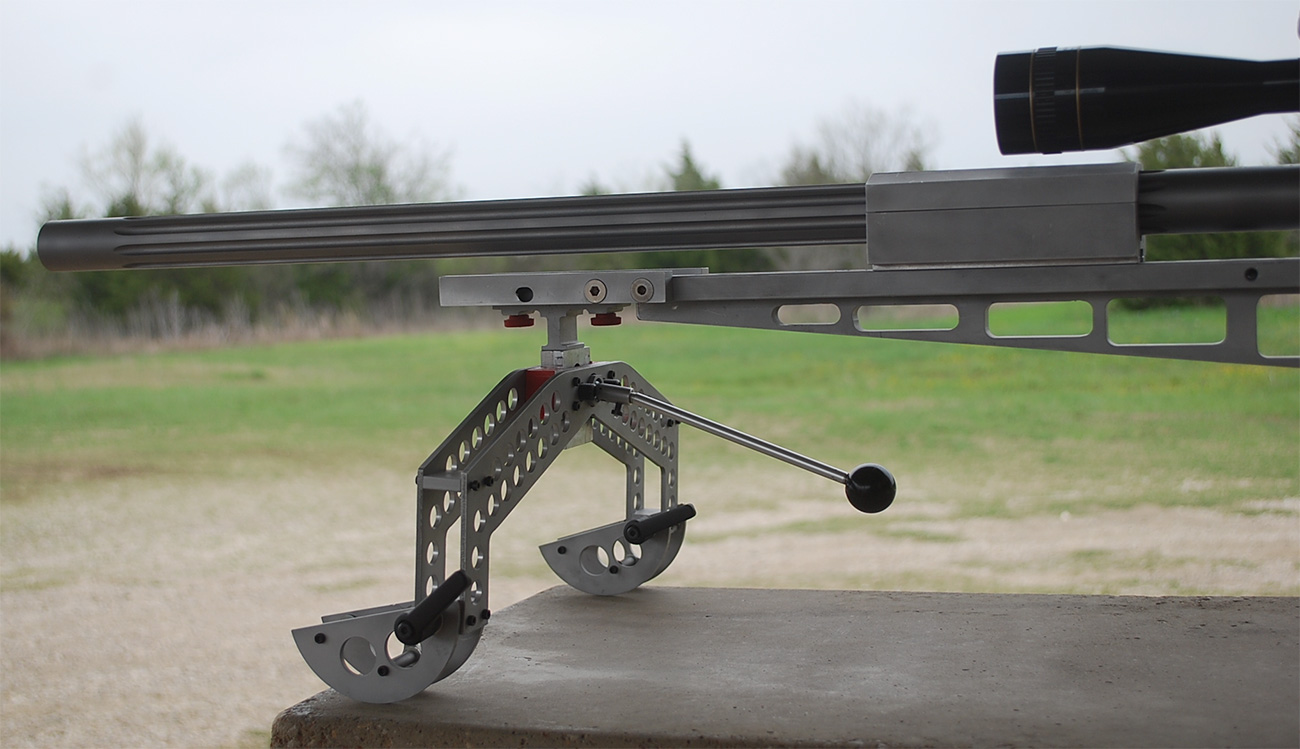


 Earlier this month we ran a story on the new


 This week’s
  Golob Goes Waterfowl Hunting


