Eurooptic vortex burris nightforce sale


teslong borescope digital camera barrel monitor


As an Amazon Associate, this site earns a commission from Amazon sales.


March 3rd, 2014

Midsouth Introduces Line of Value-Priced Reloading Products

Midsouth Shooters Supply Reloading FunnelWe like Midsouth Shooters Supply. For 44 years, this outfit has offered very competitive prices, quick shipping, and a real commitment to customer satisfaction. Midsouth has also been a strong supporter of this website since the very beginning (when we were just getting started). The guys at Midsouth are real shooters, who use the products they make and sell.

We’re pleased to report that Midsouth Shooters Supply is introducing its own line of value-priced reloading gear. You’ll find a wide selection of Midsouth-brand products: ammo boxes, load trays, powder funnels, bullet pullers, media sifters, vibratory tumblers and more. And Midsouth is even offering its own branded tumbling media (corn or walnut) and liquid brass polish. We think you’ll find the pricing on all these products to be extremely competitive. Here are a few examples:

Midsouth Shooters Supply Reloading Tumbler Kit Tumbler Kit
(Tumbler, Separator, Media, & Brass Polish)

Price: $72.93

Item: 038-502024

Midsouth Shooters Supply Reloading Box Hinged-Top
50-Round Ammo Box
222/223 Rem

Price: $1.72

Item:038-502004 (Red)
Item:038-502005 (Clr)

(100-round boxes are also available for $2.52)

Midsouth Shooters Supply Reloading Funnel Powder Funnel Set
(Two Funnels plus inserts)

Price: $4.64

Item: 038-502029

Permalink Hot Deals, New Product No Comments »
March 2nd, 2014

Defining “Overbore” Cartridges via Comparative Index

What is “Overbore”? That’s a question rifle shooters can debate to no end. This article from our archives proposes one way to identify “overbore cartridges”. We think the approach outlined here is quite useful, but we know that there are other ways to define cartridges with “overbore” properties. Whenever we run this article, it stimulates a healthy debate among our readers — and that is probably a good thing.

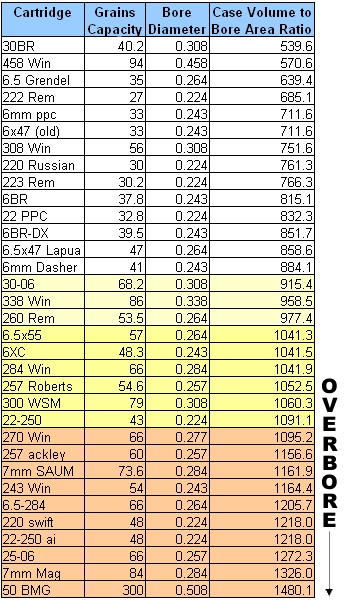
Forum Member John L. has been intrigued by the question of “overbore” cartridges. People generally agree that overbore designs can be “barrel burners”, but is there a way to predict barrel life based on how radically a case is “overbore”? John notes that there is no generally accepted definition of “overbore”. Based on analyses of a wide variety of cartridges, John hoped to create a comparative index to determine whether a cartridge is more or less “overbore”. This, in turn, might help us predict barrel life and maybe even predict the cartridge’s accuracy potential.

John tells us: “I have read countless discussions about overbore cartridges for years. There seemed to be some widely accepted, general rules of thumb as to what makes a case ‘overbore’. In the simplest terms, a very big case pushing a relatively small diameter bullet is acknowledged as the classic overbore design. But it’s not just large powder capacity that creates an overbore situation — it is the relationship between powder capacity and barrel bore diameter. Looking at those two factors, we can express the ‘Overbore Index’ as a mathematical formula — the case capacity in grains of water divided by the area (in square inches) of the bore cross-section. This gives us an Index which lets us compare various cartridge designs.”

OVERBORE INDEX Chart

Overbore Index Chart

So what do these numbers mean? John says: “My own conclusion from much reading and analysis is that cartridges with case volume to bore area ratio less than 900 are most likely easy on barrels and those greater than 1000 are hard on barrels.” John acknowledges, however, that these numbers are just for comparison purposes. One can’t simply use the Index number, by itself, to predict barrel life. For example, one cannot conclude that a 600 Index number cartridge will necessarily give twice the barrel life of a 1200 Index cartridge. However, John says, a lower index number “seems to be a good predictor of barrel life”.

John’s system, while not perfect, does give us a benchmark to compare various cartridge designs. If, for example, you’re trying to decide between a 6.5-284 and a 260 Remington, it makes sense to compare the “Overbore Index” number for both cartridges. Then, of course, you have to consider other factors such as powder type, pressure, velocity, bullet weight, and barrel hardness.

Overbore Cases and Accuracy
Barrel life may not be the only thing predicted by the ratio of powder capacity to bore cross-section area. John thinks that if we look at our most accurate cartridges, such as the 6 PPC, and 30 BR, there’s some indication that lower Index numbers are associated with greater inherent accuracy. This is only a theory. John notes: “While I do not have the facilities to validate the hypothesis that the case capacity to bore area ratio is a good predictor of accuracy — along with other well-known factors — it seems to be one important factor.”

Permalink Bullets, Brass, Ammo, Reloading 26 Comments »
March 2nd, 2014

Varmint Exterminator AR has Wood Handguard and Buttstock

Jere’s something new for you AR fans — an AR15 with laminated wood furniture. At SHOT Show 2014, Windham Weaponry introduced the VEX (Varmint Exterminator) Wood Stock line of rifles. Windham calls its first VEX model the “Pepper”, for the gray/black tones of the laminated stock. This should work better on the bags than conventional ARs. Up front, the handguard is wider on the underside (with a flared profile similar to the beavertail fore-ends on Cooper rifles). The buttstock has a dropped section at the rear for riding a sandbag. The $1480.00 VEX rifle features a 20″, 1:8″-twist fluted stainless barrel. Designed for scoped use, the A4-type flattop upper comes with optics riser blocks. There’s a Pic rail up front if you want to add a front iron sight.

Click to zoom photo
AR 15 wood laminated stock
CLICK HERE to Download PDF Version of this Spec Sheet.
AR 15 wood laminated stock

Permalink Hunting/Varminting, New Product 1 Comment »
March 1st, 2014

Good Prices on Hornady Bulk Bullets at Grafs.com

Looking for quality, name-brand projectiles at a bargain price? Then check out the Hornady Bulk Bullets Specials at Grafs.com. Currently, Grafs.com has a variety of popular Hornady rifle and pistol bullets on sale. Get one hundred 75gr .224-caliber BTHP bullets for just $16.99 (Item #HRN2279B). If you favor .30-caliber cartridges, you can get one hundred 110gr FMJ bullets for $18.99 (Item #HRN3017B).

Your Editor just ordered some .45-caliber 185gr SWCs for his S&W 1911. These .451-diameter Hornady-made FMJ bullets are $19.89 per 100 bullets (Item #HRN45137B). Round-nose 230gr .45-caliber FMJ bullets are also offered for $22.39. If you shoot a 9mm pistol, you can order 147gr FMJ bulk bullets for just $15.99 per 100 (Item #HRN35597B). These prices are comparable with the cost of cast lead bullets from other vendors. When you consider that many indoor ranges no longer allow non-jacketed lead bullets, you may want to get some Hornady bulk bullets from Grafs.com while supplies last. NOTE: the stated prices include shipping after one flat handling fee of $7.95 per order.

Grafs.com hornady bulk bullets

Product tip from EdLongrange. We welcome reader submissions.
Permalink Bullets, Brass, Ammo, Hot Deals 1 Comment »
March 1st, 2014

How to Fire-Form Dasher and BRX Brass without Bullets

Many of our Forum members shoot an “improved” 6mmBR cartridge. This might be a 30°-shoulder 6mm BRX, or a 40°-shoulder 6mm Dasher, or the 6mm BRDX, which is very similar to the Dasher, but with a slightly longer neck. This Editor shoots a 6mm BRDX and has found it very accurate, and maybe a bit easier to fire-form than a standard Dasher. Speaking of fire-forming, in our Shooters’ Forum, we often see questions about fire-forming BRX/Dasher brass. For those who need a large number of BRX or Dasher cases, one option to consider is using pistol powder in a dedicated fire-forming barrel. Here’s an explanation of how this process can work.

Forum member Skeeter has a 6mm Dasher falling block varmint rifle. The Dasher case is based on the 6mm BR Norma cartridge with the shoulder blown forward about 0.100″ and out to 40°. This gives the Dasher roughly 3.5 grains added capacity compared to the standard 6BR.

A few seasons back, Skeeter needed to form 300 cases for varmint holiday. Skeeter decided to fire-form his brass without bullets. This method avoids barrel wear and saves on components. There are various ways to do this, but Skeeter chose a method using pistol/shotgun powder, some tissue to hold the powder in place, Cream of Wheat filled to within an 1/8″ of top of the neck, and a “plug” of tissue paper to hold it all in place. Shown below are cases filled with a pistol/shotgun powder charge topped with Cream of Wheat and then a tissue paper plug.

To ensure the case headspaced firmly in his Dasher chamber, Skeeter created a “false shoulder” where the new neck-shoulder junction would be after fire-forming. After chamfering his case mouths, Skeeter necked up all his cases with a 0.257″ mandrel (one caliber oversized). Then he used a bushing neck-sizing die to bring the top half of the neck back down to 0.267″ to fit his 0.269″ chamber. The photo below shows how the false shoulder is created.

After creating the false shoulder, Skeeter chambered the cases in his rifle to ensure he could close the bolt and that he had a good “crush fit” on the false shoulder, ensuring proper headspace. All went well.

The next step was determining the optimal load of pistol powder. Among a variety of powders available, Skeeter chose Hodgdon Titewad as it is relatively inexpensive and burns clean. The goal was to find just the right amount of Titewad that would blow the shoulder forward sufficiently. Skeeter wanted to minimize the amount of powder used and work at a pressure that was safe for his falling block action.

Working incrementally, Skeeter started at 5.0 grains of Titewad, working up in 0.5 grain increments. As you can see, the 5.0 grain charge blew the shoulder forward, but left it a hemispherical shape. At about 7.0 grains of Titewad, the edge of the shoulder and case body was shaping up. Skeeter decided that 8.5 grains of Titewad was the “sweet spot”. He tried higher charges, but the shoulder didn’t really form up any better. It will take another firing or two, with a normal match load of rifle powder and a bullet seated, to really sharpen up the shoulders. Be sure to click on the “View Larger Image” link to get a good view of the cases.


The process proved to be a success. Skeeter now has hundreds of fire-formed Dasher cases and he hasn’t had to put one bullet through his nice, new match-grade barrel. The “bulletless” Cream of Wheat method allowed him to fire-form in a tight-necked barrel without neck-turning the brass first. The only step now remaining is to turn the newly Dasher-length necks down about .0025″ to fit his 0.269″ chamber. (To have no-turn necks he would need an 0.271″ or 0.272″ chamber).

Skeeter didn’t lose a single case: “As for the fire-forming loads, I had zero split cases and no signs of pressure in 325 cases fire-formed. Nor did I have any misfires or any that disbursed COW into the action of the firearm. So the COW method really worked out great for me and saved me a lot of money in powder and bullets.” To learn more about the COW fire-forming process, read this Dasher Fire-Forming Forum Thread.

Skeeter did have a fire-forming barrel, but it was reamed with a .269 chamber like his 10-twist Krieger “good” barrel. If he fire-formed with bullets, he would have to turn all 300 necks to .267″ BEFORE fire-forming so that loaded rounds would fit in the chamber. Judging just how far to turn is problematic. There’s no need to turn the lower part of the neck that will eventually become shoulder–but how far down the neck to turn is the issue. By fire-forming without bullets now he only has to turn about half the original neck length, and he knows exactly how far to go.

Permalink Bullets, Brass, Ammo, Reloading 1 Comment »