|
|
July 4th, 2014
 Today, July 4th, we are celebrating a special birthday — the launching of a new nation that would become the world’s greatest exemplar of freedom and democracy. It is easy to lose sight of the challenges that faced our fore-fathers, and the continuing burdens we all share, as Americans, to maintain freedom at home and stand as an example to other peoples engaged in the struggle for democracy. It is more important than ever that we remember the ideals on which the nation was founded, and remember that our nation became great through the efforts and talents of a free citizenry. Today, July 4th, we are celebrating a special birthday — the launching of a new nation that would become the world’s greatest exemplar of freedom and democracy. It is easy to lose sight of the challenges that faced our fore-fathers, and the continuing burdens we all share, as Americans, to maintain freedom at home and stand as an example to other peoples engaged in the struggle for democracy. It is more important than ever that we remember the ideals on which the nation was founded, and remember that our nation became great through the efforts and talents of a free citizenry.
In the Beginning — Overcoming Great Odds
In a July 4th speech, Navy Lt. Ellen Connors wrote: “Our nation declared its independence in order for our families to live free –- not just for one generation but for future generations. And what odds [the founding fathers] faced. It must have seemed impossible. Our forefathers went up against the world’s most colossal empire since ancient Rome. No colony had ever successfully left a mother country to set up a self-governing state.”
The National Guard, Heritage Paintings Collection. Battle of Long Island by Domenick D’Andrea.

The Price of Freedom… The Pride of A Nation
Here is a selection from Daniel Webster’s July 4th, 1851 Oration. His words ring true even now:
On the 4th of July, 1776, the assembled Representatives of the United States of America in Congress declared that these United Colonies are, and of right ought to be, FREE and INDEPENDENT States. This Declaration, made by most patriotic and resolute men, trusting in the justice of their cause and the protection of Heaven, and yet made not without deep solicitude and anxeity, has now stood for seventy-five years, and still stands. It was sealed in blood. It has met dangers, and overcome them; it has had enemies, and conquered them; it has had detractors, and abashed them all….
Every mans’ heart swells within him… as he remembers that seventy-five years have rolled away, and that the great inheritance of liberty is still his — his, undiminished and unimpaired, his in all its original glory; his to enjoy; his to protect; and his to transmit to future generations.
July 4th, 2014
Think you need a custom action and a custom-chambered barrel to set records? Well think again. Recently, a potential new 300-yard National record was set — 200-30X. That’s a truckload of Xs. But here’s the kicker. That 200-30x score was shot with a Savage-actioned rifle no less — a Savage with a screw-on, “no-gunsmithing” pre-fit barrel from Criterion Barrels Inc. (CBI). The shooter was David Mark Honeycutt, shooting F-0pen at the Catawba Valley Rifle & Pistol club in Conover, NC. The chambering was a favorite of ours — the 6mmBR Norma.
Check out this score sheet — no shortage of Xs here! Honeycutt fired a 200-30X relay using a CBI Savage Pre-Fit chambered in 6mmBR. This should be a new National 300-yard F-Open record, provided it was shot in a registered match.*

Mike, one of our readers, witnessed Honeycutt’s impressive marksmanship: “I was there. F-Open at 300 Yards. [Honeycutt] put on some show. Another thing that makes this so impressive is that after twenty Xs, you have … no waiting on conditions.” Shiraz Balolia, the current F-Open, 300-yard record holder (with 200-26X), explains: “You do not get an extra minute per shot once you reach 20 Xs. All shots still need to be fired within the allotted original time of the match, which I suspect was 22 minutes total.”
NRA National records can be accessed at http://compete.nra.org/national-records.aspx. We checked that website, and saw nothing that would rival Honneycutt’s 200-30X. The listed record for F-Open at 300 yards is 300-26X shot by Shiraz Balolia on 4/26/2008.
*Note: We won’t see this 200-30X as a listed record unless the appropriate paperwork is done. National record reporting forms must be submitted to NRA by the statistical officer of the registered tournament in which they were fired after being certified by the jury chairman or referee. National records can only be set in registered matches that have a minimum of two ROs running the match.
July 4th, 2014
Here’s a stunning rifle that’s perfect for the July 4th edition of the Daily Bulletin. Forum member CaptSurly from Florida posted his .223 Rem “Old Glory” in the Pride and Joy thread in our Forum. In that thread Forum members have posted photos of their favorite rifles. When we saw “Old Glory” for the first time, we knew this gun deserved more exposure.

CaptSurly tells us: “Old Glory is the second custom rifle I had built. The first was another 223 built by Bobbie Hart. In choosing 223 it was the result, at the time, of the lack of any familiarity with the BR and PPC custom cartridges. Old Glory is one of a dozen custom rifles I own, 8 of which are built on Bat 6.5″ MF actions, all with Shehane Tracker stocks in 22 and 6mm PPC, 22, 6mm, and 30 BR, as well as 222s and 22-250s built on Rem 700 trued actions. The gunsmiths include: Leonard Baity, Dwight Scott, Kevin Rayhill, Bill Truitt and Doyle Anglin.”

Old Glory is built on a trued Remington SS action. It sports a Shehane MBR Tracker stock, a 1:14″ twist Dan Lilja SS Barrel at 24″, a 1.5 oz. Jewell trigger, a Pacific Tool & Gauge (PTG) bolt, a Leupold 45×45 Competition scope, Davidson bases, and Kelby rings. The chambering is by Kevin Rayhill in Match .223 Rem Match with a .250″ neck. Kevin also pillar- and glass-bedded the action in the stock. The gun is shot with Lapua match brass (.0115″ neck thickness), Bart’s 52gr FB bullets and with Fed 205m match primers lighting off 25.0 grains of VV 133. The gun is very accurate.

CaptSurly tells us: “Old Glory is not shot in organized competition, but competition in absentia. By that I mean I keep track of what is happening in organized competition through PS Magazine and through the IBS web site. Traveling to matches at long distances does not work for me. Extreme accuracy is my passion and I am rarely satisfied with my results regardless of how good they are and more often than not they are good. Old Glory is seldom shot beyond 50 yards due to the range availability here on the island. I shoot on the Florida Keys Shooting Club Range here on Key Largo, FL. While we have 50- and 100-yard ranges, the 100-yard range is available only on Monday afternoons, so I use same for shooting my PPCs and BRs.”

 Artwork by Killer Paint’s Mike Lavallee Artwork by Killer Paint’s Mike Lavallee
The amazing paint job was done by Mike Lavallee of Killer Paint Inc. in Snohomish, Washington. Mike is a featured artist on The Discovery Channel in his own right and in association with Monster Garage (Jesse James). Lavallee is famous for his “Tru-flames” paint effects.
Three of CaptSurly’s painted stocks currently appear on the Killer Paint web site gallery and Lavallee is currently working on two more stocks for CaptSurly and his wife — one will feature a tropical motif and the other will sport a buckskin motif.
July 3rd, 2014
The NRA National Rifle and Pistol Matches kick off next Monday, July 7, 2014 at Camp Perry. There will be something special this year in honor of the soldiers, sailors, airmen, and marines who fought in World War II. Here’s the CMP’s notice of the special event:
First Shot Ceremony at Camp Perry
In recognition of the heroism many soldiers displayed 70 years ago to the day, at the Battle of Saint Lo in Normandy, France, and the Battle of Saipan in the South Pacific, the Civilian Marksmanship Program (CMP) will be bringing the sights and sounds of these great conflicts to the shores of Lake Erie at 10 a.m. on Monday, July 7, 2014. Please join us at the ranges of Camp Perry in Port Clinton, Ohio, as we merge the great sacrifices of veterans everywhere with the friendly rivalry of marksmanship competition.

 Scheduled to appear are a WW II Navy Avenger torpedo bomber and the WW II B-25 bomber “Yankee Warrior”. These warplanes will fly overhead as vintage military vehicles parade alongside the ranges towards the crowd. Leading the ground forces will be a fully-operational M-4 Sherman tank. Other vehicles on display will include a WW II AMTRAC and WW II Army Jeeps. Scheduled to appear are a WW II Navy Avenger torpedo bomber and the WW II B-25 bomber “Yankee Warrior”. These warplanes will fly overhead as vintage military vehicles parade alongside the ranges towards the crowd. Leading the ground forces will be a fully-operational M-4 Sherman tank. Other vehicles on display will include a WW II AMTRAC and WW II Army Jeeps.
Gary Anderson, DCM Emeritus, has the honor of firing the First Shot at the Opening Ceremonies. A legendary shooter, Anderson is a two-time Olympic gold medalist who also carries seven World Championships and 16 National Championships in his list of accomplishments. Anderson will fire the first shot of the National Matches with his Model 70 rifle, which he used to win one of his U.S. National Championships.

The First Shot Ceremony and the Range Dedication events are free and open to the public. All guests are welcome. To learn more about the National Matches, CLICK THIS LINK.
July 3rd, 2014
Free Steel. Sound good? How’d you like a fat grant to purchase steel targets for your shooting club? Here’s how that can happen. Shooting facilities willing to host NSSF Rimfire Challenge events can take advantage of the NSSF Rimfire Challenge Steel Target Grant Program being offered in partnership with Action Target. The steel target grant package is valued at $2100, and these targets can be used for other types of matches as well. CLICK HERE for grant application guidelines and information.

NSSF will be able to offer 30 steel target grants to shooting ranges willing to host a minimum of four NSSF Rimfire Challenge events per year. The steel target package is valued at $2,100. “We believe in supporting shooting sports, and this grant program is a great way for us to do that,” said Action Target’s portable target specialist Chad Burdette.
Who May Apply
Any shooting range that hosts NSSF Rimfire Challenge events open to the public at least 4 times a year (NSSF encourages ranges to host events on a monthly basis). NSSF range members shall be given priority. A total of thirty (30) steel target grant packages will be available.

 What’s in the Target Package What’s in the Target Package
Packages will consist of 12 targets, enabling match directors to set up two Rimfire Challenge stages. Each grant package will include the following 12 targets:
3 – 8″ Circles
4 – 10″ Circles
4 – 12″ Circles
1 – 18″ x 24″ Rectangle
Grant recipients will have the option of choosing either the Evil Roy target stand or the PT Static stand and foot package (choice of 1’, 2’, 3’ or 4’ stand height).
July 2nd, 2014
Here’s a fun and entertaining video feature from our Daily Bulletin archives. In this USA vs. UK smackdown, “Gunny” Ermey pits his m1903 Springfield and M1 Garand against a British Lee-Enfield. Watch the video to see who comes out on top.
In this entertaining video, retired Marine Gunnery Sergeant and popular TV host R. Lee Ermey, challenges Gary Archer, a British ex-pat, to a shoot-off with classic military rifles. In Round One, Ermey employs a Springfield m1903 while his opponent shoots the British 1907 Lee-Enfield No. 1, MK III. The quick-cycling bolt of the .303-caliber Enfield, and its larger internal magazine, give the Brit an advantage and Archer beats Ermey decisively.
But the Gunny doesn’t give up. For Round Two, Ermey replaces his 1903 with an M1 Garand. The Gunny then proceeds to show why the .30-06 Garand was a superior combat weapon. Gary Archer protests that it’s “hardly sporting” to pit a bolt-gun against a semi-auto like the Garand, but Ermey quashes that complaint saying: “Hey, Churchill, it’s my show. Besides… this is war, I love my M1 Garand… and all’s fair in love and war.”
July 2nd, 2014
 Want to shoot better scores at your next match? Here’s a smart, inexpensive do-it-yourself project from the good folks at Criterion Barrels. For less than one dollar in materials, in just a few minutes you can create a handy, effective mirage shield, custom-fitted to your favorite rifle. Want to shoot better scores at your next match? Here’s a smart, inexpensive do-it-yourself project from the good folks at Criterion Barrels. For less than one dollar in materials, in just a few minutes you can create a handy, effective mirage shield, custom-fitted to your favorite rifle.
All precision shooters should be familiar with mirage, a form of optical distortion caused primarily by variations in air temperature. Savvy shooters will use mirage as a valuable tool when gauging wind speed and direction. Natural mirage is unavoidable, but there are many techniques designed to limit its influence in long-range marksmanship.

A form of mirage can be produced by the barrel itself. Heat rising from the barrel may distort sight picture through your optics, leading to erratic results. Mirage caused by barrel heat can be reduced dramatically by a simple, light-weight mirage shield.
How to Make a Mirage Shield
|
A mirage shield is an extremely cost-effective way to eliminate a commonly-encountered problem. Making your own mirage shield is easy. Using old venetian blind strips and common household materials and tools, you can construct your own mirage shield for under one dollar. |
Materials Required:
1. Vertical PVC Venetian blind panel
2. Three 1”x1” pieces adhesive-backed Velcro
3. Ruler or tape measure
4. Scissors or box cutter
5. Pencil or marker |
1. Measure the distance from the end of the receiver or rail to the crown of the barrel.
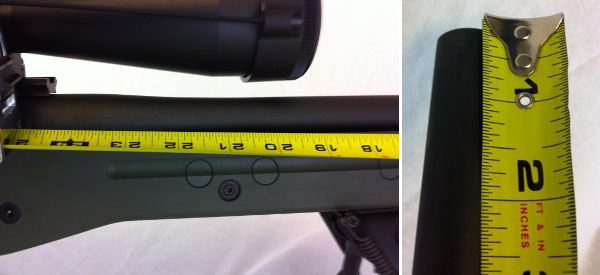
2. Using a pencil and ruler, measure the same distance and mark an even line across the blind.

3. Cut across the line using scissors or a box cutter, shortening the blind to the required length. (Remember, measure twice, cut once!)
4. Expose the adhesive backing on the loop side of the Velcro. Center and apply the Velcro strips on the barrel at regular intervals.

5. Expose the adhesive backing of the fuzzy side of the Velcro.
6. Place the blind on the upper side of the barrel. Apply downward pressure. Once the Velcro has secured itself to the barrel, separate the two sides. Proceed to mold both sides of the Velcro to fit the contour of their respective surfaces.
7. Reaffix the blind. Barrel related mirage is now a thing of the past!

How to Remove and Re-Attach the Mirage Shield
Removal of your mirage shield is accomplished by simply removing the blind. You can un-install the Velcro by pulling off the strips and then gently removing any adhesive residue left behind using an appropriate solvent. (Simple cooking oil may do the job.) Caution: With fine, high-polish blued barrels, test any solvent on a non-visible section of the barrel. Before storing the gun, re-oil the barrel to remove active solvents and residual fingerprints.
July 2nd, 2014
 American Rifleman TV begins its new season tonight, July 2, 2014, on the Outdoor Channel at 6:30 p.m. ET and 10 p.m. ET. This week’s episode features the S.A.A.M. Hunter Training Program at the FTW Ranch in Barksdale, Texas. At this facility, ARTV staffers learn the basic principles of long-range precision shooting as part of the S.A.A.M. Safari Course. In the Rifleman Review segment the new Remington R51 is featured, and in the “This Old Gun” segment you’ll see the infamous handgun that started World War I: the FN Model 1910. American Rifleman TV begins its new season tonight, July 2, 2014, on the Outdoor Channel at 6:30 p.m. ET and 10 p.m. ET. This week’s episode features the S.A.A.M. Hunter Training Program at the FTW Ranch in Barksdale, Texas. At this facility, ARTV staffers learn the basic principles of long-range precision shooting as part of the S.A.A.M. Safari Course. In the Rifleman Review segment the new Remington R51 is featured, and in the “This Old Gun” segment you’ll see the infamous handgun that started World War I: the FN Model 1910.
Watch Preview of 2014 Season Opening Episode of American Rifleman TV
American Rifleman TV is the on-screen version of the National Rifle Association’s American Rifleman magazine. American Rifleman Television covers firearms, the shooting sports, and gun rights issues. “ARTV is part of the larger American Rifleman brand,” said Editor-in-Chief Mark A. Keefe IV. “It’s a show about guns- we teach the history of them and the people who use them.”
Rifleman Feature
Each episode of ARTV is built around one primary feature segment. In that lead story, ARTV staffers may visit a firearms factory, attend a major shooting competition, or work with elite instructors at one of the nation’s leading training facilities. In this week’s season opener, ARTV’s reporters practice long-range precision shooting at the S.A.A.M. hunter training center in Texas.


July 1st, 2014
 The July 2014 digital edition of Shooting Sports USA magazine is now available. Along with the cover story on the Bianchi Cup, this month’s issue has many interesting articles. And the price is right — this month’s Shooting Sports USA eZine is FREE for the taking. Just Click This Link to load the July 2014 eZine edition right in your web browser. The July 2014 digital edition of Shooting Sports USA magazine is now available. Along with the cover story on the Bianchi Cup, this month’s issue has many interesting articles. And the price is right — this month’s Shooting Sports USA eZine is FREE for the taking. Just Click This Link to load the July 2014 eZine edition right in your web browser.
For all competitive shooters, we highly recommend a 6-page article on Mental Training by Editor Chip Lohman. Drawing on scientific studies, Lohman reveals that practice and specialized training can actually improve mental function and create beneficial physical changes in the brain itself. Lohman quotes one study which revealed that “Brain scans of concert violinists and taxi drivers show enlargement of the areas important to the practice of their profession.” Morever, Lohman notes that “the trained brain has a better idea of tripping the correct nerves and muscles, leading to memory within the muscle itself.”

What this means is that competitive shooters can benefit from mental training in profound ways that were not previously understood. If you want to shoot higher scores at your next match, you should definitely read this article, part 2 of a series.
From the ’50s — How to Shoot the High Power Rifle
Another highlight of this month’s Shooting Sports USA eZine is a “golden oldie” article, “How to Shoot the High Power Rifle”. First published in American Rifleman way back in August, 1955, this article covers basic High Power technique. Lt. Col Jim Crossman talks about position shooting, sling use, practice methods, and procedures for relaxing between firing sequences. Much of the advice Lt. Col. Crossman offers can still benefit today’s High Power shooters.

July 1st, 2014
 A while back, Sinclair International’s Reloading Press Blog featured a “round-table” discussion of reloading techniques. Sinclair’s team of tech staffers were asked: “What do you feel is the one-most crucial step in precision reloading?” A while back, Sinclair International’s Reloading Press Blog featured a “round-table” discussion of reloading techniques. Sinclair’s team of tech staffers were asked: “What do you feel is the one-most crucial step in precision reloading?”
Here are their responses (along with comments from our Editors):
Phil Hoham: “I feel that when working up a load do not go too high or too low in your powder charge. Stay away from “suggested loads” you hear at the range, or on the internet. Always be sure to use a published reloading manual that presents not only minimums and maximums, but also pressure, velocity, and a proper range of powders used. Do not get distracted in the reloading process, and remain focused at all times during each step involved.”
AccurateShooter.com: Some loads presented on the Internet are OK as a starting point, but it is absolutely critical to understand that pressure maximums will vary considerably from one rifle to another (of the same chambering). For example, one 6mmBR rifle shooting 105gr bullets can max out with 30.0 grains of Varget powder, while another rifle, with the same chamber dimensions, but a different barrel, could tolerate (and perform better) with half a grain more powder. You need to adjust recommended loads to your particular rifle and barrel.

Pete Petros: “This could be a very broad topic, but if I were to pick one, it would be making sure to pay close attention, and weigh each and every powder charge to ensure that each load is exact and consistent. This is important not only for accuracy, but also for safety reasons.”
AccurateShooter.com: If you’re shooting beyond 200 yards, it is critical to weigh your loads with an accurate scale. Loads that are uniform (within a few kernels) will exhibit lower Extreme Spread and Standard Deviation. And remember, even if you stick with the same powder, when you get a new powder lot, you may have to adjust your load quite a bit. For example, .308 Palma shooters have learned they may need to adjust Varget loads by up to a full grain from one lot of Varget to the next.
Ron Dague: “I feel that the most important step(s) in reloading for accuracy are in the initial case prep. Uniforming the primer pocket to the same depth to ensure consistency in primer seating is a crucial step. Additionally de-burring the flash holes, each in the same way to clean up and chamfer the inside is important. It ensures that the ignition from the primer is uniform and flows out in the same consistent pattern. Doing so will create uniform powder ignition and tighten up your velocity Extreme Spread.”
AccurateShooter.com: With some brands of brass, primer pocket uniforming and flash-hole deburring is useful. However, with the best Lapua, Norma, and RWS brass it may be unnecessary, or worse, counter-productive. So long as your Lapua brass flash-holes are not obstructed or smaller than spec, it may be best to leave them alone. This is particularly true with the small flash holes in 220 Russian, 6BR, and 6.5×47 cases. MOST of the flash-hole reaming tools on the market have cutting bits that vary in size because of manufacturing tolerances. We’ve found tools with an advertised diameter of .0625″ (1/16″) that actually cut an 0.068″ hole. In addition, we are wary of flash-hole deburring tools that cut an aggressive inside chamfer on the flash-holes. The reason is that it is very difficult to control the amount of chamfer precisely, even with tools that have a depth stop.
Rod Green: “I feel that bullet seating is the most important step. If you had focused on making sure all prior steps (case prep, powder charge, etc.) of the process have been carefully taken to ensure uniformity, bullet seating is the last step, and can mean all the difference in the world in terms of consistency. Making sure that the bullet is seated to the same depth each time, and time is taken to ensure that true aligned seating can make the load.”
Bob Blaine: “I agree with Rod. I strongly feel that consistent bullet seating depth is the most important step in creating the most accurate hand loads. I have seen the results in both my bench and long range rifles. Taking the time to ensure exactness in the seating process is by far, the number one most important step in my book.”
AccurateShooter.com: Agreed. When loading match ammo, after bullet seating, we check every loaded round for base of case to ogive length. If it varies by more than 3 thousandths, that round is segregated or we attempt to re-seat the bullet. We measure base of case to bullet ogive with a comparator mounted on one jaw of our calipers. You may have to pre-sort your bullets to hold the case-base to ogive measurement (of loaded rounds) within .003″.
|


