Forum member Evan K. (aka “Katokoch”) has crafted a nice rimfire benchrest rig using a Suhl action fitted into a handsome home-built cedar and carbon fiber stock. This shows what a skilled hobbyist wood-worker can create in his garage. Evan tells us: “Here is my Suhl 150-1 with a factory 1:19″ twist barrel, Leupold 36X scope, Harrell tuner, and my handmade cedar/carbon fiber stock. I started working on the laminate blank a couple years ago and finally finished it earlier this year. I’ve been using it in my IR 50/50 matches this summer. I haven’t shot a 250 with it yet but I know the rifle is very capable — as usual, I am the weak link!”
We think Evan did a great job on his stock, though he has limited stock-building experience. Evan explained: “The stock is my first attempt at making a very lightweight laminate and also gluing both vertical and horizontal seams in a blank. The wood is Spanish and Red Cedar and I made the trigger guard and buttplate with carbon fiber too (great use for small scrap pieces). The finish is hand-rubbed spar urethane and the action is semi-glued-in with Devcon 10110 and stainless pillars.”
USRA-IR50/50 is a popular .22 rimfire benchrest discipline with three (3) classes: 13.5 lb., 10.5 lb., and 7.5 lb. (Sporter). The matches are shot at 50 yards and 50 meters.
Report based on article inNRABlog.com
Today, on the anniversary of the 9/11 terrorist attack, it’s appropriate that we remember the brave public safety personnel who lost their lives on September 11, 2001. Officer Walter Weaver of the NYPD, was one of the many police officers and fire fighters who rushed into the Twin Towers to help save lives.
This stainless steel revolver was recovered from the World Trade Center ruins at Ground Zero. It was identified to have been carried by Officer Weaver on September 11, 2001. He was last seen on the 6th floor of the North Tower attempting to free passengers on an elevator. Officer Weaver’s family donated the gun to the NRA National Firearms Museum, where it now holds a place of honor as a reminder of the law enforcement officers who put their lives on the line daily.
Officer Walter Weaver’s revolver can be found in Gallery 13, Firearm Traditions for Today, at the NRA National Firearms Museum in Fairfax, Virginia.
We know you guys like saving money. Here’s a line-up of current money-saving REBATE offers for everything from ammo to optics. You can save as much as $250 off a rifle or $100 off a scope. NOTE: Deadlines vary with the program — some of these rebates are good through the end of 2015, but others expire in a few days! Check rebate/promo details by clicking on the links provided below:
ZEISS Rebates
Save up to $150.00 on select scopes and binoculars during Zeiss Field Days (through 11/17/2015).
Browning Rebates and Promotions
Get $25, $50, $75 or $100 rebates on Browning rifles or shotguns. Also $50-$100 off Browning safes.
Bushnell Rebates and Promotions
Get $100 off Elite 6500 scopes, $80 off Elite 4500 or 3500 scopes, and $50 off Legend Ultra HD scopes. Offer expires October 19, 2015.
Thompson/Center Rebates
Get $75 mail-in rebate on T/C Venture Rifles, now through 12/13/2015.
RCBS Rebates
Save $50 on $300 RCBS tools/accessory purchase or save $10 on $50 RCBS purchase.
Taurus Rebates
Get $25 or $50 rebate with purchase of qualifying Taurus pistol or revolver.
Federal Ammunition Rebates
Two Rebates: Buy a Savage centerfire rifle and get $25.00 rebate on purchase of $50 or more in Federal rifle ammunition. Or, get $10.00 mail-in rebate on Federal Power-Shok or Fusion rifle ammo.
One recent trend in F-TR competition is the use of low-profile, benchrest-type stocks shot with a light hand-hold and little or no face contact. For this method of F-TR shooting to work, you need the right equipment, and practice a “minimalist” shooting technique. One of the pioneers in this style of F-TR shooting is action-maker John Pierce of Pierce Engineering. Above you can see John shooting one of his F-TR rifles at the 2015 Canadian F-Class Championships. Note the straight-line stock and see how the adjustable bipod is set quite low to the ground (in fact the bipod’s arms are almost straight out).
Members of the Michigan F-TR Team, including Bryan Litz, have used similar rigs with success. Bryan said it took a while to adapt his shooting technique to this kind of rig, but there is a pay-off. Armed with a Pierce-built F-TR rifle, Bryan won his first-ever F-TR Match. Bryan explains the technique he uses when shooting this kind of rifle:
“Coming over from sling shooting, I knew there would be unique challenges to F-TR which I wanted to learn prior to (not during) a major tournament. I learned a new shooting position which doesn’t involve drawing the right knee up. For F-TR I get more straight behind the gun rather than at an angle. I found that the rifle shoots best with very light cheek, shoulder and grip pressure, approaching free recoil. This is how Eric Stecker shot his similar rifle into second place in the SW Nationals [with high X-Count by a large margin]. I learned the rifle’s sensitivity to different bipod and rear bag supports, and found the best buttplate position to allow the rifle to track and stay on target after recoil. This set-up shot best with a mostly free-recoil approach, that means ‘hovering’ over the comb, rather than resting your head on the stock. This took some ‘getting used to’ in terms of neck and back muscle tone. These are the kind of details I think it’s important to focus on when entering a new discipline.”
Bryan’s Pierce-built F-TR rig is a tack-driver: “I can certainly vouch for this set-up! In last weekend’s mid-range State Championship in Midland, MI, I shot my Pierce rifle into first place with a 598-44X (20 shots at 300, 500 and 600). Once you get used to the positioning and way of shooting these rifles, they just pour shots through the center of the target.”
Pierce F-TR Rifles with Scoville Stocks
Shown below are three complete Pierce F-TR rifles, along with a barreled action for comparison. The carbon-fiber/composite stocks are built by Bob Scoville. These Scoville stocks are very light, yet very strong and very stiff.
Frank Galli, aka “Lowlight”, is the head honcho of Sniper’s Hide. In the video below, Galli offers a series of shooting tips he calls the “Long Range Shooting W.T.F”. No that’s not what you think it is — no cuss words are involved. “W.T.F.” stands for Wind, Trajectory, and Fundamentals of Marksmanship. To shoot well, Frank says, you first must gauge the wind correctly. Second, you must know the trajectory of your load in your rifle — i.e. know your ballistics. If you want to hit a target at long range, you must start with a rock-solid zero, determine an accurate muzzle velocity, and know the Ballistic Coefficient of the bullet. Plug all that into a good ballistic program (along with elevation, temp, and air pressure) and you should have your point of impact (within a click or two) out to 1000 yards.
Watch Video for Tips about Wind-Reading, Ballistics, and Shooting Fundamentals:
The third element of “W.T.F” is “F” for “Fundamentals of Marksmanship”. This actually involves multiple factors — body position (relative to the rifle), finding your natural point of aim, proper head alignment behind the scope, pre-loading the bipod, breathing modulation, trigger control, follow through, recoil management and more. Frank addresses all these “fundamentals” in the second half of the video, starting at the 3:40 time-mark.
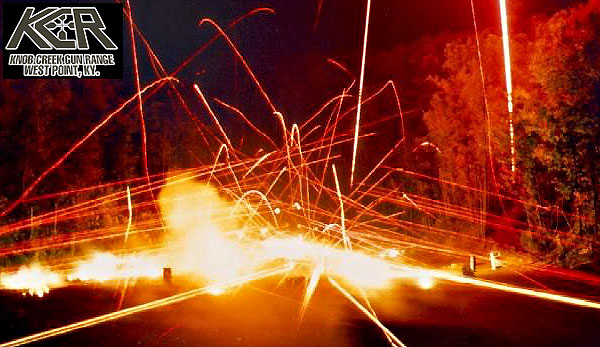
Twice a year, select-fire fans head to the Knob Creek Gun Range in West Point, Kentucky, for the nation’s largest Machine Gun Shoot. A bi-annual event, the Machine Gun Shoot is held in April and October. This year’s fall Machine Gun Shoot will take place October 9-11, 2015. The highlight of every Machine Gun Shoot is the Saturday Night event, where scores of guns send regular and tracer bullets down-range. An estimated 1.25 million rounds are fired each year during the October Night Shoot.
Click Triangle to Watch Knob Creek Machine Gun Shoot Video (Warning: Very Loud Audio)
This video was created by Top Shot Season 4 Champ Chris Cheng.
There’s a new two-stage trigger for Remington and Rem-clone actions from CADEX Defense of Canada. The new CADEX DX2 double-stage trigger adjusts from 1.5 to 5.0 lbs pull weight. Both stages can be adjusted separately through allen-head screws located on the front of the trigger body. The trigger shoe also adjusts fore and aft. The CADEX DX2 is offered in both a standard version (no safety or bolt release) and a version with integral safety and bolt release. The cost of the standard DX2 is 267.95 Canadian dollars, or $202.62 U.S. Dollars at current exchange rates. Add forty dollars (Canadian) for the version with safety and bolt release.
DX2 Dimensions: 7.21cm x 4.42cm x 1.22cm | With Safety/Bolt Release: 7.65cm x 5.23cm x 3.35cm
DX2 Weight: 37.5 grams | With Safety/Bolt Release: 52 grams
Frank Green Tries the CADEX Two-Stage
Frank Green of Bartlein Barrels recently acquired one of the CADEX two-stage triggers and he likes it. Here is his report:
“My CADEX two-stage trigger arrived[.] I installed it into my Badger M2008 action/rifle in 6 Creedmoor. Initial impression is that it’s very nice. You can adjust each stage for pull of weight. You can adjust the position of the trigger shoe and [adjust] for over-travel as well. I think the pricing on the trigger is going to be very competitive and it will be a nice option out there for another two-stage trigger.
I installed it and made no adjustments. Checked it for function and measured some pull weights while the barreled action was out of the stock. Reassembled the whole rifle and again made some pull weight measurements. I recorded the last five and they came in at 2.09, 2.15, 2.15, 2.1 and 2.12 pounds. The little variance I’m going to chalk it up to me and how I pulled on the trigger scale …but it broke clean.”
Installation Considerations
Frank Green said there may be some clearance issues with some trigger guards: “The CADEX trigger shoe assembly is a tad longer than a stock Remington. In my trigger guard it barely bottomed out/touched in the guard but functioned just fine but to give it a little room I milled .010″ off the bottom of the shoe. My trigger guard is a Defiance. I’d have to throw the trigger onto a Remington rifle/trigger guard assembly and a Badger bottom metal to see if it does the same thing but [this] is minor in my opinion.
You need a T6 Allen wrench to adjust the trigger shoe location. I had to move my shoe forward just a tad from how it came out of the package. When pulling the trigger it would just touch the back of the trigger guard.”
On our main AccurateShooter.com site, you’ll find a good article by G. Salazar on the Basics of Neck Turning. If you’re new to the neck-turning game, or are just looking for good tips on improving your neck-turning procedures, you should read German’s article. Below we offer some highlights and photos from the article, but you’ll need to read the whole story to view all the illustrations and follow all the procedures step by step.
Why Should You Consider Neck Turning?
Let’s assume that your rifle doesn’t have a tight neck chamber that requires neck turning; if you have a tight neck chamber, of course, the answer to the question is “because you have to”. For the rest of us, and that includes the vast majority of Highpower shooters, neck turning isn’t a requirement, but it can be a useful way to bring your ammunition a small but meaningful step closer to that pot of gold at the end of the rainbow: perfection. I’m not talking about a theoretical improvement, but a real one, an improvement that lies in equalizing and optimizing the neck tension of your loaded rounds. Inconsistent neck tension is a real contributor to increased muzzle velocity variance which itself is a significant factor in increased elevation dispersion at long range. So there’s our basic reason for neck turning: to equalize and optimize neck tension in order to reduce elevation dispersion.
The Tools of the Trade
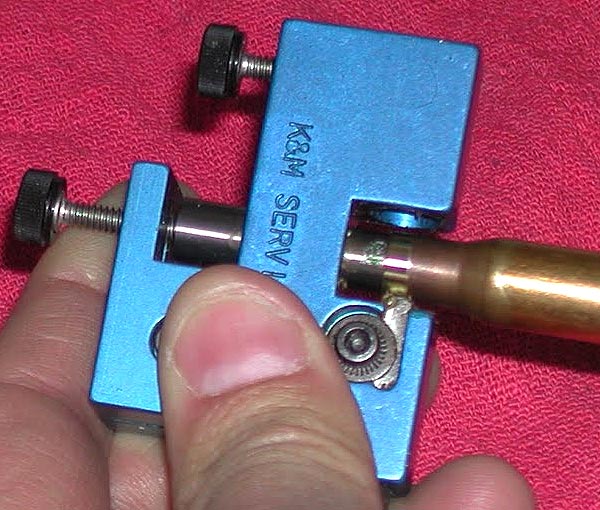
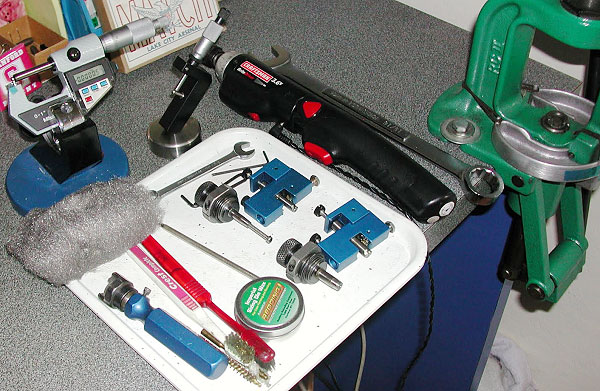
Here you see everything I use and a bit more. The press, a cordless screwdriver (always plugged in, turning is tough on the old battery), a couple of K&M neck turners (one set up for 6mm, the other for .30 caliber) an expander for each size, some Imperial lube, an old toothbrush or two to keep the cutter clean, a handle with a caseholder (for those emergencies when the screwdriver dies and there’s just one more case to go!), steel wool and a tubing micrometer finish the list of tools. Hey, I left the dial calipers out of the picture! They’re always handy, keep them around, but they are useless for measuring neck thickness, so don’t try. I usually use an Optivisor magnifier while I turn necks, very handy for a clear view of what’s happening on the neck.
Expanding the Neck
Put some lube on the inside of the case neck and run it into the expander. Really, this isn’t hard. I prefer to expand each case immediately before turning it as opposed to expanding all the cases and then turning them. Brass is somewhat springy and will tend to go back toward its original size; therefore, by expanding and turning immediately, you are more likely to have all cases fit the mandrel with the same degree of tightness and to get a more consistent depth of cut.
Cutter Adjustment for Cut Depth and Length
All the tools I’ve seen have pretty good adjustment instructions. The only thing they don’t tell you is that you should have five to ten spare cases to get it right initially. Anything of the right diameter will do while you learn, for instance, just use that cheap surplus .308 brass to do initial setup and save the precious .30-06 for when you know what you’re doing. Be patient and make your adjustments slowly; you’ll need to set the cutter for thickness as well as length of cut (just into the shoulder). The depth of cut (brass thickness) takes a bit of fiddling, the length of the cut is generally easy to set.
The Finished Product — A Perfectly Uniform Neck
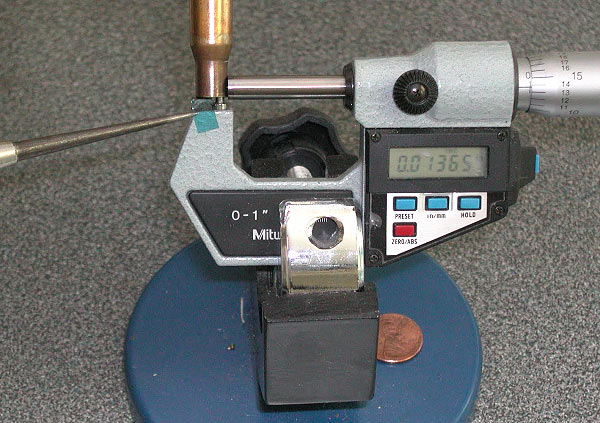
If you read the whole article, and follow the procedures using quality tools, you should get very good results — with a little practice. To demonstrate, here’s an example of my finished, neck-turned brass. You’ll see there is a perfect, 0.0125″ thick neck. It’s very uniform around the circumference, usually I only see 1 or 2 ten-thousandths variance. Now, with the necks uniformed like this, we can select the bushing size that will give us our preferred neck tension and experiment with various levels of tension, secure in the knowledge that all of the cases will actually have the desired neck tension.
Report by Tom Whitaker, Captain of USA Veterans Team
Much has been said about the fantastic performance of the Great Britain Palma Rifle Team setting a new World Record for the Palma Team course of fire, as well as the strong second place showing of our USA Palma squad. However, little to nothing has been published about the only team World Championship that the United States won at the World Championships this year at Camp Perry.
Before all the pomp and circumstance of the World Individual Championship and the Palma Team Match got underway, a dedicated group of shooters made their way to the firing line. These were the members of the 2015 USA Veterans Rifle Team. To qualify for this team one of the requirements is to have reached your 60th birthday by the first day of the World Championships. This usually means you’ve “been there and done that” for many years and still love the sport. The team consists of a maximum of 17 people, a captain, adjutant, three coaches, 10 firing members, and two reserve members. Each team has two targets so the firing members are separated into two squads of five, each with a line coach. The third coach or main coach coordinates the two squads to optimize their performance. The course of fire is two convertible sighting shots and 10 shots for score per shooter at 300, 600, 900, and 1000 yards on the ICFRA 5V Targets.
When I was child my family raced horses. My father was once asked “how do you win a horse race?” His answer was “Break out of the starting gate in first place and keep improving your position.” That is exactly what the USA Veterans Team did, as the Americans won the 300-yard stage and each stage thereafter to beat the British Team by 12 points 1919-152V (USA) to 1907-172V (GB). Canada was third with 1896-131V, Australia fourth with 1878-140V. Of special note, Wayne Forshee (maker of the famous “Rightsight”) was high score on the entire line with 196-24V!
Message from Tom Whitaker:
As Captain I would like to congratulate my team again. No captain could be more proud of a team than I am of these “oldies”. They worked very hard to accomplish their quest for the Gold, a feat that hasn’t been done since 1999. Team members are:
Captain: Tom Whitaker; Adjutant: Leo Cebula; Coaches: Steve Hardin, Jim O’Connell, Gary Rasmussen; Shooters: David Crandall, Peter Church, Gerard DeCosta, Wayne Forshee, Charles Kemp, Randall Gregory, Marty Mayo, Noma Mayo, Steve McGee, Bob Steketee; Reserves: Michel Dunia, J.P. Young.
In the World Individual Championships there were three U.S. shooters who qualified for the final “top ten” shoot-off at 1000 yards, they, too, were all Veterans. I have heard it said that old eyes can’t be counted on to get the job done, but it looks like old age and treachery won out over youth and enthusiasm this time. Many thanks to all who supported our team. We could not have done this without your help, especially Sierra Bullets, Lapua, and The Bald Eagles Rifle Club.
In recent years, Forster Co-Ax® presses have been somewhat hard to find, as demand has out-stripped supply. However, right now Grafs.com has Co-Ax presses in stock, at just $299.99 — that’s six percent off the regular price. This sale price includes a set of jaws, and includes ground shipping (in the lower 48), after a single $7.95 (per order) handling fee. If you’ve been hankering for a Co-Ax press, now is definitely a good time to buy.
If you are not yet familiar with the many unique features of the Forster Co-Ax, we recommend you watch the video embedded below. This shows how the press operates and highlights the design elements which set the Co-Ax apart from every other reloading press on the market.
Forster Co-Ax Press Video Review
This is a very thorough review of the Forster Co-Ax done by Rex Roach. This 14-minute video shows the key Co-Ax features, explaining how the floating case-holder jaws work (3:30 time-mark), how the dies are held in place (4:40 time-mark), how spent primers are captured (6:10 time-mark), and how to set the primer seating depth (10:00 time-mark). We’ve used a Co-Ax for years and we still learned a few new things by watching this detailed video. If you are considering purchasing a Co-Ax, definitely watch this video start to finish.
The Co-Ax case-holder features spring-loaded, floating jaws. These jaws have two sets of openings, small and large. This allows the system to adapt to various rim diameters. The jaw plates can simply be reversed to switch from small jaw to large jaw. In the photo above, the Co-Ax is configured with the large jaw openings in the center.





 Installation Considerations