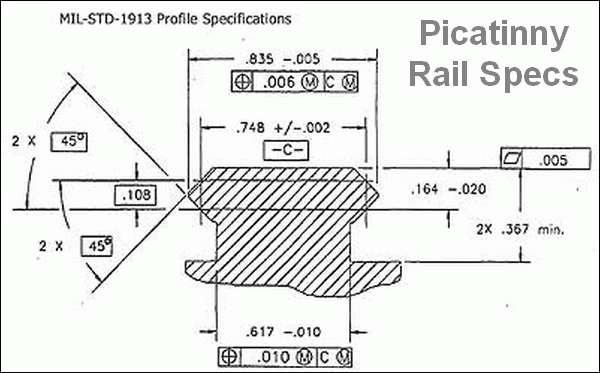
Readers often ask “What’s the difference between a Weaver scope rail and a Picatinny Rail?” The answer is not as simple as it seems. The dimensions of a Picatinny Rail should be consistent (from one rail-maker to another), since there IS a government spec. Conversely, there is some variance in “Weaver-style” rails. The width of the groove is the most important difference between Picatinny Rails and weaver rails. “Mil-spec” Picatinny rails will have a grove width of 0.206″ while Weaver rails typically have a narrower, 0.180″ groove width.
Brownell’s has a helpful GunTech™ Article that discusses the Picatinny Rail vs. Weaver Rail. That article explains:
“What are the differences between the ‘Picatinny’ and the ‘Weaver’ systems? The profile of the two systems is virtually identical. Depending on the quality of the machining done by the manufacturer, the two systems should be indistinguishable from the profile. The key difference lies in the placement of the recoil grooves and with width of the grooves. MIL-STD-1913 (Picatinny) grooves are .206″ wide and have a center-to-center width of .394”. The placement of these grooves has to be consistent in order for it to be a true ‘Picatinny’MIL-STD system. Weaver systems have a .180” width of recoil groove and are not necessarily consistent in a center-to-center measurement from one groove to the next.
In many instances, a Weaver system has a specific application that it is machined for, so interchangeability is not necessarily an issue. A MIL-STD-1913 system must adhere to the specifications listed above in order for it to be considered MIL-STD, since the military desires uniformity in the recoil grooves to allow for different systems to be mounted on the weapon with no concern for compatibility.
Now, what does this mean to you? Boiled down, it means that accessories designed for a Weaver system will, in most cases, fit on a ‘Picatinny’ system. The reverse, however, is probably not the case. Due to the larger recoil groove, ‘Picatinny’ accessories will not fit a Weaver system. There are, of course, exceptions to every rule, but for a good rule-of-thumb, [full-width] ‘Picatinny’ won’t fit Weaver, but Weaver will fit ‘Picatinny’.”
In case you haven’t heard, Sierra has a great new 7mm match bullet, the 183 grain MatchKing (item #1983). This bullet boasts an impressive 0.707 G1 Ballistic Coefficient (BC) at 2300+ fps. These bullets also have very consistent bullet-to-bullet BC, thanks to the tips being “pointed” at the factory. Sierra explains: “A final meplat-reducing operation (pointing) provides an increased ballistic coefficient for optimal wind resistance and velocity retention.” Top F-Open shooters have told us that these bullets shoot exceptionally well, with minimal vertical dispersion at 1000. “Holding waterline” at long range is a reliable indicator that the BC is very uniform from bullet to bullet.
The design of this bullet represents a radical departure for Sierra. The 7mm 183gr MK employs a new bullet shape with a special geometry: “To ensure precise bullet-to-bore alignment, a unique bearing surface to ogive junction uses the same 1.5 degree angle commonly found in match rifle chamber throats.” Mark Walker, Sierra Product Manager, explains: “We thought instead of using the typical ogive radius that can allow slight misalignment, why not use the same straight angle that is used in the chamber leade on the bullet ogive to force itself to always align with the bore? Once past that area, we use a traditional high caliber ogive radius[.]”.
Insight Into Sierra’s New 7mm MatchKing® by Sierra Product Development Manager Mark Walker
In late 2015, Sierra introduced a new 7mm MatchKing® bullet with a different type of ogive. As part of the introduction, I had the opportunity to use them at the F-Class Nationals held in Phoenix with very good results. While at the match, several people had questions about what exactly was different about the ogive on this bullet as opposed to our tried and true blended tangent ogive. So with that in mind, hopefully this blog will answer those questions.
In the past, Sierra has typically used a tangent radius ogive design on our MatchKing® bullets. This is one of the most forgiving ogive designs due to its ability to shoot extremely accurately when jumped, as well as, jammed into the rifling. On rare occasions, some of our MatchKing® bullets have used a secant ogive due to design constraints. However, this ogive is much more sensitive to changes in seating depth than the tangent ogive so we tend to shy away from it. When we decided to work on this new bullet, we wanted to see if we could improve on the accuracy of even our best shooting tangent ogive bullets.
One of the main factors of what makes an accurate shooting bullet is how it aligns itself with the bore when fired. If a bullet is slightly crooked when entering the bore, it will cause inaccuracy on the target. We set out trying to think of ways to make sure that the bullet has no choice but to align itself with the bore perfectly.
The first part of the barrel to encounter the bullet is the leade in the chamber. The leade is an angle that is cut into the leading edge of the rifling which helps to guide the bullet into the bore. To illustrate how current bullets fit into the leade, picture a cone (leade) with a ball (bullet) sitting inside it. The ball can be rotated in all directions and the cone cannot force the ball to orientate itself in any particular direction. When a bullet with a radius encounters the leade, it behaves in a similar way. Now this of course is a very simple example and of course advanced shooters use tight necks and brass that is perfectly formed to the chamber to make sure the bullet is aligned as perfect as possible. However, there is always a small element of misalignment that is possible even with all this precise preparation.
This brings us to the ogive on the new 7mm MatchKing®. We thought instead of using the typical ogive radius that can allow slight misalignment, why not use the same straight angle that is used in the chamber leade on the bullet ogive to force itself to always align with the bore? Imagine the same cone as above (leade) with an identical cone (bullet) sitting inside of it. The cone inside has no choice but to align itself perfectly with the cone that it is sitting in every time. With that in mind, we designed the area of the bullet which contacts the leade in front of the bearing surface using a straight 1 1/2 degree angle instead of the typical radius. Once past that area, we use a traditional high caliber ogive radius to provide a very sleek, high BC bullet.
I hope that explains our thought process behind this new bullet. In our testing, it is one of the most forgiving high-BC bullets we have ever made.
TV Shopping networks typically sell jewelry, housewares, and clothing items. Now there’s a new TV shopping network that will sell firearms and shooting accessories. GunTV recently launched with shows airing on cable and satellite networks (and streamed live on GunTV.tv on the web). This video unveils GunTV’s mission and explains how guns and shooting sports merchandise will be sold:
GunTV presentations combine studio sessions with range time. The hosts begin, in studio, talking about a gun’s features. Next the show may feature range footage demonstrating the firearm. Then it’s back to the studio for the sales pitch. Finally, viewers can bid on the featured item(s). Non-firearms items may ship directly to buyers. However, all actual firearms are sent to an FFL dealer, which performs background checks and handles the required paperwork.
30 Cal Gal on GunTV
One of GunTV’s hosts is our friend Anette Wachter, creator of the 30CalGal.com website. Anette, a top-level Palma and multi-gun competitor, will be testing and reviewing products, as well as selling her signature 30CalGal line of custom jewelry.
Safety is emphasized in GunTV broadcasts. The show’s creators state: “GunTV offers education, information and safety regarding firearms in America[.] GunTV is proud to offer its consumer audience an exciting mix of unique content, a wide range of firearms and related products and services, educational information, resources and entertainment, all delivered via live broadcasting on satellite and cable systems and streaming on the Internet.”
Promotional Opportunities for Manufacturers
GunTV makes money two ways. First it takes a share of sale proceeds from items sold. In addition, it gets promotional fees from product makers. If you have a shooting-related product you want to see featured, you can advertise on GunTV. You can apply online using the Product Submission Application form. GunTV charges fees for its airtime segments and advertising spots and advertising spot production services.
Guns are big money. In the past seven years, the dollars generated by the production and sales of guns and ammo have more than doubled. In fact, total economic impact of the firearms and ammunition industry in the United States increased from $19.1 billion in 2008 to $49.3 billion in 2015, a 158% increase. Meanwhile the total number of gun industry full-time jobs rose from approximately 166,000 to almost 288,000, a 73% increase in that period, according to a report released by the National Shooting Sports Foundation (NSSF), the industry’s trade association. Read NSSF Report HERE.
On a year-over-year basis, the industry’s economic impact rose from $43 billion in 2014 to $49.3 in 2015, a nearly 15 percent increase while total jobs increased from approximately 263,000 to almost 288,000, a 9 percent increase in the same period.
“Our industry is proud to be one of the truly bright spots in our economy as an unprecedented number of Americans have chosen to exercise their fundamental right to keep and bear arms and to safely enjoy the shooting sports,” said Stephen L. Sanetti, NSSF president and CEO. “We have increased our direct workforce by about 21,000 in the last two years alone, adding jobs that pay an average of more than $50,000 in wages and benefits.”
The Firearms and Ammunition Industry Economic Impact Report: 2016 provides a state-by-state breakdown of job numbers, wages and output covering direct, supplier and induced employment, as well as federal excise taxes paid. Access the full report here.
Bart Sauter of Barts Custom Bullets has acquired a LabRadar chronograph. He was curious to see how his loads performed in actual match conditions, so he brought his LabRadar to a match and set it up right on his benchtop. What he learned was quite surprising. For one thing, Bart found that tuning for the best accuracy (in the conditions), was NOT simply a matter of maintaining velocity. Read all about Bart’s experience in this AccurateShooter Forum Thread.
LabRadar Report by Bart Sauter
Bart posted: “I shot a short range NBRSA match [in March] with the LabRadar on the bench! The benches were quite close, but the LabRadar was able to pick up my shots even with the other guns going off very close to it. This is a pretty impressive piece of gear.”
It’s great for tuning. I can’t say for sure but what I saw with the PPC is that just maintaining a certain velocity will not keep the gun in tune.”
One Forum member asked: “Was the LabRadar able to pick up shots that far back (behind the muzzle) and to the side? What setting did you have it set at?”
Bart’s LabRadar unit had no trouble picking up shots when set on the bench, a bit behind the muzzle. In fact, Bart noted: “Yes it can go a long way back. At home I could get back up to around 8 feet and pick up the bullet. It’s more sensitive about the side distance. I had mine on level 4. You can be a lot farther behind the muzzle then advertised. You can also point it at your buddy’s target and get his velocity.”
Bart set his LabRadar to be triggered by the shot: “I had a tuner on the gun but no muzzle brake. [The Chrono] was set to be triggered by the sound of the gun. When you move back you have to play with the trigger level. I put mine on a tripod and was able to pick up projectiles 8 feet back, but from the side had to be within 18 inches.”
Long-Life Battery Power
Powering the LabRadar at the range is not a problem. Bart used a portable battery pack that can power the LabRadar for a long time: “I bought a RavPower battery pack from Amazon.com. It was the most powerful compact cell phone charger they had and [it costs about $30.00]. It was able to run the LabRadar for two full days without recharging and still had juice.”
The LabRadar is a pretty expensive piece of kit, but there’s nothing else like it on the market. Bart notes: “The LabRadar itself is about $560.00. The stand is $29.95 for the bench mount and the padded carry case is $39.95. So you’re around $630.00 plus shipping.”
LabRadar Field Test by Ray Gross
If you are considering purchasing a LabRadar Chronograph system, we strongly suggest you read the very thorough and informative LabRadar Review by Ray Gross, Captain of the USA F-TR team.
Have you ever left your plugs or muffs at home when you took a trip to the range? That’s happened to most of us. That won’t be a problem now, so long as you have your eye protection. Browning now offers ANSI-rated safety eyewear that includes corded NRR 25 earplugs stored in the frames. That’s a clever design — one less thing to worry about.
Browning’s new Sound Shield shooting glasses feature ear plugs stored on a retractable cord in the end of the frames. Now, if you have your shooting glasses with you, you will always have hearing protection as well. The end of each sidepiece opens to release the corded retractable ear plug. The ear plugs have a NRR of 25 dB and are replaceable and washable.
Sound Shield shooting glasses feature polycarbonate, wrap-around lenses with a frameless design to provide additional coverage and eliminate blind spots. The glasses are available in two different styles (Large/Medium) with either yellow or lightly-tinted indoor/outdoor lenses. All lens types exceed ANSI Z87.1 impact standards. A soft rubber standoff nosepiece reduces slipping and lens fogging. According to the Browning website, these Sound Shield glasses may be offered in a kit that includes NRR 27 ear muffs, but we don’t know if that is available yet.
At the request of our readers, we provide select “Deals of the Week”. Every Monday morning we offer our Bargain selections. Here are some of the best deals on firearms, hardware, reloading components, and shooting accessories. Be aware that sale prices are subject to change, and once clearance inventory is sold, it’s gone for good. You snooze you lose.
Here’s a rifle with a smooth three-lug action and good trigger that can take any game in North America. The Browning A-Bolt is justifiably respected as a solid hunting rifle. The 300 Winchester Magnum chambering offers serious hitting power, even at long range. This rifle, with a blued barreled action, normally retails for $600.00+. Now it’s on sale for under $500.00. What’s more Browning will pay the sales tax (up to 8%). That’s right, Browning is currently offering a Sales Tax Rebate for any Browning firearm purchased before April 30, 2016. That will save you forty bucks in states with 8% sales tax.
2. Brownells.com — AR15 Stripped Lower, $59.99
This small pin lower receiver is precision-machined from a 7075 T6 aluminum forging. This versatile, mil-spec lower can be the foundation for rifle builds on 5.56/.223, 6.5mm, 6.8mm, 300 AAC Blackout or other chamberings. Holes, inletting and pin locations have been cut to final dimensions and accept standard AR-15 magazines and components. Right now this Aero Precision lower is on sale at Brownells for just $59.99.
3. Midsouth — Lyman BoreCam Digital Borescope, $222.46
Note: We are repeating this special (first listed last week) because it is the best deal we’ve found on an excellent product in high demand. The Lyman BoreCam is an electro-optical borescope with a digital display. You can record “stills” on a SD card. This is one of the hottest products on the market right now — so hot that it has been back-ordered at most vencdore. But we found some in stock at a great price. Midsouth Shooters Supply now has the BoreCam for $222.46. Grab it while you can at that price. Other online vendors are charging a LOT more (e.g. MidwayUSA price is $259.99).
4. BassPro Shops — Federal .22LR Target Ammo, $4.79/50 Rounds
This Federal Gold Medal Target ammo is MUCH better than common bulk rimfire ammo, yet with this deal, it is only 9.6 cents per round. That’s cheaper than most other .22 LR ammo that’s anywhere near as good. This special is available now from Bass Pro Shops webstore. In addition, Bass Pro is currently offering Free Shipping on orders over $50.00.
Like the RCBS ChargeMaster, this Lyman Gen6 Powder System will automatically dispense and weigh powder charges. This unit features a touch screen, rapid warm-up, anti-static/anti-drift technology, and electronic shielding to resist interference from other electronic devices. It’s a good deal at $205.99.
6. Midsouth — Lyman Bleacher Loading Blocks
Lyman’s new Bleacher Block stepped cartridge holders are great. Use the different levels for sorting brass. Or, migrate the brass from top to bottom as you proceed through case prep stages. Made of durable polymer, Bleacher Blocks are molded in three sizes. The smallest size (with 0.388″-diam holes) fits .223 Rem-size case heads. The middle size (with 0.485″-diam holes) fits .308 Win-size case heads. The biggest Bleacher Block has 0.565″-diameter recesses for magnum-size cases. All three cartridge block sizes hold fifty (50) rounds. Purchase any size for just $5.90 per Block at Midsouth.
7. Monmouth Reloading — 1000 Lake City 5.56 Cases, $68.95
1000 pieces of Lake City brass for under seventy bucks? Yep, that’s a deal and a half. Monmouth Reloading is selling genuine, once-fired Lake City 5.56x45mm brass, thick-walled and sourced direct from the U.S. Military. Monmouth reports: “Our current stock of Lake City 5.56 looks to be all newer year Lake City head stamp but may contain a small percentage of other NATO headstamps. Lake City is a popular, reliable brass, normally capable of many reloads.” Monmouth includes 1% overage to account for any damaged brass. NOTE: Brass has crimped primers, so the pockets will need to be reamed or swaged prior to reloading.
8. Amazon — Leight MAX NRR33 Earplugs, $7.58 for 50 Pairs.
These Howard Leight NRR33 Max plugs are your Editor’s favorite foam earplugs. Between shooting, motorcycling and mowing lawns, I probably have Max plugs in my ears 2-3 days a week. This is a very good price for a bulk pack of 50 pairs. And if you act soon, you can get free shipping to boot.
The latest digital edition of Shooting Industry Magazine offers a run-down of hot products at SHOT Show 2016. In this FREE April edition, you’ll find a SHOT Show in Review article, a “Show Stoppers” guide to Buyers’ favorites, a list of products you may have missed, as well as a 2016 New Product Showcase. For anyone interested in new shooting products, you really should read this special April issue cover to cover. This year’s SHOT Show, held January 19-22 in Las Vegas had more than 1600 exhibitors, with a record number of new products on display.
Show Stoppers from Las Vegas
One of the Show Stoppers highlights was a quad-barrel AR Kit. The new Multi-Caliber System (MCS) from Windham Weaponry offers plenty of bang for the buck. The kit comes with four different barrels: .223 Rem, 7.62x39mm, .300 Blackout, and 9mm Luger. The gun’s modular design makes it easy to change calibers by swapping barrels and magazine wells. (That’s right, you change the magwell to fit the caliber — a smart idea. That way you can run proper AK-style 7.62×39 magazines). One dealer stated: “You can get all four conversion kits in a hard-sided case at a decent prices. The fact you can change calibers so quickly is going to make this a big seller.”
New Product Showcase
Along with the Show Stoppers Guide, this April issue of Shooting Industry Magazine featured “Products You May Have Missed At SHOT Show” as well as a New Product Showcase. The Showcase highlights interesting new products from Benelli, Browning, Colt, Kimber, Nikon, McMillan, Nosler, Polycase, and many other leading brands.
Do you shoot with a SEB joystick-equipped bipod, or are you considering acquiring a “Joy-Pod” for your F-TR rifle? Then you should read this article. Here Sebastian (“Seb”) Lambang, the inventor and builder of the SEB joystick bipod, offers tips on shooting with this impressive piece of engineering. Seb explains some techniques that can help with tracking and getting back on target. You can ask SEB questions about his Joy-Pod in this Shooter’s Forum Thread.
Joy-Pod Shooting Tipsby Seb Lambang
1. Be sure that the rear bag is settled before starting to shoot. Tap your stock into the bag. Then move your rifle back and forth, while checking your reticle. If it tracks straight, vertically perfect, and comes back to the original point of aim, it’s fine. If not, re-adjust.
2. If you use the Pod-Pad, be sure it is fully settled before starting to shoot. Tap the top where the feet rides on using your palm — you wan to create a flat top. To be sure the Pod-Pad does not move or slide, remove any gravel or pebbles under the pad — these can act as roller bearings.
3. Be sure your shooting mat is NOT springy or spongy. This is very important. Use a proper mat, or cut it if possible so your rear bag rests directly on the ground. Use a heavy rear bag. You can use a sand-filled doughnut (not a rigid spacer) to stabilize the bag on uneven ground. These doughnuts are relatively inexpensive and really work.
4. Be sure your whole body position is correct, so your shoulder is square. “Follow” the recoil with your shoulder, don’t push “against” it. Don’t move too much. Don’t make unimportant movements during your shooting string. Always be as consistent as you can in all things — how you hold the rifle, even how you breathe before taking the shot.
This young lady shooter is using a first generation Joy-Pod. The newer versions have flat, ski-like feet.
5. Be sure your rifle and rear bag are aligned. You want the slot between the ears of the bag perfectly aligned with your barrel. (You can use a yardstick or a piece of string to help with the alignment).
6. Use a heavy rear bag. The heavier and the more stable, the better.
7. It does not matter (from my own experience) whether you light-hold the joystick or leave the joystick in the air when you shoot (see Darrell Buell video — he shoots “hands off”). I believe the bullet already exits the muzzle before the joystick moves in your fingers. I lightly hold the joystick myself, just as I would hold a billiard stick.
Watch Darrell Buell shooting his .375 CheyTac equipped with a counter-balanced Joy-Pod. Note how the gun comes straight back, and how Darrell can release the joystick before breaking the shot.
SUMMARY — When It All Comes Together
If everything is set up right, and done correctly, your rifle will track beautifully straight and your reticle will come back or very close to the original point of aim, every time. If you have to change the Joy-Pod, rear bag, or your body position after a shot, there could still be something wrong with your set-up, alignment, or body position. When everything is right, you can also see your own score in the scope after every shot you make (after initial recoil). You also should not have to change the bipod’s setting, the height, the cant etc., at all. You only need to adjust for the current condition with the joystick, the joystick will do it all. That’s why we call our bipod the JOY-Pod.
SEB JOY-POD Joystick Bipod, and POD-PAD
Weighing in at just 18 ounces (510 grams), the Gen 2 Joy-Pod is unlike any other bipod on the market. Designed specifically for weight-restricted shooting classes, the Joy-Pod offers smooth and precise joystick-controlled aiming. The Gen 2 model offers up to 14 degrees of cant and an improved design that functions with up to 50 pounds of rifle weight. Each Joy-Pod comes with a Weaver rail adapter. The optional Pod-Pad accessory is designed expressly for the Joy-Pod. It works filled or unfilled with the Joy-Pod’s sleds to bring you back to your shooting position easily. CLICK HERE for more information, or visit SebRests.com.
.308 Win Tactical Rifle fitted with Joy-Pod on Pod-Pad. CLICK HERE for Video.
What can you do with $12,215.00? Well, you could buy a new Polaris RZR ATV, a really nice bass boat, 234 shares of Verizon, or 643 bottles of Jack Daniels Old #7. Or, if you are the U.S. Army, you can buy one (1) semi-auto sniper rifle, plus some spare parts. The U.S. Army announced recently that it will replace its M110 Knights Armament-made sniper rifle with a new, lighter 7.62×51 semi-auto rifle from Heckler and Koch. H&K will supply a slimmed-down variant of its G28 Rifle called the Compact Semi-Automatic Sniper System (CSASS). The potential max contract value is $44,500,000 for up to 3,643 rifles (and spare parts). That works out to $12,215.21 per rifle*. At that price, it better be good.
The military says the G28 system is lighter and more compact than the 15.3-lb M110 produced by Knights Armament Company (KAC). The G28 is certainly more compact, given its 16.6″ barrel. But somebody seems to have forgotten that velocity is lost with a shorter barrel. A longer barrel will deliver significantly higher MV for better long-range ballistics. Nevertheless the Army thinks portability trumps ballistics: “Compared to the M110, the CSASS will be easier to carry, handle and maneuver in close-quarters combat. It will lighten the load for carrying over rough terrain for the longer-range ridgeline to ridgeline fight. These improvements will not sacrifice existing performance, accuracy or reliability.”
Hmmm… “Not sacrifice existing performance”? We’re not sure how that can be the case. The current KAC M110 Sniper Rifle (shown below) has a 20″ barrel. The basic G28 has 16.6″ (421 mm) barrel). Perhaps the final CSASS production version of the G28 will be fitted with a longer barrel?
Here’s what various sources report: “On 1 April 2016, the Army announced it had awarded Heckler and Koch a contract with a maximum value of $44.5 million as winner of the competition to replace the KAC M110. H&K is to produce 3,643 rifles. A goal of the effort was to give snipers a weapon that didn’t “stick out” as a sniper rifle; with a suppressor, the current M110 is 46.5″, that’s 13″ longer than the M4 carbine. A minimum of 30 CSASS units will be used for production qualification testing and operational testing over 24 months. H&K later confirmed that a modified G28 had indeed been selected as the CSASS rifle. The G28 is nearly 2.5″ shorter and 3 pounds lighter than the M110 (unloaded and without a suppressor) and will cost about $12,000 per rifle.”
Comment: We’re not so sure about this deal. $12.2K is a lot of money for a souped up AR10. The KAC M110, by all accounts, has performed well in combat and has a good reputation with sniper teams. When introduced, the M110 Semi-Automatic Sniper System (SASS) won a U.S. Army award as one of the “Best 10 Inventions” of 2007. The M110 is highly acclaimed for its battlefield performance. If the military wanted a shorter rifle, it simply could have fitted a shorter barrel and a collapsible buttstock on existing M110s. That would have saved millions of dollars. But saving money is, apparently, not one of the Pentagon’s priorities these days.
* This HK firearm is sold as a CSASS system. Typically, the price per system unit will include optics, attachments, fitted hard case, and spares.