22nd Bud Pryor Memorial Matchby Dick Grosbier
Saturday June 11th was the 148th running of the Belmont Stakes in New York, and the 22nd running of the Bud Pryor Memorial Match at Thurmont, Maryland. Since this is a shooting website, I will be writing about the “Bud”. This year’s offering was a two-day match with 100-yard and 200-yard relays on Saturday followed by the 300-yard match on Sunday. This was a return to the format used from 1994 until we started having to turn shooters away in 2004.
It was typical “Bud” weather — hot well into the mid-90s on Saturday. Sunday was considerably cooler and with extremely challenging wind conditions all day long. There was no rain on Saturday but a big threat of a thunderstorm on Sunday. Luckily the thunderstorm held off as the shooters had their hands full just dealing with the high winds.
Wayne Lewis from South Carolina took the early lead in Varmint For Score (VFS) class, by winning the 100-yard stage with a fine 250-23X score. Wayne France, Dave Short, and Jim Cline were right behind him with 21X each. K.L. Miller won the 100-yard event in Hunter class with a 250-16X Score. Millers’s score with his 6X power-scoped rifle would have put him in the top half of VFS class. That’s impressive shooting with a low-power optic.
Pennsylvania shooter Dave Short won the 200-yard VFS with a 250-8X. Paul Bielec took second place honors with a 249-4X. Unfortunately Paul had a misstep at 100 yards on the final match. Cross-firing onto the target of the empty bench to his right and incurring a 5-point penalty marred his otherwise excellent performance for the weekend. Paul’s situation left Dave Short as the only shooter who was not at least two points down going into the 300-yard section on Sunday. Meanwhile in Hunter Class, K.L. Miller trudged along, beating second-place Orland Bunker with a 243-0X to Orland’s 241-6X.
Here are some of the top shooters. Left to Right: Richard Sissel (300-yard VFS Winner), K.L. Miller (Hunter 1st Grand Agg), Hillary Martinez (3rd VFS Grand Agg), Dan Breedan (2nd VFS Grand Agg).
EQUIPMENT Report:
Notably, the top three shooters all used Vihtavuori N130 powder, not Hodgdon H4198, the “go-to” choice for the 30BR for many years. Could this start a trend? Federal 205m primers were used by nearly all, and BAT actions were favored by the majority of competitors. Most of the Top 20 barrels were Kriegers, but Brux barrels took the number two and three spots overall. There were mostly high-end March and Nightforce scopes on the line, but overall winner Dave Short ran a 36X Weaver, proving you don’t need to spend two grand on a scope to win a big match.
Bud Pryor Memorial Shoot Equipment List (Listed in Order of Grand Agg Score) Click Chart to View larger, easier-to-read complete Equipment List
Sunday was the 300-yard stage, this is always the big equalizer in a 100/200/300 match. As previously mentioned, conditions were unusually challenging Sunday. This was demonstrated by the fact that Richard Sissel won the Aggregate with a 243-3X. Dave Short was a close 2nd with a 243-2X. Dean Breeden & Michael Clayton also turned in 243s; after that the scores fell off fairly fast. Back in Hunter Class once again K.L. Miller finished on top with a 238-1X. Scott Garman from Maine turned in a nice performance with a 236-3X.
Grand Aggregate Results — Dave Short Wins Over Runner-Up Breeden
When all the scores were totaled, Dave Short easily won the VFS Grand Aggregate with a 743-31X, Dean Breeden was 2nd with 741-27X, Hillary Martinez 3rd with 739-31X, and 100-yard winner Wayne Lewis was 4th with 739-29X. It looked like Wayne had a second-place finish in he grand until the last target of the day when instead of dropping 1 point per target as he had been doing all day, he dropped 5 points moving him to sixth place. In the Hunter Class, K.L. Miller led the entire weekend. Miller’s 731-17X Grand Agg Score put a substantial distance between himself and second-place Orland Bunker.
File photo from 2014 Bud Pryor match.
All in all I think everybody had a good time (some better than others) and I believe most will be seen back in Maryland the second weekend in June 2017 for the 23rd Annual Bud Pryor Memorial. Unless perhaps they go to New York for a horse race.
About the Bud Pryor Memorial Match Bud Pryor was a fine gentleman who started shooting IBS matches in 1983. He was a machinest turned gunsmith who made friends and got many people started in shooting IBS registered matches over the next few years. Bud and Dick Grosbier ran the first IBS match at the Thurmont range in April 1983. CLICK HERE to see vintage photos of the 1983 match.
After Bud’s untimely passing a few years later, the club decided to put on a big match and dedicate it to him. As Thurmont is one of the few ranges around with 100/200/300 yard capabilities, we decided to put on a 3-yardage Grand Aggregate match. This was not as simple as it seems, since 100/200/300 was not an IBS-recognized Aggregate. After an agenda item was approved at an IBS winter meeting, 100/200/300 records were set at Thurmont. Over the years most records have stayed at this scenic range. There are a total of four IBS ranges now holding 100/200/300 yard matches in 2014.
Any long range shooter knows that wind is our ultimate nemesis. The best ways of overcoming wind are to measure what we can and use computers to calculate deflection. The Applied Ballistics Kestrel is a great tool for this. As good as our tools may be, we don’t always have them at our fingertips, or they break, batteries go dead, and so on. In these cases, it’s nice to have a simple way of estimating wind based on known variables. There are numerous wind formulas of various complexity.
The Applied Ballistics (AB) Wind Hack is about the simplest way to get a rough wind solution. Here it is: You simply add 2 to the first digit of your G7 BC, and divide your drop by this number to get the 10 mph crosswind deflection. For example, suppose you’re shooting a .308 caliber 175-grain bullet with a G7 BC of 0.260 at 1000 yards, and your drop is 37 MOA. For a G7 BC of 0.260, your “wind number” is 2+2=4. So your 10 mph wind deflection is your drop (37 MOA) divided by your “wind number” (4) = 9.25 MOA. This is really close to the actual 9.37 MOA calculated by the ballistic software.
WIND HACK Formula
10 mph Cross Wind Deflection = Drop (in MOA) divided by (G7 BC 1st Digit + 2)
Give the AB wind hack a try to see how it works with your ballistics!
Some Caveats: Your drop number has to be from a 100-yard zero. This wind hack is most accurate for supersonic flight. Within supersonic range, accuracy is typically better than +/-6″. You can easily scale the 10 mph crosswind deflection by the actual wind speed. Wind direction has to be scaled by the cosine of the angle.
Summer is officially here! This year’s Solstice, considered the official start of summer, was marked at 6:34 pm EDT on June 20, 2016. We hope you have fun this summer with your friends and family. To help ensure those summer adventures remain safe and trouble-free, the CTD Shooters’ Log has prepared a helpful Essential Summer Survival Guide. This is worth reading before you venture away from civilization.
Here are some highlights of the article with links for MORE INFO:
First Aid Kits for Campers
You should never venture outside without a first aid kit close at hand. While exploring the outdoors, all types of accidents can occur—from cuts, scrapes, and burns to broken limbs and severe allergic reactions.
Basic Survival Skills
Basic survival skills are a necessity if you plan to spend any amount of time outdoors. These five tips, plus a how-to on what to pack in a lightweight, basic survival kit will help if you are ever stuck, lost, stranded or injured in the field.
How to Treat Burns
Fireworks, barbeques and campfires — in the summer we are frequently around fire, which increases our chance of getting burned. A first-degree burn is most likely home treatable, while a third degree burn requires immediate medical attention. Learn how to spot the differences between minor and severe burns.
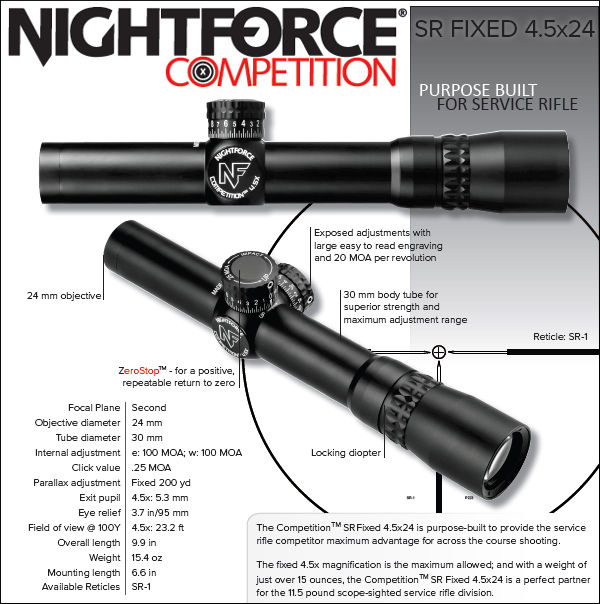
Nightforce has released an all-new 4.5x24mm scope for Service Rifle Competition. Nightforce’s new Competition SR Fixed 4.5x24mm riflescope is purpose-built for the CMP’s new Service Rifle rules that allow scopes with max 4.5X magnification, and max objective lens diameter of 34mm. Nightforce made this new scope quite light in weight (just 15.4 ounces), recognizing that Service Rifles will now be limited to 11.5 pounds for optic and gun combined. MSRP is $1950.00.
FIELD TEST COMING — Accurateshooter.com will get one of these new 4.5x24mm Nightforce scopes for evaluation soon. We will provide a complete field test, and our tester Dennis Santiago will use the new scope in actual Service Rifle competition.
The new NF Competition SR 4.5x24mm scope provides 100 MOA of both elevation and windage adjustment, with .25 MOA clicks and 20 MOA per revolution. Parallax is fixed at 200 yards. The main tube is 30mm. This scope features a handy ZeroStop on the elevation knob that allows instant, positive return to the shooter’s chosen zero setting.
Photo shows Nightforce’s new, lightweight Unimount. Half the weight of a similar steel unit, this alloy mount offers +20 MOA taper.
The new non-illuminated SR-1 reticle features heavy posts at the 3, 6 and 9 o’clock positions, and a 10 MOA center circle with 8 MOA crosshair. The Competition SR Fixed 4.5x24mm will retail at $1950.00 and the UnimountTM SR will retail at $260.00.
Product tip by EdLongrange. We welcome reader submissions.
At the request of our readers, we provide select “Deals of the Week”. Every Monday morning we offer our Bargain selections. Here are some of the best deals on firearms, hardware, reloading components, and shooting accessories. Be aware that sale prices are subject to change, and once clearance inventory is sold, it’s gone for good. You snooze you lose.
1. Monmouth Reloading — Sig Sauer Kilo 2000 LRF $499.00
This excellent laser rangefinder rivals other premium LRFs selling for hundreds more. Head-to-head field tests with Leica, Zeiss, and Swarovski LRFs proved that the new Sig Sauer Kilo 2000 can play in that league, but at a much more affordable price point. Sig accomplishes that with tight beam divergence and state-of-the-art DSP technology which allows the Kilo 2000 to range faster (and more reliably) at longer distances. Optic magnification is 7X. The Kilo 2000 weighs 7.5 oz and measures 3″ x 4.2″ x 1.3″.
— Lumatic OLED Display™ monitors ambient light and adjusts display brightness.
— AMR™ (Angle Modified Range) built-in angle compensation.
— 4X per second refresh rate in scan mode.
— Dependable waterproof (IP X-4) and fog-proof performance.
— Lightweight magnesium body and compact form.
SAVE MORE: Right now you can save an additional $110 off every Rangefinder Monmouth Reloading sells, including the Sig Kilo 2000. To save an additional $110, use Coupon Code LRF 110. That will lower your cost to $389.00 for the Kilo 2000, which is a total steal. (Time-limited offer).
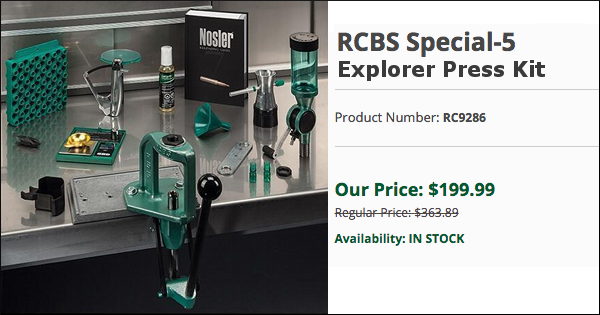
2. Natchez — Special 5 Reloading Press Kit, $199.99
This is an excellent entry-level reloading kit, which is on sale for $199.99 at Natchez Shooters Supply. We like the relatively compact Special 5 press for most reloading duties. Eventually you many want to add an additional large heavy press, but this will get the job done. This kit includes an RCBS Powder Measure, Digital Scale, Powder Trickler, Hand Priming Tool, Load Manual, Loading Tray, and more. It’s hard to beat this combination of tools for under $200.00.
3. NRA Life Membership $500 — Offer Ends 7/31/2016
If you are considering getting an NRA Life membership, now is the time to buy. You can get a Life Membership for $500.00. That’s $1000.00 off the regular $1500.00 price. You heard us right — save a thousand bucks on an NRA Life Membership. This offer is good through July 31, 2016. And with each lifetime membership, you get your choice of one of four print magazines: American Hunter, American Rifleman, Shooting Illustrated, or America’s First Freedom.
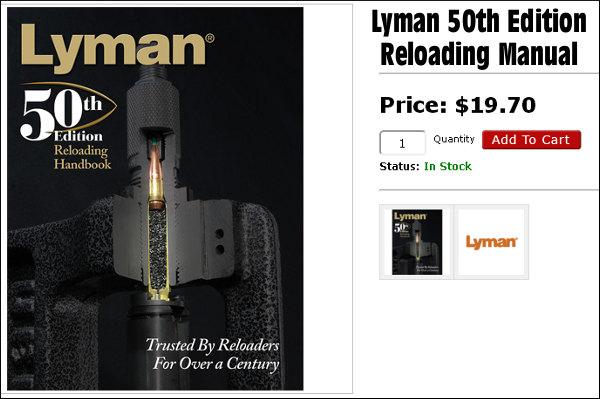
4. Midsouth — Lyman 50th Edition Reloading Manual
Here’s a good deal on the new Lyman 50th Ed. Reloading Manual. Our Forum members have rated this as the best Loading Manual for starting hand-loaders. This 50th Anniversary Edition, the first to be produced in full color, includes more load data, and covers more cartridge and bullet types than ever before. This handbook has a strong heritage, starting with the Ideal/Lyman reloading manuals from the early 20th Century. (In 1925, Lyman purchased Ideal Reloading Products, which produced the Ideal reloading handbooks.)
Bullet-maker Bart Sauter used this RAVpower portable charging unit to power his LabRadar chronograph at a short-range shooting match. He reports: “I bought a RAVPower pack from Amazon. It was the most powerful cell phone charger they had and it was reduced to $31. It was able to run the LabRadar for two full days without recharging and still had juice.” This unit has impressive specs: “4.5A Output: Highest output in the market, featuring a 4.5A total output capable of simultaneously charging two tablets, making it faster and more powerful than the rest. Exclusive iSmart Technology… ensures fastest and most efficient charge.”
Need quality .22 LR rimfire ammo at an affordable price? Consider Norma. Most folks think Norma only produces centerfire ammo and cartridge brass. As a result, people haven’t been looking for Norma rimfire ammo. Their loss is your gain. Accurate, reliable Norma .22 LR ammunition is in-stock right now at leading online vendors. This is good quality ammo, made in Europe. Bullets.com has Norma Tac-22 ammo in stock at $5.25 per 50-rd box (SKU: BL7819). In addition, Bullets.com offers Norma Match-22 ammunition at $7.50 per 50-rd box (SKU: BL11887).
7. Cabela’s — Lyman Turbo Sonic 1200, $59.99
Looking for a reliable ultrasonic cleaning unit at a rock-bottom, $59.99 price? Here’s a very good deal — this new Lyman 1200 sells elsewhere for up to $110.00. This machine will hold up to 350 9mm cases, and clean them in 10-15 minutes. The see-through cover lets you view the progress in the 6.5″L x 5.4″W x 2.6″D heated tank. Select four different dwell times with handy touch controls.
8. Amazon — 34 NRR Top-Selling Ear Muffs
If you want serious hearing protection, and can tolerate large muffs, these Clear Armor earmuffs are hard to beat for the price. They seal very well and carry an unsurpassed 34db Noise Reduction Rating (NRR). These are the #1 Best Selling Safety Muffs on Amazon. Yes they are big and bulky — but you only have one set of ears. These are a good choice for loud magnum rifles and noisy indoor ranges.
When a rifle isn’t shooting up to it’s potential, we need to ask: “Is it the gun or the shooter?” Having multiple shooters test the same rifle in the same conditions with the same load can be very revealing…
When developing a load for a new rifle, one can easily get consumed by all the potential variables — charge weight, seating depth, neck tension, primer options, neck lube, and so on. When you’re fully focused on loading variables, and the results on the target are disappointing, you may quickly assume you need to change your load. But we learned that sometimes the load is just fine — the problem is the trigger puller, or the set-up on the bench.
Here’s an example. A while back we tested two new Savage F-Class rifles, both chambered in 6mmBR. Initial results were promising, but not great — one gun’s owner was getting round groups with shots distributed at 10 o’clock, 2 o’clock, 5 o’clock, 8 o’clock, and none were touching. We could have concluded that the load was no good. But then another shooter sat down behind the rifle and put the next two shots, identical load, through the same hole. Shooter #2 eventually produced a 6-shot group that was a vertical line, with 2 shots in each hole but at three different points of impact. OK, now we can conclude the load needs to be tuned to get rid of the vertical. Right? Wrong. Shooter #3 sat down behind the gun and produced a group that strung horizontally but had almost no vertical.
Hmmm… what gives?
Shooting Styles Created Vertical or Horizontal Dispersion
What was the problem? Well, each of the three shooters had a different way of holding the gun and adjusting the rear bag. Shooter #1, the gun’s owner, used a wrap-around hold with hand and cheek pressure, and he was squeezing the bag. All that contact was moving the shot up, down, left and right. The wrap-around hold produced erratic results.
Shooter #2 was using no cheek pressure, and very slight thumb pressure behind the tang, but he was experimenting with different amounts of bag “squeeze”. His hold eliminated the side push, but variances in squeeze technique and down pressure caused the vertical string. When he kept things constant, the gun put successive shots through the same hole.
Shooter #3 was using heavy cheek pressure. This settled the gun down vertically, but it also side-loaded the rifle. The result was almost no vertical, but this shooting style produced too much horizontal.
A “Second Opinion” Is Always Useful
Conclusion? Before you spend all day fiddling with a load, you might want to adjust your shooting style and see if that affects the group size and shape on the target. Additionally, it is nearly always useful to have another experienced shooter try your rifle. In our test session, each time we changed “drivers”, the way the shots grouped on the target changed significantly. We went from a big round group, to vertical string, to horizontal string.
Interestingly, all three shooters were able to diagnose problems in their shooting styles, and then refine their gun-handling. As a result, in a second session, we all shot that gun better, and the average group size dropped from 0.5-0.6 inches into the threes — with NO changes to the load.
That’s right, we cut group size in half, and we didn’t alter the load one bit. Switching shooters demonstrated that the load was good and the gun was good. The skill of the trigger-puller(s) proved to be the limiting factor in terms of group size.
Old “Number 2″ belonging to Ray Gross. Click Photo for full-screen Image.
Ray Gross is captain of the United States F-TR Team. While he’s mostly involved in F-Class shooting these days, that wasn’t always the case. Ray is an experienced service rifle shooter, who secured his Distinguished Rifleman Badge 21 years ago. Ray has shot many different rifles during his competitive shooting career, but the rifle above has a special place in Ray’s heart. This old semi-auto earned Ray his Distinguished Badge, and he’ll never forget that…
“I said goodbye to an old friend last week…
Affectionately known as ‘Number 2′, she is the rifle that I earned my Distinguished Rifleman Badge with in 1995 (#1159).
That rifle was also responsible for a fair amount of Venison in the ’90s, as well. But since then, she has spent a lot of time in the closet. Last time I got her out was to destroy a bunch of hard drives containing evidence collected during my Computer Forensics days. She deserved better than that.
I will miss the beautiful sound of all that American steel slamming into battery when I tripped her bolt.” – Ray Gross
Larry Scott, who runs GreatScottShooters.com, has a friend, Ray Mabry, who is a very talented wood-worker and carver. Ray does master-grade decorative work and checkering on gunstocks, and he also carves realistic nature subjects from wood. Larry says: “If you need stock checkering/carving or any wildlife creation, check out a friend of mine, Ray Mabry. His finished products are superb.”
Ray Mabry is a member of our AccurateShooter Forum, and you can see many fine examples of his work in this FORUM Thread. Ray tells us: “I do this work as a hobby. I do checkering and relief-carving on rifles. I also carve out of solid tupelo and bass blocks of wood. Along with rifle stock work, I carve wildlife subjects — I’ve carved eagles, owls, quail, ducks, and even prairie dogs. If you have a project in mind, call me at 270-885-6066 or send email to: rayzr [at] twc.com.”
Since Sierra introduced the Tipped MatchKing® (TMK®) line of bullets in 2015, we have had a few questions from customers regarding the two lines of bullets (MK vs TMK). Some shooters are concerned that the tried-and-true MatchKing® bullets will be replaced with the Tipped MatchKing® bullets. For those of you worried, relax, the old standby MatchKings® that you have shot for years are here to stay, and we will happily continue to make them for you.
For those that like to try new products, we are planning on both continuing and expanding the Tipped MatchKing® line. Even where there are two bullets within these two lines that have matching weights (pictured above), 22 caliber 69 and 77 grain, 6mm 95 gr, 30 caliber 125, 155, 168 and 175 grains, we are not going to replace the MatchKings® with the Tipped MatchKing®. We are, however, going to continue to offer both lines of bullets for your use and enjoyment. Keep an eye out for new additions to our product line!
Social Media fans take note — Lapua is now on Facebook. Lapua recently launched its official Facebook page focusing on Lapua sport shooting components and ammunition. The page will feature shooting news, match results, product info, shooter profiles, videos, tech tips, and other Lapua-related material. You can follow Lapua on Facebook by visiting www.facebook.com/LapuaAmmunition.
Lapua Products and Company History
Lapua (officially Nammo Lapua Oy), is part of the large Nordic Nammo Group. Lapua’s main products include premium cartridge brass, bullets, small caliber cartridges, rimfire cartridges, and reloading components for civilian and professional use. The Lapua cartridge factory was established in 1923. From a modest and practical beginning, Lapua has grown into one of the most respected brands in the industry. The best shooters in the world choose Lapua cartridges and components. In 2014, Nammo acquired the Vihtavuori smokeless powder factory.


 Bud Pryor was a fine gentleman who started shooting IBS matches in 1983. He was a machinest turned gunsmith who made friends and got many people started in shooting IBS registered matches over the next few years. Bud and Dick Grosbier ran the first IBS match at the Thurmont range in April 1983. CLICK HERE to see vintage photos of the 1983 match.