Summer is almost over. That’s means hunting season is coming soon. To help you prepare for your fall hunts, NRABlog.com has created a set of color practice hunting targets. You can hone your skills on a trio of bucks, three gobblers, or three wild hogs.
Each target features three red bullseyes, centered on the animals. You can print the targets in black and white, but they look best in color. Click on each image below to download a FREE printable PDF file.
As the NRA Blog says: “Print out the turkey target, grab your shotgun, and head to the outdoor range. Or, try your hand at deer and hog while zeroing your rifle.”
RIght-Click Each Image to Download Printable PDF File:
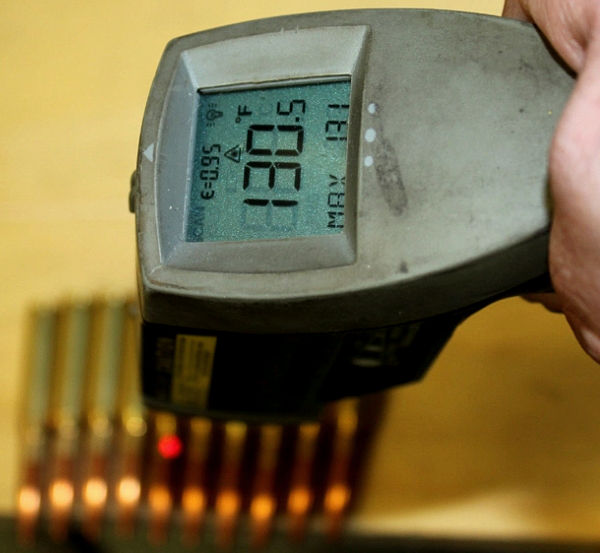
In this .308 Win test, 70° F ammo shot 96 FPS slower than ammo heated to 130.5° F. And the 130.5° ammo was 145 fps faster than ammo right out of the freezer (at 25.5° F). That’s a huge difference…
EDITOR’s NOTE: The Sierra tester does not reveal the brand of powder tested here. Some powders are much more temp sensitive than others. Accordingly, you cannot extrapolate test results from one propellant to another. Nonetheless, it is interesting to see the actual recorded velocity shift with ammo temperature variations in a .308 Win.
Written by Sierra Chief Ballistician Tommy Todd This story originally appeared in theSierra Bullets Blog
A few weeks ago I was attending the Missouri State F-Class Match. This was a two-day event during the summer and temperatures were hot one day and hotter the next. I shot next to a gentleman who was relatively new to the sport. He was shooting a basically factory rifle and was enjoying himself with the exception that his scores were not as good as he hoped they would be and he was experiencing pressure issues with his ammunition. I noticed that he was having to force the bolt open on a couple of rounds. During a break, I visited with him and offered a couple of suggestions which helped his situation somewhat and he was able to finish the match without major issues.
He was shooting factory ammunition, which is normally loaded to upper levels of allowable pressures. While this ammunition showed no problems during “normal” testing, it was definitely showing issues during a 20-round string of fire in the temperatures we were competing in. My first suggestion was that he keep his ammunition out of the direct sun and shade it as much as possible. My second suggestion was to not close the bolt on a cartridge until he was ready to fire. He had his ammo in the direct sunlight and was chambering a round while waiting on the target to be pulled and scored which can take from a few seconds to almost a minute sometimes.
This time frame allowed the bullet and powder to absorb chamber [heat] and build pressure/velocity above normal conditions. Making my recommended changes lowered the pressures enough for the rifle and cartridge to function normally.
Testing Effects of Ammunition Temperature on Velocity and POI
After thinking about this situation, I decided to perform a test in the Sierra Bullets underground range to see what temperature changes will do to a rifle/cartridge combination. I acquired thirty consecutive .30 caliber 175 grain MatchKing bullets #2275 right off one of our bullet assembly presses and loaded them into .308 Winchester ammunition. I utilized an unnamed powder manufacturer’s product that is appropriate for the .308 Winchester cartridge. This load is not at the maximum for this cartridge, but it gives consistent velocities and accuracy for testing.
I took ten of the cartridges and placed them in a freezer to condition.
I set ten of them on my loading bench, and since it was cool and cloudy the day I performed this test I utilized a floodlight and stand to simulate ammunition being heated in the sun.
I kept track of the temperatures of the three ammunition samples with a non-contact laser thermometer.
The rifle was fired at room temperature (70 degrees) with all three sets of ammunition. I fired this test at 200 yards out of a return-to-battery machine rest. The aiming point was a leveled line drawn on a sheet of paper. I fired one group with the scope aimed at the line and then moved the aiming point across the paper from left to right for the subsequent groups.
NOTE that the velocity increased as the temperature of the ammunition did.
The ammunition from the freezer shot at 2451 fps.
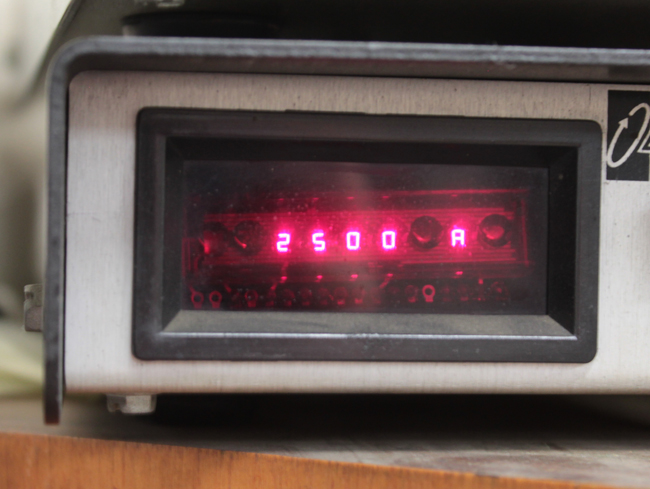
The room temperature ammunition shot at 2500 fps.
The heated ammunition shot at 2596 fps.
The tune window of the particular rifle is fairly wide as is shown by the accuracy of the three pressure/velocity levels and good accuracy was achieved across the board. However, notice the point of impact shift with the third group? There is enough shift at 200 yards to cause a miss if you were shooting a target or animal at longer ranges. While the pressure and velocities changed this load was far enough from maximum that perceived over pressure issues such as flattened primer, ejector marks on the case head, or sticky extraction did not appear. If you load to maximum and then subject your ammunition to this test your results will probably be magnified in comparison.
This test showed that pressures, velocities, and point-of-impact can be affected by temperatures of your ammunition at the time of firing. It’s really not a bad idea to test in the conditions that you plan on utilizing the ammo/firearm in if at all possible. It wouldn’t be a bad idea to also test to see what condition changes do to your particular gun and ammunition combination so that you can make allowances as needed. Any personal testing along these lines should be done with caution as some powder and cartridge combination could become unsafe with relatively small changes in conditions.
This week, American Rifleman TV looks at the history and heritage of Remington, which celebrates its 200th Anniversary this year. Founded in 1816, Remington is the oldest continuously-operating gun manufacturer in the United States, and it still sells more sporting rifles and shotguns than any other American company. Remington has also developed more cartridges than any other U.S. company. If you want to learn more about this important arms-maker, watch tonight’s episode, which you can preview below.
Two Hundred Years of Gun-Making Remington Arms Company celebrates its 200th year in business in 2016. The Remington enterprise was founded in 1816 by Eliphalet Remington in Ilion, New York, as E. Remington and Sons. Remington is America’s oldest gun maker and is still the largest U.S. producer of shotguns and rifles. And it is the only American Company that sells firearms and ammunition under its own name. CLICK HERE for 200 facts about the 200-year-old company.
American Life in 1816
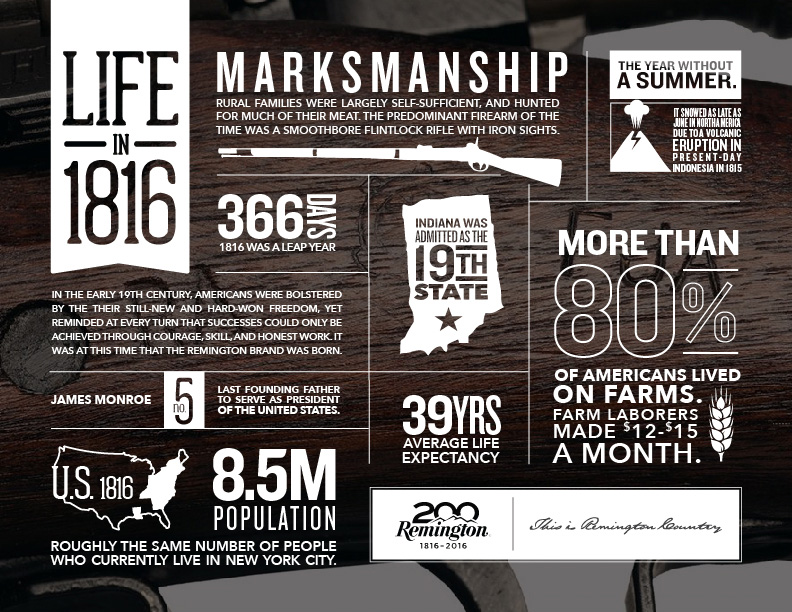
What was life like in America in 1816, two hundred years ago? This infographic offers some interesting facts. For example, average life expectancy was only 39 years, and a farm laborer earned just $12-$15 per month. Still want to go back to the “good old days”?
Long Range Success with Lapua Scenars
With the interest in ultra-long-range shooting in the USA, we thought you might like to see how they shoot out past 2000 meters in Scandinavia. Recently, a new Norwegian long range record was shot in Sokndal in Norway, at the Bøstøl shooting range, using Lapua 300 grain Scenar bullets.
With the target at 2165 meters (1.345 miles), the shooters managed 2/10 hits on steel. The cartridge (as you might expect) was the powerful .338 Lapua Magnum. The load was 89 grains of Vihtavuori N570 pushing the 300gr Scenars at 815 ms (2674 fps). The firearm used was Accuracy International .338 LM AXMC rifle with 27″ barrel and suppressor. Before the record hits at 2165 meters, the team also engaged targets at 1639m, 1710m, and 1850m scoring 4/10 hits on 95 x 100 cm steel target (that’s roughly one meter square, just over 3 feet per side).
About the Location — Sokndal, Norway
Sokndal is the southernmost municipality in Rogaland county, Norway. It is located in the traditional district of Dalane. The administrative center of the municipality is the village of Hauge. Other villages in Sokndal include Li, Rekefjord, Sogndalsstranda, and Åna-Sira.
Earlier this summer, California Governor Jerry Brown signed six restrictive new gun laws. Less than 24 hours after they arrived on his desk, Brown signed six anti-gun bills railroaded through the Democratic-controlled California Legislature. This legislation imposes many new burdens on California gun-owners and criminalizes conduct that was heretofore legal. With little public debate, these bills were rushed through the legislative process. And now Californians are facing the disturbing consequences.
FREE Online Webinar on California Gun Laws
To help Californians understand their responsibilities under the new gun laws, the Michel & Associates law firm is hosting a free online seminar this week. As space is limited, advanced registration is required for the seminar. CLICK HERE to REGISTER.
The seminar will be held, Wednesday, August 24, 2016 at 12:00 pm (PT). This live webinar will explain how the new gun laws will affect gun owners, when they will go into effect, and what citizens need to do to comply with these laws. The seminar will be hosted by C.D. Michel and Joseph Silvoso, lawyers with Michel & Associates. Important topics will include:
SB 1235 (Ammunition Purchase Bill): This new law requires the California Department of Justice (DOJ) to record ammunition vendor and ammunition purchaser information. This ill-conceived legislation has caused much confusion. It is unclear how AB 1235 will affect mail-order purchases of loaded ammunition from vendors outside the state.
SB 1446 (Magazine Ban): SB 1446 which will require Californians to forfeit, destroy, or ship out of the state ALL firearms magazines that can hold more than ten rounds. Owners of legally-obtained magazines, previously “grandfathered”, will receive no compensation though they must give up their property. Those who fail to comply will be fined and charged with an infraction, a low-level crime. This magazine restriction goes into effect July 1, 2017.
Other California Gun Laws Signed by Gov. Brown:
AB 1135 (Levine) and SB 880 (Hall) Firearms: Assault Weapons – Expands the definition of assault weapons based on whether a semiautomatic firearm has a detachable magazine, banning thousands of popular firearms.
AB 1511 (Santiago) Firearms: Lending – Makes it illegal to loan a firearm to a person who is personally known to you (except for family members with restrictions).
AB 1695 (Bonta) Firearms: False Reports – Creates a 10-year prohibition on owning firearms for someone convicted of falsely reporting a lost or stolen firearm.
At the request of our readers, we provide select “Deals of the Week”. Every Monday morning we offer our Bargain selections. Here are some of the best deals on firearms, hardware, reloading components, and shooting accessories. Be aware that sale prices are subject to change, and once clearance inventory is sold, it’s gone for good. You snooze you lose.
1. Kelbly.com — 15% Off Discount on All Products
Looking for a Panda or Atlas Action, or a complete match rifle? Here’s a great promotion from our friends at Kelbly’s. Now through Tuesday, August 23, 2016 you can get 15% of ANYthing on the Kelblys.com website. That includes rifles, actions, stocks, barrels, scope rings, muzzle brakes, Berger bullets, accessories and more. To save big, use code 15ALL at checkout. Don’t delay — this offer expires at 11:59 pm on September 1, 2016.
2. EuroOptic.com — Tikka T3 Liquidation Sale, Huge Discounts
Looking for a great price on an excellent hunting rifle? Here is the Tikka Deal of the Decade. EuroOptic.com has received nearly 3,500 Tikka T3 rifles, which will be sold at deep discounts as part of an inventory clearance program by Beretta, Tikka’s parent company. The Tikka T3 is a good, stout rifle with a smooth, 3-lug action, crisp trigger, and quality barrel. Accuracy is typically well under 1 MOA (for three shots). T3 barreled actions also are a good “core” for a tactical build. The strong T3 action handles detachable magazines, and fits a variety of third-party stocks.
3. Monmouth — Hornady 6.5 Creedmoor Brass, $34.95 for 50
The 6.5 Creedmoor has become one of the most popular chamberings for tactical/practical shooting. This mid-sized cartridge offers excellent ballistic performance with 120-140gr bullets, with moderate recoil and excellent inherent accuracy. Now you can get Hornady-brand 6.5 Creedmoor brass at a very good price: $34.95 for 50 cases (that’s $69.90 per 100).
If you are looking for a rugged, reliable, and affordable spotting scope to watch flags, mirage, and shot spotting discs, this angled-body Kowa TSN-61 will do the job. And $259.00 with free, fast Prime Shipping is a great deal. These Kowa spotters have been used successfully for years by prone and High Power competitors. Sure the glass can’t rival the latest top-of-the-line HD spotting scopes, but the TSN-61 is a small fraction of the price of high-end models which cost $2000 or more. The money you save can buy four premium hand-lapped barrels. NOTE: Eyepieces are sold separately — expect to pay $275.00 – $300.00 for a Kowa 20-60X Zoom eyepiece.
5. Midsouth — $15.00 HazMat Fee with 15-lb Powder Purchase
When you purchase powder, it makes sense to buy in bulk. That way you get powder from the same lot, and save on the HazMat fees. Now you have even more incentive to place a big order. Right now Midsouth is offering $15.00 Hazmat with orders of 15 or more pounds of powder. Get 15 one-pounders or two eight-pound jugs and you’ll qualify. Midsouth has a large selection of popular powders in stock, including Hodgdon Varget, H4198, H48931sc, and the new IMR Enduron powders. With this special HazMat deal you can save up to $20.00 (many vendors charge $35.00 HazMat per order). Don’t hesitate — this offer ends 8/25/2016.
6. Amazon — Tipton Gun Vise, $30.32 (free Prime Shipping)
This is an awesome deal on a durable, well-designed polymer Gun Vise that every rifle owner can use. Your Editor has one of these units which has served well for more than a decade. The base has compartments for solvents, patches, and tools. The cradles and pads contacting your gunstock are a soft, rubber-like material that is gentle on fine finishes. This vise is relatively light in weight, but sturdy enough to support big, heavy rifles.
A Mildot Master is one item every tactical/practical shooter should own. This handy tool has been used successfully for years. It doesn’t require batteries, no keypad data entry is require through a keypad is necessary, as the device is purely analog. No complex calculations for determination of telescopic sight adjustment or hold-over at various ranges are necessary, as the scales of the device convert drop/drift figures directly into both MOA and mils.
8. Amazon — Ten-Pack of 2″-Diameter Splatter Targets, $8.99
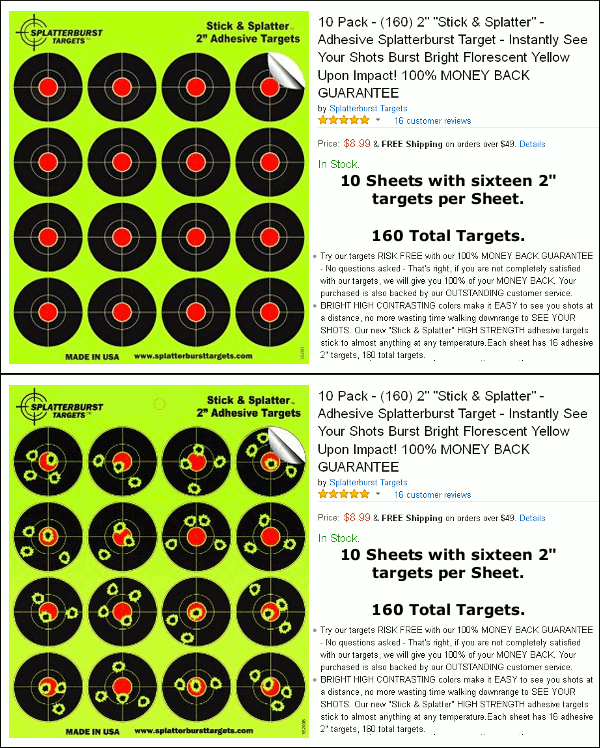
We use these splatter targets for fun shoots and practice at 300 and 400 yards. When hit, each shot displays as a bright, neon-green/yellow circle. That makes it easy to spot your shots, even with relatively low-power optics. These targets also work great for handgun practice at shorter distances. For just $8.99 you get ten sheets each with 16 stick-on circles — a total of 160 target bulls.
If you own a FN SCAR 17S rifle — check the serial number before you shoot it. FN America recently recalled hundreds of FN SCAR rifles. In an official Recall Notice, the gun maker stated that 471 SCAR 17S rifles are being recalled due to the possibility of catastrophic failure caused by defective bolts. Here are key terms of the 8/10/2016 FN SCAR Recall Notice:
FN America, LLC is recalling 471 of its FN SCAR® 17S rifles due to the possibility that certain products may have been assembled with a bolt that does not meet our hardness specifications. Firing may cause catastrophic failure of the rifle over a period of time. FN America shipped these SCARs July 28 and 29, 2016, and is hoping to contain the issue at the distributor level. In the event any of the affected SCARs have been sold to customers, FN America will reach out to those customers and warn them not to use their FN SCAR® 17S if it is one of the serial numbers being recalled. Failure to follow these instructions could cause injury or death.
Although no injuries have been reported as a result of this potential issue, FN America is advising customers to discontinue use of these rifles immediately and return affected products to FN America directly for inspection and possible retrofit with compatible bolts at no cost. FN America also advises all FN distributors to immediately return all recalled products currently in inventory to FN America[.]
For more information, contact FN’s customer service at 1-855-536-4872, ext 145 or send email to fnscar17srecall@fnamerica.com .
Forum member Mike T. (aka “Watercam”), has cleverly adapted a tubegun cheek piece to conventional fiberglass and wood stocks. The cheek piece hardware comes from Competition Machine and is the same as used on Gary Eliseo’s tubegun stocks. Here is Watercam’s Project Report:
Installing Tubegun Cheek Piece on Conventional Gun Stock
All of my match rifles are equipped with thumb-wheel adjustable cheek pieces for the best of reasons — adjustments can be made while in position, on target. I’ve learned that variations in position, terrain, and vertical angle all demand adjustability to achieve optimal cheek weld.
I wanted a cheek piece for my hunting and tactical type stocks that gave the same adjustability without having to cut a chunk off of my butt stocks. It needed to be affordable and easy to install. I also wanted a unit that would not push my head laterally away from the centerline of the scope or iron sights. Turns out I already had what I needed on my Gary Eliseo B-1 tubegun. I ran the idea past Gary, who said: “If you’ll be the guinea pig I’ll send the hardware”.
Using Gary’s hardware, I mounted Eliseo alloy thumb-wheel adjustable cheek pieces on a Bell & Carlson Medalist hunting stock and a Boyd’s laminate tactical stock. Read Forum Discussion.
Building Version One on Bell & Calson Stock
I had a Bell & Carlson Medalist stock for a Mauser 98 chambered in 9.3×62. This test rifle was enough of a thumper to reveal if the metal cheek piece could handle strong recoil.
I started by drilling three 1/2″ holes into the top of the comb to match the two pillars and one threaded shaft on the cheek piece. I used aluminum tubing to make guides for each and epoxied them in place. Inletting the oval hole for the thumb wheel was reasonably straight forward and the fiber reinforced foam in the buttstock offered enough support. A large flat washer epoxied underneath where the thumbwheel lay gave a smooth bearing surface. Total adjustment (with 2.25″ pillars and shafts) is just about an inch. I chose to trim the bottom of the skirt of Gary’s cheek plate so as to allow better position behind the scope for me and allow maximum adjustment even with the cheek piece of the stock. Set screws could be used instead of the thumb-wheel or in conjunction with it. In the end it was exactly what I envisioned and works great! The only thing left to do is paint the metal to match the stock.
Version Two — Installed on Boyds Laminated Tactical Stock
Watercam’s second metal cheek piece installation was on a laminated tactical stock. This Boyds stock did have a movable comb, but the original adjustable cheek section was too awkward to adjust from position. So I adapted the Eliseo cheek piece to to the Boyds stock, as you can see:
Cheek piece installation for both stocks was straight-forward, and the new cheek pieces work every bit as well the systems on my match rifles. Aluminum tubes epoxied in place guide the rods and threaded shank. A matching-diameter flat washer epoxied under the wheel provides smooth bearing surface. The glass-filled filler of the butt stock is plenty strong enough to support the unit. A set screw and knob can be added to lock in changes if so desired.
Our friend Kirsten Joy Weiss is a modern-day Annie Oakley. A very successful competitive shooter in the collegiate ranks, Kirsten now produces a popular YouTube Channel focusing on the “Joy of Shooting”. In her videos, Kirsten offers shooting tips and performs a variety of trick shots — such as splitting cards with a .22 LR rimfire. This young lady can shoot, that’s for sure.
In this video, Kirsten shoots at some tiny reactive targets — “Pop-Its”. These pea-sized targets “pop” audibly when hit. They make a very challenging target, even when bunched together. Kirsten secured three (3) Pop-Its with a clothespin, and then placed the clothespin in the ground.
It took a couple tries, but Kirsten did manage to light off a Pop-It or two. Kirsten reports: “Basically a small exploding target, Pop-Its, also known as ‘Bang Snaps’, snaps, snappers, party snaps, etc., are a fun firework trick noisemaker — but will they make a good target? Let’s put it to the test to see if these poppers are gun range-worthy targets. These little Pop-Its make for some challenging shots with reactive targets.” Enjoy the video:
Equipment Report: For this video, Kirsten shot Lapua .22 LR ammo in a Volquartsen Ultra-lite semi-auto .22 LR rimfire rifle, fitted with a C-More Red-Dot sight. She was using Oakley eye protection.
The Rio Olympics shooting competition has ended, and USA Shooting Team’s medalists are all women. Ginny Thrasher of Virginia got the USA medal count off to a great start by winning the first gold medal of the 2016 Olympic games in Women’s Air Rifle, and Corey Cogdell-Unrein repeated as bronze medalist in Women’s Trap. By winning a bronze medal in skeet last Friday, 37-year-old Kim Rhode became the first female and summer Olympian ever to win medals in six consecutive Olympic Games. Read coverage in the LA Times, USA Today and Associated Press. Kim Rhode’s Olympic Odyssey.
Shooting Sports USA profiled Ginny Thrasher, winner of the very first Gold Medal awarded at the Rio Olympic games:
For 36 hours, Thrasher was the face of Team USA as the lone gold medalist, winning the first medal of the 2016 Olympic Games. The 19-year-old WVU sophomore was propelled into the media spotlight…
Thrasher explained how she coped with the pressures of competing in the most important sporting event on earth:
“I think this competition is one where you can mentally out-think yourself, and that’s the danger. For me, just being very focused. During the match I started out with some struggles, and I had to come off the line and my Olympic coach down there said, ‘Ginny, all you can do is shoot the best you can.’ I got back on the line, and that’s what I did. I shot the best that I could. I had a very bad hold, but it didn’t matter. Once I got into the final, I was very much focused on my breathing, and that was the point where all the training and all the discipline just came through for me. All I did was focus on my breathing and let my body do what it knew how to do.”