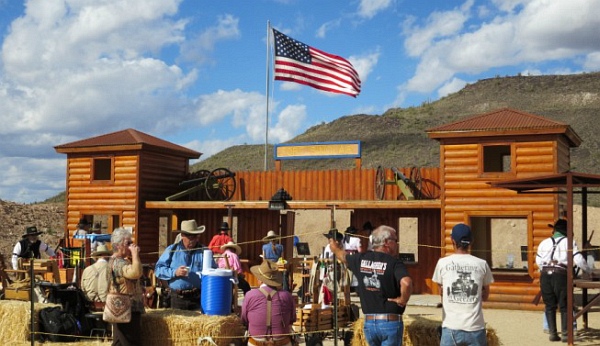
Earlier this month the Ben Avery Range in Phoenix hosted America’s top long-range shooters at the Berger SW Nationals. This upcoming week, 1000 cowboys and cowgirls take over Ben Avery during Winter Range, the SASS National Championship for Cowboy Action Shooting. Winter Range, which runs February 19-25, 2018, is the second largest Cowboy Action event of the year, after End of Trail, the annual Single Action Shooting Society World Championship held each year in Edgewood, New Mexico.
This video, produced a few seasons back by the Arizona Fish and Game Commission, covers the full Winter Range experience, including the main shooting competitions, the side matches, the Western costumes, the socializing, and more. Worth watching if you like action shooting or are just a fan of the Wild West.
Hundreds of cowboy action shooters, ages 12-80, will compete in multiple classifications based on age, and type/caliber of firearms. In addition, this year the Cowboy Mounted Shooting Association and the SASS Mounted Shooters held the exciting Winter Championship in nearby Queen Creek, Arizona. The 3-day event, held February 14-17, drew more than 100 competitors mounted on horses. You’ll see this kind of action:
Cowboy Action Shooting requires that contestants compete with firearms typical of those used in the taming of the Old West: single-action revolvers, lever-action rifles, and period shotguns. Participants each have a registered cowboy shooting alias (such as “Deadeye Dave”), used in SASS events. Competitors, organized in “Posses”, shoot a series of multi-gun stages. This is a fun shooting sport that draws multiple generations of the same family. In addition to the primary competitions, Winter Range 2018 will feature displays of period militaria, exhibitions of western skills and crafts, a fast-draw contest, and nearly 100 vendors selling vintage-style clothing and “sundries”.
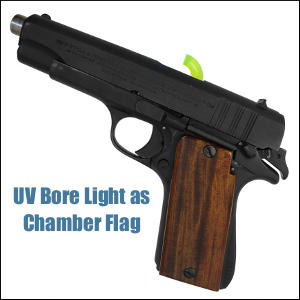
Put the short “J” end of the UV Bore Light in the chamber area. Always make sure your firearm is unloaded. Doubles as a chamber flag for most calibers.
Let there be light… Here’s a handy new device for pistol shooters. Birchwood Casey has come up with a large-diameter “J”-shaped fiber optic tube designed to illuminate pistol barrels without the need for batteries. The Birchwood Casey® UV Bore Light allows gun owners to quickly check the bore of their firearm for obstructions, dirt and fouling.
The UV Bore light is an innovative design that uses ambient light instead of batteries. Simply put the short “J” end of the bore light in the chamber area of your unloaded gun and it will provide enough illumination to check the bore.
The UV Bore Light also doubles as a safe-chamber flag for most guns. To use the UV Bore Light as a chamber flag, place the LONG end of the Bore Light in the CHAMBER end of the barrel — see photo.
The Birchwood Casey UV Bore Light is inexpensive. It’s sold by the pair in a two-pack priced at $5.40 MSRP.
After the Berger Southwest Nationals, we had a long chat with John Whidden, five-time NRA Long-Range National Champion, and a past SWN Sling Division winner. When the subject turned to reloading techniques, John reminded us that he uses a Dillon progressive presss to load much of his match ammo — with a system for much more precise control over powder charge weight. Yes John loaded his national-championship winning .243 Win ammo on a progressive. That may not work for the benchrest game, but John proved this method works well for his discipline — long range sling shooting.
John full-length sizes his match brass every time using a Whidden click-adjustable sizing die. The powder charge is dispensed with single-kernel precision using an Auto-Trickler and lab-grade force restoration scale. The process is completed on a Dillon XL 650 to produce more ammo in less time.
Whidden’s .243 Win Ammo is Loaded on a Dillon
John Whidden of Whidden Gunworks used the .243 Winchester cartridge to win the 2017 NRA Long Range Championship, his FIFTH LR title. John loaded his .243 Win ammo using a Dillon: “My loading process is different than many people expect. I load my ammo on a Dillon 650 progressive press using our own Whidden Gunworks dies. However powder charges are individually weighed with a stand-alone automated scale/trickler system from AutoTrickler.com (see below). Employing a high-end force restoration scale, this micro-processor controlled system offers single-kernel precision. The weighed charges are then dropped into the cases with a funnel mounted to the Dillon head.”
John Whidden Explains His Ammo-Loading Process
The Lapua .243 Win brass is full-length sized every time, and I run one of our custom-sized expanders in my sizer die. The expander measures .243″ which yields the desired .001″ neck tension. In my experience, the best way to get consistent neck tension is to run an expander in the case neck at some point. When sizing the case neck by a minimal amount such as is the case here, I don’t find any negative points in using an expander in the sizer die.
Championship-Winning Load: Berger Bullets, Lapua Brass, and Vihtavuori N160
For a load, currently I’m shooting Lapua brass, PMC primers (Russian, similar to Wolf), VihtaVuori N160 single-base powder, and Berger 105 grain Hybrid bullets. I switched to the Hybrid bullets at the beginning of the 2015 season. Previously I shot the 105gr Berger hunting VLDs, and in testing I found that the Hybrids were just as accurate without having to seat the bullet into the lands. The velocity of this combination when shot through the excellent Bartlein 5R barrels (32” length) is around 3275 FPS.
For my match ammo, I seat the Berger 105 Hybrids well off the lands — my bullets are “jumping” from .035″-.060″. I only use one seating depth for ammunition for multiple guns (I know some benchrest shooters will stop reading right here!) and the bullets jump further in the worn barrels than in the fresh barrels. The bullets are pointed up in our Bullet Pointing Die System and are moly-coated. The moly (molybdenum disulfide) does extend the cleaning interval a little bit, probably 20% or so. The Lapua .243 Win brass is all neck-turned to .0125″ thickness.
In my experience, the keys to accurate long range ammo are top quality bullets and the most consistent neck tension you can produce. From these starting points, the use of quality components and accurate powder measurement will finish out the magic.
Great Ballistics with 6mm 105s at 3275 FPS
Running at an impressive 3275 FPS, Berger 6mm 105 grain Hybrids deliver ballistics that are hard to beat, according to John Whidden:
“My .243 Win shoots inside a 6.5-284 with 142-grainers. Nothing out there is really ahead of [the .243], in 1000-yard ballistics unless you get into the short magnums or .284s and those carry a very significant recoil penalty. In the past I did shoot the 6.5-284. I went to the .243 Win because it had similar ballistics but had much less recoil. It doesn’t beat me up as much and is not as fatiguing.
With the .243 Win, there’s no tensing-up, no anticipating. With the reduced recoil (compared to a 7mm or big .308), I can break and shoot very good quality shots. I find I just shoot better shots with the .243 than I ever did with the 6.5-284.”
For years, many shooters have coated bullets with Moly (molybdenum disulfide) or Danzac (tungsten disulfide or “WS2″). The idea was to reduce friction between bullets and barrel. In theory, this could lengthen barrel life and extend the number of rounds a shooter can fire between cleanings.
Moly and WS2 both have their fans, but in recent years, many guys have switched to Hexagonal Boron Nitride (HBN), another dry lubricant. The advantage of HBN is that it won’t combine with moisture to create harmful acids. HBN is very slippery and it goes on clear, so it doesn’t leave a dirty mess on your hands or loading bench. Typically, HBN is applied via impact plating (tumbling), just as with Moly.
Good Source for Hexagonal Boron Nitride (HBN)
Paul Becigneul (aka PBike in our Forum) has been using HBN for many years with good results. He obtains his HBN from Momentive Performance Materials:
Sales Contact: Robert Bell
Sales Email: robert.bell [at] momentive.com
Sales Phone: Robert Bell, (980) 231-5404
HBN Results — Both on Bullets and Barrel Bores
Many folks have asked, “Does Hexagonal Boron Nitride really work?” You’ll find answers to that and many other questions on gunsmith Stan Ware’s popular Bench-Talk.com Blog. There Paul Becigneul (aka Pbike) gives a detailed run-down on HBN use, comparing it to other friction-reducers. Paul also discusses the use of HBN in suspension to pre-coat the inside of barrels. Paul observes:
We coated our bullets … how we had been coating with WS2. Now our bullets have a slightly white sheen to them with kind of like a pearl coat. They are so slippery it takes a little practice to pick them up and not drop them on the trailer floor. What have we noticed down range? Nothing different from WS2 other than the black ring on your target around the bullet hole is now white or nonexistent. Our barrels clean just as clean as with WS2. Your hands aren’t black at the end of the day of shooting and that might be the most important part.
Interestingly, Becigneul decided to try a solution of HBN in alcohol, to pre-coat the inside of barrels. Paul had previously used a compound called Penephite to coat the inside of his barrels after cleaning. Paul explains:
If Penephite was used because it was slippery wouldn’t HBN be better? … We called Momentive again [our source for HBN], and talked about mixing HBN and 90% alcohol for a suspension agent to pre-lube our barrels. He though it sounded great but that the AC6111 Grade HBN would be better for this use. It would stand up in the alcohol suspension and cling to the barrel when passed through on a patch. We got some and mixed it in alcohol 90%. We use about one teaspoon in 16 ounces of alcohol.
We started using it this fall and what we have noticed is that now that first shot fired out of a clean and pre-lubed barrel can be trusted as the true impact point. We use tuners so now I got to the line, fire two shots judge my group for vertical, adjust the tuner as needed or not, and after tune has been achieved go to my record targets. This use has saved us in time at the bench and bullets in the backstop.
You really should read the whole article by Becigneul. He discusses the use of barrel lubes such as Penephite and “Lock-Ease” in some detail. Paul also provides links to HBN vendors and to the Material Safety Data Sheets (MSDS) for the various compounds he tested.
Here’s important news for tactical shooters. There’s a rival to the Precision Rifle Series (PRS), the National Rifle League (NRL). And now the NRL has a major rifle sponsor — Howa. This Japanese rifle-maker will support the NRL’s 2018 season as Official Factory Rifle Sponsor. Good choice. We’ve shot Howa 1500-series rifles, and we know they offer excellent performance for the price. You can buy a complete Howa tactical rig, such as the KRG Bravo, or get a barreled action and put it into a variety of third-party modular stocks. Plus Criterion Barrels now offers Pre-Fit barrels in a variety of chamberings for Howa 1500 actions.
For 2018, the NRL will host 15 Precision Rifle matches, and the NRL 2018 Championships will be on October 19th – 21st in Idaho. There Howa will provide valuable prizes for top competitors. CLICK HERE for more information on the NRL 2018 match schedule.
National Rifle League Upcoming Spring Matches
Absolute Zero Sniper Match
North Carolina, February 23-25, 2018
Bighorn Steel Classic
Nebraska, March 2-4, 2018
Monster Lake Mayhem
Wyoming, April 6-8, 2018
Owen’s Armory Battle Royale
Arizona, April 27-29, 2018
JC Steel Target Challenge
Washington, May 4-6, 2018
Silent Night by Butch’s
Oklahoma, May 25-26, 2018
Howa 1500 Rifles and Actions — Good Stuff
Howa Machinery has been exporting sporting rifles for more than four decades since its first unit shipped in 1967. The Howa Model 1500 boast a smooth-running action and a fine two-stage HACT trigger (that’s a lot better than the standard trigger in most other factory rifles). For 2018, Howa is moving into the tactical/practical Precision market with a full line of competition ready rifles.
“We are very excited to be a part of the National Rifle League for 2018. We had the opportunity to be a part of a few matches in 2017 and the response was amazing. We view the NRL as an opportunity to connect with precision rifle shooters all around the country and share our passion for bolt-action rifles and the competition camaraderie.” Stated Mathew Hornback of Howa USA.
Travis Ishida, NRL President, noted “how capable these Howa rifles are for our style of shooting. The new Howa competition-ready rifles offer a sub-MOA guarantee out of the box[.] I am truly excited to have Howa supporting the NRL and to see them perform this year.”
So what does a “worn-out” barrel really look like? Tom Myers answered that question when he removed a 6.5-284 barrel and cut it down the middle to reveal throat wear. As you can see, there is a gap of about 5mm before the lands begin and you can see how the lands have thinned at the ends. (Note: even in a new barrel, there would be a section of freebore, so not all the 5mm gap represents wear.) There is actually just about 2mm of lands worn away. Tom notes: “Since I started out, I’ve chased the lands, moving out the seating depth .086″ (2.18 mm). I always seat to touch. My final touch dimension was 2.440″ with a Stoney Point .26 cal collet.”
Except for the 2mm of wear, the rifling otherwise looks decent, suggesting that setting back and rechambering this barrel could extend its useful life. Tom reports: “This was something I just thought I’d share if anyone was interested. I recently had to re-barrel my favorite prone rifle after its scores at 1,000 started to slip. I only ever shot Sierra 142gr MatchKings with VV N165 out of this barrel. It is a Hart and of course is button-rifled. I documented every round through the gun and got 2,300 over four years. Since I have the facilities, I used wire EDM (Electro Discharge Machining) to section the shot-out barrel in half. It was in amazingly good shape upon close inspection.”
Tom could have had this barrel set back, but he observed, “Lately I have had to increase powder charge to maintain 2,950 fps muzzle velocity. So to set it back would have only increased that problem. [And] I had a brand new 30″ Krieger all ready to screw on. I figured it was unlikely I’d get another full season on the old barrel, so I took it off.”
This impressive 15-round group was shot by Jim See of Elite Accuracy.
Different shooting disciplines demand different levels of precision/accuracy. In the rapid-fire 3-Gun game, you could probably “clean” most stages with a 2-MOA rifle. By contrast, in the short-range group benchrest game, to compete with the best, you’ll need a rifle that shoots in the “ones” (i.e. 0.1-0.19 MOA) in perfect conditions. In 1000-yard F-Class competition, the top shooters want a rifle that will hold one-third-MOA of vertical at that distance.
What is your standard of accuracy? How good is “good enough”. Jim See, a skilled gunsmith and successful PRS competitor, has answered that question for his tactical discipline. For the kind of matches Jim shoots, he likes to have a rifle that will hold half-MOA for five (5) shots, 3/4-MOA for 15 shots, and 1 MOA for twenty shots. Remarkably, Jim’s rifle can do that with factory ammo. Above is an impressive 15-shot group shot with .260 Remington Federal Premium Ammo.
“I say it all the time, my loads need to print 5 under 1/2″, 10 under 3/4″, and 20 under 1″. It’s simple, if a hot barrel will keep 20 rounds fired in succession under my standard it will be a good barrel and load for Precision Match Shooting. Federal Premium Gold Metal Match .260 with Sierra bullets made the cut for me today. 15 consecutive shots under 3/4 MOA.” –Jim See
It’s said that you “can never have too much accuracy”, but there are acceptable standards for each discipline, and they’re not the same. A 100/200 yard Benchrest shooter will be sorely disappointed with a rifle/ammo set-up that can only deliver half-MOA. On the other hand, a PRS competitor like Jim See can achieve great success with a lesser degree of precision. This means you can save time and money. You can run your barrels longer between cleanings, and you don’t have to go “full OCD” when loading your ammo. The PRS shooter does not need to weigh-sort primers, or load powder to single-kernel standards. Proof is the performance. Jim See recently took third place at the Spearpoint Shootout, and he has been a podium finisher at other events. Learn more about Jim’s gunsmithing and training operations at EliteAccuracy.com.
Download This Load Development Target
Jim’s target seemed a bit familiar. AccurateShooter.com created this Diamond and Dot Target a few years back. On each aiming point, there are high-contrast black horizontal and vertical lines for aligning your cross-hairs. The gray circle lets you see the bullet impacts above, without obliterating the red diamond, which is quite useful for precise aiming (we put fine cross-hairs on the points of the diamond). This target sheet includes data entry tables below each of the three aim points. There are many other free targets out there, but this format is very popular. We’re pleased to see Jim using it. You can download this and dozens of other FREE Targets from the AccurateShooter.com Target Page.
The Coriolis Effect comes into play with extreme long-range shots like this (2100 yards at Raton, NM). The rotation of the earth actually moves the target a small distance (in space) during the long duration of the bullet’s flight.
When you’re out at the range, the Earth seems very stable. But it is actually a big sphere zooming through space while spinning around its axis, one complete turn every 24 hours. The rotation of the earth can create problems for extreme long-range shooters. During extended bullet flight times, the rotation of the planet causes an apparent deflection of the bullet path over very long distances. This is the ballistics manifestation of the Coriolis Effect.
Bryan Litz of Applied Ballistics discusses explains the Coriolis Effect in his Ballistics Books and Seminars. Bryan notes that Coriolis is “a very subtle effect. People like to make more of it than it is because it seems mysterious.” In most common shooting situations inside 1K, Coriolis is not important. At 1000 yards, the Effect represents less than one click (for most cartridge types). Even well past 1000 yards, in windy conditions, the Coriolis Effect may well be “lost in the noise”. But in very calm conditions, when shooting at extreme ranges, Bryan says you can benefit from adjusting your ballistics solution for Coriolis.
Bryan explains: “The Coriolis Effect… has to do with the spin of the earth. You are basically shooting from one point to another on a rotating sphere, in an inertial reference frame. The consequence of that is that, if the flight time of the bullet gets significantly long, the bullet can have an apparent drift from its intended target. The amount [of apparent drift] is very small — it depends on your latitude and azimuth of fire on the planet.”
Coriolis is a very subtle effect. With typical bullet BCs and velocities, you must get to at least 1000 yards before Coriolis amounts to even one click. Accordingly, Bryan advises: “Coriolis Effect is NOT something to think about on moving targets, it is NOT something to think about in high, uncertain wind environments because there are variables that are dominating your uncertainty picture, and the Coriolis will distract you more than the correction is worth.”
“Where you could think about Coriolis, and have it be a major impact on your hit percentage, is if you are shooting at extended range, at relatively small targets, in low-wind conditions. Where you know your muzzle velocity and BC very well, [and there are] pristine conditions, that’s where you’re going to see Coriolis creep in. You’ll receive more refinement and accuracy in your ballistics solutions if you account for Coriolis on those types of shots. But in most practical long-range shooting situations, Coriolis is NOT important. What IS important is to understand is when you should think about it and when you shouldn’t, i.e. when applying it will matter and when it won’t.”
The Coriolis Effect — General Physics
The Coriolis Effect is the apparent deflection of moving objects when the motion is described relative to a rotating reference frame. The Coriolis force acts in a direction perpendicular to the rotation axis and to the velocity of the body in the rotating frame and is proportional to the object’s speed in the rotating frame.
A commonly encountered rotating reference frame is the Earth. The Coriolis effect is caused by the rotation of the Earth and the inertia of the mass experiencing the effect. Because the Earth completes only one rotation per day, the Coriolis force is quite small, and its effects generally become noticeable only for motions occurring over large distances and long periods of time. This force causes moving objects on the surface of the Earth to be deflected to the right (with respect to the direction of travel) in the Northern Hemisphere and to the left in the Southern Hemisphere. The horizontal deflection effect is greater near the poles and smallest at the equator, since the rate of change in the diameter of the circles of latitude when travelling north or south, increases the closer the object is to the poles. (Source: Wikipedia)
There a number of good rebate programs going on right now, but some conclude in just a few weeks. To take advantage of these deals you’ll need to start your shopping soon. Here are some current Rebate Programs for rifles, loading equipment, and shooting accessories. You can save up to $125.00 with these direct Rebate offers, or you can get bullets worth over $175.00 (500 count). The RCBS promo runs through 2/28/2018, while the Browning and Winchester rebates go through 3/31/2018. Hornady’s Get Loaded promotion is good all year
1. Browning Sales Tax Event — 10% Rebate
When you buy a new Browning firearm at retail between February 1 and March 31, 2018, you can receive a rebate of 10% of the purchase price to reimburse you for your state sales tax. This applies to a wide range of Browning firearms including rifles, shotguns, and pistols. All purchasers must be citizens or legal residents of the United States
Start Date: February 1, 2018
End Date: March 31, 2018
Redemption Deadline: April 15, 2018
Get Bucks or Bullets with purchase of Qualifying RCBS Products. This offers buyers a choice of money or bullets. You get a $10 Prepaid Card or 100 Free Bullets with: Qualifying Die Sets, Hand Priming Tool, Universal Hand Priming Tool, Trim Mate Case Prep Center, or a M500 Mechanical Scale. Alternatively, you can get a $50 Prepaid Card or 500 Free Bullets with: Rock Chucker Supreme Kit, Universal Case Prep Center, Explorer or Explorer Plus Kits, Pro Chucker 5 or 7, or an Ultrasonic Case Cleaner 2.
Start Date: February 1, 2018
End Date: February 28, 2018
Redemption Deadline: March 31, 2018
Here’s a great deal if you are looking for a new hunting rifle. Purchase any NEW Winchester XPR rifle and receive $75 via mail-in rebate. With this promotion, you can buy a new XPR for just $264.99 after rebate. You can also save $25, $50, or $100 on qualifying Winchester shotguns.
Start Date: February 1, 2018
End Date: March 31, 2018
Redemption Deadline: April 15, 2019
Receive 100 or 500 Free Bullets when you purchase select Hornady Products. The 500 Free Bullets (worth up to $181.05) are available with purchase of one of these Lock-N-Load® products: Iron Press Kit, Classic Kit, Classic Kit Deluxe, Classic Kit with Auto Charge, Ammo Plant, AP Press, Case Prep Center, Deluxe Control Panel, or Hot Tub® Sonic Cleaner. NOTE: Hornady requires you to pay for return shipping on the bullets. You must submit a check for the shipping with your rebate form. No check, no bullets — got it?
Start Date: January 1, 2018
End Date: December 31, 2018
Redemption Deadline: February 15, 2019
Here are products that the vast majority of shooters can use and afford. Birchwood Casey has four new portable metal target stands that can work with both paper and steel targets. Most of these stands are used with conventional shooter-supplied wood target frames, so perhaps they are best considered “target stand bases”. These provide a strong, durable all-metal base that is easily transported. All these new Birchwood Casey Target Stands have a $40.00 MSRP, with typical $30 street prices.
The Universal Gong Nested Stand uses standard 2×4 lumber for an upright and works well in conjunction with the Birchwood Casey 2-in-1 Gong Target Hanger to mount any metal target. The stand measures 20.5” wide x 20” deep and is 5” high.
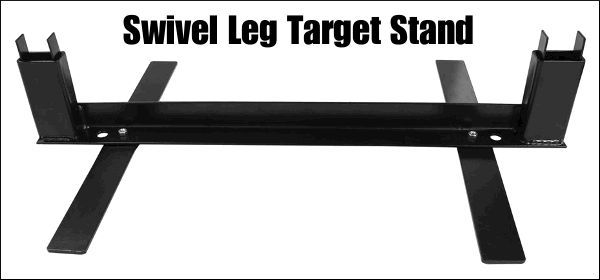
The Swivel Leg Target Stand has two legs that swivel out at a 90° angle to the target holder for stability. The stand measures 21” wide x 4.5” high and the legs are 17” long. It uses standard dimension 1”x2” lumber for uprights. This is a good choice to hold wood frames with large paper targets.




 The UV Bore light is an innovative design that uses ambient light instead of batteries. Simply put the short “J” end of the bore light in the chamber area of your unloaded gun and it will provide enough illumination to check the bore.


 Momentive Performance Materials

 National Rifle League Upcoming Spring Matches


 So what does a “worn-out” barrel really look like? Tom Myers answered that question when he removed a 6.5-284 barrel and cut it down the middle to reveal throat wear. As you can see, there is a gap of about 5mm before the lands begin and you can see how the lands have thinned at the ends. (Note: even in a new barrel, there would be a section of freebore, so not all the 5mm gap represents wear.) There is actually just about 2mm of lands worn away. Tom notes: “Since I started out, I’ve chased the lands, moving out the seating depth .086″ (2.18 mm). I always seat to touch. My final touch dimension was 2.440″ with a Stoney Point .26 cal collet.”


 When you’re out at the range, the Earth seems very stable. But it is actually a big sphere zooming through space while spinning around its axis, one complete turn every 24 hours. The rotation of the earth can create problems for extreme long-range shooters. During extended bullet flight times, the rotation of the planet causes an apparent deflection of the bullet path over very long distances. This is the ballistics manifestation of the