Many guys getting started in long range shooting are confused about what kind of scope they should buy — specifically whether it should have MIL-based clicks or MOA-based clicks. Before you can make that decision, you need to understand the terminology. This article, with a video by Bryan Litz, explains MILS and MOA so you can choose the right type of scope for your intended application.
You probably know that MOA stands for “Minute of Angle” (or more precisely “minute of arc”), but could you define the terms “Milrad” or “MIL”? In his latest video, Bryan Litz of Applied Ballitics explains MOA and MILs (short for “milliradians”). Bryan defines those terms and explains how they are used. One MOA is an angular measurement (1/60th of one degree) that subtends 1.047″ at 100 yards. One MIL (i.e. one milliradian) subtends 1/10th meter at 100 meters; that means that 0.1 Mil is one centimeter (1 cm) at 100 meters. Is one angular measurement system better than another? Not necessarily… Bryan explains that Mildot scopes may be handy for ranging, but scopes with MOA-based clicks work just fine for precision work at known distances. Also because one MOA is almost exactly one inch at 100 yards, the MOA system is convenient for expressing a rifle’s accuracy. By common parlance, a “half-MOA” rifle can shoot groups that are 1/2-inch (or smaller) at 100 yards.
What is a “Minute” of Angle?
When talking about angular degrees, a “minute” is simply 1/60th. So a “Minute of Angle” is simply 1/60th of one degree of a central angle, measured either up and down (for elevation) or side to side (for windage). At 100 yards, 1 MOA equals 1.047″ on the target. This is often rounded to one inch for simplicity. Say, for example, you click up 1 MOA (four clicks on a 1/4-MOA scope). That is roughly 1 inch at 100 yards, or roughly 4 inches at 400 yards, since the target area measured by an MOA subtension increases with the distance.
MIL vs. MOA for Target Ranging
MIL or MOA — which angular measuring system is better for target ranging (and hold-offs)? In a recent article on his PrecisionRifleBlog.com website, Cal Zant tackles that question. Analyzing the pros and cons of each, Zant concludes that both systems work well, provided you have compatible click values on your scope. Zant does note that a 1/4 MOA division is “slightly more precise” than 1/10th mil, but that’s really not a big deal: “Technically, 1/4 MOA clicks provide a little finer adjustments than 1/10 MIL. This difference is very slight… it only equates to 0.1″ difference in adjustments at 100 yards or 1″ at 1,000 yards[.]” Zant adds that, in practical terms, both 1/4-MOA clicks and 1/10th-MIL clicks work well in the field: “Most shooters agree that 1/4 MOA or 1/10 MIL are both right around that sweet spot.”
“On that day, let us solemnly remember the sacrifices of all those who fought so valiantly, on the seas, in the air, and on foreign shores, to preserve our heritage of freedom, and let us reconsecrate ourselves to the task of promoting and enduring peace so that their efforts shall not have been in vain.”
– 1954, President Dwight D. Eisenhower, Veterans Day proclamation.
100 Years Later…
On the 11th hour, of the 11th day, of the 11th month of 1918, bugle calls signaled the ‘cease fire’ ending the First World War. (The official Armistice was signed earlier that morning.) To those who endured it, WWI was the “Great War”, “the War to End All Wars.” Tragically, an even greater conflict consumed the world just two decades later.
Today, 100 years after the end of WWI, Americans mark the anniversary of the WWI Armistice as “Veterans Day”. In Canada it is known as Remembrance Day. On this solemn occasion we honor all those who have served in the military in times of war and peace.
While more WWII veterans pass away each year, there are still over 20.4 million veterans in the United States. Take time today to honor those soldiers, sailors, and airmen who have served their nation with pride. Today we remember that… “All gave some, and some gave all.” History of Veterans Day.
Former Secretary of Veterans Affairs Dr. James Peake asked Americans to recognize the nation’s 20.4 million living veterans and the generations before them who fought to protect freedom and democracy: “While our foremost thoughts are with those in distant war zones today, Veterans Day is an opportunity for Americans to pay their respects to all who answered the nation’s call to military service.”
On Veterans Day we especially need to remember the seriously wounded combat veterans. These men and women summon great courage every day to overcome the lasting injuries they suffered in battle. Some of these soldiers have lost limbs, yet volunteered to return to combat duty. That is dedication beyond measure — true patriotism.
National Veterans Day Ceremony
The Veterans Day National Ceremony is held each year on November 11th at Arlington National Cemetery. The ceremony commences precisely at 11:00 a.m. with a wreath laying at the Tomb of the Unknowns and continues inside the Memorial Amphitheater with a parade of colors by veterans’ organizations. The ceremony is intended to honor and thank all who served in the U.S. Armed Forces. Major regional ceremonies and events are also held throughout the country.
The Lee Hand Press Kit comes complete with: Breech Lock Hand Press, Ram Primer fittings, Powder Funnel, Case Lube, and one Breech Lock Quick Change Bushing.
The Lee Breech-Lock Hand Press is a useful addition to any reloader’s tool collection. This Hand Press allows you to resize brass or seat bullets while at the range or away from your loading room. No it won’t replace your Co-Ax or Rockchucker, but this is a handy piece of gear. And it’s very affordable. Midsouth Shooters’ Supply sells the Lee Breech-Lock Hand Press Kit, with everything shown above, for just $55.44. Or you can buy just the Hand Press by itself for $44.61 at Amazon.That’s a great deal.
While we don’t recommend the Hand Press for major full-length sizing chores, it does a good job seating bullets. This makes it a handy “field expedient” tool when doing load development at the range. For example you can experiment with seating depth by loading a batch of cartridges at home with the bullets deliberately seated long. Then, at the range, you can re-seat the bullets progressively shorter (in a series of rounds), until you find the optimal Cartridge OAL. Note: the maximum overall length cartridge the Lee Hand Press can accept is 3.650 inches.
The Hand Press is also great for decapping operations. Here’s a review from a verified buyer: “I mostly use it for decapping while watching TV, with a universal decapper die. Load a case, CLACK! Drop case, load another, CLACK! I can fly through them in comfort, reclined on the couch[.] Of course it is also useful for other operations. I wouldn’t love sizing large rifle cases with it, but if you’ve prepped your cases on a bigger press you could comfortably take it to the range for load development, one round at a time, working right there at the line instead of making a bunch of loads at home that you’ll have to disassemble later. It’s smaller and more lightweight than it looks and would be great for a zombie apocalypse bug-out bag.”
Using Hand Press to Load at the Range
To learn more about using the Lee Hand Press in the field with a compact scale, read Reloading Without a Bench on GunsAmerica.com. Author Chistopher Mace explains: “whether you want a better way to do load development, the capability to reload out of your ‘bugout bag’, or you’re short of space but wanting to get into reloading, the Lee Loaders and the Lee Hand Press offer you some options.”
Moly — yay or nay? Moly bullet-coating was all the rage in 1998 yet is all but dead in 2018. Glen Zediker, who has considerable experience with moly, provides some reasons why moly coating has fallen from favor.
The Pros and Cons of Moly Coating for Bullets
by Glen Zediker
In a way, I guess nothing really happened to molybdenum-disulfide-coated bullets (“moly-coated”). They’re still for sale, as are means to make up your own. What I mean is why didn’t they attain the sustained popularity they started with about 20 years ago, back when many forecasted they would virtually replace bare bullets? Here’s my take, from my experience, on “what happened.”
I don’t know any shooter who tried them and wasn’t excited about results. I sure was!
Performance-wise, moly has a lot of benefits. A lot. The first and most: take two bullets, one coated and one bare, put the same load behind them, then shoot and chronograph. The coated bullet goes slower. How is that a help? The reason it goes slower is because moly drops chamber pressure (into and through the bore easier). And! That velocity loss (at least 50 fps, usually more) is not, proportionately, nearly as much as the accompanying drop in pressure (usually ballpark 4000+ psi). (These figures vary with the cartridge, but all show similar universal influence.) So. The moly-load can be increased beyond previous “maximum” velocity: the idea is to take the coated load up to normal chamber pressure. It works! It’s common to need at the least 1+ grain more propellant to level the coated load with the original bare-bullet load.
Other advantages: Most see improved velocity consistency, evidently resulting from the coating alone. The coated bullets seem to have no limit to the number of rounds that can be fired with no change in accuracy or impact location. Of course there is a limit, but I knew many going beyond 500 rounds between cleanings. And when I say “many,” I’m talking about serious competitive shooters. Another benefit is increased barrel life (less rapid throat erosion), and this is, I think, due to a faster-accelerating bullet getting into and through the throat more quickly (less intense flame). Moly bullets also release easier from the case neck (additional “tension” is recommended).
I “switched.” (The motivation to write this came from a weekend shop-cleaning where I restacked many boxes of coated bullets, and wondered if I’d ever shoot them…)
I got more bullet speed and zero loss of zero — big benefits to an NRA High Power Service Rifle shooter. 88 rounds per day, and 80gr bullets through a 20-inch barrel trying their best to get to 600 yards in close proximity of one another.
Here was my solution to cleaning up after moly: Kroil penetrating oil and abrasive-type bore paste. This combination worked, and my zero didn’t change in the process.
Cleaning Barrels Used for Moly-Coated Bullets
What is bad, then, about moly-coated bullets? Moly itself! It coats the bore with a layer of residue. This layer traps moisture and will, not can, corrode the steel underneath it. More: molybdenum disulfide outgases (outgas is the release of an occluded gas vapor that was part of the compound; a state change, pretty much) at lower than firing temperatures. That creates a chemical that, when mixed with water (including post-firing condensation), becomes, pretty much, sulfuric acid. That meant that the whole “zillion rounds between cleanings” didn’t really work. I know many who “lost” barrels, expensive barrels.
If the barrel is cleaned (correctly) after each use, no problems. But then another advantage is lost because starting with a clean barrel it takes quite a few rounds to return to zero. The layer has to be recreated.
The residue is difficult to remove from the bore. It doesn’t respond to routine means for bore maintenance, mostly meaning brush-and-solvent. The only way I found to get it gone was using micro-penetrating oil in conjunction with an abrasive paste-type cleaner, such as USP Bore Paste or JB Bore Compound.
Hexagonal Boron Nitride (HBN) bullet coating is an alternative that functions, in my experience, well but with fewer drawbacks. First, BN is “clear”, not as messy. Bullet on the left is HBN coated. Still, though, I think that shooting coated bullets is an “all or nothing” proposition. Good groups are not likely to come “mixing” bare and coated bullets through the same barrel.
Using Coated Bullets Requires Commitment
I no longer use coated bullets. There are other coatings that have fewer disadvantages, such as Hexagonal Boron Nitride (doesn’t outgas). Some of the proprietary baked-on coatings a few major makers (such as Barnes and Winchester) use don’t exhibit the post-firing issues that “conventional” moly-coating creates (which usually was moly powder, followed by wax, which added to the tenacity of the residue).
However, another issue is that accuracy tends to suffer running bare bullets though a residue-coated bore (which results after only a few coated rounds, that are coated with anything). All that means, in short, is that running coated bullets is something that really has to be bought into. It’s a commitment, as I see it, and, as with many such things, pushing the limits on performance requires more attention to detail, more effort. It’s a matter of value.
Here’s an easy way to get bullets coated: Lyman’s Super Moly Kit. Just add a tumbler. The two bowls contain the media, moly, and bullets and then go into a vibratory-type tumbler. The 6 ounces worth of moly powder will coat thousands of bullets. It works well.
Deciding Whether to Use Coated Bullets
Weigh the pros and cons. I honestly cannot, and will not, tell anyone not to use coated bullets. Coating can provide a serious performance increase. I don’t use moly-coating anymore, but that’s because my shooting needs are not so “serious” as they once were. I, yes, have gotten a tad amount lazy. I want to go to the range and enjoy my rifles and not lose sleep over the possibility of creeping corrosion if I didn’t clean up. I also want to be able to shoot different loads, including factory ammo, and maintain accuracy.
CONCLUSION: IF you choose moly, take steps to protect the barrel bore against the potential for damage. At the least, run some petroleum-based oil through the bore after shooting if you can’t clean it soon.
It’s the holiday season — there’s no better time to sit in front of a fire and read a good gun book. Midsouth Shooters Supply now carries the full line of shooting and reloading books from Krause Publications at very attractive prices. Looking for reliable reference works on reloading, or a gift for a shooting buddy? You’ll find something worthwhile among the Krause library of gun books, which includes the respected Gun Digest Shooter’s Guides. Match directors also take note — books make great match prizes. Paperback books cost no more than wood plaques but they will provide valuable information for years instead of just gathering dust in a closet. If your club offers training programs, Krause offers many titles that will help new shooters improve their skills.
Looking to improve your competition skills? The Shooting Sports USA website has scores of informative articles that can help your score higher at your next shooting tournament. You’ll find articles on wind reading, position shooting, match strategies, and much more.
One great Shooting Sports USA article, Shooting is 90% Mental, was penned by Chip Lohman (SSUSA’s former Editor). With the help of two very smart Ph.D types, Judy Tant and Mike Keyes, Lohman examines the mental processes involved in the shooting sports. Chip’s co-authors have impressive credentials. Dr. Judy Tant is a Clinical Psychologist and National Bullseye Pistol Champion. Dr. Michael J. Keyes, is a licensed Psychiatrist and former physician for the U.S. Shooting Team.
Visualization, Brain Function, and Muscle Memory
If you shoot competitively, this is definitely a “must-read” article. The authors examine how the brain functions under stress, how “visualization” can be used to improved performance, how “brain speed” can be enhanced through proper training, and how the brain stores learned routines into “muscle memory.” And that’s just for starters — the article gives many concrete examples of techniques top shooters have employed to improve their “mental game” and shoot higher scores.
Brain Speed and Trigger Control: Research: Scientists believe that the newer frontal lobe may not be able to keep up with “deep” brain signals that transmit at nearly 300 mph. This is explained when athletes talk about “letting go”, rather than over-thinking the shot.
This conscious signal can take up to 0.3 seconds from recognizing the desired sight picture to moving the trigger finger — too long to capture the opportunity for a perfect shot. However, if the signal is initiated spontaneously in the cerebellum where such procedures are thought to be stored through repetition, the reaction speed is much quicker. Signals are processed by the “deep brain” almost twice as fast as the problem-solving frontal lobes.
Bad news for Washington State gun owners. The draconian gun-control initiative, I-1639, passed in this week’s election, with roughly 60% voter approval. Big changes are in store for the Evergreen State, starting January 1, 2019. According to Guns America, “I-1639 bans the sale of semiautomatic rifles to adults under the age of 21, creates a registry of gun owners, establishes a 10-day waiting period for certain purchases, holds gun owners liable for failing to secure firearms, and allows the state to charge a $25 fee on the sale of [broadly defined] ‘assault rifles'”.
The age restriction on gun purchases goes into effect January 1, 2019. The other provisions commence six months later, on July 1, 2019. Outdoor stores and gun-shops are getting ready for the new law, expecting confusion and some panic buying. “Now we’ve got a law that’s going to cause problems for us and it’s going to cause problems for consumers and the impact on crime is going to be zero. So there’s going to be a rush for people buying guns and beat the law to the punch but I think ultimately though it will have a negative effect for a while on gun sales” said Wade Gaughran of Wade’s Eastside Guns in King County, during an interview with KOMONews.
NRA and Second Amendment Foundation Will Challenge I-1639 in Court
Despite the election result, there is some hope. Gun rights groups plan to challenge I-1639 in court: “The Second Amendment Foundation (SAF) and the National Rifle Association (NRA) will be jointly filing a court challenge to I-1639 and the chilling effect that it has on the constitutional right to keep and bear arms,” said SAF founder Alan Gottlieb.
I-1639, over 30 pages in length, is far-reaching. This measure basically defines virtually ALL self-loading long guns as “assault rifles”. This would even include popular .22 LR rimfire rifles such as the Ruger 10/22, Marlin 60, and Remington 597. In addition, I-1639 imposes draconian gun storage requirements, imposes new taxes on gun ownership, creates a state-controlled gun registry, and mandates annual “verification” of gun owners. LEARN MORE HERE.
Alan Gottlieb explains that many negative aspects of I-1639 were not understood by voters. This initiative threatens privacy rights, and interferes with citizens’ ability to defend their homes. “Not only does the initiative discriminate against gun owners, it classifies common recreational firearms as ‘semiautomatic assault rifles’ and requires gun buyers to surrender their medical privacy in order to exercise a constitutionally-protected right.” I-1639 was pushed by the Seattle-based Alliance for Gun Responsibility, an extreme anti-gun advocacy group funded by billionaire dollars.
I-1639 was in fact so badly-drafted and extreme that even law enforcement organizations opposed this far-reaching anti-gun measure. In the weeks leading up to the election, the Washington State Sheriffs Association (WSSA), Washington Council of Police & Sheriffs (WACOPS), and Washington State Law Enforcement Firearms Instructors Association (WSLEFIA) all opposed I-1639.
A 7mm Snake for Santiago
Our friend Dennis Santiago has a reptilian rig in his arsenal. It’s actually an Eliseo R1 single-shot tubegun chambered in .284 Winchester. The eye-catching aspect of Santiago’s .284 bolt-gun is the snakeskin dip job on the exterior. This really creates a distinctive look. Dennis tells us: “It was Gary Eliseo’s idea to try a water-transfer printing finish for this rifle. There are many patterns to choose from — this is the WTP-260 Snakeskin Illusion-Fall Copper from WaterTransferPrinting.com. For a single shot LR gun, I figured something on the bright side would be interesting and pick up less heat from the sun in the summer.”
Dennis uses this eye-catching rifle in prone matches, where a single shot works fine. He says: “Underneath the hood, it’s a Rem 700 Long Action, chambered in .284 Win. Yes it’s a single shot! I don’t need anything else for a prone gun. Nothing to get in the way of building the perfect position.”
Dennis says: “Length of pull, offset and cast initially set the same as my similar RTS .308. My gun, my body dimensions.”
R1 Testing with Advanced Electronic Shot-Plotting System
Now that winter is here, Dennis plans to do some serious load development with this rifle: “I acquired a new ShotMarker electronic target system. I’ll be using that to test a variety of powders and bullets.” Dennis has previously loaded his .284 Win R1 with Hodgdon H4831 powder, but he hopes to test alternatives from Alliant and IMR as well. There are many interesting 7mm bullet options, such as Sierra’s impressive, factory-pointed 183gr MatchKing with 0.707 G1 BC, and Berger’s new 184gr F-Open Target Hybrid with 0.695 G1 BC.
The ShotMarker is a unique 8-sensor acoustic electronic target that instantly plots shot locations and transmits the data via WiFi to a mobile device. Dennis is eager to try his new Shot-Marker. The system can measure group size, velocity, and SD. The Shot-Marker App can then store your strings for later review, add notes to the target, and export data to spreadsheets.
A FFP 6-24x50mm Sightron Rides on Top
The optic is a Sightron 6-24x50mm, FFP MOA-2. Dennis reports: “I looked at many scopes (within my determined price range), and this is the one that had the best combination of features for for this gun’s particular application. The sight line sits about 3 inches above bore line on these guns. It’s been leveled, bore-sighted and pre-dialed for a 200-yard estimated zero for the ammo I plan to use. Those are Gen II A.R.M.S. rings. Super easy to tailor to different rail widths. Same rock-steady steel performance.”
You can never be too safe when hand-loading your own ammunition. This helpful Brownells video outlines the Seven Fundamental Reloading Safety Tips. This is important information for novice hand-loaders and a good refresher for those with reloading experience!
Summary of the Seven Safety Tips:
1. Store your reloading supplies in a safe and dry location, away from children and away from any possible source of ignition. It is also smart to keep your powder and primers separate.
2. Get and use respected reloading manuals, especially for new cartridges. Start low and work up slowly while watching for warning signs of pressure and/or case fatigue.
3. Locate your reloading activity where you will not be distracted. If you get interrupted, stop. (Distractions will eventually lead to mistakes.)
4. Do NOT mix powders. Keep your powders clearly marked and dated. You can use masking tape to write the date on the container.
5. If you load the same cartridge type for different firearms, make sure your ammo headspaces properly in each gun.
6. Check cases frequently. Look for split necks, case head separation or other signs of fatigue and excessive pressure.
7. If reloading military brass, be aware that case capacity is usually reduced, and initial loads should be at least 10-15% lower than published data.
Here are some other tips that will help your avoid making costly mistakes (such as using the wrong powder, or undercharging a case):
Powder Type — Always double-check the label on your powder containers. After placing powder in the powder measure, put a piece of tape on the measure with the powder type written on it. Some guys write the powder type on a card and place that right in the hopper.
Scale Drift — Electronic balances can drift. If you are using a digital powder scale, calibrate the scale with a test weight every 50 rounds or so.
Case Fill — If you throw more than one charge at a time, look INSIDE every case before seating a bullet. Squib charges can be dangerous if you don’t notice them before firing the next round.
Progressive Presses — When using a progressive press, consider using an RCBS Lock-Out Die. This will detect a low charge and stop the machine. These dies will work with RCBS, Hornady, and Dillon progressives.
Check out that 0.188″ group. Can you believe that was shot with factory .308 Win ammo? A couple seasons ago our friends at Criterion Barrels tested some .308 ammo from Creedmoor Sports. This was loaded with Lapua’s 175gr Scenar HPBT bullet. The results speak for themselves. Any time factory ammo can shoot inside quarter-MOA, that’s impressive. This ammo was used in a “Rem/Age” project rifle. That term refers to a Remington action rifle that has been re-barreled with a pre-fit Criterion barrel. The new barrel is secured with a Savage-style barrel nut. Hence the term “Rem/Age” or “Rem-Age”.
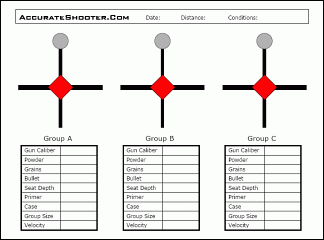
Criterion posted: “I think we may have a new favorite factory match load for the nitrided Rem/Age build.” Another reader added: “[Creedmoor’s] 175 Scenar .308 ammunition is top notch.” FYI, this group was shot on our load development target, which you can download for free from our Targets Page.
Why do Criterion barrels shoot so well? One reason is that Criterion’s barrel steel is carefully stress-relieved. In the photo below, Criterion Rack 1A (aka the “Coffin”) has been loaded with barrel blanks — made ready for the stress-relieving process.
Working with Pre-Fit Barrels
While they may require the purchase of some additional tools and a bit of a learning curve to install, using Rem/Age pre-fit barrels offer advantages over gunsmith chambering and barrel-fitting. In this video, 8541 Tactical explains how to install a Criterion 6.5 Creedmoor “pre-fit” barrel. You save money and time — you don’t have to wait for a gunsmith to chamber the barrel. While Criterion recommends that a competent gunsmith oversee the pre-fit installation, if you understand the use of go/no-go gauges and you have a barrel vise and action wrench set up to remove the original barrel, putting on a pre-fit barrel CAN be a DIY project. You don’t have to pack up your rifle to ship it off to a smith.







 Research: Scientists believe that the newer frontal lobe may not be able to keep up with “deep” brain signals that transmit at nearly 300 mph. This is explained when athletes talk about “letting go”, rather than over-thinking the shot.


 A 7mm Snake for Santiago