This is BIG news for the Extreme Long Range (ELR) game. Berger Bullets will offer a line of SOLID bullets in .375 caliber. You read that right — these will be the first-ever large diameter Berger projectiles manufactured from a solid copper alloy. Most conventional bullets feature a jacket over a metal core, typically lead alloy. These new Berger solids are lathe-turned from solid copper alloy — shaped with precision into perfect aerodynamic profiles. The new Berger ELR solids boast a long, VLD shape with ultra-high Ballistic Coefficients. The new .375 caliber Berger ELR solids will be offered in two bullet weights: 379 grains and 407 grains.
The prototype 400gr version of this solid bullet was extensively tested at 2400 yards (above). It remained supersonic at that distance, a remarkable 1.36 miles. Berger will now offer two production versions, 379gr and 407gr, based on this successful prototype, further optimized. Here is Berger’s official release:
Berger Bullets proudly announces the New Extreme Long Range (ELR) Match Solid Projectile line, beginning with .375 caliber 379 grain and 407 grain offerings.
Extreme Long-Range shooting to distances of two miles and beyond has taken the firearms community by storm. With much of its roots developed from elite military sniper and Special Forces rifle training, ELR enthusiasts are utilizing highly innovative rifle and ammunition technology to engage targets at distances previously unheard of. Berger has taken the lead pioneering ELR, similar to how it’s dominated all other long-range rifle disciplines.
Berger Bullets chief ballistician Bryan Litz states: “Our new ELR Solid Match Bullets provide both competition shooters and Mil/LE forces a long-range solid projectile like no other. Its highly-optimized VLD ogive design and lathe-turned solid copper construction provide a ballistic advantage that is unmatched by any conventional-style bullet.”
Berger .375 Caliber Bullet is a Winner
Berger’s .375 caliber solid bullet design has already been proven in competition. At the 2018 World Longest Shot Challenge (WLSC), Team Applied Ballistics used the prototype .375 Cal ELR solid with great results. The new .375 caliber monolithic Berger bullet designed by Bryan Litz was used by the first and second place finishers in the “above .338 caliber” class. The prototype .375 Cal solid performed great, and the ultra-high BC was confirmed. READ WLSC Story HERE.
Advanced Doppler Radar was used to confirm Ballistics Data for the new Berger .375-Caliber Solids:
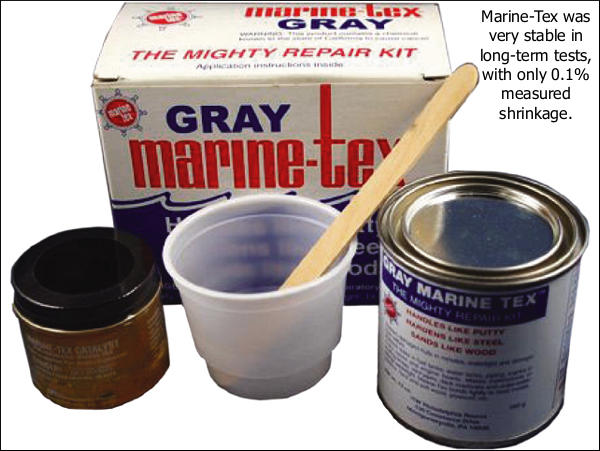
A customer of well-known gunsmith (and Hall-of-Fame shooter) Thomas “Speedy” Gonzalez recently asked Speedy about bedding compounds. Speedy offered some interesting advice based on long-term testing of various materials. Speedy favors Marine-Tex because it is very stable over time, while other materials can shrink up to 6% dimensionally. A good bedding job should be a perfect fit to your barreled action. If the bedding material shrinks over time, that is NOT a good thing….
Speedy’s customer asked: “I know you’re not a Devcon man in regards to bedding compounds but I respect your input in such matters and my question is this in regard to aluminum actions. If Devcon was considered, for an aluminum action, would you prefer aluminum compound formula or steel formula? I personally prefer Devcon steel and Marine-Tex for steel receivers but my experience with aluminum is limited. Also do you have a release agent preference that works better with aluminum?”
Speedy answered: “My only preference of one epoxy over another is their stability over time. My buddy who works for the Texas State Weights and Measures Department had me cast several of the most common types of epoxies used for bedding into 1.000″ machined blocks. After one year of being kept in a controlled climate and measured for shrinkage monthly, the Marine Tex shrunk only 1/10th of 1% (i.e. 0.1%) whereas almost all the others (including Devcon Steel formula, Devcon Aluminum formula…) shrunk 3% to 6%. The only other compounds that matched the Marine Tex were Araldite 1253 and Araldite 2014, with the latter being quite expensive for daily use.”
Speedy added: “The Marine Tex Grey has no atomized metal in its makeup even though it appears that it does. This can be proven by the use of a strong neodymium magnet. What is humorous to me is that people don’t like aluminum yet will bed their actions atop aluminum pillars that have twice the coefficient of expansion (COE) of steel. Like Devcon, it is what people have always done and used. Thus [they] perpetuate the same old stuff. That’s my two cents’ worth. But as I tell everyone, ‘I’ll tell you what I know or do, but it’s not my job to convince anyone to do it my way’.”
Release Agents — Try Shoe Polish
Regarding release agents, Speedy stated: “I use Kiwi Neutral or Tan shoe polish. This works great and you can find it anywhere. Do NOT use the black or brown as it will stick.”
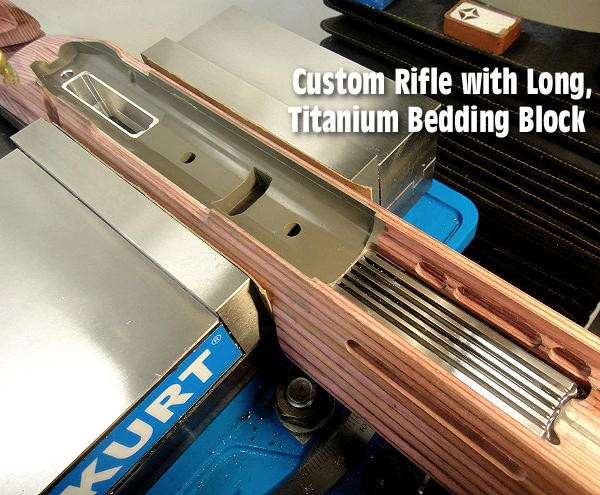
View More Photos of Speedy Inletting and Bedding Job CLICK HERE to see an interesting bedding job done by Speedy using a custom titanium bedding block. Speedy notes, “The stock was a raw blank requiring full inletting for the action to fit properly plus the titanium block. All the loading ports, bolt handle cut, bolt stop, and trigger guard cuts were done with diamond tooling to eliminate fraying and/or delamination of the wood.” You’ll find more projects by Speedy on his Facebook Page. Speedy is in San Antonio, Texas now, and accepting new projects with his company S.G. Rifles LLC.
Savage will launch 40 new products at the 2019 SHOT Show in Las Vegas. This will be a big year for Savage as 2019 marks Savage’s 125th Anniversary. The brand is celebrating the historic event by offering limited-edition rifles as well as many new offerings in bolt-action rifles, AR-platform rifles, and shotguns. “Whether you are looking for a training rifle, a competition-grade modern sporting rifle, a reliable shotgun for hunting or personal defense, or a lightweight hunting rifle packaged with a scope, Savage has those needs covered, plus more”, said Savage’s Marketing Director, Beth Shimanski.
New 2019 Product Launch Highlights
The company is expanding and improving its popular XP scoped rifle lines. New models include the 110 Apex XP series, featuring Vortex scopes, and a pint-sized Rascal Target XP. Plus, the existing AXIS XP series has been upgraded with a new modernized stock. The AccuFit system lets shooters quickly adjust comb height and length-of-pull. The feature is an integral part of a new long-range rifle with a superior finish, the 110 High Country, featured below:
Savage is expanding the popular XP scoped rifle lines. New models include the 110 Apex XP series, featuring Vortex scopes, and a pint-sized Rascal Target XP. Plus, the existing AXIS XP series has been upgraded with a new modernized stock.
Savage’s MSR 15 and MSR 10 AR-platform rifle series will include new options for long range, precision and competition shooting. These rifles are not cookie-cutter AR clones. The MSR Savages have some interesting upgrades, such as side-charging handles (on MSR 10), Magpul PRS stocks, adjustable gas blocks, and tunable muzzle brakes. The MSRs also enjoy a good reputation for build quality and reliability.
All of these new rifles, as well as more bolt-action and semi-automatic centerfire and rimfire rifles, will be on display at SHOT Show Booth No. 14551 January 22-25, 2019 at the Sands Expo Center.
The USAMU has published a “how-to” article about bullet sorting. While many of us may sort bullets by base-to-ogive length (and/or weight), the USAMU story explores the “how and why” of sorting bullets by Overall Length (OAL). Read the article highlights below, and make your own decision as to whether OAL sorting is worth the time and effort. Bryan Litz of Applied Ballistics says that sorting by OAL is not a bad idea, but base-to-ogive bullet sorting probably represents a better investment of your time.
Bullet Sorting by Overall Length
We’d like to share a specialized handloading technique which we’ve long found beneficial to our long-range (600 yards and beyond) accuracy. Sorting of bullets for extreme long range (LR) accuracy is not difficult to do, but some background in theory is needed.
Here at USAMU’s Handloading Shop, we only sort individual bullets for the most demanding Long-Range applications and important competitions. Only the most accurate rifles and shooters can fully exploit the benefits of this technique. The basic sorting process involves measuring the Overall Length (OAL) of the bullets, and grouping them in 0.001″ increments. It’s not unusual to find lots of match bullets that vary as much as 0.015″-0.020″ in length throughout the lot, although lots with much less variation are seen as well. Even in bullet lots with 0.015″ OAL variation, the bullet base-to-ogive length will show much less variation. Hence, our basic sort is by bullet OAL. One obvious benefit of sorting is easily seen in the attached photo. The few bullets that are VERY different from the average are culled out, reducing probable fliers.
How does one know what OAL increments to use when sorting? The answer is simple. As each lot of bullets is unique in its OAL distribution, it’s best to sample your bullet lot and see how they are distributed. In the attached photo, you will see a set of loading trays with a strip of masking tape running along the bottom. Each vertical row of holes is numbered in 0.001″ increments corresponding to the bullets’ OAL. A digital caliper makes this task much easier. As each bullet is measured, it is placed in the line of holes for its’ OAL, and gradually, a roughly bell-shaped curve begins to form.
Note that near the center, bullets are much more plentiful than near the edges. At the extreme edges, there are a few that differ markedly from the average, and these make great chronograph or sighting-in fodder. We recommend using a sample of 200 bullets from your lot, and 300 is even better. Some bullet lots are very consistent, with a tall, narrow band of highly-uniform bullets clustered together over just a few thousandths spread. Other lots will show a long, relatively flat curve (less uniform), and you may also see curves with 2 or more “spikes” separated by several 0.001″ OAL increments.
Bullet Sorting (OAL vs. Base-to-Ogive vs. Weight) — Litz Talks
I’m often asked what is a the best measure to sort bullets by, and the answer (to this and many other questions in ballistics) is: it depends.
Choosing to sort by overall length (OAL), base to ogive (BTO), bearing surface, weight, etc. can get overwhelming. Shooters typically look for something they can measure, which shows a variation and sort by that. It’s common for dimensional variations to correlate. For example, bullets which are longer in OAL are typically also shorter in BTO, and have longer noses. All these are symptoms of a bullet that was pushed a little further into the pointing die, or possibly had more than average lube while being swaged. So in essence, if you sort by BTO, you’re measuring one symptom which can indicate a pattern in the bullets shape.
So, the question still stands — what should you measure? You’ll always see more variation in OAL than BTO, so it’s easier to sort by OAL. But sometimes the bullet tips can be jagged and have small burrs which can be misleading. Measuring BTO will result in a lower spread, but is a more direct measure of bullet uniformity.
Then there’s the question of; how much variation is too much, or, how many bins should you sort into? Shooters who see 0.025” variation in BTO may choose to sort into 5 bins of 0.005”. But if you have only 0.005” variation in the box, you’ll still sort into 5 bins of 0.001”. What’s correct? You have to shoot to know. Live fire testing will answer more questions, and answer them more decisively than any amount of discussion on the subject. The test I recommend is to identify bullets on the extreme short end of the spectrum, and some on the extreme long end. Load at least 10 rounds of each, and take turns shooting 5-shot groups with them. If there is a difference, it will be evident. The results of the testing will answer your question of: should I sort based on X, Y, or Z?”
You can read more discussion on this and other similar subjects in the new Ballistics & Bullets board in the Accurateshooter.com forum. Here’s a link to the thread which is discussing bullet sorting: Bullet Sorting Thread
If you’ve ever attended one of the major CMP games, you’ve probably seen Dennis DeMille, former General Manager of Creedmoor Sports. A two-time National Rifle Champion, Dennis helped teach High Power Clinics and he has shared his marksmanship knowledge in many ways. Now Dennis is undertaking a fresh challenge — as the new General Manager of Virginia-based Tactical Walls, a leader in specialized USA-made gun storage/concealment systems. As the Tactical Walls GM, Dennis will oversee operations and new product development. Dennis brings with him more than 20 years of active duty Marine Corps service and nearly 14 years of experience managing Creedmoor Sports.
Dennis is pleased to be working with Tactical Walls: “Tactical Walls was the pioneer in concealing firearms in plain sight. Working with people who are passionate about what they produce, who possess that level of creativity, and at a company with limitless manufacturing ability, makes me very excited about the future of Tactical Walls. It’s a real honor and my sincere privilege to now be part of this team. Please feel free to contact me directly at dennis [at] tacticalwalls.com”.
Tim Matter, founder and President of Tactical Walls states: “Dennis’ manufacturing and operations experience will help [extend] the tremendous growth and product development we experienced in 2018. We are proud and excited to have him on our team. Stop by and visit us at our booth at SHOT Show later this month or check us out at www.tacticalwalls.com”.
Shooting Tips with Dennis DeMille
Sling Shooting Tip — The Benefits of Leather
Above, Dennis shows a young competitor at the CMP Western Games how to adjust his leather sling. “Many shooters shy away from using a leather sling because they have never been taught how to use one. That’s unfortunate. A leather sling offers more support than a web sling, which is important when competing with the heavier than normal rifles.” — Dennis DeMille
The Benefits of Dry-Fire Training
Once you set up your sling properly, you’ll need practice. Dennis DeMille stresses the importance of dry-fire practice with sling and shooting coat. Dry-Fire training is essential to the sling disciplines. DeMille, a past National Service Rifle Champion, told us that, for every minute he spent in actual competition, he would spend hours practicing without ammunition. While in the USMC, Dennis would practice in the barracks, working on his hold and dry-firing:
“The most important thing is to spend time off the range practicing. Most of what I learned as a High Power shooter I learned without ammunition — just spending time dry firing and doing holding exercises. Holding exercises will really identify the weak parts of your position. The primary purpose of dry firing is to get you used to shooting an empty rifle. If you can shoot a loaded rifle the same way you shoot an empty rifle then eventually you will become a High Master.”
You’ll find lots of notable new products in Shooting Industry’s January 2019 issue. This 108-page issue is filled with timely articles ranging from marketing insights and SHOT Show 2019 coverage to tips for success in the new year. The January issue also includes Part II of the 2019 New Product Showcase. January’s 30-page New Product Showcase features over 150 products from 115 brands. Here are some highlights from the Product Showcase:
Steyr’s Monobloc — Barrel and Action are one piece of steel. Impressive engineering, but what happens when your barrel wears out?
Berger has new 6mm Creedmoor Ammo plus new .375-Caliber bullets for ELR shooters:
Lyman has a great new Case Trimmer with speed control and carbide cutter:
New Brass from Jagemann and BOG “DeathGrip” Clamping Tactical Tripod:
New Generation Mantis — Accelerometer and software tracks your muzzle movement:
Have a LONG F-Class Rifle or a PRS rig with suppressor? This nice case will hold your rig:
MORE SHOT Show Coverage
Shooting Industry’s January Issue has extensive SHOT Show coverage, including the comprehensive Exhibitors Guide, SHOT Show Auction info, plus a sizable pullout map in the printed editions.
A couple seasons back we published our comprehensive 6.5×47 Lapua Cartridge Guide, researched by the 6.5 Guys. In case you’ve been wondering what kind of accuracy is possible for a tactical-type rifle chambered for this mid-sized cartridge, check out this tack-driver built by gunsmith Ryan Pierce. That’s a mighty impressive 0.206″ five-shot group fired with Berger 140gr Hybrids using a Brux cut-rifled barrel. The powder was Hodgdon H4350, a very good choice for this cartridge.
Ryan reports: “Here is a 6.5×47 I built for a customer. It features a trued Rem 700 action, Brux 1:8″ Rem varmint-contour barrel, Mcmillan thumbhole stock, Surgeon bottom metal, and 3-port muzzle brake. The customer’s preferred load is the same that has worked in the last couple dozen 6.5x47s I’ve built: 41.1-41.3 grains of H4350 with 140 hybrids .050″ off the lands. This should run about 2810-2815 fps from a 26″ barrel. The 3.128″ refers to length of a loaded round from the base to ogive including the Hornady ogive comparator tool.”
Yep, It Measures Up…
Lest anyone dispute Ryan’s measurement of this group (the internet is full of nay-sayers), 0.206″ is EXACTLY what we got when we measured this group using OnTarget software. See for yourself:
At the request of our readers, we provide select “Deals of the Week”. Every Monday morning we offer our Best Bargain selections. Here are some of the best deals on firearms, hardware, reloading components, optics, and shooting accessories. Be aware that sale prices are subject to change, and once clearance inventory is sold, it’s gone for good. You snooze you lose.
1. Brownells — Marlin 336Y .30-30 Lever Gun, $389.99 with Code
We think everyone should have a lever gun in their collection, and here’s an exceptional value — Marlin’s model 336Y for just $389.99. The 336Y (for “youth”) has a shorter stock that makes it suitable for younger hunters. The .30-30 Winchester chambering may seem dated, but plenty of bucks have been taken with the venerable .30-30 round. This lever-action rifle features 5-shot tubular magazine, side ejection, and Buckhorn sights. Just 34″ overall, with 16.25″ barrel and weighing only 6 pounds, Marlin’s 336Y can also be a very effective home defense arm. This gun lists for $399.99 with a $10.00 FFL handling fee. Use CODE M8Y to save $20 with FREE shipping, reducing your net cost to $389.99 delivered. NOTE: Brownells has other discount codes: Code LAV ($10 off $100 + free S/H) and Code NCS ($15 off $150 plus free S/H).
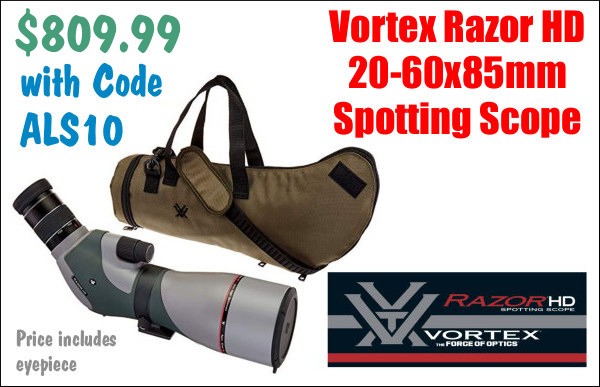
2. Al’s — Vortex Razor HD 20-60x85mm Spotting Scope, $809.99
AMAZING DEAL — save $390.00! Other vendors sell this very same Razor HD spotter for $1199.
Here’s a great deal on a high-quality spotting scope from a top optics maker. AL’s Sporting Goods has last year’s model Vortex Razor 20-60x85mm spotter for only $899.99, including eyepiece. This impressive HD-glass spotter sells elsewhere for $1200.00. But it gets better — use Code ALS10 for another 10% Off, bringing the final price down to $809.99. This is a very good spotter for the money and as Vortex will tell you, “buy a Razor now and we’ll always replace it with a Razor in the future”.
3. CCI and Federal .22 LR Rimfire Rebate — Save up to 20%
Get paid back when you buy Federal or CCI .22 LR rimfire ammunition. For every 5 boxes of Federal or CCI Rimfire Ammunition you buy, you will receive a rebate of the cost of one (1) box. The rebate amount will equal the purchase price of the LOWEST-cost box of the five. This rebate program is offered for most Federal and CCI .22 LR ammo. The maximum rebate is $200 per household. Print off your redemption form from links below. NOTE: This deal is good through the end of March, 3/31/2019. Purchase qualifying ammo from vendors including Bruno’s, Graf’s, Midsouth, Powder Valley, and Precision Reloading.
Everyone loves reactive targets, and hitting steel is particularly fun with a .22 LR rimfire — you can plink safely at relatively close range. Here is a nicely-designed, self-resetting target at a remarkably low price — just $19.88. Heck you could pay that much for a couple packs of paper targets, and this Range Ready .22 Popper target should last for years (just don’t shoot centerfire ammo at it!). These resetting popper targets are just plain fun to shoot. Plus they are cheap enough that your club could buy a half-dozen or more for use in rimfire tactical matches.
Note: You get one set of muffs (either gray or camo, NOT both) for $8.88 plus S/H.
Good muffs that offer 27 db Noise Reduction and won’t spoil your cheekweld — for under ten bucks? Can’t argue with that. Right now CDNN is offering a killer deal on Kryptek Sound Soldier 27 NRR muffs that sell elsewhere for around $24.00. Get these in either Highlander Camo or Typhon Grey for just $8.88. These passive muffs have low profile shells engineered to stay out of the way when shouldering your weapon. The ergonomic headband keeps the muffs aligned, in their proper position. Purchasers report the soft leatherette ear seals are surprisingly comfortable. These muffs provide a pretty high NRR considering the low profile design. And the price, just $8.88 on sale, is hard to beat! NOTE: Other vendors have a more conservative 25 NRR for these type of muffs. That’s still quite good.
6. Midsouth — Lyman Brass Smith Ideal Press, $69.99
Lyman’s new Ideal compact press works great as a second, lighter-duty press. It also is a good choice for loading at the range. It can easily be mounted to a range bench with C-clamps. With its cast-iron body, this C-Frame press is stronger than other presses in its price class. If you are looking for a secondary press for de-capping, bullet-seating and other tasks not requiring heavy leverage, this is an excellent choice. The Lyman Ideal costs just $69.99 at Midsouth Shooters Supply.
Still laying on the ground or using your wife’s yoga mat for shooting? For $24.99 now you can grab this NcStar Vism shooting mat and give your knees, belly, and elbows a break from the ground below. It opens wide and even has straps for pre-loading your bipod. This is a quality pad that helps put some space between you and your rocky position. When you’re done simply fold in the edges, roll it up and it takes up the same or less space as a sleeping bag. This is a good product tested and used by our staff.
8. Walmart — 46″ Workbench with LED light, $49.00
Are you looking for a solid workstation to reload or gunsmith on? This Walmart 46″ Workbench is solid, easy to assemble, and comes with an LED light, peg hooks, plus drawer liner. That’s a lot of bench for $49.00 especially considering how much you can store under it or in the drawer. The advantage of the LED light is that it won’t affect delicate electronic scales.
9. Amazon — Neiko Digital Calipers, $17.85
Even if you have a good set of calipers, you may want to get one of these Neiko 01407A Digital Calipers. The #1 best-selling digital caliper on Amazon.com, this Neiko tool features a large LCD Screen and measures up to 6.0 inches. With over 3800 customer reviews, this product has earned an overall rating of 4.4 out of 5 stars. It’s hard to go wrong for $17.85, even if you just use these as a spare set for measuring group sizes and case trim lengths.
Mossberg has reached a major milestone. 2019 marks the 100th year in business for this leading USA gun-maker. The Mossberg story began in 1919 with a dream to manufacture durable and reliable firearms that the working class could afford. As simple as that dream was, it was fairly ambitious. After all, Oscar Frederick Mossberg, a Swedish immigrant, was 53 years old. But he was talented and determined. So armed with experience, and keen knowledge of the industry, he and his two sons, Harold and Iver, began O.F. Mossberg & Sons, Inc. A lot has happened in Mossberg’s first 100 years. Yet through it all, the company has proudly remained family owned and operated.
Oscar knew the gun industry from being a product engineer at various New England companies including Iver Johnson Arms & Cycle Works, J. Stevens Arms & Tool Co., and Marlin-Rockwell. In 1919, when Marlin-Rockwell went out of business, O.F. Mossberg and his two sons, Iver and Harold, started a new firearms company of their own, O.F. Mossberg & Sons.
The company’s first gun was the Brownie, a four-shot, 22-caliber pistol that was durable and reliable. This pocket pistol cemented Mossberg’s reputation as a manufacturer of firearms that performed well, and were built to last.
Mossberg grew quickly, adding over two dozen firearms while developing and improving bolt-action rifles and shotguns. As it developed new models, the company launched a variety of innovations, including the first range-finding telescopic sight.
Oscar Mossberg passed away in 1937. However, his sons continued their father’s legacy. And in 1941, they started manufacturing training rifles for the U.S. military. That contract established a strong connection with the U.S. armed forces.
In 1961 Mossberg introduced the Model 500 pump-action shotgun. It proved to be the company’s most successful firearm, reaching the 10 million mark faster than any other, making it one of the world’s most-produced firearms. The Mossberg 500 is still one of the most popular shotguns in the world.
Mossberg’s innovations continued through the 1970s and ’80s. The 500 led the way to Mossberg’s military 500, 590, and 590A1, the only pump-action shotguns ever to meet all U.S. Military MIL-SPEC 3443 requirements. In 1988, Mossberg introduced the powerful 835 Ulti-Mag pump-action shotgun, the first-ever firearm chambered for 3.5″ shells.
Another Mossberg innovation was the MVP, the first bolt-action rifle to reliably feed from standard AR/M14 magazines. Mossberg also developed the innovative Model 590M shotgun, which added a double-stack detachable magazine to the battle-proven 590 shotgun platform.
NEW Mossberg MC1sc Subcompact 9mm Pistol
For 2019, Mossberg is introducing the all-new MC1sc, a slim 9mm single-stack compact designed to compete with the Glock 43, Ruger American Compact, and Taurus PT111 G2. The innovative MC1sc was designed to outperform industry-leading 9mm subcompacts while continuing the Mossberg tradition of durability and dependability.
Similar in size and shape to the Taurus PT111 G2, this new Mossberg pistol follows a familiar formula: soft-edged polymer frame, single-stack 6-rd magazine (with 7-rd extended option), drift adjustable sights, and an Glock-type trigger-shoe-insert safety. The barrel is 3.4″ while the MC1sc is 1.03″ thick and 6.25″ long (nearly identical to a Glock 43). The backstrap profile and grip angle is sort of a blend between a Glock and the Walther PPS.
Why choose the mini-Mossie when so many other proven 9mm carry guns are available? Well, it will definitely cost less than a Glock 43. MSRP for the Mossberg is $421.00 but we expect “street price” to be about $380.00, making the MC1sc $90 cheaper than the Glock 43, which retails for around $470.00 (with standard sights). The MC1sc also has two interesting (and innovative) design features: 1) see-through magazines; and 2) quick-removable striker assembly.
Innovative See-through Magazines
Mossberg ships the gun with see-through Clear-Count™ magazines made from a transparent polymer. This lets you quickly see the number of rounds remaining in your mags. Smart idea. That’s a good thing. Plus, this pistol will also take Glock-compatible mags, so you have a choice.
The second feature will annoy some gun owners. You must REMOVE the striker assembly in order to take-down the pistol. GunsAmerica explains: “The MC1sc…requires the user to remove the striker assembly before disassembling the handgun for cleaning. While this sounds more like an impediment than a feature, it ensures safe takedown and doesn’t require users to pull the trigger before disassembly.”
Posted on June 21, 2017 by Sierra Bullets Written by Sierra Bullets Ballistic Technician Gary Prisendorf
I recently purchased 1,000 rounds of once-fired 5.56 LC brass that was fully processed and ready to load. The brass had been wet tumbled, using stainless steel pins and looked great inside and out, including the primer pockets.
I had always used a vibrating tumbler with either corn cob or walnut media and I always thought my brass looked pretty good until I saw what the wet tumbling and pin combination did.
Being the budget minded reloader that I am, I started looking for a cheap way to wet tumble my brass using stainless steel pins. Harbor Freight had recently opened a store nearby and I had received coupons in the mail, one of the coupons was 20% off any one item.
So I headed for the Harbor Freight store and after roaming around for 20 minutes or so I found a dual drum rotary rock tumbler for $55.00 and thought it would do just fine for what I was planning. The drums are rather small and only have a 3 pound maximum load limit each, but I figured that was big enough for around 150 .223 cases or maybe 300 9MM cases at a time.
I pulled the wrinkled up coupon out of my pocket, paid, and walked out with my new $47.00 brass cleaning machine. I didn’t have any stainless steel pins and couldn’t find any locally. At our local hardware store I picked up some brass plated ½” finishing brads that I thought might work until I could get some pins ordered.
I bought two small packages of the finishing brads (1.75 oz.), for $1.69 each then headed to my local Walmart to pick up some Dawn dish soap (.99 cents) and a bottle of Lemi Shine ($3.27). I had read online that is what a lot of people use for cleaning their brass.
I bought two small packages of the finishing brads (1.75 oz.), for $1.69 each then headed to my local Walmart to pick up some Dawn dish soap (.99 cents) and a bottle of Lemi Shine ($3.27). I had read online that is what a lot of people use for cleaning their brass.
When I got home, I started depriming .223 brass for my new toy, I mean brass tumbler. I deprimed 100 cases, put 50 in each drum, dropped a package of brads in each one, filled them ¾ of the way with water, gave each drum a small squirt of Dawn dish soap and a tablespoon of Lemi Shine. I sealed up the drums and fired up the tumbler.
After an hour and a half, I just couldn’t stand it any longer and had to see the results. The water was filthy but the cases were super clean, I couldn’t be happier. For a total investment of around $55.00, I can now get my cases looking almost new.
Here are the before and after pictures of my first run of brass:
I have since ordered two pounds of stainless steel pins, I put one pound in each drum. To be honest the brass really doesn’t look any better, but the pins don’t seem to get stuck inside of the cases near as bad as the brass-plated brads did.
Tip: Make sure to inspect your cases and look inside each case to ensure all of the brads/pins are removed.
Just lay the brass and brads/pins out on a towel and let them dry. Mine were dry after about 12 hours.
If you want your cases to look like new without breaking the bank, give it a try. You can’t clean 1000 at a time like the $200.00 tumbling machines that are made for specifically for brass, but this is a much cheaper alternative and the results speak for themselves. — Gary Prisendorf, Sierra Bullets
EDITOR: Actually you can get a machine for a whole lot less than $200.00! See the next paragraph.
Lyman Cylone Rotary Tumbler with Factory Rebate
Sierra’s Technician got his rotary tumbler and brass media for $55.00. For eighty bucks more that you can get a much better, higher-capacity system from Lyman. The Lyman Cyclone Rotary Tumbler features a large, polymer drum that holds up to 1000 .223 Rem cases. The kit includes media separation trays, plus five pounds of correct STAINLESS media. The Lyman Cyclone system costs $139.39 delivered from Amazon.
Yep you can get a complete Lyman Cyclone system WITH stainless media for under $140.00. To be honest we think that’s money well spent, compared to the “El Cheapo” Harbor Freight unit. The Lyman will run six times as many .223 Rem cases, be easier to operate, AND get the job done faster. We suspect long-term durability will be better with the Lyman tumbler as well.




 The Benefits of Dry-Fire Training




 The company’s first gun was the Brownie, a four-shot, 22-caliber pistol that was durable and reliable. This pocket pistol cemented Mossberg’s reputation as a manufacturer of firearms that performed well, and were built to last.
 Innovative See-through Magazines


