Congratulations to Team Lapua-Brux-Borden (“Team Lapua”) winning the F-Open Grand Aggregate Team Award at the 2023 F-Class Long-Range Championships with a superb score of 1593-95X. Team Lapua members are Tod Hendricks, Ted Wedell, Jeremy Smith, David Christian, and Jay Christopherson, with Bob Sebold as coach and Erik Cortina as Team Captain.
In Match 1 of the F-Open Team Championship, Team Lapua also set a new National record of 800-53X, breaking the previous record by 11 Xs (set by Team Long Shots in 2014). In the 2023 Match 1 four Team Lapua members fired 20 rounds for record at 1000 yards, not dropping a single point.
“We noticed in the forecast that the wind conditions were going to be mild, and there was a chance to set a new National record”, commented Team Captain Erik Cortina. “The previous record was an 800-42X, so we knew we all had to shoot perfect scores to claim the record. It felt great when the 80th shot came up an X! We managed to score 800-53X, beating the old record by 11 Xs.”
Additionally, team members Jay Christopherson, David Christian, and Erik Cortina finished in the top 10 of the individual F-Open LR championship. Along with its record-breaking Long Range 2023 win, Team Lapua finished 3rd place overall in the Mid-Range F-Open team championships, adding an exclamation point to Lapua’s dominating results.
The 2023 United States F-Class Long Range National Championships were hosted by the Desert Sharpshooters and held November 1-5, 2023 at the Ben Avery Shooting Facility in Phoenix, Arizona. The Long Range National Team Championship consists of eight (8) 20-shot strings fired at 1000 yards. There are 160 shots total with a max score of 10-1X per shot.
About Lapua
For 100 years, Lapua has been producing superb small caliber cartridges and components for civilian and professional use. Lapua is a part of the Capstone Precision Group, exclusive U.S. distributor for Berger, Lapua, Vihtavuori and SK-Rimfire products. For more information, visit Lapua.com
On the heals of the USA NRA F-Class Nationals held earlier this month in Phoeniz, we’ll take a look at the gear used by F-Class competitors who shoot in F-TR and F-Open divisions. On the firing line you’ll see the latest and greatest stocks, actions, optics, bipods (for F-TR), and Front Rests (for F-Open). This article looks at the two F-Class divisions.
A while back, our friend Vince Bottomley in the UK wrote an excellent article for Target Shooter Magazine. Vince offers “solid-gold” advice for new F-TR and F-Open shooters. Vince reviews the cartridge options, and offers suggestions for a shooter’s first (and hopefully affordable) F-Class rifle. Vince also reviews various bipod choices for F-TR and discusses optics options (from $300 to $3000).
Getting Started in F-Class by Vince Bottomley
As membership secretary of a large club, one of the questions I’m frequently asked – “What’s the best way to get started in F-Class?” My club has an F-Class shoot every couple of weeks at ranges from 300 to 1000 yards and, not surprisingly, it’s very popular.
F-TR or Open Class?
From a shaky start way back in 2004, the F-TR Class is now proving as popular as Open Class and, at GBFCA League shoots and club shoots, many shooters choose to start with a 308, shooting off a bi-pod – in other words F-TR. In Open Class, the 7mm WSM soon established itself as the “must have” cartridge – if you wanted to win but, the WSM’s appetite for barrels eventually brought another 7mm cartridge into play – the 284 Winchester. This 50-year-old stalwart was revived a decade or so ago as the 6.5-284 and indeed this cartridge found some favor with F-Class pioneers – before the potency of the WSM was discovered. If you don’t mind shelling out for a couple of barrels per year (barrel life is about 750 rounds with the WSM) go for the 7mm WSM but, if you require a decent round-count, then opt for the .284 Win and learn to read the wind a bit better!
[Editor: In the last couple of years, another option has emerged — the 6.5 PRC necked up to 7mm. This wildcat 7-6.5 PRC offers a bit more velocity than a .284 Win or its “improved” cousin the .284 Shehane.]
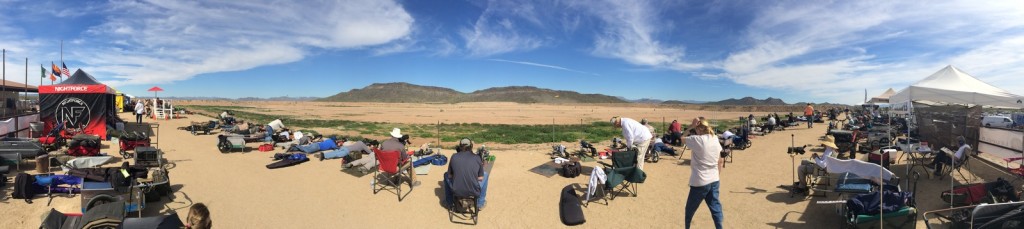
F-Open rifles on the firing line at the Ben Avery Shooting Facility in Phoenix, Arizona.
Scopes for F-Class
If you will be shooting 1000 yards then I would recommend at least 32 power and preferably a variable – like the 8-32. The cheapest “usable” scope in this range is the Sightron. It’s a great scope for the money and at under $900 (in the USA) it’s half the price of its nearest competitor. It’s also light – at 1.5 lbs – and there are some great reticles for the F-Class shooter – like the LRMOA.
The 2024 SHOT Show is now just nine-and-a-half weeks away. The NSSF SHOT Show is the leading gun/hunting/shooting industry trade show. The huge event takes place in Las Vegas, Nevada at the Venetian Expo and Caesars Forum. At SHOT Show, visitors can see thousands of new guns, optics, accessories, and ammo offerings. This is the premier opportunity to have a “hands-on” view of new products, network with industry leaders, and attend informative seminars. This year’s event runs Tuesday through Friday, January 23-26, 2024, preceded by Media Day at the Range on January 22nd.
Book Hotels Now to Save Money
Unfortunately, we are seeing that, for SHOT Show week, Las Vegas hotel rates are up to 50% higher than before the pandemic. And numerous hotels are deceptively adding extra “resort fees” and processing charges, which worsen the high costs. Before you confirm a reservation, make sure you know ALL the COSTS, including room rates, taxes, resort fees, parking charges, and non-refundable deposits.
The longer you wait, the higher the cost of Las Vegas rooms will be. NSSF notes that: “It is important for attendees to book hotel rooms sooner than later to get better room rates and to get a room in a preferred location. Hotels like The Flamingo, Harrah’s and The LINQ are great options to consider.” Learn more about hotels here: https://shotshow.org/official-hotels/.
SHOT Show Information
We expect over 50,000 people will attend SHOT Show 2024. As in 2023, this year’s SHOT Show encompasses two facilities — the Venetian Expo AND the new Caesars Forum. Combined, these facilities provide over 800,000 square feet of exhibit space. The two trade show halls are connected by an elevated walking bridge.
Sinclair International has created a series of instructional videos illustrating the basics of metallic cartridge reloading. The 8-Part series starts with reloading basics and provides step-by-step, how-to instructions that will help new reloaders get started. Detailed, animated illustrations show you what happens inside the chamber when shooting, and inside the dies during each step of reloading. The videos can be viewed on Sinclair International’s YouTube channel. Shown below is the first video in the series:
Each of the Sinclair videos is hosted by then Sinclair Int’l President Bill Gravatt (now with Creedmoor Sports). Bill doesn’t just show you “how”, he tells you “why”. The how-to segments cover case inspection, proper die set up, case sizing, primer installation, powder measuring, bullet seating, crimping, and even goes into the record keeping needed for the handloader. “We wanted to give shooters who haven’t reloaded a look at all the advantages of creating your own ammo and how easy it is to get started,” said Gravatt, “without telling them they had to have any certain brand or type of equipment to do the job.”
The Eight Video Topics Are:
Part 1 — Intro to Video Series
Part 2 — Intro to Reloading Safety
Part 3 — Metallic Cartridge Components
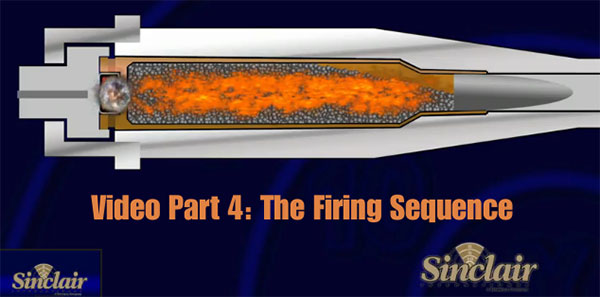
Part 4 — The Firing Sequence
Part 5 — Tools for Reloading
Part 6 — Loading Bottle-Neck Cartridges (2 videos)
Part 7 — Loading Straight Wall Cartridges
Part 8 — Reloading Series Conclusion
Reloading Tools
Shown below is Part 5 of the video series, covering the tools used for precision reloading.
We also strongly recommend the Part 4 Video to readers who are getting started in reloading. This “How Things Work” segment covers the sequence of events inside the chamber (and barrel) when the cartridge is fired. The video includes helpful graphics that show what happens to the primer, powder, cartridge, and bullet when the round is fired. The video also illustrates “headspace” and explains how this can change after firing. We think this video answers many common questions and will help reloaders understand the forces at work on their brass during the firing process.
When shooting targets, the closer to the center the better the result. But this is not necessarily true when it comes to using jags and patches. There are some good reasons to try spiking your patches away from the center. This Creedmoor Sports Tech Tip explains why you may want to spike (puncture) your patch away from the center. CLICK HERE to order patches and Swab-Its cleaning bore tips from Creedmoor Sports.
You begin to push your first patch down the barrel and you notice it is extremely tight and then it jams! How can this be? A commonly overlooked solution to remedy the frustrating occurrences of overly tight or jammed patches is what we like to call “Side-Spiking”. Side-Spiking is super simple and works!
“Side-Spiking”, as the words suggest, refers to moving your patch spiking position from the center of the patch towards the corner of a square patch or the edge of a round patch.
Moving From Center-Spiking To Side-Spiking
The closer toward the edge of the patch you spike your jag, the looser the patch will be when pushed down the bore.
Important: Be careful to not go to the very edge of the patch. Leave enough patch material to fully cover the first set of rings on your jag as this insures your jag is properly centered in the bore and that no contact with the rifling will occur.
Proper Side-Spiking Location Creedmoor Sports recommends side spiking all wet patches. This allows for a looser patch in the bore which removes gross powder fouling and leaves more cleaning solution behind to start working on the remaining fouling.
When a tighter patch is needed, simply move your spike closer toward the center of the patch. The closer to the center of the patch you get, the tighter the patch will become in the bore. The objective is to have a snug-fitting patch that allows you to smoothly push your rod down the bore. Remember you do not need to end up in the center of the patch!
Bore-Tech Patch Size Selection Chart Recommends Patch Sizes by Caliber:
Volquartsen Firearms now offers two new versions of its innovative Summit straight-pull toggle bolt rimfire rifle. Along with the original .22 LR Summit and a .17 Mach 2 variant, Volquartsen is now offering a Summit .17 HMR and Summit .22 WMR. We think the .17 HMR version would be one of our top choices for ground squirrels and small varmints inside 250 yards.
These new .17 HMR and .22 WMR offerings will be available in stainless steel and lightweight aluminum configurations, with various barrel and stock options. All configurations will feature a 2.25-pound trigger pull, 0 MOA integral Picatinny rail, and a 9-round magazine capacity. Both 1/2 x 28 threaded barrel and non-threaded barrel options will be available.
“When we started manufacturing the Summit in .22 LR, we knew that caliber was only the beginning of what was possible from the straight-pull toggle bolt design. We applied what we learned in refining the Summit 22 LR and knew it would be ideal for a .22 WMR and .17 HMR version,” commented Volquartsen President Scott Volquartsen.
From the ranch to the range, the Summit rifle is designed to be versatile but, most importantly, reliable. Assembled with Volquartsen’s signature, wire-EDM cut internal components, the Summits are built to perform from a bench but are durable enough for the toughest field use.
Specifications:
·Stainless steel or aluminum barreled action
·TG2000 with 2.25 lb. trigger pull weight
·Rapid Magazine Release installed
·Muzzle threaded 1/2 x 28 (unthreaded optional)
·0 MOA integral Picatinny rail
·9 round magazine
With inflation, the increased cost of .223 Rem centerfire ammo has driven more folks to shooting .22 LR rimfire ammo, both for fun and practice. Thankfully, handy conversion kits will let you shoot .22 LR ammo from your existing .223/5.56 AR-15 platform rifle. This allows low-cost training with no change in rifle balance, ergonomics, and/or optics.
The CMMG Bravo .22 LR Conversion Kit provides a replacement bolt/bolt carrier along with three 25-round magazines with special .22 LR-fitted followers and ammo slots. This allows you to shoot rimfire ammo from any AR-15 chambered for the .223 Rem (5.56×45). The CMMG Bravo has an integrated extension that fits into your current chamber. The rimfire bullet passes through this extension and then enters the barrel. This conversion kit is now on sale at Brownells for $179.99 with three 25-rd mags.
The CMMG Bravo conversion Kit comes with blowback-operated .22 LR bolt carrier, rubber protector for bolt carrier tip, and three 25-round polymer magazines. To use, simply replace the rifle’s .223 Rem bolt and carrier with the Bravo .22 LR conversion unit and load up the included magazine(s) with rimfire ammo.
To use the CMMG Kit, simply remove the centerfire bolt/bolt carrier, and replace it with the CMMG silver colored bolt shown above. CMMG states: “For best performance use a round-style hammer as notched hammers can cause function issues.” Testers have stated that high-velocity .22 LR ammo works best, and CMMG notes that “36gr plated-nose bullets have proven to be the best choice for function.” The copper-plated bullets help reduce fouling.
Ultimate Reloader Tests CMMG .22 LR Conversion Kit
Our friend Gavin Gear of UltimateReloader.com recently tested the CMMG .22 LR AR Conversion Kit. He observed that installation was very straight-forward and the CMMG magazines worked well. He and fellow tester Travis Fox shot the unit both slow-fire and rapid-fire successfully.
Gavin and Travis found the CMMG Kit easy to install and fun to use. With an AR that can shoot both .223 Rem and .22 LR, it’s like having “two guns in one”. Travis was impressed with the ease of use: “It is so simple to change over to the CMMG .22 LR AR kit! It took me about 68 seconds the very first time I tried. Each time after that it took me about 40 seconds — it’s that simple. It takes longer to fully load one of the mags than it does to switch over from .223/5.56 to .22 LR and back.”
The AR shot very well with the higher-velocity ammo types. 100% functioning was achieved with both 40gr Federal Game Shok ammo and American Eagle High Velocity 38gr Copper-plated HP ammo. NOTE: CMMG does recommend high-velocity Copper-plated rimfire ammunition.
Maintenance Tip — After converting back to your centerfire .223 Rem (5.56), Travis says “make sure to clean the gas tube and components as .22 LR tends to run dirty”. READ Full Test on UltimateReloader.com.
CMMG Bravo Conversion Kit Gets Thumbs Up from Gavin and Travis
“Does this conversion kit get the Ultimate Reloader stamp of approval? Absolutely! In these times of ammunition/component scarcity this gives options to shooters. Finding bulk .22 LR can sometimes be easier than 223/5.56. This kit gives that option at a great price. Any chance to keep skills up and familiarize new shooters to a platform is a good thing. Basically two rifles for a lot less than another rifle.”
How to Install CMMG Bravo .22 LR Conversion Kit
The Brownells video below shows the installation process step-by-step:
In this instructional video, a Brownells gunsmith demonstrates (step by step) how to install, disassemble, clean, lubricate, and reassemble the CMMG AR-15 .22 LR Conversion Kits. Clear the rifle and make safe before you start the conversion. Separate the upper and lower, remove the standard bolt carrier group. You then install the conversion bolt and connect the upper and lower as normal.
Details of CMMG .22 LR Conversion Kit
“For years I’ve had a CMMG conversion kit. It’s a drop-in system that’s … very reliable and it’s accurate. The [CMMG conversion] has lower recoil [and is] great for training. Even though ammo prices have gone through the roof, .22 LR is still cheaper to shoot than anything else.” — SootchGear
At the request of our readers, we provide select “Deals of the Week”. Every Sunday afternoon or Monday morning we offer our Best Bargain selections. Here are some of the best deals on firearms, hardware, reloading components, optics, and shooting accessories. Be aware that sale prices are subject to change, and once clearance inventory is sold, it’s gone for good. You snooze you lose.
NOTE: All listed products are for sale to persons 18 years of age or older. No products are intended for use by minors.
1. Graf & Sons — Major Sightron Sale, Save 25%
⏺ SAVE big bucks on competition and hunting scopes
If you’re looking for new optics consider the Sightron Optics Sale at Graf’s. You can find everything from red dots to hunting scopes to high-magnification competition scopes at huge discounts, mostly 25% off the regular price. Long-Range Benchrest and F-Class shooters should check out the Sightron SIII 10-50x56mm Long Range Scope, now just $997.49, a $332.50 savings!
2. Powder Valley — Hodgdon and IMR Powders in Stock
⏺ Ultra-popular Hodgdon powders now available at good prices
This is your lucky day — the super-popular Hodgdon powders are in stock right now at Powder Valley. That’s right, you can order Hodgdon Varget, H4350, and H4831SC right now for $48.99/lb. And other Hodgdon powders are available starting at $27.99/lb. Plus many popular IMR powders are in stock at Powder Valley including IMR 8208 XBR, IMR 4064, and IMR 4350. NOTE: If your favorite powder sells out, Midsouth also has Varget, H4350, and other top choices at $50.99/lb.
⏺ Best price on excellent electronic scale/dispenser
The Hornady Auto Charge Pro provides precise, customizable powder dispensing in an easy-to-use, space-saving unit. Precise to within 0.1 grain, the Auto Charge Pro offers customizable trickle speeds for various powders, as well as custom time settings. Store settings for up to four custom loads or use the factory setting. The backlit touch screen is easy to read, while a large knob on the side simplifies powder emptying.
4. Sportsman’s WH — Maverick Arms Mossy Oak 12ga, $219.99
⏺ Get a 12ga shotgun for crazy low price — under $220
For shooting sporting clays or duck hunting, it’s nice to have a classic long-barrel pump shotgun. One very affordable option is the Maverick Arms 88 Mossy Oak 12 gauge shotgun, right now just $219.99 on sale at Sportsman’s Warehouse (19% off). This shotgun features dual extractors, twin action bars, positive lock-up, and an anti-jam elevator for trouble-free operation.
5. Brownells — LabRadar Chronograph, $499.95
⏺ Major price reduction on proven Radar Chronograph
LabRadar Doppler Chronographs are now on sale at Brownells. The LabRadar has been favored for many years by top benchrest, F-Class, and Long Range competitors. This radar chrono provides extremely accurate velocity data and the unit runs at your shooting station so you don’t have to place a tripod downrange. Brownell’s $499.95 price represents a significant discount on the LabRadar system. The LabRadar is now $100 less than the new Garmin Xero C1 PRO Chrono.
6. Bruno’s — PT&G Chamber Reamers, $159.95 and up
⏺ Great selection of quality reamers for 30+ cartridge types
To have a custom barrel crafted, you may need a chamber reamer for your gunsmith. However, good reamers can take months to get. But right now Bruno’s has a wide selection of quality PT&G reamers in stock. These are available for $159.95 (and up) in a wide assortment of chamberings including: .223 Rem, 22-250, 6 PPC, 6mmBR, 6 Dasher, 6GT, 6XC, 6.5×47, 6.5 PRC, .284 Win, .284 Shehane, 7 RSAUM, 7 PRC, 7mm WSM, 30 BR, .308 Win, 300 WSM, .338 Lapua and many more.
⏺ Popular modern Earbuds with good Noise Reduction Rating
Electronic earbuds provide hearing protection while still allowing you to hear range commands. And earbuds are more convenient than large, bulky ear muffs. Currently, Gloryfire Electronic Silencer Earbuds with a 26dB Noise Reduction Rating (NRR) are on sale for $135.99. These feature two noise level functions, indoor and outdoor mode, and the 26dB rating is better than some thin muffs. NOTE: Gloryfire also sells 26dB NRR Silencer Earbuds with BlueTooth capability for $169.99.
⏺ Quality forward-set mount for Service Rifles and ARs
If you shoot service rifle or have an AR that needs a forward-mounted scope check out the Creedmoor 30mm scope mount, now on sale for $59.95, a 47% savings off the regular $104.99 price. Made from aircraft-grade aluminum, this light-weight but durable mount offers generous 2.5″ forward offset. That allows optimal scope placement for correct eye relief and proper arm/head position.
9. Amazon — MTM R-100 Ammo Box, $17.99
⏺ Best 100-round ammo box on the market, now on sale
For transporting ammo to the range, we like the MTM R-100 Deluxe ammo box (#ad). These durable R-100 flip-top ammo boxes provide excellent protection for your ammo. When rounds are in the nose-down position special fingers in each hole prevent bullets from hitting the bottom of the box, thereby preventing tip damage. You can also pick up a semi-transparent blue version for $16.99 at MidwayUSA. We like being able to see the cartridges inside the box.
10. Amazon — Ditron Waterproof Calipers, $39.99
⏺ Versatile calipers with waterproof feature
You can’t reload quality ammo without calipers to measure many key dimensions. A good, affordable option is the DITRON 6″ Electronic Caliper (#ad). The calipers’ components are made of hardened stainless steel for durability and rust resistance. There is a a handy thumb roller and the caliper shell is dustproof and waterproof, which helps ensure longevity.
As an Amazon Associate, this site earns from qualifying purchases.
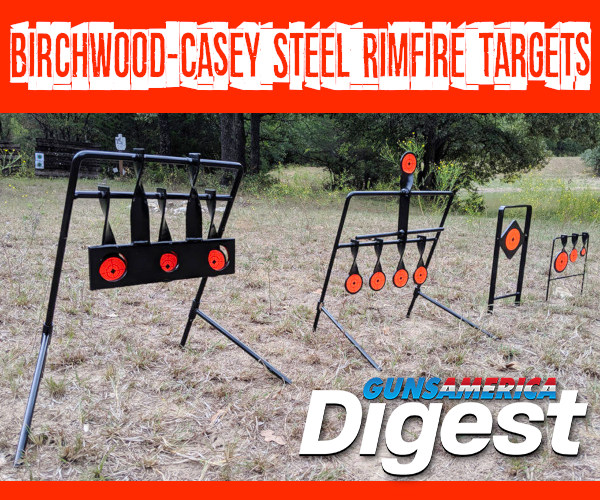
Rimfire plinking with reactive targets is FUN and affordable. We always like to include REACTIVE TARGETS during a trip to the range with our .22s. Decent .22 LR rimfire ammo is not expensive, and a wide variety of affordable steel targets are available. Rimfire-class steel is much less costly than the heavy AR500 steel plates used for centerfire rounds. In fact, Birchwood Casey makes a wide variety of reactive steel rimfire targets that retail for under $50.00. These offer great “Bang for the Buck”.
A fast-cycling, semi-auto .22 LR rifle like the Savage A22 is great for shooting reactive targets.
GunsAmerica Digest has reviewed a variety of reactive rimfire target systems from Birchwood Casey. We recommend you read this detailed article Little Targets, Big Fun, by Jordan Michaels. He acquired four different steel target systems and tested them at his Texas range. Michales was impressed: “At $30-$55 a pop, Birchwood-Casey’s targets are small enough to be challenging and cheap enough to buy four or five for the price of one centerfire-rated target. They’re also light, portable, reactive, and easy to set up.”
B/C Gallery
B/C Back Drop
B/C Qualifier Spinner
B/C King of Diamonds
Check out how these Birchwood Casey steel targets perform. These animated GIFs show actual shooting sessions with .22 LR rifles and pistols. The targets hold up well, though the black paint comes off. The reviewer notes: “You shouldn’t worry about durability as long as you stick to .22 LR. I shot the heck out of these targets with rifles and handguns using both standard and high-velocity cartridges, and I didn’t notice any denting or cracking. If the targets are going to be kept outside, however, keep an eye out for rust – the black paint comes off immediately.”
Safety Considerations with Steel Reactive Targets
The tester said the targets worked best with a .22 LR ammo with at least 1000 fps MV at the targets. He tested with .22 LR pistols as close as 7 yards, and .22 LR rifles out to 100 yards. Be advised — when shooting steel targets at relatively close ranges ALWAYS wear full-coverage eye protection because ricochets and splash-backs are definite risks. Also comply with all range rules.
Since its introduction in 2001, the .300 Winchester Short Magnum (.300 WSM), has proven very popular for hunting and long-range competition. The case has ample capacity to drive the heavy .30-caliber bullets, and with proper case prep and annealing, the WSM is capable of outstanding accuracy. When Nebraskan Greg Anderson decided to build his “ultimate long-range hunter”, he selected the .300 WSM for its accuracy and its ability to drop large game at long distances. Teaming up with Chris Matthews of LongShot Rifles, Greg developed an impressive long-range hunting rig, with high-tech components to reduce weight. The 26″ barrel is a carbon-wrapped composite over a Rock Creek stainless blank. The carbon technology saved about 3 pounds over an all-steel barrel of similar length/contour.
The Manners Composite stock also features carbon fiber construction for stiffness and reduced weight. Greg’s carbon/carbon rifle tips the scales at just 10.8 pounds, including scope and bipod. A conventional rig could easily weigh 15 pounds or more. Greg’s carbon hunter has proven accurate as well as innovative. With 175gr Sierra MKs, the gun shoots well under 1/2-MOA out to 600 yards and beyond.
The Ideal Spot and Stalk Rifle
by Greg Anderson
The purpose of this project was to create a hunting rifle that would be inherently accurate at long range and have an acceptable weight for hunting in rough country. I researched the question of overall weight with several gunsmiths. The smiths confirmed that while fat-contour barrels could deliver improved accuracy, there was a price to pay and a lot more weight. With a heavy barrel, the finished rifle would be most likely weigh about 15 pounds. That’s more than I wanted to haul around in the field. To reduce barrel weight, the suggested “traditional” solutions were fluting, which would reduce barrel weight by at least one-half pound, or going with a smaller diameter barrel.
The Quest for Reduced Weight without Accuracy Loss
Fluting didn’t promise enough weight savings, and a slim, sporter barrel probably wasn’t going to deliver the kind of consistent accuracy I wanted (particularly as the barrel heated up). Accordingly, I decided to “think outside the box”. My research on lightweight barrel options lead me to Advanced Barrel Systems, (ABS) a company in Lincoln, Nebraska that once produced custom carbon-wrapped barrels. ABS President Mike Degerness could wrap a barrel to virtually any shape and diameter, allowing great stiffness even with a huge reduction in barrel weight. As the “core” for his carbon-wrapped barrels, Mike recommends a cut-rifled blank made by any of the quality cut-barrel makers. [NOTE: ABS is not taking orders at this time. You can now get excellent carbon-wrapped barrels from Proof Research].
Significant Weight Saving with Carbon
How much weight can you save with a carbon-wrapped barrel? Well a 24-inch, #7 contour ABS carbon-wrapped barrel will weigh about 2.5 pounds compared to about 5.5 pounds for a steel barrel of the same length and contour. So, this means that you can put a fat, stiff competition-contour barrel on your hunting rifle and save over half the barrel weight compared to an all-steel barrel. Saving three pounds is a blessing when you’re carrying the rifle all day long in the field. I placed an order for a 30-caliber Rock Creek barrel blank with an 1:11.25″ twist and a finished length of 26″. Mike wrapped the barrel and finished it to an M24 contour.
Carbon Can Also Improve Barrel Vibration Damping
One interesting benefit of carbon barrel-wrapping is that the carbon components have a vibration-dampening effect. According to ABS, the extreme rigidity of the finished composite barrel dampens the vibration nodes of the barrel making it shoot like a plain steel barrel of much greater mass. Carbon fiber has a high modulus of elasticity that has the effect of lowering the amplitude of the vibration of the barrel when fired. This is what makes the ABS barrels perform so well, according to Mike.
Impressive Accuracy For a Hunting Rifle
Looking at the targets below, one may ask, “Does the rifle always shoot this well?” The answer, not surprisingly, is: “it depends on the trigger-puller”. The rifle is capable of outstanding accuracy. But it took some time and effort for me to develop the skills required to shoot up to the rifle’s inherent accuracy. I nearly always practice prone from bipod. Initially, I was getting horizontal stringing until I changed my grip and learned to be more consistent from shot to shot. Shooting a heavy-recoiling .30-caliber rifle from the ground is not the same as shooting a .223 Rem from the bench.
3-Shot Group at 200 yards | 6-Shot Group at 500 Yards
Completing the Project Build
To smith the rifle, I selected Chris Matthews of LongShot Rifles, LLC because of his expertise with the WSM cartridges and long-range shooting equipment. Because cost was a factor, we decided to use a donor Remington long action that had been used on a Remington 7mm magnum. Chris trued the action and we had Dave Kiff from Pacific Tool & Gauge grind us a bolt to fit the action more perfectly. Chris chambered the Rock barrel and installed a .300 Badger recoil lug.
Carbon-Reinforced Hunting Stock from Tom Manners
Being a fan of carbon fiber technology, I selected an MCS-T stock from Manners Composite Stocks. These stocks have an extremely high strength-to-weight ratio and the high comb of the MCS-T gave an almost perfect alignment with the scope. The finished rifle was topped off with a Leupold 4.5-14x40mm LR scope equipped with M1 windage and elevation turrets. A Harris bipod completed the package. All up, including scope, steel rings, and bipod, my .300 WSM rifle with 26″ barrel weighs 10.8 pounds.
Load Development for Accuracy
I developed a load using 63.0 grains of H4350, 175gr Sierra Match Kings with Federal 210M primers in Winchester-brand brass. This load gives 2960 FPS out of my rifle. The load would shoot sub-MOA from bipod from 100 yards to 600 yards and was adopted as the “go to” load. I have also tried the 208gr Hornady A-Max in this gun. The A-Maxs shot well but the Sierras work well for everything (paper punching and hunting) so the 175gr SMK is my bullet of choice.
Brass Prep and Annealing Are Very Important
The Winchester-brand brass is good, but you have to prep it thoroughly if you want good results. My brass prep consisted of turning the necks, de-burring the flash holes (inside and out), and chamfering the case necks. Using a Sinclair neck-turning tool, I turn the necks to .0135″ per side. That provides a complete clean-up of the necks, which run about .015″ neck-wall thickness out of the box.
One thing I’ve learned to do is anneal the brass every 3-4 firings. I started to do that after I noticed that the force required to seat bullets became inconsistent after just a few loading cycles. I also experienced flyers that were going out of the group for no apparent reason. Annealing the cases every 3-4 firings has eliminated most of the unexplained flyers and annealing has also made bullet seating much, much more consistent. I’ve also noticed a significant improvement in my groups at 500 and 600 yards now that I anneal regularly. Group sizes at 600 yards can be as much as 2″ smaller with annealed brass than with un-annealed, work-hardened brass.
Greg Anderson was successful with his .300 WSM on his very first hunt, dropping a nice buck at 364 yards. Chris reports: This was on some private land in Nebraska. As daylight faded… there were a couple of bucks, but one looked to be the best of the lot. The buck gave me a broadside shot ranged at 364 yards. I settled behind the scope and took one shot. It hit right where I aimed and the buck just folded.”






 “Side-Spiking”, as the words suggest, refers to moving your patch spiking position from the center of the patch towards the corner of a square patch or the edge of a round patch.




 One thing I’ve learned to do is anneal the brass every 3-4 firings. I started to do that after I noticed that the force required to seat bullets became inconsistent after just a few loading cycles. I also experienced flyers that were going out of the group for no apparent reason. Annealing the cases every 3-4 firings has eliminated most of the unexplained flyers and annealing has also made bullet seating much, much more consistent. I’ve also noticed a significant improvement in my groups at 500 and 600 yards now that I anneal regularly. Group sizes at 600 yards can be as much as 2″ smaller with annealed brass than with un-annealed, work-hardened brass.


