CZ has announced its new CZ 600+ bolt-action rifle series. These new rifles are offered in various formats for hunting, PRS/NRL, and target shooting. Notable features include and fast barrel swap system, a shorter bolt throw, and a wide selection of stocks. CZ offers 3-shot accuracy guarantees: Most models have guaranteed sub-MOA accuracy at 100 yards (three-shot groups), while the RANGE model offers guaranteed sub-0.75 MOA accuracy in five-shot groups.
“The CZ 600+ represents the future of hunting and precision rifles,” said Tom Taylor, CZ-USA’s Chief Marketing Officer. The CZ 600+ series features a groundbreaking modular design highlighted by patented innovations. These include an advanced Silent, Ergonomic, and Ambidextrous (S.E.A.) safety, a quick 4-position adjustable trigger, and an innovative interchangeable barrel system. The series guarantees unmatched precision accuracy, supported by CZ’s lifetime barrel warranty. For detailed information about the CZ 600+ series, visit CZFirerms.com.
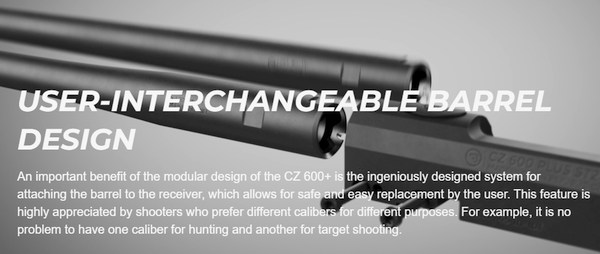
Interchangeable Barrel System for Versatility
With the interchangeable barrel system, shooters can easily and safely swap barrels, allowing one rifle to adapt to multiple calibers, from hunting to sport shooting, seamlessly.
Innovative Features and Design — CZ 600+ Rifles Include:
Advanced S.E.A. Safety: Silent, Ergonomic, and Ambidextrous cross-bolt design for secure handling.
Quick Adjustable Trigger: Easily adjusted to suit personal preferences without disassembly.
Controlled Feeding System: Smooth bolt operation with 100% controlled feeding.
Lifetime Barrel Warranty: Cold hammer-forged barrels with exceptional durability and precision.
Robust Construction: Available with lightweight aluminum alloy receivers with integrated Weaver rails or steel receivers with Remington 700-style mounting interfaces.
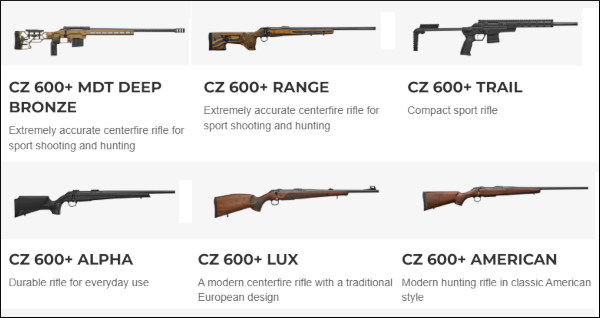
The CZ 600+ Series — SIX Models
CZ 600+ MDT: Tactical Rifle with MDT Stock for PRS/NRL.
CZ 600+ RANGE: Optimized for precision shooting with adjustable stock features.
CZ 600+ TRAIL: Compact model with retractable stock and compatibility with AR and CZ mags.
CZ 600+ ALPHA: Rugged polymer stock designed for reliable performance in all conditions.
CZ 600+ LUX: Classic European walnut stock with fiber optic adjustable iron sights.
CZ 600+ AMERICAN: Timeless American styling combined with modern enhancements.
Are you in the market for your first handgun, for target use or for self-defense? The Winchester Blog has a good article for handgun buyers. This story, “Things You Should Know When Purchasing Your First Pistol”, provides many smart tips that can help you choose the right handgun, and save money in the process. In addition, the article explains how to train with your new pistol and handle it safely. READ Full Article.
If possible, you should test a variety of different pistols, to determine which works best for you. Check the feel, the ergonomics, the sight picture, and the controls. And, if possible, test the pistols with live-fire at a range which rents samples.
How do you know if your choice is right for you?
Once you’ve narrowed down choices, try to get time shooting the pistol(s) you are considering. You can usually rent guns at commercial ranges. This is an excellent way to “try before you buy.” NSSF has a list of places to shoot[.] When looking for a range that rents firearms, an online search and then a phone call to confirm what options are available is a solid plan. If you have friends and family who own a model you are interested in, ask if they will go to the range with you so that you can try it.
Take pistols for a test drive
First, dry-fire and manipulate the pistol. Can you easily lock the slide open? Are the sights suited to your vision? Then, fire a magazine or two of ammo [in a supervised range facility]. — Winchester Blog
The Winchester Blog article lists techniques that can help you get the “feel” for a particular firearm:
1. Practice the 4 Rules of Firearm Safety and make sure the gun is empty.
2. [After confirming the gun is empty] manipulate the slide, safety, magazine release, and dry-fire.
3. Perform a dry or empty magazine change — make sure you can hit the release and also reload a new magazine easily.
4. Perform a draw, or if you’re at a range where that is not allowed, simply pick the pistol up off the table and bring it up to your eye level and align the sights. Do this a few times. Can you acquire the sights quickly?
5. How does the backstrap fit your hand? Can you get both hands on the gun with enough “purchase” that you can really grip it well?
This Winchester Blog article is by Becky Yackley. Becky has competed in 3-Gun, Bianchi pistol, Service Rifle, NCAA air rifle, smallbore and air pistol events around the world since 1989.
Most of us own a .223 Rem rifle. Now, thanks to our friends at Rifleshooter.com we can assess exactly how velocity changes with barrel length for this popular cartridge.
Rifleshooter.com performed an interesting test, cutting the barrel of a .223 Rem rifle from 26″ all the way down to 16.5″. The cuts were made in one-inch intervals with a rotary saw. At each cut length, velocity was measured with a Magnetospeed chronograph. To make the test even more interesting, four different types of .223 Rem/5.56 ammo were chron’d at each barrel length. The Rifleshooter.com team that conducts these tests has a full-service gun shop, 782 Custom Gunworks — visit 782guns.com.
Test Barrel Lost 25.34 FPS Per Inch (.223 Rem Chambering)
How much velocity do you think was lost, on average, for each 1″ reduction in barrel length? The answer may surprise you. The average speed loss of the four types of .223/5.56 ammo, with a 9.5″ shortening of barrel length, was 240.75 fps total (from start to finish). That works out to an average loss of 25.34 fps per inch.
5.56/.223 Barrel Cut-Down Speed Test 26″ to 16.5″
Start FPS at 26″
End FPS at 16.5″
Total Loss
Average Loss Per Inch
UMC .223 55gr
3182*
2968
214
22.5 FPS
Federal M193 55gr
3431
3187
244
25.7 FPS
Win m855 62gr
3280
2992
288
30.3 FPS
Blk Hills .223 68gr
2849
2632
217
22.8 FPS
*There may have been an error. The 25″ velocity was higher at 3221 fps.
Rifleshooter.com observed: “Cutting the barrel from 26″ to 16.5″ resulted in a velocity reduction of 214 ft/sec with the UMC 223 55-grain cartridge, 244 ft/sec with the Federal M-193 cartridge, 288 ft/sec with the Winchester M855 cartridge and 217 ft/sec with the Back Hills 223 68-grain match cartridge.”
How the Test Was Done
The testers described their procedure as follows: “Ballistic data was gathered using a Magnetospeed barrel-mounted ballistic chronograph. At each barrel length, the rifle was fired from a front rest with rear bags, with five rounds of each type of ammunition. Average velocity and standard deviation were logged for each round. Once data was gathered for each cartridge at a given barrel length, the rifle was cleared and the bolt was removed. The barrel was cut off using a cold saw. The test protocol was repeated for the next length. Temperature was 45.7° F.”
See More Barrel Cut-Down Tests on Rifleshooter.com
Rifleshooter.com has performed barrel cut-down tests for many other calibers/chamberings including 6mm Creedmoor, .308 Winchester, and .338 Lapua Magnum. See these test results at Rifleshooter.com.
Much Different Results with 6mmBR and a Longer Barrel
The results from Rifleshooter.com’s .223/5.56 test are quite different than the results we recorded some years ago with a barrel chambered for the 6mmBR cartridge. When we cut our 6mmBR barrel down from 33″ to 28″ we only lost about 8 FPS per inch. Obviously this is a different cartridge type, but also our 6mmBR barrel end length was longer than Rifleshooter.com’s .223 Rem start length. Velocity loss may be more extreme with shorter barrel lengths. And, of course, different cartridge types and powder/bullet combinations will yield different results.
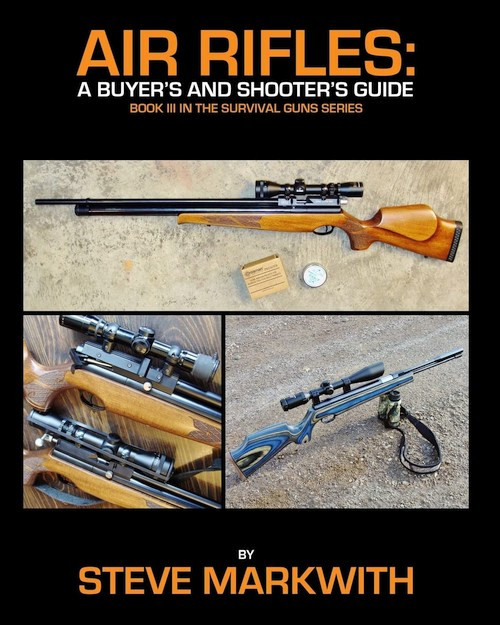
We like air rifles both for fun shooting and for competition. However, so many options are now available that is easy to get overwhelmed with the choices. Thankfully, there is a good book that helps air rifle shooters make informed decisions about air guns and accessories. Steve Markwith’s comprehensive resource, Air Rifles: A Buyer’s and Shooter’s Guide offers a wealth of useful information. This 154-page book is now available for $14.48 (paperback) or $9.95 (Kindle)..
“This is a very informative book explaining the ins and outs of air rifles, their capabilities and limitations. I highly recommend this book to anyone considering purchasing an air rifle for marksmanship practice or small game hunting.” – L. Stanek, Verified Amazon Reviewer
Read Free Sample Chapters Online
If you go to Amazon.com and look right below the book cover photo, you’ll see a “READ SAMPLE” button. Click that to view a FREE preview with extensive samples from many chapters. The book covers all the most important types of air rifle systems, both pre-charged pneumatics and other self-charging guns. Markwith reviews the wide variety of pellets available, offering suggestions for particular applications. You’ll also find a useful discussion of Airgun Power, Range, and Accuracy. This will help you pick the right air rifle.
Markwith explains the many attractions of airguns. They are not considered firearms (in most jurisdictions) so they can be purchased at local shops or mail-order outlets without FFL fees or background checks. You’ll find a huge online selection of airguns at PyramydAir.com that can ship direct to you — no FFL required. Air rifles are also quiet and very inexpensive to shoot. While .177 and .22 caliber air rifles are most common, there are also larger-caliber airguns offered for hunting or special applications.
Pyramyd Air has dozens of helpful videos about air rifles and air pistols.
Hornady has announced a new 25 Creedmoor cartridge. The SAAMI-accepted 25 Creedmoor is a necked-down version of the popular 6.5 Creedmoor. It’s primarily designed for hunters who prefer a compact 25-cal cartridge. Some PRS/NRL shooters may also turn to the 25 Creedmoor because it offers heavier bullets than the 6mm Creedmoor. This allow easier perception of hits on steel at longer ranges. The bigger bullet transfers more energy.
“The 25 Creedmoor is the end result of our constant pursuit of maximizing ballistic potential” states Jayden Quinlan, Hornady Senior Ballistician. “This cartridge fills that competitive niche between 6mm and 6.5mm — providing shooters the absolute best blend of moderate recoil, flat trajectory, and superior wind resistance.”
Hornady claims that, given its up-to-date case design, the “25 Creedmoor is the first SAAMI-accepted 25 caliber cartridge that was explicitly designed to take full advantage of the sleek, low-drag bullets that are now available.” As you might expect, the 25 Creedmoor has a 2.800″ overall length to function properly from AICS-style magazines.
“Variants of the 25 Creedmoor have existed in the wildcat space for quite some time and for good reason … it gives the discerning shooter a competitive advantage. Now we can offer that same level of performance to the shooter with factory ammo offerings” added Quinlan. Hornady claims that the 25 Creedmoor is the “first SAAMI‑accepted .25 caliber cartridge purpose‑built to harness today’s sleek, low‑drag bullets.”
Filling the gap between the 6mm and 6.5mm, Hornady claims that this new 25-caliber cartridge delivers exceptional accuracy and functions perfectly in AICS‑style magazines. For PRS/NRL shooters this offers a middle range of recoil between the 6mm Creedmoor and 6.5mm Creedmoor. Hopefully Hornady’s 25-caliber bullets will prove accurate. Initially you’ll have a choice of a 128gr ELD-X hunting bullet and a 134gr ELD Match gullet — both offered in Hornady factory ammo:
For the new 25 Creedmoor cartridge, Hornady will be offering modified cases and a variety of die sets.
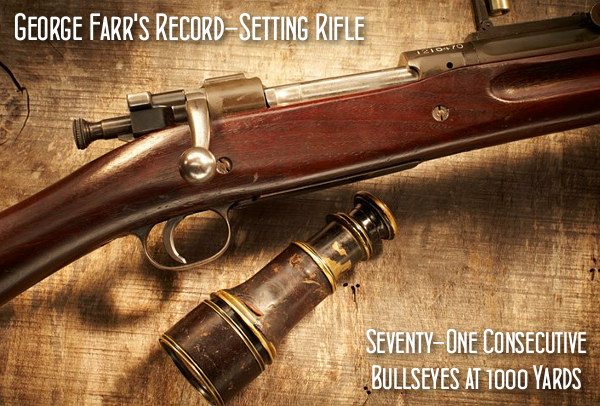
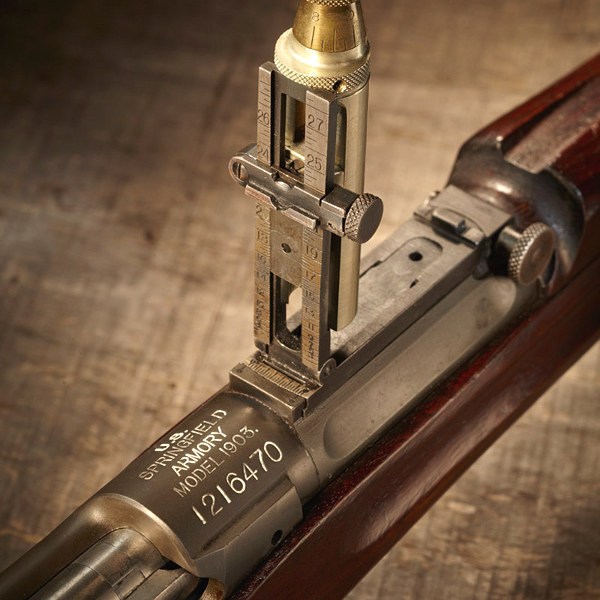
Firing an “off-the-rack” M1903 Springfield that he had never shot before, using GI-issue “tin-plate” ammunition, George Farr shot 71 consecutive bullseyes at 1000 yards (70 for record), setting a marksmanship record that has never been broken.
This is not the typical Daily Bulletin feature. It is an historical account of one of the greatest performances by a marksman in the history of the National Matches at Camp Perry. We think any competitive shooter will find this amazing narrative worth reading from beginning to end. This story is provided courtesy the NRA Blog with photos supplied by the NRA Museums.
An Old Man at the National Matches:
‘Dad’ Farr’s Golden Afternoon at Camp Perry by Doug Wicklund, NRA Museums Senior Curator
It was 1921. Warren Harding was President of the United States, and “The War to End All Wars” was less than three years past. The nation was getting back to a normal routine, and for competitive shooters, that meant an annual pilgrimage through the state of Ohio to the shores of Lake Erie, where the National Matches had been held since 1907 at Camp Perry. In those lighter days of the “Roaring Twenties”, marksmen from states banded together to make the journey, housing together in tent clusters on green lawns well behind the firing points.
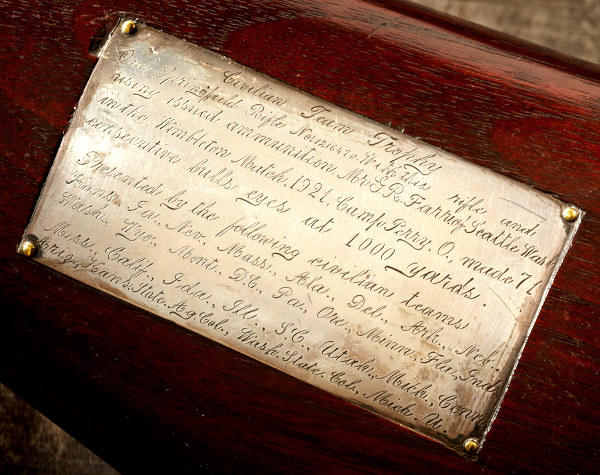
The silver plate affixed to George Farr’s M1903 Springfield states: “With this rifle and using issued ammunition Mr. G.R. Farr of Seattle Wash in the Wimbleton Match, 1921, Camp Perry O., made 71 consecutive bulls eyes at 1000 yards”.
But one man at the 1921 National Matches stood out amongst the rest. George “Dad” Farr was a 62-year-old man from the state of Washington, and this was his first time heading east to shoot in the “big leagues”, as some of his fellow Evergreen State friends termed the annual competitions.
Aptly nicknamed, “Dad” was a good bit older than the average shooter during that late summer season, striding forward hesitantly clad in a khaki shirt and dungarees. He wasn’t a practiced High Power shooter — he showed up at Camp Perry without a rifle, and relied on a crude monocular for a spotting scope that he had fashioned from a pair of French opera glasses.
At the previous day’s shooting, he had experienced issues with the initial .30-06 rifle he had chosen from the rack, a Model 1903 Springfield that didn’t seem to hold a consistent zero. This day, he chose a different gun, just another off-the-rack rifle no different from the one next to it. Though he didn’t realize it, George Farr had just made the best selection of his life.
Farr readied his bolt-action and prepared a clip of five rounds of Government Issue ammunition, then went to his position. He was ready to fire on a 1,000-yard target with a rifle he had never shot before.
Perhaps he had resigned himself somewhat to the outcome — after all, it was the last relay of the day on September 9. Off to the west, the sun was beginning its slow trip down to the horizon. But Farr shouldered his Springfield and prepared to fire. The time was 4:30 p.m. Shooters nearby were puzzled by this shooter who squirmed and shifted repeatedly, but were amazed as he made his first hits on paper. Farr was shooting Frankford Arsenal tin-plate ammunition, the standard G.I. .30-06 rounds. More experienced marksmen, like Marine Sgt. John Adkins — who had just won the Wimbledon Cup — were using commercial Remington match ammunition and had spurned the government ammo.
The Historic String of Bullseyes
At that distant 36-inch target, Farr scored two hits for his two sighters, with the last sighter being a bullseye. He then prepared to fire 20 shots for record. Each of those 20 shots went into the center. Each scored as a “5”. At the end of this amazing string, Farr gathered up his monocular and prepared to depart. His fellow shooters quickly advised that match rules required him to continue firing until he missed “the black”, the inner 5-Ring bullseye at the center of the target. Farr had only brought one box of ammunition with him to the firing line, and had run out. As he waited for more of the tin-plate ammo he had been using, the sun continued its retreat. Farr continued his shooting, racking up growing strings of bullseyes – 30, 40 50, 60 – each impact on target being carefully recorded on his scorecard in the growing darkness.
Then, at the 71st shot with daylight completely gone, the bullet strayed outside the target center, and Farr’s incredible string came to its conclusion. But counting his second sighting shot, George Farr had fired 71 consecutive bullseyes at 1,000 yards using an unfamiliar rifle plucked from an ordnance rack earlier that day. It was an amazing feat, one immediately recognized by those in attendance. His fellow shooters quickly took up a generous collection, contributing in recognition of Farr’s natural skill and enabling him to purchase that bolt-action Springfield he had worked magic with on that distant target. Enough funds remained that a silver presentation plate, inscribed with the names of the states whose competitors had contributed, was ordered and mounted on the side of the rifle’s buttstock.
The next year, the Civilian Team Trophy was re-designated as the Farr Trophy, and George Farr’s record, fired on the old target system, was never beaten. Farr’s rifle went home with him to Washington and remained there, never again traveling eastward to Camp Perry. In 2011, The Farr family donated this legendary piece of shooting history to the NRA National Firearms Museum collection.
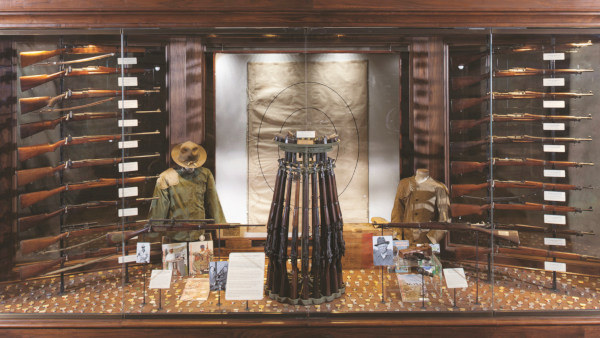
In 2013, as NRA Museums curators began assembling the collection for display at the NRA National Sporting Arms Museum at Bass Pro Shops in Springfield, Missouri, the museum staff created a unique exhibit featuring George Farr’s Model 1903 Springfield rifle and its special place in competitive shooting history. Alongside the rifle rests Farr’s simple monocular, another mute witness to Camp Perry history made on that September evening in 1921.
Farr’s Springfield… is one of thousands of historically significant firearms found in the NRA Museums collections on display across three locations. To view the collection and learn more about the incredible stories behind each gun, visit the NRA Museums in person or browse the NRA Museums website.
What we now know as the “6mm Remington” was originally called the .244 Remington. The cartridge was renamed because it was not a commercial success initially, being eclipsed by the .243 Winchester. The .244 Remington and the 6mm Remington are identical — only the name was changed. Why was the .244 Remington an “also-ran” to the .243 Win? Sierra Bullets Ballistics Technician Paul Box provides some answers…
The year was 1955. A time of carhops, drive-in movies, and Buffalo Bob. It was also the year that Winchester introduced the .243 Win and Remington counter-punched with the .244 Remington (now more commonly known as the 6mm Remington). The .243 Win was based off the time-proven .308 Win case while Remington chose the old war horse, the 7×57.
We’ve all read countless times how Winchester chose the 1:10″ twist, while Remington adopted the 1:12″ twist for their .244 Rem rifles. The first complaint in the gun magazines of that era was how the faster twist Winchester could handle 100 grain bullets, while Remington’s [12-twist factory rifles were supposedly limited to 90 grain bullets].
The first complaint I remember reading was that the 100-grainer was better suited for deer-sized game and the 1:12″-twist wouldn’t stabilize bullets in this weight range. Now, let’s look at this a little closer. Anybody that thinks a 100-grainer is a deer bullet and a 95-grainer isn’t, has been drinking too much Kool-aid. In all honesty, it’s all about bullet construction and Remington had constructed the [90s] with light game in mind. In other words, Remington got it right, but due to a lack of knowledge at the time on both bullet construction and stability, the .244 never gained the popularity it deserved. At that time, Sierra had the 100gr SMP and Hornady offered a 100gr RN that would both stabilize in the slower 1-12″ twist. The .244 Remington provides another classic example of how the popularity of a cartridge suffered due to a lack of knowledge.
.244 Rem vs. .243 Win — What the Experts Say
Respected gun writer Chuck Hawks says the .244 Remington deserved greater acceptance: “The superb 6mm Remington started life in 1955, the same year as the .243 Winchester. It was originally named the .244 Remington. Although the 6mm lost the popularity contest to the .243, it is one of my favorite rifle cartridges, and much appreciated by reloaders generally. The .244 Rem and 6mm Rem cartridges are completely interchangeable, and anyone with a .244 Rem rifle can shoot [6mm Rem] ammunition in complete safety (or vice-versa). Remington .244 rifles made from 1958 on can stabilize all 6mm bullets, while those made in 1955 through 1957 are limited to loads using spitzer bullets not heavier than 90 grains for best accuracy.”
Nathan Foster, author of The Practical Guide to Long Range Hunting Cartridges, states: “In 1963 Remington attempted to regain ground by releasing .244 rifles with a new 1:9″ twist to handle heavier bullets. The cartridge was renamed the 6mm Remington and new ammunition was loaded giving the hunter the choice of either an 80gr bullet for varmints or a 100gr bullet for deer. In comparison to the .243 Win, factory loads for the .244/6mm Remington are slightly more powerful while hand loads increase this margin further.”
Was the .244 Remington Actually Better than the .243 Winchester?
The .244 Remington (aka “6mm Remington”) has a velocity advantage over the .243 Winchester due to a slightly larger case capacity. The longer case neck of the .244 Remington is considered desirable by handloaders. We like the added capacity and long neck of the original .244 Remington. As renamed the “6mm Remington”, the cartridge HAS developed a following, particularly with varmint hunters looking for a high-velocity 6mm option. But it never achieved the success of the .243 Winchester for many reasons. As a member of the .308 family of cartridges, the .243 Winchester has certain obvious advantages. First, you can simply neck down .308 Win brass, which was available at low cost from many sources. Moreover, a .308 Win or 7mm-08 full-length sizing die could be used for body sizing. Still the .244 Remington (6mm Remington) presents an interesting “what if?” story…
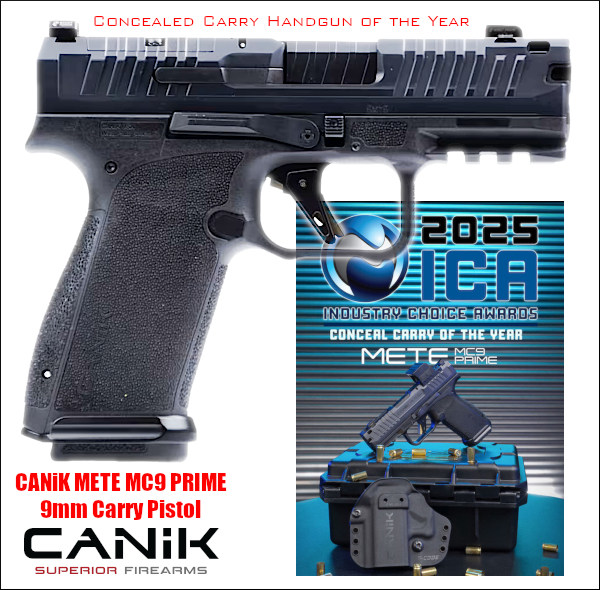
The compact CANiK METE MC9 PRIME pistol has been named the 2025 ICA (Industry Choice Awards) Concealed Carry Handgun of the Year. This compact single-stack 9mm pistol features a ported barrel and an optics-ready slide. Average retail price is $599.99.
Testers have stated the METE MC9 Prime has good ergonomics, a good trigger, and the ported barrel reduces muzzle rise compared to popular carry pistols such as the Glock 19 and Ruger American. The controls are nice and the pistol ships with 3 backstraps, so the grip can be adapted to owner hand size.
The METE MC9 Prime is equipped with an integrally-compensated slide and ported barrel, flat-faced trigger with 90-degree break, slide lightening cuts, and flared slide for smoother manipulation. The frame boasts full grip stippling for a better feel and control. The slide is optics-ready with co-witness capability. This made-in-USA CANik firearm ships in a premium hard case and includes two 17-round magazines, a G-Code IWB/OWB ambidextrous holster, 3 sizes of backstraps, tool/cleaning kits, and magazine speed loader.
Jeff Rose, CANiK Director of Marketing stated: “This isn’t just another micro-compact. The MC9 Prime delivers unmatched capacity, uncompromising control, and a trigger that redefines what you expect from a concealed carry firearm.” The METE MC9 Prime is the first pistol made in CANiK’s new facility in West Palm Beach, Florida.
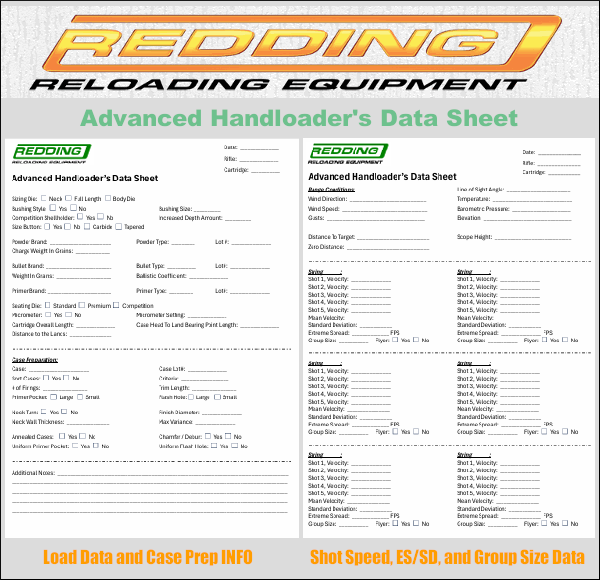
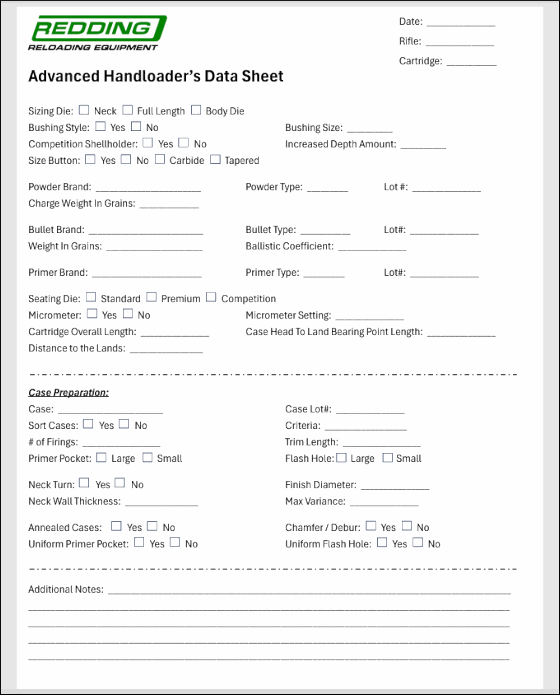
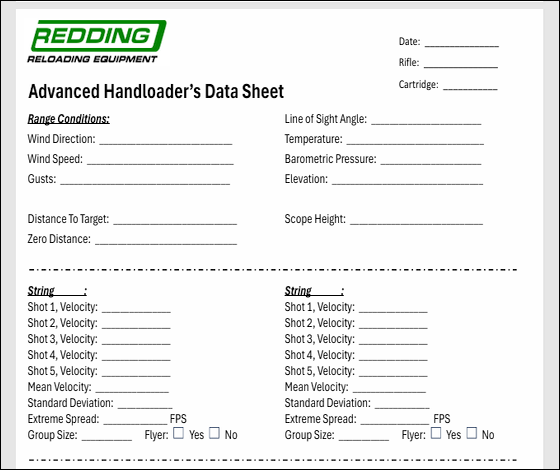
Redding Reloading offers handy Handloader’s Data Sheets in printable PDF format. This FREE 2-page form allows hand-loaders to document their tool settings, bushing size, powder charge, load specs (COAL etc.), and case prep status on Page 1. Then the second page allows you to enter your load testing information, complete with chronograph data, group size, zero range, and wind/temp conditions. The top of page 2 has fields for listing wind and weather conditions. Then below there are six (6) blocks for 5-shot strings, with places to record ES, SD, Average Velocity, and group size. With this single, handy form you can document all the vital information for your particular cartridges and loads. We suggest you print these out, 3-hole-punch ‘em, and then keep them in a three-ring binder.
We’ve seen various reloading log templates, but this Redding form (shown below) is better than most because it combines both reloading data AND range-test data in one place. You can see all key details of the reloading process (tool settings etc.) plus the end results — how the load actually performed over the chronograph and on paper. This form allows the user to capture a large amount of information for later use, while accurately track load development. CLICK HERE to DOWNLOAD.
FREE Ammunition Box Label Template Redding also provides a FREE printable template for your ammo boxes (see photo at top of article). This lets you put all vital load info on your ammo boxes. There are fields for: Date, Cartridge, Powder, Grains, Bullet, Weight, Primer, Case type. Designed for Avery 5260 (or similar) label sheets, this template allows you to print 30 labels at one time. You can purchase the Avery 5260 peel-off printable label sheets at any office supply store.
At the request of our readers, we provide select “Deals of the Week”. Every Sunday afternoon or Monday morning we offer our Best Bargain selections. Here are some of the best deals on firearms, hardware, reloading components, optics, and shooting accessories. Be aware that sale prices are subject to change, and once clearance inventory is sold, it’s gone for good. You snooze you lose.
NOTE: All listed products are for sale to persons 18 years of age or older. No products are intended for use by minors.
1. BRUNO Shooters Supply — 50th Anniversary Blow-Out Sale
⏺️ » Major 20-40% savings on vast selection of products
Bruno Shooter’s Supply is celebrating its 50th Anniversary with a Major Blow-Out SALE. Bruno’s is offering HUGE discounts on a vast selection of products. Powders and primers are discounted, and there are big savings on rimfire and centerfire ammo. In addition, Lapua brass and Alpha brass are discounted as well as a huge variety of bullets from major manufacturers. Plus there are discounts on dies and other reloading tools. Guys, definitely check out this Bruno’s sale — you’ll find exceptional savings this week.
2. CDNN Sports — Gun Sale with FREE Shipping 8/11/2025
⏺️ » Significant savings plus FREE firearms shipping on 8/11/25
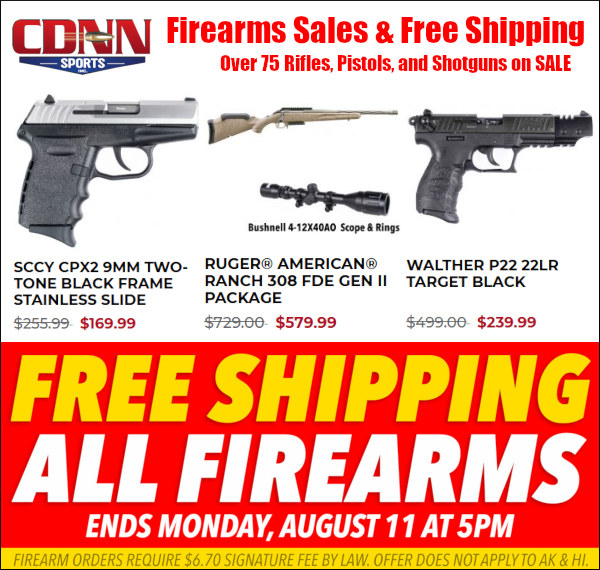
Here’s a cool deal that can save you $30-$70 — but you better act fast. Right now, through 5:00 pm on Monday August 11, 2025, CDNN Sports is offering FREE Shipping on firearms. This promotion is “icing on the cake” with CDNN’s already great pricing on guns. For example the cool Walther .22 LR pistol is discounted a whopping $459 (from $699.00 to $239.99), while the Ruger American Ranch rifle with optic is discounted $149 (from $729.00 to $579.99).
3. Creedmoor Sports — Berger Bullet Sale, Save up to 20%
⏺️ Good discounts on very large selection of Berger bullets
Now’s the time to get components, with the competition season getting underway. And right now Creedmoor Sports is running a major Berger Bullet Sale with quality Berger bullets from .17 to .30 calibers in a wide variety of hunting and match types. Choose target hybrids, varmint bullets, Elite Hunters or other bullet types for your next match or hunt. Many of the most popular .22-Cal, 6mm, 6.5mm, 7mm, and .30-Cal match bullets are on sale.
4. SIG Sauer — SIG Sauer 2.5-8X Scope and Rangefinder, $299.99
⏺️ » Amazing deal on BDX Bluetooth-connected scope and laser rangefinder
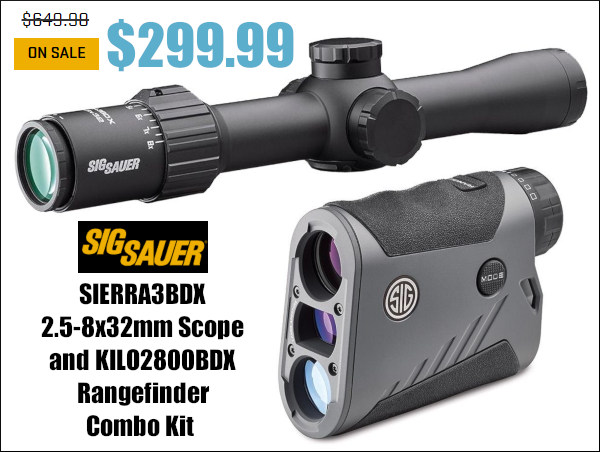
Here’s a good SIG Sauer Combo Kit at a great price. For just $299.99 you can get a 2.5-8x32mm scope PLUS a laser rangefinder. The SIERRA3BDX scope boasts a BDX system that “talks” to the KILO2800BDX rangefinder to determine target distance. Then the scope automatically shows your hold-over point — no need to dial turrets. This system uses Bluetooth to share readings from the BDX-enabled rangefinder with the BDX-enabled optic. The BDX system enables hunters to hit their target prey rapidly and precisely.
5. MidwayUSA — Walkers Electronic Plugs and Muffs 40-53% Off
⏺️ » Good electronic hearing protection with 23dB+ Ratings
All shooters need high quality hearing protection. Modern electronic muffs and plugs offer over 23 decibles of sound reduction, with the advantage that users can still hear range commands and communicate with fellow shooters. Right now MidwayUSA is offering 40% Off Razor Slim Muffs with Walkie-Talkie system and 53% off Walker’s Restrictor Earplugs with an impressive 23dB NRR. These electronic plugs have Bluetooth so you can listen to messages from your cellphone or other devices.
6. Palmetto State Armory — AR15 Lower Receiver, $49.99
⏺️ » Amazing Deal on quality AR lower receiver
With the election just a month away, and Biden/Harris slamming through anti-gun executive orders, you want to get that AR15 build started while you still can. If you need an AR lower, here’s a great deal. Palmetto State Armory (PSA) now has stripped AR15 lowers for just $49.99. With this lower as the core, you can build up your AR for any discipline you choose: 3-Gun rifle, service rifle competition, varmint rifle, or even “race gun” for the PRS Gas Gun Series. These PSA lowers are forged using 7075-T6 Aluminum and have a durable, mil-spec anodized hardcoat finish.
7. Palmetto SA — Bulk .22 LR Ammo, 6 to 8 cents per round
⏺️ » Great deals on American-made rimfire ammo — Federal, Rem, Winchester
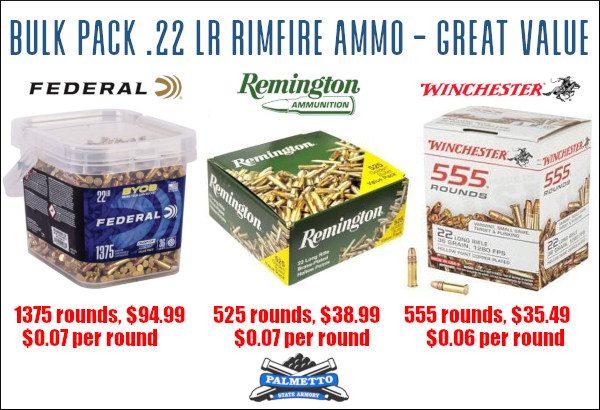
For fun close-range shooting, it’s hard to beat the .22 LR rimfire cartridge. It is inexpensive, has low recoil, and barrels last many thousands of rounds. Right now you can get good, reliable, American-made .22 LR ammo at big savings. Bulk ammo packs of 250 to 1400 rounds are on sale for just 6 to 8 cents per round at Palmetto State Armory. Show above are three bargain packs, but there are many other great deals.
⏺️ » Excellent, rugged rifle case at a very good price
When flying or driving it’s vital to protect your rifles. A good hard case option (at a great price) is the APACHE 9800 Weatherproof Protective Rifle Case. On sale for $149.99, this 53″-long case is $190.00 less than an equivalent-size Pelican case. Constructed from durable polypropylene, this quality hard case can protect long guns from from impact, moisture, and dust. The built-in purge valve equalizes pressure so you can open the case after changing elevations. NOTE: Case interior dimensions are 50⅜” by 13⅝”.
9. Amazon — Tactical Shooting Mat & Rest Bags, $22.99
⏺️ » Handy shooting mat with two bags — all for under $23
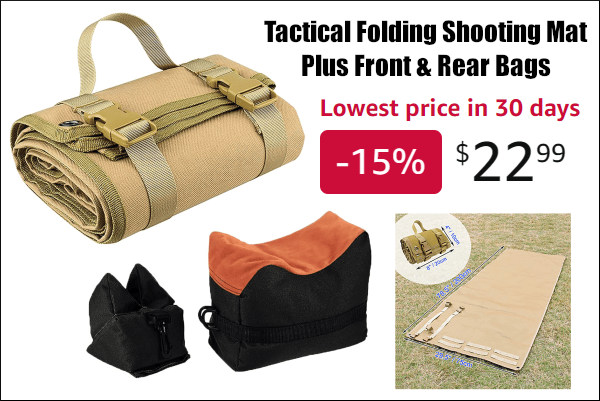
Shooting prone requires a good shooting mat. And it helps to have front and rear bags. One budget-priced option is this DGVR Tactical Shooting Mat (#ad) set that comes with both front and rear bags. Get the mat and both bags for just $22.99 on Amazon (#ad). The 1000D Nylon shooting mat is waterproof with a non-slip coating and handy carry strap. NOTE: The two nylon bags ship empty — you add filling.
As an Amazon affiliate, this site can earn revenues through sales commissions.








 Redding also provides a FREE