“Freedom is never more than one generation away from extinction. We didn’t pass it to our children in the bloodstream. It must be fought for, protected, and handed on for them to do the same, or one day we will spend our sunset years telling our children and our children’s children what it was once like in the United States where men were free.” — Ronald Reagan
Today marks the 24th anniversary of a tragic day in American history. Much like December 7th, 9/11 remains a “date which will live in infamy”. On this 11th day of September 2025, we think it is good for Americans to honor the sacrifice of the first responders who went to the World Trade Center (WTC) and who lost their lives. And we must remember all those who died as the towers collapsed. It is also a good time to remember those key values for which this nation stands — freedom, liberty, and justice for all. In a modern world where media sources and politicians seek to divide Americans and create hostility, the shared memory of 9/11 can perhaps serve to unite us.
Forum member Charlie NC posted: “Everybody remembers where they were when the attacks happened, and the emotions they felt. God bless the victims who died that day, and those who followed in the pursuit of justice. But at a terrible time our country was more united than at any other point in my lifetime. Hopefully may we regain that harmony again under better circumstances.”
Remembrance from 24 Years Ago — Days Before the Attack
Forum member David Joe was in New York City in September 24 years ago. David had actually been in the World Trade Center with his family just a few days before the attack. Here is his perspective on how the tragedy of 9/11 has changed life in America…
24 Years Ago at the World Trade Center…
Twenty-three years and a week ago, my wife, son, and unborn daughter spent five hours at the World Trade Center. We ate, took pictures everywhere, watched the tilting platform movie, pressed souvenir pennies, went to the top, talked to the employees and watched birthday flowers being delivered up the escalator to one of them. And that’s what we first thought about on the morning of 9/11…
By the evening of 9/11, I knew the world was different, and always would be. In all the years that have gone by, families like mine eventually travelled again, grew up and recognized at least once a year, the magnitude of the events of that day. Some think about it all the time and became more vigilant, and that is certainly, I hope, good.
Other families were directly involved daily in preventing terrorism from coming home again. Thousands of families lost relatives that day, and many more in the years after.
GunBroker & Savage Arms Offer Precision Backcountry Rifle Prizes
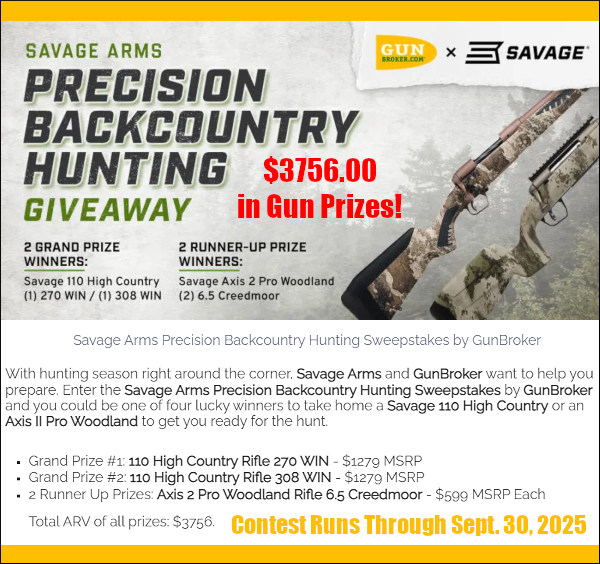
With hunting season right around the corner, Savage Arms and GunBroker.com have kicked off the Savage Arms Precision Backcountry Hunting Sweepstakes, giving hunters the chance to win one of four handsome, rugged hunting rifles. Entries are open now through September 30, 2025. Participants can return daily for bonus entries that boost the odds of winning.
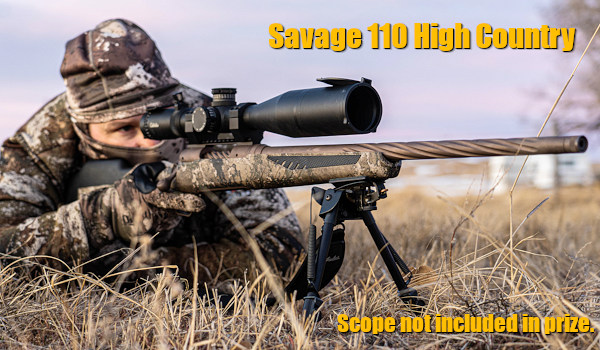
“Backcountry hunts demand preparation, reliable gear, and confidence,” said Beth Shimanski, Savage Arms VP of Marketing. “The 110 High Country and Axis 2 Pro Woodland deliver the accuracy and rugged finishes serious hunters demand. We’re excited to partner with GunBroker to put these rifles in the hands of four lucky winners just in time for fall.”
Allen Forkner, Gunbroker Brand Management VP, noted: “This sweepstakes helps hunters gear up with proven Savage platforms and reminds everyone to come back every day in September for bonus entries.”
Prizes — Four Rifles (Two Savage 110s; Two Savage Axis IIs)
Grand Prize #1: Savage 110 High Country Rifle, .270 Win — $1,279 MSRP
Grand Prize #2: Savage 110 High Country Rifle, .308 Win — $1,279 MSRP
Runner-Up Prizes (2): Savage Axis II Pro Woodland Rifles, 6.5 Creedmoor — $599 MSRP each
Total value of all prizes: $3,756.00.
How to Enter Contest
Enter the Savage Arms Precision Backcountry Hunting Sweepstakes at GunBroker.com/c/sweepstakes. You can re-visit every day through September 30th to earn bonus entries. Full details and entry form are available at GunBroker.com/c/sweepstakes.
Fine Print Contest Rules
No purchase necessary. Void where prohibited. Open to eligible U.S. residents. Sweepstakes runs through September 30, 2025. Odds of winning depend on number of eligible entries received. Firearm transfers must be completed through a licensed FFL in accordance with all applicable laws. See Official Rules at GunBroker.com/c/sweepstakes for eligibility, entry methods and prize details.
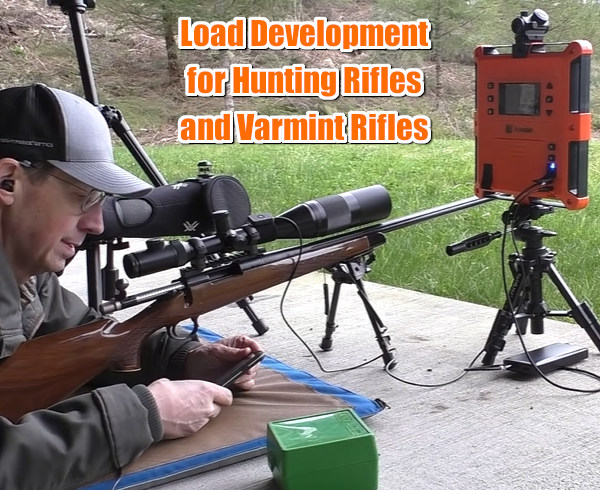
Hunting season kicks off this month in many parts of the USA. If you have a new hunting rifle or need to develop a load for your rig with a new choice of bullets and/or powder, this article can help. Ace shooter Keith Glasscock explains how to develop a good load for a hunting rifle or varmint rifle.
Keith is an outstanding competitive shooter, who has finished second at the F-Class National Championships (F-Open) multiple times. Keith is also a skilled wind coach who runs the popular Winning in the Wind YouTube Channel. Along with his interest in mid-range and long-range F-Class competition, Keith also enjoys game hunting and varmint adventures.
Developing accurate hand-loaded ammo for hunting and varmint rifles involves procedures that may be a bit different than load testing for a match rifle. You want to be efficient, and use the types of brass and bullets you’ll be using on the hunts. In two recent videos, Keith shows how he developed good, accurate loads for a .223 Rem varmint rifle and a .308 Win hunting rifle.
.223 Rem Load Development — Powder Charge and Seating Depth
In the first video, Keith covers the load development process for a Remington 700 bolt-action varmint rifle chambered in .223 Remington. Keith starts by full-length sizing the brass. Then he experimented with powder charge weights, and came up with a promising load of 24.7 grains of Alliant AR Comp with Hornady 50gr A-Max bullets.
Next Keith experimented with seating depths (see 5:30-6:100) and found that accuracy improved as he changed OAL length in .005 increments. Keith ended up with 2.270″ with a 3-shot group in the twos! This video shows the importance of testing your bullet choice at various seating depths. Keith shoots this rig prone off bipod, which is similar to the bipod shooting he does in the varmint fields. Keith explains key factors to consider when optimizing the .223 Rem cartridge in a varmint rig. Velocity readings are made with a LabRadar unit.
Load Development for .308 Win Hunting Rifle
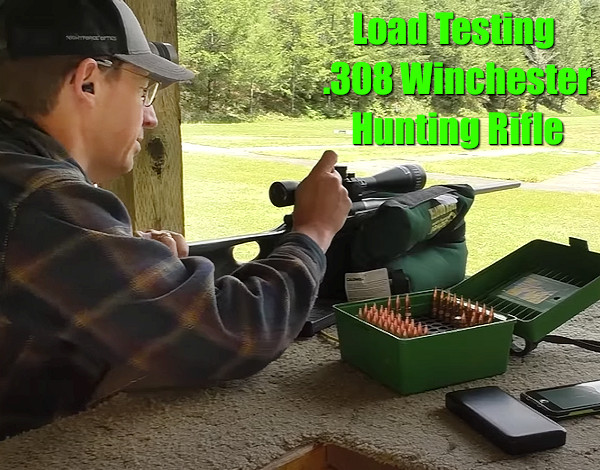
In a second video, Keith shows the process for load development with a .308 Winchester hunting rifle. Here Keith uses a large X-type sandbag for a front support. Again, he was shooting a Remington 700 bolt-action rifle, this time with Barnes TSX solid copper bullets, PPU Brass, Federal 210m primers, and AR Comp powder. Keith said the Barnes bullets were excellent — he commented that these bullets were “match quality in terms of precision”. Keith achieved some very small three-shot groups with AR Comp and the TSX projectiles. Keith did note that point-of-impact shifted up significantly with increases in charge weight (see 6:20-7:10). With thinner-contour hunting barrels, this is not unexpected. But POI change should be observed carefully during load development, as you may need to adjust your zero after completing testing.
Ever wondered what the air around a moving supersonic bullet really looks like? Check out this video from the Bryan Litz Ballistics Facebook page. This is a Schlieren video* of a 6mm 109gr Berger LRHT bullet at about 2800 fps as fired from Francis Colon’s PRS rifle at the Applied Ballistics Lab.
Bryan Litz notes: “You can clearly see the compression (shock) wave at the front of the bullet. A compression wave is formed when the air has to move faster than the speed of sound to get out of the way, which is certainly the case for this bullet which is moving about 2.5 times the speed of sound (Mach 2.5).
That shock wave is the ‘snap’ you hear when bullets fly past you if/when you’re downrange. Also, compressing the air into a shockwave takes energy, and that energy comes directly out of the forward velocity of your bullet and gets converted into heat and noise as the shock wave forms and dissipates.
The turbulent wake at the base of the bullet shows where/how base drag applies. The third and smallest component of drag for a supersonic bullet is skin friction drag, which is a viscous boundary layer effect, and is the least visible in this image. So as you head to the range or the hunting stand, think about the absolute violence your bullets are committing in the atmosphere, before they even reach the target!”
This can be very important — even life-saving. For example, with a hang fire, i.e. a round that does not fire immediately, it is vital to keep the gun pointed DOWN-RANGE. And with a squib load, which may have left a round inside the barrel, it is vital to UNLOAD and NOT take another shot! If you did, the gun could blow up in your hand when the second, full-charge bullet hits the trapped bullet.
The Five Topics Covered Are:
Misfeed (aka Tip-Up)
Double Feed
Stovepipe (Failure to Extract)
Misfire / Hangfire
Squib Load
1. Misfeed or Tip-Up: With any misfeed you should stop firing. With the muzzle pointed safely down-range, remove the magazine, then pull the slide back and remove the round that did not feed. Check the slide for dirt, debris, and check the round that did not feed. After re-inserting the magazine, make sure the mag is seated properly.
2. Double-Feed: This is a fairly common issue with some gun types with worn springs or cheap magazines. Again you want to remove the magazine. CTD states: “Remove the magazine and cycle the action until your double-fed rounds fall out — always keeping the muzzle pointed in a safe direction[.]”
3. Stove-Pipe: This occurs when the case of a fired round does not eject fully. There can be many causes — damaged extractor, low-pressure powder charge, dirty chamber, or greasy cartridge brass. In addition the issue is common with old, worn-out recoil springs. To avoid Stove-Pipes, replace the recoil spring every 4000 rounds, and make sure your chamber is clean and the extractor is not chipped or damaged.
4. Misfires and Hang-Fires: There are multiple causes for misfires (“click no bang”) and hang-fires (slow ignition). There can be a defective primer, the firing pin could be damaged, the powder many have been bad, or the case not filled properly. With a misfire, keep the gun pointed down-range at least one minute. If the case does not fire, eject it but leave it on the ground. With a hang-fire (delayed ignition after firing pin strike), keep the gun pointed down-range, then drop the magazine and eject the (new) unfired cartridge in the chamber and inspect the gun when completely empty.
5. Squib Load: A squib load is when the gun fires, but the actual case ignition is very light with little noise, smoke, or recoil. This can be because the case had a primer but no powder. Or it can be because the powder did not ignite. Squib loads can be very dangerous in rapid-fire situations. If you EVER get a squib load STOP immediately! Do NOT fire another round! This is because the squib may have left a bullet inside the barrel.
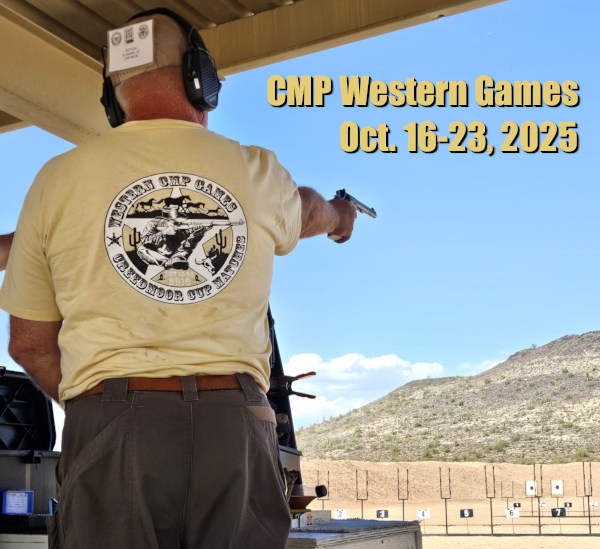
If you live out west and enjoy rifle and/or pistol competition, then consider signing up for for the Civilian Marksmanship Program (CMP) 2025 Western Games. Featuring a wide variety of Rifle and Pistol matches, the annual event is set for October 16-23, 2025 at the Ben Avery Shooting Facility in Arizona. This big match is run very efficiently, with electronic targets eliminating pit duty. And new this year is a 1000-yard Long-Range Rifle Match.
The Western CMP Games & CMP Cup Matches will feature Garand/Springfield/Vintage & Modern Military Matches, a Carbine Match, a Vintage Sniper Match and a Rifle Marksmanship 101/M16 Match (Introductory Marksmanship Class & Live Fire). The CMP Cup Matches include a CMP Mid-Range 3X600, a 2-Man Team Match, three days of CMP 800 Aggregate Matches and a CMP Service Rifle EIC Match. The Western Games will also include popular CMP vintage rifle events. All rifle matches will be held on the CMP’s outdoor eTargets — recently used at the 2025 National Matches at Camp Perry.
NEW FOR 2025: The CMP will be adding six 20-shot, 1000-yard Long Range matches held October 20-22. Competitors may fire in the Service Rifle, Match Rifle, F-Class, F T/R, AR Tactical or Palma Rifle categories.
RANGE & SQUADDING INFORMATION: All matches fired on the Highpower Range will be using the KTS Electronic Target System (no pit duty required). The CMP 80 Shot Matches, EIC Rifle Match, Carbine Match, Mid-Range 3X600 Match and Garand/Springfield/Vintage/Modern Military Matches will be pre-squadded.
2025 Western Games Notable Events:
Rifle Competitions
Garand, Springfield, Vintage & MM Matches
Carbine Match
Rifle Marksmanship 101/M16 MATCH
Rimfire Sporter Match
Mid-Range 3X600
1000-Yard LR Match
80 Shot Rifle
2-Person Rifle Team
EIC Service Rifle
Pistol Competitions
CMP Match Pistol 2700 (.22, .45, Centerfire)
Pistol Marksmanship 101/M17 MATCH
.22 Rimfire Pistol
EIC Service Pistol
EIC Service Revolver
Military & Police Service Pistol
1911 As-Issued Pistol Match
CLICK HERE to To see the Full Schedule of all Matches.
There Will Be Instruction as Well as Competition
The Western Games are open to any adult or junior with an interest in the sport – regardless of experience. Educational sessions will be held by trained instructors in the classroom and on the range. These are suitable for both beginners and more advanced individuals. This training will include Rifle/Pistol Marksmanship 101 training seminars.
Handgun Matches at Western Games
Handgun shooters can compete in four days of Pistol Matches including a Pistol Marksmanship 101/M9 Match (Introductory Marksmanship Class & Live Fire), CMP Match Pistol 2700, CMP .22 Rimfire Pistol EIC Match, CMP EIC Service Pistol Match, CMP Service Revolver EIC Match, Military & Police Service Pistol Match, and CMP 1911 As-Issued Pistol Match.
HOUSING: Competitors who plan to stay overnight near the Ben Avery Shooting Facility should stay north of the Phoenix area. There are numerous hotels, Air BnBs as well as Vacation Rentals (VRBO) in this area.
In discussions of ballistics, you’ll see references to “tangent”, “secant”, and “hybrid” bullet shapes. We know that, for many readers, these terms can be confusing. To add to the confusion, bullet makers don’t always identify their projectiles as secant or tangent designs. This article provides a basic explanation of tangent, secant, and hybrid ogive bullet designs, to help you understand the characteristics of these three basic bullet shapes.
Tangent vs. Secant vs. Hybrid
Most match bullets produced today use a tangent ogive profile, but the modern VLD-style bullets employ a secant profile. To further complicate matters, the latest generation of “Hybrid” projectiles from Berger Bullets feature a blended secant + tangent profile to combine the best qualities of both nose shapes. The secant section provides reduced drag, while the tangent section makes the bullet easier to tune, i.e. less sensitive to bullet seating depth position.
Berger Bullets ballistician Bryan Litz explains tangent and secant bullet ogive designs in a glossary section of his Applied Ballistics website, which we reprint below. Bryan then explains how tangent and secant profiles can be combined in a “hybrid” design.
How Bullet Ogive Curves are Defined
While the term “ogive” is often used to describe the particular point on the bullet where the curve reaches full bullet diameter, in fact the “ogive” properly refers to the entire curve of the bullet from the tip to the full-diameter straight section — the shank.
Understanding then, that the ogive is a curve, how is that curve described?
LITZ: The ogive of a bullet is usually characterized by the length of its radius. This radius is often given in calibers instead of inches. For example, an 8 ogive 6mm bullet has an ogive that is a segment of a circular arc with a radius of 8*.243 = 1.952”. A .30-caliber bullet with an 8 ogive will be proportionally the same as the 8 ogive 6mm bullet, but the actual radius will be 2.464” for the .30 caliber bullet.
For a given nose length, if an ogive is perfectly tangent, it will have a very specific radius. Any radius longer than that will cause the ogive to be secant. Secant ogives can range from very mild (short radius) to very aggressive (long radius). The drag of a secant ogive is minimized when its radius is twice as long as a tangent ogive radius. In other words, if a tangent ogive has an 8 caliber radius, then the longest practical secant ogive radius is 16 calibers long for a given nose length.”
Bryan Litz Explains Hybrid Design and Optimal Hybrid Seating Depths
Ogive Metrics and Rt/R Ratio
LITZ: There is a number that’s used to quantify how secant an ogive is. The metric is known as the Rt/R ratio and it’s the ratio of the tangent ogive radius to the actual ogive radius for a given bullet. In the above example, the 16 caliber ogive would have an Rt/R ratio of 0.5. The number 0.5 is therefore the lowest practical value for the Rt/R ratio, and represents the minimum drag ogive for a given length. An ogive that’s perfectly tangent will have an Rt/R ratio of 1.0. Most ogives are in between an Rt/R of 1.0 and 0.5. The dimensioned drawings at the end of my Applied Ballistics book provide the bullets ogive radius in calibers, as well as the Rt/R ratio. In short, the Rt/R ratio is simply a measure of how secant an ogive is. 1.0 is not secant at all, 0.5 is as secant as it gets.
Hybrid Bullet Design — Best of Both Worlds?
Bryan Litz has developed a number of modern “Hybrid” design bullets for Berger. The objective of Bryan’s design work has been to achieve a very low drag design that is also “not finicky”. Normal (non-hybrid) secant designs, such as the Berger 105gr VLD, deliver very impressive BC values, but the bullets can be sensitive to seating depth. Montana’s Tom Mousel has set world records with the Berger 105gr VLD in his 6mm Dasher, but he tells us “seating depth is critical to the best accuracy”. Tom says a mere .003″ seating depth change “makes a difference”. In an effort to produce more forgiving high-BC bullets, Bryan Litz developed the hybrid tangent/secant bullet shape.
Hunting season is right around the corner. That means its time to inspect all your hunting gear, including your scope set-up. If you have a new optic, you’ll want to get it mounted correctly on your current rig. And if you have a new hunting rifle, you’ll need to mount the properly rings and install the riflescope so that you have the correct eye relief.
A proper scope installation involves more than just tensioning a set of rings — you need to consider the proper eye relief and head position, and it should be leveled correctly. This video shows a simple, quick method to mount a scope. The method assumes that the reticle (cross-hairs) are square without the turret. You’ll want to confirm that with a plumb line hanging straight down, a procedure you can do indoors.
In this NSSF video, Ryan Cleckner shows how to set up a scope on a hunting or tactical rifle. Ryan, a former U.S. Army Sniper Instructor, notes that many hunters spend a small fortune on equipment, but fail to set up their rifle to use the optics optimally. Cleckner likens this to someone who owns an expensive sports car, but never adjusts the seat or the mirrors.
Ryan notes that you want your head and neck to be able to rest naturally on the stock, without straining. You head should rest comfortably on the stock. If you have to consciously lift your head off the stock to see through the scope, then your set-up isn’t correct. Likewise, You shouldn’t have to push your head forward or pull it back to see a clear image through the scope. If you need to strain forward or pull back to get correct eye relief, then the scope’s fore/aft position in the rings needs to be altered. Watch the full video for more tips.
Tips on Mounting Your Scope and Adjusting Your Comb Height:
1. Normally, you want your scope mounted as low as possible, while allowing sufficient clearance for the front objective. (NOTE: Benchrest shooters may prefer a high mount for a variety of reasons.)
2. Once the scope height is set, you need to get your head to the correct level. This may require adding an accessory cheekpad, or raising the comb height if your rifle has an adjustable cheekpiece.
3. Start with the rifle in the position you use most often (standing, kneeling, or prone). If you shoot mostly prone, you need to get down on the ground. Close your eyes, and let you head rest naturally on the stock. Then open your eyes, and see if you are too low or too high. You may need to use a cheekpad to get your head higher on the stock.
4. If your scope has a flat on the bottom of the turret housing, this will help you level your scope. Just find a flat piece of metal that slides easily between the bottom of the scope and the rail. Slide that metal piece under the scope and then tilt it up so the flat on the bottom of the scope aligns parallel with the flats on the rail. Watch the video at 8:40 to see how this is done.
Video find by EdLongrange. We welcome reader submissions.
At the request of our readers, we provide select “Deals of the Week”. Every Sunday afternoon or Monday morning we offer our Best Bargain selections. Here are some of the best deals on firearms, hardware, reloading components, optics, and shooting accessories. Be aware that sale prices are subject to change, and once clearance inventory is sold, it’s gone for good. You snooze you lose.
NOTE: All listed products are for sale to persons 18 years of age or older. No products are intended for use by minors.
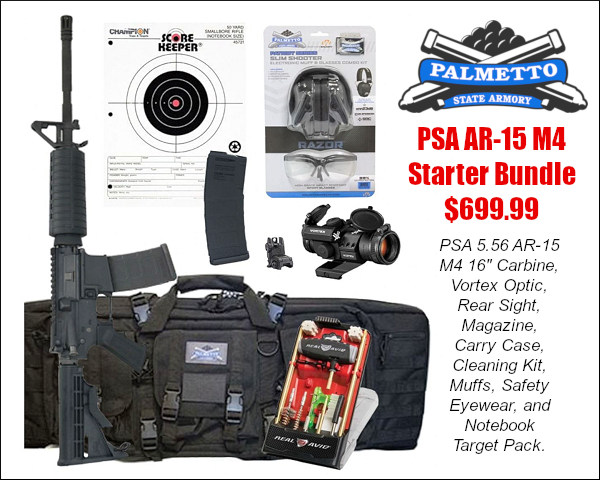
1. Palmetto SA — AR-15 M4 Rifle Starter Bundle, $699.99
⏺️ » Complete package for new AR shooters — gun, optic, case and much more
This combo kit includes all you need to get started with an AR carbine (except ammo). This handy $699.99 AR Package includes: PSA PA-15 Classic M4 Carbine (16″ barrel); Vortex Strikefire II 1x30mm 4 MOA Red/Green Dot optic; PSA 36″ Rifle Bag, Magpul PMAG A4/M4 30rd Magazine; Magpul MBUS AR-15 Rear Iron Sight; Real Avid Gun Boss AR Cleaning Kit; Walkers Electronic Muffs and Glasses Combo; and Champion 50-yard notebook target pack. With this package you save $62+ off the individual items total cost. For someone getting started with a Black Rifle, this is a very handy gun/gear collection.
⏺️ » Save $50 on compact Radar chronograph with FREE Shipping
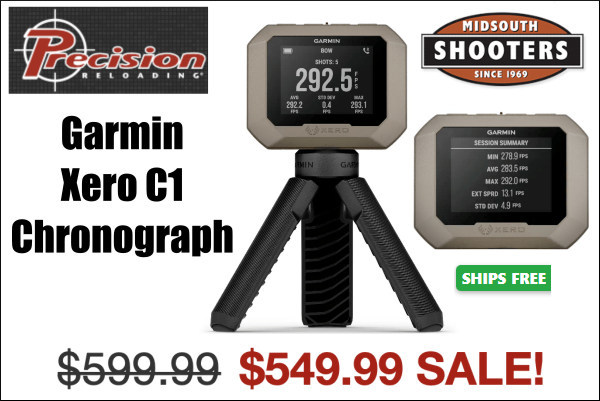
Since its introduction, the Garmin Garmin Xero C1 Chronograph has been hugely popular with shooters. This radar chronograph is compact, accurate, reliable and easy to use. And right now you can save $50 off the regular $599.99 price and get FREE Shipping. This excellent compact chrono is on sale now for $549.99 at Precision Reloading with FREE Shipping or $549.99 at Midsouth with FREE Shipping. Now’s your chance to save $50 on one of the best chronographs on the market.
3. Amazon — Frankford Intellidropper + Case Prep CTR, $306.14
⏺️ » Two excellent, advanced products with combo discount
Here’s a great Frankford Arsenal combo — the impressive Intellidropper powder scale/dispenser PLUS the Frankford Platinum Series Case Trim & Prep System. The Intellidropper is fast and reliable and can be controlled via a free smart-phone App. The Case Prep Center boasts four power stations with VLD chamfering tool, Outside Chamfer Tool, primer pocket uniformers, and Adjustable Collet System for cases from .17 Rem to .460 Weatherby. You get BOTH advanced products for $306.14 on Amazon (#ad) — a $65 savings! NOTE: If you do not need the Case Prep Center, you can get the Intellidropper Scale/Dispenser by itself for just $159.99 on Amazon (#ad), $94 less than it sells for elsewhere at $253.99.
5. Peterson — 58 Types of Cartridge Brass, Direct Purchase
⏺️ » You can direct order excellent American-made cartridge brass
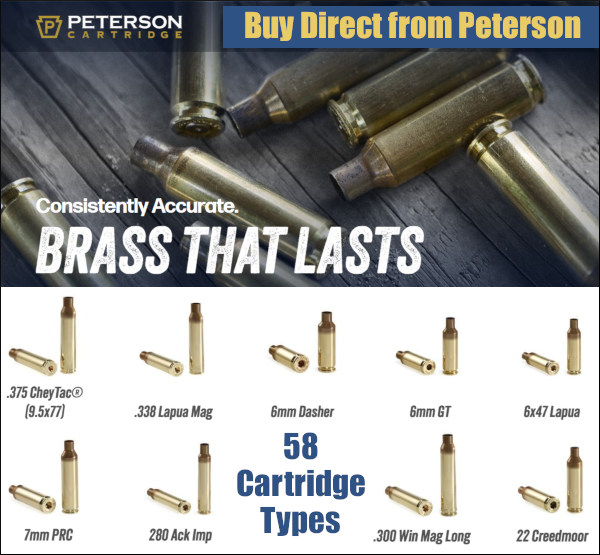
Good news — you can now buy excellent, long-lasting Peterson Brass directly from Peterson. Currently Peterson produces 58 types of cartridge brass and most are IN STOCK in Peterson’s Online Store. In addition to the direct purchase option, you can order Peterson brass through leading vendors including Brownells, Bruno’s, Bullet Central, Creedmoor Sports, EuroOptic, Graf’s, Midsouth, MidwayUSA, Precision Reloading, and Scheels. In addition Peterson 6mmBR brass is offered exclusively through Graf & Sons.
5. MidwayUSA — Hunting Ammunition Sale, Many Brands
⏺️ » Discounts on good hunting cartridges from top ammo-makers
Hunting season kicks off soon in many areas of the country. If you need ammo for your hunting rifle(s) head over to MidwayUSA which is running a major sale on hunting ammunition. You’ll find good hunting ammo for deer, elk, and other game. Choose ammo types from dozens of leading suppliers including Barnes, Berger, Federal, Fiocchi, Hornady, Lapua, Norma, Nosler, Remington, Winchester and more. NOTE: Nearly all Hornady ammo is now 10-20% Off.
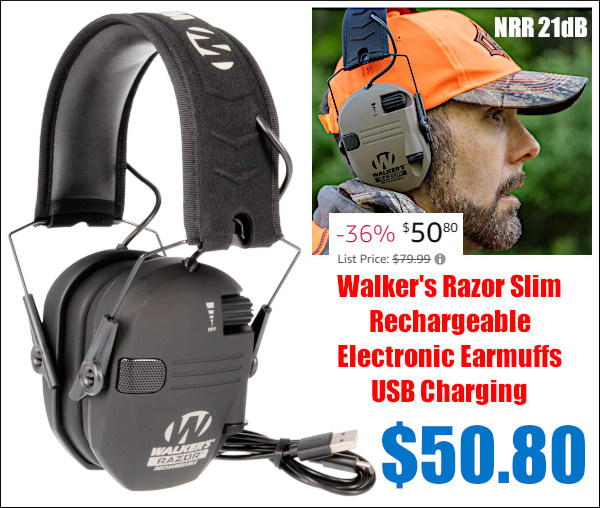
How many times have you grabbed your electronic earmuffs only to find the batteries are dead. To avoid the hassles (and cost) of battery replacement, consider Walker’s Rechargeable Razor Ear Muffs (#ad). These rechargeable muffs have an estimated 80 hours of run time. That’s enough to get through several DAYS at the range. Then you can recharge the muffs conveniently at home or in your vehicle. To hear range commands clearly, the muffs have HD speakers. Plus there’s a handy audio jack. These muffs are comfortable and boast a 21 dB Noise Reduction Rating (NRR).
7. Amazon — Night Vision Binoculars, $85.49
⏺️ » Top-seller with 4k HD image that can be recorded
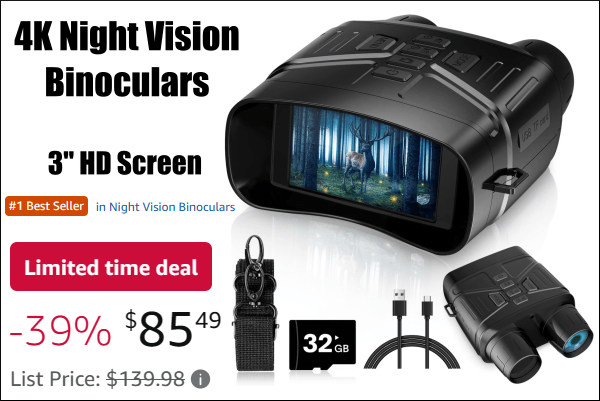
Here is a great product for hunters that can also serve for home security, allowing you to scan your property at night. These Hexeum 4K Night Vision Binoculars (#ad) can “watch live” as well as record stills and video. Now available for just $85.49 (39% off), these view-screen binoculars can take high definition photos and record/playback video in daytime or night time. The recording is 4K HD quality with playback via a 3″ wide view screen. This unit is Amazon’s #1 Best-Seller among Night Vision Binoculars and Goggles. This Hexeum unit comes with a 32GB storage card and offers USB Type-C fast charging.
8. Amazon — Vevor 50″ Rifle TSA-Std Hard Case, $108.99
⏺️ » Good waterproof hard case with wheels — big size, great price
Protecting your firearms requires a good, tough transport case. The VEVOR 50″ Rifle Case (#ad) features 3 layers of fully-protective foam, solid locking points, wheels, and a IP67 waterproof case. This VEVOR gun case meets all TSA gun case requirements, making it a good choice for marksmen and hunters who travel by air. At just $108.99 this is a fantastic deal — cheaper than other sturdy, wheeled rifle cases of similar size. Try to grab one at that $108.09 low Amazon price.
9. Natchez — CCI 9mm Blazer FMJ Ammo, $219.99/1000 rds
⏺️ » Very good, reliable pistol ammo at just $11 per 50 rds
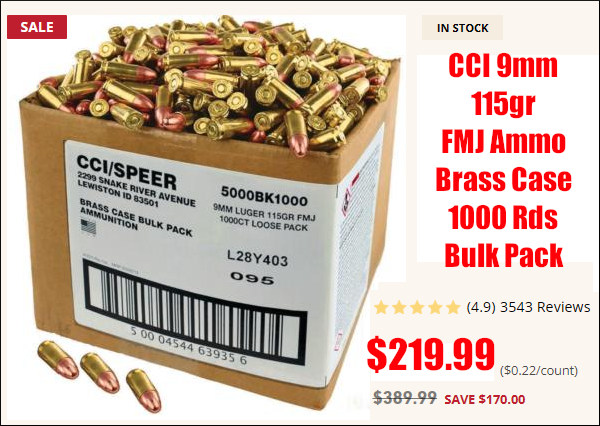
We have had very good luck with CCI Blazer ammunition in our handguns. Here’s a great deal on CCI Blazer 9mm Luger ammo. Right now at Natchez you get a 1000-round bulk case for just $219.99 — that works out to just $11 per 50 rounds. This ammo boasts durable brass cases that can be reloaded many times. This ammo is consistent, reliable, and feeds smoothly in virtually all 9mm handguns.
⏺️ » Great price on handy targets that display hits brightly
These handy 6″ Splatter Targets (#ad) make it easy to identify where your shots are hitting. The target design is good for aiming with bright red vertical and horizontal lines, plus a center “X”. When a shot lands on the target, a bright yellow on black circle instantly appears at point of impact. These 6″-diameter stick-on targets are easy to apply to any target backer. Get a handy 100-target roll now for $26.99 on Amazon.
As an Amazon affiliate, this site can earn revenues through sales commissions.
With hunting season coming up soon, we know that many readers will be out in the field — with a set of binoculars. On most game hunts, you’ll speed a lot more time glassing with binocs than looking through your riflescope. With wide field of view and extended low-light capability, a good set of binoculars will be your most important game-finder. And with premium LRF binoculars, such as the ZEISS Victory series, one tool serves both for spotting and laser ranging.
“Without the stabilization of your binoculars [provided by] a tripod … you will be missing a majority of the game you are glassing for.” — Outdoorsmans.com
In this article, Vortex Optics’ Mark Boardman, an experienced hunter, explains the benefits of using a tripod with high-magnification binoculars. Everybody knows that powerful spotting scopes work best when mounted to a stable tripod or otherwise secured to a steady mount. Yet when most folks use binoculars, they never even think of using a tripod, despite the fact that tripod adapters are available for many premium binoculars.
Outdoorsmans Tripod Adapters Outdoorsmans.com sells tripod adapters for various kinds of binoculars. These really work: “Mounting your binoculars to a quality tripod is a must for the serious western hunter. Without the stabilization of your binoculars [by] mounting them to a tripod … you will be missing a majority of the game you are glassing for.”
A serious hunter should learn how to glass with tripod support, using methods outlined here. With binoculars offering more that 8X magnification, you can really benefit from a steady mount. You’ll be amazed at the difference the tripod will make.











 Hybrid Bullet Design — Best of Both Worlds?
 In this NSSF video, Ryan Cleckner shows how to set up a scope on a hunting or tactical rifle. Ryan, a former U.S. Army Sniper Instructor, notes that many hunters spend a small fortune on equipment, but fail to set up their rifle to use the optics optimally. Cleckner likens this to someone who owns an expensive sports car, but never adjusts the seat or the mirrors.





 Outdoorsmans Tripod Adapters


