Product innovation is all about “building a better mousetrap”, or in this case, building a better bore-cleaning patch. A real smart guy, Shane Smith, has invented a triangular patch that earned a patent. The U.S. Patent Office has awarded a utility patent for BoreSmith’s Triangle Patch™. This unique cleaning patch was designed by Shane Smith, a mathematician/physicist who employed his scientific and firearms knowledge to create innovative bore-cleaning products.
BoreSmith’s Triangle Patch™ (aka Pyramid Patch) presents more cleaning surface area to the bore wall than does a conventional square or round patch (of equivalent size). At the same time, the unique geometry makes Triangle Patches much less likely to jam in the barrel. This is because the notches in the sides of the triangle allow the patch to sit more uniformly on the jag (without bunching up). Also the Pyramid patch is much less likely to jam due to pleating. One reason conventional patches get stuck is unwanted 5-layer pleating. The special notches in the Pyramid patch remove all or most 5-layer pleating. As a result the patch does not bunch up and this also reduces rod bowing.
Triangle Patch Function and Geometry Explained (See 1:18 time-mark):
NOTE: Despite what you may see in this video, you should ALWAYS insert brushes and patches from the chamber end first, using a fitted cleaning rod bore guide. With bolt-action rifles, NEVER insert a cleaning rod (with brush or jag) in through the muzzle. This may damage the delicate crown of your barrel.
The Triangle Patches work great with Boresmith’s patented dual-diameter bore brushes:
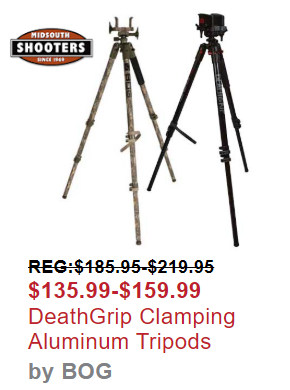
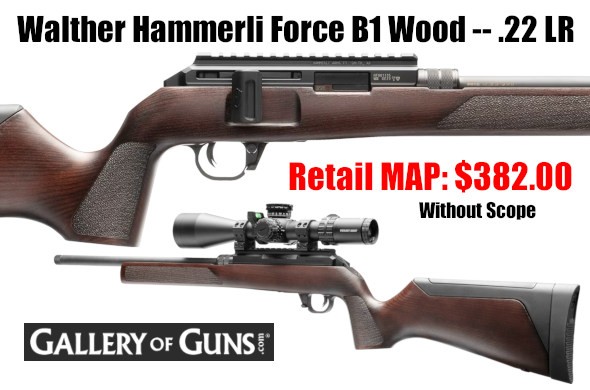
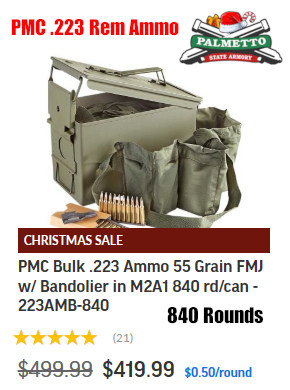
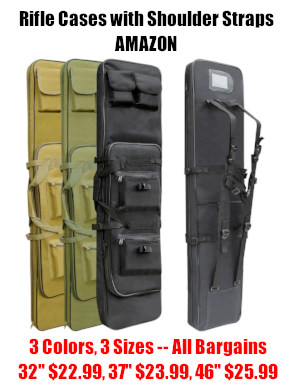
At the request of our readers, we provide select “Deals of the Week”. Every Sunday afternoon or Monday morning we offer our Best Bargain selections. Here are some of the best deals on firearms, hardware, reloading components, optics, and shooting accessories. Be aware that sale prices are subject to change, and once clearance inventory is sold, it’s gone for good. You snooze you lose.
NOTE: All listed products are for sale to persons 18 years of age or older. No products are intended for use by minors.
EuroOptic — 12 Days of Christmas Sale on Guns, Gear & More
⏺️ » Big discounts through 12/19/2025 — Optics, Rifles, Pistols and more
For the first time ever EuroOptic.com presents its big, sitewide 12 Days of Christmas sales event. Special savings are published daily through 12/19/2025. There are major discounts on optics, rifles, pistols, hunting gear and more. Check out the featured Daily Deals through December 19, 2025:
Day 1: Riflescopes
Day 2: Thermals
Day 3: Pistols
Day 4: Glasses
Day 5: Crossbows
Day 6: Boots/Footwear
Day 7: AR-Type Rifles
Day 8: Binoculars
Day 9: TBA
Day 10: TBA
Day 11: TBA
Day 12: TBA
Sportsman’s Warehouse — Major Product Doorbuster Sale
⏺️ » Optics, handguns, ammo, hunting gear, triggers, tools and more
If you need quality guns, hunting gear, reloading tools, optics, rangefinders, and more, then check out the major Doorbuster Sale now at Sportsman’s Warehouse. Among the fantastic deals are 60% off many optics, $275 off Colt pistols, and $250 off Garmin In-reach Satellite GPS devices.
As an Amazon affiliate, this site can earn revenues through sales commissions.
In this video, former Army Ranger sniper team leader Ryan Cleckner explains how proper head and scope position is a critical component to accurate shooting. Ryan finds that some shooters place the scope too far forward or too far rearward. If the scope is too far back you may have issues with eye relief and stock reach to shoulder. If it is too far forward, you may have cheek-weld problems or get neck strain. Cleckner cautions: “When you are in a good prone position, you don’t want any strain in your neck muscles or back.”
In the video, Cleckner offers a simple method to check your scope position:
“To see if your scope is set up properly … close your eyes, lay your head on your gun, get completely comfortable, and only when you are set-up, then open your eyes. If you can’t see clearly through your scope, CHANGE something [such as comb height or scope position]”.
“When you open your eyes, if you see some scope shadow [i.e. the black ring around the edge of the scope picture], figure out which way you need to move your head to get rid of that shadow, and then make adjustments to either your position, the rifle, or the scope.”
“Very often you’ll open your eyes and realize you need to move further back or further forward. Instead of moving your position [or head], move the scope and get it set up properly.”
Tip on Viewing Your Reticle:
Cleckner: “Sometimes it can be difficult to focus between the target and the reticle, even with the parallax adjusted properly. I recommend you focus only on the reticle. Just like the front sight on a rifle or a handgun, that reticle is what you can control, and it’s what matters. Focus on a crisp, clear reticle, in a stable platform, and all that’s left is trigger control.”
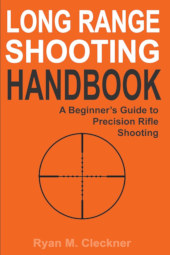
Long Range Shooting Handbook — A Good Resource Cleckner’s Long Range Shooting Handbook covers a wide range of topics important for precision marksmanship — both shooting skills and technical matters. You can view Sample Chapters from Ryan’s Book on Amazon.com. Cleckner’s book is designed as an intro to key concepts such as MOA vs. Mils, External Ballistics, and Environmental Effects. Included are personal tips and advice based on Cleckner’s years of experience as a sniper instructor and special operations sniper.
The Long Range Shooting Handbook is divided into three main categories: What It Is/How It Works, Fundamentals, and How to Use It. “What It Is/How It Works” covers equipment, terminology, and basic principles. “Fundamentals” covers the theory of long range shooting. “How to Use It” gives practical advice on implementing what you’ve learned, so you can progress as a skilled, long range shooter.
Ryan Cleckner was a special operations sniper (1/75 RGR) and he served as a U.S. Army sniper instructor. Currently he works as a firearms industry executive and practicing firearms attorney.
Clearance Check — Remove the seating stem and drop a bullet into it. The farther down the ogive or nose-cone the step recess grips the bullet, the better. If it’s only pressing down against the bullet tip, a crooked seat is assured, along with inconsistent seating depth. — Glen Zediker
Some folks acquire a new seating die and then are surprised to find their hand-loads show crooked bullets and/or inconsistent seating depth. The problem could be a mis-match between the bullet and the die’s seating stem. In some case, particularly with long, streamlined bullets, the bullet tip can actually touch the bottom inside of the stem. This can cause a variety of problems, as Glen Zediker explains…
Invest in a Good Seating Die Reloading Tip by Glen Zediker
The bullet seating operation is the “last thing” that happens and it’s also the one thing that can corrupt the care and treatment given to the quality of the loaded round prior. A sleeve-style seater, well-machined, goes a whopping long ways toward preserving alignment, and, therefore, concentricity. Also make sure that the stem in yours comes to rest well down onto the bullet ogive, and, above all else, is not contacting the bullet tip! That will wreck a round.
If you have this problem, you should contact the die maker — some will offer a different seating stem expressly designed for longer, pointier bullets. This “long bullet stem” will normally drop right into your existing die. If you plan to run long, VLD-style bullets you should request the special seating stem right from the get-go.
NOTE: Glen Zediker passed away in October 2020. He will be missed — his books were important additions to the gun world’s knowledge base. This tip comes from Glen’s book, Top-Grade Ammo, now out of print.
22Plinkster runs of the most popular gun-centric YouTube channels. His videos have been watched by hundreds of thousands of firearms fans. Many of 22Plinkster’s videos involve trick shots, such as shooting a .22LR through 100 balloons, but he also does serious reviews. He’s actually a competent marksman who has shot a vast collection of .22 LR/22 WMR pistols and rifles, making him a qualified rimfire expert (as well as a trick-shot artist and showman). Today we feature five 22Plinkster Firearms Videos, plus a bonus Vudoo Gun Works video review from GunsandTactics.com.
Vudoo Gun Works Ravage Precision .22 LR Rifle
For this Sunday GunDay article, we showcase a complete Vudoo rifle, a mag-fed Ravage with Ridgeback stock. 22Plinkster declared: “It’s a Tack-Driver … this .22 LR Rifle is the most accurate .22 LR bolt-action rimfire rifle I have ever shot in my life.” And he notes that he has shot Anschutz, Lithgow and other quality rifles. Vudoo Gunworks offers the .22 LR Ravage model as a custom build with a McMillan or Grayboe stock starting at $3230.00. The images here show the Ravage with Grayboe Ridgeback stock.
Firing from a Lead Sled, 22Plinkster starts out at 50 yards, and produced a 0.335″ group at 50 yards using Lapua Midas+ ammunition (4:00 time-mark). Then this session gets really impressive. Continuing with Lapua Midas+ ammo, this Vudoo Ravage produced a sub-half-inch group at 100 yards*. You can watch that Midas+ group form up from 7:20 to 8:25 in the video. Then, with ELEY Tenex ammo, he produced a 0.707″ group (10:30) and an even smaller group (11:55).
22Plinkster says Vudoo’s Ravage is a top choice for NRL22/PRS rimfire matches and Rimfire ELR competitions: “This is the cream of the crop. [Many] people who are winning PRS rimfire matches are shooting Vudoos. What sets this rifle apart from a lot of the other Match 22 rifles is what it does past 300 yards. A lot of rifles — Anschutz, Lithgow, CZ — shoot really good out to 300 yards. But after 300 yards, their accuracy diminishes big-time.”
Vudoo V22 Ravage with a fluted 18″ Kukri barrel in an Urban Camo Grayboe Ridgeback stock.
If you are interested in getting a Vudoo rimfire rifle, then definitely watch this 20-minute Guns & Tactics video. It provides extensive accuracy testing for multiple ammo types with verified group sizes. Then the reviewer shows the working details of the rifle, including the bolt, trigger system, and magazine. The video also includes field testing from bipod as well as competition-type practical stages out to nearly 400 yards.
Savage A22, 22 Magnum (WMR) Rifle Field Test
The Savage A22 is the .22 WMR “big brother” to Savage’s popular A17 17 HMR rifle. In this video, 22Plinkster demonstrates that the A22 is a very reliable semi-auto that can deliver near-1 MOA accuracy when the barrel is clean. This rifle retails for about $390.00.
Smith & Wesson Model 41 .22 LR Pistol Review
The S&W Model 41 is a classic American rimfire target pistol. Beautifully crafted, the Model 41 boasts a superb trigger, comfortable grip, and excellent accuracy. New or used, a Model 41 would be a fine addition to any firearms collection.
Volquartsen Scorpion .22 LR Pistol Review
The Scorpion demonstrated exceptional accuracy in the hands of 22Plinkster. It comes with a large target-style grip. With a built-in compensator, the Scorpion stays on target with almost no muzzle rise. The comp can be easily switched out with a suppressor (See video at 3:00 time-mark).
S&W Victory Vs. Ruger Mark IV Pistol Shoot-Off
22Plinkster liked both pistols. He favored the grips on the Ruger while preferring the S&W’s trigger. He felt the Ruger’s iron sights were best for precision work, but he noted that the green dot fiber optic sights on the S&W Victory worked better for speed work.
*Footnote regarding 22Plinkster Measured Groups: At least one of the measured groups (in close-up view) does NOT show the exact same group which formed in the preceding video sequence. You can tell from the shot placements relative to the center of the target — it’s a different group. Still we believe that 22Plinkster did shoot very small groups with this rifle at 50 and 100 yards. We just think 22Plinkster’s video editing may have been out of sequence. You can tell the group measured with calipers is not the same as the group shown forming top right in the preceding live video.
These days, online gun Auctions and Classifieds attract more attention than ever. With so many folks accessing the internet daily, many gun owners find it easier to sell their firearms online rather than in the local gun store. Online selling opens up a much larger audience. With 80,800+ members in the AccurateShooter Forum, we have a very active gun Classifieds area. And then of course, there are the big dogs — Gunbroker and GunsAmerica. You’ll find tens of thousands of guns for sale on those big sites, but there are significant sale fees.
Before selling your stuff online, you should survey the major online sales and auction sites, comparing their fees and features. The costs are NOT all the same. For example, though you can list an item on Gunbroker for free, if the gun sells you may end up paying a LOT of money. Confirm this with the Gunbroker FEE Calculator. Using Gunbroker’s Fee Calculator we determined that, for a $3000.00 gun, the seller will pay $128.00 in fees! Yes, that’s for a single sale.
That’s why many sellers prefer to list their rifles on Benchrest.com, or on the AccurateShooter.com FORUM Classifieds. Currently, basic Accurate Forum members get two (2) free adverts in a 12-month period, while Gold and Silver members get unlimited classifieds for 12 months. A $30 Silver membership is less than you’d pay to sell one single $600 item on Gunbroker ($32.00 fee).
SEVEN TIPS for Selling Your Gear Online
1. Include Good, Sharp Photos: A custom rifle or expensive optic will sell two to three times as quickly, at a higher price, if you include good sharp photos. We can’t over-emphasize the importance of good photos. For all products, show multiple angles, and include the original boxes if you still have them. For a rifle, include detail shots as well as a photo of the complete gun.
2. Resize Your Photos Before Posting: Half of users will probably be viewing your ads with a smartphone. So you don’t need huge photos. We recommend you size your photos down to 1000 pixels wide. This will make uploads more efficient and ensure the Forum server can handle the file sizes.
3. Be Fair and Complete in Your Description: Buyers appreciate honesty and thoroughness in product descriptions. Potential buyers want details. For a rifle, list the gunsmith, barrel-maker, round count, and provide the specifications. If the rifle has a winning competition history, say so. Always highlight the positives in your description, but you should disclose significant flaws. A buyer will be more willing to purchase if he thinks the seller is 100% honest.
4. Don’t Forget Contact Info: We’re amazed by how many adverts omit key contact info. In a forum classified ad, include a first name, e.g. “Ask for Dan.” We also suggest you list your residence city and state. Some buyers will prefer to buy from a seller in their home state. When communicating with a buyer, provide your phone number and email address. We recommend that all buyers and sellers actually talk live on the phone before concluding high-value deals.
5. Make the Price Attractive: Buyers, everywhere, are looking for good deals. If you want your item to move quickly, set the price accordingly and don’t expect top dollar. Check comparable listings and then discount by 10-15% if you want the item to move fast.
6. Include a Call to Action: Advertisements can be twice as effective if they include a “Call to Action”, i.e. a statement that directly inspires the potential buyer to respond. Sample calls to action are: “Free Shipping — today only.” Or, you can use a time limit: “Special Sale Price good ’til the end of the month”.
7. Always Follow ALL Applicable Laws: Even in states where private face-to-face gun sales are allowed, we recommend ALWAYS using an FFL for firearms transfers. This will protect YOU the seller. In addition, do your homework. Don’t sell to a buyer in a city or state (such as California) state or city where the particular firearm (such as an AR15) may be restricted
Classified Advert vs. Auctions For benchrest, F-Class, Silhouette, Tactical or High Power rifles, you may get the best results posting a For Sale ad on a Forum that caters to the right discipline. You want your ad to reach the right audience. On the other hand, a GunBroker.com auction will have tens of thousands of potential buyers. Realistically, however, if you price your rig attractively, it should sell quickly in a Forum Classified Advert. Plus with conventional Classifieds, you can sell immediately — you don’t have to wait for the auction to end. For scopes and reloading equipment (but not firearms, actions, barrels etc.), also consider eBay, which still allows many gun-related items.
A while back, Shooting Times released an article entitled “Ten Most Common Reloading Mistakes”. Listed below are the Top Ten mistakes hand-loaders can make, at least according to Shooting Times. What do you think of this list — does it overlook some important items?
Top Ten Reloading Mistakes According to Shooting Times:
1. Cracked Cases — Reloaders need to inspect brass and cull cases with cracks.
2. Dented Cases — Dents or divets can be caused by excess case lube.
3. Excessive Powder Charge — Overcharges (even with the correct powder) can be very dangerous.
4. Primers Not Seated Deep Enough — “High” primers can cause functioning issues.
5. Crushed Primers — Some priming devices can deform primers when seating.
6. Excess Brass Length — Over time, cases stretch. Cases need to be trimmed and sized.
7. Bullets Seated Too Far Out — If the bullet is seated too long you may not even be able to chamber the round. Also, with hunting rounds, bullets should not engage the rifling.
8. Burrs on Case Mouths — Ragged edges on case mouths can actually shave bullet jackets.
9. Excess Crimp — This is a common problem with pistol rounds loaded on progressives. If case lengths are not uniform some cases will get too much crimp, others too little.
10. Inadequate Crimp — This can be an issue with magnum pistol cartridges in revolvers.
Do you agree with this list? We think some important things are missing, such as not adjusting full-length sizing dies properly. This can cause the shoulder to be pushed back too far (or not far enough). Another common mistake is using brass that is worn out, i.e. stretched in the case-head area from multiple cycles of hot loads. We also think the #1 error a reloader can make is using the wrong powder altogether. That can be a fatal mistake. See what happens when you load pistol powder in a rifle.
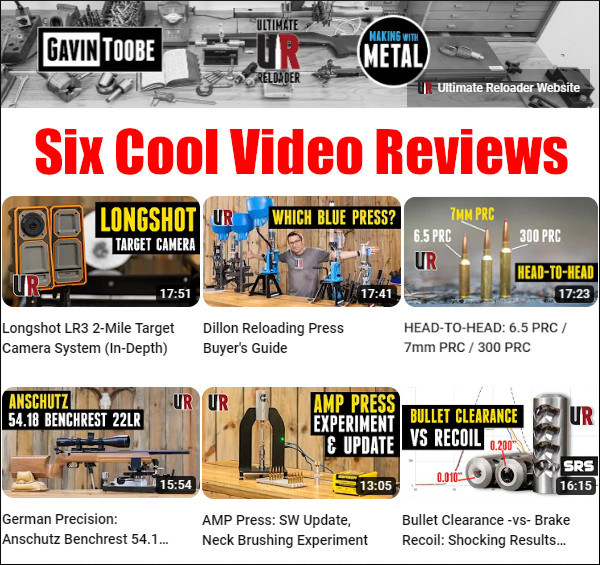
UltimateReloader.com offers some of the most thorough firearms and reloading tool tests on the internet. And UltimateReloader’s YouTube Channel has hundreds of great videos that showcase reloading tools, accurate firearms, precision optics, gunsmithing methods, and top-tier reloading components. For today’s Saturday at the Movies feature, we showcase six great videos recently created by Gavin Gear and his UltimateReloader team. These videos highlight a superb Long-Range Target Camera, the remarkable AMP Press, the new Hornady PRC cartridges, and other interesting topics. On this final day of 2022, enjoy our Saturday Video Showcase.
With the high price of centerfire powders, bullets, and brass, everyone should have an accurate .22 LR rimfire rifle for marksmanship training and competition at 25 to 200 yards. In this video, Ultimate Reloader’s Gavin Gear tests the impressive Anschutz 54.18 BR50-U7 match rifle using a quality Sinclair Int’l front rest. Anschutz offers several versions of the 54.18 and BR-50. There are two barreled actions available: 20″ threaded and 25.9″ non-threaded. Gavin tested the 20″ threaded model with the U7 stock. In this video, Gavin tested the trigger with a sophisticated TriggerScan TS-11. The trigger was superbly repeatable at a measured 3.8 ounces. Gavin also did a bore examination. He then tested the Anschutz with a variety of premium ammo. In this rifle, Lapua Midas+ producing the smallest groups. FULL STORY HERE.
This video features the impressive, high-tech AMP Bullet Seating Press. The AMP Press combines a motor driven ram, a distance sensor, and a load cell to deliver extremely accurate and precise force/distance bullet seating measurements. The AMP Press offers unrivaled consistency in the bullet seating process. And as the AMP Press is linked to a computer, seating data can be stored and you can chart variations in seating resistance. A wealth of precise data is collected during the bullet seating process. This helps you optimize your brass prep and annealing for the best, most consistent results. FULL STORY HERE.
Past 400 yards or so, it can be difficult to see bullet holes on paper, even with spotting scopes. That’s why we recommend a high-quality wireless target camera. The best long-range target cameras on the market are produced by Longshot Camera Systems. The Longshot Target Cam provides a live WiFi camera feed. This comes back to your shooting station and you can view the image with a laptop or mobile device. You don’t need internet coverage and no separate tall antennas are required. Simply place the camera unit next to your target and the receiver unit close to your rifle or bench. The Longshot system is completely self-contained. Longshot produces a variety of cameras starting at $449.00 for the LongShot Marksman. We recommend the $899.00 LR-3 unit which works out to two miles! In this video Gavin Gear of UltimateReloader tests the LR-3 at long range. PRODUCT INFO HERE.
This video examines how muzzle brakes reduce recoil. Just how important is bore clearance for a muzzle brake? Should you have an exit diameter that’s just slightly larger than bullet diameter, or will a larger diameter work well also? Along with no brake at all (bare muzzle), Ultimate Reloader tested multiple different brake bore clearances on a 6.5 Creedmoor rifle: 0.010″ over bullet diameter, 0.020″, 0.030″, 0.050″, 0.100″, and 0.200″. The testers expected to get the best recoil reduction with the tightest fit. Surprisingly, this wasn’t quite the case.
Using all brake configurations (all bore clearances) Ultimate Reloader saw a significant reduction in recoil, almost half, as compared to a bare muzzle: “What we didn’t expect was how close together the rest of the clearances would cluster. All of the clearances that we tested had good recoil reduction.” FULL STORY HERE.
Dillon Precision continues to be the leader among progressive press makers. Dillon offers the largest variety of progressives, the most accessories, and legendary customer service. In this video, Gavin Gear of Ultimate Reloader looks at a variety of Dillon machines to help buyers decide which progressive best suits their needs. Featured Dillon progressives include: Square Deal B, Xl750, and RL1100. Along with basic press feature, Gavin shows the operation of Dillon’s automated bullet feeder and case feeder accessories. The video also provides pricing summaries with various configurations. FULL STORY HERE.
Hornady’s PRC (Precision Rifle Cartridge) family of cartridges are becoming quite popular. The 6.5 PRC fits in a short action, while the 7mm PRC and 300 PRC both require a long action. The 7mm PRC is a long-action centerfire hunting cartridge designed to shoot 180gr bullets at 2950+ FPS. The 6.5 PRC is a good hunting cartridge that can fit a standard-length action. And, a number of top F-Open shooters are necking up the 6.5 PRC for 7mm bullets. This 7-6.5 PRC wildcat has shown excellent F-Class accuracy with a higher velocity node than the .284 Winchester. Along with these two cartridges, Hornady has a 300 PRC that can shoot the big .308-caliber bullets. In this video, Ultimate Reloader analyzes and compares each of the three PRC cartridge types. FULL STORY HERE.
With major forest fires this past year in Western states, many have wondered about hazards faced by gun owners in fire zones. This important video shows what really happens when loaded ammunition burns. You will probably be surprised. Contrary to Hollywood notions, the ammo doesn’t ignite in a massive explosion. Far from it… basically the rounds “cook off” one by one, and the bullets release at relatively low velocity. We’ve featured this SAAMI research project before, but it is worth reprising for those who have not yet seen the burn tests.
A few years back, SAAMI released an important video concerning ammo and fire. With professional fire-fighters standing by, over 400,000 rounds of ammo were incinerated in a series of eye-opening tests. If you haven’t had the chance to view this video yet, you should take the time to watch it now
The Sporting Arms and Ammunition Manufacturers’ Institute (SAAMI) has produced an amazing 25-minute video that shows what actually happens to sporting ammunition involved in a fire. This video shows the results of serious tests conducted with the assistance of professional fire crews. We strongly recommend you watch this video, all the way through. It dispels many myths, while demonstrating what really happens when ammunition is burned, dropped, or crushed.
Watch SAAMI Ammunition Testing Video
Video Timeline
2:10 Impact Test (ignited outside firearm)
3:40 65-foot Drop Test
5:08 Bullet Impact (.308 Win firing)
7:55 Blasting Cap Attacks
9:55 Bulldozer and Forklift Tests
12:20 Boxed Ammo Bonfire
15:37 Bonfire without Packaging
17:21 Retail Store Simulation Burn
20:55 Truck Trailer Burn
Over 400,000 rounds of ammunition were used in the tests. Some of the footage is quite remarkable. Testers built a bonfire with 28,000 rounds of boxed ammo soaked in diesel fuel. Then the testers loaded five pallets of ammo (250,000 rounds) in the back of a semi-truck, and torched it all using wood and paper fire-starting materials doused with diesel fuel.
The video shows that, when ammo boxes are set on fire, and ammunition does discharge, the bullet normally exits at low speed and low pressure. SAAMI states: “Smokeless powders must be confined to propel a projectile at high velocity. When not in a firearm, projectile velocities are extremely low.” At distances of 10 meters, bullets launched from “cooked-off” ammo would not penetrate the normal “turn-out gear” worn by fire-fighters.
We are not suggesting you disregard the risks of ammo “cooking off” in a fire, but you will learn the realities of the situation by watching the video. There are some amazing demonstrations — including a simulated retail store fire with 115,000 rounds of ammo in boxes. As cartridges cook off, it sounds like a battery of machine-guns, but projectiles did not penetrate the “store” walls, or even two layers of sheet-rock. The fire crew puts out the “store fire” easily in under 20 seconds, just using water.
Additional Testing: Drop Test, Projectile Test, Crush Test, Blasting Cap Test
Drop Test
The video also offers interesting ammo-handling tests. Boxes of ammo were dropped from a height of 65 feet. Only a tiny fraction of the cartridges discharged, and there was no chain-fire. SAAMI concludes: “When dropped from extreme heights (65 feet), sporting ammunition is unlikely to ignite. If a cartridge ignites, it does not propagate.”
Rifle Fire Test
SAAMI’s testers even tried to blow up boxes of ammunition with rifle fire. Boxes of loaded ammo were shot with .308 Win rounds from 65 yards. The video includes fascinating slow-motion footage showing rounds penetrating boxes of rifle cartridges, pistol ammo, and shotgun shells. Individual cartridges that were penetrated were destroyed, but adjacent cartridges suffered little damage, other than some powder leakage. SAAMI observed: “Most of the ammunition did not ignite. When a cartridge did ignite, there was no chain reaction.”
Bulldozer Crush Test
The test team also did an amazing “crush-test” using a Bulldozer. First boxes of loaded ammo, then loose piles of ammo, were crushed under the treads of a Bulldozer. A handful of rounds fired off, but again there was no chain-fire, and no large explosion. SAAMI observed: “Even in the most extreme conditions of compression and friction, sporting ammunition is unlikely to ignite. [If it does ignite when crushed] it does not propagate.”
Blasting Cap Test
Perhaps most amazingly, the testers were not able to get ammunition to chain-fire (detonate all at once), even when using blasting caps affixed directly to live primers. In the SAAMI test, a blasting cap was placed on the primer of a round housed in a large box of ammo. One cartridge ignited but the rest of the boxed ammo was relatively undamaged and there was no propagation.
The Pew Pew Tactical website has interesting article on rifle and pistol cartridges and bullet types. This contains a large selection of interesting photographs and illustrations. If you load and/or shoot for a wide variety of cartridge types, you’ll find that article well worth reading. It has nearly 50 photographs and more than a dozen short videos. READ FULL Article.
The article also shows all types of pistol bullets, along with a variety of rifle projectiles. It even illustrates multiple types of shotshell cartridges.
The article also explains the basic components of modern cartridges — bullet, case, powder, and primer:
Photo courtesy Ammunitiontogo.com which sells ammo from many leading brands.
Popular Cartridge Types Profiled
The article provides quick summaries of popular ammunition types including 9mm Luger (9x19mm), .357 Magnum, .40 SW, .45 ACP, .223 Rem, and .308 Winchester. The author’s favorite pistol round is the 9mm Luger: “9mm is my personal favorite and if there was a “Goldilocks” round, this would be it. The very first gun I bought was a 9mm. They’re fun at the range. They’re good for defense. It is the standard round for NATO countries and the majority of police forces around the world. It is mild shooting, can vary in weight from 115 to 147 grains, and has varying stopping power based on the type of bullet.”
This Pew-Pew Tactical guide to cartridge types also provides a quick explanation of cartridge ignition — both centerfire and rimfire: “The rimfire’s primer is built into the rim while the centerfire cartridge has the primer in the center. Pro tip — if you can see a circle in the middle…it’s a centerfire cartridge.”
There are two common types of centerfire primers — Boxer and Berdan. This helpful Wikipedia illustration shows how Boxer, Berdan, and rimfire primers ignite the powder in the cartridge:
This centerfire and rimfire ignition animation is by BBODO – Own work, CC BY-SA 3.0 licensed under the Creative Commons Attribution-Share Alike 3.0 license.


 BoreSmith’s Triangle Patch™ (aka Pyramid Patch) presents more cleaning surface area to the bore wall than does a conventional square or round patch (of equivalent size). At the same time, the unique geometry makes Triangle Patches much less likely to jam in the barrel. This is because the notches in the sides of the triangle allow the patch to sit more uniformly on the jag (without bunching up). Also the Pyramid patch is much less likely to jam due to pleating. One reason conventional patches get stuck is unwanted 5-layer pleating. The special notches in the Pyramid patch remove all or most 5-layer pleating. As a result the patch does not bunch up and this also reduces rod bowing.









 These days, online gun Auctions and Classifieds attract more attention than ever. With so many folks accessing the internet daily, many gun owners find it easier to sell their firearms online rather than in the local gun store. Online selling opens up a much larger audience. With 80,800+ members in the
 For benchrest, F-Class, Silhouette, Tactical or High Power rifles, you may get the best results posting a For Sale ad on a Forum that caters to the right discipline. You want your ad to reach the right audience. On the other hand, a GunBroker.com auction will have tens of thousands of potential buyers. Realistically, however, if you price your rig attractively, it should sell quickly in a Forum Classified Advert. Plus with conventional Classifieds, you can sell immediately — you don’t have to wait for the auction to end. For scopes and reloading equipment (but not firearms, actions, barrels etc.), also consider eBay, which still allows many gun-related items.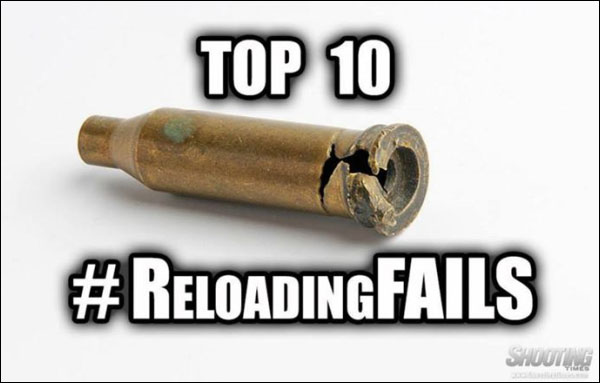


 The Sporting Arms and Ammunition Manufacturers’ Institute (
 We are not suggesting you disregard the risks of ammo “cooking off” in a fire, but you will learn the realities of the situation by watching the video. There are some amazing demonstrations — including a simulated retail store fire with 115,000 rounds of ammo in boxes. As cartridges cook off, it sounds like a battery of machine-guns, but projectiles did not penetrate the “store” walls, or even two layers of sheet-rock. The fire crew puts out the “store fire” easily in under 20 seconds, just using water.


 Popular Cartridge Types Profiled


