With the Whidden Click-Adjustable Sizer Dies, you can change shoulder bump by .001″ (one-thousandth) with a simple click. Fast. Easy. Precise.
As handloaders have become more aware of shoulder bump and proper adjustment of the sizer die in recent years, there has become a need for an easier way to adjust the sizer die properly. For most folks, with their conventional dies, it takes lengthy trial trial and error to get the shoulder setback correct. Anyone who has done this can attest that it can be a slow and annoying job.
Whidden Gunworks has solved the problem with the innovative Click Adjustable Sizer Die. Patent No: 10,393,488. This die and lock ring work together to give the user a clicking feel to the adjustment just like a high end rifle scope. Each click moves the shoulder bump exactly .001″ so you can easily find the exact shoulder bump that you desire.
The Click Adjustable option is available on Whidden Custom Sizer dies as well (7/8”-14 format dies only)! Included with the Click Adjustable Sizer Die is a Shoulder Bump Gauge. This gauge attaches to standard calipers and allows measurement from the case shoulder to the base. Using the Shoulder Bump Gauge with the Click Adjustable Sizer Die will make the proper sizer die setup easier than ever before.
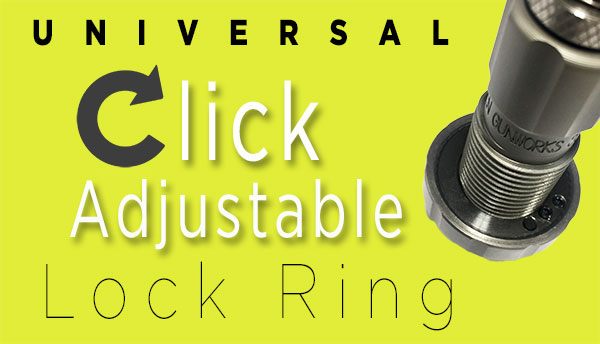
Click-adjustable die sets are available with both bushing and non-bushing configurations. Along with these complete die sets, Whidden Gunworks offers a separate click-adjustable ring to use with existing dies. Priced at $54.95, the Whidden Click-Adjust Lock Ring represents a modest investment for a major gain in die ease-of-use and precision adjustability.
The Whidden Universal Click Adjustable Lock Ring you can instantly turn your sizer die into a Click Adjustable Die. This ring works with any 7/8 OD sizer of any brand with adjustable shoulder bump. Simple in design, the inner and outer ring can rotate independently of each other. Each click is metered in true 1 thousandths adjustment and has 0.100″ total available travel. These work great with nearly all sizing 7/8 OD sizing dies, and one verified purchaser noted: “Not only are they useful on reloading dies, but it’s the cat’s meow on the Giraud Power Trimmer Case Holders.”
Dillon Users Take Note: The Whidden Click Adjustable Sizing Die will not work with the Dillon 550 or 650 progressive reloading press systems. The Universal Click Adjustable Lock Ring is not compatible with the Dillon floating toolhead.
The online video format is a superior method of presenting information on reloading techniques, rifle maintenance, marksmanship skills, scope operation and much more. But with millions of videos on YouTube, it can be hard to cherry-pick the best videos for serious shooters and competitors. That’s why we offer this Saturday at the Movies Series. Each week we will select a variety of very informative videos by knowledgeable shooters and handloaders. Here are our first five Saturday Select videos for 2022.
Reading the Wind — How to Determine Wind Speed
Keith Glasscock is a top-tier F-Class shooter who has finished second at the F-Class Nationals multiple times. Keith is also a highly-respected wind coach with a background in commercial aviation — so he really understands wind and weather. In this video Keith explains the best techniques for reading the speed of the wind. He notes that you can’t simply rely on the Kestrel in your hand because the wind speed can vary significantly between the firing line and the targets. Keith shows how to look at multiple signs (including flags, grass movement, and mirage) to better understand wind velocity. See more of Keith’s videos on his Winning in the Wind YouTube channel.
Rodzilla T-Rex Front Rest Review — State-of-the-Art Beast
In this video our friend F-Class John reviews the impressive T-Rex front rest from Rodzilla.This recently-introduced joystick front rest from Rodzilla really represents significant innovation. The new T-Rex offers impressive capabilities based on the innovative design by creator Rod Brackage (the “Rod” in Rodzilla”> that can truly take your shooting experience to the next level. F-Class John used this rest in F-Open competition and really likes it. CLICK HERE for John’s full review with three videos and many more photos.
How BAT Actions Are Made and BAT Factory Tour
Note: This has loud music as the start — lower volume if at work.
Ultimate Reloader’s Gavin Gear is a skilled and respected video producer. This Ultimate Reloader video shows how top-end BAT rifle actions are crafted with modern CNC machinery. This is one of Gavin’s most popular videos, with 763,000+ views. If you are interested in accurate rifles for benchrest, F-Class, Long Range, or PRS/NRL you should definitely watch this video. Visit Gavin’s YouTube Channel to see dozens of other informative, well-made videos.
Protect Your Dog’s Hearing with Mutt Muffs
Do you take your dog(s) hunting, or to the shooting range? Well dogs need hearing protection too! Loud gunshots from pistols, rifles, or shotguns can cause permanent hearing damage to your canine. Prevent canine hearing loss with Mutt Muffs — protective earmuffs designed especially for dogs. In the Precision Riflecraft video, the host shows how to fit Mutt Muffs to your dogs and help your canines tolerate the muffs in place. Available in five sizes (XS, S, M, L, XL), these cost under $60 on Amazon.
How to Use Ballistics Solvers — Bryan Litz Lesson
A past national F-TR champion, Bryan Litz is a brilliant engineer and trained rocket scientist. He is also the founder of Applied Ballistics LLC (AB), the world’s leading source of ballistics software. AB software now comes integrated into some Kestrel handheld wind-reading units, with accompanying Applied Ballistics Apps that run on your mobile devices. In this short video Bryan explains how to use ballistics solvers to determine your bullet’s drop and drift at long range. If you don’t have the AB App on your smartphone you can also use the excellent JBM Ballistics Solver, available FREE on the internet.
Field Test and Hunt Review by Colton Reid
Dawn breaks. It’s a brisk 28 degrees. I sit concealed amongst a grove of fallen trees near the edge of a steep decline where I can see the canyon below and opposing hillsides. Snow blankets the mountainous slopes with patches of fir and naked aspen woven into the landscape. The soft glow of sunrise brightens southeastern slopes and illuminates a solitary statue of orange and green on an adjacent ridge. His presence alerts an already wary elk of the danger that moved in the night before.
It is second rifle season in Colorado and I have a cow elk tag in hand. I would love to say this is not my first rodeo, but in many ways it is. I’m on my first hunt in pursuit of an elk and my first hunt in Colorado. It is, however, the second test of my newest piece of hunting equipment — Leica’s latest, state-of-the-art Geovid 3200.COM 10×42 rangefinding binoculars.
Early morning light in Colorado, on a hunt for elk…
These laser rangefinder binoculars I purchased for myself from the good people at EuroOptic.com. I should note that I am not sponsored by EuroOptic or Leica. I happen to know a few people at EuroOptic and they are a knowledgeable friendly group who use the gear they sell.
When I evaluate optics I have a clear priority in how I rank them. At the top of the list is optical quality. That is, how clear is the optical image? How crisp are the edges? Can I resolve and distinguish similar small items? Anyone who has been hunting in the great American West knows that most of your time is spent behind optics of some sort, so it is best to buy optics that make it easier to spot your target and are easy on your eyes.
Second on the list is a combination of weight and durability. I tend to hunt rugged backcountry terrain, so weight is a big consideration for my trips. But if something is feather light but breaks when you sneeze? That isn’t good either. So a combination of a robust rubberized body with modest additional weight is desired. And since the Geovid 3200.COM is a combination optic, i.e. it includes a laser rangefinder, then that helps with weight since I don’t need a separate LRF.
Third on this list is the rangefinder’s performance. By performance I mean mostly accuracy and precision of the measurement. I can live with a max of 500 yards, as long as the measurement is correct and repeatable to within a handful of yards. If, however, the measurement is off by 10% (50 yards in the case of a 500-yard reading) or measurement to measurement varies by say 20 yards, then that will dramatically affect my ability to make an ethical shot.
The Geovid’s laser ranging beam showed excellent precision. Here it picks up a single male pronghorn (not broadside) at nearly 400 yards. The return was immediate.
Other considerations such as ergonomics or comfort are less important to me because they start to move away from “functional” requirements. That is, they don’t make a big difference when it comes to spotting and harvesting an animal. So while I do think about “nice to have” features when selecting equipment, they are of lower consideration than the functional requirements.
With my framework for evaluation laid out then, here is my assessment. The Leica Geovid 3200.COM 10x42s are high-quality rangefinding binoculars — well made, with good materials, and a thoughtful design. They weigh a mere 34.6 ounces (about 2 lbs.) and are built to withstand more than a few falls. They also come with both objective and ocular lens caps. Even though they are built tough, I would not take these into the field without some sort of binocular case. I personally use a Badlands Bino case (see top and bottom photos) but there are plenty of other good options.
This 6-minute Leica factory video shows the technical features and operations of the Geovid 3200.COM series of rangefinding binoculars. Worth watching:
The glass is amazing — remarkably good (and I have high standards). The image is extremely crisp, noticeably better than my tried and true pair of Swarovski Habicht 10×40 Porro prism binoculars. This matters because the exaggerated hand motion observed in higher power optics, aka “shake”, initially made me dizzy. Leica does offer a lower power unit, the Geovid 3200.com 8×42, for those who prefer less magnification. One could argue that the optics being too sharp means they aren’t a good fit, however, my philosophy is to get the best gear possible and figure out how to use it to the max potential. My solution here was an ultralight tripod to stabilize the image when glassing or if weight is a factor I place my arms on my knees while leaning against a tree or rock. Scouting with these binoculars over long periods on a stable platform is a pleasant experience. Shown belong is the Geovid mounted on my tripod.
The Geovids present a bright, crisp image, with excellent distance distinction (pop out effect) — all characteristics of high quality optics. The image at the edge of the field of view is less sharp, but that is typical, even for scientific glass. Because the binocular image quality is so good, the image quality change when I go to my spotting scope is a much shorter jump than with previous binoculars. That means I can resolve more items with the binoculars and therefore only go to my Swarovski spotting scope when I really want to clarify something. Overall A+ optics.
Over 950 yards — yes that is what we were looking for…
The rangefinder is top shelf. One innovation I like about these rangefinding binoculars is that Leica put the laser source outside of the optic tube. That means the source is unimpeded by additional optics allowing for more power transmission and reflection. They also implemented the patented Perger prism which incorporates the rangefinder into the base optical design as opposed to using extra optics to “modify” a non-laser rangefinder configuration. As an engineer I love the idea of function integration and minimizing components. It usually makes for a more efficient and superior performing design.
One other impressive feature is the ability to link to a rangefinder program. The Leica website explains: “Thanks to Bluetooth® connection, [the Geovid 3200.com] can be paired to either the Leica Hunting App to adjust and manage quickly and easily on the fly, or to a LINK-enabled Kestrel windmeter to get results from the Kestrel right in your Range Finder[.] In addition, users will benefit from various integrated atmospheric sensors, such as temperature, air pressure and inclination sensors, producing angle-compensated distance measering for shooting uphill or downhill with maximum precision.”
Testing Laser Ranging Performance
To test the Geovid’s laser rangefinder I did my usual measurement of different objects near my house and checked the accuracy with Google earth. I was able to consistently range larger objects (trees, hills, rocks) out to about 2200 yards, which is longer than I would ever shoot, but good when planning where to move for my next vantage point. I was also able to range a large reflective target (pedestrian overpass) out to a staggering 3300+ yards (see below).
In this video, the Geovid ranges a concrete pedestrian overpass at distance of 3334 yards.
I suspect the max range I can consistently get with large, non-reflective objects is somewhere around 2400 yards, but didn’t have the opportunity to test that specific distance. The rangefinder had some trouble at shorter distances and through thick branches. Around 25 to 45 yards I would get several yards variation when ranging tree trunks. Tall grass and a nest of tree branches would also interfere with the measurement. I would either get a slightly incorrect reading or no reading at all. This might come up if I am trying to range a buck bedded in tall grass. That is a drawback for me because that is a typical situation in archery. My workaround was to range nearby objects and estimate the handful of yards separation between the ranged item and target.
Summary: Geovid 3200.COM Rangefinding Binoculars Are Excellent
In summary, the Leica Geovid 3200.COM rangefinder binoculars are excellent in all key respects. The glass is top-notch and the rangefinding performance is very impressive. The modern Bluetooth connectivity is a plus. These Leica Geovids offer a slightly better price point than their equivalent competitors and are the optics I bought with my own money. I doubt you will be disappointed.
New for 2022 — Leica Geovid Pro 32 RangeFinding Binoculars
Smaller, Lighter, with Applied Ballistics and GPS Mapping Integration
Trading on the success of the Geovid 3200.COM series, on 1/6/2022, Leica announced a new smaller, lighter version, with enhanced software — the Leica Geovid Pro 32. Weight 30.6 ounces, this is about 4 oz. lighter than the original, and 0.83 inches shorter. With notably smaller objective lenses (32mm for the Pro 32 vs. 42mm with the Geovid 3200.com) these new Geovid Pro 32s should be easier to hold for extended periods, but they may give up a bit of low light capability compared to their bigger brothers.
The other big news is enhanced software in the Pro 32: “Leica Geovid Pro was built ground up to combine the on-board atmospheric sensors with NEW on-board Applied Ballistics[.] The Geovid Pro comes standard with Applied Ballistics Ultralight … upgradable to Applied Ballistics Sportsman or Elite. The Geovid Pro 32 now also offers advanced GPS tracking connectivity, Leica ProTrack, to guide the user to the target based on the last ranged measurement. The Geovid Pro 32 is the first premium rangefinder to feature GPS mapping integration through BaseMaps, Google Maps and Garmin mapping.”
Savage Arms has won a second major award for its innovative Savage Impulse straight-pull hunting rifle. This is the only straight-pull centerfire rifle currently produced by a major U.S. manufacturer. The rifle has won the coveted NRA American Hunter 2022 Golden Bullseye Award as Rifle of the Year. Previously, Guns & Ammo magazine editors named Savage’s Impulse the 2021 Rifle of the Year.
“The new Savage Impulse is more than just a good first attempt at an American-made straight-pull,” wrote American Hunter magazine’s Associate Editor David Herman. “It is a rifle that can take long-range precision shots with ease, yet is in its element stacking lead in rapid fashion. It would make an excellent addition to any serious hunter’s arsenal.”
Beth Shimanski, Savage’s Marketing Director, says the design is a game-changer for hunters: “The speed of Impulse’s straight-pull action has changed the way Americans think about hunting rifles. This design combines everything Savage has learned about accuracy and reliability with innovation that provides marksmen and women with new capabilities with new capabilities.”
Savage’s Impulse series of straight-pull bolt rifles is the first American-designed and crafted straight-pull centerfire rifle. The new Impulse features an innovative Hexlock bolt-locking mechanism with six spherical bearings that move radially outward into a ring in the barrel extension, thereby locking the bolt in place. That barrel extension is held in the receiver assembly by four cross-bolts on the lower front section. Ahead of the barrel extension is a conventional recoil lug and a familiar Savage barrel nut.
Savage Impulse Straight-Pull Rifle — Overview
Savage claims the new system offers the cycling speed of a semi-auto, with the accuracy of a bolt-action. However, based on the videos that Savage has posted, the cycling of the Impulse’s straight-pull bolt does not seem to be as smooth as some European straight-pulls, such as the Blaser R8, Merkel RX Helix, and Strasser RS 14. We’ve tried those Austrian/German rifles and you really can cycle them very smoothly. From the video the Savage Impulse appears to require somewhat more muscle and effort. Watch below. The video will launch at the 15-second mark for a comparison between the Impulse and a conventional Savage bolt-action:
Savage Speed Comparison — Impulse vs. Regular Bolt Action
Savage says: “Conventional bolt-actions require four steps to cycle the bolt. Impulse simplifies the process with a simple back-and-forth motion.”
Advantages of Straight-Pull Cycling System
What is the advantage of a straight-pull system? You should be able to cycle faster, and (ideally) maintain your cheek-weld and target view. Savage says: “The smooth bolt throw allows a shooter to cycle rounds intuitively, without the need for the standard four changes-of-direction common to a conventional bolt’s path-of-travel. Impulse reduces split times and allows a shooter to manipulate the bolt without losing [his] cheek weld. The bolt travels out and back and shooters don’t have to take their eyes off the target.” Sounds good, but if you watch the above videos, it’s not as wonderful as claimed. That said, if one slows down a bit, a straight pull should allow the shooter to maintain his cheek weld.
When the bolt is closed, the Hexlock system holds it in place instead of conventional lugs. With the Hexlock, six (6) hardened steel bearings lock the bolt in place inside the receiver’s barrel extension. Savage says “As pressure increases, Hexlock’s hold tightens, ensuring that there can be no rearward movement of the bolt. Once the round has left the barrel, the pressure subsides, and the action can safely open again with the straight pull of the bolt handle.”
Savage Impulse — Hexlock System (Bolt Locks in Barrel Extension)
The cleverly-designed, modular Impulse bolt can be disassembled without tools. And the bolt-handle can be moved to either side easily. Impulse barrels are connected via barrel extension which is held in the action/receiver by a lower-side four-bolt barrel clamp.
Now here is an example of truly impressive marksmanship skills and amazing aiming from a USAMU soldier. From a standing position, SPC Ivan Roe shoots a tiny aspirin pill off the top of a balloon — without breaking the balloon. In fact, he does this twice … with iron sights no less.
Watch Video to See Aspirin Pill Shot Twice off Balloon:
The first time the pill sits on a small piece of tape just millimeters above the upper edge of the balloon (Time mark 00:40-45). But the second time, the aspirin pill lies flat on the top on the balloon — an even tougher challenge. Watch Ivan nail that flat pill again without hitting the balloon at 00:59. No that is truly impressive — and remember it was done from standing with Iron sights!
SPC Ivan Roe was using a German Feinwerkbau, an elite precision air rifle favored by Olympic and World Cup competitors. Originally from Montana, SPC Roe is a member of the USAMU International Rifle Team.
Did you like this demonstration of Trick-Shot marksmanship? Then visit the USAMU’s Facebook Page. The USAMU often releases shooting skills/marksmanship videos on Facebook and YouTube, with the Trickshot examples featured on Tuesday. CLICK HERE for another USAMU trick-shot video — hitting a poker chip on a fast-moving target frame with a pistol. Very impressive.
Do you enjoy watching gun videos on YouTube or reading gun Blogs? Then here’s your chance to vote for your favorite video hosts, firearms instructors, and celebrity shooters. The 2022 Gundies Awards program is taking votes now. Modeled after the Oscars/Emmys, the Gundies Awards focus on the world of guns, shooting, and hunting. The annual community-voted Gundies awards spotlight notable firearms-centric content creators — shooters who do videos, gun reviews, and Second Amendment commentaries.
Vote and Get a Chance to Win Prizes
Voting is now open for the 3rd Annual Gundies Voter Choice Awards. You can cast your votes online through 1/32/2022. Voters can vote each day throughout the month of January to earn entries towards prizes valued upwards of $2,000. The final Gundies Awards “ceremony” will be streamed live on February 19th at 9:30 EST at TheGundies.com.
Voting gives you a chance to win category prizes, plus ALL voters are also automatically entered towards the GRAND PRIZE, a trip to attend the Gundie Awards & Range Day.
2022 Gundies Award Categories
This year features five new categories: Top Voices of the Second Amendment, Firearm Instructor of the Year, Best Guns of Hollywood, Most Dapper Influencer and Pro Gun Celebrity.
Here are four leading candidates in the Gundies Best Shooter Category. There are 47 shooters vying for this honor overall. CLICK HERE to cast your vote for “Best Shooter”.
Sponsors of the 2022 Gundie Awards include: Brownells, Gallowtech, Henry Repeating Arms, Savior Equipment, Walker’s Ear Pro, Retro Rifle, Heckler & Koch, X Products, CMMG, Eotech Optics, Timney Triggers, Crossbreed Holsters, True Shot Gun Club, Primary Arms Optics, and Midwest Gun Works. These companies will provide prizes.
How the Nomination and Selection Process Works
The Gundies leave the decision to the public to choose the official nominees in each category. Fan voting opens on January 1st, 2022. The top five contestants in each category with the most fan nominations will automatically be chosen as one of the category nominees.
The previous Gundie Awards saw over 140,000 voters, over 1 million votes and over 20,000 viewers of the Award Ceremony. For more information go to TheGundies.com.
Mixed Bag of Nominees — Some Good, Some Laughable
Best Shooter candidate Kirsten Joy Weiss was a top-level NCAA 3-position rifle competitor in college. She is VERY skilled with firearms and just happens to be very attractive as well. However, to be honest, some of the female “influencers” are just narcissistic social media queens who trade on their looks. They get dolled up in revealing outfits and lots of make-up for posed shots with guns. And on the male side there are plenty of tattooed tactical poseurs with almost no technical knowledge. But there ARE some solid nominees, especially in the Best Shooter and Best Gun Reviewer categories.
Today’s feature story showcases an impressive 6.5×47 Lapua benchrest rifle crafted by Gavin Gear of UltimateReloader.com. A gifted writer, video producer, and gear reviewer, Gavin has also acquired some serious gunsmithing skills over the past few years.
For this project, the multi-talented Mr. Gear did ALL the work himself — barrel chambering, muzzle crowning, stock inletting, action bedding, and yes even the stock painting. That brilliant red design with white and black stripes is an “homage” to the famous “Frankenstrat” guitar played by Rock N’ Roll legend Eddie Van Halen (EVH). That red/white/black guitar was the inspiration for this tribute rifle.
Gavin explained: “I decided to build a benchrest rifle as a tribute to Eddie Van Halen as I’ve been inspired by his guitar playing, his energy, and himself as a person. This is my first benchrest rifle build. And when I set out to build this rifle I was looking around at what other people were doing in the benchrest community in terms of stock graphics, and I decided I needed to do something ‘loud and crazy’ and when I thought about that, the first thing that came to mind was Eddie Van Halen’s iconic Frankenstrat guitar.”
Here it is! My first all-out benchrest build! This rifle will serve as a test bed for the evaluation of different cartridges and components. In this multi-part series, I’ll walk through the … process of building this rifle including the barrel work, stock inletting, stock bedding, and some paint work that will be “a little different”. — Gavin Gear
Rifle Components — BAT Action, Krieger Barrel, Wheeler Stock, Sightron Scope Bat Model B Action, .308 Win Bolt Face (modular), octagonal profile, integral recoil lug
Bix’n Andy Remington 700 Competition Trigger (from Bullet Central)
Wheeler Engineering LRB Stock with 4″ fore-end and steerable buttstock rudder
Sightron SV 10-50x60mm ED SFP Scope (FCH Target Dot Reticle) in 34mm BAT Rings
Painting the Eddie Van Halen Tribute Rifle
Gavin told us: “I’ve long been inspired and impressed by Eddie Van Halen (EVH). He changed the game for guitar in the late 1970s, and the world took notice! I’ve been a Van Halen fan for a long time, and that’s where the inspiration for my latest rifle build came from. Benchrest rifles are known for their loud and vivid paint jobs, and that made me think: ‘I need to do an EVH Frankenstrat paint job!’. In this video I share my experiences putting together this automotive-style rifle paint job.”
Gavin painted the stock himself with red/black/white graphics inspired by the rock legend’s famous guitar. Gavin actually has some serious painting skills learned decades ago. When Gavin was 16 he was “hell-bent on learning auto body prep and paint work”. He managed to score a job with a local shop, and did his first complete professional paint job (on a Toyota Supra) when he was just 17 years old.
The EVH tribute stock was painted in multiple stages, with masking to create the stripes after the bright red was applied. For the finishing touch, the entire stock was sprayed with Omni clearcoat: “This [clear-coating] is when things really start to look good because you’re covering up all those masked transitions between the striping and the backgrounds.” Gavin says the key to clear-coating is “seeing the reflection of the light on the surface. This gives you visual feedback”. Watch the video above to see the entire painting process. CLICK HERE for Gavin’s full write-up on the stock painting job with many photos.
Barrel Break-In and Load Testing
The rifle showed great accuracy right from the get-go. In fact, the very first three shots through the barrel formed a 0.298″ group at 100 (see video at 05:35)! Then the gun produced a series of good three-shot groups (high 2s and low 3s), demonstrating the quality of the Krieger barrel and Gavin’s chambering work. CLICK HERE for testing target showing multiple groups.
Gavin selected top components for his loads: Lapua 6.5×47 brass, Berger 140gr Hybrid 6.5mm bullets, and Hodgdon Varget powder (unobtanium these days). To find promising starting loads, Gavin went straight to the best 6.5×47 Lapua resource on the web — AccurateShooter.com’s 6.5×47 Cartridge Guide. Researched by the 6.5 Guys (Ed and Steve), our Cartridge Guide includes recommended accuracy loads for a wide variety of bullets and powders.
Stock Work and Bedding
In this Part 2 video, Gavin reveals the extensive work he did to prepare the stock for the barreled action. This video shows multiple operations: barrel channel and receiver inletting; machining of custom pillars; stock bedding, and trigger guard installation. Yes, Gavin did all the final inletting using his own machines, and he even created his own precision pillars. Watch the above video to see the entire inletting job followed by the action bedding process. Gavin’s skills are impressive.
This Alex Wheeler LRB stock has some very innovative features, such as the adjustable “rudder” (or keel) on the bottomside of the buttstock. This helps ensure great tracking. Alex has noted: “This stock tracks exceptionally well due to the adjustable rudder system and 4″-wide fore-end. Aluminum rails in the front prevent rocking on the front bag as well as form small trenches to aid tracking. The adjustable rudder in the rear allows you to fine tune the bag riding surfaces until exactly parallel. The 4″-wide fore-end is legal in Benchrest and helps control torqueing in the bag.”
Chambering the Barrel for 6.5×47 Lapua
Gavin did ALL the gunsmithing for the project, including chambering the Krieger barrel, and headspacing it for the BAT M Action. Gavin also crowned the muzzle. He did this all on his own advanced Precision Matthews PM-1440GT Lathe using Triebel Guntools 6.5x47mm body/neck finisher reamer, 6.5x47mm throater reamer, and Go and No-Go gages.
Clearly, this is not your average DIY project — Gavin performed ALL the most critical and demanding gunsmithing tasks. He trained himself to do these tasks working with ace gunsmith Gordy Gritters. You can see all the chambering and barrel-fitting functions in this revealing video:
Muzzle Work — Cutting Threads and Target Crown
This photo shows the finishing of the barrel’s muzzle end. Gavin notes: “For the muzzle end, I again used the True Bore Alignment System. Above you can see the SSG Range Rod I used which features two tight-fitting bushings that ride on the barrel lands. This makes for quick barrel dial-in! I then cut an 11-degree target crown, as recommended by Gordy Gritters.”
The next step with this EVH Tribute rifle will be fitting the barrel for an Erik Cortina (EC) tuner, and proceeding with further load tuning. But that will have to wait for spring, when the snow has melted….
As a 2022 New Year’s bonus for our Bulletin readers we decided to showcase 10 of our favorite gun tech, reloading, and shooting technique videos for our readers. These videos were created by top YouTube content providers: F-Class John, Gavin Gear, Keith Glasscock, Erik Cortina, Thomas Haugland, and Pieter Malan. Consider this like an all-star gun channel collection. These videos will help you load more accurate ammo, improve your “mental game”, and shoot better in matches. Enjoy!
Do you use an AR15 for service rifle, 3-Gun, or tactical competitions? Then you should consider dry-fire training. Many top competitors spend an hour (or more) dry-firing for every minute they shoot live cartridges in competition. The allows effective training without spending a fortune on live ammunition (which can run $1.00 per round or more).
There is a handy new system that resets the trigger on AR-platform rifles — the Mantis Blackbeard (see videos below). This permits you to make multiple successive shots without having to alter your grip and manually recycle the charging handle. This two-part system employs a replacement bolt carrier/bolt and replacement magazine. With these two components installed, your AR can automatically reset the trigger instantly after you pull the trigger. It works, it’s effective, and it’s affordable at $219.00 MSRP.
The Blackbeard system is used by the U.S. Marine Corps and U.S. Army (including Special Forces), so you know it works. During training the Mantis Blackbeard allows unlimited, repetitive Dry Firing without resetting the charging handle. That eliminates a tedious task that requires altering your hold on the rifle.
No Gun Modifications
Same Trigger Weight, Break, and Reset
Installs in under a minute
Up to 10 shots per second
Up to 100,000 Shots per Charge
Save on Ammunition Costs
In the video below Top Shot Champion Dustin Ellermann shows how to use the Mantis Blackbeard. He vividly demonstrates the clear advantage of the Blackbeard compared to manually pulling the charging handle over and over (See 00:02 – 00:20 time).
Dustin Ellermann Review of Mantis Blackbeard Trigger Reset System
This next video, from the manufacturer Mantis, shows how to install the Mantis Blackbeard, how to set the zero, and how to operate the unit with your AR-platform rifle.
The easy-to-install-Mantis Blackbeard replaces your bolt carrier and magazine in less than a minute, allowing easy training transitions. The magazine battery pack is good for 100,000 shots per charge and the Blackbeard is rated to reset as quickly as 10 shots per second, allowing rapid fire training for 3-Gun and tactical competitions.
Americans love AR-platform rifles. However, they can be maintenance-intensive, as hot gasses are directed right back into the action to operate the bolt. Because ARs have a somewhat unique (and dirty) semi-auto operating system, we think all AR owners should learn how their rifles operate — from the inside out. This feature provides an “inside look” at the AR, with X-Ray and Cutaway views created through advanced 3D computer modeling.
AR15 Functions Revealed with 3D Computer Animation
Ever wondered how the parts inside an AR15 work together? Just exactly how does the reciprocating bolt carrier feed rounds from the magazine? How do the elements in the trigger group work and reset after each shot? How does the gas system bleed gas from the barrel and operate the bolt carrier? These and other questions are answered in this eye-opening video from 45Snipers. Using “cutaway” 3D computer animation, this 5-minute video shows all features of an AR15 inside and out. This fascinating firearms animation allows the viewer to look inside the upper and lower receivers, into the bolt carrier, chamber, barrel, and magazine.
This video starts off slow and has annoying background music, but it is well worth watching if you own or shoot any AR-platform rifle. It illustrates all the key operations during the charging, loading, firing, and ejection processes. The cutaway animation shows how rounds are stripped from the magazine and then chambered. It then shows how every part of the trigger group works, and how the firing pin strikes the primer. You can even watch the bullet move down the barrel before the empty shell casing is removed from the chamber and tossed out the ejection port. Here are sample frames from the video:
How AR-Platform Rifles Work — General Introduction
To help reader understand the general operation of AR-type rifles, this video shows the control functions of an AR and how the upper and lower sections work together.
Cutaway 3D Animation of AR15/M16 Action — Watch Video
Here is an excellent “cutaway” animation by Thomas Schwenke that shows how an AR-15 functions — how the entire loading cycle works from start to finish.
AR platform rifles are semi-automatics version of the M16. These feature distinctive upper and lower receivers which can be readily separated via front and rear pins. The upper includes the barrel, handguard, forward gas tube, and bolt assembly, while the lower contains grip, trigger group, fire selector, and mag well. In addition the lower is attached to the stock which encloses the buffer assembly.
The original ArmaLite AR-15 was a select-fire, air-cooled, gas-operated, magazine-fed rifle designed by American gun manufacturer ArmaLite in 1956. It was based on Armalite’s AR-10 rifle chambered for the 7.62×51 NATO (.308 Win). In 1959, ArmaLite sold its rights to the AR-10 and AR-15 to Colt. Some key modifications were made — most notably, the charging handle was re-located from under the carrying handle to the rear of the receiver. The redesigned rifle was adopted by the U.S. military as the M16 carbine, which went into production in March 1964.




 Savage Arms has won a second major award for its innovative