Americans love AR-platform rifles. However, they can be maintenance-intensive, as hot gasses are directed right back into the action to operate the bolt. Because ARs have a somewhat unique (and dirty) semi-auto operating system, we think all AR owners should learn how their rifles operate — from the inside out. This feature provides an “inside look” at the AR, with X-Ray and Cutaway views created through advanced 3D computer modeling.
AR15 Functions Revealed with 3D Computer Animation
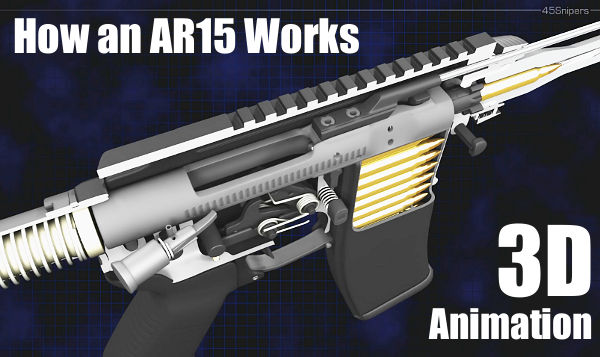
Ever wondered how the parts inside an AR15 work together? Just exactly how does the reciprocating bolt carrier feed rounds from the magazine? How do the elements in the trigger group work and reset after each shot? How does the gas system bleed gas from the barrel and operate the bolt carrier? These and other questions are answered in this eye-opening video from 45Snipers. Using “cutaway” 3D computer animation, this 5-minute video shows all features of an AR15 inside and out. This fascinating firearms animation allows the viewer to look inside the upper and lower receivers, into the bolt carrier, chamber, barrel, and magazine.
This video starts off slow and has annoying background music, but it is well worth watching if you own or shoot any AR-platform rifle. It illustrates all the key operations during the charging, loading, firing, and ejection processes. The cutaway animation shows how rounds are stripped from the magazine and then chambered. It then shows how every part of the trigger group works, and how the firing pin strikes the primer. You can even watch the bullet move down the barrel before the empty shell casing is removed from the chamber and tossed out the ejection port. Here are sample frames from the video:
How AR-Platform Rifles Work — General Introduction
To help reader understand the general operation of AR-type rifles, this video shows the control functions of an AR and how the upper and lower sections work together.
Cutaway 3D Animation of AR15/M16 Action — Watch Video
Here is an excellent “cutaway” animation by Thomas Schwenke that shows how an AR-15 functions — how the entire loading cycle works from start to finish.
AR platform rifles are semi-automatics version of the M16. These feature distinctive upper and lower receivers which can be readily separated via front and rear pins. The upper includes the barrel, handguard, forward gas tube, and bolt assembly, while the lower contains grip, trigger group, fire selector, and mag well. In addition the lower is attached to the stock which encloses the buffer assembly.
The original ArmaLite AR-15 was a select-fire, air-cooled, gas-operated, magazine-fed rifle designed by American gun manufacturer ArmaLite in 1956. It was based on Armalite’s AR-10 rifle chambered for the 7.62×51 NATO (.308 Win). In 1959, ArmaLite sold its rights to the AR-10 and AR-15 to Colt. Some key modifications were made — most notably, the charging handle was re-located from under the carrying handle to the rear of the receiver. The redesigned rifle was adopted by the U.S. military as the M16 carbine, which went into production in March 1964.
The past couple weeks we have had the privilege to test an impressive new First Focal Plane riflescope from ZEISS. Our tester, Jim See of Elite Accuracy LLC, received the ZEISS LRP S5 525-56 optic, Milrad version, and took a quick look at it. Jim was immediately impressed by the bright, clear markings on the turrets, and the positive clicks. He liked the lever-equipped zoom control, the positive zero-stop on the elevation knob, and he believed the lockable windage turret can have definite benefits in the field.
After doing his first inspection, Jim quickly installed the LRP S5 525-56 on his 6mmBR PRS/NRL rifle, which features a red J. Allen Chassis and Impact Precision action. Jim placed the scope in high-quality Zeiss rings with integral bubble level. He then took the rig out into the field and completed an initial Tall Target test. That test confirmed the precision and repeatability of the 0.1 MRAD elevation and windage click values.
Jim also liked how positive the clicks felt with both elevation and windage knobs. Jim told us: “The scope operates well, it tracks well, and the turrets are accurate in their movements. All the functions work well — elevation, windage, parallax. This LRP scope has a quality feel — similar to other ZEISS products I have used.” Jim also noted that the ZEISS LRP S5 scope resisted solar flare very well: “This is important in PRS matches where we get that low sun in the afternoons”. Jim had high praise for the highly visible numbers on the dials: “With my eyes, I can’t read the numbers on most scopes, but with this ZEISS LRP S5 scope I CAN read the numbers.” Overall, Jim believed this ZEISS 5-25x56mm optic “will fit well in its intended market”, namely PRS/NRL and long range hunting.
Scope mounted in ZEISS rings with bubble level. Optional sunshade is attached in front.
Stay Tuned for Full Field Test of ZEISS LRP S5 525-56 Optic
The past few weeks Jim See has been testing the impressive new 5-25X ZEISS scope in the field, with the optic fitted on his PRS/NRL competition rig. Even in cold winter weather, the optic has performed very well, with positive adjustments and good results in the tall target test. Jim is now doing field tests with targets from 100 yards to 1200 yards and beyond.
To test ruggedness and weatherproofing, Jim is putting the Zeiss LRP through its paces in harsh winter conditions. He’s using a tripod here to keep off the snowy ground. The tripod mount also allows smooth traversing to view a wide selection of terrain and objects near and far.
Advanced Optical Technology — ZEISS LRP S5 Features
The ZEISS LRP S5 525-56 has many notable features, including a lockable windage turret, adjustable reticle illumination, and a HUGE amount of elevation travel — 40.7 Mils in the MIL model and 140 MOA in the MOA version. That gives this optic the ability to shoot at extreme range without requiring holdovers.
F-Class ace Erik Cortina recently interviewed noted author and Olympic Gold Medal-winning shooter Lanny Bassham. For his popular video channel, Erik asked Lanny about his book With Winning in Mind. The two talented shooters also broadly discussed the “mental game” in the shooting sports and Lanny’s program for visualization of a winning performance. Lanny explains that after you have mastered your rifle skills, and learned to read the wind, it is important to adopt a winning mentality and to visualize success. Lanny should know. He won a shooting Gold Medal in the Olympics along with 22 world individual and team titles.
Watch Full Video Interview
Here is the wide-ranging and fascinating hour-long Lanny Bassham interview hosted by Erik Cortina. If you are looking to enhance your motivation, discipline, and “mental focus” when competing, this video is worth watching:
Visualization is a process of mental preparation that is done before you get to the range. Many of the greatest shooting champions have used this technique to get ready for big matches, and to optimize their performance during record fire. If you want to enhance your “mental game” through pre-match visualization, we strongly recommend Lanny Bassham’s book, With Winning in Mind.
As a competitive smallbore 3P shooter, Bassham developed a mental management system. Using this system, Lanny Bassham won 22 world individual and team titles, set four world records, and captured an Olympic Gold Medal in Montreal in 1976. His techniques have been embraced by professional and Olympic athletes in many sports. With Winning in Mind covers a complete system of “mental management” techniques used by Olympians and elite champions.
Putting principles into practice — Anette Wachter
Our friend Anette Wachter, aka “30CalGal”, did a series of videos for the NRAWomen.com site. In one episode, Anette talks about the “mental game” in competition. Specifically she explains how to “visualize success”:
I have found that a lot of my success in competition has come through what I call a ‘mental rehearsal’. I actually visualize every stage of the match and I visualize the success of the match and winning the match.
I actually visualize that round going downrange into the target, and the target coming up with a dead-center ‘X’. I visualize this over and over. If you visualize success you will achieve success.
Headed to SHOT Show in January? It will be a huge event, with a new twin-building layout. As before hundreds of exhibitors will be in the Venetian EXPO Center. But next door, the new Caesar’s Forum building will house scores of other exhibitors, and there is a new Outdoors Pavilion. Check it out:
This animation shows the layout of SHOT Show 2022, with the multiple buildings and levels. At the end you can see the new elevated walkway connecting the Venetian facility with the new Caesar’s Forum building. NOTE: This video will auto-run once. Click the button lower left to replay or pause.
FREE SHOT Show 2022 Mobile Apps
As in years past, FREE Mobile Apps are available for both iOS and Android users. These handy Apps provide interactive maps, schedules of seminars, plus a full directory of exhibitors. One of the best features of the App is that you can plot the most efficient route among multiple booths. That saves considerable time. To download the SHOT Show Mobile App for Android (Google) and iOS (Apple), go to SHOTmobile.com.
This 59-page digital resource contains the full list of exhibitors, along with maps, activity schedules, resource links, and much more. If you will be attending SHOT Show in January, this Notebook provides a wide collection of important information all in one place.
There is a special website with detailed maps of all the exhibitor locations. IMPORTANT: You can type in the name of a vendor, such as LAPUA, and this page will display that vendor’s booth on the appropriate floor map. This is very helpful for planning. CLICK HERE to search vendors on Floor Plan.
Sinclair International has created a series of instructional videos illustrating the basics of metallic cartridge reloading. The 8-Part series starts with reloading basics and provides step-by-step, how-to instructions that will help new reloaders get started. Detailed, animated illustrations show you what happens inside the chamber when shooting, and inside the dies during each step of reloading. The videos can be viewed on Sinclair International’s YouTube channel. Shown below is the first video in the series:
Each of the Sinclair videos is hosted by then Sinclair Int’l President Bill Gravatt (now with Creedmoor Sports). Bill doesn’t just show you “how”, he tells you “why”. The how-to segments cover case inspection, proper die set up, case sizing, primer installation, powder measuring, bullet seating, crimping, and even goes into the record keeping needed for the handloader. “We wanted to give shooters who haven’t reloaded a look at all the advantages of creating your own ammo and how easy it is to get started,” said Gravatt, “without telling them they had to have any certain brand or type of equipment to do the job.”
The Eight Video Topics Are:
Part 1 — Intro to Video Series
Part 2 — Intro to Reloading Safety
Part 3 — Metallic Cartridge Components
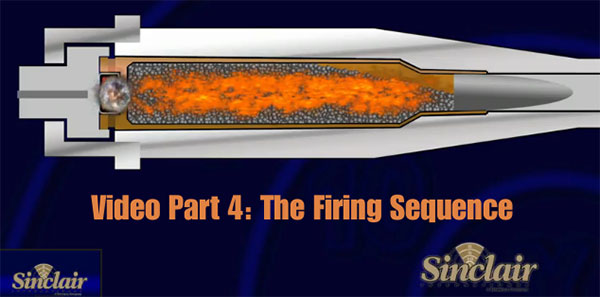
Part 4 — The Firing Sequence
Part 5 — Tools for Reloading
Part 6 — Loading Bottle-Neck Cartridges (2 videos)
Part 7 — Loading Straight Wall Cartridges
Part 8 — Reloading Series Conclusion
Reloading Tools
Shown below is Part 5 of the video series, covering the tools used for precision reloading.
We also strongly recommend the Part 4 Video to readers who are getting started in reloading. This “How Things Work” segment covers the sequence of events inside the chamber (and barrel) when the cartridge is fired. The video includes helpful graphics that show what happens to the primer, powder, cartridge, and bullet when the round is fired. The video also illustrates “headspace” and explains how this can change after firing. We think this video answers many common questions and will help reloaders understand the forces at work on their brass during the firing process.
“Science tells us that exposure to continuous noise of 85 dB for eight hours is enough to cause permanent hearing loss, and worse, spikes of 130 dB and more can result in permanent hearing damage instantly.” Source: NRA Blog.
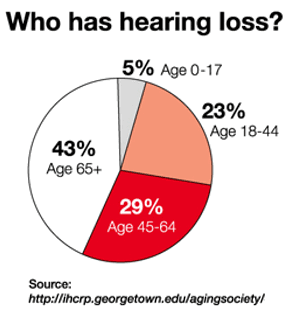
The Risk of Hearing Loss
Hearing loss can be progressive and irreversible. If you are a shooter, this is serious business. As the NRA Blog cautions: “You may not even realize you’re harming your hearing. Hearing loss occurs gradually, and can go effectively unnoticed until symptoms become severe. By then, the damage is done.”Effective hearing protection is a must whenever you are shooting firearms or when you are in the vicinity of gun-shots. For ultimate protection, we recommend a good set of tapered foam earplugs, topped by ear-muffs. However, there are situations when you may prefer lighter-weight hearing protection that can be quickly removed. For example, if you are standing well behind the firing line as an observer, or if you are working as a rangemaster or waddie some distance away from the shooters.”
Sound Levels for Common Noises:
9mm Luger pistol: 160 dB
Jet aircraft engine (near): 140 dB
.22 LR pistol: 134 dB
Normal human pain threshold: 120 dB
Noisy Nightclub: 110 db
Riding Motorcycle at 65 mph: 103 db
Power Lawnmower: 95 dB
Hearing damage possible: 85 dB (sustained for 8+ hours)
Ringing Telephone: 80 dB
Normal conversation: 60 dB
What about suppressors? If you use a suppressor is it OK to dispense with hearing protection? Not really. Even the most effective suppressors, on the smallest and quietest calibers (.22 LR), reduce the peak sound level of a gunshot to between 110 to 120 dB. To put that in perspective, according to the National Institute for Occupational Safety and Health (NIOSH), that is as loud as a jackhammer (110 dB) or an ambulance siren (120 dB). For normal caliber handguns and rifles, suppressed sound levels routinely exceed 130 dB, just shy of OSHA’s “hearing safe” threshold of 140 dB. Accordingly, we recommend use of hearing protection even when shooting suppressed.
1. Ear Muffs — Max Protection and Compact Options
The highest current USA Noise Reduction Rating is 34 dB NRR. To get that kind of protection, you need pretty big muffs, but thankfully, you don’t have to spend big bucks. For under $15.00 you can buy quality ANSI-approved muffs with a 30+ dB Noise Reduction Rating. Chose the 34 NRR G&F Pro Muffs at $10.99 or the more comfortable 30 NRR Walker EXT Range Muffs for $12.75. Both products have padded head-bands which retract.
Many hunters and competitive shooters prefer low-profile ear muffs. As these typically have a lower Noise Reduction Rating, perhaps NRR 22-24, we recommend running earplugs under muffs, particularly when you are at a busy range or shooting a match. If you use low-profile electronic muffs, such as Howard Leight Impact Sport Muffs, you should still be able to hear range commands even with plugs underneath.
2. Electronic Plugs — New Technology with Adjustable Volume
For maximum hearing protection we still recommend good muffs over quality foam ear plugs, there is a new option available. A variety of companies now offer electronic ear buds that include small speakers so you can hear range commands and conversations. Please note — these MUST be specially-designed protective in-ear devices. Do NOT just use ear-buds designed for music playback!
Howard Leight recently introduced new Impact Sport In-Ear plugs with an impressive 29 dB Noise Reduction Rating (NRR). That NRR is better than most compact ear muffs. The plugs automatically compress amplification when loud impulse sounds (like gunshots) exceed 85dB. Internal amplification allows you to hear range commands and conversations. The cord connecting the plugs includes twin, handy volume controls. These plugs come with moldable earhooks with 3 different ear tip sizes. The base unit (dark green color) is $85.39 on Optics Planet. A deluxe model with BlueTooth is also available for $113.62 on Amazon. With the BlutTooth version you can take phone calls.
3. Foam Earplugs — Small, Inexpensive, but Essential
20 Pairs
50 Pairs
Quality foam earplugs offer great hearing protection at low cost. These Howard Leight NRR33 Max plugs are your Editor’s favorite foam earplugs. Between shooting, motorcycling and mowing lawns, I probably have Max plugs in my ears 3-4 days a week. These Leight Max plugs are very effective, easy to insert/remove (with the flared ends), and they seem to be less abrasive in the ear canal than some other brands. Right now you can get 20 pairs of these NRR33 Leight Max plugs for just $8.88 or 50 pairs for $11.90.
Note, if you prefer thin, light-weight earmuffs, we recommend running earplugs underneath for double protection while shooting firearms (or when you’re on the firing line). Sound experts tell us that running plugs and muffs together can effectively improve your effective noise reduction by 4-7 dB NRR.
Hearing bands are inexpensive, lightweight, and are handy for special situations, such using hedgetrimmers and noisy power tools, when you may need to frequently remove the protection. These banded products are a also a very good form of hearing protection for hunters. You can keep them handy around the neck while spotting game, and then insert the plugs before shooting. We have tried two types of banded hearing protection, the Howard Leight Quiet Band (shown above) (25 dB NRR), and the Radians Rad-Band (23 dB NRR). The Leight Quiet Band is quite durable and the plugs can be replaced.
Radians Rad-bad is very light-weight, with Jelli™ Plugs that are comfortable, washable, and reusable. Peltor also offers Sport Banded Earplugs but we think those are a bit flimsy and the NRR seems exaggerated.
This time of year, deer and elk hunters throughout the Northern Hemisphere trek into the wilds in search of game. To celebrate the hunting lifestyle, we’re reprising a story from Europe that showcases the beauty of nature that can be experienced on a hunting trip.
If you need a break from your hum-drum day at the office, how about taking a virtual vacation to Norway, where you can explore the scenic mountains in the Fjord region?
Forum member Kenneth Skorpen (aka “Sal”) has created a cool video of a deer-hunting trip he took in Norway. He didn’t bag a buck on this trip, but the walk in the Fjordland mountains took Kenneth through some spectacular scenery. (At the 11:25 time mark you’ll see an amazing sunset over the Fjord.) Kenneth did encounter a doe that had fallen down the mountain, and apparently broken its neck (14:35 time mark). The terrain is very steep, and Kenneth observed that: “I feel fortunate to be able to do this, but I also feel very tired in my legs. Did you know that the hares around here have shorter left legs due to the steep hills?”
More Hunting/Shooting Videos from Norway
You can watch more interesting hunting and shooting videos from Norway on Kenneth Skorpen’s Streken Vertebrae YouTube Channel. Here are some links:
And here is another Skorpen video showcasing beautiful Norwegian landscapes. This was filmed during a February rifle testing session with targets at 1100 and 1400 meters. You’ll see some stunning snow-capped scenery here, starting at the 4:30 time mark.
Do you know someone getting started in the shooting sports? Or perhaps you know shotgun or rifle shooters who want to improve their handgun skills because they have obtained CCW pistol permits? Then here is a good resource for those shooters-in-training. Smith & Wesson GUNSMARTS is a new video series that covers the key points of firearm ownership, from purchasing a pistol, to shooting techniques, gun safety, and storage. While this 38-part series does include some rifle-centric videos, it is mostly focused on handgun training, as you might expect from Smith & Wesson.
The GUNSMARTS series has 38 different videos covering gun safety, gun operation, marksmanship, maintenance, and secure storage. There are both general videos about gun handling and very specific videos about topics such as sight alignment, magazine loading, optics and more. Here are six of the best videos in the series. You will find 32 more on the Smith & Wesson Gunsmarts Playlist Page.
10 Tips for Your First Visit to the Range
Shooting Fundamentals — Sight Picture and Sight Alignment
Handgun Skills — Grip Pressure
Concealed Carry Positions and Holster/Belt Options
Talented sharpshooter Kirsten Joy Weiss is featured in an episode of NRA All Access. The show covers Kirsten’s development as a competitive shooter, and her success as a trick-shot artist with her own popular YouTube channel. Here’s the All Access segment featuring many of Kirsten’s most famous trick shots.
During the video Kirsten also talks about her background in shooting and how she wants to be a good ambassador for the shooting sports, “spreading the positive reality of shooting”. Kirsten explains: “The fun challenge and joy of shooting is important to me because I really wanted to be a positive example. So when the media says the ‘guns are a bad thing and nobody does anything good with guns’, they can say ‘Well, what about her [Kirsten]’?”
Kirsten: “I think that it’s important for young girls to have somebody that they can look up to… I feel responsibility to show young shooters coming up, especially females, that you can respect yourself and shoot a gun as well.”
A gifted “natural” shooter, Kirsten started shooting fairly late — at age 16. Despite her relatively late start, she learned very quickly, and managed to earn a place on the University of Nebraska shooting team. That literally opened up a new world for Kirsten: “During the course of my career, I’ve had a lot of success. I’ve gone to World Cups… in Zagreb, Croatia, in Munich, Germany. I’ve won National Championships, and got on to the U.S. Olympic short list, so it’s been a good career.”
Kirsten tells us: “A lot of people don’t think of shooting as a sport, but it absolutely is, and I would even go so far as to say that it is an art form.” We don’t know if this is art, sport, or magic, but very few shooters have the skill or flexibility to make this upside-down shot…
In this video, former Army Ranger sniper team leader Ryan Cleckner explains how proper head and scope position is a critical component to accurate shooting. Ryan finds that some shooters place the scope too far forward or too far rearward. If the scope is too far back you may have issues with eye relief and stock reach to shoulder. If it is too far forward, you may have cheek-weld problems or get neck strain. Cleckner cautions: “When you are in a good prone position, you don’t want any strain in your neck muscles or back.”
In the video, Cleckner offers a simple method to check your scope position:
“To see if your scope is set up properly … close your eyes, lay your head on your gun, get completely comfortable, and only when you are set-up, then open your eyes. If you can’t see clearly through your scope, CHANGE something [such as comb height or scope position]”.
“When you open your eyes, if you see some scope shadow [i.e. the black ring around the edge of the scope picture], figure out which way you need to move your head to get rid of that shadow, and then make adjustments to either your position, the rifle, or the scope.”
“Very often you’ll open your eyes and realize you need to move further back or further forward. Instead of moving your position [or head], move the scope and get it set up properly.”
Tip on Viewing Your Reticle:
Cleckner: “Sometimes it can be difficult to focus between the target and the reticle, even with the parallax adjusted properly. I recommend you focus only on the reticle. Just like the front sight on a rifle or a handgun, that reticle is what you can control, and it’s what matters. Focus on a crisp, clear reticle, in a stable platform, and all that’s left is trigger control.”
Long Range Shooting Handbook — A Good Resource
Cleckner’s Long Range Shooting Handbook covers a wide range of topics important for precision marksmanship — both shooting skills and technical matters. You can view Sample Chapters from Ryan’s Book on Amazon.com. Cleckner’s book is designed as an intro to key concepts such as MOA vs. Mils, External Ballistics, and Environmental Effects. Included are personal tips and advice based on Cleckner’s years of experience as a sniper instructor and special operations sniper.
The Long Range Shooting Handbook is divided into three main categories: What It Is/How It Works, Fundamentals, and How to Use It. “What It Is/How It Works” covers equipment, terminology, and basic principles. “Fundamentals” covers the theory of long range shooting. “How to Use It” gives practical advice on implementing what you’ve learned, so you can progress as a skilled, long range shooter.
Ryan Cleckner was a special operations sniper (1/75 RGR) and he served as a U.S. Army sniper instructor. Currently he works as a firearms industry executive and practicing firearms attorney.




 After doing his first inspection, Jim quickly installed the LRP S5 525-56 on his 6mmBR PRS/NRL rifle, which features a red


 F-Class ace Erik Cortina recently interviewed noted author and Olympic Gold Medal-winning shooter Lanny Bassham. For his popular video channel, Erik asked Lanny about his book
  Our friend



 The Risk of Hearing Loss


 If you need a break from your hum-drum day at the office, how about taking a virtual vacation to Norway, where you can explore the scenic mountains in the Fjord region?


 A gifted “natural” shooter, Kirsten started shooting fairly late — at age 16. Despite her relatively late start, she learned very quickly, and managed to earn a place on the University of Nebraska shooting team. That literally opened up a new world for Kirsten: “During the course of my career, I’ve had a lot of success. I’ve gone to World Cups… in Zagreb, Croatia, in Munich, Germany. I’ve won National Championships, and got on to the U.S. Olympic short list, so it’s been a good career.”


