Product Review by F-Class John
The Frankford Arsenal Platinum Series Intellidropper is the latest automated powder scale/dispenser to hit the market. This new-for-2019 machine offers a unique powder calibration mode and the first-ever, mobile APP-controlled powder dispensing system. With a retail price under $200, does the new Intellidropper live up to its promises? We’ll cover the key product features one by one, testing Frankford’s claims:
Feature 1 — Powder Calibration (Custom Profiles)
Feature 2 — Mobile APP Control with Load Database
Feature 3 — 1/10th of a Grain Accuracy
The $200 Intellidropper from Frankford Arsenal looks fairly similar to other electronic scale/dispensers. It has a digital touch-screen, a powder hopper, and a collection pan. But look a little deeper and you can see that it’s a whole lot more. Frankford Arsenal has brought new software technology to the table, with a Bluetooth controller/database APP. What’s more, this new machine has an innovative powder calibration mode, a software “brain” that helps the unit dispense powder with greater speed and precision.
As a technophile I find few things more annoying than technology developed or implemented for the wrong reasons or in the wrong way, so I was pretty apprehensive when I saw this was a ‘smart’ powder measure. I would soon be proved wrong. Unboxing was as easy as pulling out the unit, power cord, powder hopper, and a couple accessories. I simply plugged it in, leveled it on my work surface, allowed it to warm up, then calibrated it using the easy-to-use instructions. Once I was done with calibration, I could immediately begin dropping powder. It was then time to test Frankford’s claims about this new machine.
Powder Calibration
First came the powder calibration mode. Zero the tray, click the “Powder Cal” button and the machine instantly begins to dispense your powder at various rates. As it does this the machine’s “brain” records its ability to flow/dispense the powder most efficiently. In just a few minutes the unit knew the fastest and most consistent way to drop that particular powder. The beauty of this system is that it’s so fast and easy to use that I can picture myself using this anytime I change powder without giving it a second thought. As easy as the calibration was, I was left wondering if it really made a difference. A test of calibrated versus non-calibrated throws showed an average of 22 seconds for calibrated throws vs. nearly 40 seconds non-calibrated. This demonstrated a major improvement with Frankford’s powder calibration system. Once I was done with the powder calibration it came time to add the APP.
Intellidropper Controller APP — How It Works
Frankford offers Intellidropper APPs for both iOS (Apple) and Android phones. A quick search in the iOS and Android APP stores turned up the free Intellidropper APPs. Once downloaded and installed, the APP activated easily and then automatically connected to my Intellidropper unit. Simply ensure your Bluetooth is turned on and that’s it. There was no pairing or manual connections necessary, just open the APP, count to three and now you can control your unit from your phone or tablet. I was expecting this to be a novelty that did nothing more than let me replace the touchpad on the unit but there’s a lot more to it than that.
Touch the menu button at the bottom and now you can enter as many loads as you want including caliber, bullet, powder, powder charge, OAL, firearm, primer and brass used. This allows you to create a database of all your favorite cartridge types, bullets, and powders. For example you could have 10 different .308 Win loads, all with different bullets and/or powders. Or you could have 10 different cartridge types with many different loads for each. The software remembers the powder type and charge weight. Loads from the database can be instantly sent to the unit, which will then rapidly dispense the exact charge weight the APP commands. I found this system provides just enough options to work efficiently without cluttering it up with needless functions. It really is the right balance of style and substance that made this a joy to use and kept me wanting to play with it more. Frankford Arsenal’s tech team told us that Frankford is committed to keeping the firmware, software, and APP updated over time. This should ensure that you can use this unit for many years to come.
WARNING: The Intellidropper is smart but it does NOT know what powder the human user has poured into the hopper! You obviously need to confirm you have the correct powder in the hopper before you send a command from the APP!
Powder Weighing Precision — The Tenth of a Grain Standard
Like the RCBS ChargeMaster, the Intellidropper is really two machines in one — a powder dispenser AND a SCALE that weighs the dispensed powder. Even with its cool APP and fast dispensing speed, to be a winner, the Intellidropper must be able to WEIGH CHARGES accurately and repeatedly. Frankford Arsenal claims this machine can weigh charges with ± 1/10th of a grain accuracy. With that in mind, I put it to the test. After giving the unit the recommended 15-minute warm-up, I ran twenty H4350 loads with a target weight of 50.8 grains. The machine was fast — the average drop time was just 22 seconds.
How did the Intellidropper do? After each of the twenty loads was dispensed, I then double-checked the actual charge weight, using a $600+ lab-quality scale. As confirmed with the lab scale, every one of the 20 Intellidropper-thrown charges was within the stated variance, i.e. plus or minus one-tenth of a grain. Not only that but I found the average drop time to be only 22 seconds with H4530. It may vary with other types of powders, but I expect that drop time to stay fairly consistent when calibrated correctly.
CONCLUSION: Intellidropper is Fast, Accurate, and Software Works Well
The Frankford Arsenal Intellidropper is an impressive, affordable Scale/Dispenser that throws charges accurately and consistently. It has a very handy software APP and more practical features than anything else out there. In the world of sub-$300 powder measures, this $200 machine seems to have hit a home run — this machine demands your serious attention. I try to review products strictly based on the manufacturers’ claims and how they deliver on them. In the case of the Frankford Arsenal Intellidropper, it delivers on those promises. Of course, the $200 Intellidropper won’t replace a Prometheus — it is not for handloaders who demand to measure each charge down to the kernel. But the Intellidropper certainly doesn’t claim single-kernel accuracy, and it costs a fraction of the Prometheus.
Want More Info? This UltimateReloader.com Video reviews the Intellidropper’s key features:
Do you need a quality, affordable lower for your next black gun build? Here’s one of the best deals we’d found. Palmetto State Armory (PSA) now has stripped AR15 lowers for just $49.99. With this lower as the core, you can build up your AR for any discipline you choose: 3-Gun rifle, competition service rifle, varmint rifle, or even “race gun” for the popular PRS Gas Gun Series (see below).
These forged PSA lowers are quality-made using 7075-T6 Aluminum. Finish is Black Hardcoat Anodized per MIL-8625 Type 3 class 2.
PRS Gas Gun Series — What You Need to Know
PRS Gas Gun Series Basics — How to Get Involved
Capitalizing on the success of the bolt-gun competitions, the PRS runs a Gas Gun series for semi-auto rifles such as AR15s and AR10s. The inaugural 2017 PRS Gas Gun Series competition took place February 17-19, 2017 at the CORE Shooting Solutions range in Baker, Florida. Now there are PRS Gas Gun Matches around the country.
PRS Gas Gun Series Rules
For the new PRS “Gasser” Competition, the PRS developed rules on gun types, scoring, match timing, penalties, safety and other key topics. CLICK HERE for Full PRS Gas Gun Series Rules.
Open Division: The Open Division rifles will not exceed a caliber of .30 or a velocity of 3,200 fps. A match DQ will result any rounds over the speed limit of 3,200 fps (+/- 32 fps for environmental factors and equipment discrepancies). Match Officials may request at any point during a match that a competitor fire their rifle through chronograph. If the bullet exceeds the 3,200 fps speed limit, the shooter will receive an automatic match DQ.
Tactical Light Division: Intended to allow competitors the opportunity tocompete using traditional military and law enforcement caliber. This promotes Active Duty military and law enforcement competitors use of their Service and Department-issued rifles. Tactical Light Division rifles are restricted to 5.56 NATO/.223 Remington calibers only. Bullet weight cannot exceed 77 grains and muzzle velocity cannot exceed 3,000 fps.
SSUSA: What will be the format of the PRS Gas Gun Series matches?
Wiseman: The matches will be a two-day format with 8 to 10 stages per day. There are three Divisions: Tactical Light for 5.56x45mm NATO/.223 Rem. rifles; Tactical Heavy for 7.62x51mm NATO/.308 Win.; and Open for everything else up to .30 cal. The maximum distance will be 800 yards.
SSUSA: What guns do you expect to be popular?
Wiseman: In the Open Division, I expect to see a lot of 6.5 Creedmoors for two main reasons; it’s an inherently accurate cartridge and Hornady makes great ammo for the folks that aren’t into reloading. I think the Tactical Light Division will probably be the most popular. It is hard to say specifically what rifles will be the most popular but there are a few AR companies that are known for the accuracy. Armalite, GA Precision, LaRue and Seekins will all be very popular rifles in this Series. I think we will continue to see high-end optics with 5X to 6X zoom range on the rifles. Bushnell, Kahles, Leupold, Nightforce and Vortex will continue to be the most popular.
Looking 1000 yards downrange at the Deep Creek Range outside Missoula, Montana.
On Facebook recently, we saw an eye-catching rifle. Owned by top 1000-yard competitor (and past IBS Champ) Tom Mousel, this rifle was smithed by Alex Wheeler of Wheeler Accuracy. This rig features the McMillan-crafted Wheeler LRB stock with adjustable keel. It also has BAT Machine’s very impressive new Neuvo LR (aka “Neuvo M”) action, serial number LR0001. The Neuvo LR has some important design features — horizontal lug orientation, full-diameter bolt body, and advanced fire control system. More about those features below.
This gun is a shooter. Tom has already shot a 1.5″ four-shot group at 1000 yards. How does he do that? First you need a great barrel, great bullets, and superior hand-loading skills. But then it comes down to great gun-handling. You can see that in the video below. NOTE to ALL Long-Range Benchrest shooters — Watch this video! You’ll definitely learn from watching Tom shoot — he’s one of the best in the business.
Tom Mousel shoots 1000-yard ladder test with first-released Neuvo LR action, SN LR0001.
Rifle chambering is 6BR Ackley (6BRA) in 28″ Krieger barrel.
Rifle Components and Build INFO:
This rifle has a BAT Neuvo LR (aka Neuvo “M”) action glued and screwed into the LRB stock using a special bedding block, a Boyd Allen concept that Tom has requested to use on every future build. The 28″ Krieger 1:8″-twist HV barrel was indexed using a little different method than most use. It is “panning out well” says Alex, who adds: “So far it has shot [multiple low ones] with two barrels and three different bullet types. This rifle is definitely one of the better shooters I have seen.” We’d agree — owner Tom Mousel has had a 1.5″ 4-shot group at 1000 yards in testing, plus some “zero” 3-shot groups at 100 yards.
Chambering is the 6mmBR Ackley (6BRA). The stock is a Wheeler/McMillan LRB stock with vivid orange and black paint job. It features an adjustable keel in the rear. Trigger is a Bix N Andy unit from Bullets.com.
This BAT Neuvo LR action is a Left-loading Drop Port. Cartridges eject out the bottom of the action.
BAT Machine Neuvo Long Range “M” Action
This is the “Long Range” version of the BAT Neuvo. Dwight Scott and Chris Harris were the original inspiration. I worked with Chris to come up with a version for long range. The main differences for the LR Neuvo (compared to the shorter Neuvo) are this has integral lug and rail, with flat bottom and sides for better bedding. The BAT Neuvo LR is available in drop port, dual port, and single port as well as magnum.
Take a look at the bolt. Notice the lug orientation and full diameter bolt body. There are no bolt raceways in the action and the two lugs sit HORIZONTALLY when the bolt is closed — that’s different than the vast majority of other two-lug actions.
Alex Wheeler says the Neuvo is a winner. He thinks some of the action’s design features really do contribute to enhanced accuracy: “The … fire control (firing pin assembly) carries a lot of energy and has a very “clean” release. This is an excellent design with many small details that combine to deliver superior function. In addition, the full-diameter bolt can be fitted tighter than one with lugways. Also the horizontal lugs may be why we see less vertical stringing in the groups. They are timed perfectly as well.”
Chris Cheng, Top Shot TV Season 4 Champion, worked at Google from 2007-2012. A self-taught amateur turned pro, he beat 17 competitors to win the title of Top Shot, a $100,000 grand prize, and a professional marksmanship contract with Bass Pro Shops. After his Top Shot success, Cheng left Google to pursue a new career in the firearms industry. He is the author of Shoot To Win, now in its Second Edition (2018). The book is available from Amazon for $19.99 (or $14.99 Kindle). You can also get an eBook version for $14.95 through Google Play with a free sample.
What is pretty remarkable, given the current state of “political correctness” in our nation is that Google invited Cheng to discuss his book at a Google Authors event. Here is the video of that interview.
Chris explains: “Google invited me back to discuss the 2nd Edition of my book Shoot to Win and it was an honor to become a two-time Google @Authors talk guest.
Given the political climate and anti-conservative accusations levied on Google and other tech companies it was notable I got invited. But more notable was that Google employees voted on authors they wanted to come speak and my name floated to the top. It goes to show that Google is trying to balance things out and bring more divergent perspectives and increase intellectual diversity.
In the talk we discussed sacrifice, hard work, and the focus required to win at life. We also discussed my advocacy for gun rights, gay rights, and freedom and how there are folks who want gay people and gun people to not exist on this Earth.
The only way we’re going to find our way out is if we have more respectable, civil dialogue to find solutions. It isn’t about agreeing on everything, but finding common ground and moving quickly where we agree.”
After winning the Top Shot Season 4 title, Chris Cheng left his job at Google to pursue a new career in the firearms industry. Cheng now travels the country speaking professionally and sharing his passion for the shooting sports. He is a Certified Pistol, Rifle, and Shotgun Instructor. Cheng also serves as a Member of the NSSF’s Outreach and Inclusion Committee where he represents LGBT and Asian interests.
A team of Texas engineers uses the principle of convolution to plot shot impacts. By triangulating data from multiple accelerometers, each shot’s exact point of impact can be plotted with great precision.
Waterloo Labs is a group of engineers from National Instruments and other self-declared “nerds” from Austin, Texas. These folks conducted an interesting demonstration using electronic accelerometers to plot bullet impacts from a suppressed Ruger MKIII .22LR pistol. The accelerometers respond to vibrations caused when the bullets hit a drywall target backer. By triangulating data from multiple accelerometers, each shot’s exact point of impact can be plotted with great precision. These point-of-impact coordinates are then fed into a computer and super-imposed into a Flash version of the Half-Life video game (which is projected on the drywall board). The end result is being able to “play” a video game with a real firearm.
Do-It-Yourself Electronic Target System?
Now, we are NOT particularly interested in shooting Zombies in a video game. However, the technology has interesting potential applications for real shooters. Waterloo Labs has published the computer code, used to triangulate bullet impacts from multiple accelerometers. Potentially, a system like this could be built to provide display and scoring of long-range targets. Sophisticated electronic target systems already exist, but they use proprietary hardware and software, and they are very expensive. The Waterloo Labs experiment shows that shooters with some computer and electronic skills could build their own electronic scoring system, one that can be adapted to a variety of target sizes and materials.
In addition, we imagine this system could be utilized for military and law enforcement training. The walls of structures used for “live-fire” room-clearing exercises could be fitted with accelerometers so the bullet impacts could be plotted and studied. Then, later, the impact plots could be combined with a computer simulation so that trainees could “replay” their live-fire sessions, viewing the actual location of their hits (and misses).
In this Gear Update the 6.5 Guys take a look at the Vudoo Gun Works V-22 rimfire repeater rifle. The action has the same footprint as a Remington 700 so it is compatible with a wide variety of Rem 700 chassis, triggers, and rifle accessories. This allows you to have a rimfire trainer with near-identical ergonomics as your centerfire match rifle. Rimfire training provides valuable trigger time with dramatically lower ammo costs. Additional magazines for this rifle system are available from Vudoo Gun Works for $39.95. Vudoo also sells many other products and accessories through its website: VudooGunworks.com.
Why Train with a .22 LR Rimfire Rig?
Frequent practice, particularly live fire sessions with your match rifle, is the standard prescription for success in the PRS/NRL game. However the cost of shooting thousands of rounds of ammo and the inevitable wear on precision rifle barrels can become cost-prohibitive. Rimfire training allows needed trigger-time while conserving precious centerfire barrel life. Rimfire cost per round might be 12 cents compared to 80 cents (or more) for centerfire.
The Vudoo Gun Works V-22 rimfire repeater action, arguably one of the best tactical rimfire actions available, owes its lineage to the respected Remington 40X action. Many rimfire matches have been won with 40X actions, so we understand why Vudoo chose that design for a starting point. Vudoo then added some important enhancements.
Seen at the WSC: Vudoo Gunworks Tactical .22 LR Rimfire Rifles
The 2017 NRA World Shooting Championship (WSC) included a side-match featuring Vudoo Gunworks .22 LR rimfire tactical rigs. Shooters were impressed with the V-22 rifle, which looks and feels like a centerfire rig, but with a rimfire repeater action running full-size mags.
Vudoo states: “Our V-22 also runs a full-size short action bottom metal (DBM) and our V-2210 magazine has a [full-size] AICS form factor. The V-22 is the only controlled-round-feed .22 LR receiver out there. The bolt has full capture control of the cartridge from the time it leaves the magazine until it ejects the spent round out the ejection port.” That means the round never touches anything during feed travel so the bullets won’t be nicked/dented during rapid cycling.
This very thorough video explains how to clean a .22 LR Vudoo Rifle:
At the request of our readers, we provide select “Deals of the Week”. Every Monday morning we offer our Best Bargain selections. Here are some of the best deals on firearms, hardware, reloading components, optics, and shooting accessories. Be aware that sale prices are subject to change, and once clearance inventory is sold, it’s gone for good. You snooze you lose.
1. Brownells — 500 Rds Am Eagle .223 Rem, $124.99 with Rebate
American Eagle is good, safe, reliable ammo, made in the USA by Federal. We’ve used this FMJ ammo for function testing in many ARs and it worked well. It’s not ideal for varmint hunting but it will do the job. This is also a good choice for guys who want a big supply of .223 Rem for SHTF scenarios. Using all the promos you can get 500 rounds delivered for just $124.99 net cost — that’s just twenty-five cents ($0.25) per round. Here’s how it works. This ammo is currently on sale for $164.99 at Brownells. Use Code NCS to knock that down to $149.99 with free shipping. Then apply for Federal’s five cents per round rebate. That gives you $25 bucks back on 500 rounds. REBATE FORM HERE.
2. Palmetto State Armory — Taurus 9mm Pistol, $179.99
Here’s an amazing deal on a reliable, subcompact 9mm pistol. For the next day or two, you can get this Taurus G2S 9mm (9x19mm Luger) handgun for just $179.99. That’s one-third the price of a Glock 9mm compact! Put the money you save into a holster and ammo. This is a Palmetto Armory “Daily Deal”, so act quick. We have used Taurus pistols and they worked fine. Is this as nice as a $700 SIG Sauer? Frankly no. But it will do the job and could serve well as a back-up defense gun for your vehicle or bedroom.
3. Midsouth — Hornady LNL Auto Charge Dispenser, $168.99
Looking for a good electronic scale/powder dispenser for under $200.00? The Hornady LNL Auto Charge is one of the best bargain scale/dispensers. Enter your charge weight and watch it accurately dispense your load accurate to the tenth of a grain. For those of you who load multiple calibers and charges it can be programmed for easy use. Other competing electronic powder dispensers can cost $250 – $350, so the AutoCharge is a great value.
4. MidwayUSA — Pro Series Competition Shooting Mat, $39.99
The MidwayUSA Pro Series Competition Shooting Mat is now on sale for just $39.99, 33% off the regular $59.99 price. The Pro Series mat measures a full 73.5″ x 35.5″. Zippered pockets on the front flap hold ammo or log books. And there are webbing “pockets” for bipod feet so you can pre-load your bipod with forward pressure. This quality mat boasts 0.35″ thick padding, multiple pockets, 6 grommets for staking, and a nice carry strap. It’s easy to transport, rolling up to about nine inches in diameter. NOTE: This mat is offered in two colors: Olive Drab (see photo), and Coyote Tan. They both look good.
5. Stocky’s — LR Stocks with Aluminum Bedding Block, $199.99
Here’s a good deal on a versatile Stocky’s Long Range Stock with aluminum V-block bedding system. For just $199.99, order this for Rem/Rem Clone long actions or short actions, with either narrow or wide (varmint/tactical) barrel channel. This would be a good choice for a varmint rifle. This is also offered with handsome hydrographic or web-pattern baked-on textured finishes for $219.99.
6. MidwayUSA — Free Hazmat with $150 Powder and/or Primers
MidwayUSA’s FREE Hazmat promo is good through 3/31/2019. Buy at least $150.00 worth of powders and/or primers and MidwayUSA waives the HazMat fee (you still pay for ground shipping). This can save you $30-$35, based on comparable Hazardous Materials surcharges. Remember, you must buy $150.00 or more of powder and/or primers and use Promo Code OFFER18203.
7. Midsouth — Hornady L-N-L Auto Progressive Press, $399.99
Plus Rebate for 500 Free Bullets
If you need large quantities of pistol or rifle ammo, it makes sense to get a progressive press. This auto-indexing, 5-station press will give you one loaded round for every complete cycle of the loading handle. We’ve used this Hornady Lock-N-Load AP Progressive press and can confirm that it works well. We actually prefer the rotary powder measure to the sliding powder system on Dillon progressives. We find it much easier to change load weights with the Hornady system (which uses inserts), and it is more precise with certain types of powder. This press also uses convenient quick-change die bushings. Right now you can save $107.29 with the $399.99 sale. PLUS LNL AP Press purchasers can get 500 free bullets through the Hornady Rebate Program.
8. Amazon – Proster Wind Meter, $16.99
Wish you had a modern impeller-style wind meter but only shoot a couple matches a year and can’t justify spending $150 (or more) on one? This Proster wind meter has a very impressive 4.5 star overall rating (with hundreds of reviews), so buy with confidence. Now on sale for just $16.99, this is a very useful tool for a bargain basement price. Get this affordable Wind Meter to ensure you have reliable wind readings for ballistics calculations. And unlike a costly Kestrel, with this low-priced wind meter, you won’t feel too bad if it gets lost or misplaced some time.
9. Amazon — 12″ x 12″ Splatter Grid Targets, 10 for $9.99
This 12″x12″ Splatterburst Target combines splatter shot marking with a grid background, with five aiming points. The bright neon shot circles make it easy to see your shots. And the handy grid lets you quickly estimate your group size. Get a 10-pack for $9.99, or a 25-pack for $17.99 (better deal). This particular target has earned rave reviews — 87% of verified buyers gave this a FIVE-Star rating. One example: “Excellent quality and durability. The adhesive is really strong. High contrast makes down range targeting easy and the splatter contrast is [great].”
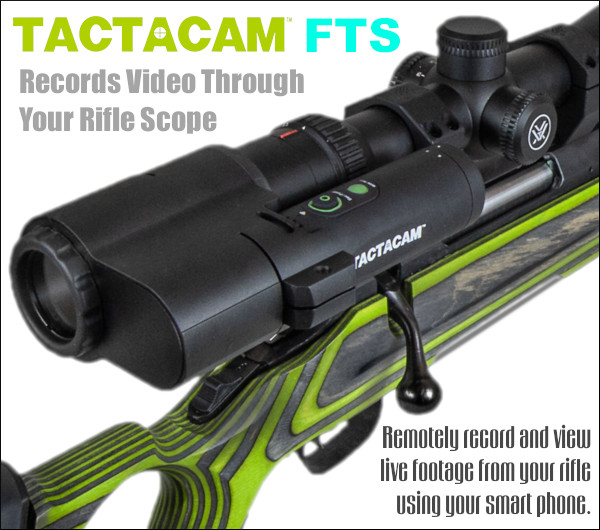
Tactacam, builder of compact, waterproof video cameras, now offers a new system, the Tactacam FTS, that allows you to film directly through your rifle scope. The images you see can be recorded to your mobile device or smart phone as well as viewed live. We think this is an important technology for marksmanship training. In addition, this is great for hunters who may want to record a successful hunt sequence.
The Tactacam FTS combines the high definition video from your Tactacam camera with the high-power zoom of a rifle scope. This lets you remotely view and record live footage from your rifle on your smart phone. Simply couple your scope and your camera together with the Tactacam FTS components. Then sync the camera to the Tactacam APP on your smart phone for live viewing.
You continue to watch your target through the normal optical axis of the rifle scope. The camera records via the offset FTS camera mount. The output of the FTS camera system can then be viewed, in real time, via a live feed to a smart phone. After setup, the Tactacam FTS allows the riflescope to operate as normal without additional adjustment or modification.
4K Resolution, Remote Control, Slo-Mo, Wifi Viewing and More
Tactacam’s innovative camera systems allow easy, in-the-field recording of hunts and shooting sessions. The FTS mount can handle all Tactacam Solo, 3.0, 4.0, and 5.0 cameras. The latest Tactacam 5.0 unit provides 4K resolution with outstanding image quality. Other features include Wifi and APP viewing options, remote control activation, slow motion, and live-streaming capabilities. The camera output can be viewed both in the App and on external WiFi-capable devices.
The Tactacam FTS system can attach to nearly any conventional rifle scope. This system is less expensive and easier-to-mount that most other through-the-scope viewing systems. Importantly, your valuable smart-phone remains separate, i.e. NOT attached to the rifle. Hence it cannot be harmed by recoil or muzzle blast.
Ian Klemm, 2017 F-TR USA National Champion, is one of America’s top F-Class shooters, both shooting individually and in team competition. Ian is known for his consistency, smooth gun handling, and an uncanny ability to shoot well even in the toughest wind conditions. In this Vortex Video, Ian and fellow long-range shooter Niles Richardson, reveal some of their competitive secrets, and wind-reading techniques. This video focuses primarily on F-Class competition but Ian and Niles also talk more broadly about the myriad factors that contribute to rifle accuracy. Topics include: match strategies, wind and mirage reading, barrel harmonics, bipods, and optics.
Vortex Nation Podcast Episode 57 Summary
From Vortex: Our original intent was to have just a podcast about the sport of F-Class shooting, but when you get these brainiacs (Ian Klemm and Niles Richardson) talking about their obsession… er… “Hobby” you better believe it’s going to turn into a full on long range shooting information assault to the brain. Fact of the matter is, in F-Class, the only thing that matters is long range accuracy – and when we say “Accuracy”, we’re talking about sub-MOA groups on paper at 1000 yards with .308 Wins. Every single aspect of an F-Class competitor’s game is completely dialed in for long range accuracy.
We talk about the guns, their bipods, wind, mirage, barrel harmonics and the special scopes F-Class competitors need for their rifles. Ian even goes so far as to tell us how much his rifle has moved prior to the bullet leaving his 30-inch barrel. Just a simple equation involving acceleration, terminal velocity, moment of inertia of the rifle and coefficient of friction of the bipod and rifle on the ground.
If you like accurate rifles and reactive targets, you’ll enjoy this 48-minute video from Shooting USA TV, which features long-range varmint silhouette competition in Texas, the Lone Star State. We have participated in these kind of matches on the West Coast — they are definitely a ton of fun. The sport combines the pure accuracy of benchrest competition with the fun of knocking down critter targets. These are smaller than standard silhouettes, so it’s quite a challenge to hit them at 300 yards and beyond.
In this episode, host John Scoutten competes with his 6.5 Creedmoor PRS rifle. He found that 1-MOA Coyotes offered plenty of challenge at 385 meters! Most shooters use benchrest-grade rifles with premium front rests.
Full 48-Minute Episode of Shooting USA featuring Texas Varmint Silhouette:
5″x4″ Hogs — 500 Meters
Chickens (on Swingers) — 600 Yards
Pigs (on Swingers) — 750 Yards
EDITOR: We strongly recommend you take the time to watch this Shooting USA feature — it shows some top-flight benchrest rifles, and also covers the origins of benchrest varmint silhouette in Pennsylvania. There are even some AccurateShooter Forum members on screen. John Scoutten also does nice job explaining the challenges of shooting this discipline with a PRS rig. We think any benchrest or tactical shooter will really enjoy watching this video.
Travis Frazier of Field & Cave Outfitters says shooters love the reactive targets: “The most exciting thing is seeing your hits — these [targets] really go airborne”. Yep, that’s the best thing about Varmint Silhouette matches — hits deliver instant gratification. Travis designs and produces these steel targets.
This Texas match features multiple target shapes, 10 at each distance: Tiny Prairie Dogs at 200m, 3″x3″ Armadillos at 300m; 3″x5″ Coyotes at 385m; 5″x4″ Hogs at 500m; Chickens (on swingers) at 600 yards; and Pigs (on Swingers) at 750 yards. Competitors are allowed 10 rounds and 10 minutes to hit each set of targets.


 Do-It-Yourself Electronic Target System?