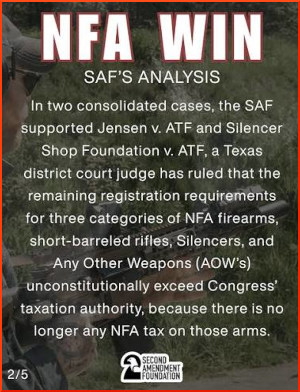
There has a been a notable federal legal holding regarding the National Firearms Act of 1934 (NFA). Two consolidated lawsuits — Jensen v. ATF and Silencer Shop Foundation v. ATF — had challenged the NFA’s regulation of now-untaxed firearms, such as suppressors, short-barreled rifles, and short-barreled shotguns. In a memo for the cons the judge held the registration requirements are no longer valid. U.S. District Court Judge James Wesley Hendrix ruled that “[b]y zeroing out the transfer and making taxes for most NFA firearms, Congress eliminated the constitutional basis for the regulations that formerly supported the taxes for those firearms.”
Gun reviewer and attorney Colion Noir explained: “For ninety years, the government defended NFA registration by tying it to Congress’s taxing power. Then the tax disappeared, and suddenly the government tried to argue the same paperwork could be justified another way. The judge didn’t buy it. And honestly, the way the gun groups set this up was borderline masterful. They beat the NFA at its own game.”
The Court’s injunction applies to “the plaintiffs and, where applicable, the plaintiffs’ agencies, political subdivisions, members, and customers—both current and future,” but does not take effect for 7 days “to allow the defendants to seek relief, if any, at the appellate level.”
The Jensen v. ATF plaintiffs included three individuals, Hot Shots Custom LLC, the Texas State Rifle Assoc., FPC Action Foundation, and the Citizens Committee for the Right to Keep and Bear Arms. NOTE: This Jensen Case had been consolidated with a similar legal challenge entitled Silencer Shop Foundation v. ATF, with plaintiffs Silencer Shop Foundation, Silencerco, Firearms Regulatory Accountability Coalition, Gun Owners Foundation, Gun Owners of America, Inc., Brady Wetz, B&T USA, and Palmetto State Armory.
The opinion was issued on August 5, 2026, in the U.S. District Court for the Northern District of Texas. READ Memorandum Opinion and ORDER.
Because Congress eliminated the NFA’s making and transfer taxes for most regulated firearms in 2025, the District Court held the Act’s remaining registration and recordkeeping mandates lack any valid constitutional foundation.
“This is a massive win and an important step forward in our strategic plan to end the NFA. We cannot wait to fully and finally eliminate this unconstitutional scheme so people can exercise their rights when, where, and how they choose.” — Brandon Combs, FPC President
This 12″ Bullseye Pistol Diagnostic Target helps improve handgun marksmanship. The target diagnoses common problems with one-handed shooting based on shot impact zones. While this target is designed for righties, left-handed shooters can use the target too. Just observe the opposite tips.
Do you know someone who wants to get started in pistol shooting? Here’s a helpful resource. The NRA now offers its Basics of Pistol Shooting Course in an online format. That makes it easy to cover the “classroom” phase of the course on your own time. The $60.00 online course includes 11 step-by-step lessons (to be followed by live range training). CLICK HERE to enroll in online Pistol Training Course.
Train Online, Then Register for a Range Session
For the NRA Basics of Pistol Shooting course, Phase 1 is conducted in an online environment, completed on your own time (cost is $60.00, non-refundable). After successfully completing the online exam, students can register for Phase 2, the instructor-led training session. Phase 2 is conducted at your local range with an NRA-Certified Instructor. NOTE: There will normally be an additional fee for Phase 2. You must successfully complete BOTH Phase 1 and Phase 2 in order to receive your NRA Basics of Pistol Shooting course certificate.
Designed and developed by experts to accommodate busy schedules, the web-based course takes a blended learning approach to firearms training with both online and physical components. Students have 90 days to work through 11 online lessons before registering for Phase 2, the NRA Certified Instructor-led phase at a local range.
“Thanks to our online courses and network of more than 125,000 NRA Certified Instructors, it has never been easier to learn basic firearm skills,” said Kyle Weaver, NRA General Operations Exec. Director. The NRA offers other online training courses at Onlinetraining.nra.org. Along with pistol course, these offerings include Rifle Training, Shotgun Training, a Range Safety Office (RSO) course, and a Range Development and Operations course.
Know someone getting started with handguns? Here is a useful video focusing on safety:
For today’s Saturday Movie showcase we present six videos with .22 LR rimfire ammunition testing. Most of the videos include a wide variety of ammunition types, from bargain ammo, to high-end .22 LR match ammo. If you want to learn more about the properties of .22 LR rimfire ammo, you’ll find a good .22 LR ammo analysis on the Widener’s Blog. That article discusses .22 LR Bullet Design/Stability, Primer Ignition, Velocity Consistency, and Quality Control. In addition, 100-yard test results are provided for five (5) ammo types: Norma Xtreme LR-22, SK Rifle Match, ELEY Match, Lapua Long Range, and CCI Standard.
Big .22 LR Rimfire Ammo Comparison Test
This Backfire Channel Video features an accuracy comparison test of 13 .22 LR ammo types from multiple manufacturers. This includes low-priced ammo, such as Aquila, as well as more costly match ammo from ELEY, Lapua, and SK. Various types of ammo were tested in an outdoor range with three different NRL22-suitable rifles with slightly different chamber specs. Take note — this was NOT a benchrest rifle test conducted indoors. The most accurate ammunition overall was Lapua Center-X. NOTE: Different ammo may shoot better or worse in different rimfire guns. For example a round that works in an Anschutz rifle may not be the best choice for a .22 LR revolver. But this review can help you get started in ammo selection.
Testing Rimfire Ammo at New Whidden Gunworks Test Center
Whidden Gunworks operates an impressiv Rimfire Test Center in Nashville, Georgia. In this video, long-range champion John Whidden shows the Whidden Gunworks test range developed with ELEY Ammunition. The facility features two testing lanes — one for testing ELEY ammo and a second for testing other brands. On the second test lane, customers can test Lapua, SK, Norma, and RWS. Testing on this lane occurs at 50 meters and 100 meters simultaneously, registering results for BOTH distances. For more info, visit Whiddengunworks.com/ammunition-testing.
CLICK HERE to schedule a test at the Whidden facility.
.22 LR Ammo Buyers Guide
The Pursuit of Accuracy YouTube Channel has 420 videos, nearly all involving .22 LR rimfire rifles. The host tests different ammo in a variety of rimfire rifles. In this particular video, the host explains the key considerations in selecting .22 LR ammunition — how to choose the most cost-effective ammo for your rimfire rifle and discipline. You don’t need $14/box ammo to hit large steel plates at 20 yards. But you do need very consistent high-quality ammo for .22 LR Rimfire ELR Matches.
Testing Lapua Long Range Ammo at 400 Yards
With the emergence of long-range .22 LR rimfire matches, with targets at 100, 200, and 300 yards, the long-range capabilities of .22 LR have been pushed to the limits in recent years. In 2023 Lapua announced two new .22 LR rimfire ammo types — Long Range and Super Long Range. These are both specifically designed to optimize .22 LR performance past 100 yards. In this video, Gavin Gear of UltimateReloader.com tests the new Lapua ammo types on his range, with steel targets placed at 400 yards.
Subsonic vs. Supersonic .22 LR Ammunition
Here is another Pursuit of Accuracy Channel .22 LR ammo test. This specifically compares the performance of supersonic ammunition vs. subsonic ammo. What offers better accuracy? What is the best option for long range? The video addresses these questions.
Cheap .22 LR Ammo Tested with a $4000 Custom Rifle
Can relatively inexpensive ammo shoot well in $4000 rimfire rifle? This Midwest Long Range video seeks to answer that question. The results are interesting, with some surprisingly good results with CCI (8:03 time-mark) and Fiocchi (11:25 time-mark) Standard Velocity ammo. If you’re shooting NRL22 or PRS Rimfire matches on a tight budget, this video may steer you to some accurate yet affordable ammo options.
BONUS — Rimfire Ammunition Test with 31 Types
If watching today’s showcased videos has wet your appetite for .22 LR ammo comparison testing — here’s a “must-read” related article. The October 2018 issue of Shooting Sports USA (SSUSA) includes a great article with data on thirty-one (31) different types of popular .22 LR rimfire ammunition. The line-up includes low-speed, standard, and Hi-Velocity types, plus choices for plinking, varminting, and target applications. Brands tested include: Aguila, American Eagle, CCI, Federal, Fiocchi, Lapua, Remington, and Winchester. The ammo types ranged in speed from 727 FPS to 1735 FPS.
For each ammo type, SSUSA lists the bullet weight, velocity (FPS), and average of two, 5-shot groups at fifty yards. The most accurate ammo was Lapua Center-X LRN, with a 0.37″ average 50-yard group size. Second best was Lapua X-ACT LRN at 0.42″. Ammo was tested from a bench with a Cooper Model 57-M rifle fitted with 3-9x33mm Leupold VX-2 scope. The ammo offerings were grouped into three categories: (1) Varmints/Small Game; (2) Target; and (3) Plinking.
August is National Shooting Sports Month, a time when many new shooters are introduced to the fun of rifle, shotgun, and pistol shooting. To help serve America’s many new gun owners, Winchester offers an online information site for first-time ammunition and firearms buyers as well as those just getting started in the shooting sports and hunting. Winchester’s New Shooters Site has many helpful articles plus a series of informative videos.
Winchester’s New Shooters Site also links to the NSSF’s WHERE-To-SHOOT Resource, the internet’s most comprehensive listing of gun ranges. The Where-to-Shoot section makes finding a local range easy. Simply input your location and max desired distance, and the site will generate a list of nearby indoor and outdoor ranges with a Google map.
If you ever shoot with electronic targets, ShotMarkers, or target cams, chances are you’ll spend lots of time looking at the screen of a tablet computer or iPad. These electronic devices are pretty amazing, but they have one major shortcoming when used outdoors — reflections from the highly-polished glass screen.
Well it turns out there is a simple, inexpensive solution to the problem of annoying tablet screen reflections. Just purchase a quality anti-reflective screen protector for your tablet, iPad, or smartphone and you will eliminate most annoying reflections and make your mobile device MUCH easier to use at the range.
Take a look at the two photos above. The first photo shows how annoying reflections can obscure the ShotMarker display on a tablet. The second shot shows how much easier it is to view the ShotMarker target image with an anti-reflective screen cover in place. BIG improvement!
Our friend Keith Glasscock added an anti-reflective screen protector to his iPad tablet and found that it works wonders. Keith reviewed the iCarez Matte Screen Protector for his Winning in the Wind YouTube Channel. These screen covers are available in a wide variety of sizes to fit most Apple iPhones and Apple iPads. These thin, matte screen protectors are quite affordable, with prices starting at $7.95.
In addition, there are other brands of screen protectors for Android devices that work the same way. Again, you’ll find a variety of sizes. For example, Supershieldz now offers a 3-pack of matte screen covers for 10″ Samsung tablets for just $6.99 on Amazon.
In the above video, Keith Glasscock explains the problem of screen reflections when using mobile devices for shot monitoring. Keith then describes his positive experience with the iCarez Matte screen cover installed on his personal iPad.
A good screen cover can eliminate this kind of harsh reflection on tablet screens:
When shooting at long range, two heads (and two sets of eyes) can be better than one. Teaming up with a buddy who acts as a spotter can speed up your long-range learning process. You can focus 100% on the shot, while your buddy calls the wind and spots your hits and misses.
The NSSF has created a short video that shows how shooter and spotter can work as a team. In the video, the NSSF’s Dave Miles works with Rod Ryan, owner of Storm Mountain Training Center in Elk Garden, WV. As the video shows, team-work can pay off — both during target training sessions and when you’re attempting a long shot on a hunt. Working as a two-person team divides the responsibilities, allowing the shooter to concentrate fully on breaking the perfect shot.
The spotter’s job is to watch the conditions and inform the shooter of needed wind corrections. The shooter can dial windage into his scope, or hold off if he has a suitable reticle. As Rod Ryan explains: “The most important part is for the shooter to be relaxed and… pay attention to nothing more than the shot itself.” The spotter calls the wind, gives the information to the shooter, thus allowing the shooter to concentrate on proper aim, gun handling, and trigger squeeze. Rod says: “The concept is that the spotter does all the looking, seeing and the calculations for [the shooter].”
Spotter Can Call Corrections After Missed Shots
The spotter’s ability to see misses can be as important as his role as a wind-caller. Rod explains: “If you shoot and hit, that’s great. But if you shoot and miss, since the recoil pulse of the firearm is hitting your shoulder pretty good, you’re not going to be able to see where you missed the target. The spotter [can] see exactly where you missed, so I’ll have exactly an idea of how many [inches/mils it takes] to give you a quick secondary call so you can get [back on target].”
+ONE Program to Encourage New Shooters
August is National Shooting Sports Month. As part of this effort, the NSSF encourages firearms owners to take one novice to the range this month. This +ONE Movement will help strengthen the ranks of shooters, which, in turn, can help protect our Second Amendment freedoms. The NSSF states: “If just one in three of America’s recreational shooters adds one new person to the shooting sports, we’ll secure a strong future for generations to come. So be the one. For all the thrills and excitement recreational shooting has given you, join the +ONE movement and invite someone to the range today. Share your experience on social media.”
The +ONE campaign seeks to build the ranks of shooters. The NSSF says: “If just one in three of America’s recreational shooters adds one new person to the shooting sports, we’ll secure a strong future for generations to come.” Learn more at LetsGoShooting.org.
As part of the +ONE Movement, the NSSF encourages all participants to practice gun safety and proper firearms handling and storage practices. This video covers basic gun safety procedures:
SHARE THESE 10 SAFETY TIPS WITH +ONE INVITEES
The NSSF has created a list of TEN Rules of Firearms Safety. While you’re at the shooting range or anywhere you handle a firearm, safety ALWAYS comes first. Here are the 10 Key Rules of Firearms Safety. NOTE: The first four rules are the most important.
Gorgeous wood stock crafted by Joel Russo: “A customer from Texas commissioned me to make him a one-of-a-kind stock, so I pulled a slab out of inventory, and put it all together.”
One of the most popular items in our Shooters’ Forum is the ongoing “Pride and Joy” thread. Since 2009, Forum members have posted photos and descriptions of their most prized firearms. Here are some notable “Pride and Joy” rifles (and one wheelgun) showcased in our Forum. Do you have a gun you’d like to see featured there? Register for the Forum and you can add your favorite gun to the list.
This 22 BR Savage, with upgrades from Sharpshooter Supply, is the “pride and joy” of Forum member Maynard. Note the heavy-contour custom barrel with brake. That 22 BR cartridge is a very effective choice for varmint work, as the ground hog in the photo proves. The 22 BR and 22 Dasher are capable of outstanding accuracy with a large variety of bullets and powders. A 22 Dasher can rival the ballistics of a 6mmBR out to 500+ yards, but with reduced recoil.
Above is a nice field rifle built up by a father for his daughter. Forum member FrankZ explains: “This is my favorite rifle and it will become my daughter’s first centerfire. The action is from the first rifle I purchased with my own money 21 years ago (700VSS).” The rifle now sports a 24″ Brux barrel chambered in 6mm Creedmoor, with aftermarket PT&G Bolt and DBM metal.
This handsome 30BR competition rifle was crafted by its owner, Forum member WillyTP who runs Todd Payseur Stocks in South Carolina. He posted: “Finally found the time to make myself a new stock and get it finished this time. All work from the rooter to the tooter by yours truly.” This score benchrest rifle features top-end components: BAT SV action, BRUX Barrel, Bix’N Andy trigger, and Nightforce 42x44mm scope.
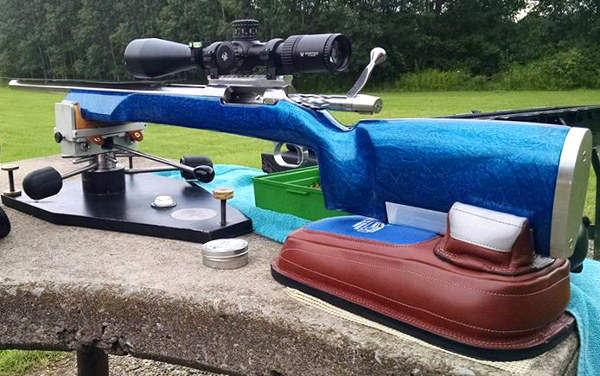
Here is a 6BR Ackley Improved built by Alex Wheeler. This blue marble-painted beauty features a BAT “B” action timed by Alex, fitted with Jewell trigger, and Borden trigger guard. The barrel is a Hawk Hill HV contour finished at 28 inches. The stock is a Deep Creek Tracker with 4″ forearm and rudder system (the toe of the stock adjusts for angle, allowing better tracking). This scope is a Vortex 15-60x52mm Golden Eagle riding in Burris Signature Zee rings.
Forum member Grimstod posted this nice 6BRX in a scenic setting: “Bill Goad at Premier Accuracy crated this fantastic 6BRX. It shoots better then I do.” The rifle features a single-feed Alpin action, with Hart 26″ 1:8″-twist barrel, chambered for the 6BRX (6mmBR wildcat) with .269 neck. Grimstod currently runs 95gr Berger VLDs in Lapua brass. On top is a Leupold 40x45mm scope on a Picatinny rail that Grimstod machined himself. The stock is an HS Precision painted by Premier Accuracy.
Here’s a gorgeous green 6mm Dasher. Forum Member Gunnermhr states: “This is my new 12-lb Dasher for the 1000 Yard Benchrest silhouette matches. My good friend at CRS Custom Rifle Stocks in Aaronsburg, PA made and painted the stock. It’s similar to a Tooley MBR with a few modifications. It still supported on a 3″ forearm and is full length. Hard to imagine it still makes weight with a wood stock and a 36 power Leopold. Crossed the scale at 11.7lbs. The rifle features a BAT “B” Action. The paint is Candy Apple Green, the forearm has a white base-coat, center section is gray base coat and the buttstock is black base coat, all covered with five coats of clear. It’s the new pride of the fleet as it shoots as good as it looks. This gun hammers with 105gr Berger Hybrids.”
Here’s a state-of-the-art Benchrest rifle, finished proudly in bright red. Forum Member JimmyMac posted: “Picked up my new 6 PPC today. This red rig features a Borden B action (Jewell trigger) fitted with a Lederer 1:14″-twist barrel with a Loker tuner. The barrel action rides in a Roy Hunter stock. On top is a Nightforce 42x44mm Competition scope in BAT rights. The rifle was smithed by Dave Bruno.
This impressive rifle features an “antique” 1917 Enfield action chambered for the .338 Win Magnum cartridge. The lovely Maple stock was hand-carved by Forum member Spitfire_ER. He tells us: “I found this piece of wood as a return at a lumber yard about 7-8 years ago. I asked the guy in the yard about it and he said it had been returned because it had too much figure for the job the customer was working on. First thing I thought was, ‘That would make a nice stock’.”
Not a Rifle But Still a Stunner…
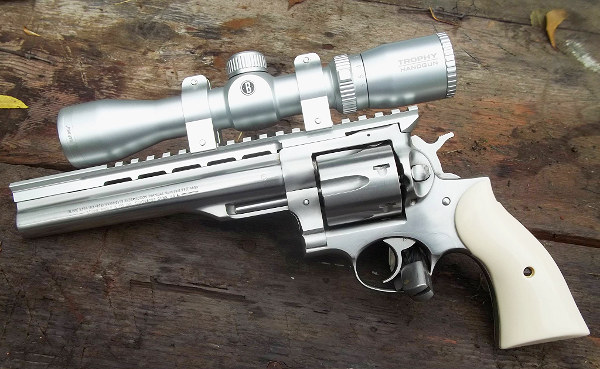
Last but not least is one of the nicest stainless Ruger revolvers we’ve ever seen. Forum member Longcarbine says: “This is not a rifle, but it’s my favorite weapon”. The Ruger is fitted with a custom Picatinny scope rail with matching silver-tone Bushnell Trophy handgun scope, plus handsome faux Ivory grips. This wheelgun is almost too pretty to hunt with…
Our friend Gavin Gear has crafted an excellent video showing how to make a threaded Modified Case for use with the Hornady Lock-N-Load Overall Length Gauge. You can watch Gavin make a Modified Case start to finish in the video below:
Video Shows How to Drill and Tap Modified Case
Gavin has some clever tricks. First he uses a sizing die to hold the cartridge case during the threading process. Second he uses two drill bits in sequence — a smaller bit to ream out the primer pocket, and then a larger “M” bit to increase the hole diameter before threading the brass. Finally he leaves the threading tap IN the brass, locks the tailstock, and then “gently pulls on the quill” to remove the brass from the die held in his lathe (See 5:46 timemark).
Get the Correct 5/16″-36 RH Tap
Unfortunately, Hornady has selected an uncommon thread type for OAL Gauges. You probably won’t be able to buy the correct 5/16″ – 36 RH HSS Tap at your local hardware store. However you CAN order this special tap from Amazon for $9.99.
Modified Case Q & A — TECH TIPS
Why do I need a Modified Case?
Every serious reloader should have a Modified Case for each cartridge type they shoot. The reason is that this allows you to get very precise measurements of the length-to-lands in your chamber. When used with the Hornady OAL Gauge, with some practice, you should be able to get repeatable length-to-lands measurements within about 0.0015″. We generally do 4-5 measurements with the OAL Gauge and usually 3 or 4 will be “on the money”. NOTE: We recommend a gentle, easy pressure on the plastic pusher rod. Don’t push too hard or you will jam the bullet hard into the lands, which produces inconsistent results.
Can’t I Just Buy a Modified Case?
Hornady makes a variety of Modified Cases sold on Amazon and through retailers such as Midsouth. While Hornady makes modified cases for many standard cartridges, if you shoot a wildcat such as the 6mm Dasher or .284 Shehane, you’ll need to create a custom modified case. And even if you shoot a standard cartridge such as the .308 Win, you can get more consistent measurements with a custom Modified Case.
If you do decide to make your own modified case, you’ll want to start with a case that’s been fired in your rifle. That way you get the best fit to YOUR chamber. Also, you won’t need to expand the neck to provide bullet clearance. Then you need to drill out the primer pocket and tap the base of the case to match the threads on the Hornady OAL Gauge tool. Make at least two modified cases, as you’ll probably misplace one at some point.
MORE INFORMATION: Want to learn more? We published a much longer story in which Erik Cortina explains in greater detail how to made the Modified Case. That article illustrates the 5/16″ – 36 RH HSS Tap required and shows how to set up the lathe to drill and tap your case. If you are serious about making your own Modified Cases, you should Read the Full Article.
A while back our Aussie friend Stuart Elliot of BRT Shooters Supply filmed some interesting videos at the QTS range in Brisbane, Australia. Stuart told us: “I was shooting in an Air Gun Benchrest match here in Brisbane, Australia. I finished my target early and was awaiting the cease fire and took a short, slow-motion video of windflag behavior.” You may be surprised by the velocity changes and angle swings that occur, even over a relatively short distance (just 25 meters from bench to target).
Here are windflags in slow motion:
The flags show in the videos are “Aussie Wind Flags”, developed by Stuart Elliot. These are still produced in Australia, and are now available through BRTFlags.com.
Here is a video in real time:
Stuart says this video may surprise some shooters who don’t use windflags: “Many people say the wind doesn’t matter. Well it sure does — whether for an airgun at 25 meters or a long range centerfire at 1,000.” This video illustrates how much the wind can change direction and velocity even in a small area.


 The Court’s injunction applies to “the plaintiffs and, where applicable, the plaintiffs’ agencies, political subdivisions, members, and customers—both current and future,” but does not take effect for 7 days “to allow the defendants to seek relief, if any, at the appellate level.”


 +ONE Program to Encourage New Shooters